VPD and Light Intensity: How Environment Changes Plant Demand
Vapor Pressure Deficit (VPD) does not exist in an environmental vacuum. While standard horticultural charts present VPD as a static target based solely on air temperature and relative humidity, the actual transpirational pull experienced by a cannabis plant is governed dynamically by incident light intensity. As Photosynthetic Photon Flux Density (PPFD) escalates, photon absorption energizes stomatal guard cells, alters leaf surface temperature, and dramatically scales root-zone water and mineral consumption. Harmonizing VPD targets across the lighting intensity gradient is the definitive key to preventing nutrient toxicities, transpirational collapse, and canopy stagnation.
- Direct Answer: How Light Intensity Directly Scales Transpirational Demand
- The Biomechanical Link: PPFD, Stomatal Conductance, and Leaf Energy Balance
- Environmental Interactions: Balancing Airflow, Latent Dehumidification, and Substrate EC
- Step-by-Step Optimization: Adjusting VPD Targets Across the PPFD Gradient
- Cultivation Pitfalls: Low VPD Stagnation and High VPD Desiccation Under High PPFD
- Hardware Sizing and Sensor Placement: Latent Load, CFM, and Aspirated Probes
- Field Verification Protocols: Measuring Transpiration Volume, Dryback, and Canopy Health
- Final Decision Checklist and Companion Weedth Resources
Direct Answer: How Light Intensity Directly Scales Transpirational Demand
The central rule of indoor crop physiology is that light intensity dictates plant demand, while Vapor Pressure Deficit governs the rate at which the plant can fulfill that demand. Photons striking the canopy do not simply fuel carbon fixation; they impose a direct thermodynamic and hydraulic load on the entire vascular system. As PPFD increases from low vegetative levels (300 μmol/m²/s) to high commercial flowering levels (1,000 to 1,400 μmol/m²/s), daily transpirational water demand increases by 200% to 300%.
Under low light intensity (200 to 400 μmol/m²/s), the plant operates at a modest metabolic pace. Photons excite fewer chlorophyll molecules, generating limited adenosine triphosphate (ATP) and nicotinamide adenine dinucleotide phosphate (NADPH). Stomatal aperture remains narrow, transpirational flux is weak, and root water uptake is slow. In this low-intensity regime, running a high VPD (above 1.2 kPa) causes rapid desiccation of delicate leaf margins because root pressure cannot replace evaporated moisture quickly enough. Conversely, running a gentle VPD of 0.6 to 0.8 kPa creates the ideal low-stress moisture gradient for vigorous rooting and vegetative cell division.
Under high light intensity (800 to 1,200+ μmol/m²/s), this dynamic reverses entirely. Massive photon influx forces stomata wide open to absorb carbon dioxide. The absorbed radiant and convective energy must be actively dissipated via evaporative cooling; otherwise, delicate leaf proteins denature. To facilitate this intense transpirational cooling, the surrounding atmospheric deficit must be expanded to 1.2 to 1.5 kPa. If the atmosphere is too humid (a low VPD below 0.9 kPa under 1,000 PPFD), transpiration stalls, the leaf cannot cool itself, latent heat accumulates, and severe calcium transport failures (such as tip burn and calyx necrosis) develop rapidly.
Vapor Pressure Deficit (VPD), Transpiration ($E$), and Stomatal Conductance ($g_s$)
Vapor Pressure Deficit (VPD) is the absolute difference between the pressure exerted by water vapor inside a saturated leaf substomatal cavity and the water vapor pressure of the ambient room air, expressed in kilopascals (kPa). Transpiration Rate ($E$) is the mass flux of water evaporated through leaf stomata per unit area per second. Stomatal Conductance ($g_s$) measures the physical ease with which water vapor and carbon dioxide diffuse through microscopic stomatal apertures on the leaf epidermis.
Crucially, because high light intensity forces plants to drink vastly greater volumes of water, the ratio of water consumption to mineral ion consumption changes fundamentally. When PPFD and VPD are both elevated, cannabis absorbs water much faster than it consumes dissolved mineral salts. Cultivators who maintain high nutrient fertilizer concentrations under high PPFD inevitably experience root-zone salt accumulation, tip burn, and osmotic nutrient lockout. Tuning environment and nutrition requires treating light, VPD, and root electrical conductivity as a single unified system.
Golden Bioclimatic Axiom: Light intensity steps on the gas pedal; Vapor Pressure Deficit controls the transmission. If you rev the engine with high PPFD without shifting the environmental transmission into high gear, the system overheats and mechanical breakdown follows.
The Biomechanical Link: PPFD, Stomatal Conductance, and Leaf Energy Balance
To master the interaction between light intensity and environmental deficit, cultivators must look beneath the leaf epidermis to inspect the biophysical mechanisms governing stomatal aperture and energy exchange. Every square millimeter of a cannabis leaf surface contains between 100 and 300 microscopic pores called stomata, each flanked by a pair of specialized guard cells.
Photoreceptor Activation and Stomatal Opening
Stomatal opening is triggered by incident light through two distinct biological pathways: photosynthetic assimilation and blue-light photoreceptors. Specialized blue-absorbing pigments known as phototropins and cryptochromes detect photons in the 420 nm to 470 nm spectrum. Upon photon absorption, these photoreceptors activate plasma membrane proton pumps (H+-ATPases). These pumps extrude protons from guard cells, creating an inside-negative electrical potential that drives rapid influx of potassium ions ($K^+$) and chloride ions ($Cl^-$) through voltage-gated ion channels.
The accumulation of inorganic ions dramatically lowers the osmotic solute potential inside the guard cells, drawing water inward across the plasma membrane via aquaporin channels. The resulting increase in guard cell turgor pressure causes the cells to bow outward, physically opening the stomatal aperture. As PPFD increases from 200 to 1,000 μmol/m²/s, stomatal conductance ($g_s$) rises proportionally, opening wide conduits for gas exchange. However, this open portal allows water molecules to escape into the atmosphere at accelerated rates.
The Leaf Energy Balance Equation
A cannabis leaf hanging beneath an intense luminaire is subject to continuous energy influx that must be balanced according to the first law of thermodynamics. The leaf energy budget is defined by the steady-state equation:
$$R_n = H + \lambda E + S$$
Where $R_n$ represents net absorbed radiation (visible light and infrared), $H$ represents sensible heat exchange with surrounding air via convection, $\lambda E$ represents latent heat flux dissipated via transpiration (where $\lambda$ is the latent heat of vaporization of water, roughly 2,450 J/g), and $S$ represents minor energy storage in biochemical bonds (less than 3% to 5% of total energy).
Under high PPFD, absorbed radiation ($R_n$) surges. If the ambient atmosphere has an appropriate vapor pressure deficit (1.2 to 1.4 kPa), the leaf transpires vigorously, directing the vast majority of incoming thermal energy into latent heat dissipation ($\lambda E$). This evaporative cooling chills the leaf tissue, maintaining internal enzymatic machinery within the safe thermal band. However, if the ambient VPD is excessively high (above 1.7 kPa) under intense light, transpirational pull exceeds the hydraulic delivery capacity of the xylem vessels. In response to hydraulic tension and localized water deficit, guard cells lose turgor pressure, forcing photo-protective stomatal closure. With transpiration halted, latent cooling drops to zero, leaf temperature spikes by 6°F to 10°F, and acute heat stress and photobleaching destroy chlorophyll proteins.
The Stomatal Shutdown Cascade Under Intense Light
Pushing PPFD beyond 1,000 μmol/m²/s while allowing room relative humidity to collapse below 40% (creating a Leaf VPD above 1.7 kPa) triggers acute transpirational collapse. The plant shuts its stomata to prevent vascular cavitation. Deprived of evaporative cooling and carbon dioxide, the leaves curl inward into sharp canoes or tacos, top foliage turns pale yellow, and floral growth arrests completely. Never increase lighting wattage without ensuring adequate humidity capacity to support transpiration.
Environmental Interactions: Balancing Airflow, Latent Dehumidification, and Substrate EC
Adjusting light intensity causes ripple effects that alter three major engineering systems within an indoor facility: canopy boundary layer air velocity, mechanical dehumidification load, and root-zone nutrient electrical conductivity.
The Boundary Layer: Why Air Velocity Dictates True VPD
Directly adjacent to every leaf surface lies the boundary layer: a microscopic layer of still, undisturbed air where gas movement occurs purely via slow molecular diffusion rather than bulk air movement. As light intensity drives transpiration, water vapor pours out of stomatal apertures, saturating the boundary layer with 95% to 100% relative humidity.
If canopy air movement is insufficient (air velocity below 0.2 m/s), this humid boundary layer thickens, insulating the leaf from room air. Even if your room air sensor reads an ideal 1.3 kPa VPD, the microclimate at the leaf epidermis is trapped in stagnant 0.4 kPa conditions. Stomatal transpiration grinds to a halt, causing localized calcium deficiency and fungal vulnerability. Commercial facilities maintain horizontal canopy air velocities between 0.4 and 0.8 meters per second across the upper trellis. This gentle breeze continuously strips away the boundary layer, ensuring that the room VPD gradient actually contacts the stomatal pores.
HVAC-D Engineering: Sizing for Latent Transpiration Loads
Every drop of water delivered through irrigation drippers that does not leave the room as table runoff must be extracted from the atmosphere by mechanical dehumidifiers. Under 1,000 PPFD, a mature cannabis canopy transpires between 0.5 and 1.0 gallon (1.9 to 3.8 liters) of water per plant per day. In a commercial room containing 100 flowering plants under high-intensity fixtures, the canopy injects up to 100 gallons of moisture into the air during the 12-hour photoperiod.
Because 100 gallons of water equates to roughly 834 pounds of moisture (or 800 pints per day), facility engineers must deploy dedicated commercial dehumidification units sized specifically for peak lights-on transpiration. If dehumidifiers are undersized, humidity will spike to 80% within 45 minutes of lights-on, collapsing VPD and stopping transpiration at the very moment the plants need it most.
Root-Zone EC Dynamics Across the PPFD Gradient
The physiological relationship between transpiration volume and mineral uptake is governed by mass flow and active ion transport. While cannabis absorbs essential macronutrients (nitrogen, phosphorus, potassium) primarily through active transport at root cell membranes, water enters via passive osmosis driven by the transpirational suction pull created by VPD.
When light intensity is high (1,000+ PPFD) and VPD is dialed to 1.3 kPa, transpiration runs at maximum volume. Plants drink enormous quantities of water to stay cool. If the input nutrient solution is heavily concentrated (for example, 2.5 to 3.0 EC), the roots absorb water far faster than they can assimilate dissolved salts. Unused fertilizer ions accumulate in the substrate, driving root-zone EC to toxic levels (exceeding 4.5 to 5.5 EC in runoff). This osmotic buildup pulls water out of root hairs, causing severe tip burn and nutrient lockout. Cultivators must dilute input fertilizer EC by 15% to 25% when stepping up lighting power, ensuring that high transpiration volume delivers nutrients smoothly without substrate salt buildup.
| Crop Stage / Lighting Band | PPFD (μmol/m²/s) | Target Leaf VPD (kPa) | Optimal Input EC (mS/cm) | Daily Transpiration / Plant |
|---|---|---|---|---|
| Nursery / Early Veg | 200 – 350 | 0.6 – 0.8 | 1.0 – 1.3 | 0.10 – 0.25 Gallons |
| Mid Vegetative Growth | 400 – 650 | 0.8 – 1.1 | 1.4 – 1.8 | 0.30 – 0.50 Gallons |
| Transition & Early Bloom | 700 – 900 | 1.0 – 1.3 | 1.8 – 2.2 | 0.50 – 0.75 Gallons |
| Peak Bloom Floral Bulking | 950 – 1,300 | 1.2 – 1.5 | 1.6 – 2.0 | 0.75 – 1.10 Gallons |
| Late Ripening & Senescence | 500 – 750 | 1.1 – 1.3 | 0.8 – 1.2 | 0.35 – 0.55 Gallons |
Step-by-Step Optimization: Adjusting VPD Targets Across the PPFD Gradient
To maintain seamless crop steering throughout an entire indoor cycle, cultivators must follow a structured standard operating procedure that synchronizes lighting ramp schedules with room climate setpoints. Follow this five-phase calibration framework.
Phase 1: Seedlings and Fresh Clones (Low Photon / Low Deficit Regime)
Set fixture output to deliver 200 to 300 μmol/m²/s PPFD. With minimal root mass and delicate epidermal layers, plants cannot sustain high transpirational demand. Maintain daytime air temperatures at 76°F to 78°F with 70% to 75% relative humidity, generating a gentle Leaf VPD of 0.6 to 0.8 kPa. This prevents cell desiccation while allowing roots to expand without hydraulic stress.
Phase 2: Vegetative Canopy Establishment (Moderate Intensity Scaling)
As root zones establish and three to four internodes develop, ramp fixture dimmers to provide 450 to 650 μmol/m²/s PPFD. Elevate daytime room air temperature to 80°F to 82°F and adjust relative humidity to 65% to 70%, establishing a Leaf VPD of 0.8 to 1.1 kPa. This moderate transpirational pull accelerates cell elongation, strengthens vascular bundles, and supports steady nutrient delivery.
Phase 3: The Stretch and Early Floral Transition (Weeks 1 to 3 of Bloom)
Upon initiating the 12/12 photoperiod, increase lighting output to 700 to 900 μmol/m²/s PPFD over a 7-day ramp period. Increase ambient air temperature to 82°F to 84°F and hold humidity at 60% to 65% RH, producing a Leaf VPD of 1.1 to 1.3 kPa. This robust deficit prevents excessive stem stretching by promoting tight internodal spacing and accelerating the transition into floral primordia formation.
Phase 4: Peak Floral Bulking (Weeks 4 to 7 of Bloom: Maximum Demand)
Operate luminaires at full commercial output: 1,000 to 1,350 μmol/m²/s PPFD (supplemented with 1,200 to 1,400 PPM CO2 in sealed facilities). Maintain room air temperatures at 82°F to 85°F and set relative humidity to 58% to 64%, locking Leaf VPD into the high-performance window of 1.2 to 1.5 kPa.
During this phase, transpirational volume peaks. Ensure oscillating fans provide 0.5 to 0.8 m/s canopy airflow, irrigate in frequent small pulses to achieve 15% to 20% daily runoff, and keep feed EC moderate (1.7 to 2.0 mS/cm) to support heavy floral expansion without tip burn.
Phase 5: Late Ripening and Finishing (Final 14 Days: Mold Prevention)
In the final two weeks, dense floral colas become susceptible to Botrytis cinerea (bud rot). Lower light levels back down to 550 to 750 μmol/m²/s to avoid terpene volatilization. Lower room temperatures to 72°F to 75°F and drop relative humidity to 48% to 54%, maintaining Leaf VPD at 1.1 to 1.3 kPa. This controlled dry air protects swollen floral bracts from fungal spores while preserving rich secondary cannabinoid and aromatic profiles.
Cultivation Pitfalls: Low VPD Stagnation and High VPD Desiccation Under High PPFD
When the delicate balance between photon delivery and vapor pressure deficit is broken, plants exhibit characteristic physiological breakdown symptoms that are frequently misdiagnosed as viral infections or soil nutrient imbalances.
Pitfall 1: Low VPD Stagnation Under High PPFD
When a grower pumps intense light (1,000+ PPFD) into a room with excessive relative humidity (above 75% RH, yielding a Leaf VPD below 0.7 kPa), the atmosphere is too saturated to absorb transpired water vapor. Even though photons are driving the light reactions, water cannot escape the stomata. This creates two severe disorders:
- Intracellular Edema: Root pressure continues pushing water upward into leaf cells, but evaporation cannot occur. Cells swell, burst, and form blister-like, corky necrotic bumps along leaf veins that mimic russet mite or broad mite damage.
- Localized Calcium Starvation: Because calcium ions ($Ca^{2+}$) travel exclusively through transpiration-driven mass water flow, stagnant VPD halts calcium delivery to rapidly dividing shoot tips. Newly emerging leaves emerge twisted, hook-shaped, and crinkled, with necrotic margins.
Pitfall 2: High VPD Desiccation Under High PPFD
The opposite extreme occurs when high photon intensity is paired with bone-dry air (below 40% RH, generating a Leaf VPD above 1.7 kPa). The dry air exerts an aggressive evaporative suction force that outstrips root hydraulic uptake. To prevent fatal vascular embolism (air bubbles in xylem conduits), the plant undergoes defensive stomatal closure.
Without evaporative cooling, leaf surface temperatures spike, photosynthetic carbon fixation ceases, and leaves curl their margins upward into severe “tacos” or “canoes” to shield their stomatal pores from drying winds. Continued exposure causes bleached white floral tips and brittle, crispy foliage.
The Nevada Desert Facility: Rescuing a 1,100 PPFD Canopy from 30% RH Desiccation
A licensed commercial cultivator in North Las Vegas, Nevada, reached out after installing high-powered 800W multi-bar LED fixtures delivering 1,150 μmol/m²/s PPFD across double-deck flower tables. Because of the hyper-arid outdoor desert climate, the facility room air ran at 81°F air temperature and an astonishingly low 29% relative humidity. The resulting room VPD was an extreme 2.5 kPa.
The symptoms: By week 3 of flowering, every plant was canoe-curled, serrated margins were crispy brown, leaves were praying vertically in distress, and daily water uptake had plummeted to less than 0.8 liters per plant. The grower assumed the LEDs were defective and was planning to dump \$40,000 worth of new fixtures.
The intervention: We immediately installed commercial ultrasonic humidifiers capable of injecting 150 pints of clean reverse-osmosis mist per day, bringing room humidity up from 29% to 62% RH. This shifted Leaf VPD from 2.45 kPa down to an optimal 1.32 kPa. We simultaneously reduced input feed EC from 2.6 mS/cm down to 1.8 mS/cm. Within 72 hours, stomata re-opened, leaf blades uncurled and relaxed into a flat horizontal orientation, water consumption surged to 2.8 liters per plant per day, and the facility harvested 2.2 grams per watt with zero light burn.
When diagnosing canopy stress in arid commercial environments, cultivators must distinguish between physical light bleaching and transpirational desiccation. Light bleaching occurs when photon irradiance destroys photosynthetic pigments directly, turning foliage paper-white while leaves remain flexible and hydrated. Transpirational desiccation, in contrast, results from hydraulic failure; leaves retain green pigmentation initially but curl upward, feel papery, and develop necrotic margin scorching due to excessive water evaporation.
Furthermore, maintaining proper substrate hydration buffering prevents transpirational shock during peak midday irradiance. In rockwool or coco coir media, letting substrate volumetric water content (VWC) drop below 35% during maximum light intensity forces roots to exert high matric suction pressure to pull water from capillary pores. When combined with a high atmospheric VPD, this matric tension triggers sudden stomatal closure. Implementing automated irrigation pulses that maintain substrate VWC between 55% and 65% during peak photoperiod hours ensures continuous transpirational cooling.
Do
Scale VPD Targets Upward as PPFD Increases
Target 0.7 to 0.9 kPa in early veg under 400 PPFD, expanding to 1.2 to 1.5 kPa during peak flowering under 1,000+ PPFD to ensure vigorous transpirational cooling.
Avoid
Keep High Fertilizer EC When Stepping Up Lighting
Never maintain concentrated nutrient feeds when boosting light power; plants drink far more water under intense light, requiring diluted EC to prevent root salt burn.
Hardware Sizing and Sensor Placement: Latent Load, CFM, and Aspirated Probes
Executing precise bioclimatic control requires engineered mechanical infrastructure. Sizing facility hardware based on guesswork or generic square-foot estimates leads directly to environmental failure.
Calculating Facility Latent Dehumidification Load
To accurately size commercial dehumidifiers, use the direct volumetric water input formula. In a sealed indoor room, 100% of daily irrigation water delivered to the root zone that is not removed as drain-to-waste runoff enters the air as water vapor via plant transpiration and substrate evaporation.
$$\text{Latent Load (PPD)} = \text{Total Daily Water (Gallons)} \times (1 – \text{Runoff Fraction}) \times 8.34 \times 0.96$$
For example, a 20-light room delivering 30 gallons of water daily with a 20% runoff fraction injects 24 gallons of moisture into the room per day (equating to roughly 192 pints of water). To manage humidity spikes during lights-on transitions and maintain a tight 1.3 kPa VPD under 1,000 PPFD, the facility requires at least 250 to 300 pints per day of dedicated dehumidification capacity at rating conditions (80°F / 60% RH).
Aspirated Sensor Probes and Radiation Shields
Never mount temperature and relative humidity sensors on perimeter drywall or hang bare sensor probes directly beneath high-intensity grow lights. Radiant photon flux from overhead luminaires strikes bare sensor housings, heating internal thermistors and capacitive humidity chips 3°F to 6°F above actual room air temperature. This false reading generates wildly inaccurate VPD calculations.
Deploy aspirated sensor boxes equipped with internal miniature continuous fans that pull room air across shielded sensing elements at 2 to 3 m/s. Position these aspirated probes directly at upper canopy crown height, suspended midway along the plant bench to measure true canopy boundary conditions.
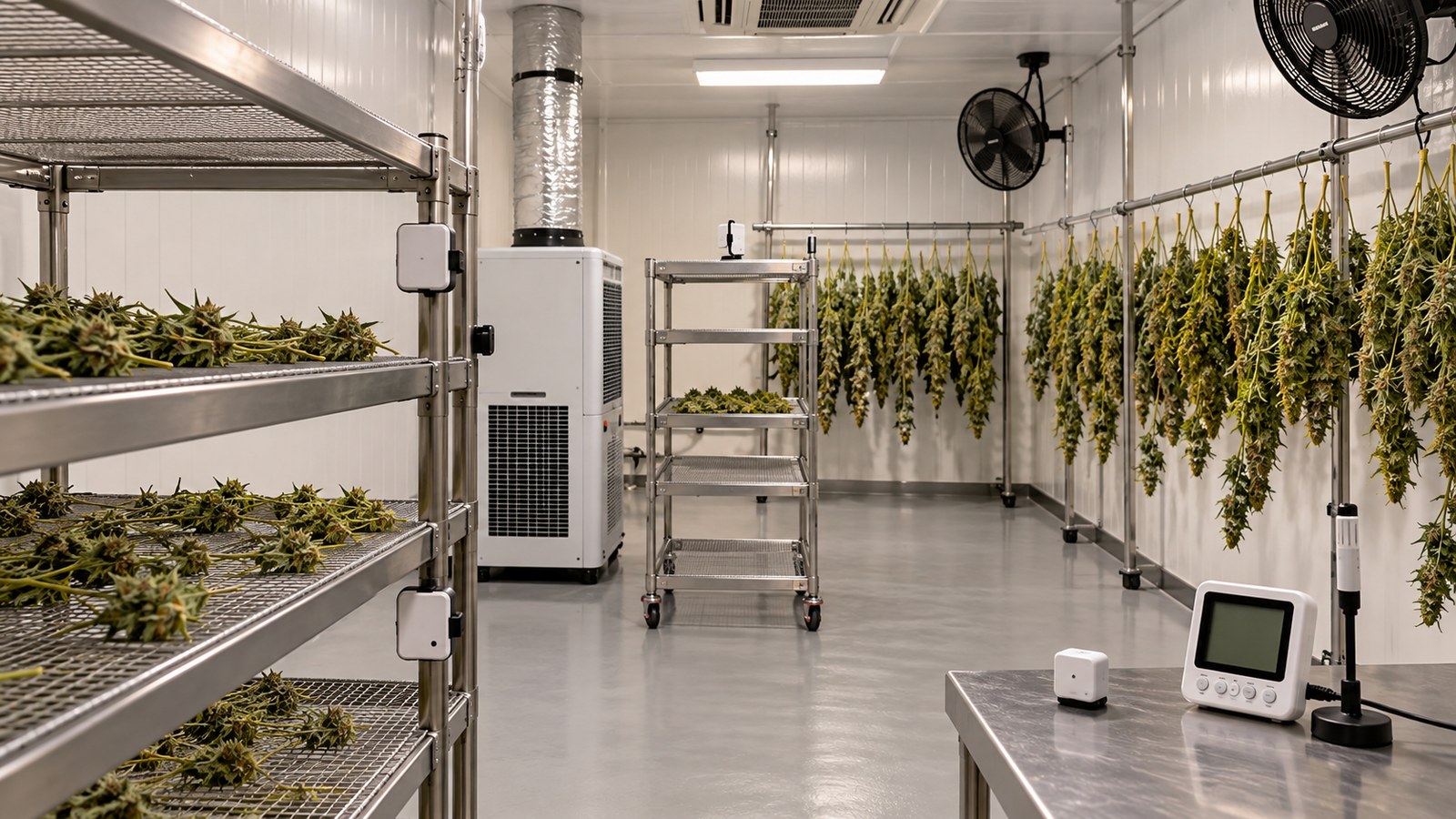
How can I tell whether my leaves are curling from high light intensity or excessive VPD?
Question sent by: Jordan Miller, via email.
Look closely at leaf color and canopy distribution. If high light intensity (excess PPFD) is the culprit, symptoms are strictly localized to leaves directly beneath fixture hot spots, characterized by photobleaching (yellowing or whitening of leaf centers between veins) while lower foliage remains emerald green. If excessive VPD (dry air desiccation) is the cause, leaf curling occurs across the entire room, including perimeter plants and lower canopy foliage, accompanied by crispy serrated leaf margins and papery texture while green chlorophyll pigment is initially preserved.
Field Verification Protocols: Measuring Transpiration Volume, Dryback, and Canopy Health
To verify that your light intensity and VPD settings are operating in biological harmony, implement this repeatable diagnostic routine.
Step 1: Deploy Continuous Substrate Load Cells
Place representative bench containers onto digital scale load cells connected to your facility data logger. By tracking container weight decline throughout the 12-hour photoperiod, you measure real-time hourly transpirational dryback. Under tuned 1,000 PPFD and 1.3 kPa VPD, container weight should decline steadily by 2.5% to 4.5% per hour during peak photoperiod hours. A flatline in weight loss indicates stomatal closure, signaling that VPD is either too high (desiccation) or too low (stagnation).
Step 2: Track Daily Runoff EC Delta
Measure input fertilizer EC and runoff collection EC daily. Compare the two values:
- Runoff EC equals Input EC (±0.2 mS/cm): Perfect equilibrium; plant is consuming water and nutrients in exact stoichiometric balance.
- Runoff EC climbs 0.6+ mS/cm above Input EC: Transpirational water demand is outpacing nutrient uptake; dilute input fertilizer EC by 10% to 15% immediately.
- Runoff EC drops 0.4+ mS/cm below Input EC: Plant is feeding aggressively relative to water consumption; input EC can be slightly increased.
Step 3: Measure Leaf Cooling Offset via Infrared Pyrometer
During peak lights-on hours, measure Leaf Surface Temperature (LST) and ambient air temperature. Under commercial LED arrays with properly calibrated VPD (1.2 to 1.4 kPa), healthy transpirational evaporative cooling should keep leaf surfaces 2°F to 4°F cooler than ambient room air. If LST matches or exceeds ambient air temperature under LEDs, transpiration has halted and stomata have shut down.
Final Decision Checklist and Companion Weedth Resources
Before modifying lighting intensities or altering room environmental setpoints, review this comprehensive bioclimatic decision checklist:
VPD & Light Intensity Integration Checklist
- Scale Vapor Pressure Deficit targets proportionally with lighting: 0.6-0.8 kPa in nursery, 0.9-1.1 kPa in veg, and 1.2-1.5 kPa in peak bloom.
- Maintain horizontal canopy air velocity between 0.4 and 0.8 m/s to strip stagnant boundary layers without causing windburn.
- Dilute input nutrient fertilizer EC by 15% to 25% when increasing lighting levels beyond 900 μmol/m²/s PPFD.
- Verify that commercial dehumidification capacity matches total daily irrigation volume injected into the room.
- Deploy aspirated, shielded environmental sensors at canopy crown height rather than relying on bare wall sensors.
- Monitor container weight dryback curves with load cells to confirm steady, uninterrupted transpirational flux.
- Audit runoff EC daily; ensure runoff salt concentration remains within 0.3 mS/cm of input solution.
- Confirm leaf surface temperature is 2°F to 4°F cooler than ambient air under LEDs to verify active transpirational cooling.
Mastering the dynamic interplay between light intensity and Vapor Pressure Deficit unlocks complete environmental control over cannabis physiology. When photons, atmospheric demand, and root hydration work in biological synchrony, cannabis canopies reward cultivators with explosive growth rates, robust disease resistance, and commercial-grade harvest yields.
Final Verdict: Light creates the biological potential; VPD regulates the transpirational reality. Synchronize them across every growth phase, and your grow room will operate with precision engineering.
To expand your technical cultivation foundation with our companion foundational guides, continue exploring Weedth resources below.
Share this article
A quick overview of the topics covered in this article.
Follow us
Latest articles
October 29, 2026
October 29, 2026
October 29, 2026