
Dante’s Inferno Strain: Complete Cultivar & Grow Guide
In the contemporary landscape of boutique cannabis breeding, few cultivars have captured the imagination of modern connoisseurs and commercial cultivators quite like Dante’s Inferno. Born from a collaboration between Tiki Madman and Clearwater Genetics, this visually mesmerizing hybrid represents a tour de force pairing between the frosted, ultra-dense powerhouse Oreoz and the flavorful, fruit-forward resin titan Devil Driver. Renowned across top-tier extraction circles and luxury flower showcases, Dante’s Inferno stands apart through its near-black pigmentation, dense diamond-encrusted trichome jackets, and an intricate sensory bouquet that shifts seamlessly between sweet vanilla cream, candied grape preserves, ripe forest berries, black tea, cracked pepper, and raw chemical hydrocarbon gas.
For the serious cultivator, Dante’s Inferno is both a breathtaking showpiece and a demanding botanical study in phenotypic sensitivity. The cross unites two vastly different morphological habits: the squat, heavy-foliaged, slow-stretching architecture of Oreoz and the tall, vigorous, branch-heavy frame of Devil Driver (itself a cross of Sundae Driver and Melonade). As a consequence, Dante’s Inferno cannot be approached as a generic cookie hybrid. Phenotypic expressions range from compact, slow-vegetating bushes that stretch barely 1.3x during transition to towering, vigorous selected keeper cuts (such as the famous Mile High Dave cut, Dante’s Inferno #8) that surge up to 2.2x and produce sprawling lateral branches requiring immediate structural support and canopy orchestration.
The greatest horticultural hazard when managing Dante’s Inferno lies in its optical deception. The cultivar initiates heavy resin secretion and deep royal purple, maroon, and obsidian calyx coloring remarkably early in the flowering cycle, often appearing deceptively ripe by the conclusion of week six or seven. Inexperienced cultivators frequently harvest early based purely on frost density and dramatic coloration, missing the vital final calyx swell and terpene maturation that occurs between days 63 and 70. This master cultivation guide provides an exhaustive analysis of Dante’s Inferno, detailing its genetic foundation, complex phytochemical matrix, cut-specific canopy training, precise fertigation targets, and post-harvest drying protocols to ensure maximum bag appeal, pest resilience, and connoisseur combustion quality.
Strain Features
| Feature | Details |
|---|---|
| Strain Type | Indica-dominant hybrid (approximately 70% Indica / 30% Sativa with notable phenotype variation) |
| Genetic Lineage | Oreoz (Cookies and Cream x Secret Weapon) x Devil Driver (Sundae Driver x Melonade) |
| THC Potency | 24% to 30%+ total cannabinoids in optimized commercial environments |
| CBD Content | Low (typically beneath 0.2% in third-party laboratory assays) |
| Primary Terpenes | D-Limonene, Beta-Caryophyllene, Linalool, Beta-Myrcene, Beta-Ocimene |
| Flowering Time (Indoor) | 8.5 to 10 weeks (60 to 70 days depending on specific phenotype selection) |
| Harvest Window (Outdoor) | Early to mid-October in Northern temperate zones; sensitive to late-season dampness |
| Plant Morphology | Dense lateral framework, broad foliage, heavy secondary branching, tight golf-ball to spear nodes |
| Stretch Potential | Variable; compact expressions stretch 1.3x to 1.5x, while elite cuts like #8 stretch 2.0x to 2.2x |
| Bud Density & Structure | Rock-hard floral clusters, swollen calyxes, extreme glandular trichome coverage, low leaf ratio |
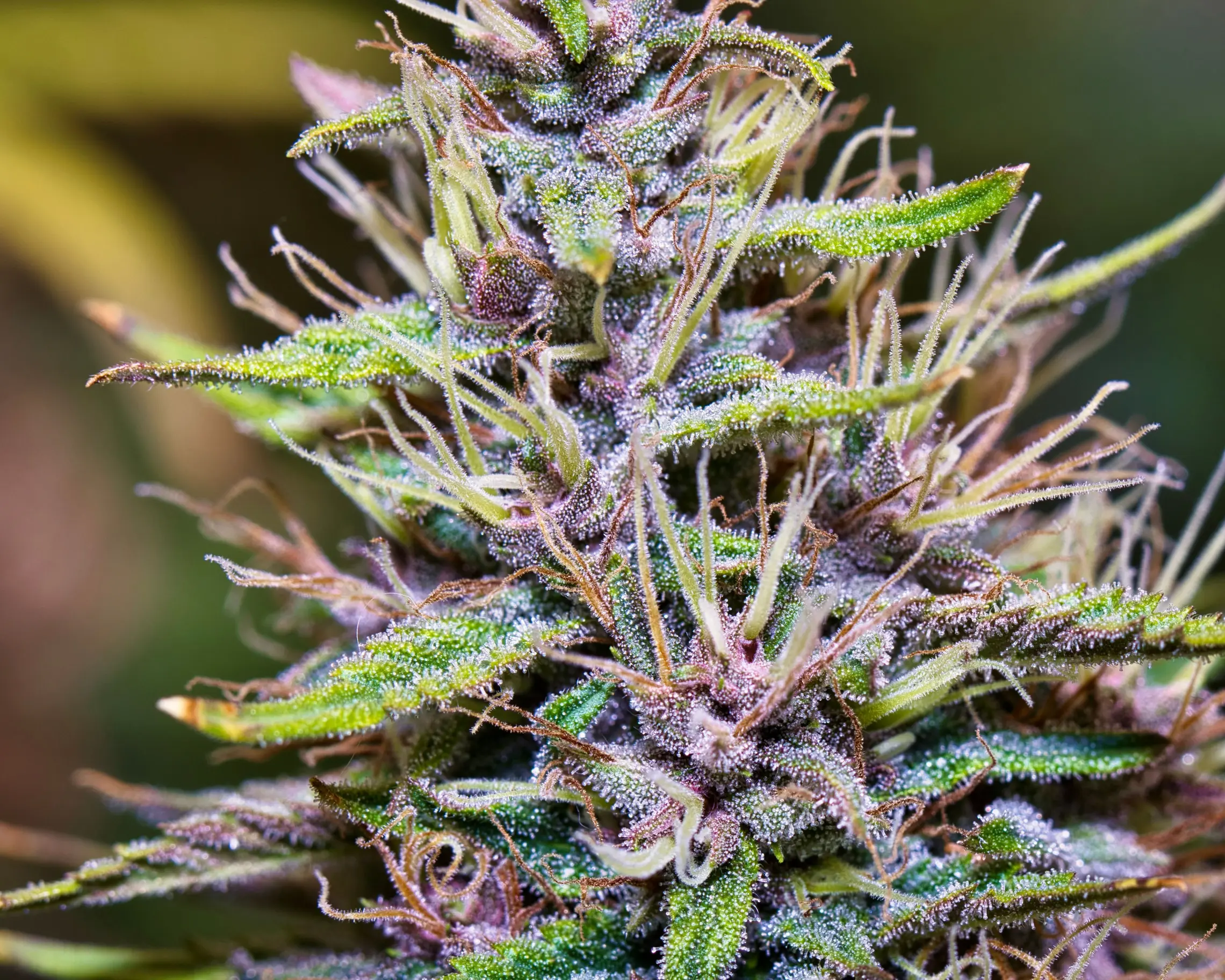
| Color Expression | Midnight purple, jet black, dark forest green with bright tangerine pistils and silver frost |
| Aroma & Palate | Vanilla bean cream, grape candy, dark berry compote, black tea, cracked pepper, chemical fuel |
| Yield Potential | 425 to 525 g/m² indoors; up to 700 g per plant outdoors under arid solar conditions |
| Difficulty Level | Intermediate to Advanced; requires phenotype-specific training and strict mold prevention |
Upon inspecting a healthy stand of Dante’s Inferno, horticulturists are immediately struck by its intense structural density and dark pigmentation. In the vegetative stage, the cultivar generally showcases broad, leathery fan leaves with pronounced serrations and deep forest-green pigmentation, reflecting its heavy Oreoz heritage. The leaf petioles and main stems frequently exhibit deep purple striping early in development, an indicator of the plant’s intense anthocyanin synthesis capacity. Internodal spacing varies significantly based on whether the grower is running a seed-selected compact phenotype or a vigorous cloned keeper such as Dante’s Inferno #8, requiring growers to observe node development closely during weeks two and three of vegetative growth.
The floral architecture of Dante’s Inferno is where the cultivar commands exceptional commercial value. As blooming proceeds past week four, calyxes stack tightly along the lateral stems, forming rock-hard, rounded clusters that resemble resin-dipped golf balls. What distinguishes Dante’s Inferno from ordinary dark cultivars is the contrast between its calyx pigmentation and its trichome coverage. The floral bracts turn a deep royal purple that deepens into near-black obsidian by week eight. Against this dark canvas, capitate-stalked glandular trichomes form an opaque, snow-white blanket of resin heads that shimmer like crushed diamonds under artificial lighting.
However, this structural density comes with horticultural caveats that growers must respect. Because the calyxes swell tightly against one another and form dense, moisture-trapping clusters along the interior stems, internal humidity within the colas can skyrocket during late bloom. The calyx-to-leaf ratio is remarkably favorable, meaning that manicuring requires minimal effort, but internal microclimate monitoring is essential. Growers must ensure that relative humidity is steadily reduced through weeks seven through nine to prevent botrytis from colonizing the interior centers of these obsidian floral clusters.
Genetic Lineage
The pedigree of Dante’s Inferno is an inspired collaboration between two modern powerhouse genetics: Oreoz and Devil Driver, brought together through the joint efforts of Tiki Madman and Clearwater Genetics. To understand the dual nature of Dante’s Inferno, one must examine each parent’s agronomic and sensory contributions. The maternal parent, Oreoz (bred by 3rd Coast Genetics by crossing Cookies and Cream with Secret Weapon), is renowned throughout the global cannabis industry as one of the most resinous and visually striking cultivars ever created. Oreoz contributed dense, rock-hard bud architecture, an almost unbelievable density of capitate-stalked trichomes, dark purple color tendencies, and a rich earthy cream bouquet, alongside heavy somatic potency.
However, pure Oreoz has frequently faced criticism within craft connoisseur circles for having a relatively muted, one-dimensional flavor profile despite its extraordinary visual appeal. That is precisely where Devil Driver enters the equation. Bred by Clearwater Genetics by crossing Sundae Driver (Fruity Pebbles OG x Grape Pie) with Melonade (Watermelon Zkittlez x Lemon Tree), Devil Driver is an explosion of sparkling, sweet fruit terpenes, zesty melon candy, and pungent chemical fuel. In addition to infusing vibrant terpene complexity into the union, Devil Driver introduced substantial hybrid vigor, elongated lateral branching, and a lively cerebral onset that completely redefines the smoking experience.
When Oreoz and Devil Driver were united, the resulting progeny yielded an astonishing spectrum of phenotypes that quickly took the craft cannabis world by storm. Chief among these selections is Dante’s Inferno #8 (popularized as the Mile High Dave cut), which captured widespread acclaim for uniting the deepest obsidian purple pigmentation and heavy frost of Oreoz with the loud, grape-melon candy and gas aromatics of Devil Driver. Other recognized selections, such as the #6 cut, lean slightly more into the earthy, black tea, and pepper notes, offering cultivators distinct flavor expressions from the same genetic cross.
Because Dante’s Inferno exhibits significant phenotypic segregation when grown from seed, cultivators should understand the three primary expressions found in seed packs. The Oreoz-dominant phenotype is squat, broad-leafed, stretches very little (1.2x to 1.4x), and finishes with dark chocolate, cream, and earth notes. The Devil Driver-dominant phenotype stretches vigorously (up to 2.5x), displays lighter purple tones, and smells intensely of candied grape soda, honeydew melon, and sour gas. The balanced keeper expression, exemplified by the #8 cut, captures the best of both worlds: rock-hard midnight purple buds, intense resin coverage, moderate 1.8x to 2.0x stretch, and an intoxicating aroma of vanilla bean cream, grape compote, and peppery diesel.
Effect Breakdown
The psychoactive and physiological journey of Dante’s Inferno is characterized by a fascinating, two-stage experience that defies initial visual expectations. Given its near-black pigmentation and heavy trichome frost, many consumers assume Dante’s Inferno will act as an immediate, narcotic sleeping aid. Instead, the initial onset begins with a sparkling, euphoric cerebral lift that registers within minutes of the first inhalation. A warm, tingling sensation sweeps across the scalp and temples, dissolving mental fatigue and inducing an upbeat, creative headspace where thoughts flow with joyful curiosity.
During the first thirty to forty-five minutes, this cerebral ignition provides functional clarity. Users often find themselves engaged, talkative, and artistically inspired, making the cultivar surprisingly versatile for relaxed daytime socializing, listening to music, or tackling creative projects that require an open mind. The presence of limonene and ocimene, inherited from the Devil Driver ancestor lines, prevents the high from immediately collapsing into cognitive fog. There is a buoyant, light-hearted buoyancy to the initial phase that elevates mood and washes away situational anxiety.
As the session progresses past the one-hour threshold, the heavy Oreoz parentage steadily asserts its dominance. The tingling sensation that began in the head cascades downward through the cervical spine, shoulders, torso, and legs, loosening tight muscles and easing somatic discomfort. A profound physical tranquility wraps around the body like a heavy weighted blanket. While the mind remains pleasant and peaceful, physical motivation begins to ebb, naturally guiding the user toward comfortable seating, deep conversation, or leisurely entertainment.
At elevated dosages, Dante’s Inferno easily transitions into a deeply sedating, immobilizing powerhouse. Because tested batches regularly register between 25% and 30%+ THC, heavy consumption will overwhelm low-tolerance consumers, transforming the upbeat mental state into heavy-lidded drowsiness and couch-lock. Common adverse effects at high doses include dry mouth, dry eyes, and mild disorientation. When enjoyed in moderation, Dante’s Inferno provides an exquisite bridge between cognitive euphoria and restorative somatic peace, making it a premier selection for late afternoon and evening relaxation.
Flavor & Aroma Profile
The aromatic bouquet of Dante’s Inferno is an olfactory triumph that addresses the historical critique of Oreoz by infusing it with dynamic, multi-layered fruit and fuel terpenes. When an airtight curing jar is first unsealed, the immediate impression is one of rich, decadent sweetness: thick vanilla bean cream, baked sugar cookies, and sweet milk chocolate rise to the forefront. However, this dessert foundation is instantly electrified by top notes of candied Concord grapes, macerated blackberries, and sweet honeydew melon inherited directly from the Devil Driver parentage.
As the dense, frosty buds are broken apart or run through a precision grinder, the profile pivots into an intriguing, savory complexity. Broken resin heads release a pungent rush of cracked black pepper, steeped black tea leaves, and damp forest loam, underpinned by an unmistakable chemical fuel fume. This combination of sweet dessert cream, dark fruit preserves, herbal tea, and volatile hydrocarbons creates a sophisticated aroma that commands attention and lingers in the room long after the jar is sealed.
On the palate, Dante’s Inferno delivers a velvety, multi-dimensional flavor experience. When consumed through a clean glass pipe or a temperature-controlled dry-herb vaporizer at low settings (340°F to 365°F), the initial inhale coats the palate in rich vanilla cream, sweet grape confectionery, and smooth berry pastry. The vapor feels cool, thick, and luxurious, carrying zero harshness when the flower has been properly flushed and cured. The dessert sweetness dominates the front of the tongue, providing an almost confectionery mouthfeel that delights the senses.
Upon exhalation, the flavor profile undergoes a striking transformation. The creamy fruit notes recede to reveal a complex, savory finish characterized by warm peppery caryophyllene spice, earthy black tea, and a sharp dash of diesel fuel. This lingering aftertaste remains on the palate for minutes, leaving a pleasant sensation of roasted cocoa and sweet grape compote. If the crop is dried too quickly or harvested prematurely, the delicate berry and vanilla top notes can diminish, leaving behind primarily earth and pepper; however, a disciplined slow dry preserves the full symphonic range of this extraordinary cultivar.
Dominant Terpenes
| Terpene | Estimated Range | Aroma Profile | Physiological & Entourage Role |
|---|---|---|---|
| D-Limonene | 0.6% to 1.4% | Sweet citrus, candied lemon, sparkling fruit | Drives the initial cerebral euphoria; promotes mood elevation and aids cannabinoid bioavailability across cellular barriers |
| Beta-Caryophyllene | 0.5% to 1.1% | Cracked black pepper, warm woody spice, dry earth | Selectively binds to human CB2 receptors, providing potent somatic anti-inflammatory relief and physical ease without central sedation |
| Linalool | 0.2% to 0.5% | Floral lavender, sweet cream, French spice | Exerts calming neurochemical effects via GABAergic modulation; enhances physical relaxation and buffers potential THC-induced tension |
| Beta-Myrcene | 0.2% to 0.6% | Earthy musk, sweet ripe berries, herbal cloves | Enhances blood-brain barrier permeability; deepens somatic muscle relaxation and contributes to the heavy late-phase body stone |
| Beta-Ocimene | 0.1% to 0.3% | Sweet tropical fruit, green foliage, delicate wood | Provides natural antiviral and antifungal properties; contributes to the complex grape-candy and black tea aromatic nuances |
The terpene profile of Dante’s Inferno represents an intricate chemical balance that dictates both its captivating flavor profile and its dynamic psychoactive trajectory. Leading the profile in most verified laboratory tests is d-limonene, often accounting for 30% to 40% of the cultivar’s total volatile fraction. In combination with beta-ocimene, limonene provides the uplifting, sparkling energy that characterizes the first stage of the high, preventing the heavy indica genetics from feeling overwhelmingly somnolent right out of the gate.
Working directly alongside limonene is beta-caryophyllene, an atypical terpene that functions biologically as a non-psychoactive dietary cannabinoid. By selectively docking into peripheral CB2 receptors located throughout the immune system and musculoskeletal tissues, caryophyllene delivers meaningful somatic relief, quelling inflammatory pathways and easing chronic physical tension. In Dante’s Inferno, caryophyllene provides the warm, peppery, woody backbone that balances the sweet vanilla cream and anchors the smoke with depth and character.
The supporting cast of linalool, beta-myrcene, and trace sesquiterpenes creates a synergistic sedative foundation that emerges as the high matures. Linalool contributes significantly to the soothing, anti-anxiety attributes of the cultivar, modulating neurotransmitter release to induce a state of mental serenity. Meanwhile, beta-myrcene facilitates the rapid transport of cannabinoids across the blood-brain barrier, intensifying the overall potency and paving the way for the profound, full-body tranquilization that defines the cultivar’s lingering finish.
Indoor vs Outdoor Growing
| Cultivation Parameter | Indoor Environment | Outdoor Environment |
|---|---|---|
| Phenotypic Canopy Management | Cloned single-cut runs allow uniform canopy netting; seed runs require individual branch adjustment for stretch variance | Massive root zones amplify phenotypic differences; vigorous cuts can reach 8 to 10 feet wide with heavy branching |
| Moisture & Botrytis Risk | Superior protection; late-flower dehumidification safely holds RH at 42% to 46% to protect dense, dark colas | Extreme hazard; dense obsidian colas trap morning dew and autumnal rain, creating high risk for hidden internal bud rot |
| Pigmentation & Anthocyanin Expression | Achieved reliably by lowering night temperatures to 64°F to 66°F during weeks seven through nine | Natural cold autumn night drops stimulate stunning jet-black and midnight-purple coloration across all bracts |
| Flowering Duration & Harvest | Predictable 60 to 70 days under controlled 12/12 photoperiod lighting fixtures | Finishes early to mid-October; requires an arid, sun-drenched autumn climate with minimal late-season precipitation |
| Structural Trellis Demands | Essential; rock-hard colas cause secondary branches to bow and sag; double trellis strongly recommended | Critical; heavy-duty exterior wire cages and internal bamboo staking necessary to resist autumn winds and rains |
| Averaged Harvest Yield | 425 to 525 grams per square meter under high-efficiency LED or DE HPS fixtures | 500 to 750+ grams per plant in 100-gallon fabric containers in arid, Mediterranean-like environments |
Choosing the optimal cultivation environment for Dante’s Inferno requires a clear assessment of environmental risks versus visual rewards. Indoors, Dante’s Inferno is an absolute showstopper that allows the craft grower to dial in every environmental variable with surgical accuracy. Because the cultivar’s signature aesthetic relies on deep purple-to-black calyx coloration enveloped in immaculate, undamaged trichome heads, the sealed indoor grow room provides the ideal canvas. By maintaining tight control over relative humidity (dropping it to 42% to 46% in late bloom) and dropping night temperatures by ten to twelve degrees during the final two weeks, indoor horticulturists can produce museum-grade, boutique flowers that fetch premier dispensary prices.
However, indoor cultivation of Dante’s Inferno demands that growers understand the nature of their specific cut. If cultivating from seed, plants should be labeled and monitored individually, as the stretch variance between an Oreoz-dominant phenotype (1.3x) and a Devil Driver-dominant phenotype (2.2x) can create an uneven, chaotic canopy if left unmanaged. Running verified clonal cuts, such as Dante’s Inferno #8, simplifies canopy management, enabling cultivators to set a double-tier trellis and weave lateral shoots into a uniform, multi-top screen that receives identical PPFD across the entire footprint.
Outdoors, Dante’s Inferno displays remarkable vegetative vigor, developing thick, sturdy stems and an expansive root system when established in rich living soil beds of 100 to 200 gallons. Natural sunlight stimulates intense resin gland development, and the wide spectrum of solar ultraviolet light triggers an explosion of anthocyanin pigments by late September. Outdoor plants frequently turn completely black, creating a dramatic, gothic visual spectacle in the garden that turns heads from a distance.
Despite its outdoor vigor, Dante’s Inferno faces an acute environmental vulnerability: autumnal moisture and botrytis cinerea. Because the floral bracts swell into rock-hard, moisture-trapping clusters, autumn rains, heavy morning dews, or coastal fog can easily initiate internal stem rot that remains invisible from the outside until substantial damage has occurred. Furthermore, the dark pigmentation of the colas makes early gray mold infections remarkably difficult to spot with the naked eye. Cultivators in humid, northern, or rainy climates should avoid planting Dante’s Inferno outdoors unless they can provide full greenhouse cover, automated exhaust ventilation, and supplemental dehumidification.
Strain-Specific Grow Guidance
Mastering Dante’s Inferno requires a structured horticultural protocol that balances its vigorous vegetative growth against its extreme floral density and unique nutritional appetite. Vegetative development should begin under moderate illumination (350 to 450 µmol/m²/s PPFD) with an ambient temperature of 78°F to 81°F (25.5°C to 27°C) and a relative humidity of 65% to 70%, creating a comfortable vegetative VPD of 0.8 to 1.0 kPa. Young plants establish root systems quickly, but growers should avoid pushing heavy synthetic nutrient concentrations during early veg, as excess nitrogen can lead to overly broad, leathery fan leaves that restrict interior air penetration.
Canopy shaping must begin early. We recommend topping the main stem when the plant reaches five developed nodes, cutting cleanly back to node four. This early intervention breaks apical dominance and directs hormonal energy into the four primary lateral branches. As these lateral branches surge outward, apply low-stress training clips or soft garden wire to train them horizontally at a 45-degree angle. For vigorous keeper cuts like #8, a second topping of the primary shoots seven to ten days later establishes an eight-to-twelve top candelabra canopy that will distribute floral mass evenly across your trellis grid.
Upon flipping the photoperiod to twelve-twelve, growers must be prepared for the transition stretch. Depending on your phenotype, expect the plant to expand between 1.5x and 2.2x in height over the next 21 days. Install a lower trellis net approximately eight to ten inches above the pot rim just before the flip, and diligently weave the rising shoots through the squares during weeks one and two. By day 14 of flower, stop weaving and allow the selected tops to rise vertically through a second support net positioned twelve inches above the first. This second tier provides vital physical reinforcement when the rock-dense calyxes begin to weigh down the branches in late bloom.
CULTIVATION ALERT: THE DANGER OF PREMATURE HARVEST BY COLOR AND FROST
Dante’s Inferno presents one of the most deceptive visual timelines in modern cannabis horticulture. Due to its Oreoz heritage, the calyxes and sugar leaves develop a heavy, glittering coat of white glandular trichomes and deep obsidian purple coloration as early as Day 42 of flower. Inexperienced growers frequently assume the plant is fully finished and chop the crop at week seven. Chopping at this stage severely reduces yield, leaves the smoke harsh and grassy, and prevents the complex grape candy, vanilla cream, and gas terpenes from developing. Always verify maturity by inspecting glandular trichome heads on the calyxes with a 60x microscope; Dante’s Inferno requires 63 to 70 full days for complete calyx swelling and cannabinoid maturation.
Nutritional management requires disciplined calibration throughout the flowering cycle. In inert substrates such as coco coir or rockwool, initiate bloom with an EC of 1.6 to 1.8 mS/cm, gradually increasing to a peak of 2.0 to 2.2 mS/cm during the bulking window in weeks five and six. Dante’s Inferno exhibits an elevated demand for calcium and magnesium during early bloom, particularly under high-intensity LED fixtures; supplementing with extra chelated cal-mag prevents premature leaf chlorosis. As the crop transitions into week seven, taper nitrogen inputs sharply while maintaining available potassium and phosphorus to support calyx swelling.
GROWER DILEMMA: PREVENTING INTERNAL MICROCLIMATE STAGNATION IN OBSIDIAN COLAS
Because Dante’s Inferno forms exceptionally tight, golf-ball calyx clusters with minimal internal air space, how can cultivators prevent microclimate humidity pockets from developing deep inside the colas during late bloom? The solution requires a three-tiered approach: perform a thorough interior defoliation on Day 21 and Day 42 to remove moisture-transpiring fan leaves; position oscillating under-canopy fans to maintain a constant, gentle upward airflow; and drop room relative humidity to 42% to 45% (VPD 1.35 to 1.45 kPa) from Day 45 until harvest.
To lock in the cultivar’s stunning purple-to-black coloration without shocking the root zone, introduce a controlled diurnal temperature differential starting around Day 45. Maintain daytime canopy temperatures at 74°F to 76°F (23.3°C to 24.4°C) and lower nighttime temperatures to 64°F to 66°F (17.7°C to 18.8°C). This ten-degree drop encourages the plant to express its natural anthocyanin pigments while preserving the fragile monoterpenes responsible for its sweet grape and berry top notes. During the final ten days, irrigate with clean, conditioned water with an EC below 0.4 mS/cm to encourage the plant to metabolize internal nutrient stores, ensuring a pristine white ash burn and velvety smooth smoke.
Weedth Bud Flavor Tips
Cultivating Dante’s Inferno with exceptional flavor requires deliberate environmental and post-harvest discipline. The historical knock against Oreoz crosses is that they can look like ten-out-of-ten museum pieces while tasting like dry cardboard or muted earth. To ensure your Dante’s Inferno bursts with sweet vanilla pastry, Concord grape candy, and chemical fuel, you must protect its terpene synthesis pathways from start to finish. Avoid late-bloom thermal stress: keep your canopy surface temperature strictly beneath 78°F during weeks six through nine, as excessive heat will boil off the fragile ocimene, limonene, and linalool fractions that give the cultivar its vibrant fruit and cream complexity.
The incorporation of organic biological inputs during vegetative and mid-flowering stages significantly amplifies terpene complexity. Drenching the root zone with organic humic and fulvic acids, cold-water kelp meal extracts, and complex carbohydrates feeds beneficial rhizosphere bacteria and mycorrhizae. In turn, these microorganisms stimulate secondary metabolite production within the glandular trichome secretory cells, enriching the depth of beta-caryophyllene, black tea, and roasted cocoa notes that underpin the smoke.
Post-harvest drying is where the flavor profile of Dante’s Inferno is either immortalized or lost. Because the floral clusters are dense and rock-hard, fast drying will cause the outer shell of the buds to dry into a crisp crust while trapping core moisture around the central stem, leading to internal mold or a sour, vegetal hay aroma. Always dry the entire plant whole or in large multi-branch segments with fan leaves intact. Hang the plants in total darkness in an environmentally sealed drying room maintained at exactly 60°F (15.5°C) and 60% relative humidity for 14 to 16 full days.
Once the smaller stems snap cleanly, manicured buds should be transferred into airtight glass curing jars or stainless steel containers, filling them to 70% capacity. Burp the vessels daily for ten minutes during the first two weeks, monitoring internal humidity with calibrated mini-hygrometers to maintain a steady 58% to 62% RH. Dante’s Inferno requires a minimum four-week cure for the sharp hydrocarbon fumes and sweet berry dessert notes to fully marry into its signature vanilla cream profile.
Weedth Bud Boost Tips
Maximizing the commercial yield and trichome density of Dante’s Inferno requires optimizing photosynthetic efficiency and fine-tuning substrate moisture dynamics. When cultivating under high-efficiency full-spectrum LED fixtures, elevate light intensity to a PPFD of 850 to 1000 µmol/m²/s during weeks four through seven of bloom. To enable the plant to process this high photon flux without photoinhibition, enrich the grow room atmosphere with carbon dioxide maintained between 1100 and 1200 ppm during the lights-on cycle. This accelerated metabolic rate drives massive calyx expansion and increases cannabinoid synthesis.
Irrigation strategy must be dialed in with precision pulse feeding. In coco coir or rockwool slabs, schedule multiple micro-irrigations during the first six hours of the light cycle, ensuring a total daily runoff of 15% to 20% to prevent the accumulation of concentrated fertilizer salts in the root zone. Allow a daily substrate dry-back of 25% to 35% before lights-off. This generative steering stimulates root oxygenation and prompts the plant to produce a denser forest of capitate-stalked glandular trichomes across all floral surfaces.
Trellis reinforcement is non-negotiable for high-yielding crops of Dante’s Inferno. Because the cultivar stacks dense, heavy golf-ball clusters that add tremendous weight to secondary branches, unsupported stems will bend, twist, or snap by week seven. When branches bend, vascular vascular flow is restricted, stunting calyx swelling and resin production. Installing a sturdy double-tier trellis or tying individual branches to vertical bamboo supports ensures unhindered xylem and phloem transport right up to harvest day.
Finally, implement a potassium silicate supplementation regimen throughout vegetative growth and into week six of flower. Soluble silica strengthens the cellular walls of the stems and floral bracts, providing structural rigidity that supports heavy colas while increasing the plant’s natural resistance to fungal pathogens and environmental heat stress. Paired with a gradual flush using pure water during the final ten days, this boost protocol ensures rock-solid, glistening colas that command maximum value in any market.
Medical Uses & Benefits
Dante’s Inferno presents substantial therapeutic versatility for medical cannabis patients who need effective relief from chronic physiological and psychological conditions. Its dual-action effect profile makes it uniquely valuable: patients can enjoy immediate mood elevation and cognitive clarity during the initial phase of the high, followed by sustained, full-body somatic relief as the session progresses. For patients suffering from chronic stress, major depression, or generalized anxiety, the uplifting surge of limonene and ocimene provides a rapid, joyful reprieve from depressive thoughts and emotional exhaustion.
In the physical realm, Dante’s Inferno is an exceptional choice for the management of chronic pain, neuropathic discomfort, and severe muscular spasms. The high concentration of beta-caryophyllene selectively stimulates peripheral CB2 receptors, modulating inflammatory cascades and reducing systemic inflammation without clouding the mind. Patients dealing with fibromyalgia, cervical spine tension, sciatica, and arthritis report meaningful reductions in physical agony, allowing them to move with greater ease and comfort.
The cultivar also holds notable utility for patients struggling with treatment-related nausea, gastrointestinal distress, and appetite loss. Following the initial cerebral elevation, Dante’s Inferno routinely stimulates a hearty appetite, making it easier for patients undergoing chemotherapy or taking appetite-suppressing pharmaceuticals to consume nutritious meals. The soothing somatic relaxation eases abdominal cramping and calms digestive spasms, restoring gastrointestinal harmony.
During the latter stages of the experience, Dante’s Inferno provides effective relief for sleep-onset insomnia and nighttime restlessness. While not an immediate knockout sedative upon first inhalation, the gradual transition into deep physical tranquility naturally prepares the body and mind for restorative sleep. Patients using Dante’s Inferno for sleep should consume their dose roughly 60 to 90 minutes before bedtime to allow the energetic cerebral onset to transition smoothly into somatic sleepiness. As with any high-potency cultivar testing near 30% THC, novice patients should begin with low doses to assess individual tolerance.
Ideal User Profile
Dante’s Inferno is tailored specifically for the experienced cannabis enthusiast who demands the ultimate convergence of extraordinary bag appeal, complex dessert-fuel flavor, and potent, multi-stage hybrid effects. If you are a connoisseur who appreciates the aesthetic beauty of midnight-purple and jet-black calyxes coated in a blizzard of sparkling white trichomes, Dante’s Inferno is an indispensable addition to your personal collection. It is a true showpiece cultivar that commands attention the moment a container is opened.
Creative thinkers, writers, musicians, and artists will appreciate Dante’s Inferno during late afternoon and evening brainstorming sessions. The initial cerebral spark unlocks creative associations and promotes cheerful, focused ideation, while the subsequent somatic relaxation keeps physical restlessness at bay. It is also an ideal cultivar for social evenings with close friends, providing lively conversation and laughter before settling into relaxed, comfortable movie watching or dining.
Flavor chasers who find ordinary cookie crosses too monotonous will find Dante’s Inferno deeply satisfying. The interplay between vanilla bean pastry, Concord grape candy, black tea, and peppery diesel creates a sophisticated, memorable tasting experience that lingers on the palate long after the session concludes. Solventless extractors and hash makers will also find Dante’s Inferno to be a dream cultivar, as its brittle, large-headed trichomes wash cleanly into pale, aromatic live rosin that bursts with grape cream terpenes.
Conversely, Dante’s Inferno is not suited for unseasoned beginners looking for a mild, low-potency daytime puff before work. The cultivar’s high THC ceiling and heavy somatic finish can quickly overwhelm individuals with low cannabinoid tolerance. Furthermore, consumers seeking an instantaneous, purely sedating knockout to put them to sleep within five minutes should look toward heavy legacy indicas, as Dante’s Inferno features an energetic, talkative cerebral opening that requires time to wind down.
Grower Notes and Feedback
Community feedback across commercial cultivation platforms, boutique caregiver networks, and craft grower forums reveals consistent acclaim alongside practical agronomic lessons for Dante’s Inferno. Cultivators universally praise the cultivar for its jaw-dropping visual appeal. In dispensary showcases, Dante’s Inferno is consistently among the fastest-selling top-tier selections, with customers drawn to the stark contrast between its obsidian calyxes, fiery orange pistils, and blinding trichome frost. Commercial trimmers also celebrate the cultivar’s high calyx-to-leaf ratio, reporting that manicuring colas takes roughly half the time required for leafy cookie varieties.
The primary topic of discussion among experienced growers centers on phenotypic variation and stretch control. Cultivators running seed packs emphasize that Dante’s Inferno exhibits significant divergence in vegetative vigor. Those who have hunted keeper cuts highlight the superiority of selections like Dante’s Inferno #8, which balances the resin encrustation of Oreoz with the vigorous branching and loud grape-gas aroma of Devil Driver. Growers advise taking backup cuttings of every seed plant during vegetative growth, as keeper phenotypes stand head and shoulders above average expressions in both terpene output and commercial yield.
Another recurring theme in grower journals is the absolute necessity of post-harvest patience. Commercial cultivators who rushed their harvest at day 56 based on early frost development consistently reported disappointment with final terpene expression and yield. Conversely, operations that allowed the plants to push to day 65 through 68 experienced a dramatic final calyx swelling phase that added 15% to 20% to total dry weight, while unlocking the deep vanilla cream and grape compote aromas that define connoisseur quality.
In terms of pest and pathogen resilience, growers note that Dante’s Inferno demonstrates strong natural resistance against powdery mildew and spider mites. However, its dense floral clusters make it acutely sensitive to botrytis cinerea during late bloom. Commercial facilities operating in humid climates emphasize the necessity of aggressive dehumidification and under-canopy airflow, noting that failure to manage late-flower humidity will result in localized mold outbreaks inside the densest colas.
Weedth Editor’s Note
When I ran this cut in my 4×4 tent during a punishing winter cycle, Dante’s Inferno proved why it deserves every ounce of hype surrounding its name. Here in the Great Lakes region, indoor cultivation during the dead of winter is a constant balancing act against environmental extremes. Outside, blizzard winds drove temperatures below zero, turning my basement floor into a freezing thermal heat sink. Leaving containers resting directly on the cold concrete slab will chill root zone temperatures down to 55°F, completely shutting down phosphorus translocation and stalling flower development. I built a raised timber platform six inches off the floor, lined it with rigid foam insulation, and kept root temperatures stabilized at a cozy 68°F.
I vegetated my rooted cutting of the #8 cut under a 600W metal halide lamp, topping the main stem early at the fourth node and pinning down the lateral shoots with vinyl-coated training wire. The vegetative structure was robust and thick-stemmed, displaying leathery, broad leaves that drank up calcium-magnesium feed with eager appetite. When I transitioned the room to twelve-twelve under my 1000W double-ended high-pressure sodium fixture, the stretch caught me by surprise: over the next three weeks, the branches surged vertically by nearly 2.2x, filling my trellis netting with an army of uniform shooting heads.
By day 42 of bloom, the visual transformation inside the tent was nothing short of breathtaking. The calyxes had begun turning an ominous, deep royal purple, and an avalanche of snow-white trichomes covered every available surface. But I knew the trap with Oreoz lineage: chopping now would produce flavorless, cardboard flower. I resisted the temptation to harvest and kept feeding balanced bloom nutrients through week seven. Outside, the dry winter air helped me maintain my tent relative humidity at a rock-steady 44%, while I dialed the lights-off temperatures down to 64°F to draw out the plant’s deepest genetic pigmentation.
By day 67, the colas were completely jet-black, dense as carved obsidian, and smelled like a bakery that had been doused in grape soda and race fuel. The calyxes had swollen to twice their week-six size, crowding the stems in rock-hard clusters. Harvesting the plant whole and drying at 60°F and 60% RH for sixteen days resulted in some of the most spectacular flower I have ever held in my hands. The cured smoke burned with clean white ash, coating the palate in sweet vanilla cream and dark peppery grape compote. Dante’s Inferno demands horticultural discipline and patience, but the rewards are nothing short of legendary.
Weedth Score
The Weedth Score evaluates cultivars across six comprehensive performance metrics, synthesizing commercial agronomic feasibility, visual bag appeal, phytochemical complexity, combustion quality, physiological impact, and overall cultivation satisfaction. Every metric is rigorously scored on a ten-point scale to provide growers and connoisseurs with an unvarnished assessment of genetic quality.
Growing Experience: 8.5 out of 10. Cultivating Dante’s Inferno is an exciting, highly rewarding horticultural endeavor that requires an attentive touch. Its strong vegetative vigor, responsive branching, and high calyx-to-leaf ratio make shaping and manicuring a pleasure. The plant takes well to structural training and responds enthusiastically to dialed-in feeding. However, significant phenotypic stretch variance in seed crops and acute late-bloom botrytis sensitivity in dense colas require proactive grower intervention, keeping it just shy of a higher score.
Bud Structure & Visual Appeal: 9.8 out of 10. The visual presentation of Dante’s Inferno is virtually unmatched in modern cannabis genetics. Its obsidian, midnight-purple calyxes form rock-hard, swollen clusters that contrast dramatically with fiery mandarin pistils. Encrusted from base to tip in an opaque, blinding blanket of capitate-stalked glandular trichomes, cured buds look like frosted volcanic rock. It commands instant, jaw-dropping reverence in any dispensary showcase.
Aroma Complexity: 9.3 out of 10. Dante’s Inferno solves the historic weakness of pure Oreoz by delivering a loud, multi-layered aromatic symphony. The combination of rich vanilla bean cream, baked sugar cookies, Concord grape soda, ripe blackberries, black tea, and peppery chemical fuel creates an intoxicating bouquet that fills an entire room. It offers both dessert decadence and savory, pungent depth.
Flavor & Smoothness: 9.2 out of 10. When properly flushed and dried under cold, stable conditions, the flavor translation is magnificent. The inhale delivers sweet vanilla custard, grape compote, and berry dough, while the exhale introduces warm peppery spice, roasted cocoa, and chemical gas. The vapor is thick, luxurious, and completely gentle on the throat, leaving a sweet, savory glaze on the palate that lingers for minutes.
Effects & High Experience: 9.1 out of 10. The effect profile offers a beautifully engineered two-stage journey. The experience initiates with an uplifting, talkative cerebral euphoria that sparks creative inspiration and dissolves mental stress without inducing jittery paranoia. As the session matures, a profound wave of physical tranquility eases muscle tension and brings peaceful restorative calm without immediate sedation. It is a premier choice for late afternoon and evening relaxation.
Overall Weedth Score: 9.2 out of 10. Dante’s Inferno is an undisputed triumph of modern craft breeding, successfully uniting the breathtaking visual density and frost of Oreoz with the vibrant fruit terpenes, hybrid vigor, and balanced euphoria of Devil Driver. For growers capable of managing its late-flower humidity and exercising patience at harvest, it represents an essential, top-shelf masterpiece.
FAQ
What exact genetic lineage constitutes Dante’s Inferno?
Dante’s Inferno is a boutique hybrid created through the crossing of Oreoz and Devil Driver, bred collaboratively by Tiki Madman and Clearwater Genetics. Oreoz (Cookies and Cream x Secret Weapon) contributes rock-hard bud density, jet-black anthocyanin pigmentation, heavy resin production, and sweet earthy cream undertones. Devil Driver (Sundae Driver x Melonade) introduces vibrant hybrid vigor, strong lateral branching, an uplifting cerebral onset, and explosive terpenes of candied grape, melon, and chemical fuel.
How much does Dante’s Inferno stretch during the photoperiod flip?
The stretch of Dante’s Inferno is phenotype-dependent. Compact, Oreoz-dominant seed expressions may only stretch 1.3x to 1.5x during the transition. However, vigorous selected cuts such as Dante’s Inferno #8 (the Mile High Dave cut) routinely stretch between 2.0x and 2.2x over the first three weeks of twelve-twelve lighting. Cultivators running unknown seed phenotypes should plan for a 2x stretch and install double-tier trellis netting to maintain canopy control.
Why do growers warn against harvesting Dante’s Inferno too early?
Dante’s Inferno develops heavy trichome frost and deep midnight-purple coloration as early as Day 42 of bloom, creating an optical illusion that leads inexperienced cultivators to harvest at week seven. However, the plant undergoes a critical secondary calyx swell and significant terpene synthesis between days 63 and 70. Harvesting prematurely results in loose calyxes, reduced dry weight, a flat hay-like flavor, and a fleeting high. Trichomes on the calyxes must be verified with a microscope before chopping.
What are the primary terpene drivers in Dante’s Inferno?
The dominant terpenes in Dante’s Inferno are typically d-limonene, beta-caryophyllene, and linalool, supported by secondary concentrations of beta-myrcene and beta-ocimene. Limonene and ocimene deliver the bright citrus, sweet grape candy, and uplifting mental euphoria. Caryophyllene provides cracked black pepper, woody earth, and anti-inflammatory somatic relief, while linalool and myrcene contribute floral vanilla cream and deep physical relaxation.
Is Dante’s Inferno prone to mold or powdery mildew?
Dante’s Inferno displays good natural resilience against powdery mildew and common insect pests, but its extremely dense, rock-hard calyx clusters make it susceptible to botrytis cinerea (gray mold) during late bloom. Because the colas trap internal moisture along the stem, cultivators must ensure strong under-canopy airflow, perform strategic defoliation on Day 21 and Day 42, and lower room relative humidity to 42% to 45% during the final three weeks of flowering.
How does Dante’s Inferno compare to its parent Oreoz in flavor?
While Oreoz is legendary for its frost and dark bag appeal, its flavor profile is often mild, subtle, and dominated by simple earthy chocolate and sweet cream. Dante’s Inferno dramatically improves upon this profile by incorporating the loud fruit and fuel genetics of Devil Driver. Dante’s Inferno delivers pronounced notes of sweet Concord grape candy, ripe berries, black tea, and pungent petrol alongside the vanilla cream foundation, offering a far louder and more complex palate.
What temperature targets produce the darkest purple calyxes?
Dante’s Inferno possesses strong genetic anthocyanin expression that will turn purple naturally, but the deepest obsidian, near-black coloration is achieved by introducing a ten- to twelve-degree diurnal temperature drop in late bloom. Maintain daytime canopy temperatures at 74°F to 76°F and allow night temperatures to drop to 64°F to 66°F starting around Day 45 of flower. Avoid dropping temperatures below 60°F, as excessive cold will stall root nutrient uptake.
What post-harvest curing timeline brings out the best smoke quality?
Dante’s Inferno requires a slow, whole-plant dry at 60°F and 60% relative humidity for 14 to 16 days to allow core moisture to equalize without evaporating delicate monoterpenes. After manicuring, buds should be cured in airtight glass jars at 58% to 62% RH for a minimum of four weeks. This curing window allows residual chlorophyll to break down and enables the heavy grape, vanilla cream, and fuel terpenes to fully harmonize into a silky smooth smoke that burns with clean white ash.
Similar Strains
Oreoz: As the maternal foundation of Dante’s Inferno, Oreoz shares the identical rock-hard bud architecture, opaque white trichome jackets, and dark purple coloration. Bred from Cookies and Cream and Secret Weapon, Oreoz delivers deep somatic sedation and a mild chocolate-cream aroma. While visually indistinguishable from certain dark Dante’s Inferno phenotypes, Oreoz lacks the loud candied grape, melon, and chemical fuel notes infused by Devil Driver, offering a more subdued, purely earthy dessert profile.
Devil Driver: The pollen parent of Dante’s Inferno, Devil Driver represents the fruit and fuel engine of the cross. A hybridization of Sundae Driver and Melonade, Devil Driver produces vigorous, branchy plants with an explosive aromatic profile dominated by sweet melon candy, sparkling grape soda, and sour gas. Cultivators who appreciate the uplifting cerebral onset, rapid vegetative vigor, and fruity top notes of Dante’s Inferno will find Devil Driver to be an exceptional daytime alternative.
Sundae Driver: Sharing direct lineage as the grandparent of Dante’s Inferno through Devil Driver, Sundae Driver (Fruity Pebbles OG x Grape Pie) is celebrated for its smooth, creamy marshmallow and sweet berry dessert flavors. In the garden, Sundae Driver produces colorful, resinous buds with moderate stretch and balanced hybrid effects. While Sundae Driver provides similar relaxing euphoria and grape-cream sweetness, Dante’s Inferno delivers significantly higher THC potency and far darker, near-black bag appeal.
Gastro Pop: Another modern powerhouse combining fruit confectionery with heavy hydrocarbons, Gastro Pop (Apples and Bananas x Grape Gasoline) offers a compelling counterpart to Dante’s Inferno. Gastro Pop delivers fizzy grape soda, tart apple, and intense petrol aromas alongside dense, purple-accented colas and soaring hybrid effects. Connoisseurs who enjoy Dante’s Inferno for its sophisticated balance of sweet fruit and savory fuel will find Gastro Pop equally captivating.
Zoap: Uniting Rainbow Sherbet with Pink Guava, Zoap is an elite modern hybrid that rivals Dante’s Inferno in sensory complexity and connoisseur demand. Zoap features an intoxicating blend of floral perfume, citrus confectionery, and pungent soapy fuel, delivering an energetic cerebral lift paired with functional body ease. While Zoap’s flowers are lighter green and pink rather than obsidian black, both cultivars represent the cutting edge of contemporary boutique cannabis breeding.
Permanent Marker: A powerhouse cross of Biscotti, Jealousy, and Sherb Bx, Permanent Marker shares Dante’s Inferno’s intense bag appeal, high cannabinoid ceiling, and pungent chemical fuel complexity. While Permanent Marker leans into pungent floral soap, sour candy, and industrial ink markers, both cultivars deliver a multi-stage high that transitions from joyful cerebral stimulation into heavy somatic relaxation, commanding top-tier respect in legal markets.
Final Verdict
Dante’s Inferno stands as a definitive triumph in modern exotic cannabis breeding, seamlessly resolving the historic flavor limitations of Oreoz by infusing it with the vibrant fruit candy, hydrocarbon pungency, and hybrid vigor of Devil Driver. The result is a cultivar that delivers on every front: jaw-dropping midnight-purple and obsidian bag appeal, a blizzard of crystalline trichomes, an intoxicating bouquet of vanilla cream, grape soda, and fuel, and a beautifully balanced, two-stage high that elevates the mind before soothing the body.
For commercial cultivators and craft artisans, Dante’s Inferno offers a high-value showpiece that commands instant reverence from both retail consumers and solventless extractors. While managing its phenotypic stretch requires proactive canopy training and its rock-hard calyx density demands disciplined late-bloom humidity control, its rapid vegetative rooting, exceptional calyx-to-leaf ratio, and generous yields make it an absolute pleasure to run. When treated with environmental respect and given the patience to reach full sixty-five to seventy-day maturity, Dante’s Inferno produces some of the most spectacular, top-shelf flower available in the modern era.
For the consumer, Dante’s Inferno delivers an unforgettable sensory journey that begins the moment the jar is opened and lingers long after the final exhale. Whether you are seeking creative daytime inspiration, looking to elevate a social evening with friends, or searching for deep somatic relief after a demanding week, this cultivar provides a luxurious, multi-dimensional experience that firmly cements its status as a modern classic. Cultivate it with care, cure it with patience, and enjoy one of the finest expressions of contemporary botanical artistry.
Share this article
A quick overview of the topics covered in this article.
Follow us
Latest articles
November 3, 2026
November 3, 2026
November 3, 2026

November 3, 2026
