
Grow Tent Humidity at Night: Lights-Off RH, Dew Point, and Condensation
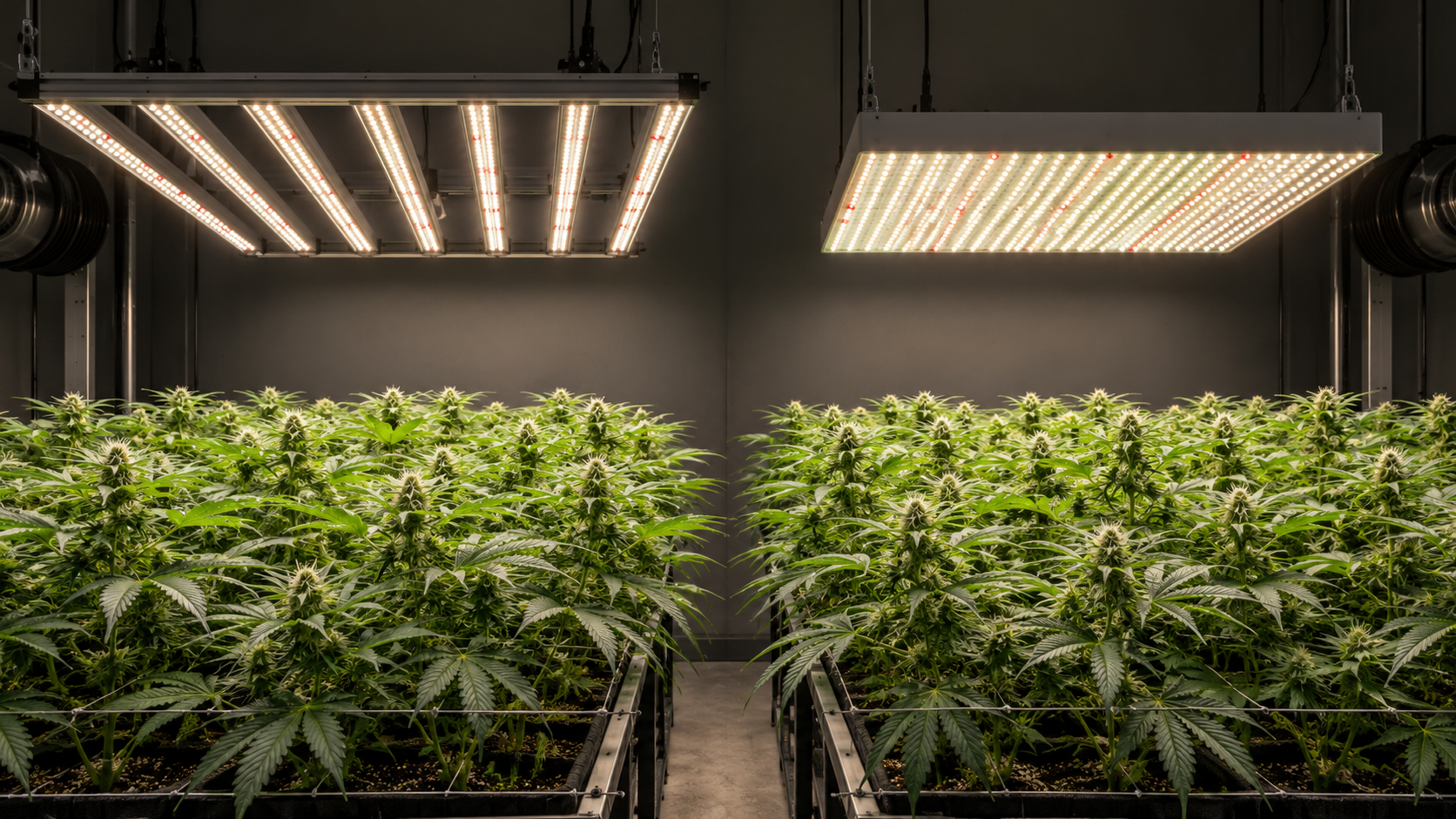
The daily transition from the illuminated photoperiod to the dark cycle represents the single most dangerous microclimate window in indoor cannabis cultivation. Within minutes of luminaire de-energization, sensible thermal energy input collapses to zero, triggering an abrupt decline in ambient air temperature. However, the root zone, growing medium, and dense plant canopy remain thermally warm and continue to transpire substantial water vapor into the cooling air column. In an enclosure governed by basic temperature-triggered environmental controllers, the exhaust fan throttles down or disengages completely just as air temperature plummets, causing relative humidity (RH) to surge violently upward toward 90 to 100 percent.
When moist air cools rapidly without mechanical dehumidification or active air evacuation, it inevitably reaches its dew point, the exact temperature at which the air becomes completely saturated and water vapor undergoes a phase change into liquid water. Microscopic water droplets condense along cooler tent fabric walls, reflective Mylar sheeting, structural corner poles, and most catastrophically, deep within dense floral clusters and outer bract leaf margins. This liquid film provides the exact physical trigger required for the conidia of Botrytis cinerea (gray mold or bud rot) and Podosphaera macularis (powdery mildew) to hydrate, germinate, and penetrate plant epidermal cell walls, devastating months of careful horticultural labor in fewer than 48 hours.
Achieving absolute dark-cycle environmental stability requires understanding psychrometric physics rather than relying on intuitive heating or cooling adjustments. Managing nighttime humidity demands an integrated approach that balances sensible air cooling, latent moisture removal, minimum baseline exhaust velocities, supplemental heat inputs, and continuous boundary layer air circulation. By mastering the psychrometric relationships between absolute humidity, dew point margins, vapor pressure deficit (VPD), and thermal air displacement, cultivators can eliminate condensation risks permanently across every developmental stage of flowering.
Psychrometric Law: The Temperature-Dependent Moisture Capacity of Air
Relative humidity is not an absolute measure of the physical water content in the air; it represents the percentage of moisture present relative to the maximum amount the air could hold at that specific dry-bulb temperature. As air cools, its saturation vapor pressure drops exponentially according to the Clausius-Clapeyron relation. For every 10 degrees Celsius (18 degrees Fahrenheit) drop in temperature, the moisture-holding capacity of the air is cut approximately in half. Consequently, air containing 12 grams of water vapor per cubic meter at 26 °C registers 50 percent RH, but if that same air cools to 16 °C without removing a single drop of moisture, its relative humidity automatically surges to 90 percent.
To establish a fully protective nighttime environmental control strategy, cultivators must analyze the fundamental aerodynamic and thermodynamic variables that govern enclosure physics. Controlling night humidity requires understanding how volumetric extraction rates, static pressure differentials, and thermal gradients interact with plant transpiration dynamics during the dark cycle.
Defining the Problem: CFM, Static Pressure, Dew Point Margins, and VPD
The Primary Environmental Variables Governing the Nighttime
The primary environmental variables governing the nighttime grow tent atmosphere comprise dry-bulb air temperature, relative humidity, dew point margin, vapor pressure deficit (VPD), and enclosure static pressure differentials. In dark-cycle management, the critical metric that separates healthy crops from fungal infection is the dew point depression, defined as the difference between the actual air temperature and the calculated dew point temperature.
When a grow space operates with a wide dew point depression (e.g., air temperature at 22 degrees Celsius and dew point at 14 degrees Celsius, yielding an 8-degree margin), the risk of liquid condensation is virtually zero. However, when nighttime temperatures drop to 18 degrees Celsius and relative humidity climbs to 85 percent, the dew point rises to 15.5 degrees Celsius, narrowing the safety margin to a precarious 2.5 degrees Celsius. In this narrow window, any cooler physical surface inside the tent, such as uninsulated exterior walls, metal corner poles, or leaf surfaces undergoing radiative cooling, will drop below 15.5 degrees Celsius, triggering immediate surface condensation.
Vapor pressure deficit during the dark cycle must be maintained within a tight target window of 0.8 to 1.1 kilopascals (kPa). During the day, higher VPD levels (1.2 to 1.5 kPa) drive vigorous transpirational water movement and nutrient mass flow. At night, while stomata largely close in response to darkness, residual cuticular transpiration and stomatal night leakage continue. If nighttime VPD collapses below 0.6 kPa, transpirational pull halts completely, causing root pressure to push excess water into leaf intercellular spaces, a physiological disorder known as edema that ruptures leaf cells and invites bacterial soft rot.
Volumetric Flow Rate (CFM) Requirements
Volumetric flow rate (CFM) requirements shift fundamentally between day and night cycles. During lights-on, high CFM is required to extract sensible heat generated by high-intensity luminaires. During lights-off, sensible heat extraction is zero, but moisture evacuation remains mandatory. If an exhaust fan shuts down completely at dark, latent water vapor accumulates trapped inside the sealed enclosure. The exhaust system must maintain a calibrated minimum volumetric flow rate (typically 20 to 35 percent of full speed) to continuously displace moisture-laden air with drier intake air while preserving negative static pressure for odor containment.
Static Pressure Differential between the Tent
Static pressure differential between the tent and the host room guarantees that all exhausted air passes through the activated carbon filter rather than seeping into the residence. However, maintaining negative pressure during the dark cycle requires careful balancing: exhaust air velocity must be sufficient to keep tent walls deflected slightly inward without drawing in unconditioned, freezing drafts that chill the canopy excessively.
“My dehumidifier runs all night inside my four-by-four tent, but humidity still hits 85 percent. Why is it failing?”
Question sent by: ThunderBayTent, via contact form.
“I bought a small Peltier-type desktop dehumidifier and put it on the floor of my four-by-four grow tent. During the day humidity is fine, but thirty minutes after lights go out, my Bluelab monitor alarms with 85 percent RH. The dehumidifier reservoir only collects a few tablespoons of water by morning. Why can’t it pull the humidity down?”
Small Peltier-effect (thermoelectric) dehumidifiers are completely inadequate for horticultural applications. They are designed for tiny closets and can only remove 200 to 500 milliliters of water over 24 hours under extreme conditions. A four-plant flowering cannabis canopy in a 4×4 tent transpires between 6,000 and 8,000 milliliters (6 to 8 liters) of water daily, with over 2 liters released into the air column during the first few hours of darkness. To extract this massive latent moisture load, you need a commercial compressor-based refrigeration dehumidifier rated to remove at least 35 to 50 pints (16 to 24 liters) of water per day. However, placing a large compressor dehumidifier inside a compact 4×4 tent is problematic because it dumps massive compressor heat and consumes valuable floor space. The professional engineering solution is to place the compressor dehumidifier outside the tent inside your surrounding host room (lung room), drying the ambient intake air down to 40 to 45 percent RH. Your exhaust fan can then continuously exchange tent air, pulling dry air in and evacuating moist air out cleanly.
Understanding these psychrometric principles allows cultivators to diagnose microclimate anomalies accurately. Nighttime humidity surges are not random equipment failures; they are predictable physical consequences of thermodynamic cooling interacting with active plant transpiration.
System Layout: Intake Path, Exhaust Path, Dehumidifier Positioning, and Sensor Placement
The Physical Arrangement of Ventilation and Environmental
The physical arrangement of ventilation and environmental conditioning equipment dictates whether a grow room maintains a uniform microclimate or suffers localized pockets of cold, stagnant, saturated air.
The standard architectural framework for nighttime humidity control is the lung room configuration. In this layout, the host room enclosing the grow tent functions as a primary environmental conditioning buffer. A high-capacity compressor dehumidifier and a thermostatically controlled space heater are stationed inside the lung room. The dehumidifier continuously condenses ambient moisture out of the air column, maintaining the lung room at 45 percent relative humidity and 21 degrees Celsius (70 degrees Fahrenheit). When the grow tent exhaust fan runs at low speed during the dark cycle, it pulls pre-warmed, pre-dehumidified air from the lung room through lower intake ports, sweeps it across the canopy, and expels it outdoors or back into the lung room through a carbon filter.
“How much margin for error do I really have with the physical arrangement of ventilation and environmental during peak flowering when plant demand is at its highest?”
Question sent by: Carter Kingsley, via email.
Start by taking a direct baseline measurement rather than guessing from foliar symptoms alone. In practice, Compressor dehumidifiers generate substantial sensible waste heat (typically 300 to 600 watts of electrical heat), which can over-heat a tent during the photoperiod.
Once you have confirmed the baseline reading, adjust only one variable at a time and log the response over the next 24 to 48 hours. Installing an exterior spring-loaded backdraft damper with a silicone seal ensures that air can only travel outward under positive fan pressure, sealing tightly against external drafts when the fan operates at minimum speed.
Attempting to Control Nighttime Humidity by Placing
Attempting to control nighttime humidity by placing a dehumidifier directly inside a small grow tent creates severe thermal and spatial complications. Compressor dehumidifiers generate substantial sensible waste heat (typically 300 to 600 watts of electrical heat), which can over-heat a tent during the photoperiod. Furthermore, localized exhaust from a dehumidifier blower creates hot, dry microclimate jets that induce severe foliar stress on adjacent plants while leaving opposite corners damp and stagnant.
Aerodynamic Rule: Vertical Canopy Circulation at Lights-Out
Warm air rises while cool, moisture-laden air sinks toward the floor, creating intense vertical thermal and humidity stratification during the dark cycle. In an uncirculated tent, relative humidity at the floor level can register 85 percent while upper ceiling sensors report 65 percent. Cultivators must maintain continuous, 24/7 internal air circulation utilizing multi-speed oscillating fans. Positioning one oscillating fan beneath the canopy pushing air upward through the root containers, and another fan above the canopy pushing air diagonally downward, equalizes vertical stratification, continuously disrupts leaf boundary layers, and prevents pockets of stagnant moisture from forming inside dense floral colas.
Sensor Placement Represents Another Critical Factor
Sensor placement represents another critical factor in preventing false controller readings. Relative humidity and temperature transducers must never be mounted against exterior tent fabric walls, which are chilled by cold room air and register artificially high humidity. Sensors must also never be placed in the direct linear jet of incoming intake air. Probes must be housed inside aspirated, radiation-shielded enclosures positioned at average canopy height in the center of the garden, directly sampling the biological microclimate experienced by expanding flowers.
Ducting geometry during dark-cycle exhaust operation must be engineered to prevent back-drafting and thermal siphoning. If exhaust ducting terminates at an exterior building wall without an airtight backdraft damper, cold outdoor winter air will siphon backward down the conduit into the grow tent the moment the fan throttles down. Installing an exterior spring-loaded backdraft damper with a silicone seal ensures that air can only travel outward under positive fan pressure, sealing tightly against external drafts when the fan operates at minimum speed.
Sizing and Measurement Workflow: Calculating Latent Removal and Night Air Exchange Rates
Accurately Sizing Ventilation and Dehumidification Equipment
Accurately sizing ventilation and dehumidification equipment for dark-cycle operation requires calculating the exact latent water mass transpired by the crop rather than relying on arbitrary volumetric room-exchange shortcuts.
The total moisture load generated by an indoor cannabis canopy is directly proportional to daily irrigation volume. A full canopy of mature flowering plants transpires approximately 90 to 95 percent of all applied water. For an eight-plant garden in a 5×5 tent receiving 16 liters (4.23 gallons) of water per day, approximately 15 liters of liquid water is vaporized into the atmosphere every 24 hours. While daytime transpiration accounts for roughly 75 to 80 percent of this total, nighttime cuticular transpiration and medium surface evaporation continuously release 3 to 4 liters (6.3 to 8.5 pints) of water into the air column during the 12-hour dark cycle, or approximately 0.25 to 0.33 liters per hour.
“When working on accurately sizing ventilation and dehumidification equipment in my home grow, how do I know if my current setup is drifting out of range before visible plant stress appears?”
Question sent by: Carter Halvorsen, via reader Q&A form.
Start by taking a direct baseline measurement rather than guessing from foliar symptoms alone. In practice, For an eight-plant garden in a 5×5 tent receiving 16 liters (4.23 gallons) of water per day, approximately 15 liters of liquid water is vaporized into the atmosphere every 24 hours.
Once you have confirmed the baseline reading, adjust only one variable at a time and log the response over the next 24 to 48 hours. Reviewing the empirical engineering data in the table above demonstrates why relying on fan shutoff or unconditioned intake air causes disaster.
To calculate the volumetric exhaust airflow required to evacuate this latent moisture without active dehumidification, cultivators apply the psychrometric moisture balance formula:
CFM Equals Moisture Evaporation Rate Grains Per
CFM equals Moisture Evaporation Rate (grains per minute) divided by 4.5 multiplied by the Specific Humidity Differential (W_inside minus W_intake in grains per pound of dry air).
For Example Evaporating 030 Liters 2100 Grains
For example, evaporating 0.30 liters (2,100 grains) of water per hour equals 35 grains per minute. If the intake air from the host room contains 50 grains/lb of moisture (21 °C at 45% RH) and the target enclosure air is 68 grains/lb (20 °C at 65% RH), the specific humidity differential is 18 grains/lb. Applying the formula: 35 divided by (4.5 multiplied by 18) equals 35 divided by 81, yielding a required continuous dark-cycle exhaust rate of approximately 43.2 CFM of actual air exchange against installed filter resistance.
| Tent Dimensions & Canopy Size | Daily Irrigation Volume | Estimated Night Moisture Transpiration | Minimum Continuous Night Exhaust (CFM) | Recommended Dedicated Dehumidifier Capacity | Critical Dew Point Condensation Threshold |
|---|---|---|---|---|---|
| 2 x 2 x 4 (1 to 2 Plants) | 2.0 Liters | 0.45 Liters (0.95 Pints) | 15 to 25 CFM | 20 to 30 Pints/Day (Lung room) | 18.5 °C @ 85% RH (Dew Point 15.8 °C) |
| 3 x 3 x 6 (2 to 4 Plants) | 6.0 Liters | 1.35 Liters (2.85 Pints) | 30 to 45 CFM | 35 to 50 Pints/Day (Lung room) | 19.0 °C @ 85% RH (Dew Point 16.3 °C) |
| 4 x 4 x 6.5 (4 to 6 Plants) | 10.0 Liters | 2.25 Liters (4.75 Pints) | 50 to 75 CFM | 50 to 70 Pints/Day (Lung room) | 19.5 °C @ 85% RH (Dew Point 16.8 °C) |
| 5 x 5 x 6.5 (6 to 9 Plants) | 16.0 Liters | 3.60 Liters (7.60 Pints) | 80 to 120 CFM | 70 to 100 Pints/Day (Commercial) | 20.0 °C @ 85% RH (Dew Point 17.3 °C) |
| 4 x 8 x 6.5 (8 to 12 Plants) | 22.0 Liters | 4.95 Liters (10.45 Pints) | 110 to 160 CFM | 100+ Pints/Day (Commercial) | 20.5 °C @ 85% RH (Dew Point 17.8 °C) |
Reviewing the empirical engineering data in the table above demonstrates why relying on fan shutoff or unconditioned intake air causes disaster. In a 4×4 or 5×5 tent during late flower, mature plants pump several pints of water into the air column overnight. If an exhaust fan drops below its minimum volumetric threshold, or if the intake air drawn into the tent is already humid, relative humidity crosses the 85 percent threshold rapidly, compressing the dew point safety margin to less than 2.5 degrees Celsius and triggering catastrophic condensation on leaf surfaces.
To verify that air exchange is sufficient, cultivators must continuously monitor their dew point depression using digital psychrometric logging sensors. Maintaining a minimum dew point depression of at least 4.5 degrees Celsius (8 degrees Fahrenheit) during all dark hours guarantees that foliage remains dry and completely safe from spore hydration.
Technical Deep Dive: The Physics of Dark-Cycle Humidity and Dew Point Dynamics
To eliminate conflicting folklore and provide absolute clarity on nocturnal moisture behavior, cultivators must explore the exact thermodynamic mechanisms that cause humidity to rise after dark, the physics of dew point condensation, and the step-by-step resolution of nighttime spikes.
Grow Tent Humidity at Night: Why RH Rises After Lights-Out
The primary reason relative humidity climbs immediately after lights-out is the mathematical relationship between sensible temperature and saturation vapor pressure. Relative humidity is a ratio: actual vapor pressure divided by saturation vapor pressure. Saturation vapor pressure is dictated entirely by temperature. When grow lights extinguish, sensible heat input drops to zero, and the air temperature inside the tent drops rapidly by 4 to 8 degrees Celsius. Because cold air cannot hold as much moisture as warm air, the denominator in the relative humidity equation shrinks dramatically. Even if plants ceased transpiring instantly at dark, relative humidity would still climb by 15 to 25 percent purely due to air cooling. When ongoing transpirational moisture is added to this chilling volume, RH spikes into the critical danger zone.
“I am trying to dial in grow tent humidity at night for my indoor tent, what is the most reliable measurement to check first so I do not overcorrect?”
Question sent by: AshevilleAromaLab, via grow journal submission.
Start by taking a direct baseline measurement rather than guessing from foliar symptoms alone. In practice, When grow lights extinguish, sensible heat input drops to zero, and the air temperature inside the tent drops rapidly by 4 to 8 degrees Celsius.
Once you have confirmed the baseline reading, adjust only one variable at a time and log the response over the next 24 to 48 hours. Successfully managing grow tent humidity at night requires a dual-stage environmental protocol:
Why Humidity Rises After Grow Lights Turn Off
Beyond air cooling, plants do not stop transpiring immediately when lights turn off. While stomatal guard cells begin to close when photons cease striking leaf photoreceptors, complete stomatal closure takes between 20 and 45 minutes depending on cultivar genetics and plant water status. Furthermore, root containers, moist soilless substrates, and wet fabric pots retain substantial thermal energy accumulated during the photoperiod. This warm root medium acts as a thermal evaporator, continuously releasing warm water vapor into the cooling tent air column for several hours after dark. This thermal lag creates a massive influx of moisture into an atmosphere that is rapidly losing its capacity to hold vapor.
Dew Point and Condensation in Cannabis Grow Rooms
Condensation occurs when moist air contacts a physical surface that is at or below the dew point temperature of that air. In a grow tent, condensation does not occur uniformly in open air; it begins on the coldest surfaces first. In winter, tent fabric walls facing cold exterior foundation walls, metal corner poles, uninsulated ducting collars, and outer leaf tips radiating heat to cold surfaces drop below the dew point first. Liquid water condenses on these surfaces, forming beads that drip into pots or run down walls. If leaf surfaces drop below dew point, microscopic water films form directly over stomatal pores, blocking oxygen absorption and providing fungal spores with the liquid water required to dissolve cuticle layers and infect floral tissue.
Dew Point in an Indoor Cannabis Room
Managing dew point in an indoor facility requires calculating and monitoring dew point depression continuously. Dew point depression is the mathematical buffer: Air Temperature minus Dew Point Temperature. In a professional commercial facility, environmental automation systems are programmed to alarm whenever dew point depression narrows to less than 3.5 degrees Celsius (6.3 degrees Fahrenheit). If the margin narrows, the controller responds immediately: it does not shut down fans; instead, it accelerates exhaust extraction, engages lung room dehumidification, and activates low-intensity radiant heating coils to warm the air column, instantly widening the dew point depression back to safe operational levels.
Grow Tent Humidity at Night: Operational Management Framework
Successfully managing grow tent humidity at night requires a dual-stage environmental protocol:
- Stage 1: Minimum Baseline Continuous Exhaust: Never allow the inline exhaust fan to shut off completely at night. Configure the controller to maintain a continuous baseline speed of 25 to 35 percent throughout the entire dark cycle, guaranteeing continuous moisture evacuation and negative static pressure.
- Stage 2: Lung Room Conditioning: Station a high-capacity compressor dehumidifier in the host lung room outside the tent, maintaining ambient intake air at 45 percent RH and 21 °C. This guarantees that replacement air drawn into the tent is warm and dry.
- Stage 3: Supplemental Dark-Cycle Heat: If host room temperatures drop below 19 °C (66 °F) in winter, install an automated, low-wattage ceramic space heater or oil-filled radiator inside the lung room to temper incoming air, keeping dark-cycle tent temperatures strictly between 20 and 22 °C (68 to 72 °F).
- Stage 4: 24/7 Boundary Layer Air Circulation: Keep oscillating circulation fans running continuously on medium speed throughout the dark cycle, preventing localized cold, damp microclimates from forming around dense colas.
Failure Modes, Look-Alikes, and Diagnostic Pitfalls
Diagnosing Nocturnal Environmental Failures
Diagnosing nocturnal environmental failures requires separating genuine biological symptoms from mechanical controller errors and psychrometric measurement bias.
A common diagnostic mistake is misidentifying dark-cycle moisture stress as a nutrient toxicity or fungal blight. When relative humidity spikes past 90 percent at night and collapses VPD, plants frequently develop foliar edema. Edema manifests as small, blister-like bumps, watery translucent spots, and upward curling leaf margins on upper fan leaves. Many inexperienced growers misdiagnose edema as calcium deficiency, potassium toxicity, or broad mite damage, responding by flushing nutrients or spraying foliar chemical pesticides. Spraying foliar liquids onto plants already suffering from nocturnal moisture saturation adds more liquid water to the canopy, ensuring immediate bud rot infection. True edema is resolved exclusively by widening dew point depression and restoring active nighttime transpiration.
Sensor Condensation and Psychrometric Measurement Bias
Sensor condensation and psychrometric measurement bias represent common hardware failure modes. When relative humidity reaches 100 percent in an unventilated tent, microscopic water droplets condense directly onto the capacitive sensing element of digital thermo-hygrometers. Once saturated with liquid water, capacitive sensors lock at 99 percent RH or provide erratic, false readings for hours, even after ambient air conditions have returned to normal. Furthermore, mounting a sensor probe against cold tent fabric causes the sensor housing to be chilled by conduction, reading an artificially high relative humidity that does not represent the central canopy atmosphere.
Operational Warning: Filter Blinding and Breakthrough Under Nocturnal Humidity
Virgin activated carbon filters lose VOC adsorption capacity catastrophically when exposed to relative humidity exceeding 80 percent. High-humidity moisture molecules condense inside the sub-microscopic micropores of the carbon granules, physically blocking terpene adsorption. In as few as three consecutive nights of 85+ percent humidity, an activated carbon filter will suffer breakthrough, spewing pungent skunk and pine odors into the surrounding living space even if the filter is brand new. Controlling nighttime humidity protects not only plant health, but also residential security and filter longevity.
Controller hunting and cycling fatigue represent electrical failure modes in improperly configured systems. If an environmental controller is programmed with a zero-hysteresis threshold (e.g., fan turns on at 55% RH and turns off at 54% RH), the fan will cycle on and off hundreds of times each night. This rapid cycling wears out motor relays, causes thermal stress in motor windings, and creates violent static pressure fluctuations that pulse tent fabric walls. Controllers must be configured with a deadband buffer of at least 3 to 5 percent RH and a minimum runtime of five minutes to smooth out environmental transitions.
Commissioning Protocol and Pre-Flower Nocturnal Verification
Before switching crops from the 18/6 vegetative cycle into the 12/12 flowering cycle, cultivators must conduct a formal 48-hour nocturnal commissioning test to verify that the ventilation and dehumidification systems can manage the violent lights-off thermal shock.
Step 1: Dark-Cycle Transpiration Simulation
To simulate the latent moisture load of a mature flowering canopy during commissioning, place a shallow tray containing 3 liters of warm water and an ultrasonic mist maker inside the sealed grow tent. Power on the lighting fixtures at 100 percent output for four hours to establish daytime thermal equilibrium (26 to 28 degrees Celsius).
Step 2: Lights-Off Transition Stress Test
Disengage the lighting contactor while leaving environmental controllers, exhaust fans, and lung room dehumidifiers fully active. Monitor environmental parameters continuously across the subsequent four hours using a calibrated data logger recording at 1-minute intervals. Observe the psychrometric decline:
- Confirm that the exhaust fan successfully detects the lights-off cooling drop and executes its minimum baseline speed override, maintaining continuous negative static pressure.
- Verify that the lung room dehumidifier activates and prevents incoming intake air from exceeding 50 percent relative humidity.
- Confirm that relative humidity inside the tent stabilizes between 45 and 55 percent, and never spikes above 65 percent at any point during the transition.
- Calculate the dew point depression at the lowest temperature trough; verify that the margin between air temperature and dew point remains greater than 4.5 °C (8 °F).
Step 3: Physical Condensation Inspection
One hour after lights-out, enter the cultivation room and inspect the interior tent surfaces utilizing a green-spectrum inspection light. Feel the lower fabric walls, metal corner poles, exhaust duct collars, and floor trays. Confirm that every surface is completely dry to the touch. Any trace of surface moisture indicates that incoming air is too cold, exhaust velocity is insufficient, or internal circulation is failing to break up cold boundaries.
Standard Operating Verification Checklist
- Baseline Minimum Speed: Verify exhaust fan controller enforces at least 25% continuous speed throughout all dark hours.
- Lung Room Dehumidifier: Confirm compressor dehumidifier maintains lung room ambient humidity below 45% RH.
- 24/7 Canopy Circulation: Ensure oscillating circulation fans operate continuously on medium speed during lights-out.
- Aspirated Sensor Placement: Position environmental probes at mid-canopy level inside radiation-shielded housings.
- Backdraft Damper Check: Verify exterior exhaust duct termination damper seals tightly against reverse cold drafts.
- CO2 Burner Lockout: Ensure supplemental CO2 burners or compressed gas solenoids are completely locked out at night.
Preventative Maintenance and Recheck Schedule
Maintaining Flawless Dark-cycle Humidity
Maintaining flawless dark-cycle humidity control requires regular preventative maintenance. Particulate accumulation on dehumidifier coils, pre-filters, and sensor transducers steadily degrades dehumidification efficiency over consecutive cropping cycles.
Cultivators Must Periodically Audit Controller Hysteresis Algorithms
In addition to regular component cleaning, cultivators must periodically audit controller hysteresis algorithms and sensor response latency. Over months of exposure to high-humidity vapor and organic terpene aerosols, capacitive humidity sensing elements experience microscopic surface coating, causing sensor response times to lag by several minutes. In a rapidly cooling dark-cycle transition, a five-minute sensor lag can delay exhaust fan acceleration until relative humidity has already crossed the dew point threshold, triggering localized condensation before the controller detects the event. Furthermore, growers should verify the physical seal and counterweight balance of exterior gravity dampers quarterly; any damper flapper that sticks slightly open allows freezing winter air to siphon backward into the enclosure, creating cold spots that induce condensation on adjacent floral colas. Documenting weekly dew point margins in an environmental log ensures that subtle sensor drifts and mechanical damper faults are corrected before crop damage occurs.
Field Advice: Maintenance Protocol: Dehumidifier Coil Cleaning and Sensor Recalibration. Every 30 days or between cropping cycles, disconnect electrical power to your lung room dehumidifier and remove the air intake filter screen. Wash the screen in warm soapy water to remove airborne dust, pet hair, and foliar spray residue. Inspect the aluminum evaporator and condenser coils: if dust has bypassed the filter and coated the coil fins, spray them with non-rinse foaming coil cleaner to restore thermal heat transfer efficiency. Calibrate your digital psychrometric sensor probes against an analog chilled-mirror hygrometer or laboratory-grade reference instrument, and clean the sensing heads gently with dry compressed air.
In addition to dehumidifier servicing, inspect carbon filter pre-filter sleeves monthly for dust accumulation. Wash pre-filters between harvest cycles and ensure they are 100 percent dry before reassembly. By executing systematic preventative maintenance, pre-conditioning intake air in a lung room, and maintaining continuous minimum exhaust displacement, cultivators permanently eliminate nighttime humidity spikes and harvest mold-free, premium-grade cannabis colas cycle after cycle.
Scientific References
- ASHRAE. (2021). Handbook of Fundamentals: Psychrometrics, Dew Point Calculations, and Space Moisture Control. American Society of Heating, Refrigerating and Air-Conditioning Engineers, Atlanta, GA.
- Stanghellini, C., & de Jong, T. (1995). A model of humidity and its control in greenhouse plant canopies: Nocturnal transpiration and condensation. Agricultural and Forest Meteorology, 76(2), 113-128.
- Zheng, Y. (Ed.). (2021). Handbook of Cannabis Production in Controlled Environments: Plant Pathogen Management, Dew Point Margins, and Microclimate Control. CRC Press, Boca Raton, FL.
- Gauthier, L. (1994). A model for the simulation of greenhouse microclimate: Temperature, humidity, and nocturnal dew formation. Transactions of the ASAE, 37(4), 1279-1286.
- Jarvis, W. R. (1992). Managing Diseases in Greenhouse Crops: Environment Manipulation and Botrytis Control. APS Press, St. Paul, MN.
Share this article
A quick overview of the topics covered in this article.
Follow us
Latest articles
November 7, 2026
November 7, 2026
November 7, 2026
November 7, 2026
