
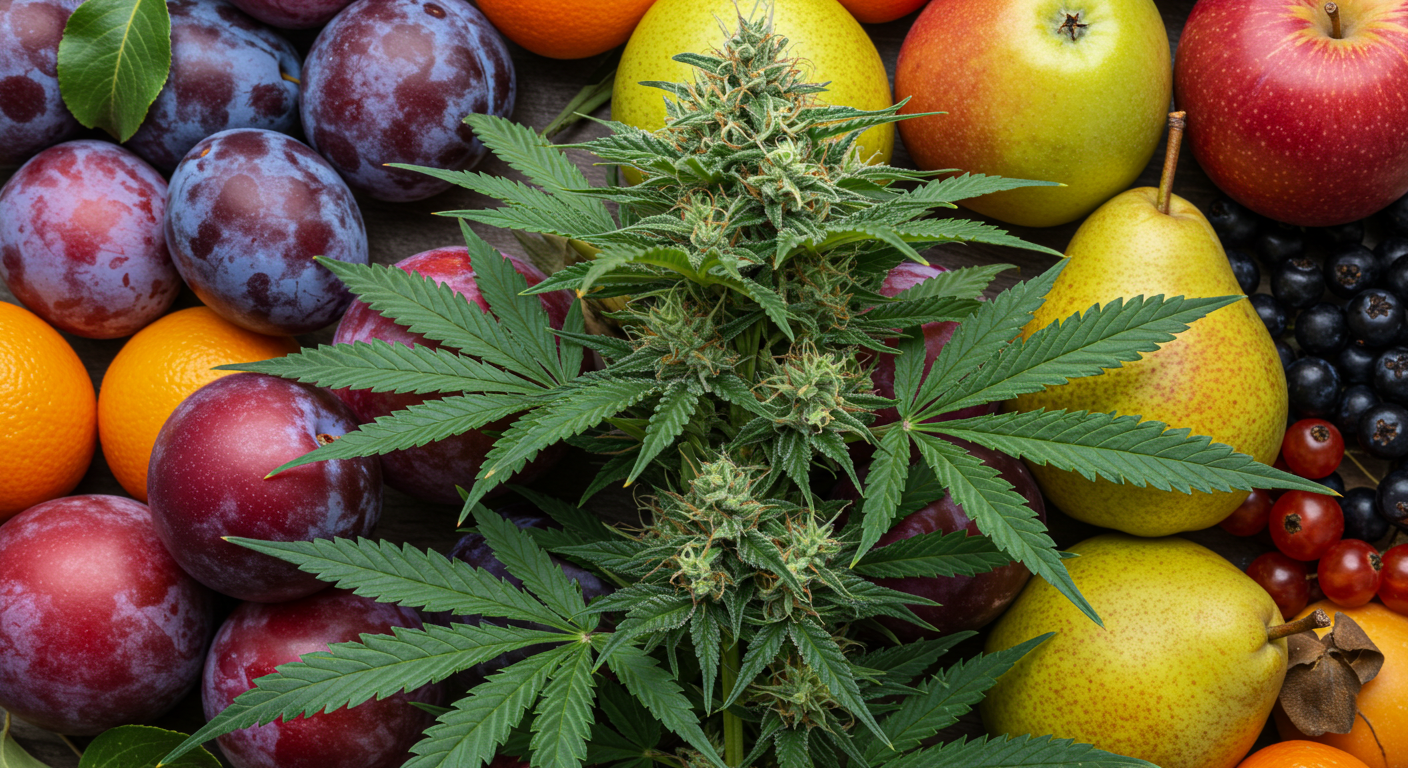
Apples and Bananas
Apples and Bananas is a fruit-forward hybrid with a growth habit that is easier to underestimate than its name. The finished flower can smell like green apple skin, ripe banana, pear, tropical fruit, sweet dough and fuel, yet the plant often grows with strong apical drive, active side branching and enough flowering stretch to challenge a low ceiling. Its best expressions combine tall hybrid vigor with dense, swollen calyxes rather than loose, airy spears.
The cultivar is also genetically less simple than many strain databases suggest. Some records use a shortened two-parent description, while others document a broader breeding stack involving Platinum Cookies, Granddaddy Purple, Blue Power and Gelatti-related material. That uncertainty matters because different cuts can lean toward purple berry, sharp apple, banana cream, cookie dough or gas. A grower should expect a recognizable family resemblance rather than one perfectly uniform plant.
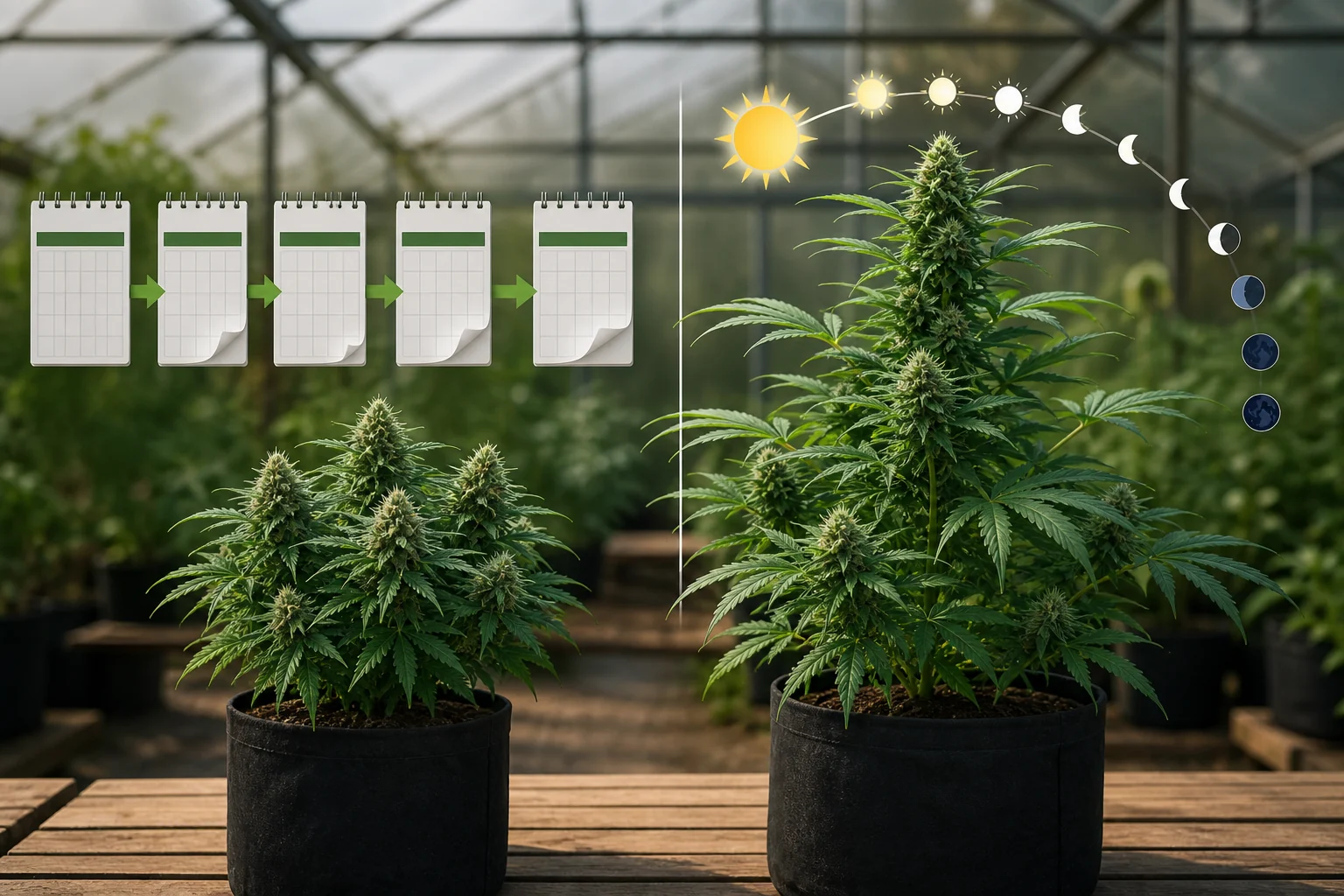
The most useful cultivation question is how to control the medium-high stretch without sacrificing the lateral branches that produce its best yield. Flipping too late creates a tall, layered canopy with weak lower flowers. Flattening it too aggressively can leave too many thin tops and an overcrowded center. Apples and Bananas performs best when early training creates several strong arms, the screen still has open space at the flip and the late flower environment protects its volatile fruit notes.
How full should the screen be before I flip Apples and Bananas?
Leave more open space than you would for a compact dessert hybrid. A vigorous cut can stretch roughly 1.5x to 2x, so use the transition to finish the screen instead of entering flower with every square already occupied.
Sent by: Maya via e-mail
Strain Features
| Feature | Details |
|---|---|
| Strain Type | Balanced to slightly indica-leaning hybrid; cut-dependent |
| Genetic Profile | Public records vary. Commonly documented as a multi-generation hybrid involving Platinum Cookies, Granddaddy Purple, Blue Power and Gelatti-related material; some records use a shortened Now N Later x Jet Fuel Gelato description. |
| THC | Commonly reported from the low 20% range into the upper 20s; exceptional batches may test higher |
| CBD | Usually very low |
| Dominant Terpenes | Beta-caryophyllene, limonene and linalool are frequently reported; myrcene and pinene vary |
| Flavor / Aroma | Green apple, banana, pear, tropical fruit, berry, cookie dough, vanilla and fuel |
| Effect Character | Fast euphoria and creative energy followed by warm body relaxation |
| Flowering Time | Approximately 8 to 9 weeks, with some fruit-forward cuts benefiting from the later end |
| Stretch | Medium-high; vigorous cuts may approach 1.5x to 2x after the flip |
| Plant Architecture | Tall, apically driven and strongly branched with good training response |
| Bud Structure | Dense, chunky flowers with swollen calyxes and heavy resin |
| Grow Difficulty | Intermediate |
| Primary Grow Risk | Height mismanagement, interior crowding and loss of apple-banana top notes during heat or rapid drying |
Genetic Lineage
The most repeated full lineage places Apples and Bananas within a multi-generation cross involving Platinum Cookies, Granddaddy Purple, Blue Power and Gelatti-related genetics. Other records compress the story into Now N Later crossed with Jet Fuel Gelato. These accounts may reflect shorthand, different release descriptions or the way a complex breeding stack was marketed over time. The exact crossing order should not be presented as more certain than the available record allows.
The inherited traits are easier to recognize. Cookies-family material contributes dense flower formation, resin, sweet dough and a tendency toward dark color. Granddaddy Purple and Blue Power help explain berry, grape, fruit skin and cooler-night pigmentation. Gelatti and fuel-related material contribute vigor, gas, cream and a sharper psychoactive opening.
This combination produces meaningful phenotype variation. Some plants are tall and apple-dominant with brighter citrus and pear. Others carry more banana cream, berry, vanilla and purple color. A third group may be fuel-forward and less obviously fruity. The most productive plant is not automatically the best flavor keeper, so selection should continue through drying and cure rather than ending at harvest.
The disagreement between the long and short lineage descriptions should not be solved by pretending one record cancels the other. Current first-party strain material identifies the commercial cross as Now N Later x Jet Fuel Gelato, while the broader family history commonly associated with the cultivar helps explain why growers encounter fruit, purple color, cookie density and fuel in different proportions. For cultivation, the useful approach is to label the actual cut, record its behavior and avoid transferring one seed-run description to every plant carrying the name.
That distinction becomes practical during selection. An apple-led plant may carry brighter peel, pear and cider notes but need more time for the aroma to return after drying. A banana-cream expression can feel softer and rounder in the jar while showing stronger dessert density. A darker fuel-led plant may look impressive and finish with excellent resin yet miss the contrast that makes the cultivar memorable. The best keeper is therefore not simply the highest-yielding or darkest plant. It is the individual that retains a recognizable fruit sequence after cure while staying manageable in the grower’s actual room.
Structure also helps separate useful phenotypes. Watch pre-flip internodal distance, the angle of the first four lateral branches, how quickly the main stem reasserts dominance after topping and whether the center fills with weak secondary shoots. These observations predict canopy labor more reliably than leaf width alone. A cut that builds four to eight sturdy, evenly spaced arms is usually easier to finish than a taller plant that produces many thin leaders competing for the same light.
Effect Breakdown
Fast, bright onset
The effect usually arrives quickly. At a moderate dose, mood rises, thoughts become more associative and ordinary activities may feel more interesting. Many users describe a creative, giggly or socially open phase. This is the part of the experience that makes the cultivar feel more energetic than its dense flower structure suggests.
Hybrid balance
After the initial lift, a warmer physical calm develops. Muscles loosen and the mental intensity becomes smoother without necessarily disappearing. Experienced users may remain productive, conversational or artistically engaged while feeling noticeably relaxed.
The overconsumption line
High doses can turn the same fast euphoria into racing thoughts, anxiety or disorientation before the body effect becomes heavy. Appetite, dry mouth and dry eyes are common. The strain is potent enough that a pleasant first phase can encourage additional use before the full dose is understood.
Flavor & Aroma Profile
An intact jar may open with sweet fruit, pear skin and a faint banana-candy note. Breaking the flowers usually reveals sharper green apple, tropical fruit, berry, vanilla dough and fuel. The apple quality is often closer to tart peel or cider than to artificial candy, while the banana note may appear as ripe fruit, cream or pudding depending on the expression.
On inhalation, the profile can feel sweet, fruity and lightly creamy. The middle of the palate brings apple acidity, pear and banana. The exhale introduces pepper, cookie dough and gas, preventing the flower from becoming a simple fruit dessert. Better phenotypes keep the apple and banana identifiable instead of collapsing into generic sweetness.
The cultivar loses flavor unevenly. Green apple, pear and banana cream are more volatile than the peppery fuel base. High late-flower heat or a fast dry can leave a loud but incomplete result that smells mostly sweet, earthy and gaseous. A patient cure often clarifies the fruit after the initial sharpness settles.
Dominant Terpenes
Terpene order can change between phenotypes, cultivation environments and laboratory batches. The table describes recurring patterns rather than a fixed chemical formula.
| Terpene / Group | Likely Role in Apples and Bananas |
|---|---|
| Beta-Caryophyllene | Commonly supports black pepper, dry spice and the fuel-dough base. It may help shape the later body relaxation, although aroma attribution is more reliable than predicting individual effects. |
| Limonene | Contributes citrus peel and the bright acidic edge that can make the apple note feel fresh rather than syrupy. |
| Linalool | May soften the profile with floral cream, vanilla and a calmer aromatic texture. |
| Myrcene and Pinene | These vary by sample. Myrcene can deepen ripe fruit and earth, while pinene may reinforce fresh peel, herbs and sharper green-fruit impressions. |
Indoor vs. Outdoor Growing
| Decision Point | Indoor Growing | Outdoor Growing |
|---|---|---|
| Height management | Early topping, LST and a partially open screen make the stretch productive. | Root freedom can create a tall, broad plant that needs early shaping and generous spacing. |
| Canopy behavior | Strong apical growth must be distributed before flowering. | Multiple supported arms are safer than one dominant central structure. |
| Flower quality | Indoor temperature control protects tart apple, banana cream and dense calyx development. | Full sun can deepen fruit and gas, but late heat or rain can reduce aroma and increase rot risk. |
| Support | A second net is useful because dense flowers gain weight late. | Cages and branch ties should be installed before flowering stems become rigid. |
| Harvest timing | The plant can be allowed to complete final swelling without weather pressure. | A dry early-autumn window is valuable because some cuts need the full ninth week equivalent. |
| Best fit | Growers comfortable controlling a vigorous, medium-high stretch hybrid. | Warm, dry regions with enough season length and room for a large branchy plant. |
For Apples and Bananas, the indoor decision is mainly about controlling the cultivar-specific risk before it reduces premium flower. Outdoor cultivation can increase root volume and plant size, but only a suitable finishing climate allows the strongest aroma and bud structure to mature safely.
Indoor and outdoor versions should not be judged by the same silhouette. Indoors, branch placement and a shallow canopy create quality. Outdoors, the same genetics can express as a much larger radial plant, and early staking determines whether the late flowers remain separated after wind or rain. In both cases, the goal is identical: preserve several strong fruit-bearing arms without allowing the middle of the plant to become a shaded humidity reservoir.
Container choice changes the cultivar’s rhythm. In a small pot the plant can look controlled until irrigation demand rises sharply during stretch. In a large bed or outdoor root zone it may accelerate before the grower has finished installing support. Choose root volume according to the finished footprint, not according to the compact appearance of a young clone. Extra root space should come with an earlier flip and a support plan.
Strain-Specific Grow Guidance
Read the apical drive early
Apples and Bananas often reveals its growth strategy before flowering. The central leader rises quickly and the lateral branches follow with enough vigor to become productive if they receive light. Top once above a healthy node set or bend the main stem early. The purpose is to divide dominance among several strong branches, not to create a large number of thin shoots.
Flip before the screen looks finished
A completely filled vegetative screen is usually too late for vigorous expressions. Leave meaningful open area so the first two to three weeks of flowering can complete the canopy. Continue light tucking while stems remain flexible, then allow the tops to rise into a shallow productive zone.
Keep the interior selective
The plant can create attractive side growth below the main canopy, but many of those sites remain shaded after stretch. Remove inward-facing shoots and branches that cannot reach useful light. This improves airflow and increases the percentage of dense, mature flower without requiring severe defoliation.
Do not confuse hunger with unlimited feed tolerance
Fast growth can make the cultivar look hungry, yet excessive nitrogen encourages long internodes, dark leaves and a humid interior. Use a steady program and read the newest leaves, tip condition and irrigation demand together. A vigorous plant should not need to remain glossy and clawed to yield well.
Maintain a repeatable wet-dry rhythm
Large, fast-growing plants can drink aggressively once established. That does not mean the root zone should remain constantly wet. Saturation reduces oxygen and can slow the very vigor the grower is trying to support. Severe dryback during transition can also harden stems before training is complete. Match irrigation frequency to container size, medium and actual plant demand.
The most informative irrigation signal is the change in demand across the flip. A healthy plant usually increases water use as lateral growth and leaf area expand. If demand suddenly stalls while the room remains stable, inspect the root zone, salinity and canopy temperature before adding more feed. A plant that empties the container unusually early may need a larger irrigation volume or an additional event rather than a stronger nutrient solution.
Feeding behavior and transition control
Fast extension can create the false impression that the plant needs aggressive nitrogen. The better reading is whether new leaves remain evenly colored, tips stay clean and stems continue to thicken as they lengthen. Excess nitrogen during the first three weeks of flower can lengthen internodes, preserve too much interior leaf mass and postpone the clean shift into calyx production. A moderate-to-firm program is reasonable after roots are established, but strength should rise only when irrigation demand and leaf posture support it.
Calcium and magnesium shortages can become visible under strong light or in coco because the plant is building a large frame quickly. Treat the cause rather than automatically adding a heavy supplement: confirm source-water composition, root-zone pH and total EC first. Late in flower, avoid trying to force density with repeated high-phosphorus or high-potassium pushes. The cultivar’s last increase in weight comes from healthy leaf function, stable water supply and time for calyxes to swell.
| Stage | Canopy Priority | Feeding and Irrigation Reading |
|---|---|---|
| Early veg | Build roots and identify apical dominance | Gentle nutrition; allow a clear but not severe dryback |
| Late veg | Top once, spread the strongest arms and remove inward shoots | Increase only if new growth and water use remain active |
| Weeks 1-2 flower | Tuck through open screen space and control vertical leaders | Avoid excess nitrogen while irrigation demand rises |
| End of stretch | Clean weak lower growth and stop major structural stress | Hold a stable root-zone EC and watch runoff trend |
| Mid-flower bulk | Maintain light lanes and install final support | Consistent moisture matters more than booster strength |
| Late flower | Protect fruit aroma, flower spacing and calyx health | Reduce unnecessary inputs; do not create a harsh late dryback |
Light response after stretch
Apples and Bananas can use productive intensity, but the sequence matters. Do not solve a height problem by driving the tops harder while the architecture is still changing. Control the first two weeks of flower, finish tucking, then increase light only after the canopy has settled into a consistent plane. A practical non-supplemented room may work around 450-650 PPFD in established veg, 650-850 PPFD during transition and roughly 800-1000 PPFD after stretch when temperature, irrigation and leaf response remain stable. These are Weedth operational ranges, not the output of a cultivar-specific lighting trial.
Fruit preservation sets the upper limit. If the top leaves cup, edges dry, bleaching appears or the apple note becomes quieter while lower flowers remain aromatic, the top layer is receiving more environmental load than it can process. Raising the fixture, improving temperature control or reducing intensity can increase final quality even when the meter suggests the plant could accept more photons.
Flowering timeline and finish
During the first two weeks, the plant spends most of its energy extending and positioning flower sites. Weeks three and four should show a clear transition from stem building to flower stacking. Mid-flower can look less dramatic than expected because the cultivar often saves its visual weight for later calyx expansion. The final two to three weeks are where support, irrigation steadiness and aroma protection become most important.
| Flower Period | Expected Change | Best Grower Response |
|---|---|---|
| Weeks 1-2 | Medium-high stretch, rapid lateral extension and early pistils | Tuck gently, preserve open screen space and avoid heavy nitrogen |
| Weeks 3-4 | Stretch slows; flower positions become obvious | Remove only weak lower sites and establish final airflow lanes |
| Weeks 5-6 | Resin increases; fruit, dough and fuel begin separating | Keep the root zone stable and support branches before they lean |
| Weeks 7-8 | Calyxes swell and density improves quickly | Protect top flowers from heat and inspect interior contact points |
| Week 9+ | Later cuts complete swelling and develop a heavier finish | Harvest by calyx maturity and trichomes, not by color alone |
Support the late-swelling calyxes
The branches may appear strong through mid-flower, then bend as the calyxes swell and resin accumulates. Install a second net or soft ties before the flowers become difficult to handle. Supporting each arm also preserves spacing between colas and reduces humid contact points.
Protect fruit expression during the final weeks
Heat can erase the fruit before it harms the bud
The plant may still finish dense and potent in a warm room, but green-apple, pear and banana-cream top notes can flatten into generic sweet gas. Treat late-flower canopy temperature and drying speed as quality variables, not cosmetic details.
The cultivar can tolerate productive light, but excess canopy heat near finish is especially damaging to the green-apple, pear and banana layer. Watch the top flowers for bleaching, stalled aroma or dry leaf edges. More light is not useful when temperature and root demand are no longer balanced.
Harvest by calyx maturity, not purple color
Some expressions darken late, while others remain green. Use swollen calyxes, slowing fresh pistil production and mostly cloudy trichomes on calyx tissue. Earlier harvest preserves a sharper mental effect and tart fruit. Additional maturity strengthens body relaxation and deepens dough and gas, but waiting too long can soften the brightest apple note.
Grower Note: Use environmental numbers as adaptable ranges rather than strain mythology. The cultivar-specific priority is the growth behavior, flower structure and quality risk described above.
Weedth Bud Flavor Tips
The flavor target is not maximum sweetness. It is separation between tart apple, ripe banana, pear, dough and gas. Keep the final flower period stable and avoid unnecessary heat spikes. Outdoor plants should be harvested after surface moisture has dried but before strong sun warms the flowers.
Dry medium branches in darkness with indirect circulation. Dense tops should have enough space that the exterior does not harden while the core remains wet. A whole-plant dry can work in a controlled room, but very large outdoor colas are safer when separated into manageable branches.
The cure often changes the profile noticeably. Gas and spice may dominate first, followed by clearer apple, banana and cream after several weeks. Divide long-term flower into smaller containers so the most volatile fruit notes are not repeatedly exposed to fresh air.
Treat this cultivar as a bright-fruit chemotype, not as a forgiving gas strain. Published post-harvest research consistently shows that drying method changes volatile composition more strongly than cannabinoid content, and that elevated heat accelerates terpene loss. Apples and Bananas can therefore remain potent while losing the exact green-apple and banana-pudding contrast that justifies growing it. A controlled, unhurried dry is part of cultivation, not a separate cleanup step.
My preferred operational target is large-branch hanging in darkness around 16-19°C and 55-60% RH, with gentle room exchange rather than a fan aimed at the flowers. Ten to fourteen days is a useful goal when branch size and room control allow it, but the correct endpoint is even moisture movement, not a calendar. Dense tops should not feel crisp outside while the center remains cool and wet. If that imbalance appears, increase spacing between branches instead of increasing direct air speed.
Use minimal wet trimming. Leaving protective sugar leaves in place slows the exposed surface and reduces unnecessary handling of resin heads. After the dry, trim carefully and begin the cure only when the flower can stabilize without repeatedly climbing into unsafe humidity. Smaller sealed containers are better for long-term storage than one large jar opened every day. The less often the preserved fruit fraction meets warm fresh air, the longer the jar retains its layered identity.
Protect the tart top notes
Finish cool, dry slowly, trim with minimal handling and split cured flower into smaller storage units.
Chasing speed after harvest
Hot drying, direct fan air and daily opening can leave plenty of potency while reducing the profile to ordinary sweet gas.
Weedth Bud Boost Tips
Indoors, the most reliable quality-yield strategy is a wide canopy of several strong leaders. One early topping, lateral spreading and removal of weak lower sites create more premium flower than allowing every secondary shoot to remain. The stretch should be used to fill the final gaps rather than fought after it has already raised the canopy.
Outdoors, give the roots room but build support at the same time. Large root volume can produce a substantial plant with heavy late flowers. A cage or radial tie system should be installed before the branches need it. Open the center so sunlight and wind reach the interior.
Do not trade flavor for unnecessary late feeding. The final increase in weight depends on healthy leaf function, calyx expansion and stable water supply. Excess salts or nitrogen can keep the plant leafy and make the cured smoke sharper without adding meaningful premium bud.
The most important bud-boost sentence for this cultivar is simple: Apples and Bananas responds better to disciplined branch selection than to bottle-chasing. A crowded lower half, an overfilled screen and unsupported leaders cannot be corrected by a stronger bloom formula. The meaningful yield decisions happen while the plant is still easy to touch: select the arms, preserve open lanes, flip with room to stretch and remove only growth that has no realistic path to the canopy.
Outdoors, avoid concentrating the entire crop in one central spear. A broad, supported frame exposes more flower surfaces to moving air and reduces the consequence of a single damaged branch. After rain, inspect the inward-facing sides of dense tops and the junctions where tied branches meet the cage. Fruit-heavy aromas can encourage growers to handle the flowers repeatedly; resist that habit because every squeeze damages resin and transfers moisture and debris.
Medical Uses & Benefits
Reported use often centers on low mood, stress, appetite loss and mild physical tension. The bright opening may suit experienced users who want an emotional lift without immediate sedation, while the later body calm can support evening relaxation.
The rapid onset and high THC potential create limitations. Sensitive users may experience anxiety, dizziness or racing thoughts. CBD is usually minimal, so the profile is primarily THC-driven. Reported symptom relief does not establish medical treatment.
Use reports are not medical proof
Cannabis responses vary by dose, tolerance, chemotype and individual physiology. Reported experiences do not replace medical advice and do not prove that a cultivar treats a disease.
Duration and intensity depend strongly on dose. A small amount may preserve the sociable, associative front half, while a larger amount can narrow attention and make the later body phase much heavier. This dose-dependent shift is why reports can sound contradictory: one user describes daytime creativity, another describes a floaty evening experience, and both may be responding accurately to different amounts and different cuts.
For symptom-oriented use, the key limitation is chemical variability. A label carrying the same strain name does not guarantee the same THC level or terpene ratio. Anyone using cannabis alongside prescribed medication, during pregnancy, or for a serious condition should discuss it with a qualified clinician and should not substitute a strain profile for individualized medical advice.
Ideal User Profile
Apples and Bananas suits experienced consumers who enjoy fruit-forward hybrids with a creative or social beginning and a relaxed finish. It works well for music, art, conversation and low-pressure afternoon or early-evening activities.
For growers, it fits spaces with enough vertical room or a willingness to train early. It is less suitable for a low ceiling without a screen, for users who dislike rapid cerebral effects or for anyone seeking a mild CBD-rich experience.
Grower Notes and Feedback
One recurring pattern in grow reports is stronger stretch than the plant's dense finished buds suggest. Growers who flip early and continue guiding branches during transition generally achieve a more even canopy. Those who wait for the tent to look full often fight height for the rest of flowering.
Another repeated observation is late improvement in density and resin. Flowers may appear modest in the middle of bloom, then harden significantly near finish. Aroma also changes during cure, which is why keeper decisions made only from the living plant can be misleading.
Growers also report meaningful cut-to-cut variation. One plant can announce itself as tart peel and pear while another from the same family reads as banana cream, berry dough or peppery fuel. That variability is not a reason to make the guide vague. It is a reason to keep phenotype notes. Record pre-flip height, final height, days to full calyx swelling, the strongest live-plant aroma and the jar aroma after four weeks. The most useful keeper becomes obvious only when those observations are compared together.
The recurring structural mistake is overfilling the room before the flip. Apples and Bananas can recover from topping and bending, but recovery does not create new floor space. Once every screen square is occupied, the grower is forced to stack branches above one another or remove productive growth after investing time in it. Leaving deliberate emptiness at transition looks inefficient for a week and efficient for the rest of the cycle.
The recurring flavor mistake is judging the jar too soon. Freshly dried flower may present gas, pepper and sweet dough before tart apple and banana cream become clear. Give representative samples a patient cure before deciding whether a cut failed to express fruit. At the same time, curing cannot restore monoterpenes already lost to heat; it can only reveal and integrate what survived.
Weedth Editor's Note
I would not give Apples and Bananas a long unrestricted vegetative period in a low room. I would top it early, build several strong arms and flip while the screen still looks incomplete. The stretch is useful when it has somewhere to go.
The reason I would grow it again is the tart fruit, not the THC number. I want green apple and banana to remain visible after the cure. If the flower ends up as generic sweet gas, the plant may still be potent and attractive, but the most interesting part of the cultivar has been lost.
What I enjoy about this plant is the way it rewards restraint in three different moments. The first is the flip, when an unfinished-looking screen is often the correct screen. The second is mid-flower, when the urge to push bottles can be stronger than the plant’s actual need. The third is harvest, when attractive color can tempt an early cut before the calyxes have finished building texture and weight.
The best run would not be the tallest plant or the loudest room on day forty. It would be the one that reaches the end with clear lanes between branches, dense tops supported without touching and a jar that opens in sequence: sharp apple skin, pear, banana cream, dough, then fuel. That sequence feels specific. It tells me the cultivar survived the room instead of being compressed into the same generic sweet-gas result as dozens of other modern hybrids.
If I were selecting a mother, I would wait until after cure and choose the cut that combines moderate stretch, sturdy lateral angles and persistent tart fruit. I would gladly accept slightly less raw yield for a plant whose identity remains obvious after drying. Apples and Bananas earns its place when the name is not merely marketing, but a sensory description the finished flower can still defend.
Weedth Score
Growing Experience: 8.2/10
Vigorous and responsive, but height and interior growth require planning.
Bud Structure & Visual Appeal: 9.0/10
Dense, swollen calyxes and strong resin create premium flower.
Aroma Complexity: 9.0/10
Apple, banana, pear, berry, dough and fuel provide excellent layering.
Flavor & Smoothness: 8.6/10
Distinctive after a careful dry; bright fruit is vulnerable to heat and speed.
Effects & High Experience: 8.6/10
Fast euphoria and creativity transition into balanced physical calm.
Overall Satisfaction & Recommendation: 8.7/10
A rewarding modern hybrid for growers who can manage medium-high stretch.
I would keep Apples and Bananas for the tart apple and banana-cream contrast, but I would leave more empty screen at the flip than the plant seems to need.
FAQ
What is the true lineage of Apples and Bananas?
Public records differ. A multi-generation lineage involving Platinum Cookies, Granddaddy Purple, Blue Power and Gelatti-related material is widely documented, while some databases use a shorter Now N Later x Jet Fuel Gelato description.
How much does Apples and Bananas stretch?
Vigorous expressions commonly show medium-high stretch and may reach roughly 1.5x to 2x their pre-flip height.
Does it respond well to topping?
Yes. One early topping and branch spreading usually create a productive frame. Repeated late topping can overcrowd the interior.
Why do my buds smell mostly like gas instead of apple and banana?
Phenotype, canopy heat, harvest maturity, rapid drying and repeated oxygen exposure can all suppress the brighter fruit notes.
Does Apples and Bananas need a trellis?
A trellis is highly useful for controlling stretch, distributing light and supporting dense late flowers.
When should it be harvested for the best flavor?
Wait for complete calyx swelling and mostly cloudy calyx trichomes while tart fruit remains vivid. Very late harvest can deepen body effects but soften the apple note.
Similar Strains
Gastro Pop – Shares Apples and Bananas genetics and fruit-gas intensity, but adds darker grape, blueberry and a heavier appetite-driven finish.
Blue Dream – Offers berry fruit and a functional uplift, but grows taller and usually produces a softer, less dessert-dense flower.
Gelato – Matches cream, dense buds and balanced potency, with less tart apple and more sweet dough.
Mimosa – Provides bright fruit and creative daytime energy, but leans more toward citrus and usually has a lighter body finish.
Gary Payton – Comparable potency and vigorous hybrid growth, with more pepper, fuel and savory dough than fruit.
Educational content. Always follow local laws and regulations.
Share this article
A quick overview of the topics covered in this article.
Follow us
Latest articles
October 28, 2026
October 28, 2026
October 28, 2026
October 28, 2026
