
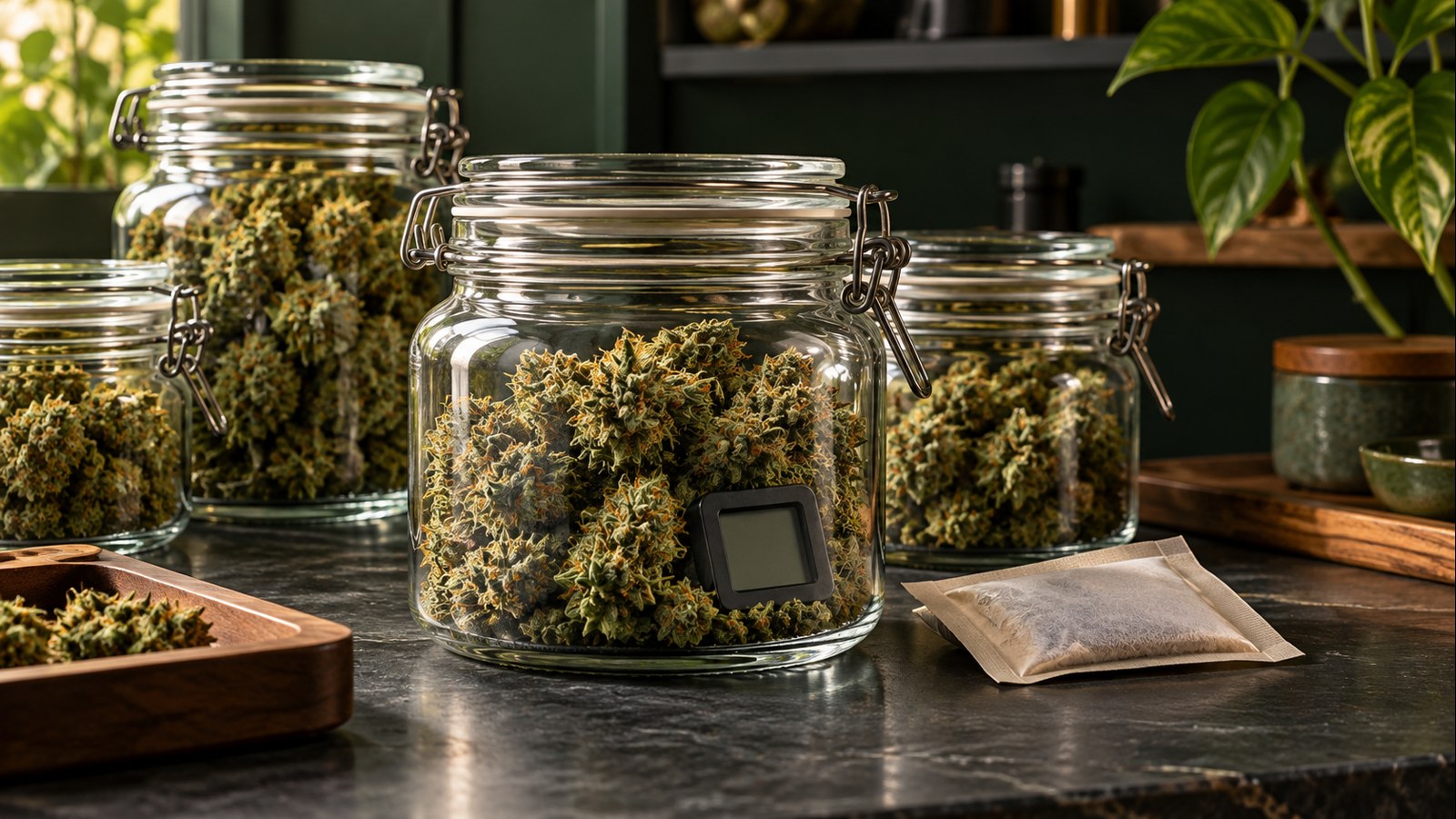
Cannabis Curing Moisture Management: Burping, Humidity Packs, and Rebalancing
A curing jar is a controlled holding environment, not a miniature drying room. Once adequately dried cannabis enters a sealed container, water can continue moving from wetter inner flower tissue toward drier surfaces. The air around the flower responds to that exchange. A humidity reading that rises after sealing is information about the batch, not an instruction to open every jar for an arbitrary number of minutes.
Manage curing moisture by starting with genuinely dry-enough flower, testing representative containers at stable temperatures, watching the trend after resealing, and correcting the material when moisture remains excessive. Brief opening can exchange headspace air and allow inspection. It cannot reliably remove the water retained in wet flowers, eliminate established mold, or replace an appropriate drying process. Humidity-control packs have a different job: maintaining a suitable environment around already-conditioned material.
This resource begins after the drying-to-curing readiness decision. If you still need to decide whether a batch can be sealed at all, use the separate guide to determining when cannabis is dry enough to jar. The task here is what to measure and change once a qualified batch is in its curing container.
Identify the curing moisture decision
The decision is whether the sealed batch remains within an appropriate moisture condition, is still redistributing water but can be monitored, or must leave the jar for controlled drying or a contamination assessment. Do not make the decision from a pleasant aroma, a dry-feeling surface, or a single reading immediately after closing the lid.
Three different moisture questions
Water activity (aw) describes the availability of water in the flower at a specified temperature. Equilibrium relative humidity (ERH) describes the relative humidity of air equilibrated with that sample in an appropriate sealed measurement system. At equilibrium, ERH expressed as a percentage approximately equals aw multiplied by 100. Room RH describes the surrounding room, which may be entirely different from the air in a sealed jar. A jar hygrometer reads headspace RH, not the flower’s water activity directly; it becomes an approximate equilibrium indicator only after suitable equilibration and under adequate measurement conditions.
ASTM D8197-22 specifies a 0.55 to 0.65 aw range for dry cannabis flower storage, balancing resistance to undesirable microbial growth with resistance to physical breakage. Its publicly displayed abstract contains an inconsistent special-case value compared with the detailed standard text available elsewhere; use the stated 0.55 to 0.65 specification, follow a validated current testing protocol, and avoid presenting any single jar reading as certification. The standard concerns storage conditions, not a promise that a contaminated batch is safe.
Moisture redistribution is not moisture removal
Water may move from a wetter flower center to a drier surface and then into the headspace. A closed jar permits redistribution but provides no meaningful ongoing escape route for the total water in a wet harvest. A jar reading that temporarily falls after opening does not show that the wet interior has been corrected.
Safety and quality are separate outcomes
A compliant aw reading can help limit subsequent microbial growth under specified conditions. It does not kill spores, erase an earlier contamination event, or substitute for required microbial testing. Conversely, overdry flower may be less likely to support growth but can break easily and lose desirable texture. The objective is stable moisture with independently acceptable product condition.
Important: Never treat burping as a sanitation step. If mold, internal rot, or a persistent musty odor is suspected, isolate the affected material and follow applicable testing or disposal procedures rather than attempting to cure it away.
Measure representative jars and flower
A jar is a measurement unit only when its contents are reasonably comparable. A large dense top and small airy flowers can equilibrate differently despite spending the same number of days in the drying room. Mixing them obscures the wettest pieces. Divide batches by meaningful differences in cultivar, flower density, harvest date, drying location, trim style, and flower size where those differences could change moisture behavior.
Choose the samples that might fail
Test representative jars from different positions in the processing sequence, but deliberately include the densest or slowest-drying flowers. Inspect a sample from a dense flower interior without turning the whole batch into fragments. Keep the jar ID and flower group linked in your notes. A few conveniently small, dry pieces cannot clear a container filled with larger, wetter pieces.
For larger batches, use a documented sampling plan appropriate to the applicable testing or quality system. No universal home-grower sample count is scientifically established. If one group is suspicious, isolate and evaluate that group instead of averaging its measurements into reassuring batch-wide numbers.
Check sensor placement, calibration, and temperature
A small hygrometer may be useful for observing a trend, but inexpensive sensors can differ substantially. Check them against an appropriate reference or calibrated instrument; do not assume two displays showing different values mean the flowers differ. Put the sensor where it reads the container air without being crushed against wet plant matter or a humidity pack. Keep the jar away from direct sun, a heater, or repeated temperature swings during comparison.
Temperature matters because headspace relative humidity changes with temperature even without a corresponding change in the total mass of water. Write down jar temperature with RH. If a reading changes after moving the jar from a cool room to a warm room, allow the system to settle before interpreting that change as moisture migration.
What a water-activity meter adds
A calibrated aw instrument used according to ASTM D8196 or an appropriate validated laboratory method provides a more direct measurement than a general-purpose jar hygrometer. Follow the instrument’s specified sample preparation, temperature and equilibrium procedure. An accurate sample measurement still applies to the sampled material, not automatically to every flower in a heterogeneous batch.
Compare like with like
Record a consistent temperature, the same jar and sensor, elapsed time after sealing, and the moisture trend for the same flower group.
Trusting a convenient snapshot
Do not declare a mixed harvest safe from one small dry flower, one freshly closed reading, or a single uncalibrated display.
Interpret RH, water activity, and trends
A number becomes actionable when the instrument, equilibrium state, temperature and sampling context are known. The table below describes how to interpret measurements in properly prepared dry flower. Headspace RH values are approximate indicators only when a sealed sample has equilibrated; they are not an interchangeable replacement for laboratory water-activity testing.
| Observation | Likely interpretation | Next action |
|---|---|---|
| Validated flower aw within 0.55 to 0.65 and stable sample behavior | Inside the ASTM D8197-22 dry-flower storage specification, subject to other safety requirements | Continue controlled holding and monitor representative lots. |
| Validated flower aw above 0.65 | Above that specification’s upper storage limit | Hold the lot out of sealed curing and return otherwise sound flower to controlled drying; retest. |
| Validated flower aw below 0.55 | Below the specification’s lower quality limit; brittle handling is a concern | Do not keep ventilating. Consider controlled reconditioning only for sound, qualified product and verify afterward. |
| Jar RH climbs again after a brief opening and resealing | Likely ongoing moisture redistribution, temperature effects or sensor error | Check conditions and representative material; do not repeatedly reset the display and ignore rebound. |
| Visible mold, internal rot, or persistent musty odor at any RH | Possible contamination, regardless of the displayed number | Isolate, do not consume, and seek appropriate testing or disposal. |
The table uses the standard’s numeric bounds only for measured water activity in dry flower. It does not invent an equivalent universal household-hygrometer action threshold, a fixed waiting period for all jars, or a day count at which curing is complete. If using headspace RH as a screening tool, interpret a sustained upward trend as a reason to investigate, not as a prompt to wait indefinitely for the number to fall.
Why the first reading can mislead
A jar may begin near room RH because it was just filled or opened. More water can move into the air after sealing. A sensor may also need time to respond, and a humidity pack can mask the natural drift without proving the center is adequately dry. Repeated readings at comparable conditions matter more than a single favorable number taken just after opening.
What the smell and texture can, and cannot, tell you
Inspect the flower and container for dampness, condensation, discoloration and abnormal odor. These are reasons to investigate. A clean odor does not certify microbial safety, and an earthy cultivar aroma is not automatically mold. If suspicious material is present, do not use a smell test as permission to consume it. Firm but not brittle flower may handle well, yet tactile assessment does not quantify aw.
Burping Jars Based on Moisture Behavior
Burping means briefly opening a container so its headspace exchanges with surrounding air, often while inspecting the batch. It may temporarily lower or raise the jar’s RH depending on the room conditions. It also admits oxygen and releases aromatic volatiles. Burping is therefore a conditional management action, not a mandatory daily ritual or a proven mechanism that creates better flavor.
When opening a jar has a useful purpose
Opening is useful when you need to inspect representative flowers, investigate a questionable odor, check a sensor, or perform a limited headspace exchange for a batch that is otherwise known to be adequately dried. If the room is wetter than the jar, opening can move the headspace in the wrong direction. Measure the room as well as the container and use a controlled working environment.
For an otherwise sound jar showing a small, nonpersistent fluctuation, document the event and observe what happens after resealing. If the same jar repeatedly climbs above its validated acceptance criteria, stop relying on openings and reassess the flower itself. In a wet batch, the headspace contains very little water compared with the plant material; replacing that air again and again is an inefficient substitute for drying.
When to stop burping
Once representative jars remain stable without repeated intervention, have no concerning signs, and meet the applicable moisture and safety criteria, routine opening has little clear moisture-management value. Move toward sealed, cool and dark holding with periodic checks suited to the risk and storage system. There is no well-validated universal prescription of twice per day for week one, every other day for week two, or a fixed number of minutes per opening.
My jar looks fine right after burping, but RH rises again. Should I keep opening it?
Question sent by: Ethan Brooks, via email.
No. First rule out sensor and temperature effects, then check the moisture of representative dense flowers. Continued rebound points to an unresolved condition. If the flower is otherwise sound but too moist, remove it for controlled drying and retest. If spoilage is suspected, isolate it instead.
Why a jar cannot replace the drying room
The drying room has a pathway for water to leave through controlled ventilation or dehumidification while the product remains spread out for relatively uniform exposure. A sealed jar does not. Leaving its lid ajar or burping for longer can overdry exposed surfaces while centers remain wet. If the jar is doing the bulk of the drying, the product entered curing prematurely.
Humidity Packs: Maintenance Tool, Not a Drying Tool
A two-way humidity-control pack is intended to buffer the relative humidity in a suitable sealed volume. Depending on the pack’s design and capacity, it can absorb some moisture or release some to help maintain its nominal setpoint. It cannot make a wet batch safe, sterilize contaminated material, or guarantee uniform conditions inside dense flowers. The pack regulates the container environment within its operating limits; it does not validate the flower.
When a pack makes sense
Use an appropriately sized, intact pack designed for the application after the product has passed its initial drying and storage-readiness checks. Select a setpoint consistent with the quality specification and equipment documentation. The common 58% and 62% labels are nominal RH setpoints, not universal proof that either level is superior for every cultivar’s flavor or texture. Consult the product instructions for loading capacity, compatible containers and replacement indicators.
If a batch is already too dry but remains otherwise sound and qualified, the ASTM specification allows controlled moisture addition, including an appropriate humidity-control device, to bring water activity into its defined range. This is controlled reconditioning, not a way to undo previously lost volatile aroma or repair broken trichomes. Confirm the result by measurement and remain alert for uneven hydration.
When a pack hides the problem
Putting a pack directly into an unqualified wet jar may temporarily produce a reassuring display while wetter internal tissue continues to redistribute water. A saturated or undersized pack can lose control, and it has no antimicrobial kill function. If a jar is too wet by a validated measurement or shows sustained problematic rebound, remove otherwise sound material for controlled drying, not a larger stack of packs.
Tip: Record a baseline without a humidity pack during initial representative readiness assessment when your method permits. After adding a pack, label the reading as a pack-assisted storage condition, not an independent measurement of the flower’s original moisture state.
Does a humidity pack remove the need to burp?
Neither the pack nor a calendar determines that decision. A stable, properly dried batch generally needs less handling, and opening a well-controlled container unnecessarily can add oxygen and humidity swings. A pack does not eliminate inspections or testing for a batch with unusual behavior. Conversely, it does not create a scientific requirement to open every jar daily. Act on the lot’s measured condition.
Can I put a humidity pack in a damp jar and leave it sealed?
Question sent by: Julia Schneider, via contact form.
No. First establish that the material is suitable for sealed holding using representative checks and an appropriate moisture method. A pack has limited buffering capacity and is not a substitute for drying or microbial assessment.
Recognize failure modes and exceptions
Hidden wet cores and unevenly dried batches
Dense flowers, oversized tops and batches dried under uneven airflow may look finished externally while retaining more moisture internally. Mixed trimming styles or drying positions can amplify those differences. A dry surface does not establish a safe interior. Segregate groups, sample the slowest-drying pieces and retest after any correction. A large harvest should be divided into manageable lots rather than treated as one giant jar.
Mold, condensation and abnormal smells
Condensation signals a serious moisture or temperature issue and warrants an immediate hold and inspection. Visible mold or internal rot requires isolation and appropriate disposition. Persistent musty, putrid or ammonia-like odors are warning signs, not proof of any one organism or a diagnosis by smell alone. Do not scrape off a suspicious patch, heat the batch, or mask odor with flavorings and declare it safe.
Do not attempt a mold rescue by re-drying
Returning otherwise sound but excessively moist flower to controlled drying is not the same as salvaging visibly contaminated flower. Moisture correction does not neutralize mycotoxins or remove organisms already present. Isolate suspect lots and follow the relevant testing and disposal requirements.
Overdrying and uncontrolled rehydration
If flower is below the lower aw storage specification, stop ventilation aimed at lowering moisture. Repeated jar opening can worsen brittleness and increase handling loss. A properly sized humidity pack may help bring otherwise acceptable flower toward the specified storage range, but it cannot restore terpene compounds already volatilized or chemically changed. Never add citrus peel, lettuce, wet paper, or sprayed water: these can create localized wet spots and contamination risks.
Temperature changes, sensor errors and false confidence
Temperature swings alter RH readings. A hygrometer adjacent to a pack may read the pack’s local influence rather than a representative air space. If data contradict texture or another sensor, verify equipment and temperature before changing the crop. Water activity is sample- and temperature-specific; readings from a small sampled piece cannot establish the condition of an entire untested container.
What curing research does not prove
A 2025 controlled study on two industrial-hemp cultivars observed changes in moisture during jar or bag curing and found that the measured changes in total cannabinoids and microbial loads were not statistically significant under several comparisons. It did not establish a universal household burping schedule or show that curing kills microbes. A 2024 study of three hemp varieties found that drying and storage choices changed volatile and cannabinoid profiles, but its container comparisons cannot justify a universal promise that any one jar or humidity setpoint maximizes all cannabis aromas.
Those studies are useful warnings against one-size-fits-all claims. The cultivar, original moisture, temperature, container, length of storage and sampling protocol all matter. Claims that curing necessarily creates THC, guarantees chlorophyll breakdown on a fixed schedule, or needs repeated oxygen replenishment are not established by these data.
How to Cure Cannabis in Jars Safely: A Measured Workflow
Begin with a batch that has already met your documented drying endpoint. This workflow is about monitoring, correcting and documenting the early sealed period. It is not a replacement for a validated commercial process or legal testing requirements.
- Confirm the entry decision. Review the representative readiness check. Do not seal questionable or visibly contaminated flowers. Keep lots that dried differently separate.
- Prepare clean, dry, compatible containers. Ensure jars and lids are clean, undamaged and completely dry. Avoid compacting buds; leave enough room to inspect without crushing. Label each lot and record the fill date.
- Establish an initial baseline. Record flower group, representative aw when available, headspace RH, temperature, sensor ID, and whether a humidity pack is present. Distinguish a newly sealed reading from an equilibrated one.
- Observe moisture behavior. Check representative containers after suitable settling and at comparable conditions. Look for rising, stable or falling trends; inspect slower-drying flower groups more carefully. Use your validated process to set monitoring intervals rather than assigning every cultivar an identical clock.
- Investigate exceptions. If measurements or odor are questionable, verify sensor and temperature, then inspect the material. Do not reset the display through repeated opening and call that a successful correction.
- Stop and correct excessive moisture. For otherwise sound flower that exceeds the validated storage endpoint, remove it to an appropriate controlled drying space, separate pieces, complete drying and repeat readiness testing. Isolate suspicious contamination instead of trying to fix it by drying.
- Address excessive dryness cautiously. If otherwise sound material tests below the specified lower storage range, avoid further airing. Consider controlled, approved reconditioning and verify resulting aw. Do not mist flowers or introduce fresh plant materials.
- Move to stable holding. Once representative lots remain within acceptance criteria without persistent rebound or signs of spoilage, minimize routine openings and protect the containers from heat, light and unnecessary handling. Continue risk-based checks and follow applicable testing requirements.
| Observed pattern | Question to answer | Decision |
|---|---|---|
| Stable, qualified lot; no abnormal signs | Is there a genuine reason to open? | Continue sealed holding; inspect according to the monitoring plan. |
| Brief RH rise, then a consistent plateau | Has an adequate representative sample reached equilibrium? | Verify conditions and aw when needed; document rather than reflexively burp. |
| Repeated upward rebound or aw above acceptance limit | Is sound flower still too moist? | Stop sealed curing and finish controlled drying; remeasure. |
| Dry/brittle flower or aw below the specification | Is further air exchange causing harm? | Stop unnecessary opening; consider qualified controlled reconditioning. |
| Suspect mold, rot or abnormal persistent odor | Is this a contamination issue? | Isolate and follow appropriate testing/disposal procedures. |
Field Advice: Use the same labeled jar and a second representative jar for follow-up measurements. A consistent record of what the material does after resealing is more useful than resetting each jar to room humidity and noting only the lower number.
Protect Aroma, Verify Stability, and Build a Repeatable Baseline
A stable cure favors less unnecessary exposure. Repeated opening introduces fresh oxygen and ambient moisture, while warmth and light can alter volatile compounds and cannabinoids over storage. Evidence supports controlling storage conditions rather than promising a particular number of burps will create a richer terpene profile. Do not use the loudest aroma released into the room as your success metric; those volatile molecules have left the container.
Keep the record that explains next harvest’s outcome
Record cultivar or lot, harvest and drying dates, relevant drying conditions, flower-density grouping, trim style, container type and size, fill level, sensor identity, sampled aw if available, temperature, RH measurements, interventions and follow-up outcomes. Write down whether packs were present. An improvement is demonstrated by a comparable, stable trend and acceptable product condition, not by the disappearance of an old smell alone.
Before calling the batch stable
- Its drying-to-curing entry check was documented.
- Representative dense and airy flowers were not pooled blindly.
- Temperature, sensor validity and equilibration were considered.
- Water activity meets the applicable specification when formally assessed.
- No persistent rebound, condensation or suspicious product condition remains unexplained.
- Humidity packs, if used, are identified as maintenance controls.
- Corrective drying was followed by a fresh readiness measurement.
- Stable containers are stored cool and dark with minimal unnecessary opening.
The practical endpoint is a batch that holds an appropriate moisture condition without repeated rescue actions and meets its separate contamination and quality requirements. Burp to investigate a real issue, not to obey a calendar. Use a humidity pack to maintain suitable material, not to make wet material suitable. If readings remain unstable, resolve the flower’s condition outside the jar and verify the result before resuming curing.
Educational content. Follow applicable post-harvest handling, testing, worker-safety and disposal requirements.
Share this article
A quick overview of the topics covered in this article.
- Identify the curing moisture decision
- Measure representative jars and flower
- Interpret RH, water activity, and trends
- Burping Jars Based on Moisture Behavior
- Humidity Packs: Maintenance Tool, Not a Drying Tool
- Recognize failure modes and exceptions
- How to Cure Cannabis in Jars Safely: A Measured Workflow
- Protect Aroma, Verify Stability, and Build a Repeatable Baseline
Follow us
Latest articles
November 9, 2026
November 9, 2026
November 9, 2026
November 9, 2026
