
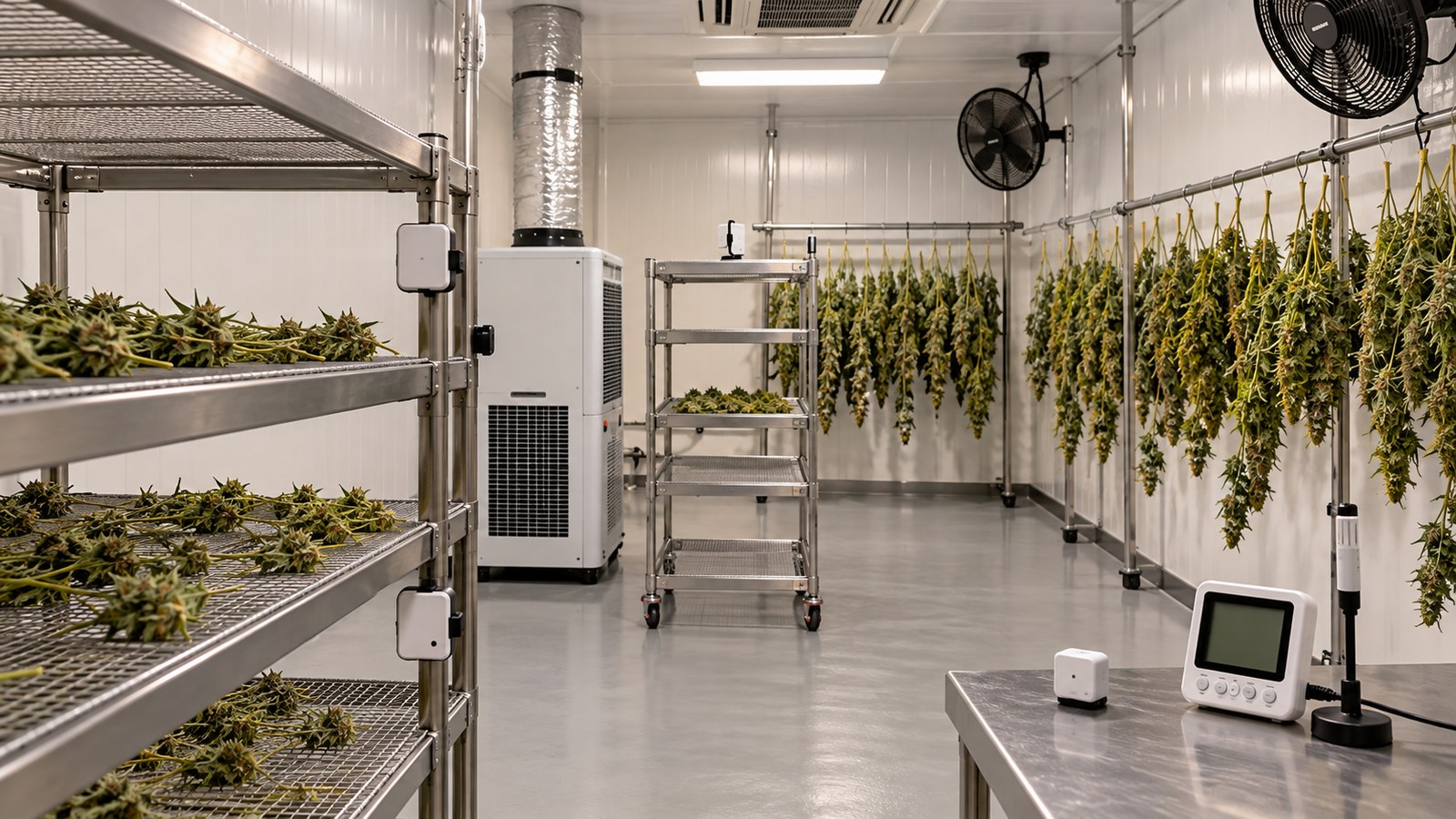
How to Commission a Cannabis Drying Room
A newly fitted drying room may show the desired temperature and relative humidity on its wall display while the first harvest dries unevenly. The display reports conditions at one sensor. It does not reveal whether the room can remove the incoming water load, whether shelves at the back run warmer, whether a door opening causes an extended humidity excursion, or whether dense flowers retain water after their surfaces feel dry. Commissioning closes those gaps before the room is trusted with an entire harvest.
A sound commissioning procedure sets acceptance criteria first, confirms the equipment and instruments are installed correctly, checks how the empty room behaves, maps multiple locations, then challenges the system under a controlled representative load. It ends with a written go, hold, or stop decision, an operator handover, and a plan to repeat the tests when the configuration changes. Room approval and flower release are separate decisions: a well-controlled room does not prove every harvested flower is uncontaminated or ready for airtight storage.
This resource covers room qualification and first-batch acceptance rather than a universal drying recipe, trimming method, a complete harvest schedule, or curing instructions. For environmental rule-of-thumb background, read the 60/60 drying rule explained. For final flower-to-jar checks, use How Dry Should Buds Be Before Jarring?. Processing and possession must comply with local law, product standards, fire and electrical rules, worker protection requirements, and applicable laboratory-testing obligations.
Define Drying-Room Acceptance Before the Harvest Arrives
Commissioning asks whether the installed system meets an explicit, observable requirement. Turning on the air conditioner and dehumidifier is only a start-up check. An acceptance test must also challenge their controls, show that the occupied drying positions behave acceptably, demonstrate a response to ordinary disturbances, and record results that another operator can reproduce. In commercial practice, the engineering logic resembles installation qualification, operational qualification and performance qualification, but a home grower can apply the same sequence without pretending to operate a regulated pharmaceutical facility.
Write an operating envelope rather than copying one magic setting
Before arranging a test, document the intended drying method, expected fresh incoming mass and its likely range, number of branches or trays, layout, environmental target band, alert thresholds, and maximum permitted time outside the band. Record whether those limits come from a facility standard operating procedure, a validated product specification or a provisional operating hypothesis. The acceptance band is a site-specific engineering criterion, not a universally proven cannabis drying optimum. A central readout meeting a popular 60/60 setting does not certify the room.
A review of medical cannabis postharvest practices describes conventional cool, moderate-humidity drying, while actual systems range from hanging stems to rack or industrial tray methods. Those studies report conditions for particular processes; they do not validate one climate and duration for every cultivar, harvest mass or desired quality outcome. When no previous validated range exists, designate an initial proposed operating band and refine it with actual trial records, sample water activity, sensory and laboratory results rather than quietly calling it a standard.
Specify what can fail and who has authority to stop
Set criteria for sensor agreement, space-to-space variation, return to control after loading or an ordinary door cycle, persistent condensation, exposed electrical hazards, and alarm or backup function. Define what requires an immediate stop versus corrective work while a trial remains on hold. For example, visible condensation contacting flowers, a known failure of moisture-removal equipment under a wet load, an unreliable sole control sensor, or suspect mold are not acceptable conditions to overlook for the sake of finishing a test. The trained operator must know who can authorize a restart and what evidence is required.
Commissioning versus validation versus product release
Commissioning documents that a specified room and its equipment meet defined functional requirements. Process validation evaluates whether the chosen drying procedure repeatedly produces acceptable output under defined conditions. Product release requires separate lot-specific checks, including the applicable quality, water-activity and contaminant criteria. One certificate or sensor cannot substitute for all three.
Build a realistic first-load specification
Write the planned lot mass, harvest condition, plant or branch count, wet-trim or dry-trim extent, dense versus airy flowers, maximum loading density and intended hang/tray geometry. Document the date, season and expected incoming air conditions. If the trial uses a modest load of separated thin branches, approval applies to that load and layout only. A later room packed with full plants, damp foliage and dense flowers is a new process challenge, not an automatic extension of the first test.
Important: Equipment nameplate capacity is not demonstrated drying capacity. The tested temperature, humidity, load, spacing and disturbance conditions define the approved operating envelope.
Keep safety prerequisites independent of drying success
An electrician or appropriately qualified professional should verify electrical installation and protection where required. Confirm that fire exits and access routes remain unobstructed and that condensate drains cannot leak onto products, equipment or walkways. Check approved sanitation materials, ventilation or filtration design, worker hygiene, safe ladder or rack access and lawful odor-control arrangements. A drying trend that looks excellent is irrelevant if the installation presents a fire, fall, contamination or other worker-safety hazard.
Map Sensors and Choose Representative Test Locations
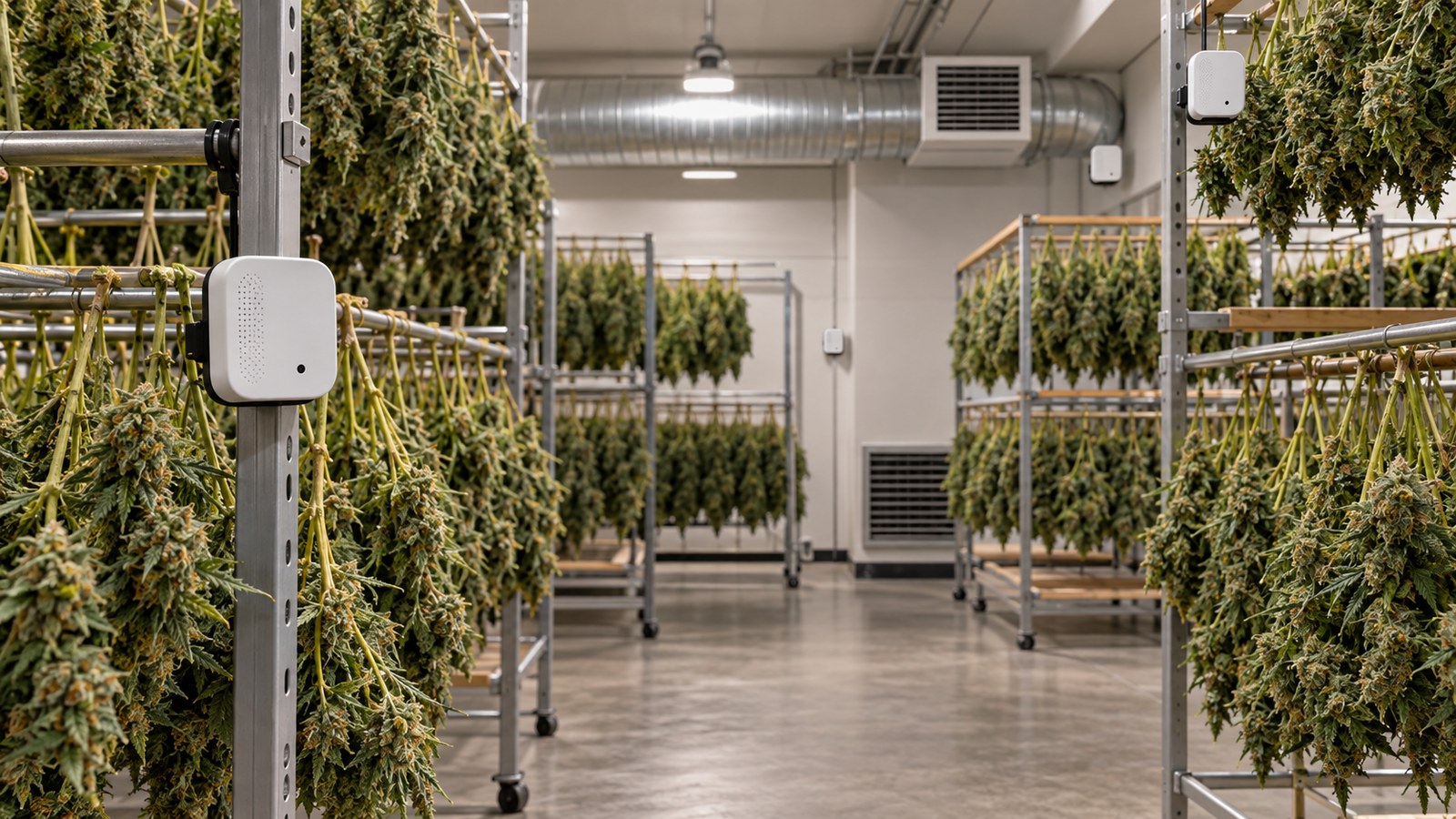
A useful monitoring map captures conditions where the material actually hangs or rests, including places likely to be missed by the main controller. The sampling design must represent both room heterogeneity and flower heterogeneity. Three sensors clustered beside a control panel provide little more evidence than one. A single small flower beside the entrance says little about the large, sheltered colas hanging in the room center.
Check the instruments before believing the readings
List every air-temperature and RH logger by device ID, model, location, measurement range, resolution, logging interval and most recent calibration or documented comparison. Verify the control sensor and an independent reference against a traceable or otherwise appropriate reference using the instrument manufacturer’s method. A side-by-side check at one condition detects discrepancies but does not prove accuracy across the operating range. Humidity calibration may require controlled known-humidity reference conditions, adequate equilibration and temperature control; do not improvise a salt-bag procedure and claim traceable calibration.
Place loggers close together for the comparison, let readings stabilize and log any offsets. Replace or recalibrate a device if its disagreement exceeds the site’s predetermined measurement tolerance. After returning the units to their mapped positions, record each sensor ID on a simple floor plan. Keep a portable reference device available for disputed hot or humid spots. An inaccurate controller can make all downstream trend graphs look precise and still be wrong.
Choose positions that challenge the room
Include representative top, middle and lower product levels where the room is tall; positions near supply air, return air, a corner or rear wall, and the position most affected by the door. Place probes at the flower plane but do not let them touch wet plant material, water droplets, direct supply jets, hot equipment, or sunlit or conductive surfaces. The number of loggers should fit room size and complexity, not an invented universal cannabis sensor count. Use early empty-room trends to add loggers wherever an unexplained gradient appears.
Record access routes and the clearance needed for inspecting the central and back rows. A location that cannot be sampled without crushing flowers or moving several plants does not provide reliable quality control. Check that racks, hangers and trays remain accessible after full loading, when branches shrink, and when condensate containers or cleaning equipment must be serviced.
Build a flower sampling matrix, not a random handful
For the performance run, identify each separate harvest lot and the combinations likely to dry differently: large dense flowers, smaller airy flowers, foliage-heavy hanging sections, center rows, outside edges, high positions and the least ventilated positions. Map those categories before inspecting. Label a few non-destructively monitored reference branches or trays, and reserve separate representative flowers for destructive water-activity or moisture measurements when the process requires them. Do not repeatedly crush the same finished flower while measuring; use a consistent documented sampling method.
| Sampling position | What it can reveal | Evidence to record |
|---|---|---|
| Independent controller comparison | Instrument disagreement or control-loop bias | Reference method, device ID, paired readings and tolerance |
| Door-adjacent flower plane | Infiltration, repeated recovery delay or temperature swings | Temperature and RH time series before/during/after access |
| Rear corner and return-side positions | Weak mixing, local dampness, return-path imbalance | Trends, obstruction notes and visual observations |
| Upper and lower product levels | Stratification, equipment heat or condensate exposure | Level-specific trends and rack map |
| Large dense flowers in sheltered center | Slow internal moisture removal | Lot, geometry, sample date and validated aw or moisture method |
| Small exposed flowers near a supply path | Accelerated surface drying and handling damage | Position, texture notes and a separate aw/moisture sample |
“My controller says the room is stable. Why place more sensors?”
Question sent by: Ethan Brooks, via email.
The controller only represents its own position. A second logger near the densest flower and another at a suspected weak location can reveal gradients and excursions that a central display averages away. Verify sensor accuracy before calling any difference a real room problem.
Decide what may be measured continuously and what must be sampled
Ambient air temperature and RH can be logged continuously. Door events, equipment cycles, alarms, condensate removal and observed flower changes can be time-stamped. Flower water activity is a measurement of a prepared representative sample with an appropriate instrument and procedure, not something a wall hygrometer can infer directly. Actual moisture content requires a separate validated method. A small sealed-container humidity check is a useful screening tool but should not be presented as equivalent to a calibrated water-activity analysis or a laboratory test.
Read Room Trends and Flower Measurements Without Confusing Them
Commissioning becomes meaningful only when the log can be interpreted correctly. Temperature and relative humidity tell you about the air around the flowers. Drying is driven by coupled heat and mass transfer, water movement within the flower and the conditions at its surface. Two rooms with similar average RH can produce different drying patterns because flower size, loading density, airflow distribution and initial water content differ.
Understand the air measurement and the product measurement
RH is the moisture state of the air relative to saturation at its measured temperature. It changes when temperature changes even if the actual amount of water vapor remains unchanged. Water activity, written aw, describes the effective availability of water within the tested material under the relevant measurement conditions. In an equilibrated sealed system, equilibrium headspace RH is related to water activity, but room RH is not the water activity of a flower hanging in that room. Product temperature, equilibration, measurement protocol and sample heterogeneity matter.
ASTM D8196-22 describes measurement of water activity in cannabis flower. ASTM D8197-22 describes a dry-flower storage specification around aw 0.55 to 0.65, with provisions for material outside that band. That is an applicable reference for post-drying storage assessment where consistent with local requirements, not a command to set the drying room to 55-65% RH, and not a certification that the batch is free of mold or toxins. Confirm which edition and standards the actual operation uses, and apply the laboratory’s authorized methods when required.
Three numbers with different meanings
Room RH measures the surrounding air. Flower water activity characterizes water availability in a prepared product sample. Moisture content measures water mass relative to a specified basis. They are related through material-specific sorption behavior but cannot be interchanged without a validated relationship and consistent sampling.
Interpret trends, not a comforting average
Graph each logger across start-up, occupied operation, door events and equipment on-off cycles. Examine maximum and minimum values, how long readings were outside the defined operating envelope, differences between locations, whether excursions coincide with a specific event, and the time taken to return inside the band. An hourly average can hide a long local humidity spike. Keep raw data or adequately frequent records so event timing remains visible. Do not choose a universal logging interval blindly; it must resolve the control cycles and disturbances the commissioning protocol is meant to catch.
Cross-check the dehumidifier’s actual operating status, condensate output or drainage, HVAC temperature control and whether the outdoor air is adding moisture. Condensate volume alone does not provide a defensible moisture balance when ventilation, infiltration and other water pathways are unknown. If room RH is controlled only because an enormous stream of outside air passes through, verify the room remains safe and stable when external weather changes.
Choose a product finish criterion before finishing the run
Define how representative samples will be collected, prepared and analyzed, when each lot can leave drying, and when additional checks are needed for large or sheltered pieces. A physical stem-snap check may show changes in stem flexibility but cannot prove the water activity of the flower interior. Surface brittleness cannot prove the entire batch is dry. A single tested flower cannot safely clear material from every zone when mapped data already show different drying rates.
Where laboratory microbiological testing is required, define sampling and acceptance independently of water activity. Reducing water activity inhibits future growth under suitable conditions; it is not a sterilization or kill step. The research on commercial cannabis shows that fungal loads can change over the drying period and vary with genotype, flower structure, handling and drying method. Therefore a good room trend, a pleasing smell and a passing aw result do not cancel a suspicious visible lesion or a failed contaminant test.
Remember: Room averages establish environmental control. Representative flower tests establish product behavior. Lot-specific safety and release decisions still require their own inspection and, where applicable, laboratory evidence.
Distinguish published examples from transferable requirements
A 2023 industrial tray-drying study reported three runs at 20°C, 50% RH and a specified facility air volume with initial and final moisture measurements. Its models were developed for that exact process and validated on another run. A 2026 outdoor-grown cannabis comparison reported faster drying on trays than hanging under the studied facility conditions. Both support monitoring, consistent loading and predictive process improvement. Neither creates a universally safe six-day dry, a universal fan speed or a room-size-independent formula for all flowers.
Qualify the Room for the Actual Harvest and Drying Format
An empty room contains no evaporating crop and may stabilize easily despite insufficient dehumidification or poor airflow once fully loaded. The performance trial must therefore introduce a representative product load or other appropriately engineered and documented moisture challenge. An improvised humidifier challenge may help test a control response, but it does not reproduce stem geometry, foliage shielding, flower microclimate or internal moisture diffusion. Only a real or defensibly representative loaded run can test those product-level behaviors.
Translate the incoming harvest into an expected water-removal challenge
Record incoming fresh mass and, if available, a representative measured initial moisture content on an explicitly stated wet-mass basis. Estimate the water that must leave to reach the chosen final moisture content using a mass balance rather than equating fresh weight loss with pure water in every handling configuration. Stems and leaves retained during drying change the measured gross mass and the water load; material removed by trimming must not be counted as water evaporated. The equipment supplier or qualified designer should evaluate latent moisture-removal capacity for the expected room temperature, humidity and climate, with a margin appropriate to uncertainty.
Consider peak evaporation early in the run, when the plant contains substantial water, as well as reduced evaporation later when internal migration becomes limiting. The 2023 fungal study observed an early increase in total yeast and mold during hang drying before levels declined with further drying. That observation makes early-load monitoring relevant, but does not establish a universal 72-hour unsafe interval. Loading design must accommodate both peak moisture release and later unevenness.
Test the arrangement that will actually be used
Use the planned number of racks or hangers, aisle widths, branch lengths, leaf-retention policy and product spacing. Record the initial gap between neighboring flowers and whether branches contact walls, ducting, surfaces or one another as they settle. If the operator plans to hang whole plants and later switch to separated branches, commission both configurations or explicitly restrict approval to the tested one. The whole-plant versus branch drying comparison covers the harvest-method tradeoff; the acceptance test here checks whether the chosen format behaves reliably in this particular room.
Check how air reaches the center, exits the room and circulates around product without blowing strongly onto exposed flowers. Airflow should prevent neglected stagnant locations without creating jets that desiccate the first row. A rack layout can obstruct supply and return paths after loading even when the empty room passes. A fan specification is not a substitute for checking the arrangement under load, and a smoke or tracer test in an empty room cannot certify the flower microclimate after hanging.
Separate diagnostic pilot batches from production lots
For a new system without prior data, begin with a manageable trial load and explicitly mark the result as provisional if it is below the intended maximum capacity. Retain lot identity. Collect relevant reference flowers across positions and densities, and compare their drying curves. Only extend the approved load after a higher-load trial passes predefined room and product criteria. Do not force wet or questionable harvest material into an otherwise clean qualification run merely to make a capacity number look attractive.
“The room passed empty, then RH climbed as soon as I hung the harvest. Did commissioning fail?”
Question sent by: Julia Schneider, via contact form.
The empty-room test passed only its own scope. A sustained loaded excursion means the moisture challenge, air distribution or control response has not passed performance qualification. Check the measurement, actual removal capacity, infiltration and arrangement; correct the cause and repeat a representative loaded test before expanding production.
Treat outdoor conditions and source material as inputs to the test
A wet-weather harvest can enter with more surface water, more leaves, less predictable starting moisture and greater contamination concerns than a carefully staged dry-weather harvest. Record those differences and do not mix sound material with suspect flowers to average out the risk. If outside air is used for ventilation, test the system during relevant humid and warm conditions or mark seasonal performance as not yet qualified. The same installed dehumidifier may behave differently at a changed room temperature; verify actual capacity under the intended range, not the marketing number alone.
Find Failure Modes Before They Damage a Lot
A commissioning trial must deliberately look for bad outcomes, not just wait until everything appears normal. Most failures come from mismatched sensor readings, a control sequence that fights itself, moisture-removal shortfall, localized stagnant air, direct supply jets, inaccessible product, loss of lot identity or weak operator response. A high-quality outcome also requires that flowers arrive sound; drying cannot rehabilitate contaminated harvest material.
High RH in one corner is different from high RH everywhere
If nearly every logger rises together during early drying, investigate peak evaporative load, equipment status, outdoor air and condensate management. If only the rear corner runs high, verify that logger and inspect the rack arrangement, airflow obstruction and local product density before buying a larger dehumidifier. If a reading spikes exactly when the door opens then recovers promptly, that may be a manageable disturbance within the agreed acceptance criteria. An unexplained persistent local excursion requires correction even when the room average looks acceptable.
Fast surface drying can coexist with a damp center
When a fan blows directly onto the first row, exposed flower surfaces may become papery while sheltered colas continue to release water. Drying is not improved simply because every surface gets a higher local air speed. Relocate or diffuse the jet, increase separation where needed and retest the representative wettest and driest positions. Do not solve a hot dry zone by making the entire room excessively humid if another zone is already moisture-limited. Strong unevenness is a layout or control problem to diagnose, not a signal to pursue a universal slower schedule.
Condensation and equipment faults override pleasant-looking set points
Condensate leakage, wet insulation, pooling water, blocked drains, condensation at a cold surface or an inaccessible wet floor can create contamination and electrical or slip hazards. Trace the water source and isolate affected product. Verify equipment cycles and alarm behavior rather than assuming the controller’s status icon proves that a compressor or dehumidifier is actually removing moisture. If defrost, condensate-pump failure or an external power outage interrupts operation, document how long the room remained outside criteria and whether the product requires hold and investigation.
| Observed failure | First distinction to check | Commissioning response |
|---|---|---|
| All zones become humid after loading | Real peak water load versus biased controller or failed removal | Verify sensors/equipment; compare planned load with actual capacity; repeat loaded trial |
| Back corner stays damp | Localized obstruction versus defective logger | Swap in a verified reference; map return path and product clearance |
| Front-row flowers turn brittle early | Supply jet or excess exposure versus naturally small flowers | Compare like-size samples; alter distribution and reassess |
| Room sensor is stable; samples vary sharply | Product density, starting moisture or unmeasured microclimate | Segment lots, revise sampling map and test at representative positions |
| Door events produce long RH excursions | Infiltration, slow control recovery or excessive traffic | Check door seals/operating procedure, time and retest events |
| Visible mold or suspicious odor | Product contamination, not merely environmental drift | Isolate affected material; stop release and follow inspection/lab/disposal policy |
| Condensate appears on racks or wiring | Drainage/leak/thermal-bridge or electrical hazard | Stop affected operation; repair and retest before product exposure |
Mold is a product hold, not a drying adjustment
If a flower shows suspect fuzzy growth, spreading internal decay or other evidence of contamination, segregate it without agitation and follow applicable laboratory, rejection and disposal procedures. Lowering RH, trimming, sealing, curing or adding more fan speed does not make moldy flower safe. Water-activity compliance cannot reverse a pre-existing contamination event.
Watch for equipment interactions and false precision
A humidifier can fight a dehumidifier, and cooling may change the room RH simply by lowering temperature. Controls can hunt across set points, generating repeated peaks and troughs. A controller reading with decimal places is not necessarily accurate to that decimal. Verify the intended sequence of operations and hysteresis or deadband with a qualified controls technician when needed; record whether equipment responds in the correct order and shuts down safely. Do not disable protective interlocks for the sake of keeping a graph perfectly flat.
Distinguish an inspection failure from a drying failure
An otherwise adequate room can fail because the back row cannot be examined without moving the entire load, the same sample location cannot be identified again, or waste containers obstruct a required exit. Commission access, labeling, maintenance clearance and product flow as part of the process. A blind corner can conceal early damage until the batch is already compromised. If the layout must be substantially changed to obtain access, repeat the environmental map after changing it.
Run the Commissioning Protocol and Decide Go, Hold, or Stop
Use a written procedure with prerequisites, expected response, measured result, responsible person and sign-off for every stage. A one-page checklist is useful for simple rooms, but do not omit time-series data or exception records where they determine whether the system recovered. The sequence below can be scaled to a small home room or a larger licensed facility; the acceptance criteria, staffing and formal qualification requirements differ by jurisdiction and operation.
Step 1: approve the room and product specification
Enter the room identifier, equipment inventory, supply/return positions, electrical and condensate checks, maximum proposed load, drying geometry, environmental target band, excursion rules, inspection access, cleaning status, measurement methods and product release specification. Note the basis for every numerical limit. Mark any provisional criterion as provisional. No product should enter a room that has unresolved safety or sanitation prerequisites.
Step 2: complete installation qualification
Confirm installation against the intended design: power and protection, mechanical supports, condensate routing, intake/exhaust configuration, filter access, door sealing, cleanable surfaces, sensor mounting, logger storage and alarms. Check equipment manuals and identify who services each component. Capture photographs or a layout sketch, asset IDs and maintenance requirements. A unit that turns on but drains into an occupied rack has not passed installation qualification.
Step 3: check sensors and prove empty-room control
Perform and record the instrument comparisons first. Then operate the empty room long enough to observe representative equipment cycles and reach a credible steady operating pattern. Log all mapped temperatures and RH values while checking the controls against their set points. Test the alarm or alert pathway, and confirm that a failed probe does not quietly produce a green status. Do not impose a universal 24-hour pass rule without basis; use a test period sufficient to observe the relevant cycles and documented conditions.
Step 4: challenge an ordinary disturbance
Simulate the routine door-open pattern that actually occurs during inspections and record the environmental excursion and time to recover. Where safe and authorized, verify notification of equipment failure or loss of power and confirm restart behavior. Do not deliberately interrupt safety-critical ventilation or create a dangerous electrical test. If weather extremes are not present, defer those tests explicitly and limit the approval envelope until they are witnessed or otherwise appropriately demonstrated.
Step 5: run the defined representative load
Inspect and label incoming material before loading. Enter the actual incoming mass, flower classes, layout and start time. Log conditions continuously at mapped positions and record equipment behavior, condensate/drainage status and significant operator events. Sample sound flowers using the predetermined locations and validated procedure. Compare drying progress among dense, airy, exposed and sheltered positions instead of recording only a batch-average moisture result. If one area consistently lags or dries too fast, correct configuration and repeat an appropriate challenge.
Step 6: investigate deviations and repeat the failed test
For each deviation, record whether it is a genuine environmental excursion, suspect instrument, product-specific problem, load mismatch or safety failure. Change a clearly identified cause, such as a blocked return, sensor position, spacing, control setting or equipment fault. Document the change and rerun the test it affects. A system that passes only after silently redefining the target has not demonstrated compliance with its original requirements; update the specification transparently and seek approval where required.
| Decision | Conditions at the end of testing | Next action |
|---|---|---|
| GO: qualified for the tested envelope | Safety prerequisites cleared; calibrated/checked instruments; mapped conditions, disturbances and loaded run meet approved criteria; records complete | Sign off load, format, climate envelope and monitoring plan; keep product release separate |
| HOLD: limited or unresolved evidence | Under-capacity pilot passed but max load untested; disputed sensor; seasonal limit unverified; localized deviation under investigation | Restrict use or hold new product; correct evidence gap and retest affected case |
| STOP: unacceptable system or product condition | Safety hazard, major uncontrolled excursion, condensation contacting product, critical failed equipment or suspected contaminated flower | Suspend affected use, segregate material if applicable, repair/investigate and require documented approval before restart |
“If every graph looks good, can I jar the whole harvest on the same day?”
Question sent by: Mason Carter, via Facebook page.
No. The graphs qualify room behavior, not every flower. Sample distinct lots and the wettest plausible product positions using the agreed water-activity or moisture procedure; isolate suspect material and meet any required laboratory criteria before releasing each lot.
Step 7: close the deviations and sign over responsibility
The handover should state what was tested, what passed, what failed, what was corrected, which tests were repeated and which conditions remain outside the approved envelope. Assign operators responsibility for trend review, representative sampling, alarm response, equipment care, lot holds and deciding when a new load pattern triggers requalification. A signature without an issues log and an accessible procedure is a weak handover.
Field Advice: Write each acceptance criterion before testing. Otherwise the same data can be retroactively described as a success even when the room did not behave as expected.
Document the Baseline and Hand Over a Quality-First Room
A commissioning file should allow another trained person to recreate the qualified configuration without guessing where a logger was placed or what “full load” meant. Keep the approved operating envelope, instrument IDs, room map, rack configuration, lot and sampling plan, raw trends, deviations, corrective actions, repeated tests, environmental and safety inspections, operator training and sign-off together. For regulated operations, integrate these records with the applicable approved quality management system rather than treating this resource as a replacement for legal requirements.
Record the practical baseline, not just a passing badge
Document the typical first-load moisture challenge, environmental range and excursion behavior, wettest and driest sampled positions, product variability, maintenance events and observed drying progress. Include an explicit date, cultivar or lot type, harvest condition and trim/hang format. If a later batch shows a different curve, the baseline helps diagnose whether the cause is the room, the load or the material. Do not establish quality by smell alone; smell can flag concern but does not identify microbial hazards or measure aw.
Keep flavor protection inside the qualified system
Protect flower from unnecessary heat, direct illumination, rough handling and aggressive direct air jets while maintaining adequate moisture removal. Research reviews note that postharvest choices affect cannabinoid and terpene outcomes, but controlled methods and genotypes differ. Commissioning should minimize uncontrolled exposure and characterize outcomes, not claim that a special climate automatically produces superior flavor. Compare representative finished lots only after accounting for incoming condition, cultivar and trim format; if chemical or sensory tests are used, record their methods and limitations.
Decide when to recommission or requalify
Repeat the affected tests after equipment replacement, relocation of a critical sensor, controls changes, major rack rearrangement, new loading density, change from branches to whole plants, altered ventilation or an unexplained performance deviation. Seasonal extremes may require deferred tests. A minor adjustment that does not affect function may need documented review rather than a complete qualification, but the basis for that choice should be recorded. Regular monitoring and calibration checks keep a past sign-off relevant; they do not eliminate the need to assess meaningful changes.
For the narrower question of whether an individual flower is ready to leave drying, continue with the dry-flower readiness guide. For method-dependent drying speed and flower protection, compare whole-plant and branch drying. The broader curing and drying resource collection provides context without changing the commissioning acceptance criteria established here.
Drying-room commissioning handover checklist
- Write the tested load, harvest condition, format, room operating envelope and approval authority.
- Verify electrical, drainage, hygiene, access and worker-safety prerequisites.
- Check control and independent sensors; record device IDs, comparison results and map positions.
- Pass empty-room control, mapped-zone uniformity, alarm and normal disturbance tests.
- Pass a representative loaded run with labeled lots and flower samples from wettest and driest credible positions.
- Verify product endpoints separately using the approved water-activity/moisture procedure and required contaminant criteria.
- Close deviations, repeat failed tests and restrict use to the proven operating envelope.
- Archive trends and sign-off; train operators and list changes that trigger retesting.
Educational content. Always follow applicable cultivation laws and safety requirements.
Share this article
A quick overview of the topics covered in this article.
Follow us
Latest articles
October 11, 2026
October 11, 2026
October 11, 2026
October 11, 2026