LED Grow Room Heat: Why Efficient Lights Still Produce Heat
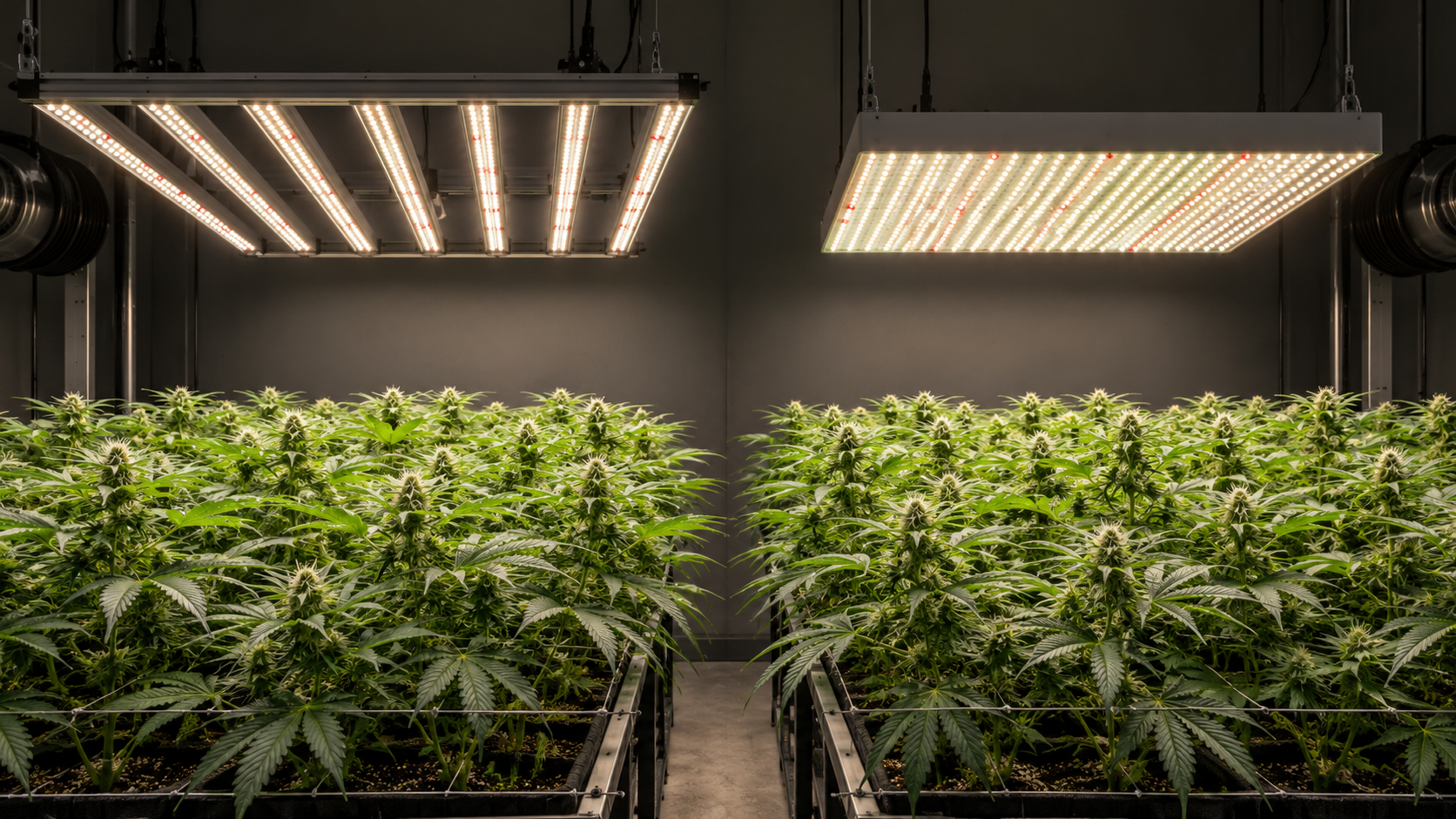
One of the most persistent misconceptions in modern indoor horticulture is the myth that solid-state light-emitting diodes produce no heat. Early LED marketing campaigns frequently advertised fixtures as cold light sources that could eliminate grow room air conditioning entirely. In commercial reality, horticultural luminaires are governed by the unyielding laws of thermodynamics. While high-efficiency LED arrays consume fewer total watts than legacy High-Pressure Sodium fixtures for equivalent photon output, every single watt of electrical power delivered to an LED grow room is eventually converted into thermal heat that your climate control infrastructure must extract.
- Direct Answer: The Thermodynamics of LED Efficiency and Thermal Dissipation
- Heat Dissipation Mechanisms: Convective Heat in LEDs vs Radiant Infrared in HPS
- Room Layout and Space Constraints: Electrical Capacity, Airflow, and Exhaust Paths
- Sizing Major Cooling Equipment: Measured Load vs Marketing Claims
- Safety Standards: Protected Circuits, Cable Routing, and Fire Risk Mitigation
- Empty-Room Commissioning and Emergency Failure Planning
- Maintenance/Reset Checklist and Companion Weedth Resources
Direct Answer: The Thermodynamics of LED Efficiency and Thermal Dissipation
The definitive scientific answer to why efficient grow lights still produce heat is dictated by the First Law of Thermodynamics: energy cannot be created or destroyed; it can only change form. When an electrical circuit delivers 1,000 watts of electrical power into an indoor grow room, exactly 1,000 watts of energy must exist inside that room, divided strictly between optical radiation (photons) and thermal dissipation (heat).
In top-tier horticultural LED luminaires utilizing high-bin Samsung, Osram, or Lumileds chips, photosynthetic efficacy ranges between 2.7 and 3.1 μmol/J. At this state-of-the-art efficiency, approximately 45% to 50% of input electrical energy is converted into photosynthetically active photons (400 to 700 nm). The remaining 50% to 55% of electrical power is converted immediately into sensible thermal heat via electrical resistance inside the semiconductor diode junctions and electronic switching losses in the LED driver.
To comprehend where this heat originates at the microscopic scale, physicists analyze the Wall-Plug Efficiency (WPE) of the semiconductor die: $$WPE = \frac{P_{optical}}{P_{electrical}} = \eta_{inj} \times \eta_{int} \times \eta_{extraction}$$ Where $\eta_{inj}$ represents electrical carrier injection efficiency, $\eta_{int}$ is internal quantum efficiency (IQE), and $\eta_{extraction}$ is optical photon extraction efficiency. Inside the indium gallium nitride (InGaN) quantum wells, not every electron-hole recombination yields a photon. Three non-radiative recombination mechanisms convert incoming electrical current directly into heat: Shockley-Read-Hall (SRH) recombination occurring at crystal lattice defects, ohmic resistance within the p-doped and n-doped semiconductor layers, and Auger recombination. Auger recombination becomes dominant at high current drive levels (such as operating diodes at 700 mA to 1050 mA), creating the well-documented phenomenon of efficiency droop where excess current generates proportionally more heat than light.
A secondary source of internal thermal generation is the Stokes shift occurring within the phosphor coating. Horticultural broad-spectrum white LEDs do not emit white light natively; they utilize monochromatic royal blue semiconductor dies (peaking at 450 nm) coated with a phosphor slurry, typically cerium-doped yttrium aluminum garnet (YAG:Ce). When high-energy blue photons strike phosphor particles, electrons are excited and re-emitted at lower energy, longer wavelengths (green, yellow, and red). The quantum energy difference between the absorbed blue photon and the emitted longer-wavelength photon ($$\Delta E = h\nu_{blue} – h\nu_{phosphor}$$) cannot vanish; it is dissipated directly into the silicone phosphor matrix as microscopic atomic lattice vibrations (phonons), generating pure thermal heat right on the surface of the primary optical lens.
What happens to the 45% to 50% of energy that leaves the fixture as visible photons? When photons strike plant fan leaves, reflective white walls, concrete floors, or plastic drainage tables, they do not vanish into a vacuum. Plant foliage utilizes only 2% to 4% of absorbed light energy to synthesize chemical bonds via photosynthesis. The remaining 96% to 98% of absorbed photons is converted into sensible heat or drives the latent evaporation of water via transpiration. In a sealed indoor facility, transpired water vapor must be condensed back into liquid by a dehumidifier: a mechanical process that releases the latent heat back into the room as sensible heat.
Therefore, over a steady-state photoperiod, 100% of the electrical wattage drawn by an LED luminaire eventually becomes thermal heat inside the facility. A 680-watt LED fixture generates exactly 2,320 British Thermal Units (BTU) of heat per hour, calculated by the fundamental thermal conversion factor: $$1\text{ Watt} = 3.412142\text{ BTU/hr}$$
Diode Junction Temperature ($T_j$), Thermal Resistance, and Sensible Heat
Diode Junction Temperature ($T_j$) is the operating temperature of the active microscopic p-n semiconductor crystal within an LED chip. Thermal Resistance ($R_{th}$) measures the opposition to heat flow from the diode junction through the ceramic substrate to the aluminum heatsink. Sensible Heat is the thermal energy that directly increases the temperature of room air, measured in British Thermal Units per hour (BTU/hr) or kilowatts (kW).
The critical distinction between LED and legacy High-Pressure Sodium (HPS) luminaires is not that LEDs produce no heat, but that LEDs produce less total heat per micromole of light and distribute that heat through a completely different physical mechanism.
Inviolable Thermodynamic Principle: Efficiency does not mean zero heat; efficiency means more photons per watt. In a closed room, all electrical energy degrades to thermal energy. An 800W LED and an 800W electric space heater produce the exact same 2,730 BTU/hr of heat.
Heat Dissipation Mechanisms: Convective Heat in LEDs vs Radiant Infrared in HPS
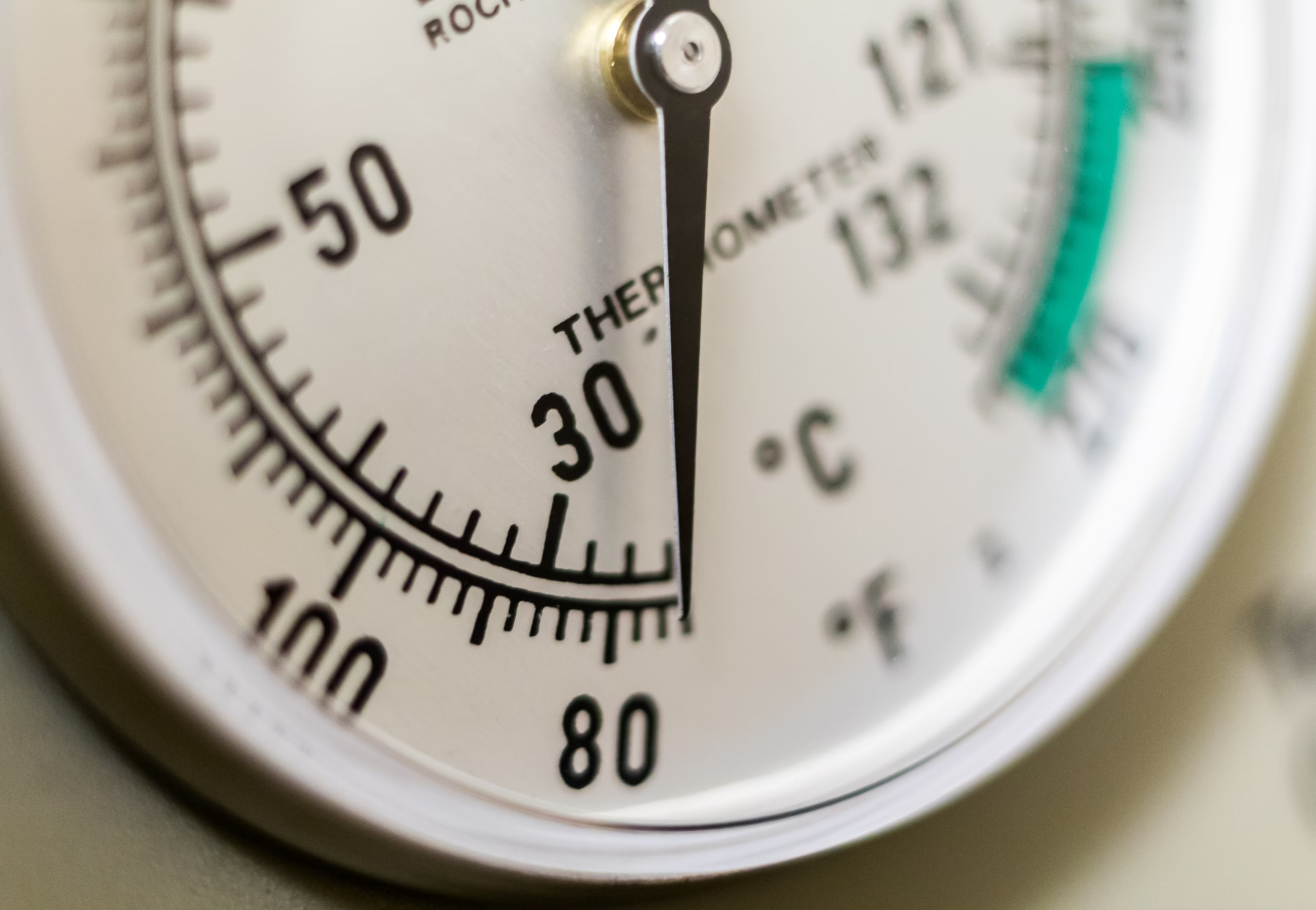
Cultivators often perceive that LEDs run cool because they can place their hand directly beneath an operating LED bar without feeling the scorching radiant burn characteristic of a 1,000-watt double-ended HPS lamp. Understanding this sensation requires distinguishing between radiant infrared heat transfer and convective air heating.
The HPS Mechanism: Forward Radiant Infrared Energy
High-Pressure Sodium arc tubes operate at white-hot internal temperatures exceeding 1,200°C. While roughly 34% of electricity becomes visible PAR light, approximately 50% is emitted as long-wave and mid-wave radiant infrared (IR) radiation. This radiant thermal energy projects directly downward from the optical reflector into the plant canopy. Radiant IR travels through the air without heating air molecules directly; it heats the leaf tissue upon contact, forcing leaf surface temperatures (LST) 3°F to 6°F hotter than room air.
The LED Mechanism: Backward Convective Air Heating
Solid-state LEDs generate zero forward-facing radiant infrared energy. Photons leaving the diode are cold visible photons. However, the electrical resistance of the semiconductor junction produces intense localized heat on the back of the diode chip. This thermal energy is conducted backward through a thermal interface material (TIM) into thick extruded aluminum heatsink bars.
The physical conduction of heat away from the microscopic semiconductor junction obeys Fourier’s Law of thermal conduction: $$q_{cond} = -k A \frac{dT}{dx}$$ where $k$ is thermal conductivity, $A$ is surface cross-sectional area, and $\frac{dT}{dx}$ is the thermal gradient. In high-performance fixtures, diodes are soldered directly onto metal-core printed circuit boards (MCPCB) containing a solid copper or aluminum backing layer with high thermal conductivity ($k \approx 200\text{ to } 385\text{ W/m}\cdot\text{K}$). High-grade phase-change thermal interface materials (TIM) eliminate microscopic air pockets between the board and the extruded aluminum chassis, transferring heat rapidly into external radiating fins.
Once thermal energy reaches the exterior aluminum fins, dissipation into room air occurs via natural convection governed by the dimensionless Rayleigh ($Ra$) and Nusselt ($Nu$) numbers: $$Nu = \frac{h L}{k_{air}} = C (Ra)^n$$ Warm air in direct contact with aluminum fin surfaces decreases in density, creating natural buoyant upward convective plumes. As warm air rises toward the ceiling, cooler room air is drawn upward through the gaps between LED bars, creating a continuous convective chimney effect across the luminaire. Consequently, while the plant canopy below experiences zero radiant heat, the air above the fixtures warms rapidly. In an unventilated or poorly mixed room, this convective heat forms an intense thermal layer trapped between the fixtures and the ceiling.
Room Layout and Space Constraints: Electrical Capacity, Airflow, and Exhaust Paths
Designing an indoor grow space to accommodate LED thermal dynamics requires strategic equipment layout, adequate vertical ceiling height, and intentional airflow routing.
Ceiling Clearances and Destratification Airflow
Because multi-bar LED fixtures dissipate heat upward via convection, mounting fixtures tight against a flat ceiling or drywall surface restricts natural convective airflow. Trapped heat accumulates around heatsinks, driving diode junction temperatures above 85°C (185°F). High junction temperatures trigger accelerated lumen depreciation, shift optical color spectra, and can cause premature driver failure. Always maintain at least 12 to 18 inches (30 to 45 cm) of clear open air space between the top of your LED fixture and the ceiling.
Furthermore, deploy horizontal destratification circulation fans positioned near the ceiling to break up the buoyant hot air layer. These fans should gently blend warm ceiling air back into the lower room envelope or sweep it directly into HVAC return air plenums.
Remote Driver Placement: Removing Heat at the Source
An LED driver (the external power supply converting 120V/240V/277V AC line power into low-voltage DC current) accounts for 12% to 18% of the total thermal output of a luminaire. For a 680W fixture, the driver alone generates roughly 350 to 420 BTU/hr of pure sensible heat.
In commercial facilities, mounting drivers remotely on aluminum racking outside the grow room: such as in a dedicated electrical hallway or central equipment corridor: physically removes hundreds of thousands of BTUs from the cultivation envelope. This reduces required in-room air conditioning capacity, simplifies electrical maintenance, and extends the operational lifespan of the electronics.
Computational Airflow Engineering: Linear Diffusers vs Microclimates
In precision indoor agriculture, managing convective heat requires designing deliberate airflow vector fields. When HVAC supply air is discharged straight down onto plants through round sheet metal diffusers, high-velocity chilled air pierces the convective plume, forcing hot stagnant ceiling air downward into upper colas. This creates localized microclimates where one bench sits at 74°F while an adjacent bench bakes at 86°F. Commercial facilities utilize porous fabric duct sox or continuous linear slot diffusers mounted along room perimeters. These diffusers throw conditioned air horizontally across the ceiling envelope at 400 to 600 feet per minute (FPM), scrubbing heat directly off aluminum heatsinks and blending it into a uniform mixed airstream before it descends gently through the plant canopy at the optimal 0.4 to 0.7 m/s velocity.
| Fixture Electrical Draw (Watts) | Total Heat Output (BTU/hr) | Driver Heat Share (~15%) | In-Room Heat with Remote Drivers | Cooling Tonnage per 10 Fixtures |
|---|---|---|---|---|
| 320W LED Fixture | 1,092 BTU/hr | 164 BTU/hr | 928 BTU/hr | 0.91 Tons AC |
| 680W LED Multi-Bar | 2,320 BTU/hr | 348 BTU/hr | 1,972 BTU/hr | 1.93 Tons AC |
| 800W High-Output LED | 2,730 BTU/hr | 410 BTU/hr | 2,320 BTU/hr | 2.28 Tons AC |
| 1,000W Industrial Array | 3,412 BTU/hr | 512 BTU/hr | 2,900 BTU/hr | 2.84 Tons AC |
Sizing Major Cooling Equipment: Measured Load vs Marketing Claims
Sizing commercial HVAC equipment based on outdated rules of thumb (such as “one ton of cooling per four lights”) leads directly to climate failure under modern LED fixtures. Commercial air conditioning must be sized by calculating the total sum of all internal sensible heat loads.
The Complete Sensible Heat Formula
To determine required cooling capacity, calculate every heat source operating inside the room during peak photoperiod hours:
$$\text{Total Heat Load (BTU/hr)} = Q_{\text{lights}} + Q_{\text{dehum}} + Q_{\text{fans}} + Q_{\text{envelope}}$$
- $Q_{\text{lights}}$: Total connected lighting wattage multiplied by 3.412. For twenty 680W fixtures, $20 \times 680 \times 3.412 = 46,403\text{ BTU/hr}$.
- $Q_{\text{dehum}}$: Commercial dehumidifiers reject sensible heat into the room while extracting moisture. Each pint of water removed adds roughly 1,100 to 1,300 BTU of heat from the compressor and condensing coil. A unit removing 200 pints per day adds approximately $200 \times 1,200 / 24 = 10,000\text{ BTU/hr}$ of sensible heat.
- $Q_{\text{fans}}$: Every internal oscillating fan and inline duct blower consumes electricity that ends up as heat. Ten 50-watt oscillating fans add $500 \times 3.412 = 1,706\text{ BTU/hr}$.
- $Q_{\text{envelope}}$: Conductive heat gain through exterior walls and roof insulation during hot summer months, calculated via building surface area and R-values.
Psychrometric Analysis: Sensible Heat Ratio (SHR) Under LEDs
A critical engineering parameter that distinguishes LED facilities from HPS facilities is the Sensible Heat Ratio ($SHR$): $$SHR = \frac{Q_{sensible}}{Q_{sensible} + Q_{latent}}$$ Under HPS lamps, massive radiant thermal output creates a high Sensible Heat Ratio ($SHR \approx 0.75\text{ to } 0.85$). Standard commercial air conditioning coils are optimized for this high-sensible regime, running continuously to cool air while easily pulling moisture as a secondary byproduct.
Under LED arrays, sensible heat is roughly 35% lower per micromole of light, while vigorous plant transpiration injects massive quantities of latent water vapor into the air. The room Sensible Heat Ratio drops to 0.50 to 0.60. If a grower deploys standard residential or commercial cooling equipment without independent reheat capability, the room air temperature reaches the thermostat setpoint quickly. The AC compressor cycles off, leaving latent humidity unmanaged and causing relative humidity to spike to 85% within minutes. To conquer this thermodynamic shift, commercial LED facilities must install dedicated HVAC systems equipped with modulated hot-gas reheat or decouple sensible cooling (via chilled water air handlers) from latent dehumidification (via stand-alone commercial dehumidifier arrays).
Summing these sensible loads and dividing by 12,000 (the BTU equivalent of one ton of refrigeration) provides the exact cooling tonnage required. Applying a 15% safety buffer prevents air conditioner compressors from running continuously at 100% capacity during extreme outdoor heat waves.
Safety Standards: Protected Circuits, Cable Routing, and Fire Risk Mitigation
Operating high-wattage lighting arrays in warm, humid cultivation rooms introduces serious electrical and thermal safety hazards. Conforming to National Electrical Code (NEC) standards preserves facility safety and prevents catastrophic electrical fires.
The 80% Continuous Load Rule (NEC Article 210.20)
Because grow room luminaires operate continuously for 12 to 18 hours per day, the electrical circuit is classified as a continuous load. Under NEC standards, a continuous load must not exceed 80% of the breaker and branch circuit rating. For example, a standard 20-amp 240V circuit (rated for 4,800 watts) must not be loaded beyond 16 amps or 3,840 watts. Powering six 680W fixtures (4,080 watts) on a 20A circuit violates code, causing continuous thermal stress on circuit breakers and creating severe fire risk.
IP Ratings and Cable Routing in Humid Envelopes
All luminaires, power connectors, and sensor boxes installed inside the active canopy envelope should carry a minimum ingress protection rating of IP65 or IP66 (dust-tight and protected against water jets). Route high-voltage power cables along dedicated overhead wire trays suspended above water lines. Never allow cables to lie on concrete floors where irrigation runoff or condensation can contact electrical junctions.
High-Frequency Capacitive Leakage and GFCI Protection
In commercial LED retrofits, cultivators frequently experience mysterious tripping of Ground Fault Circuit Interrupters (GFCI). This nuisance tripping is rarely caused by a physical short to ground; rather, it results from high-frequency capacitive leakage currents. Modern switch-mode power supplies utilize pulse-width modulation (PWM) switching at frequencies between 50 kHz and 150 kHz. In long runs of shielded DC wiring connecting remote drivers to luminaires, distributed capacitance between the conductor insulation and grounded cable trays creates high-frequency micro-leakage currents (often 1.5 to 3.5 mA per fixture). When multiple fixtures are grouped on a single standard 5 mA Class A GFCI breaker, cumulative leakage exceeds the trip threshold. Electrical engineers resolve this by zoning circuits to fewer fixtures per breaker, utilizing adjustable industrial earth leakage relays (ELRs), or employing high-grade double-insulated shielded cables that minimize parasitic capacitance.
Ceiling Thermal Trapping: How 40 LED Drivers Nearly Melted a Massachusetts Facility
A commercial cultivation company in Massachusetts installed forty 720W LED fixtures in a flower room with a 9-foot ceiling. The fixtures were hung with only 6 inches of clearance from the ceiling drywall, and the integrated drivers remained mounted directly on top of the fixture chassis. The room HVAC thermostat was placed at plant canopy height and held at 80°F.
The failure: By week 3 of flowering, individual light bars began shutting off intermittently. We inspected the room with an infrared pyrometer. While canopy air was a comfortable 80.2°F, the stagnant air layer trapped at the ceiling was a sweltering 114°F. The driver cases had reached 188°F (87°C), triggering their internal thermal protection circuits to shut down power to protect diode chips from melting.
The solution: We took immediate emergency action. We lowered the hanging height of the fixtures to provide 20 inches of top clearance, installed three horizontal destratification duct blowers pulling hot air from the ceiling into the HVAC return plenum, and relocated the drivers to an adjacent mechanical corridor. Ceiling air temperature dropped to 83°F, driver temperatures stabilized at 125°F, and the room completed the harvest with zero further electrical trips.
When analyzing electrical heat dissipation within high-density LED arrays, engineers must account for inrush current during automated contactor switching. When master lighting relays close, thousands of decoupling capacitors inside electronic LED drivers charge simultaneously, creating a transient inrush current spike that can reach 40 to 60 amps per fixture for several milliseconds. If multiple circuits are switched concurrently, this combined inrush current can trip main distribution panel breakers or weld mechanical contactor points together. Installing staggered time-delay relays (firing lighting banks in 3-second intervals) or utilizing zero-cross switching modules eliminates destructive inrush transients while protecting sensitive HVAC electronic controls.
Furthermore, harmonic distortion in electrical distribution networks is significantly higher with solid-state switch-mode power supplies compared to magnetic ballasts. Total Harmonic Distortion (THD) on neutral conductors can cause unexpected neutral wire overheating in three-phase 120/208V and 277/480V commercial distribution systems. Facility electrical contractors must install oversized, full-rated neutral conductors and deploy luminaires with high power factors (PF > 0.95) and low harmonic distortion (THD < 10%) to prevent dangerous thermal accumulation within electrical raceways.
Do
Calculate Sizing with 100% of Fixture Wattage as Heat
Base HVAC cooling calculations on total connected fixture wattage multiplied by 3.412 BTU/hr, accounting for all internal sensible thermal loads.
Avoid
Mount LED Fixtures Flush Against Ceilings
Never choke convective heatsink airflow; maintain at least 12 to 18 inches of clearance between fixture heatsinks and ceiling surfaces.
Empty-Room Commissioning and Emergency Failure Planning
Never introduce expensive cannabis genetics into an uncommissioned facility. Conducting rigorous empty-room thermal testing reveals HVAC design errors before living crops are put at risk.
The 48-Hour Empty-Room Burn-In Protocol
Prior to loading plants, run all lighting arrays at 100% output continuously for 48 hours alongside all dehumidification and circulation equipment. Place temperature data loggers at three vertical heights: bench height, canopy height, and ceiling height. The commissioning test verifies:
- Air conditioning cooling stages modulate smoothly and hold room air temperatures within ±1.5°F of the 82°F target setpoint during continuous full-power operation.
- Vertical thermal stratification between bench and ceiling does not exceed 3°F, confirming effective destratification air movement.
- Electrical panels and branch circuit breakers operate coolly, verified with an infrared thermal imaging camera (no breaker should exceed 60°C).
Automated Emergency High-Temperature Failsafes
If a commercial air conditioning compressor fails or trips a breaker during peak summer, a 20-light LED room will climb from 82°F to over 105°F within 40 minutes, causing catastrophic heat damage and terpene volatilization. Install independent, mechanical high-temperature limit switches wired directly into the master lighting contactor coil. If room temperature reaches 88°F (31.1°C), the safety switch immediately drops power to all lighting fixtures, triggering automated SMS text alerts to facility managers while keeping ventilation and circulation fans active.
Emergency Purge Ventilation and Generator Sizing
In addition to electrical contactor cutoffs, commercial facilities must install motorized emergency exhaust louvers and high-CFM intake blowers wired to an un-interruptible power supply (UPS) or automatic standby generator. If chilled water pumps or main rooftop compressor chillers fail, the emergency controller commands the motorized dampers to snap open, dumping buoyant convective heat directly to the building exterior while pulling tempered outdoor air across the crop. When sizing standby diesel or natural gas generators, electrical engineers must account for the power factor and non-linear harmonic distortion of switch-mode LED drivers, sizing generator capacity at least 30% above total steady-state electrical load to absorb transient motor startup currents without voltage dips.

If LEDs produce so much heat, why do they feel cool to the touch compared to HPS bulbs?
Question sent by: Patrick Sullivan, via email.
The difference lies entirely in surface area and radiation type. A 1,000-watt HPS lamp concentrates all its electrical power into a tiny quartz glass envelope roughly 10 inches long, resulting in an extreme surface temperature exceeding 1,000°F that radiates intense infrared heat outward. In contrast, a 680-watt LED fixture spreads its heat over six or eight separate aluminum bars totaling over 25 square feet of surface area. The aluminum operates at a mild 115°F to 135°F, which feels warm rather than burning to human skin. However, the total quantity of BTUs rejected into the room air over one hour is virtually the same for equal electrical wattage.
Maintenance/Reset Checklist and Companion Weedth Resources
To maintain peak thermal efficiency and electrical safety across multiple cultivation cycles, implement this repeatable facility maintenance protocol:
LED Thermal Management & HVAC Sizing Checklist
- Calculate total facility cooling load using 3.412 BTU/hr per watt of connected lighting plus dehumidifier sensible heat.
- Maintain a minimum of 12 to 18 inches of clear vertical space between fixture heatsinks and the ceiling.
- Install ceiling destratification fans to prevent convective heat layers from accumulating above luminaires.
- Consider remote-mounting LED drivers outside the cultivation envelope to remove 15% of fixture heat at the source.
- Enforce the NEC 80% continuous load rule across all lighting circuits and branch breakers.
- Install independent mechanical high-temperature emergency limit switches set to shut off lights at 88°F.
- Execute a 48-hour empty-room commissioning burn-in test before introducing plants to verify HVAC setpoints.
- Clean aluminum heatsink fins between cycles using compressed air to remove dust layers that insulate against cooling.
Understanding why efficient grow lights still produce heat transforms facility design from guesswork into precise thermodynamic engineering. When commercial cultivators design HVAC infrastructure to match the true convective thermal realities of solid-state lighting, crops thrive in stable, optimized climates that deliver maximum yield and energy efficiency.
Final Verdict: The laws of thermodynamics are non-negotiable. Plan for every watt of heat, manage convective air currents, and your facility will run with industrial stability and uncompromised harvest quality.
To expand your technical cultivation foundation with our companion foundational guides, continue exploring Weedth resources below.
Share this article
A quick overview of the topics covered in this article.
Follow us
Latest articles
October 29, 2026

October 29, 2026