Potassium for Cannabis: Flowering Function, Requirements, and Toxicity
Potassium is essential to cannabis growth and flower development, but it is not a switch that turns ordinary flowers into larger or more potent ones. It helps regulate stomata, water movement, enzyme activity and the distribution of photosynthesis products. A deficient plant can lose function and yield. A plant already receiving sufficient potassium may gain nothing from another bloom booster and can develop a less balanced nutrient profile. The useful decision is whether potassium supply is deficient, adequate or excessive in the actual root zone, not whether the plant has entered flowering.
Start with the complete fertilizer, source water, medium and recent irrigation history. Compare those inputs with the plant’s symptoms and, when needed, a potassium-specific laboratory result. Correct the demonstrated problem, then check whether damage stops advancing and healthy growth continues. This resource concentrates on potassium itself: its biological role, changing demands, deficiency and excess, label calculations, testing and evidence behind flowering-product claims. For the larger feeding framework, use the Nutrients and Fertilizers guide.
Potassium in Plant Physiology: What K Actually Does
Plants take up potassium primarily as the dissolved cation K+. It is a macronutrient because the plant needs comparatively large quantities of it, yet it is not incorporated into plant structures in the same way nitrogen is incorporated into proteins or phosphorus into nucleic acids. Much of potassium’s contribution comes from maintaining ionic and osmotic balance and enabling enzyme function. Potassium can move within the plant, so a shortage may become visible in older tissues as the plant redistributes its remaining supply toward growing areas.
Water regulation is a real function, not a drought-proofing guarantee
Guard cells regulate the opening and closing of stomata partly through changes in ion content and water pressure. Potassium participates in this process. Stomata allow carbon dioxide to enter for photosynthesis while water vapor leaves. Potassium also contributes to cell turgor and the plant’s broader water relations. When a plant is potassium-deficient, this coordinated functioning can deteriorate, and leaf temperature or transpiration patterns may change. Yet supplying extra potassium above sufficiency cannot replace irrigation, oxygenated roots, appropriate humidity or suitable air temperature.
There is a practical difference between supporting a normally functioning stomatal system and rescuing a plant with water-stressed roots. If a container has become waterlogged, roots may have trouble absorbing potassium along with water and other ions. If the medium dries unevenly, ions become concentrated in remaining water films and uptake can become irregular. A booster added to either situation is unlikely to address the first limitation.
Enzymes, photosynthesis and transport
Potassium activates or supports numerous enzyme systems and participates in the osmotic conditions that permit normal photosynthesis and the movement of carbohydrates from source leaves toward demanding tissues. During flowering, developing inflorescences are active sinks for carbon and mineral nutrients. Adequate potassium contributes to those processes, but it does not manufacture extra sugars, terpenes or cannabinoids on command. Genetics, functional leaf area, root health, light and developmental timing constrain the outcome.
Definition: Potassium sufficiency
Sufficiency means potassium is available and being used at a level that supports normal function under the current cultivar, growth stage and production system. It does not mean the highest potassium concentration a fertilizer can supply or the maximum amount a leaf can accumulate.
Potassium in Flowering: Function vs Marketing Claim
Potassium remains essential through reproductive development. That established function often becomes the starting point for a marketing leap: flowering occurs, therefore potassium must suddenly be multiplied, therefore the product with the biggest final N-P-K number must produce the biggest flowers. The first statement is true; the proposed dosing conclusion does not follow from it. There is no single cannabis-wide potassium concentration or one flowering-day threshold shown to maximize every crop.
In a controlled study of two medical cannabis cultivars grown under reproductive conditions, the lowest experimental potassium treatment impaired plant function and reduced inflorescence yield. Raising potassium beyond the sufficient treatments did not produce a corresponding increase in flower mass. Another deep-water-culture study found no significant inflorescence-yield response across its tested potassium treatments. These findings do not prove all cultivars have identical requirements. They do show why the question is whether the original supply was limiting rather than whether a higher number sounds more powerful.
Remember: Potassium supports normal flowering, but flowering is not itself a potassium-deficiency diagnosis. Check the base formula and root-zone evidence before adding a high-K product.
Flower mass, cannabinoid percentage and total cannabinoid output
Three endpoints must remain separate. Dry inflorescence yield describes how much flower the plant produces. Cannabinoid concentration describes how much of a compound is present per unit of tested material. Total cannabinoid yield depends on both mass and concentration. A stressed treatment can sometimes show a higher concentration while producing so little flower that total compound output falls. Terpenoid concentrations, individual terpene profiles and sensory quality are yet other outcomes. Do not use one isolated laboratory percentage to claim that a treatment improved overall harvest quality.
The potassium studies also show that changes in secondary-metabolite concentration can be compound-specific, cultivar-specific and affected by where the flower sample was taken. A low-potassium treatment that appears attractive when viewed through one concentration figure may have impaired photosynthesis and flower biomass. Deliberately inducing deficiency to chase a reported percentage is not an evidence-based universal production strategy.
How Demand Changes With Stage and the Root Zone
Potassium need reflects the plant’s size, active growth rate, organ development and the environmental capacity to use nutrients. Supply means the amount entering the system. Availability means potassium present in a chemical and physical setting where roots can reach it. Uptake means the amount the plant actually acquires. These are different measurements. A plant can receive a large dose without acquiring a useful quantity when roots are damaged, the medium is dry or another ion dominates the solution.
Vegetative growth: canopy building and changing requirements
Vegetative plants use potassium for leaf expansion, stem growth and water regulation long before flowering. Research conducted with cannabis during long photoperiods has shown that both inadequate and excessive potassium can impair performance, but the high-dose response differed between the two tested genotypes. Another vegetative hydroponic experiment reported significant interactions among nitrogen, phosphorus and potassium. Its suggested input concentrations belong to that experimental environment; they should not be copied into soil beds, coco fertigations or unrelated cultivars as universal prescriptions.
A small plant in a charged potting mix can be well supplied without frequent liquid additions. A large plant in inert media may depend more directly on a complete nutrient solution. The goal at this stage is to maintain steady growth and a usable nutrient balance, not to pre-load the plant with potassium in anticipation of future flowers.
Transition and flowering: do not turn the calendar into a fertilizer diagnosis
At the transition to flowering, many photoperiod cultivars continue elongating while reproductive structures form. Leaf area, irrigation demand and flower sink strength can change. Autoflowering material follows different developmental controls and does not necessarily match a photoperiod plant’s schedule. Neither category justifies switching to maximum-potassium feeding on a fixed day. Keep nitrogen, phosphorus, potassium, calcium, magnesium and micronutrients in the picture instead of treating the final number on the label as a stand-alone flowering control.
A cultivar that grows vigorously after transition may use a different amount of nutrient than a compact, slow-growing plant under less light. Mature inflorescences also differ in size and development. Evaluate the complete plant and the existing program. If symptoms are absent and the measured root zone is stable, an automatic booster may add cost and salt without improving the endpoint.
Medium and water determine what the plant encounters
In deep-water culture and other recirculating systems, potassium enters the solution directly and its concentration can be checked in a representative reservoir sample. As plants remove water and ions at different rates, a reservoir’s nutrient ratios may drift even when its EC looks familiar. Mineral-fed coco has exchange behavior that can influence relationships among potassium, calcium and magnesium, especially when the medium is new, poorly buffered or repeatedly subjected to concentrated feeds. Peat mixes vary in their initial charge, pH buffering and water retention.
Living soil and native ground add further variables: exchangeable potassium, clay mineralogy, organic matter, biological cycling, weathering and soil moisture. A total-potassium number in an agricultural soil is not the same as immediately available potassium in a pot. Use the correct soil or media test and regional laboratory interpretation. A bag labeled enriched, living or pre-fertilized may already carry substantial nutrients; do not assume every irrigation needs supplemental K.
Water movement, oxygen and temperature change apparent demand
Water delivers dissolved potassium through the root zone. Too little water reduces contact and movement. Prolonged saturation displaces oxygen and can depress root activity. Cold root zones and impaired root systems can also slow uptake. These effects are why the outline’s drainage and pore-space concepts matter here only as conditions affecting potassium acquisition, not as reasons to replace this article with a soil-structure guide. Review irrigation and root function before concluding that a brown leaf needs potassium sulfate. The broader Watering Basics guide explains these water and oxygen checks.
Source water can supply potassium, calcium, magnesium, sodium, bicarbonate and other ions. Its contribution varies widely by location and treatment. A reverse-osmosis system may remove nearly all existing mineral inputs, while some well waters contribute meaningful amounts of cations and salinity. A source-water test gives context that an EC pen alone cannot. Record the actual water used after blending or filtration.
Field Advice: If plant water use suddenly declines, check moisture, root condition, temperature and reservoir behavior before increasing nutrient concentration. Reduced uptake can make a fully supplied root zone look deficient.
Genotype differences are not a marketing category
Research has demonstrated different potassium responses even between two named experimental cultivars. That variability is more meaningful than assuming broad labels such as indica, sativa, fast-finishing or high-yielding provide a potassium prescription. Record how each actual cultivar responds to a complete formula over a full cycle. A previous crop is useful context, but a change in source water, light, container or nutrient product can alter the comparison.
Recognizing Deficiency, Excess and Look-Alikes
A potassium problem can be a shortage of supply, limited uptake despite adequate supply, excessive potassium itself or an imbalance that restricts another element. These can produce overlapping symptoms. Begin with the first affected tissue and the pattern through the canopy, then add the recent fertilizer and irrigation record. A single rusty edge cannot establish the cause.
Potassium Requirements and Toxicity
The required concentration cannot be expressed as one number independent of stage, cultivar, nutrient matrix and system. Experimental concentrations describe what happened under specific conditions. In a long-day cannabis study, 15 mg/L was inadequate in both tested cultivars, while the top treatment affected the two genotypes differently. In a subsequent reproductive study, the lowest tested treatment reduced flower mass and function; the highest treatment caused signs of oversupply in one tested cultivar. The different high-dose responses should not be flattened into a universal toxicity threshold.
Potassium toxicity is also not necessarily a simple symptom in which leaves display a unique excess-K pattern. High potassium supply can shift uptake or tissue concentrations of other cations, particularly calcium and magnesium. It can contribute to total salinity and complicate water relations. A laboratory may reveal that K is abundant while Ca or Mg is comparatively low. Such results are evidence for a balance investigation, not proof that every observed spot was caused exclusively by K.
What a true deficiency may look like
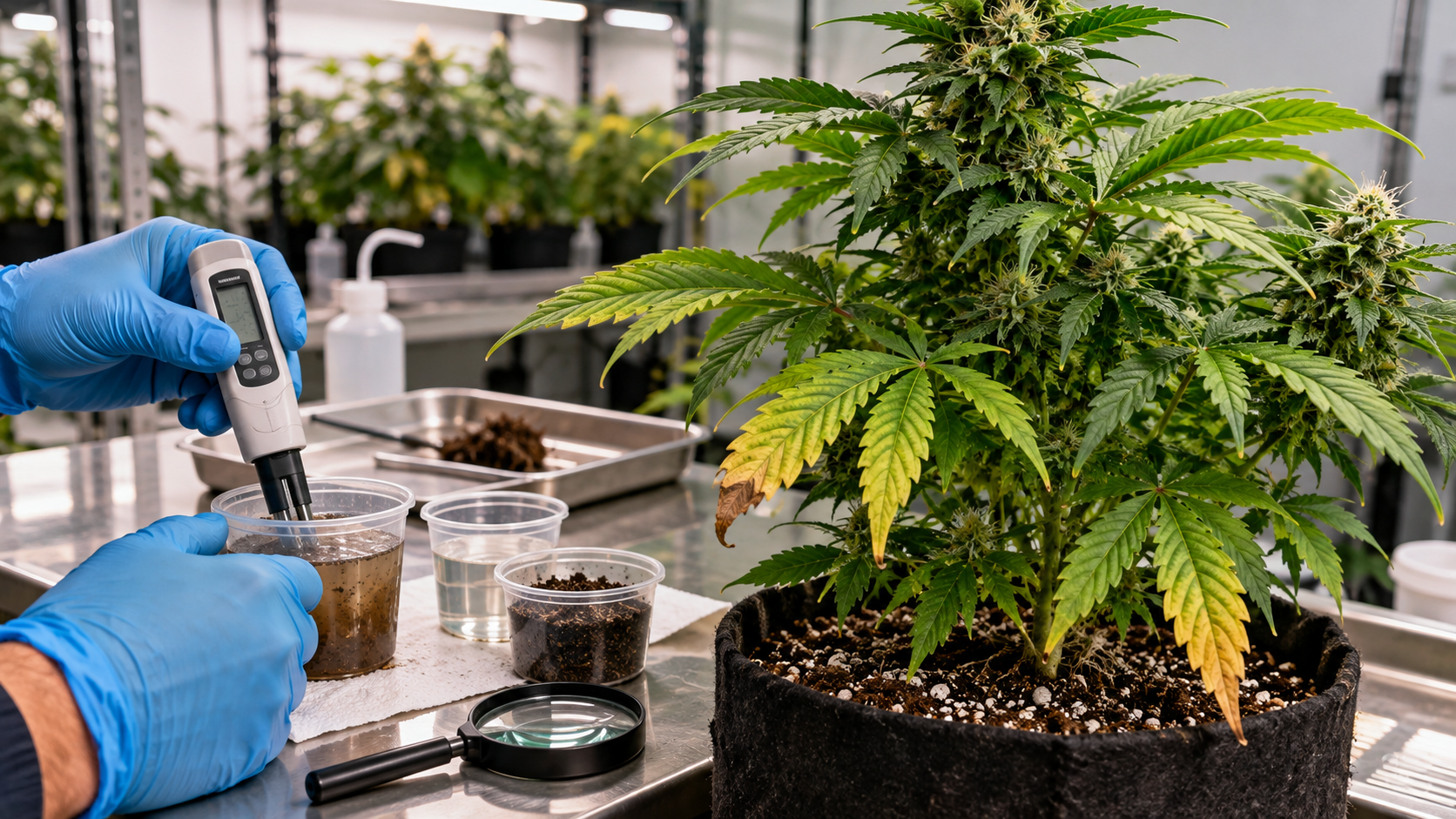
Classic potassium deficiency often includes chlorosis or necrosis along older leaf margins and leaflet serrations because potassium is mobile. However, cannabis-specific single-element withholding trials have shown that the earliest visible patterns can differ by leaf type. In one flowering trial, larger sugar leaves developed lesions around secondary veins before the more familiar lower-fan-leaf margin pattern became pronounced. In another vegetative hemp experiment, marginal yellowing and necrosis took much longer to appear. These different observations demonstrate why symptom order depends on trial conditions and tissue. For the basics of nutrient mobility, see Nutrient Basics.
Look for progression: a repeatable pattern, several similarly affected plants or leaves, and a plausible history of low potassium input or disrupted uptake. Lower-leaf damage alone can also reflect aging or shading. Marginal burn can arise from high EC, inadequate irrigation, heat or other nutrient disorders. Irreversible necrosis will not turn green after a successful correction, so do not use an old damaged edge as your recovery test.
Excess potassium and calcium-magnesium antagonism
Potassium, calcium and magnesium are positively charged ions whose root acquisition and distribution can interact. In controlled cannabis research, increasing potassium supply raised tissue K while calcium and magnesium concentrations tended to decline. This is a measured relationship in that study, not proof that every calcium- or magnesium-looking symptom anywhere is caused by K. Low calcium in young tissue can also result from transpiration constraints and root stress; magnesium deficiency commonly creates interveinal chlorosis on older leaves.
A grower can make this situation harder to resolve by adding a K-rich flowering supplement and then responding to an emerging magnesium symptom with an unmeasured second product. Both additions raise total ionic input, but neither identifies what the root zone actually contains. Test the formula and root zone, including Ca and Mg, before choosing the first correction.
Warning: Do not diagnose potassium from leaf-tip burn alone
High EC, drought cycles, spray injury, heat, calcium or magnesium disorders and actual K deficiency can overlap visually. Do not stack potassium, Cal-Mag and flush treatments in one unmeasured response. Record the current formula and inspect the roots first.
Diagnosis table: evidence that separates similar symptoms
| Working possibility | Pattern that raises suspicion | What can imitate it | Best next check |
|---|---|---|---|
| Potassium shortage | Progressive margin/serration injury or trial-consistent leaf lesions with plausible inadequate supply | Old leaf aging, drought, salt injury, Ca or Mg disorders | Check elemental K inputs, consistent media or solution sample, tissue testing if unresolved |
| High K or cation imbalance | Strong K supplement history, high tissue or solution K, reduced relative Ca/Mg | Low Ca/Mg base feed, unsuitable water, root dysfunction | Full K/Ca/Mg analysis and formula reconstruction, not just EC |
| General salinity | Multiple nutrient symptoms, drying difficulty, high standardized root-zone EC | Localized dry pockets, severe heat, root disease | Compare source/input/root-zone EC using the same sampling protocol |
| Root-zone impairment | Wet, cold, damaged or poorly oxygenated roots and declining water use | Missing nutrient in an otherwise healthy medium | Check moisture, drainage, temperature and accessible roots before feeding more |
| Normal aging or shading | A few older, deeply shaded leaves decline without a spreading pattern | Early mobile-nutrient deficiency | Mark leaves, inspect comparable sunlit tissue and recheck progression |
Deficiency, antagonism and toxicity are not synonyms
A deficient plant is not receiving enough usable potassium. Antagonism means one ion’s availability or uptake is affected by the presence of another. Toxicity or oversupply describes an input or accumulation that impairs performance; it may act through direct physiology, ion balance or salinity. These mechanisms require different corrections. Adding potassium to an antagonism or high-EC problem may make it worse. Cutting all nutrients in response to a genuine isolated shortage can create new deficiencies.
“My flowering leaves have brown tips. Is this potassium deficiency?”
Question source: Common grower question.
Not from that sign alone. Identify where the first damage appeared, whether it spreads, the current K-containing products, irrigation history and root-zone EC. Compare young and old tissues and test K, Ca and Mg when the explanation remains uncertain. A brown tip is an observation, not a prescription.
Measure Potassium Before Changing the Recipe
Measurement begins with clear units. An N-P-K label, a nutrient calculator, an EC meter, a soil test and a plant tissue report describe different things. Comparing their numbers without conversion or method context produces false certainty. Start by writing down exactly which concentration each document reports.
Read K2O on the label as an oxide equivalent
In common fertilizer labeling systems, the third N-P-K number reports soluble potash as a K2O equivalent by weight. The product does not need to contain literal potassium oxide. Elemental potassium represents approximately 83 percent of the labeled K2O quantity. For example, a product listing 10 percent K2O provides an elemental-K equivalent of about 8.3 percent by product mass. A label showing elemental K directly should not be converted again.
For a hypothetical dry fertilizer labeled 0-0-10, dissolving 1 gram of product in a final volume of 1 liter would supply about 83 mg/L elemental K if the labeled potassium is fully soluble and the stated percentage applies to that product as weighed. This is an arithmetic illustration, not an application recommendation. Liquid labels may report mass percent, density or other units. Calculate from the actual guaranteed analysis, product density where relevant and total final dilution volume, not a guessed milliliter-to-gram equivalence.
Pro Tip: Reconstruct elemental K from every input: base fertilizer, calcium or magnesium product that may also contain potassium, bloom additive and source water. The amount from a single bottle is not the crop’s total potassium supply.
Measure source water, finished solution and root-zone trends separately
Source EC establishes how much conductivity arrives before fertilizer. Finished-solution EC reflects all dissolved conductive ions after mixing. Root-zone EC provides a trend for accumulation or depletion but depends on the sampling method. A high EC reading does not identify potassium; it may reflect nitrate, calcium, magnesium, sodium, chloride or several ions. A low EC reading does not prove K is adequate, either. Potassium-specific analysis requires an appropriate laboratory method or a validated ion-specific measurement.
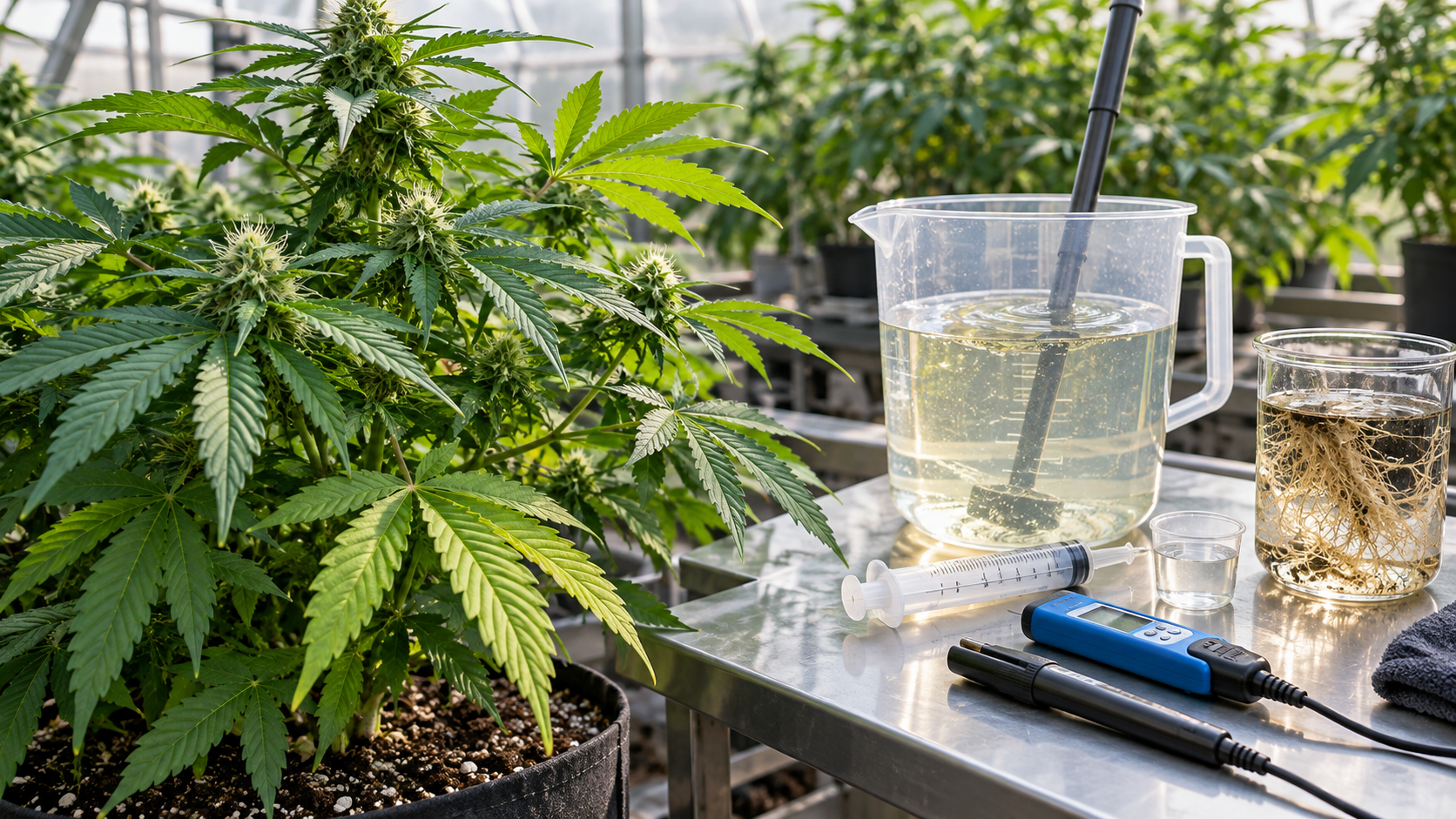
Take measurements consistently. Use calibrated instruments, record the sample location and temperature, and state the units. Reservoir readings should be collected from a well-mixed system rather than a stagnant corner. In containers, uncontrolled runoff from one irrigation cannot be compared uncritically with a saturated media extract or a deliberate pour-through sample. The amount of water added changes dilution and therefore interpretation.
Choose the test for soil, potting mix or hydroponics
A native-soil laboratory generally measures potassium using an extraction method selected for that soil and region, often reporting exchangeable or plant-available K. That number is not interchangeable with a reservoir’s dissolved K concentration. Soilless potting media are commonly evaluated using saturated media extract, a defined dilution or a standardized pour-through method. The reported potassium and EC ranges depend on which procedure was used. Ask the laboratory which extraction method it employed and request its own interpretation for the medium.
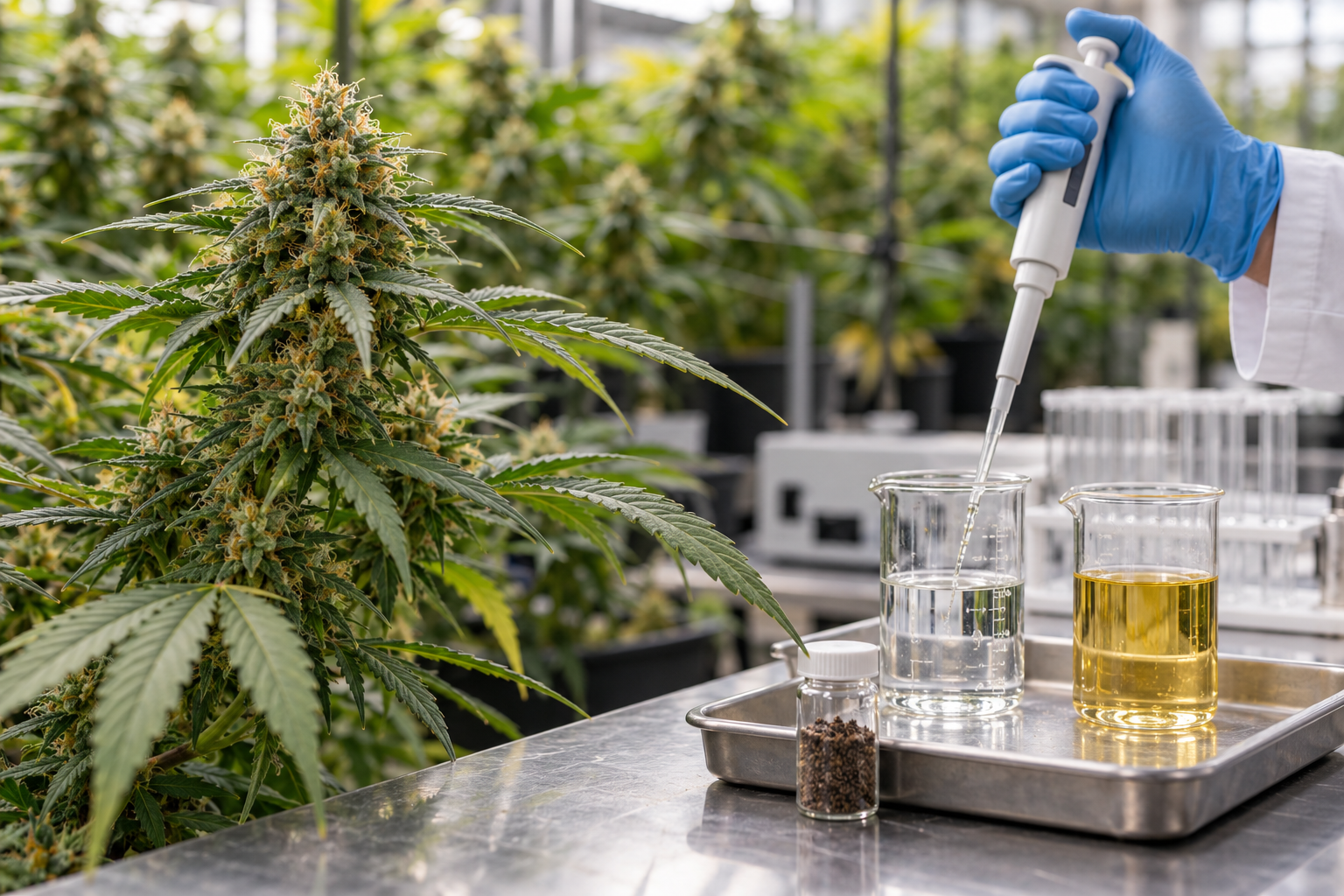
For hydroponics, a representative nutrient-solution sample can be analyzed for K, Ca, Mg and other ions. A tissue test can help establish what the plant has accumulated, but sampling leaf position, developmental stage and timing changes the result. Laboratory reference ranges are not perfectly calibrated for every cannabis genotype or flower stage. Pair the report with current input analysis, root health and the timing of symptoms; do not treat any single percentage as infallible.
A practical measurement table
| Measurement | Question answered | What it does not prove | Repeatable method |
|---|---|---|---|
| Guaranteed analysis | Declared nutrient content of each product | Actual root uptake or precise tissue need | Record formulation, K vs K2O basis, dose and dilution |
| Source-water analysis | Background minerals and alkalinity | Final mixed feed composition | Test current water source after treatment or blending |
| Input EC/pH | Overall solution conductivity and acidity | Individual K or Ca concentration | Calibrated meters, same stage after complete mixing |
| Root-zone extract or reservoir | Nutrient status at a stated sampling location/method | Universal crop threshold across different methods | Same extraction method, timing and representative locations |
| Element-specific media/water test | Measured potassium and other selected ions | Plant response without environmental context | Laboratory K, Ca, Mg, sodium and relevant nutrients as needed |
| Plant tissue analysis | Element accumulated in sampled tissue | Cause by itself or universal optimum | Document cultivar, leaf position, stage and sampling history |
Definition: A potassium number needs a matrix and units
“120 ppm K in nutrient solution,” “120 ppm exchangeable K in soil” and “1.2% K in leaf tissue” are not comparable measurements. Always record the sample type, extraction or analysis method, units and stage before interpreting a result.
What to record before the first correction
Write down plant identity and growth stage, substrate and container, source-water report, every product and dose, previous irrigation and drainage behavior, current input EC/pH, standardized root-zone trend and symptom distribution. Photograph marked leaves under similar light. Where only one container is affected, compare a healthy plant receiving the same solution: a shared formulation problem should prompt a different investigation than an isolated root or irrigation problem.
Do not use an arbitrary lab threshold copied from a different crop or extraction method to declare cannabis toxicity. Compare the result with the laboratory’s method-specific reference range, the actual product input and the plant’s growth history. If possible, preserve the original sample and formulation records before an emergency correction changes the evidence.
Compare Potassium Sources and Bloom Products
Once a potassium gap is confirmed, the source matters because potassium salts introduce partner ions and influence total EC. A complete base fertilizer may already supply sufficient K, while a standalone additive can inadvertently increase sulfur, phosphate, chloride or another nutrient. Read the entire guaranteed analysis, not only the last N-P-K number.
Base fertilizer versus bloom booster
A base fertilizer is intended to supply a balanced set of nutrients in the context of its accompanying products and the source water. A bloom booster often concentrates one or more of potassium, phosphorus and other ingredients. Its suitability depends on the nutrient gap it fills. If the base is adequate, adding a booster can increase EC without a corresponding benefit. If the base is truly short of K and its other ions are appropriately supplied, a documented K adjustment may be reasonable. The distinguishing evidence is the measured deficit, not the word bloom.
Some product schedules prescribe an abrupt rise in potassium alongside a reduction in nitrogen. Such paired changes make outcomes difficult to interpret: the grower has altered two nutrient variables, possibly changing EC and the plant’s total carbon-assimilation capacity as well. Make comparisons around one defined change when possible. A schedule printed for an unspecified cultivar under unknown light and water conditions is a starting hypothesis, never a crop-specific proof.
Common potassium salts bring different companion ions
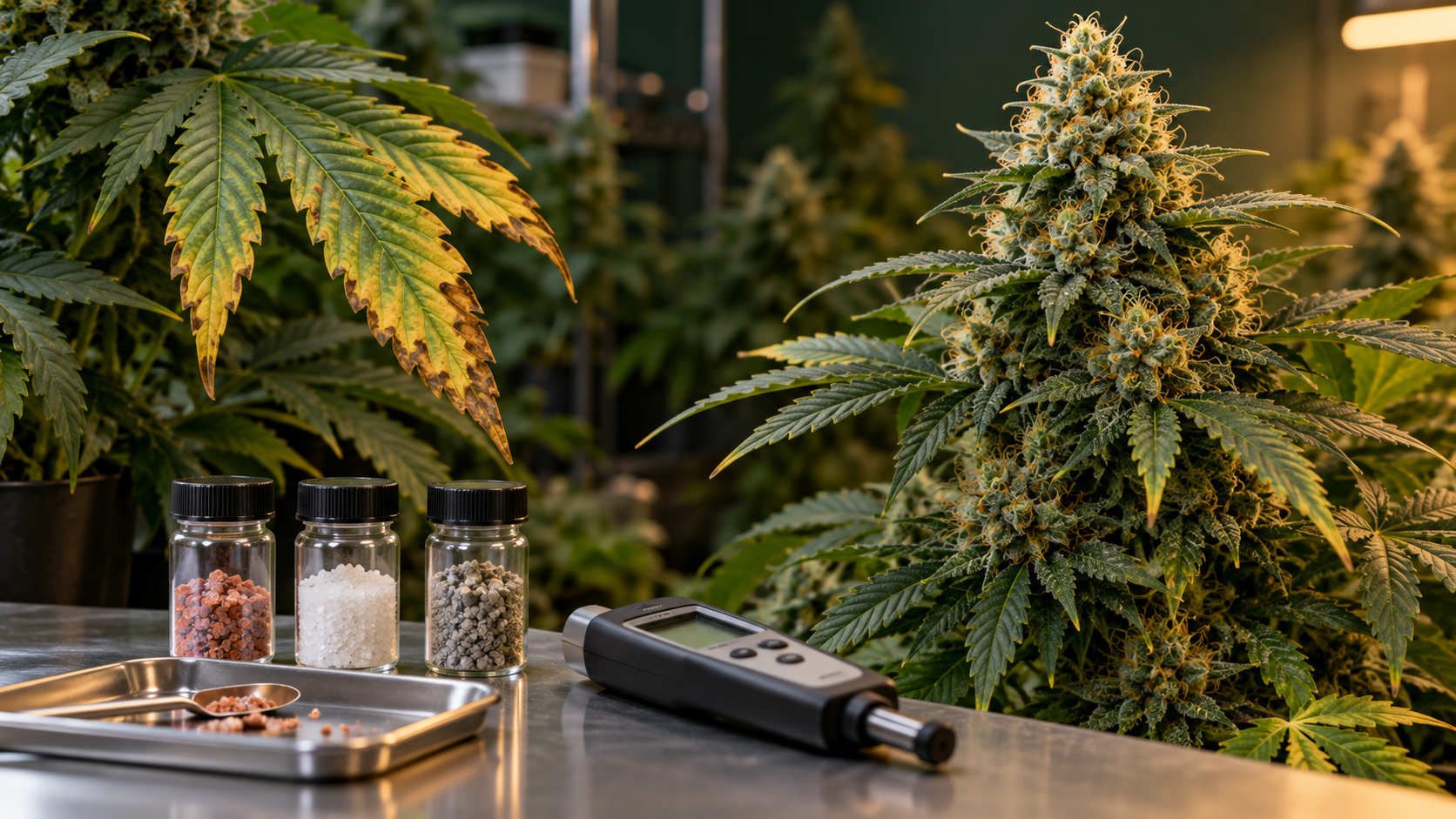
Potassium nitrate supplies nitrate nitrogen as well as K. Monopotassium phosphate supplies phosphorus along with K. Potassium sulfate contributes sulfur. Potassium chloride contributes chloride, which may become a concern when water or medium already contains substantial chloride; chloride is an essential micronutrient but that does not make unlimited chloride desirable. Potassium silicate provides potassium while influencing solution pH and mixing compatibility. These materials are not interchangeable gram for gram. Use an actual formulation calculation and follow product-specific mixing instructions.
Do not mix concentrated calcium solutions directly with incompatible concentrated phosphates or sulfates: precipitation can make nutrients unavailable and block equipment. Dilute products separately into the intended water volume in the manufacturer’s stated order. If solids, haze or unusual reaction appear, stop and verify compatibility instead of adding more acid or product to force clarity.
Organic, mineral and hybrid supply without ideology
Compost, manure, plant residues, mineral amendments and organic fertilizer blends can contribute potassium at varying rates. Their reported total K may differ from what becomes soluble during the crop’s actual season. Laboratory testing, feedstock variability and decomposition conditions matter. A dry amendment marketed as natural can still deliver excess salts or an unsuitable nutrient balance. Mineral soluble fertilizers are easier to quantify quickly, but they also become easy to overapply. Hybrid programs require careful accounting because the slow-release component remains present when soluble feeding begins.
Foliar potassium is not a routine substitute for root-zone correction. Leaf uptake depends on product formulation, concentration and application conditions. Dense flowering tissue should not be treated as a convenient spray target: residues, phytotoxicity, trapped moisture and product legality must be considered. If a root problem prevents sustained uptake, restoring root function is the more fundamental objective.
Do
Count elemental K and companion nutrients from every source. Select an adjustment that addresses the demonstrated deficiency without duplicating phosphorus, nitrogen or sulfur.
Avoid
Stacking a base formula, PK booster, potassium silicate and an unmeasured organic top-dress solely because the plant is flowering.
“My booster has a huge final N-P-K number. Is that enough to show it is stronger?”
Question source: Common grower question.
No. The number is a guaranteed-analysis percentage or equivalent, not the final dilution or proof of yield response. Compare the intended amount per liter, K2O-to-K conversion, all companion ions and the existing formula. A high concentration can be useful for a precisely identified gap and unnecessary when the base already meets demand.
What a Bloom-Booster Trial Must Actually Prove
When the sales claim moves from “potassium is required” to “more potassium creates heavier, denser or more aromatic flowers,” require a controlled comparison in the relevant production system. Look for dry trimmed flower yield, consistent sampling, replicated plants and statistical uncertainty. If a product trial changes nitrogen, phosphorus and potassium simultaneously, it cannot isolate which ingredient caused the result. If an anecdote compares two different cultivars or seasons, weather and genetic differences may overwhelm the nutrient effect.
Troubleshoot One Variable and Verify the Correction
The purpose of troubleshooting is not to make a leaf photograph match a deficiency chart. It is to identify the cause that can be corrected, choose the least disruptive intervention and see whether the plant stops deteriorating. Separate an emergency root problem from a nutrient-ratio problem before touching the feed.
Step 1: Confirm the pattern and stop automatic additions
Mark the first affected leaves and determine whether symptoms began low, high, in larger sugar leaves or everywhere simultaneously. Note whether one plant, one irrigation zone or an entire reservoir is affected. Stop newly introduced boosters while reconstructing the actual input, but do not abruptly withdraw all essential nutrients from an otherwise functioning crop without evidence. Examine irrigation, temperature, recent spray applications, pests and root behavior.
Step 2: Determine which constraint is active
Ask whether potassium is actually missing from the complete input. If the calculation suggests adequate K but the plant is deteriorating, inspect water availability and root oxygen, measure standardized root-zone EC/pH and consider ion-specific laboratory testing. High potassium relative to Ca or Mg suggests a different response from a low-K feed with an otherwise healthy root zone. If only one container is affected, investigate its drainage, emitter and root integrity before redesigning the whole crop’s nutrient formula.
Step 3: Make one documented, system-appropriate correction
When a potassium shortage is substantiated, adjust the complete nutrient balance at a conservative, calculated level appropriate to the exact product and system. Check whether the selected source adds nitrate, phosphate, sulfate or chloride. When oversupply or high EC is substantiated, remove the unnecessary input and restore the intended complete formula. Correct irrigation and drainage practices if they are causing accumulation. Where severe salinity requires leaching, the response must fit the medium, water quality, drainage capacity and local runoff rules; an indiscriminate high-volume flush can damage roots or create contaminated runoff.
If calcium or magnesium is low relative to high K, review the entire cation balance rather than automatically stacking supplements. If roots are physically impaired, improve the actual oxygen and water regime. Changing the formula and irrigation frequency together may sometimes be necessary for safety, but record both changes and avoid claiming that a later improvement proves only one of them was responsible.
Warning: Do not force correction through extreme feeding or flushing
Do not apply a concentrated booster directly to damaged roots, intentionally induce severe dry-back to “pull” potassium into the plant, or assume clear runoff means salts are absent. Confirm drainage, water quality and the medium-specific method before corrective irrigation.
Step 4: Verify improvement with the right signals
Existing brown margins and necrotic lesions will not repair. Look instead for the rate of new injury, consistent leaf function, resumed water use, healthier newly expanded tissue and stable growth. Repeat input and root-zone measurements using the same method. When the original problem was an ion imbalance, a follow-up nutrient-specific test can show whether K, Ca and Mg moved toward a more balanced condition. Do not assume a prettier EC number proves the K problem is resolved.
Allow the next meaningful growth interval for the plant to respond, but do not promise a universal number of days. A rapidly growing vegetative plant, a late-flowering canopy, a cold root zone and a damaged plant will not recover on the same schedule. If new damage continues, revisit the working diagnosis and seek plant tissue or media laboratory support instead of repeating the same correction at a higher dose.
Verification table: what happened after the change?
| Follow-up observation | Interpretation | Next decision |
|---|---|---|
| New injury stops and measured root-zone trend stabilizes | Consistent with an effective correction, not proof of a single cause | Keep a balanced baseline and continue monitoring |
| Old necrotic edges remain but fresh growth is healthy | Old damage is irreversible; recovery may still be occurring | Judge new tissue and progression rather than demanding old tissue regreen |
| EC remains high or water use keeps falling | Salinity or root function may remain limiting | Recheck irrigation, drainage, source water and measured ions |
| Ca/Mg symptoms progress while K input stays high | Possible imbalance; other causes still require exclusion | Analyze the complete formulation and K/Ca/Mg status |
| Symptoms spread despite a documented change | Original diagnosis may be wrong or multiple constraints exist | Pause repeated dosing and use laboratory or specialist diagnosis |
“Why did my old leaves stay brown after I corrected potassium?”
Question source: Common grower question.
Dead tissue does not regenerate. Compare new injury, fresh growth, water use and the standardized root-zone results. If the lesion border keeps spreading, reassess the diagnosis. If the pattern stops progressing and measured conditions stabilize, old discoloration alone does not mean the correction failed.
Do not interpret every change as fertilizer success
Watering, temperature, light and flower maturation can change at the same time as nutrient dosing. A plant may resume growth because the root zone dried into a healthier oxygen range, even though the grower also added K. A controlled small comparison, where lawful and feasible, is better evidence than a single uncontrolled success story. Document the untreated baseline and any unavoidable changes to the environment.
What Research Supports and the Final Decision Checklist
The evidence supports potassium as an essential nutrient and shows that severe deficiency can reduce cannabis growth and inflorescence yield. It also shows non-linear and genotype-dependent responses: an adequate range exists, and more fertilizer is not automatically more productive. The direct studies remain limited in cultivar count and cultivation methods. Research recommendations from one experiment cannot be lifted into a universal ppm or tissue-% target for every site.
Read the flowering potassium studies side by side
A 2022 controlled experiment with two medicinal cultivars and five potassium treatments found that severe restriction impaired both plants and reduced flower production. Most measured cannabinoid and terpenoid concentrations declined as potassium supply rose, although responses differed by metabolite, plant organ and genotype. The study suggested one lower adequate concentration for its system. That suggestion is an experimental conclusion, not a universal cannabis feeding recipe. Maximizing an isolated concentration under severe nutrient shortage would ignore losses in flower biomass and plant function.
A separate flowering deep-water-culture study used one high-THC cultivar while varying nitrogen, phosphorus and potassium together. It detected yield responses to nitrogen and phosphorus but not to potassium across the investigated range. That finding cannot establish a global maximum or minimum K requirement. It means additional potassium was not the limiting yield factor in that particular experiment. Compare this with the study that deliberately included a deficient K treatment: the apparent disagreement becomes understandable once the treatment ranges and designs are considered.
Vegetative experiments and deficiency trials answer different questions
The 2019 long-photoperiod comparison showed that potassium supply affected the plant ionome and that high-dose growth responses differed between two cultivars. A later vegetative response-surface study measured interactions among N, P and K, as well as declines in leaf magnesium as P and K increased. Neither trial should be treated as a flowering-stage potassium dose chart. The 2023 single-element withholding experiment helps identify deficiency symptoms and documents yield losses, but intentionally withholding one mineral is not equivalent to diagnosing an unknown real-world fertilizer problem from one photograph.
Across these studies, source water, cultivar, medium, nutrient ratios, organ sampled and harvest endpoint all matter. Another complication is that potassium supplied by potassium phosphate can change while the investigator intends to study phosphorus. Read the actual experimental nutrient recipe, not merely the nutrient named in the paper’s title. Commercial claims require at least as much scrutiny.
The potassium decision checklist
Use this checklist when considering an added K product, investigating suspected deficiency or reviewing an unusually strong bloom formula. A decision is ready only when the nutrient input, plant response and measurement method can be explained together. If one of those components is missing, record the uncertainty rather than inventing certainty.
Before changing potassium
- Confirm the plant’s growth stage, cultivar, lighting and recent water-use trend.
- List all fertilizer products, doses, amendments and source-water contributions.
- Convert K2O label percentages to elemental K when needed and retain correct mass/volume units.
- Inspect roots, moisture, drainage, temperature and signs of general salinity.
- Map the first affected leaves and check for look-alikes, not only margin burn.
- Measure input EC/pH and repeatable root-zone conditions by the correct method.
- Use ion-specific analysis for K/Ca/Mg where a nutrient imbalance remains plausible.
- Choose one documented correction and account for its companion ions.
- Reinspect the same plant locations, fresh tissue and water use after the change.
- Stop escalating when evidence is absent, damage spreads or the root zone deteriorates.
The most reliable flowering potassium strategy is neither deprivation nor maximum supplementation. It is adequate, balanced supply delivered through a functioning root zone, with adjustments based on real measurements and verified plant response. That approach protects yield while keeping bloom-booster claims and potassium-toxicity diagnoses open to evidence rather than guesswork.
Educational content. Always follow your local laws.
Share this article
A quick overview of the topics covered in this article.