
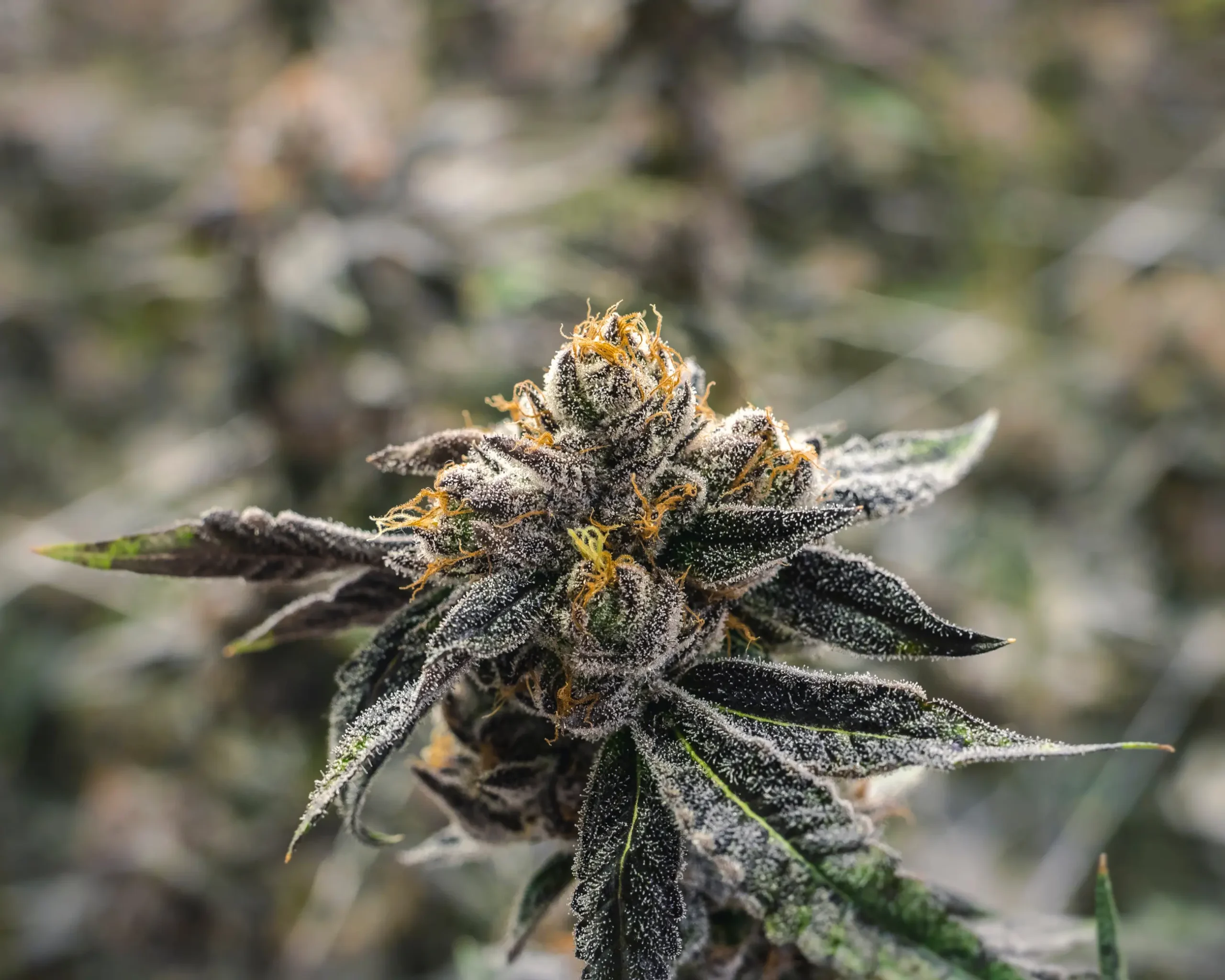
Purple Urkle
Purple Urkle is a strain that can disappoint growers who judge progress by speed. During vegetative growth it often builds itself slowly, keeping its internodes tight and its broad leaves close to the stem while faster cultivars race past it. That slow start has caused more than a few gardens to flip it too early. The result can be a beautifully colored plant that simply never developed enough productive structure to make the space worthwhile.
The better way to understand Purple Urkle is as a quality-first, slow-building indica-dominant cultivar. Its appeal is not extreme biomass. It is the combination of dense resinous flowers, dark purple expression, a grape-plum aroma that can survive a careful cure, and a body-heavy effect that has remained recognizable for decades. When it is rushed, overfed, kept too wet, or dried too quickly, those strengths become much less convincing. The buds may still look purple, but the flavor can collapse into generic earth and skunk while the yield remains modest.
Its genetic history is also less tidy than modern strain charts imply. Purple Urkle is most consistently linked to the Mendocino purple family from Northern California and is widely described as a selected expression of that line. Some later accounts reverse the relationship and connect it to Granddaddy Purple, but the historical timeline makes that explanation difficult to accept as the original story. The safer conclusion is that Purple Urkle belongs to the older Mendocino purple lineage and later became an important parent in its own right.
For growers, the central question is not how to make Purple Urkle as large as possible. It is how to give this naturally slow, compact plant enough vegetative time to build a useful canopy without letting that canopy become too dense for its own flowers. The same short internodes and heavy foliage that make it easy to keep low can create shaded interior growth and stagnant pockets of humidity once the buds harden. Good Purple Urkle is therefore shaped early, opened deliberately, and allowed to finish without being pushed for color or weight at the expense of aroma.
The finished flower makes the effort understandable. Strong examples smell less like artificial grape candy than many modern purple hybrids. The profile can move from ripe grape and dark plum into berry skin, damp earth, skunk, pepper, pine, and a faint floral softness. Some batches are sweeter, some are muskier, and some lean harder into skunk and spice. The keeper is not necessarily the darkest plant. It is the plant that carries a clear grape-plum identity through drying and into the cure.
Strain Features
| Feature | Details |
|---|---|
| Strain Type | Indica-dominant hybrid or indica-leaning heirloom selection |
| Genetic Profile | Commonly described as roughly 70-80% indica; exact ratio is not verifiable across all circulating versions |
| Lineage | Most consistently linked to a selected Mendocino Purps expression; later lineage claims conflict and should be treated cautiously |
| THC | Commonly reported around 18-22%, with much wider batch-to-batch results possible |
| CBD | Usually very low, commonly well below 1% |
| Dominant Terpenes | Myrcene, alpha-pinene, beta-caryophyllene, humulene, and linalool appear repeatedly, but dominance varies by sample |
| Flavor / Aroma | Grape, dark plum, berry skin, earth, skunk, pepper, pine, and light floral notes |
| Effect Character | Fast relaxation, heavy body calm, appetite increase, mental softening, and strong sleepiness at higher doses |
| Flowering Time | Usually about 8-10 weeks, phenotype and environment dependent |
| Outdoor Harvest | Typically early to mid-autumn where the season remains warm enough to finish cleanly |
| Vegetative Speed | Slow to moderate; extra veg time is often more important than aggressive feeding |
| Plant Architecture | Short, wide, broad-leafed, tight internodes, dense lateral growth |
| Stretch | Low to moderate compared with Haze-dominant cultivars; enough to open the structure but rarely enough to rescue an undersized plant |
| Bud Density | High in mature upper flowers; dense flower cores increase humidity and drying concerns |
| Yield Character | Usually moderate rather than exceptional; quality improves when the canopy is not overcrowded |
| Training Compatibility | Responds well to early topping, LST, trellising, and a lightly filled SCROG; repeated late high-stress training is less useful |
| Color Expression | Strong genetic potential for purple pigmentation, often intensified late in flower; color is not a potency measurement |
| Feeding Behavior | Can be finicky, especially when flowering; heavy feeding is not a reliable shortcut to faster growth |
| Main Grow Risk | Under-veg followed by an overpacked, humid canopy once dense flowers form |
| Grow Difficulty | Moderate; not fragile, but slower and less forgiving of impatience than many modern hybrids |
| Best Time of Use | Evening and nighttime |
Genetic Lineage
Purple Urkle belongs to a part of cannabis history where clone names, regional selections, and informal exchange often mattered more than documented pedigrees. The cultivar was circulating in Northern California by the late twentieth century, and the most persistent account places it within the Mendocino purple family. In that version of the story, Purple Urkle is not a modern two-parent cross at all. It is a selected phenotype or closely related expression that became distinct because growers preserved its flavor, color, compact structure, and heavy effect.
That explanation fits the plant better than a neat modern family tree. Purple Urkle shows the broad leaves, short internodes, dense flowers, and strong body effect associated with old indica-leaning selections, yet its grape and plum character is unusually prominent. The Mendocino purple family was valued for precisely that combination of dark pigmentation and fruit-driven aroma, which is why the connection remains plausible even when the exact parent plants cannot be reconstructed.
A second account sometimes describes Purple Urkle as related to or descended from Granddaddy Purple. The problem is chronology. Granddaddy Purple is generally described as a later cultivar that used Purple Urkle or closely related purple material as a parent. Treating Purple Urkle as a phenotype of Granddaddy Purple therefore reverses the direction of influence in the better-known historical record. The honest Weedth position is that Purple Urkle’s exact ancestry remains disputed, while a Mendocino purple origin is the most consistent explanation.
The uncertainty also helps explain why plants carrying the name do not always behave identically. Clone-derived material can preserve a narrow expression, while seed reproductions and later reconstructions may widen the phenotype range. One plant may stay extremely squat and leafy. Another may open more during stretch. One may turn dark purple early and carry a sweet grape nose. Another may remain greener and lean toward earth, pine, pepper, or skunk. The name predicts a family resemblance, not a guarantee that every seed-grown plant will reproduce an old clone exactly.
Purple Urkle’s later breeding influence is easier to see than its own ancestry. Its grape-heavy aroma, purple coloration, and sedating effect became useful building blocks for later purple hybrids. That historical role matters to growers because it explains why Purple Urkle can feel less exaggerated than some of its descendants. The flowers may be smaller and the yield less aggressive, but the flavor can feel more natural, with ripe fruit sitting on an earthy, skunky base rather than a purely candy-like top note.
Effect Breakdown
Purple Urkle does not need an elaborate effect map because its progression is relatively coherent. The experience usually begins with a noticeable reduction in mental tension, then deepens into physical heaviness. At a restrained dose, there can still be a clear and pleasant headspace. At a larger dose, functionality becomes much less reliable.
The first few minutes often feel calmer rather than more stimulated. Users commonly describe a soft euphoric lift, a quieter internal dialogue, and a sense that the body is beginning to release tension. The strain can make music, food, films, and low-pressure conversation more enjoyable without producing the rapid idea generation associated with energetic sativas. For some consumers, that early phase remains surprisingly clear. For others, the eyelids become heavy almost immediately.
As the dose settles in, the body effect becomes the defining feature. Shoulders loosen, movement becomes less urgent, and sitting down starts to feel better than getting back up. Appetite often increases. The mental tone generally remains positive, but attention can become lazy and short-term memory less dependable. This is where Purple Urkle earns its nighttime reputation. The strain is better at ending a demanding day than extending it.
At higher doses, the distinction between relaxation and sedation can disappear. Experienced users may find the heaviness comforting, while low-tolerance consumers can feel pinned down, dizzy, or mentally foggy. Dry mouth and dry eyes are common complaints, and dizziness appears often enough in user reports to deserve mention. Anxiety is less characteristic than with racier cultivars, but high THC can still produce discomfort in sensitive users.
The later phase is typically quiet and sleepy. Rather than a sudden crash, many users describe a gradual narrowing of activity until sleep feels like the obvious next step. This makes Purple Urkle particularly appealing to people who want a recreational session to transition naturally into bedtime. The same characteristic makes it a poor match for driving, late-night work, detailed planning, or anything that depends on sustained alertness.
Potency should not be reduced to one THC number. Samples carrying the name have tested across a wide range. A lower-THC flower can still feel substantial if the dose is large or the user is sensitive, while a high-testing batch can be overwhelming. The most useful expectation is therefore qualitative: calm first, body weight second, sleepiness increasingly likely as the dose rises.
Flavor & Aroma Profile
Purple Urkle’s flavor is the reason to be selective about phenotype and post-harvest handling. Color may be the visual signature, but the cultivar becomes genuinely distinctive when the fruit remains recognizable after the flower is dried. The target is not vague sweetness. It is a dark-fruit profile with enough earth, skunk, pine, and spice underneath to keep the grape character from becoming flat.
A good cured jar usually opens with ripe grape, plum skin, dark berry, or a sweet-sour purple-fruit impression. Some expressions lean toward grape juice or berry syrup, but the older style is often less candy-like than modern fruit hybrids. There can be a damp-earth note almost immediately behind the fruit, followed by skunk, pepper, or pine. In strong examples, the contrast is obvious: the first smell is fruit, the second is something darker and more resinous.
Breaking the flower apart tends to expose the base. The sweet grape note may become sharper while pepper, soil, wood, and skunk rise from the interior. Resinous flowers can leave a persistent odor on the fingers. That persistence is useful when selecting a keeper because a phenotype with only surface sweetness may smell attractive in the room but lose definition after drying.
On the inhale, the fruit is often rounder than the jar aroma suggests. Grape and plum can combine with a soft berry sweetness and an occasional floral note. The middle of the palate becomes earthier. On the exhale, spice, pine, herbal bitterness, or skunk may remain longer than the fruit itself. A well-finished sample should still leave a recognizable dark-fruit aftertaste instead of collapsing into generic smoke.
Vapor tends to separate the profile more clearly. Lower-temperature vapor can reveal the grape, plum, floral, and fresh pine aspects before the earth and pepper become dominant. Combustion pushes the profile toward skunk, spice, and heavy resin. Neither method changes the underlying flower, but they emphasize different parts of it.
Phenotype variation is significant. A fruit-forward expression can smell like dark grape and berry with a clean floral edge. An earthy expression may carry only a light fruit top note over myrcene-heavy musk, skunk, and wood. Some plants show more pine and pepper than expected. A purple flower that lacks a clear fruit identity should not be selected simply because the color photographs well.
Cure changes the balance rather than inventing a new aroma. Freshly dried Purple Urkle can smell grassy, sharp, or oddly muted. Over the first weeks of controlled curing, the green character should fall away and the grape-plum note should become cleaner. Earth and spice become more integrated instead of competing with the fruit. If the flower was dried too hot or too fast, that improvement is limited because the volatile top notes have already been lost.
Dominant Terpenes
Purple Urkle does not have one fixed terpene hierarchy. Aggregated chemical profiles and commercial laboratory results show wide variation, with myrcene, pinene, caryophyllene, humulene, linalool, and limonene all appearing at meaningful levels in different samples. That variation is consistent with the strain’s uncertain preservation history and the fact that modern products carrying the name may not all descend from one identical clone.
| Terpene | Sensory Role | Interpretation |
|---|---|---|
| Myrcene | Earthy, musky, herbal, ripe-fruit depth | Frequently reported, but not universally dominant. It may help shape the heavy aromatic base. Sedation should not be attributed to myrcene alone. |
| Alpha-Pinene | Pine needle, fresh wood, resinous sharpness | Appears prominently in some profiles and can explain why certain Purple Urkle samples smell fresher and less syrupy than expected. |
| Beta-Caryophyllene | Black pepper, spice, dry wood | A recurring secondary terpene. It binds to CB2 receptors and is scientifically interesting, but its presence does not prove a specific medical outcome. |
| Humulene | Earth, hops, wood, dry herbal bitterness | Can strengthen the dark base under the fruit. Some aggregated profiles place it unusually high, while others do not. |
| Linalool | Floral softness, lavender-like sweetness | More obvious in selected samples than others. It may help explain the floral edge that sometimes appears beneath grape and plum. |
| Limonene | Citrus peel and brightness | Usually secondary rather than defining, but can add lift to fruit-forward expressions. |
The useful conclusion is sensory rather than numerical. The classic profile requires a fruit top layer and an earthy-resinous base. Myrcene and humulene can support the earth and musk. Pinene adds freshness. Caryophyllene brings pepper and dryness. Linalool can soften the profile with a floral edge. None of these compounds, by itself, explains the complete effect or flavor of the cultivar.
Terpenes are far more reliable as aroma markers than as predictors of subjective psychoactive response. It is reasonable to say that caryophyllene contributes pepper or pinene contributes pine. It is much less responsible to claim that one terpene guarantees sleep, eliminates anxiety, or cancels THC-related memory effects. Purple Urkle’s heavy experience comes from the entire chemical profile, dose, harvest maturity, and the person consuming it.
Indoor vs. Outdoor Growing
| Factor | Indoor | Outdoor |
|---|---|---|
| Vegetative pace | Slow growth is easier to accommodate because the grower controls veg duration | A long season can turn the slow start into a large plant, but only if planting begins early enough |
| Plant shape | Short and wide; easy to keep below lights, but tight internodes can overfill the center | Can become a broad shrub that needs spacing more than vertical control |
| Training value | Early topping and LST are useful; SCROG works if the screen is not overfilled before stretch | Early branch spreading improves sun penetration and keeps the interior accessible |
| Flower density | Dense upper buds can be protected by controlled humidity and canopy airflow | The same density becomes a liability in rain, dew, or cool humid autumn weather |
| Color expression | Environment can be managed, but cold should not be forced at the expense of growth | Seasonal cooling may intensify purple expression naturally where genetics allow |
| Yield strategy | Moderate yield improves when veg time and productive branch count are planned deliberately | More root space can improve plant size, but the cultivar still should not be treated as a maximum-yield outdoor line |
| Flavor control | Strongest advantage: harvest timing, drying conditions, and storage are easier to control | Sun-grown flower can be excellent, but heat and weather make fruit retention less predictable |
| Main risk | Under-vegging, then compensating with too much feeding or too many weak shoots | Finishing dense flowers cleanly before prolonged wet weather |
| Best fit | Quality-focused growers with limited height but enough time for a longer veg | Warm, dry-season growers who can start early and keep the plant open |
Purple Urkle is often called an indoor-friendly indica because it stays short. That description misses the real issue. Height is rarely the limiting factor. Time and horizontal space are. A small plant flipped too early may remain easy to manage yet fail to build enough flowering sites to justify the cycle. Indoors, the grower can simply extend vegetative growth until the plant has a useful frame. That control makes indoor cultivation especially attractive for this cultivar.
The second indoor advantage is late-flower climate management. Purple Urkle’s mature buds can become compact enough that the flower core dries and exchanges moisture more slowly than the surrounding room. A clean, open canopy and controlled humidity make it easier to finish those buds without sacrificing the grape-plum aroma. The grower can also choose the harvest window based on maturity instead of an approaching storm.
Outdoor cultivation becomes more interesting in a long, dry season. The cultivar’s slow vegetative behavior matters less when the plant has months to establish itself, and a broad canopy can develop without fighting a ceiling. Full sunlight can produce thick stems and deeply resinous flowers. The problem arrives near the finish. Dense purple buds that are ideal in a dry autumn are much less forgiving when rain, dew, or cold nights remain trapped in the canopy.
Purple Urkle therefore does not have a universal best environment. Indoors is usually better for consistency, flavor control, and predictable maturity. Outdoors can outperform it in plant size when the climate provides a long vegetative runway and a dry finish. In a short or wet season, the strain’s moderate yield does not justify taking unnecessary late-season mold risk simply for the possibility of darker color.
Strain-Specific Grow Guidance
Purple Urkle should be planned from the vegetative stage forward because the plant rarely fixes an undersized structure with a dramatic flowering stretch. That is the central difference between it and many modern hybrids. With a vigorous stretch cultivar, an early flip can still produce a full canopy. With Purple Urkle, the canopy should already contain the main productive framework before flowering begins.
Slow Vegetative Growth Is a Planning Issue, Not a Feeding Emergency
The most common mistake is seeing a compact plant, assuming it is hungry, and increasing nutrition in an attempt to make it accelerate. Purple Urkle can be a finicky feeder, and the plant’s naturally deliberate pace does not necessarily indicate deficiency. Heavy feeding can create dark, thick foliage and salt stress without meaningfully changing its genetic growth rate.
A better response is to judge the new growth itself. If leaves are healthy, roots are active, internodes are developing, and water use is consistent, the plant may simply need more time. The extra vegetative period should be considered part of the cultivar’s cost. Growers who need rapid room turnover may find Purple Urkle inefficient even when the final flower is excellent.
Architecture: Short Internodes Can Hide an Overcrowded Plant
The plant usually develops broad leaves, thick stems, and close node spacing. That creates a sturdy silhouette, but the interior can become crowded before the canopy looks large from above. Leaves overlap, small shoots remain shaded, and several branches may compete for the same narrow pocket of light.
The fix is structural rather than aggressive. Open the plant while it is still flexible. A single early topping can reduce apical dominance and allow several primary branches to share the canopy. Low-stress training is particularly useful because the objective is width, not repeated injury. Once those branches have been established, secondary shoots can be evaluated according to whether they have a realistic path to strong light.
Topping and SCROG: Useful, but Only if You Respect the Slow Recovery
Purple Urkle can respond well to topping. The important word is early. A healthy plant topped after it has established several nodes usually has enough time to redirect growth into laterals. Repeated topping can work in a long vegetative cycle, but it extends an already slow phase and can create more branch tips than the light footprint can finish properly.
Build support before the flowers demand it
SCROG can be very effective because the plant is naturally low and lateral. The mistake is filling the entire screen before the flowering transition. Even a low-stretch plant still extends after the flip, and every occupied square does not need another branch. Leave enough space for the primary shoots to spread and for air to move between future colas. A screen used as a support and spacing tool is more valuable than a screen used to count the maximum possible number of tops.
Defoliation Should Create Windows, Not a Bare Skeleton
The broad leaves can block several bud sites at once, so selective defoliation has real value. Remove leaves that overlap heavily in the center, block multiple productive sites, or trap humidity against developing flowers. Do not turn the plant into a stripped framework simply because Purple Urkle is leafy. Its slow growth means replacing lost leaf area can take longer than on a highly vigorous hybrid.
The best canopy has visible gaps when viewed from the side. Air should be able to pass through the interior instead of being forced only across the top surface. That spacing becomes increasingly important once the flowers begin hardening.
Flowering Transition: Do Not Expect a Rescue Stretch
Purple Urkle generally stretches modestly. Some expressions open more than others, especially seed-derived recreations, but the cultivar is not known for multiplying its height like a Haze. The first weeks of flower should therefore be used to finish positioning branches, not to wait for an empty canopy to fill itself.
The low stretch has one advantage: once the main tops are level, they tend to remain easier to manage under fixed lights. The disadvantage is that shaded lower growth often stays shaded. If a branch is clearly below the productive zone after transition, keeping it usually adds trim work and small flower rather than meaningful premium yield.
Root Zone: Keep It Aerated and Avoid the Wet-Feet Trap
A compact canopy can make growers underestimate root-zone demand, but Purple Urkle still needs oxygen around the roots. A medium that remains saturated for long periods slows an already unhurried plant and can make nutrient uptake look inconsistent. The response should not be stronger feeding. It should be better drainage, appropriate irrigation timing, and enough root volume for the planned vegetative period.
Allowing reasonable dryback between irrigations encourages a more responsive root zone. Severe wilting is not the goal. The plant should move through a predictable moisture cycle rather than alternate between saturation and drought.
Feeding: Stability Matters More Than Intensity
Grow reports repeatedly describe Purple Urkle as less straightforward to feed than many commercial hybrids. Some plants accept moderate nutrition without complaint, while others show burnt tips, dark foliage, or stalled-looking growth when pushed. Flowering can be particularly deceptive because the grower sees a slow plant and wants to increase inputs just as the canopy is becoming denser.
Watch leaf color and water use. Excess nitrogen tends to keep the plant too leafy and dark, which works directly against airflow and light penetration. A balanced program that preserves steady growth is safer than trying to force a large late vegetative push. If the plant is healthy, increased flower density should come from light distribution and maturation, not from an abrupt increase in salts.
Light: A Flat Canopy Matters More Than Extreme Intensity
Because Purple Urkle is short, it is easy to create a uniform canopy distance. Use that advantage. The strain does not need a few dominant tops receiving extreme intensity while the rest of the plant remains shaded. The quality goal is even development across a relatively shallow flowering zone.
If upper leaves bleach, curl, or lose healthy texture while lower sites remain weak, more light is not the answer. Rebalance the canopy and remove low-value growth. Premium Purple Urkle comes from evenly mature flowers, not from one overdriven top and a collection of soft lowers.
Humidity and Dense Flowers: The Risk Arrives Late
The canopy can look safe in early flower because the plant is compact and the buds are still small. Risk increases as the calyxes swell and individual flowers begin joining into dense clusters. At that stage, moisture can remain inside the flower even when the room feels acceptable.
Air movement should pass through the branch structure without blasting one cola continuously. The center of the plant deserves as much attention as the top surface. Outdoors, inspect dense flowers after rain or heavy dew and pay attention to dead sugar leaves, localized browning, or a musty odor. Those can be early signs that the interior is deteriorating.
Purple Color: Genetics First, Temperature Second
Purple Urkle has genuine genetic capacity for anthocyanin accumulation. Cooler late-flower conditions can intensify that expression, but the relationship between color and temperature is not a reason to chill the plant aggressively. Modern cannabis research confirms that anthocyanin accumulation is genetically regulated and temperature-responsive, while flower biomass and cannabinoid accumulation do not necessarily share the same temperature optimum.
Do not trade flower development for darker pigment. If the plant naturally purples as it matures, enjoy the expression. If a phenotype stays greener, judge it by resin, aroma, maturity, and effect. A stressed dark plant is not automatically superior to a healthy green one.
Flower Development and the Real Finish
Purple Urkle often looks finished before it has reached its best combination of flavor and density. The color can appear early enough to distract from actual maturity. Use calyx swelling, pistil recession, trichomes on the calyx surface, aroma development, and the slowing of new floral growth together.
An earlier harvest can preserve a slightly brighter mental edge and fresher fruit, but it may leave the flowers less dense and the effect less complete. A later harvest usually emphasizes body heaviness and sleepiness. Waiting too long, however, can flatten the grape top note and increase the time dense flowers remain exposed to humidity. The best window is where the fruit aroma is still vivid and the flower has clearly completed its final swell.
Branch Support and Trimming
Purple Urkle is not famous for gigantic weak branches in the way some high-yielding cultivars are, but mature dense tops can still lean. A simple trellis or soft support prevents colas from collapsing into each other, which matters as much for airflow as for structural safety.
Trim quality is phenotype-dependent. Compact expressions may carry more sugar leaf around the flower than modern low-leaf hybrids. The sugar leaves are often resinous, so rough trimming wastes trichomes. Handle the flower by the stem, remove only what affects presentation or burn quality, and avoid squeezing dense buds during processing.
Weedth Bud Flavor Tips
Purple Urkle should be finished for aroma, not for color. The most fragile part of its identity is the dark-fruit top note. Earth, skunk, wood, and pepper are comparatively easy to preserve because they remain noticeable even after an imperfect dry. Grape, plum, and berry clarity are what disappear first when the flowers are overheated, handled roughly, or dried too fast.
Harvest While the Fruit Is Still Alive
Near maturity, compare the aroma over several days. A good phenotype often moves from green plant smell into a more complete grape-plum profile as the calyxes swell. The ideal harvest is not simply the day the flowers look darkest. It is the point where the fruit is fully developed but has not become dull.
An excessively late harvest may produce a heavier effect, but that can come with a flatter sensory profile. If flavor is the main reason for growing Purple Urkle, do not chase maximum amber trichomes as a universal target. Judge the plant as a whole.
Indoor Flavor Strategy
Indoors, the best flavor advantage is consistency. Keep the upper canopy from running hot, especially during the final weeks when the grape and floral notes are fully developed. Avoid repeated late stress and unnecessary foliar products. The flowers should enter harvest clean, dry on the surface, and still strongly aromatic.
A uniform canopy also matters for flavor because it synchronizes maturity. If some tops are overexposed while lower buds remain immature, the harvest becomes a compromise between two different flavor windows.
Outdoor Flavor Strategy
Outdoor Purple Urkle can develop a deeper earthy and skunky base beneath the fruit. The difficulty is timing. Hot afternoons may reduce aromatic freshness, while rain near harvest can force decisions before the flowers are ready. If mature buds have been exposed to rain or heavy dew, give them surface-drying time in clean moving air before harvest when conditions allow. Do not leave wet colas pressed together simply to gain another few days of color.
A weather-protected harvest with slightly less purple is preferable to a darker crop carrying internal decay.
Drying: Slow Enough for Flavor, Fast Enough for Safety
Controlled drying research in cannabis and hemp consistently shows that higher drying temperatures reduce terpene retention. Purple Urkle makes that loss obvious because its selling point is a volatile fruit layer. Warm, rapid drying can leave the flower looking good while the aroma shifts toward hay, earth, and pepper.
Dense colas should be judged by actual structure. Whole-plant hanging can work in a dry, well-controlled room when branches are spaced freely. If individual tops are very thick, if the crop came in from damp outdoor conditions, or if the drying room is humid, separating large branches is safer. The goal is an even dry, not adherence to one ritual.
Cure: Expect Integration, Not Magic
During the first weeks of cure, the grape and plum notes should become cleaner as green odors recede. Earth, floral softness, and spice settle into the background. This is where an average-looking but aromatic phenotype can outperform a spectacular purple one.
Curing cannot rebuild terpenes that escaped during a hot dry. It can only reorganize the sensory balance of what remains. Seal only flower that is dry enough for safe moisture redistribution, then monitor closely because dense buds can re-soften after several hours in a closed container.
Storage
Store finished Purple Urkle cool, dark, and airtight. Use smaller containers for active use so the entire harvest is not repeatedly exposed to fresh oxygen. Avoid crushing the buds, which damages the resin-rich surface. For this cultivar, long-term quality is best judged by whether the grape-plum note remains identifiable after weeks of storage rather than by how dark the flower still looks.
Weedth Bud Boost Tips
Purple Urkle is not the right cultivar for a grower who measures success only by maximum grams per square meter. Its slow vegetative pace and moderate yield are part of the tradeoff. The better objective is quality yield, meaning the largest possible proportion of mature, well-lit, flavorful flower.
The Indoor Yield Lever Is Veg Time
The most effective way to increase indoor production is to give the plant enough time to build the right number of strong primary branches before flowering. More fertilizer cannot replace missing structure. A grower with low plant numbers can use a longer veg, early topping, and lateral training to fill a broad footprint. A grower prioritizing faster turnover may prefer more smaller plants rather than waiting for one Purple Urkle to fill a large screen.
The key is to decide which strategy the room is using. Halfway approaches often waste time: one underdeveloped plant is given a long cycle but still carries too few productive branches, or an overgrown plant is kept too long and ends up with a crowded center.
Keep the Productive Zone Shallow
Because stretch is limited, the lower canopy does not automatically rise into strong light. Remove weak shoots that remain below the productive plane after transition. This may reduce the number of visible bud sites, but it usually improves average flower size, trim quality, and maturity consistency.
The plant should not be stripped aggressively. The purpose is to stop spending room volume and irrigation capacity on branches that can only produce small leafy buds.
Use SCROG as a Spacing Tool
Purple Urkle’s shape makes it compatible with a screen, but the screen should organize strong branches rather than reward density for its own sake. Leave enough empty area that mature colas are not touching. A slightly open screen can produce better premium yield than a completely packed screen because each flower receives more light and the center remains accessible.
Feed for Continuity
Yield suffers when the slow plant is repeatedly pushed and corrected. Overfeeding followed by flushing the root zone, severe drybacks followed by heavy irrigation, or aggressive late defoliation all interrupt the steady flowering cycle. Purple Urkle gains more from uninterrupted health than from a dramatic mid-flower booster strategy.
There is no good evidence that heavy PK products, molasses, a pre-harvest dark period, or deliberate stress automatically increase Purple Urkle potency or sweetness. If those practices are used, they should be understood as general or anecdotal techniques rather than strain-specific requirements.
Outdoor Yield Comes From Season Length and Width
Outdoors, plant early enough that the slow vegetative stage is not happening while the season is already turning toward flower. Give the plant space to widen. Early topping and branch spreading can create a low shrub with several strong sun-exposed limbs. The plant does not need to become extremely tall to produce a useful crop.
Do not overpack neighboring plants. Dense purple flowers plus overlapping foliage create exactly the late-season humidity problem the cultivar handles poorly. More spacing can reduce the number of plants in a garden while increasing the percentage of usable clean flower.
Support Before the Flowers Lean Together
Even moderate-yielding Purple Urkle can develop heavy individual tops. Support should keep those flowers separated rather than simply stop branches from breaking. The quality benefit is airflow and access for inspection. A branch that falls into the center can create a humid contact point at the same time the flowers are most vulnerable.
The cultivar’s yield ceiling may not impress someone accustomed to modern production hybrids. Its value is that a well-run canopy can convert a moderate harvest into a high proportion of desirable flower. For Purple Urkle, better yield means fewer compromised buds, not merely more wet weight.
Medical Uses & Benefits
Purple Urkle is most often chosen for nighttime relaxation, sleep support, stress reduction, appetite stimulation, and relief from physical discomfort. These are reported uses, not proof that the strain treats a medical condition. The evidence for a strain-specific medical effect remains limited because products carrying the same cultivar name can differ in cannabinoid and terpene chemistry.
Sleep is the most consistent practical use. Large consumer datasets repeatedly place sleepiness and relaxation among the leading effects, and insomnia among the most common reasons people say they choose the strain. The progression makes sense from a user-experience standpoint: mental tension decreases, the body becomes heavier, and activity loses urgency. For someone whose main problem is settling down at night, that profile can feel useful.
Stress and anxiety reports are also common, but the relationship is dose-sensitive. A moderate amount may quiet mental overactivity and reduce physical tension. A high dose can produce dizziness, cognitive fog, or discomfort, especially in THC-sensitive users. It should not be presented as universally calming simply because it is indica-dominant.
Purple Urkle’s heavy physical phase is frequently described as useful for aches, muscle tension, and general pain. The effect may make discomfort less intrusive and can support rest. That is different from demonstrating a specific analgesic mechanism for the cultivar. People dealing with persistent or severe pain should not substitute a strain description for medical care.
Appetite increase is another recurring effect. This can be useful for some consumers, but it is also a limitation for anyone who does not want strong hunger late at night. Nausea relief is sometimes reported as well, though individual response varies widely.
The medical limitations are straightforward. The profile is usually THC-dominant with little CBD, so there is limited cannabinoid buffering for THC-sensitive users. It can be too sedating for daytime use, may impair memory and coordination, and can leave some people groggy after a heavy evening dose. Purple Urkle is best framed as a strongly relaxing cultivar with a user-reported sleep and stress profile, not as a treatment for insomnia, anxiety, pain, or any disease.
Ideal User Profile
Purple Urkle fits the consumer and grower who are willing to trade speed for a very specific kind of quality.
For the consumer, the best match is someone who wants the evening to get quieter. They prefer a heavy body effect, do not need to remain productive, and enjoy dark-fruit flavors rather than sharp citrus or fuel. Moderate THC tolerance is helpful because the strain can become much more sedating than its smooth grape aroma suggests. It is particularly well suited to films, music, food, relaxed conversation, and the final hours before bed.
The strain is a weaker match for a person seeking daytime focus, exercise motivation, social stimulation, or a clean creative push. A very small dose may remain functional for some users, but Purple Urkle’s strongest identity points in the opposite direction. It is also a poor choice before driving, technical work, or anything requiring quick decisions.
For the grower, the ideal match is someone who can tolerate a slower vegetative schedule and cares about flavor enough to protect it after harvest. Limited vertical space is not a problem. Limited patience is. A grower who enjoys training a low plant, opening a dense canopy, and selecting for aroma rather than raw yield can get much more from Purple Urkle than someone trying to force commercial speed from it.
Outdoor growers need a long enough season to compensate for the slow start and a dry enough finish to protect compact flowers. Indoor growers need enough scheduling flexibility to extend veg. In both environments, the person most likely to enjoy the cultivar is the one who accepts that Purple Urkle’s best trait is not production efficiency. It is the finished flower.
Grower Notes and Feedback
Grower reports are unusually consistent about one thing: Purple Urkle feels slow before it feels impressive. Plants often spend more time building short stems, roots, and close lateral growth than growers expect. The common reaction is to interpret this as a problem. The more useful interpretation is that the cultivar’s schedule begins earlier than the flowering calendar suggests. Extra vegetative time is part of the run.
Another recurring observation is that the plant can be difficult to feed by intuition alone. Some growers report that it responds well once flowering demand increases, while others find that pushing nutrition quickly produces burnt tips or dark, heavy foliage. That disagreement is probably real rather than contradictory. Different preserved cuts and seed-derived versions are likely being grown under the same name, and a slow plant in one root zone may behave differently from a slow plant in another.
The color also creates misleading expectations. Some plants turn dramatically purple. Others remain dark green with purple calyxes or leaves. Growers who have handled older purple lines frequently emphasize that aroma and quality can be stronger in a less colorful plant. This matches the broader science of anthocyanin expression: genetics establish the capacity for color, while environment modifies how strongly that capacity appears.
Reports on yield are less flattering than the visual reputation. Purple Urkle is often described as moderate or low yielding compared with newer hybrids, particularly when it is flipped early. The growers who report better production usually compensate with more vegetative time, wider training, or a screen. That pattern reinforces the main lesson of the cultivar: yield is built before flower, not rescued during it.
The finished buds tend to receive more consistent praise. Dense calyx clusters, sticky resin, orange pistils, and dark coloration create strong bag appeal. Aroma can vary more. Grape, plum, berry, earth, skunk, pine, and floral notes all recur, but not every expression carries them with equal intensity. Some growers find the smell grows stronger after a short cure, while others describe batches that look excellent but never become particularly loud.
A final recurring point is how quickly the flower can move from relaxing to sedating. Consumer experiences describe a smooth euphoric start followed by heavy body relaxation, strong appetite, and sleepiness. That transition is one of the more stable parts of Purple Urkle’s identity even when potency numbers and terpene rankings vary.
Weedth Experience
Where Purple Urkle earns its space
I would not choose Purple Urkle for a room that needs to turn quickly. That is not a criticism of the flower. It is a scheduling fact. The plant can spend enough time in vegetative growth that a faster hybrid would already be filling a flowering space, and trying to force Purple Urkle to match that pace usually creates the wrong response: more feed, more stress, or an early flip followed by a small harvest.
If I were planning a run, I would decide the final canopy width first and give the plant enough time to build that frame. I would top early, use gentle lateral training, and stop adding branches once the productive area was spoken for. I would rather finish ten strong, separated tops than twenty small tops buried in broad leaves. The plant does not need help becoming dense. It needs help staying open.
I also think the color is overrated as a selection criterion. Purple Urkle should be allowed to be purple because the genetics can express that trait beautifully, but I would never choose the darkest plant before smelling the cured flower. A green-leaning phenotype with a persistent grape-plum nose and cleaner smoke is more valuable to me than a nearly black plant that tastes mostly earthy.
The cure is where I would make the final decision. If the fruit survives drying and becomes clearer after a few weeks, the plant has done something worth preserving. If the aroma disappears as soon as the flower leaves the drying room, the photographs do not matter much. Purple Urkle is old enough that it does not need to compete with modern hybrids on extreme THC or yield. Its reason to exist is character.
My criticism is efficiency. The cultivar can occupy vegetative space for a long time, yield less than modern production lines, and still require careful humidity management because the finished buds are dense. That is a real tradeoff. A grower who wants maximum output per week may reasonably skip it.
My praise is equally specific. When the right expression is finished well, the grape, plum, earth, and floral-skunk profile feels different from modern candy strains. The effect is also direct and useful for its intended setting. It relaxes rather than performs. For an evening cultivar, that honesty is part of the appeal.
On a second run, I would make only a few strategic changes: start the canopy earlier, keep the center more open, and evaluate harvest by aroma as carefully as by trichomes. I would not chase darker color with aggressive cold, and I would not increase feed simply because the plant looks slow. Purple Urkle improves when the grower stops trying to make it behave like a faster strain.
Weedth Score
Growing Experience 7.3/10 Compact height and good training response are useful, but slow veg, variable feeding response, and moderate yield reduce efficiency.
Bud Structure & Visual Appeal 8.8/10 Dense resinous flowers, orange pistils, and strong purple potential give excellent visual appeal. Humidity risk and phenotype variation prevent a higher score.
Aroma Complexity 8.7/10 The best flower combines grape, plum, berry, earth, skunk, pine, spice, and floral notes. Some modern versions are less aromatic than the classic reputation suggests.
Flavor & Smoothness 8.5/10 Excellent when the dark-fruit top note survives a cool controlled dry. Fast drying can flatten the profile quickly.
Effects & High Experience 8.6/10 A coherent progression from calm euphoria into deep body relaxation makes it very effective as an evening experience. Sedation and dizziness reduce versatility.
Overall Satisfaction & Recommendation 8.2/10 Worthwhile for flavor-focused growers and nighttime consumers, but the slow cycle and moderate yield make it a deliberate choice rather than a universal recommendation.
Personal line: I would keep the Purple Urkle that still smells like grape and plum after the cure, even if the prettier plant next to it turned darker.
FAQ
Is Purple Urkle an indica or a sativa?
Question sent by: Elena R., via email.
Purple Urkle is generally treated as an indica-dominant cultivar. Exact percentage claims vary and should not be treated as genetically precise, but the plant’s common morphology and effect support the classification: short stature, broad leaves, tight internodes, dense flowers, strong physical relaxation, and increasing sleepiness at higher doses.
What is Purple Urkle’s real lineage?
The safest answer is that the exact lineage is disputed. The most persistent historical account links Purple Urkle to the Mendocino purple family and often describes it as a selected expression of Mendocino Purps. Later claims sometimes connect it to Granddaddy Purple, but that likely reflects confusion because Purple Urkle is more commonly described as an ancestor of that later line rather than its offspring.
Why does Purple Urkle grow so slowly in veg?
Slow vegetative development is a recurring cultivar trait. A healthy plant may spend time building thick stems, roots, and close lateral nodes without producing dramatic height. If leaf color, root health, and water use are normal, the answer is usually more time rather than more fertilizer. Plan the schedule around the cultivar instead of trying to force it into the pace of a faster hybrid.
How long should I veg Purple Urkle?
There is no universal week count because light, container size, propagation method, and final canopy area change the answer. The strain should remain in vegetative growth until the main productive framework is already present. Because flowering stretch is limited to moderate, an undersized plant is unlikely to fill a large empty screen after the flip.
Does Purple Urkle respond well to topping?
Yes, early topping is generally useful because it reduces apical dominance and gives several lateral branches a chance to become primary tops. The plant’s slower pace means repeated topping should be used only when the grow schedule allows enough recovery. One well-timed topping plus LST is often more efficient than repeatedly cutting a plant that is already slow.
Is SCROG good for Purple Urkle?
It can be very effective. Purple Urkle is short, lateral, and easy to keep below a screen. The important adjustment is to leave some screen space unfilled before flowering and use the net to separate strong branches rather than retain every weak shoot. An overfilled screen creates the same dense interior that the technique is supposed to solve.
Why are my Purple Urkle buds not turning purple?
Color depends on genetics, maturity, and environment. Some expressions purple strongly while others stay mostly green. Cooler late-flower conditions can intensify anthocyanin accumulation in genetically capable plants, but cold cannot guarantee the same result in every phenotype. Do not create harmful temperature stress just to force color. Resin, aroma, and maturity matter more.
Does darker purple mean stronger Purple Urkle?
No. Purple coloration mainly reflects anthocyanin pigment, not THC concentration. A darker plant is not automatically more potent, more aromatic, or more resinous. A greener phenotype can produce better flavor and stronger effects. Color is part of bag appeal, not a laboratory potency measurement.
Is Purple Urkle a heavy feeder?
Not reliably. Grow reports often describe it as finicky rather than aggressively hungry. Some plants accept stronger flowering nutrition once established, while others burn or become excessively dark when pushed. Start with a stable moderate program and increase only when growth rate, leaf color, water use, and root-zone behavior show that the plant actually needs more.
Why is my Purple Urkle canopy so crowded even though the plant is short?
The cultivar’s short internodes and broad leaves concentrate a lot of foliage into a small volume. Height therefore underestimates canopy density. Open the plant sideways with LST, remove weak interior shoots, and selectively defoliate leaves that block several productive sites or trap humidity. The goal is visible airflow through the middle, not simply a low plant.
Is Purple Urkle susceptible to bud rot?
Dense mature flowers can be vulnerable when humidity, rain, dew, or stagnant canopy air remain high. The risk is more about flower structure and canopy density than the color itself. Keep the interior open, separate touching colas, inspect outdoor flowers after wet weather, and avoid assuming that acceptable room humidity means the center of every bud is equally dry.
When should Purple Urkle be harvested for the best flavor?
The best flavor window is usually when calyxes are fully swollen, fresh pistil production has slowed, trichomes on the calyxes are mature, and the grape-plum aroma is still vivid. Harvesting too early can leave the flowers less developed. Waiting too long can shift the effect heavier while flattening the bright fruit note. Use aroma and flower development together with trichome appearance.
Why does one Purple Urkle smell like grape while another smells earthy or skunky?
Phenotype and provenance matter. Clone-preserved material, seed reproductions, and modern recreations can express different terpene ratios. Myrcene, pinene, caryophyllene, humulene, linalool, and limonene all vary between tested samples. Environment, harvest timing, drying, and storage then modify the final aroma further.
How should dense Purple Urkle flowers be dried?
Drying method should follow flower size and room conditions. Large intact sections can help slow drying in a dry room, but thick or damp colas may need to be separated so the center does not stay wet while the exterior dries. Keep the environment dark, cool, clean, and gently ventilated. Direct fan pressure and warm rapid drying are especially damaging to the cultivar’s fruit notes.
Is Purple Urkle beginner-friendly?
A patient beginner can grow it successfully, but it is not the easiest first strain for someone expecting rapid growth. The plant stays manageable in height and responds to basic training, yet slow veg, feeding variability, and dense late flowers require observation. Beginners who understand that the plant needs time rather than constant correction will have a much easier run.
Similar Strains
Granddaddy Purple
The closest comparison by family history and flavor. Both can produce grape and berry notes, purple coloration, dense flowers, and a heavy evening effect. Granddaddy Purple is generally associated with more yield-oriented structure, while Purple Urkle often feels slower and more old-school in both growth and flavor.
Grape Ape
Similar for dark grape flavor, compact indica behavior, and strong physical relaxation. Grape Ape can feel more directly sedating and may show a different earthy-skunky balance, while Purple Urkle often carries more plum, floral, and pine detail.
Blueberry
A good flavor comparison rather than a close genetic one. Both reward careful drying because their fruit identity is the reason to grow them. Blueberry usually leans toward fresh berry and sweetness, while Purple Urkle is darker, more grape-plum, earthy, and skunky.
Purple Punch
A modern alternative for growers who want purple color, dense flowers, sweet fruit, and nighttime relaxation with somewhat more contemporary dessert character. Purple Punch can be more productive and candy-like, while Purple Urkle is slower and usually more earthy, floral, and old-school.
Bubba Kush
A grow-style alternative for people who appreciate compact plants, slow vegetative development, dense flowers, and heavy evening effects. Bubba Kush replaces the grape-plum identity with coffee, cocoa, earth, and hash-like notes.
Forbidden Fruit
A useful choice for someone who likes dark fruit and relaxing effects but wants a brighter, more tropical citrus-cherry direction. It can offer more aromatic intensity, while Purple Urkle remains more restrained, earthy, and grape-driven.
Share this article
A quick overview of the topics covered in this article.
Follow us
Latest articles
September 13, 2026
September 13, 2026
September 13, 2026