
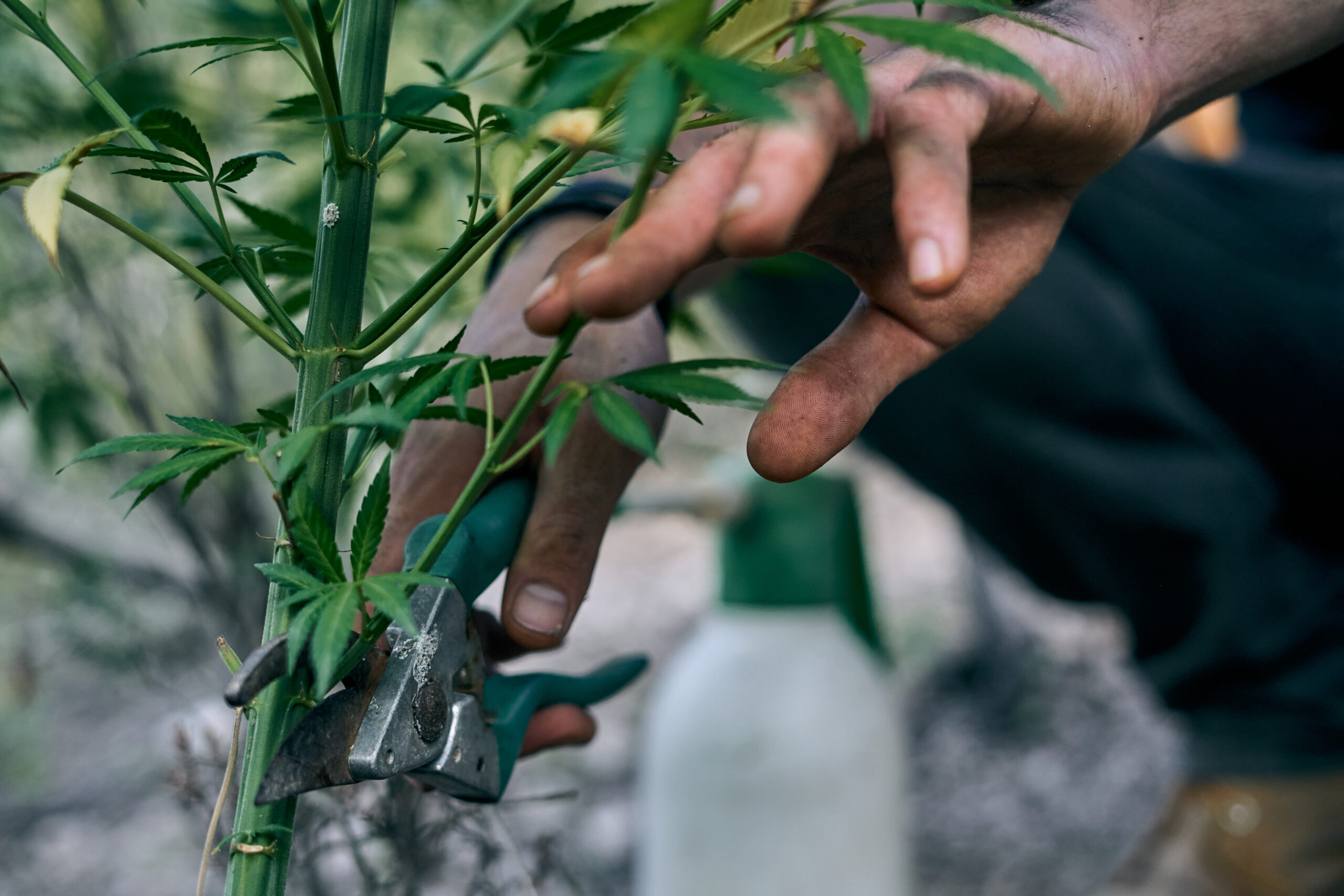
Topping Cannabis Outdoors: When It Helps and When It Does Not
Topping can be useful outdoors, but it is not a requirement for a productive cannabis plant and it is not a guaranteed yield technique. The cut removes the dominant shoot tip and changes how the plant allocates growth among its remaining buds. In a healthy vegetative plant with enough season left, that can reduce height, encourage lateral growth, widen the canopy, and create a structure that is easier to support or inspect. In the wrong plant or at the wrong time, the same cut can simply remove productive tissue and spend recovery time the plant cannot afford.
The practical decision is therefore not, Should outdoor cannabis always be topped? It is: Does changing this plant’s architecture solve a real outdoor problem, and does the plant have enough vigor and vegetative time to rebuild after the cut?
Research supports the idea that apical pruning can alter cannabis height, branching, biomass distribution, light relationships, and in some experiments inflorescence yield. It does not support one universal node, one universal timing rule, or one guaranteed percentage increase in harvest. Genotype, plant size, density, root volume, season length, and the rest of the training system all change the outcome.
What Topping Actually Changes Outdoors
Topping is the deliberate removal of the active apical shoot tip. That matters because a growing shoot apex participates in the hormonal and resource-signaling system that suppresses or slows the outgrowth of axillary buds below it. Remove that dominant apex and the balance changes. Several lateral shoots may then gain relative dominance and extend more strongly.
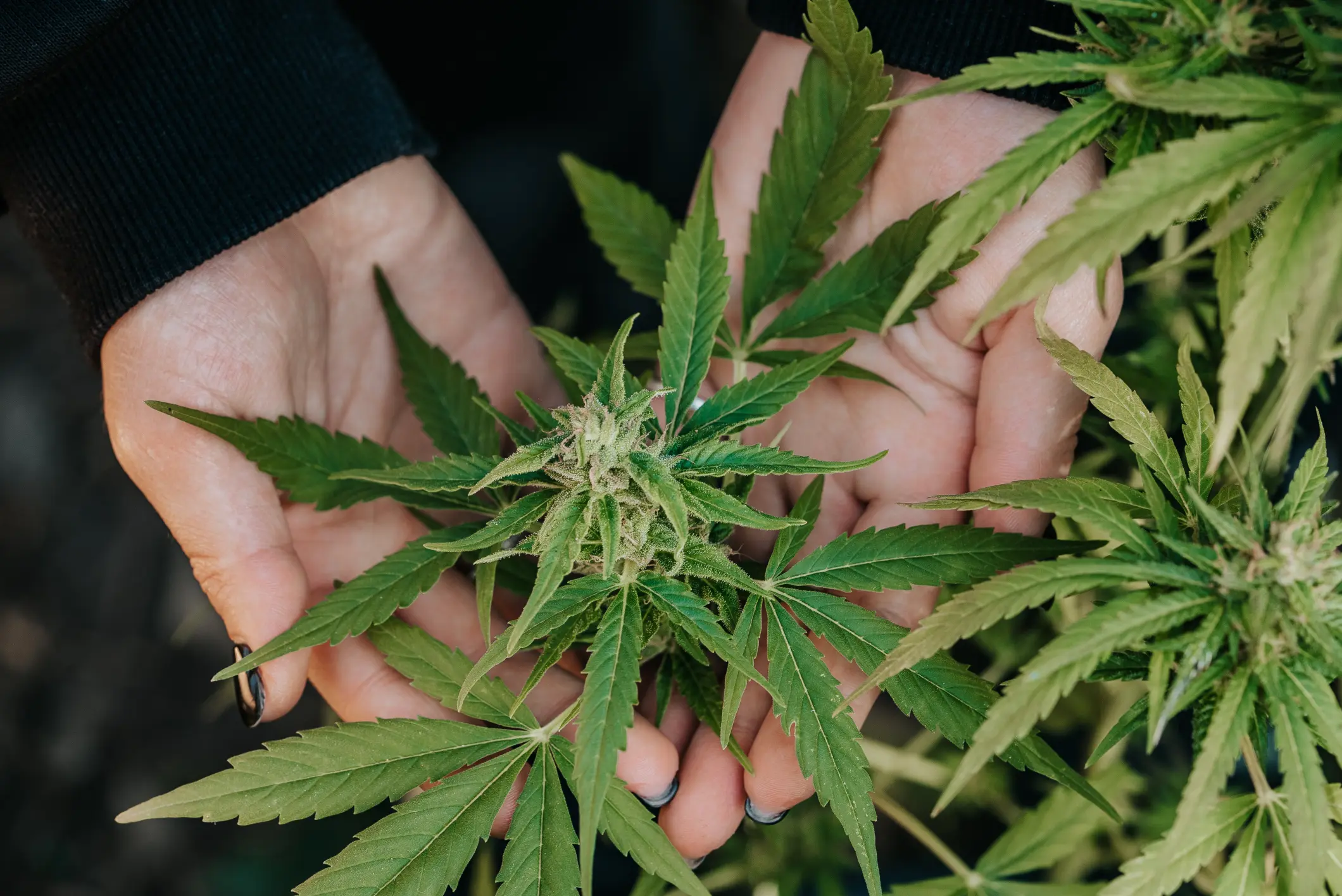
Apical dominance
The tendency of the leading shoot apex to suppress or limit the outgrowth of lateral buds below it. Auxin, cytokinin, strigolactones, sugar signaling, and the competitive strength of other shoots all participate in branching control. Topping changes this system, but it does not reduce branching biology to a single hormone switch.
Why topping changes more than energy flow
The common explanation that topping “redirects all energy to the side branches” is useful as shorthand but biologically incomplete. Shoot branching is regulated by interacting hormonal signals, vascular relationships, local sugar availability, light, and the growth strength of competing buds. The visible result is usually increased lateral development, but the exact response depends on the plant.
This is why two plants cut at similar heights can rebuild differently. One may produce two strongly dominant upper branches. Another may activate several laterals. A third may respond unevenly because one side was already receiving more light or had a stronger root and vascular connection.
Topping usually reduces height and increases lateral structure
Cannabis studies consistently show the architecture effect more clearly than they show a universal yield effect. In a 2026 greenhouse study of two industrial hemp cultivars, topping reduced height and promoted secondary shoot growth. Earlier medicinal-cannabis work likewise found that apical pruning changed plants from a single dominant stem toward a multi-leader structure.
Outdoors, that can be useful when height is becoming difficult to support, when the top would extend above a practical trellis, when the plant is building one very dominant leader, or when a broader structure will make later inspection and support easier. It can also be useful when you want several major branches to share flower weight instead of concentrating much of the plant’s leverage around one vertical axis.
Important: Height reduction is one of the most predictable effects of topping. A fixed yield increase is not.
A wider canopy still needs a practical purpose
Outdoor sunlight moves across the plant through the day. That is different from a fixed indoor light footprint where a relatively flat canopy can be a major design goal. An outdoor plant may already receive strong multi-angle light without being topped. If its natural branching fits the site, an untopped structure can perform very well.
A wider plant also occupies more horizontal space, catches more wind, may lean over paths or neighboring plants, and can create a denser interior if laterals are allowed to overlap. Topping solves a height or architecture problem only if the new width and branch load still fit the garden.
Top for a defined structural reason
Use topping when you need to limit height, encourage lateral leaders, distribute future flower sites, improve access, or fit the plant to an existing support system.
Top because every grow chart says to
If the natural plant already fits the site, receives useful light, and has a manageable support plan, removing the apex may add recovery cost without solving a real problem.
Topping can change access as much as yield
For a home outdoor garden, access can be a legitimate reason to shape a plant. A very tall central leader can make upper flower inspection, caterpillar checks, branch tying, post-rain inspection, and support installation harder. A lower, wider plant may be easier to work around if you preserved pathways and did not let the center become a tangled mass.
This practical benefit is easy to overlook because topping discussions often focus only on grams. A structure that lets you inspect flowers before rot spreads, support branches before a storm, and reach all sides without crushing tissue can improve the quality of management even when topping does not produce a dramatic yield difference.
“Do I have to top a big outdoor plant to get a good harvest?”
Question sent by: Ethan Brooks, via email.
No. A vigorous untopped plant can produce well when its natural height, branch spacing, root volume, season, and support fit the site. Topping is a structural tool. Use it when the new shape gives you a practical advantage, not because an untopped main cola is automatically a mistake.
Best Timing and Plant Condition Before Topping
The best time to top is when the plant has enough established structure to tolerate the cut and enough vegetative runway to rebuild before flowering changes the priority from architecture to reproduction. Calendar age alone is a poor trigger. An actively growing plant with a well-established root system may be ready while another plant of the same age is still recovering from transplanting, drought, cold nights, pest pressure, or root restriction.

Active vegetative growth matters more than a magic node number
A new 2026 study topped two industrial hemp cultivars above the fourth, fifth, or sixth node at 29 days after sowing under greenhouse conditions. The fourth- and fifth-node treatments produced the highest biomass in that experiment. That is useful evidence that nodal position can matter, but it is not a universal outdoor cannabis prescription.
The experiment used two monoecious industrial hemp cultivars in 10 L pots, under a greenhouse natural photoperiod, with topping performed during active vegetative growth. A large photoperiod drug-type plant in the ground, an autoflower, a recently transplanted clone, and a short-season northern garden do not share those conditions.
Do not convert one hemp experiment into a universal fourth-node rule
The fourth- and fifth-node result belongs to the cultivars, container size, environment, timing, and measurements used in that study. Use it as evidence that topping position affects response, not as proof that every outdoor cannabis plant should be cut at the same node.
Look for a plant that is already using its root zone well
Before topping, the plant should be holding normal turgor through the day, producing healthy new growth, and using water predictably. A plant that remains wet for too long, wilts unusually, has stalled new leaves, or recently lost root volume has a more important problem than canopy shape.
Topping removes active tissue at the moment the plant needs to seal a wound and redirect growth. The healthier the root and leaf system, the easier that transition is to absorb. A cut does not repair poor drainage, underdeveloped roots, nutrient imbalance, or chronic water stress.
Do not stack stressors because the calendar says today is training day
A recent transplant, severe heat event, pest outbreak, nutrient correction, major root-zone disturbance, storm injury, or heavy pruning session can already be demanding recovery. Adding topping immediately afterward makes it harder to tell which intervention caused a stall.
Separate major interventions when practical. The goal is not to protect cannabis from every cut. Healthy plants tolerate pruning. The goal is to preserve enough diagnostic clarity that you can see whether the plant recovered normally.
Field Advice: If you would hesitate to remove another healthy shoot because the plant already looks stressed, that is usually a good reason not to top it today.
Season length is part of plant condition outdoors
Indoor photoperiod growers can extend vegetative growth. Outdoor growers cannot add weeks to the season simply because a plant recovered slowly. As natural day length shifts and the cultivar approaches reproductive transition, the value of making a major architecture change declines.
This means the same vigorous plant may be a good topping candidate in early vegetative growth and a poor candidate later. A long-season site can provide more recovery opportunity than a short northern season or an early-finishing cultivar. Autoflowering plants are especially sensitive to lost time because flowering is strongly age-driven rather than delayed by maintaining a long photoperiod.
Weather changes the quality of the recovery window
Choose a period when you can actually observe the plant after the cut. A major heatwave, storm sequence, saturated root zone, or unusually cold period can complicate recovery and increase mechanical risk. You do not need perfect weather, but avoid creating a fresh training problem immediately before conditions that already demand structural or water-management attention.
Outdoor topping is easier to evaluate when the plant returns to normal transpiration and shoot extension without several new stresses arriving at once.
How to Top an Outdoor Cannabis Plant
The physical cut is simple. The decision around it is where most of the value lies. A good topping session begins with the intended final structure and ends with a plan for what the new leaders will do when they elongate.

Step 1: define the architecture you are trying to create
Before touching the plant, look at the available height, horizontal space, sun path, neighboring plants, fence or trellis position, prevailing wind, access path, and likely late-season flower load. Decide whether you want fewer tall leaders, a lower plant, wider branch spacing, or simply a more manageable top.
If you cannot describe the problem topping will solve, wait. The cut is irreversible, while a flexible vegetative stem can often be repositioned later with lower-stress training.
Step 2: choose a healthy cut point, not a memorized node
Select a point that leaves enough established lower structure to rebuild the plant. The nodes below the cut should have healthy axillary shoots or buds with useful spacing. Avoid making the cut through damaged, diseased, hollowing, split, or unusually weak tissue.
The correct location is therefore architectural. On one plant, a lower cut may be needed to control a very dominant stem. On another, preserving more lower structure may be more valuable. Research confirms that nodal position can change plant response, but it does not justify one universal outdoor node count.
Step 3: clean and inspect the cutting tool
Use a sharp pruning shear or clean scissors that can sever the stem without crushing it. Remove visible sap and debris and use a sanitation method appropriate to the disease risk and the product label. A dull blade can mash tissue and leave an irregular wound.
If you are moving from a suspect plant to a healthy one, sanitation deserves more attention than a casual wipe. Tool-borne pathogens and viroids can move through contaminated sap. The exact disinfectant protocol depends on the target organism and validated method, so do not assume one quick alcohol wipe eliminates every cannabis pathogen.
Step 4: make one clean cut above the structure you intend to keep
Support the stem lightly with the other hand so the cutting force does not bend the whole plant or twist the root ball. Remove the apical tip cleanly without slicing into the node or damaging the axillary growth you expect to become the next leaders.
You do not need a large decorative stub, and you do not need to cut so close that the node itself is injured. The goal is simply a clean removal of the dominant apex while preserving healthy tissue below it.
Remove the apex deliberately
Make one clean cut, preserve the node below it, and know which lateral shoots you expect to become the new structural leaders.
Combine topping with random heavy stripping
Removing the apex, many branches, and a large amount of leaf area at once changes several variables and increases the chance that the plant simply loses productive capacity.
Step 5: leave the new leaders room to develop
After the cut, the upper lateral shoots often become more competitive. Watch where they are headed. If they will immediately cross, rub, or crowd the center, topping has created a structure problem rather than solved one.
Soft ties can be used later to guide flexible branches outward. The tie should spread force over a broad contact area and leave room for stem expansion. Do not pull a newly activated branch into a hard angle just to force a perfectly flat shape.
Step 6: anchor ties to something that will not move the root ball
If you combine topping with low-stress training, use stable stakes, a cage, trellis, container rim designed for anchoring, or another support point that can resist the pull. A strong tie attached to a weak pot or loose stake can transfer the load into the roots or tilt the container.
For outdoor containers, stabilize the container before using the plant itself as a structural anchor. For in-ground plants, make sure the training system does not create one rigid direction of pull that becomes dangerous in a reverse wind.
Step 7: record the cut before you judge it
Take one whole-plant photo and one close view of the cut and the upper lateral shoots. Record the date, plant ID, growth stage, and why you topped. This gives you a baseline for recovery.
Without that record, it is easy to remember only the final bushy plant and forget how much time it took to get there. A repeatable training system depends on knowing what happened after the intervention, not just admiring the final silhouette.
“Should I top and tie the new branches down on the same day?”
Question sent by: Julia Schneider, via contact form.
You can plan both techniques together, but there is usually no need to force newly released shoots immediately. Make the topping cut, confirm normal recovery, then guide flexible shoots as they extend. This separates wound recovery from bending stress and makes it easier to see whether the plant is responding normally.
Read Recovery Before You Train Again
Recovery should be judged by plant behavior, not by a fixed number of days. Cannabis studies use specific research schedules, but those schedules are not universal outdoor recovery intervals. A plant in warm, stable vegetative conditions can resume growth differently from one facing cold nights, heat, root restriction, or strong wind.

Normal recovery is a return to active growth
Useful recovery signs include normal leaf turgor, continued water use, healthy color, a dry and stable cut surface, and visible extension of the lateral shoots expected to replace the lost apex. The key is not that the cut disappears. The key is that the rest of the plant resumes normal development.
The architecture should also begin to make sense. If the upper two or several branches are extending into the space you intended, the cut is doing its job. If one branch races vertically while the others remain weak, you may still have an uneven canopy even though the plant is healthy.
A dry wound is different from an expanding lesion
Cut surfaces naturally dry and discolor. That is not the same as soft tissue, spreading dark necrosis, collapse below the cut, unusual odor, or progression into the node. Judge whether the affected area is stable or expanding.
If the wound appears to be deteriorating rather than sealing, stop additional training and inspect the stem and surrounding tissue. Do not hide a questionable wound under tape, sealant, or another product simply because you want to continue the training schedule.
Do not use old damage as the only recovery metric
The removed apex will not regrow. Leaves damaged before topping will not become perfect. Recovery is seen in the new growth and in the plant’s return to normal function.
Remember: The correct question is not “Does the plant look exactly like it did before topping?” It is “Has the plant resumed healthy growth with the new architecture I intended?”
Wait for evidence before repeating the cut
Repeated topping can create more leaders, but every new cut resets part of the architecture and adds another recovery event. Before topping again, wait until the first set of replacement shoots has clearly established, the plant is growing strongly, and you can see where the next cut would improve rather than merely multiply branches.
Do not repeat topping simply because a diagram shows a symmetrical manifold. Outdoor plants grow under unequal sun, wind, and space. A slightly asymmetric but well-supported canopy may be more functional than a perfectly symmetrical structure built through repeated stress.
| What you observe | What it means for the next training decision |
|---|---|
| Healthy lateral extension | The plant is rebuilding around the removed apex. Continue observing until the new leaders are long and flexible enough for any planned guidance. |
| Normal turgor and water use | The root and leaf system appear to be functioning normally. This supports, but does not by itself prove, full recovery. |
| Dry, stable cut surface | Normal wound drying is expected. Continue to watch for spread into the node or stem rather than reacting to harmless discoloration. |
| Persistent wilt or stalled growth | Pause training. Check root-zone moisture, transplant history, heat, pests, nutrient problems, and stem damage before blaming the topping cut alone. |
| Soft or expanding necrosis | Treat this as a health problem, not a training milestone. Stop additional cuts and inspect the affected tissue carefully. |
| One replacement shoot dominates | The plant may be healthy but architecturally uneven. Light, branch position, or gentle later training may be more useful than another immediate topping cut. |
Recovery includes structural stability
A plant can look physiologically healthy while the new leaders are poorly supported. Once topping creates multiple major branches, inspect the unions where those branches emerge. As they thicken and later carry flowers, wind and rain will apply leverage to those junctions.
If the new architecture requires support, install it while branches are still accessible rather than waiting until heavy flowers are already pulling the leaders apart.
When Topping Stops Helping
The value of topping falls when the remaining recovery window becomes short, when stems are no longer easy to reshape, or when the plant has a more urgent stress problem. The technique is most useful while the plant is still building architecture. Once reproductive development becomes the main task, late removal of major growing points becomes harder to justify.
Flowering transition changes the objective
As an outdoor photoperiod plant transitions toward flowering, its growth pattern and resource allocation change. Stretch may still occur, but the grower is no longer working with an open-ended vegetative schedule. A late topping cut can remove sites that were already contributing to the final reproductive structure while leaving limited time to replace them.
There is no universal outdoor calendar date for the last topping. Latitude, cultivar, planting date, seasonal day length, plant maturity, and local weather all matter. Use visible developmental change and remaining season, not a memorized month.
Do not chase symmetry into flowering
A slightly uneven but healthy plant entering flower is usually a better starting point than a freshly cut plant that now needs to rebuild major leaders. Once the training window closes, shift the priority toward support, inspection access, water management, and flower protection.
Rigid stems may favor support over reshaping
Young vegetative stems can often be guided gradually. Older stems become thicker and less forgiving. If a branch strongly resists bending, do not apply more force simply because topping created a shape you now want to flatten.
At that point, external support may be safer than aggressive bending. Stakes, cages, trellis lines, and soft ties can carry load without requiring the branch to be forced into a new angle.
Stop when recovery time is becoming the limiting resource
A long outdoor season can tolerate more structural experimentation than a short one. If the plant is approaching flower, weather is deteriorating, or the cultivar must finish early, every recovery event competes with the remaining productive season.
The decision becomes even more conservative with autoflowering plants. Their reproductive clock is not postponed simply because training slowed them. Some growers successfully top vigorous autoflowers, but the evidence does not support treating topping as a universal autoflower requirement.
Do not top a plant that needs diagnosis first
Persistent droop, chlorosis, root-zone problems, pest injury, distorted new growth, stem lesions, or unexplained stalling should be investigated before canopy training. Removing the apex can temporarily change growth patterns and make diagnosis harder.
If the plant is already struggling, the highest-value intervention is usually to identify the limiting factor and restore normal growth. Topping a weak plant does not convert stress into vigor.
Do not use topping as emergency wind protection
Reducing plant height weeks earlier can produce a more manageable form, but cutting the top immediately before a storm is not a substitute for structural preparation. Wind load depends on total canopy area, branch leverage, flower mass, root anchorage, support geometry, and gust direction.
A topped plant can still become broad and wind-exposed. Storm planning belongs to the support system, not to a last-minute pruning reaction.
“My plant is getting too tall, but it has already started flowering. Should I top it now?”
Question sent by: MapleGrower, via Facebook page.
Usually the better question is whether you can support, guide, or safely reposition the existing structure without removing reproductive growth. Once flowering is underway, the recovery window is narrower and the removed top cannot contribute to harvest. Reserve a late cut for a real safety or damage-management reason rather than routine canopy shaping.
Yield Claims vs Reality
Research makes a useful distinction possible: topping can increase yield in some cannabis systems, but it does not create a universal yield multiplier. The outcome depends on genotype, plant size, plant density, timing, pruning severity, light distribution, and how much productive tissue remains.
One CBD-rich cannabis experiment found more inflorescence biomass after topping
A medicinal cannabis study comparing an apical cut, lower-side-shoot removal, and an unpruned control found that topped plants produced greater leaf and inflorescence biomass than the other pruning treatments. The topped plants developed longer side shoots and a broader distribution of terminal inflorescences.
That result supports the mechanism: removing apical dominance can redistribute growth into side shoots and alter where flowers develop. It does not prove every outdoor drug-type plant will produce more final usable flower after topping.
A 2026 hemp study found strong node and cultivar effects
The 2026 two-cultivar hemp study found higher fresh and dry biomass in topped plants, with the strongest results at the fourth and fifth nodes under its greenhouse design. It also found that the response magnitude differed between cultivars. That genotype effect matters.
The practical lesson is not “top above node four.” The practical lesson is that where and when the apex is removed can change the response, and cultivar matters enough that one recipe should not be treated as universal.
Large medical cannabis studies show architecture can change yield and chemical uniformity
Research on large medical cannabis plants around 2.5 m tall found that architectural manipulation changed light penetration, inflorescence yield, and cannabinoid uniformity. In that experiment, double pruning produced the highest cannabinoid yield per plant, while severe removal of primary branches dramatically reduced inflorescence yield.
This is an important warning against the idea that more pruning automatically means more production. Architecture can increase access to light and redistribute growth, but excessive removal can also remove meristems and photosynthetic area that the plant needed to produce flowers.
| Research finding | What you can and cannot conclude outdoors |
|---|---|
| Topping reduces height and promotes lateral growth | This is a consistent architecture effect and a strong reason to use topping for height and branch redistribution. It does not guarantee a specific final shape. |
| Some studies report higher inflorescence or biomass yield | Topping can improve production in particular genotypes and systems. The percentage gain cannot be transferred directly to a different cultivar, season, pot size, or outdoor site. |
| Nodal position changed the result in two hemp cultivars | Cut position matters. The studied fourth- and fifth-node advantage is experimental context, not a universal cannabis rule. |
| Large-plant architecture affects light penetration | A broad canopy can redistribute light and chemical uniformity, but dense lateral growth can also create shading if spacing and training are poor. |
| Severe branch removal reduced yield sharply | Training has a cost. Removing too much active meristem and leaf area can reduce productive capacity instead of improving it. |
| Cultivars respond differently | Use the first season as data. Record height, branch response, recovery, support demand, harvest distribution, and whether topping solved the original problem. |
Redistribution is a better mental model than multiplication
Topping does not create energy. It changes the plant’s architecture and therefore changes how leaves, shoots, light, and future inflorescences are distributed. If the new structure captures useful light more effectively and fits the root zone and season, production may improve. If the plant becomes overcrowded, recovery is slow, or major productive tissue is repeatedly removed, yield can stagnate or decline.
This is why a useful topping record should include more than final dry weight. Record plant height, canopy width, number and position of major leaders, broken branches, support requirements, disease access, lower-canopy shading, and the distribution of harvest across the plant. A plant that yields similarly but is easier to manage may still justify the technique.
Master Advice: Treat topping as canopy engineering, not as a yield button. The technique earns its place when the new structure uses the site better than the old one would have.
Outdoor sunlight can reduce the need for extreme flattening
Indoor growers often train toward a level canopy because lamp distance strongly affects light intensity. Outdoors, the sun changes angle and position. That does not make canopy architecture irrelevant, but it changes the optimization problem.
A well-spaced outdoor plant can use vertical depth productively. You do not need every flower at the same height. The goal is useful light penetration, airflow, access, and structural stability, not a perfectly flat roof of branches.
Yield quality can matter more than total biomass
Large-plant cannabis research shows that lower, heavily shaded inflorescences can differ chemically from well-lit upper flowers. Architecture that improves light penetration may therefore affect spatial uniformity as well as total mass. Again, the direction and magnitude are treatment- and cultivar-specific.
For a home outdoor grower, this means the best training result is not necessarily the plant with the most branches. It is the plant whose productive branches remain well lit, inspectable, supportable, and able to finish cleanly.
Late-Season Support and the Final Topping Decision Checklist
Topping changes the plant long after the cut has healed. The new lateral leaders can become long lever arms carrying wet, heavy flowers. The wider canopy may catch more wind and may require more attachment points than the original single-stem form. Late-season success therefore depends on whether the support system evolves with the architecture.
Map the new major leaders before they become heavy
As topping response becomes clear, identify which branches are likely to carry the greatest flower load. Give those leaders independent support where practical. A single central stake may no longer match a plant that now has several dominant arms.
Leave enough movement for stems to strengthen and enough access to inspect branch unions. Support should reduce destructive leverage, not bind the entire plant into one rigid mass.
Keep access lanes open
A very successful topping response can create an access problem. If branches fill every gap, later flower inspection becomes harder precisely when rain, caterpillars, mildew, and rot deserve closer attention.
Guide leaders outward with space between them instead of allowing all lateral growth to stack into the center. The objective is not an empty plant. It is a canopy you can still see into and reach without crushing flowers.
Recheck ties as stems thicken
Soft ties that were safe during vegetative growth can become restrictive as stems expand. Reinspect every contact point. A tie should support or guide the branch without cutting bark, trapping moisture, or preventing normal thickening.
After wind or heavy rain, inspect the branch unions created by the new architecture. Look for shifting stakes, stretched ties, rubbing, split crotches, branch lean, and flowers compressed against other surfaces.
Before you top an outdoor cannabis plant
- Define the structural problem topping is supposed to solve.
- Confirm the plant is in active vegetative growth and is not recovering from another major stress.
- Check that the root zone is functioning normally and the plant is using water predictably.
- Estimate the remaining vegetative runway instead of relying on plant age alone.
- Choose the cut point from the plant’s real branch structure, not a universal node recipe.
- Use a sharp, clean tool and preserve healthy axillary growth below the cut.
- Record a whole-plant and close-up photo before judging recovery.
- Wait for healthy lateral extension and normal function before another major intervention.
- Stop topping when flowering transition, stress, rigid stems, or limited season make recovery the limiting factor.
- Plan support for the wider multi-leader canopy before flower weight develops.
- Keep inspection access between branches and through the canopy interior.
- Judge success by structure, recovery, support demand, flower distribution, and final harvest, not by branch count alone.
An outdoor plant does not need to be topped to be well grown. Topping is valuable when it creates a structure that better matches the site, season, support system, and management goals. It is less useful when the plant is already stressed, the natural architecture already works, or the remaining season is too short to rebuild what was removed.
The strongest decision is therefore simple: top only when the architecture you expect after recovery is more useful than the architecture you have now.
Share this article
A quick overview of the topics covered in this article.
Follow us
Latest articles
September 24, 2026

September 24, 2026
September 24, 2026
September 24, 2026