
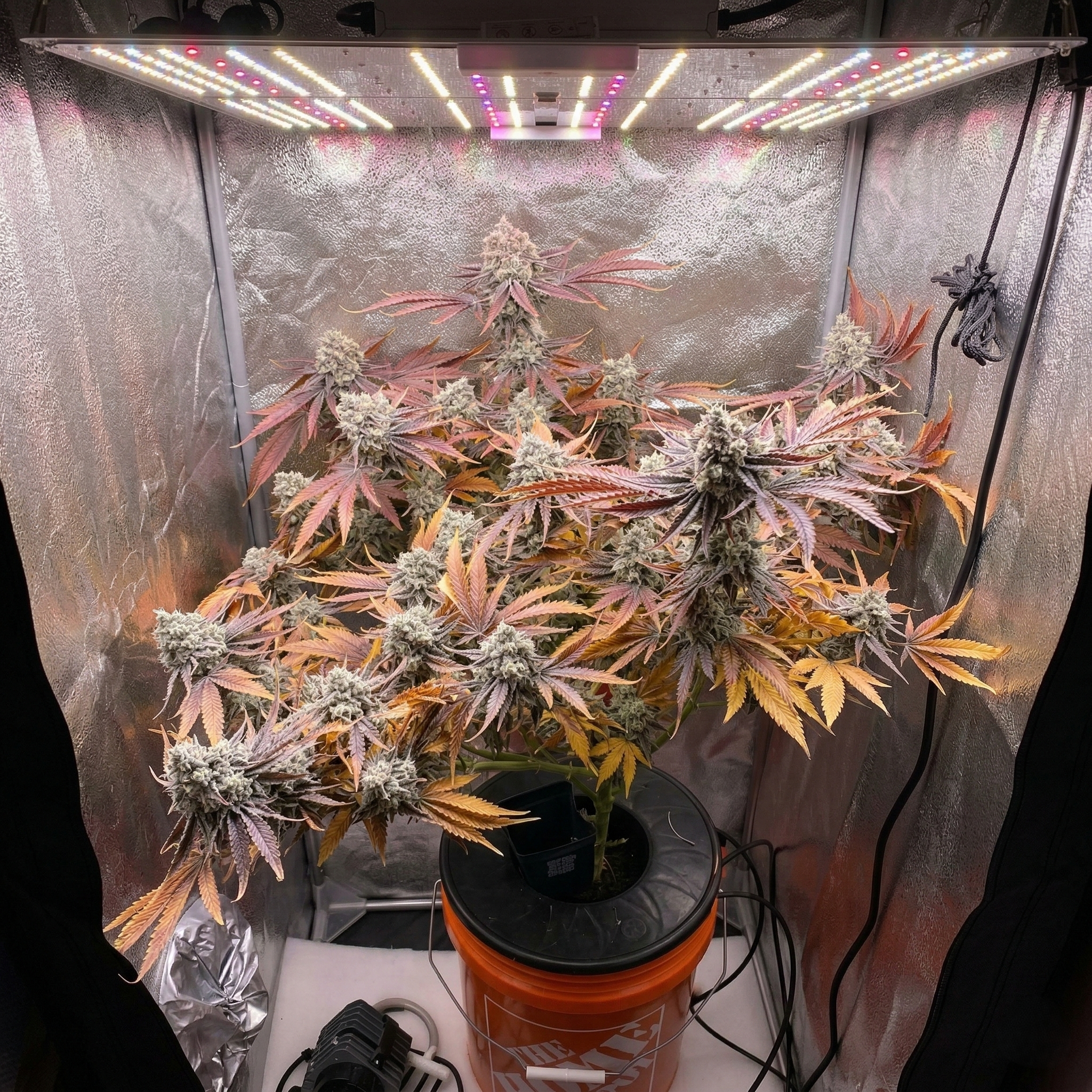
What Color LED Is Best for Cannabis Growth?
What Color LED Is Best for Cannabis Growth?
The best LED color for cannabis growth is usually not one color. A quality broad-spectrum white LED, with a meaningful blue component and enough red output, is the most useful single answer for a complete indoor crop. It lets a plant build compact, functional vegetative growth, supports normal flowering, and makes it much easier to inspect leaf color, pests, nutrient issues, and flower condition.
The familiar shortcut is simple: blue for veg and red for bloom. There is a real biological reason behind it, but it becomes misleading when it turns into a buying decision. Cannabis responds to the whole light environment: photon intensity at the canopy, spectrum, photoperiod, fixture coverage, heat, root-zone health, and cultivar. A purple fixture can grow plants. It is rarely the clearest or most forgiving route to a healthy, high-quality crop.
Let’s make the decision practical. This guide explains what each useful color range does, why white full-spectrum LEDs are usually the better base, when a spectrum adjustment can help, and what to check before blaming color for a problem that is actually caused by too much or too little light.
Advice: Start by choosing a fixture that can deliver even, dimmable PPFD across the canopy. Spectrum matters, but a well-balanced light at the wrong intensity still produces avoidable problems.
Light spectrum is the mix of wavelengths a fixture produces, not simply the color your eyes see.
White LEDs can contain substantial blue, green, and red photons. A fixture that looks pink or purple may be dominated by narrow red and blue peaks. Plants respond to the photon distribution and intensity at leaf level, while growers also need enough visible light to judge plant health accurately.
Why full-spectrum white LED is usually the best answer
A broad-spectrum white LED is the practical default because it covers the photosynthetic range while giving the grower a readable working environment. Blue and red photons are strongly involved in photosynthesis and plant development, but green photons are not wasted. They can move deeper into leaves and through a canopy, where they still contribute to photosynthesis.
That broader distribution also makes diagnosis easier. Under heavily purple lighting, early chlorosis, pest damage, nutrient burn, and subtle powdery mildew can be harder to see. A white fixture will not prevent every problem, but it removes one unnecessary obstacle when you are trying to read a living plant.
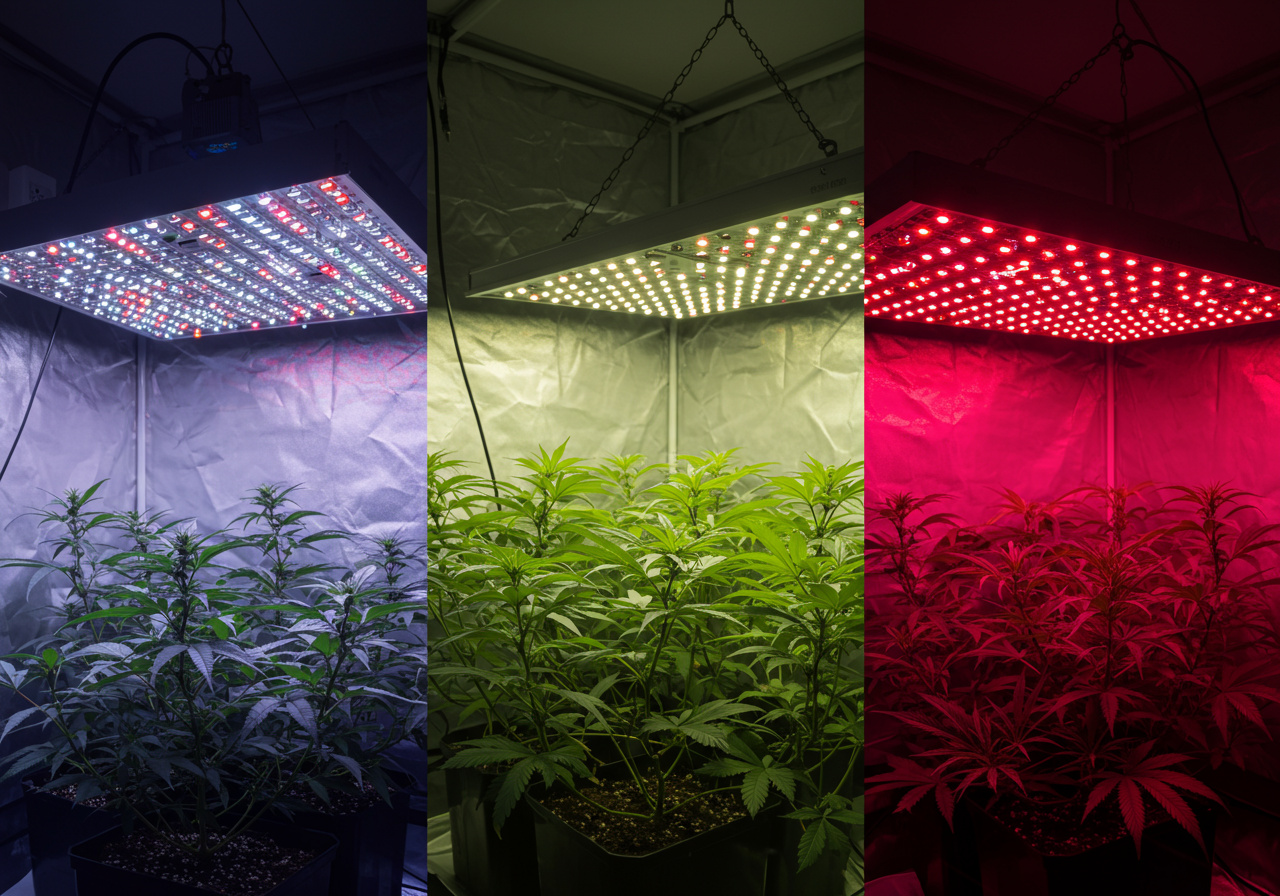
University of Minnesota Extension notes that white or mixed lights are suitable across plant stages, while lumens and nominal wattage do not tell a grower how much plant-usable light reaches the canopy. For cannabis specifically, controlled research also shows that spectral response changes with light intensity and cultivar. That is why no single diode color can honestly promise the best result for every room.
What blue, red, green, and far-red light actually do
Colors are a useful way to talk about spectrum, but they should not be treated as separate on-off switches. A plant experiences all wavelengths together, then responds according to the total environment around it.
| Range | Typical role | What a grower may notice | Practical limitation |
|---|---|---|---|
| Blue, roughly 400 to 500 nm | Supports photosynthesis and photomorphogenic responses. | More compact vegetative structure is commonly associated with an adequate blue fraction. | Blue alone is not a complete flowering solution and can make a room difficult to inspect. |
| Green, roughly 500 to 600 nm | Contributes to photosynthesis and can penetrate further through leaves and canopy layers. | Broad white fixtures are easier to work under and inspect. | Do not judge usefulness only by chlorophyll’s visible absorption peaks. |
| Red, roughly 600 to 700 nm | Efficiently drives photosynthesis and interacts with flowering-related light signals. | Strong red output is common in effective flowering fixtures. | Extra red does not replace sufficient PPFD, root health, or a correct photoperiod. |
| Far-red, roughly 700 to 750 nm | Influences phytochrome signaling and shade-avoidance responses. | May alter stretch and development when used deliberately. | It is an advanced lever, not a mandatory addition or a free yield button. |
Blue light is often associated with shorter internodes and compact vegetative growth. That does not mean a plant wants an all-blue fixture. When blue is used as part of a broad spectrum at a sensible intensity, it can help a plant develop a manageable structure. If the canopy is stretching excessively, first check actual PPFD, hanging height, fixture spread, temperature, and cultivar behavior. Do not assume the answer is simply to buy a bluer lamp.
Red photons are highly useful for photosynthesis and are a large part of most modern flowering fixtures. But an all-red approach creates a narrow environment that is difficult to inspect and does not automatically produce better flowers. Flower density, resin expression, and aroma depend on genetics, intensity, environmental stability, nutrition, root function, and harvest handling as well as spectrum.
Remember: A plant can stretch under an expensive full-spectrum fixture if the canopy PPFD is too low or uneven. Before changing spectrum, measure or estimate the light actually arriving at the tops.
Is blue LED best for vegetative cannabis growth?
Blue is useful during vegetative growth, but “best” still means a balanced spectrum with enough blue rather than blue-only light. Broad white fixtures with a cool-to-neutral visual appearance often contain a stronger blue component than warmer white fixtures, and many modern horticultural LEDs offer a spectrum designed to work from propagation through flowering without changing the fixture.
For a young plant, intensity and distance matter just as much as color. A weak lamp with a cool color temperature can still cause long internodes if it is too far away or does not cover the canopy. A strong lamp set too close can bleach or curl new growth even when its spectrum is excellent.
“My vegetative plant is tall and loose under a white LED. Do I need a blue-only lamp?”
Question sent by: Olivia Chen, via e-mail.
Probably not as the first response. Check the measured or estimated PPFD at canopy height, the fixture’s dimmer setting, the distance to the tops, the uniformity at the edges, and whether the cultivar naturally stretches. A balanced LED at an appropriate intensity is often enough. Blue-only lighting can complicate the rest of the crop without fixing weak coverage or a low-intensity canopy.
A sensible vegetative-lighting approach
Start young plants conservatively, then increase light only when roots, leaf posture, water use, and new growth show that the plant can use more. For many indoor gardens, a broadly useful starting zone is around 200 to 400 umol/m2/s PPFD for established vegetative plants, with seedlings and fresh clones below that range. These are working ranges rather than universal prescriptions. A vigorous rooted plant in coco under stable climate may accept more than a small plant in soil that is still establishing its root system.
A grower’s goal in vegetation is not to make the light look blue. It is to build a level, healthy canopy with enough leaf area and branch structure to use the flower-stage light that comes later.
Is red LED best for flowering cannabis?
Red light is a valuable part of flowering spectrum, but red-only lighting is not the best default for cannabis flowers. Modern broad-spectrum flowering LEDs already include substantial red output alongside white, blue, and usually some green. That combination supports productive photosynthesis while retaining the visual clarity needed to inspect leaves and flowers.
The larger flower-stage decision is usually intensity. Cannabis research has found yield to rise with increasing indoor light intensity over the tested range when plants were otherwise supported, but the useful ceiling depends on CO2 level, leaf temperature, airflow, irrigation, cultivar, and the plant’s ability to use that light. Adding more red while the root zone is dry, the room is hot, or the canopy is already stressed is not a flowering strategy.
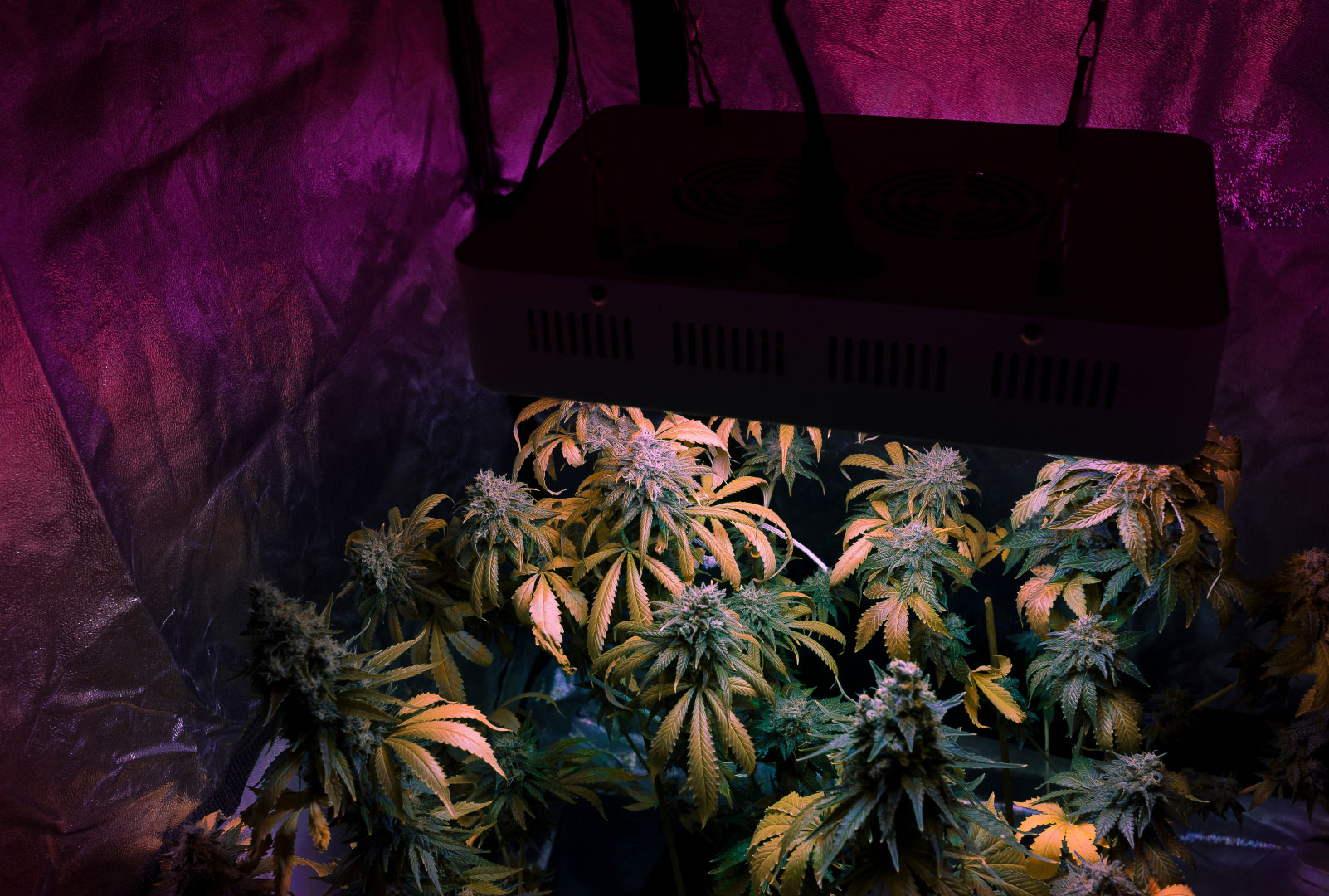
Use the fixture’s dimmer and hanging height to build up flower intensity gradually.
Increase light in response to healthy leaf posture, water use, and a stable room. Keep the whole canopy within a useful range rather than creating one extreme center hotspot.
Buy a red booster because flowers look smaller than expected.
Small flowers can reflect genetics, insufficient overall PPFD, heat, drought, poor coverage, an immature crop, or an unhealthy root zone. Diagnose the limiting condition first.
What about purple blurple LEDs?
Older red-blue “blurple” fixtures can grow cannabis, and a well-run crop under one does not become invalid because the fixture looks dated. The problem is not that red and blue photons are useless. The problem is that a narrow spectrum usually gives the grower fewer practical advantages than a modern broad-spectrum fixture with comparable efficiency and coverage.
Blurry visual diagnosis is the everyday cost. Purple lighting can hide early yellowing, nutrient burn, pest stippling, pale new growth, and developing mold. Some fixtures also publish incomplete performance data, making it hard to compare their real PPFD map and photon efficacy with a broad-spectrum bar light.
If you already have a working blurple fixture, use it safely, check the actual canopy intensity, and supplement room light briefly for inspection if needed. There is no need to throw away a functioning fixture mid-cycle. If you are buying new, prioritize a broad-spectrum, dimmable LED with credible power draw, efficacy, and PPFD-map data.
Does far-red make cannabis grow faster?
Far-red is more nuanced than the marketing around it. It can affect phytochrome signaling and can encourage shade-avoidance traits such as elongation, depending on the red-to-far-red balance, timing, intensity, and cultivar. That may be useful in a controlled strategy, but it can also make a space-limited canopy more difficult to manage.
Far-red also sits outside the traditional 400 to 700 nm PAR definition, although modern horticultural measurement increasingly considers the wider 400 to 750 nm range. This does not make far-red a universal add-on. It means a grower should treat it as a targeted choice and observe the plant’s response rather than expecting automatic improvement.
Pro Tip: If you are still learning your fixture, run its main broad-spectrum output well before adding far-red schedules, UV accessories, or bloom boosters. A stable baseline gives you a meaningful way to judge one change at a time.
“Should I add far-red to make my flowering plant finish with bigger buds?”
Question sent by: Daniel Foster, via Facebook page.
Do not treat far-red as a finishing additive. It may change morphology and signaling, but it cannot compensate for low average PPFD, uneven coverage, water stress, or a cultivar’s normal flowering time. Establish a stable broad-spectrum baseline first. Only test far-red when you can keep notes, control the environment, and compare the change without also altering nutrition, irrigation, or canopy management.
Why PPFD and DLI matter more than fixture color
PPFD measures the density of photosynthetic photons arriving at a surface each second. DLI, or daily light integral, combines PPFD with the hours of light in a day. These metrics are more useful than a fixture’s advertised color, “equivalent wattage,” or visual brightness.
For example, two white LEDs can look nearly identical to a person while producing different photon output, coverage patterns, and canopy intensity. A dimmable fixture with a transparent PPFD map lets you set a sensible starting point and make measured changes. A fixture described only as “full spectrum” leaves much more guesswork.
| Stage | Typical starting PPFD | What matters most | Watch for |
|---|---|---|---|
| Seedling or fresh clone | About 100 to 250 umol/m2/s | Gentle, even light while roots establish. | Bleaching, slow rooting, stretched stems, a medium staying wet too long. |
| Vegetative growth | About 200 to 500 umol/m2/s | Healthy roots, even canopy, appropriate distance and dimming. | Weak lower coverage, excessive stretch, leaf stress after a sudden increase. |
| Early flower | About 450 to 700 umol/m2/s | Gradual transition and a controlled canopy. | Top hotspots, rapid dry-back, heat buildup, unmanageable stretch. |
| Established flower | Often about 650 to 900 umol/m2/s without supplemental CO2 | Uniformity, leaf temperature, irrigation, and a cultivar-specific response. | Bleached tops, upward leaf curl, stalled water use, overly dry air or heat. |
Those numbers are a framework, not a dare. A modest, even 650 umol/m2/s canopy can be more productive than a tent with a 1,000 umol/m2/s center and weak corners. The target should always reflect the plant’s condition and the rest of the room.
Use the plant and the meter together
A measurement gives the grower a starting point, not permission to ignore the plant. Let’s raise intensity only after the roots are active, the leaves stay calm through the light period, irrigation is keeping pace, and the room can hold temperature and humidity without swinging.
Then keep the next adjustment small. When the canopy responds well, the change is easier to understand. When it responds poorly, the correction is simpler than it would be after changing the dimmer, spectrum, nutrients, and watering routine all at once.
How to choose LED color by your actual goal
The decision becomes clearer when it is based on the garden rather than the product label.
- For a first complete indoor setup: choose a dimmable broad-spectrum white LED with an honest PPFD map for the footprint.
- For compact vegetative structure: use a balanced fixture with an adequate blue fraction, then correct height and PPFD before chasing spectrum.
- For flowering: use the same broad-spectrum base, increase intensity gradually, and protect the root zone, temperature, and airflow.
- For a short tent: prioritize low-profile fixture design, dimming, spread, and heat management. Extra far-red may make height management harder.
- For diagnosis: favor white or broad-spectrum light because it shows the real condition of leaves and flowers.
Common LED color mistakes that cost quality
Buying by “purple versus white” instead of performance data
Look for actual power draw, photon efficacy, a PPFD map at the intended hanging height, dimming range, and realistic coverage. A color label cannot tell you whether corners are lit well or whether the fixture will be manageable in your tent.
Changing spectrum to solve a light-intensity problem
Plants often stretch because the canopy is underlit, unevenly lit, or too far from the fixture. They show top stress because PPFD, leaf temperature, dry air, or root-zone demand is too high. Spectrum can influence morphology, but it is not the first diagnosis for every lighting symptom.
Adding red, far-red, or UV before establishing a baseline
Extras make it harder to identify cause and effect. They can also encourage a grower to ignore the larger limitations: a poor PPFD map, a hot driver inside a small tent, weak airflow, or inconsistent irrigation. Dial in the main fixture before adding a separate spectral channel.
Do not look directly into high-output LED diodes or work on a wet electrical setup.
Bright horticultural fixtures can strain eyes, and water, damaged cables, overloaded circuits, or loose hanging hardware create real electrical and fire risks. Use rated equipment, keep connections dry and elevated, and get qualified help when mains work exceeds your competence.
How to tell whether the light color is actually the problem
Before buying a new fixture or spectrum supplement, work through the conditions that have a larger effect on the plant.
| What you see | Possible cause | Check first | Useful first action |
|---|---|---|---|
| Long internodes | Low PPFD, poor edge coverage, high heat, cultivar tendency. | Canopy PPFD, hanging height, fixture map, temperature. | Improve even intensity before changing diode color. |
| Bleached or curled upper leaves | Excessive light, heat, dry air, wind, root stress. | Top-canopy PPFD, leaf temperature, humidity, airflow, pot moisture. | Reduce stress and give the plant time to respond. |
| Small flowers | Insufficient total light, genetics, root limitation, heat, early harvest. | Average PPFD, canopy depth, root health, flowering stage. | Protect a stable, adequately lit canopy instead of adding a red booster. |
| Hard-to-read leaf color | Narrow purple fixture. | Inspect under neutral white room light. | Use broad spectrum for routine diagnosis or add safe inspection light. |
“My top leaves are fading under a full-spectrum LED. Is the spectrum too blue?”
Question sent by: Avery Lawson, via contact form.
Blue content may be part of a fixture’s overall spectrum, but fading at the top is more often a cue to check excessive PPFD, fixture distance, leaf temperature, root-zone EC, water availability, and whether the issue is limited to the brightest sites. Make one evidence-based correction, then watch new growth. Do not change feeding and spectrum together unless you have a clear reason for both.
Frequently asked questions about LED color for cannabis
Can cannabis grow under regular white LEDs?
It can grow under suitable white LEDs, but many household bulbs lack the intensity, spread, cooling, and durability needed for a full productive canopy. For a small propagation area they may be useful. For flowering, compare actual PPFD and coverage rather than relying on bulb color or household wattage.
Should I switch from blue to red light when flowering starts?
Not when using a good broad-spectrum fixture. Its red and blue output can support both stages. A dimmer adjustment, hanging-height adjustment, or a controlled increase in total PPFD is usually more useful than replacing the color of the entire light at the flip.
Is 3000K or 5000K better for cannabis?
Color temperature is only a shorthand for how warm or cool white light appears. A 3000K fixture often has relatively more red, while a 5000K fixture often has relatively more blue, but two fixtures with the same Kelvin rating can still have different spectra and output. Check the actual spectrum, PPFD map, efficacy, and coverage. A broad-spectrum fixture designed for full-cycle horticulture is usually more useful than choosing by Kelvin alone.
Does UV make cannabis more potent?
Do not assume it does. Research is limited and results depend on dose, cultivar, and the rest of the environment. UV can also stress plants and pose eye and skin hazards. Treat it as advanced, optional equipment rather than a required route to quality flowers.
Do I need a PAR meter?
A quality quantum sensor is the most direct way to verify PPFD, but a published map, a responsible fixture manufacturer, and careful observation still help when a meter is unavailable. Phone apps can provide rough comparisons, but they are not a substitute for a calibrated horticultural measurement when making high-intensity decisions.
Choosing a spectrum that keeps the whole crop manageable
For most cannabis gardens, choose a broad-spectrum white LED that covers the actual canopy evenly and can be dimmed. Keep enough blue in the spectrum to support compact, functional growth. Let the fixture’s existing red output support flowering. Treat far-red, UV, and narrow-spectrum supplements as later experiments, not the foundation of the room.
The strongest lighting decision is rarely the one with the most colorful diodes. It is the fixture that gives you clear plant visibility, useful coverage, controllable intensity, manageable heat, and a stable canopy from the first rooted plant through harvest.
- The fixture is a broad-spectrum white or mixed horticultural LED rather than a narrow-spectrum guess.
- It publishes actual power draw, efficacy, and a PPFD map for your intended footprint.
- The fixture is dimmable and fits the usable height of the tent or room.
- You can provide even light from the center to the edges of the canopy.
- You have a plan to inspect plants under clear, neutral light.
- You will increase intensity gradually as roots and water use develop.
- The electrical circuit, hanging hardware, ventilation, and water routing are safe.
- You will change one major lighting variable at a time.
Selected research behind this guide
Light response is cultivar- and environment-dependent. The practical recommendations in this guide are supported by research on cannabis lighting, broad-spectrum LED performance, and horticultural lighting measurement:
Share this article
A quick overview of the topics covered in this article.
Follow us
Latest articles
October 26, 2026
October 26, 2026
October 26, 2026
October 26, 2026