
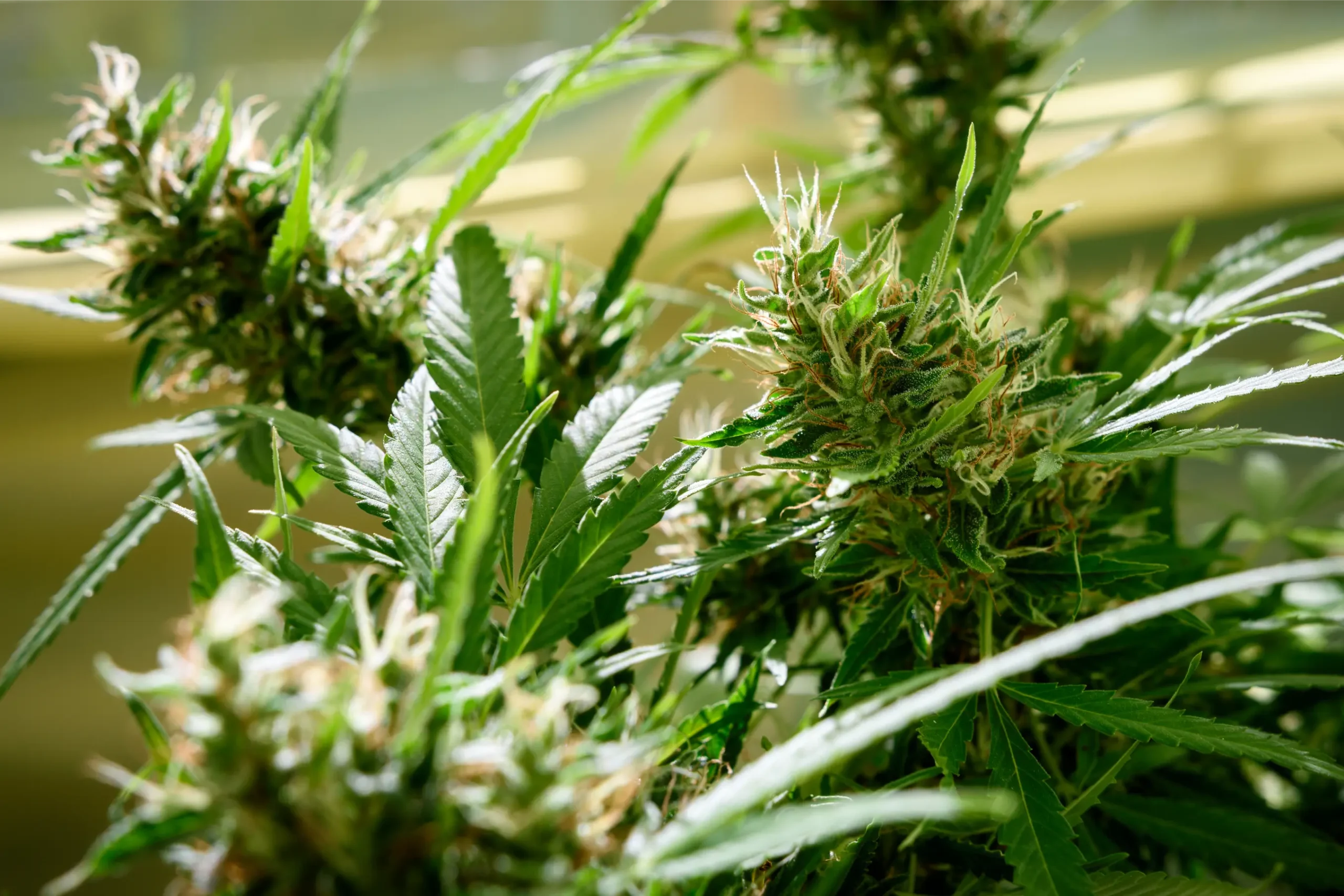
Afgoo
A compact Afghani-Haze hybrid with vigorous branching, sticky pine-and-earth flowers, strong feeding capacity, and a sedating finish that builds behind a brief euphoric lift.
Afgoo, also called Afgooey or Afghan Goo, is an indica-dominant cultivar commonly linked to Afghani and Island Maui Haze ancestry. It grows like a thick, bushy indica but carries a brighter aromatic and mental edge than a pure hash plant. The flowers are sticky, dense, and pungent, with pine, earth, wood, tar, herbs, and occasional tropical sweetness.
Its grow reputation is built around vigor and yield. Afgoo can accept stronger feeding than many compact indicas and responds well to SOG, SCROG, topping, and low-stress training. The danger is assuming that vigor makes it invulnerable. Heavy branches, crowded interior foliage, and resinous buds create a late-flower microclimate that needs active management.
The strongest Afgoo harvests come from a plant that is opened early, supported before swelling, and allowed to finish without excess nitrogen. The flavor target is not generic pine. It is fresh conifer, damp earth, wood resin, sweet herbs, and a dark tar-like finish preserved through a cool, controlled dry.
Strain Features
| Feature | Details |
|---|---|
| Strain Type | Indica-dominant hybrid with a compact frame and a brief uplifting phase before heavy relaxation. |
| Lineage | Commonly described as Afghani crossed with Island Maui Haze or closely related Maui Haze material. |
| THC Range | Often around 17-23%, with substantial batch variation. |
| CBD | Usually low. |
| Dominant Terpenes | Commonly myrcene, ocimene, and pinene, with beta-caryophyllene, limonene, and humulene varying by phenotype. |
| Aroma | Pine, damp earth, wood, herbs, tar, hash, spice, and mild tropical or sweet fruit. |
| Effect Character | Euphoric and centered at first, then relaxed, hungry, heavy, and sleepy. |
| Flowering Time | Approximately 7-9 weeks indoors; many plants finish close to eight weeks. |
| Outdoor Harvest | Late September to mid-October in suitable Northern Hemisphere climates. |
| Height | Short to medium, commonly 100-130 cm indoors depending on training. |
| Stretch | Low to moderate. |
| Yield | Moderate to high with strong light, root oxygen, and an open canopy. |
| Bud Structure | Dense, sticky, rounded-to-conical flowers with high resin coverage. |
| Training Response | Strong response to topping, LST, SCROG, and carefully spaced SOG. |
| Feeding Behavior | Can accept moderate-to-strong nutrition when healthy, but late nitrogen should be reduced. |
| Main Cultivation Risk | Crowded inner growth, heavy branches, strong odor, and moisture inside dense flowers. |
| Grow Difficulty | Moderate and forgiving when irrigation and airflow are controlled. |
| Best Time of Use | Evening or nighttime; small doses may suit late afternoon. |
Afgoo’s Afghan structure gives it a broad, leafy frame, while the Maui Haze side helps explain the subtle uplift, occasional tropical sweetness, and slightly more flexible branching than a pure compact indica.
The cultivar is often called easy because it is vigorous. A more accurate description is responsive. It rewards confident training and nutrition, but the late flowers still require disciplined humidity control.
Genetic Lineage
Afghani foundation
The Afghani side provides broad leaves, short internodes, strong resin, a heavy body effect, and the ability to build compact flowers quickly. It also contributes the earthy, hashy, woody foundation and explains why Afgoo often remains manageable in height.
In the garden, this influence creates a plant that can become wider than expected. Side branches rise quickly after topping and can crowd the center if they are not guided outward. The flowers gain density faster than their visible size suggests.
Maui Haze influence
The Maui Haze side adds a brighter mental onset, more flexible branch development, and occasional tropical, floral, or sweet herbal notes. Some phenotypes show slightly longer internodes and a clearer effect before the body stone takes control.
This is not usually enough sativa influence to make Afgoo tall or slow. It acts more like a lift inside an indica framework, creating a cultivar that can feel centered and euphoric before becoming strongly sedating.
Clone history and phenotype drift
Afgoo circulated for years as selected clone material before seed reproductions became common. That history matters because not every product carrying the name represents the same plant. Some expressions are extremely compact and tar-earth dominant. Others branch more and carry clearer pine, citrus, or tropical notes.
Keeper selection
A useful keeper should combine manageable density, strong lateral structure, and aroma that survives cure. The heaviest plant is not automatically the best if it produces excessive leaf, hidden moisture, or flat earthy smoke. Compare dry yield, resin, flavor, and effect together.
Lineage note: The most recognizable Afgoo expression combines Afghan density and resin with enough Haze lift to keep the opening from feeling flat.
Effect Breakdown
Initial lift
Afgoo can begin with more brightness than its compact indica structure suggests. Mood may rise, thoughts feel centered, and a small amount can create focused euphoria. Some users describe a brief creative or giggly phase.
The opening is usually calm rather than speedy. It does not remove the underlying physical weight; it delays it. This makes Afgoo easy to underestimate during the first part of the session.
Physical descent
The body effect strengthens steadily. Shoulders release, limbs feel heavier, and movement becomes less appealing. Appetite commonly increases. The effect may feel warm and resinous, matching the strain’s thick pine-and-earth aroma.
Peak sedation
At moderate-to-high doses, Afgoo can create deep couch-lock and sleepiness. The mind remains pleasantly softened, but planning, memory, and coordination decline. It is best used when demanding tasks are complete.
Duration
The heavy phase can last several hours, especially with well-grown flower or concentrates. A late harvest may extend sedation and next-day heaviness. A cloudy-trichome harvest usually keeps more of the euphoric opening.
Adverse reactions
Dry mouth, dry eyes, and dizziness are common at high doses. Sensitive users may experience anxiety during the initial uplift or headache if they consume too much. The safest approach is a small dose followed by enough time to observe the full progression.
| Stage | Common Experience | Best Context |
|---|---|---|
| First 10-20 minutes | Centered euphoria, mild focus, mood lift. | Quiet creative work or conversation. |
| Developing phase | Muscle release, hunger, slowed movement. | Evening relaxation and low-demand activities. |
| Peak | Heavy body stone, couch-lock, reduced coordination. | Home setting with no travel or obligations. |
| Late phase | Sleepiness and lingering calm. | Bedtime for experienced users. |
Use timing: Afgoo often feels balanced only at the beginning. Plan for the body effect to become the dominant phase.
Flavor & Aroma Profile
The living plant
Afgoo becomes strongly aromatic in flower. The first clear notes are pine sap, fresh wood, herbs, and damp soil. As resin increases, the aroma becomes darker and stickier, adding tar, hash, pepper, and sometimes sweet tropical fruit.
The odor can cling to hands, tools, clothing, and support netting. Indoor growers should have filtration operating before late bloom rather than waiting for the smell to escape the room.
Jar aroma
A properly cured jar should smell resinous and forest-like. Pine, wet bark, soil, and herbs lead, followed by tar, spice, and a small sweet note. The best phenotypes have enough brightness to prevent the profile from feeling muddy.
Inhale and exhale
The inhale often begins with fresh pine and mild sweetness. The exhale is heavier, with earth, wood, tar, pepper, and hash. Some batches leave a tropical herbal aftertaste, while others remain almost entirely dark and resinous.
Common flavor failures
Excess late nitrogen can leave a green bitter finish. Warm drying strips the sweet and pine top notes, leaving tar and earth. Sealing dense buds too early can create stale, sour, or musty odors that should not be confused with the cultivar’s natural pungency.
Phenotype comparison
The Afghan-heavy phenotype is shorter, denser, and more tar-earth dominant. The Maui-leaning phenotype may stretch slightly more and show clearer pine, flowers, citrus, or tropical fruit. A balanced keeper combines the better airflow of the latter with the resin and body effect of the former.
Aroma checkpoint: Afgoo should smell sticky and forested, not wet or stale. Tar and earth are desirable only when fresh pine and resin remain present.
Dominant Terpenes
Myrcene
Myrcene commonly supplies musk, damp earth, ripe fruit, and the heavy body quality. It can deepen the tar-like aroma and may be more obvious in Afghan-leaning plants. Myrcene is often associated with sedation, but the full effect depends on the complete chemotype and dose.
Ocimene
Ocimene can contribute sweet herbs, tropical fruit, and a fresh green lift. It may help explain why Afgoo occasionally smells brighter than a typical compact indica. Ocimene-rich expressions can present as sweet grass, mango skin, or floral fruit behind pine.
Pinene
Pinene is central to the cultivar’s forest identity. It creates pine needle, sap, and fresh wood. It also adds aromatic sharpness that can be lost through high drying temperatures or repeated exposure to air.
Beta-caryophyllene
Beta-caryophyllene adds pepper, spice, and warm wood. Its ability to interact with CB2 receptors makes it scientifically interesting, but the strain should not be treated as a standardized medical product.
Limonene and humulene
Limonene may brighten the profile with citrus rind, while humulene adds dry wood and hops. These secondary terpenes help separate a complex Afgoo phenotype from one that smells only earthy.
Chemotype note: Afgoo chemotypes can shift from pine-ocimene brightness to myrcene-heavy earth. Evaluate the actual batch rather than assuming one universal terpene order.
Indoor vs. Outdoor Growing
| Factor | Indoor Cultivation | Outdoor Cultivation |
|---|---|---|
| Plant size | Compact and easy to contain, but can become very wide. | Broad bush with heavy lateral branching. |
| Best method | SCROG for fewer plants; SOG for uniform selected material. | Early topping, wide cage, and open center. |
| Feeding | Can accept moderately strong nutrition when roots are healthy. | Rich soil works, but excessive fertility creates leaf mass. |
| Humidity | Control is easier, especially during the dark period. | Airflow and dry autumn weather are essential. |
| Yield | Moderate to high in a level canopy. | High potential in warm sun with large root volume. |
| Odor | Strong filtration required. | Pine-earth odor can travel far. |
| Difficulty | Moderate. | Moderate in a Mediterranean climate; difficult in prolonged humidity. |
Indoor priorities
Indoors, the plant’s compact height allows strong light to be used across a shallow canopy. The main task is preventing lateral branches and fan leaves from sealing the center. A wide net, staged thinning, and strong under-canopy airflow are more useful than repeated topping.
Afgoo can drink and feed aggressively under strong light, but irrigation should still follow container dryback. High uptake during stretch does not justify permanent saturation.
Outdoor priorities
Outdoors, Afgoo can become a productive bush with substantial side branches. Full sun and a long season increase flower size. Plant it where morning light dries dew and where air can reach all sides. A wall or hedge that blocks wind can create a humid pocket.
The cultivar may tolerate some humidity, but tolerance should not be mistaken for immunity. Dense mature flowers remain vulnerable after repeated rain. A smaller protected plant can produce more usable flower than a huge unprotected one.
Greenhouse use
A greenhouse offers rain protection and warmth, but Afgoo’s strong transpiration can raise humidity quickly. Roof venting, circulation fans, and nighttime dehumidification or heating may be needed. Keep the canopy below condensation zones.
Environment priority: The ideal environment combines strong light, root oxygen, and moving air. Afgoo uses resources well only when the canopy and medium can breathe.
Strain-Specific Grow Guidance
Top early enough for recovery
Top once after vigorous vegetative growth is established. Afgoo usually responds by strengthening side branches. Give the plant time to rebuild before flowering. A second top can be useful in a large room, but repeated cuts are unnecessary when LST can spread the same branches.
Open the center before it becomes woody
Pull branches outward while stems are flexible. Remove shoots that remain trapped near the main stem. The target is a bowl or low candelabra shape where the future flowers are visible from above and air can pass through the middle.
Choose SCROG or SOG according to material
Build support before the flowers demand it
SCROG works well with fewer seed plants because it corrects differences and supports heavy branches. SOG is efficient with uniform clones or selected plants. Do not crowd SOG plants so tightly that broad leaves overlap permanently.
Use nutrition as a response, not a challenge
Afgoo can accept stronger feeding than many compact indicas, but that does not mean every plant should be pushed to the edge of burn. Raise concentration gradually and monitor leaf tips, color, runoff or root-zone EC, and growth rate. Healthy uptake should produce faster development, not darker clawed foliage.
Reduce nitrogen after stretch
Continue enough nitrogen to maintain functional leaves, then allow the plant to focus on flower. Late excess increases leaf in the buds, slows fade, and can leave a bitter herbal finish. The best cured pine is easier to perceive when the plant finishes cleanly.
Keep irrigation synchronized with canopy demand
Water use can rise sharply during stretch and mid-flower. It may then slow during ripening. Adjust volume and frequency as the plant changes. A fixed peak-flower schedule continued too late keeps the medium wet and raises night humidity.
Defoliate for channels, not appearance
Remove selected fan leaves that completely block interior airflow or important flower sites. Keep enough healthy leaf for photosynthesis. Extreme stripping can reduce yield and force the plant to rebuild tissue during flower.
Prepare two layers of support
The first net shapes the canopy. A second higher layer or individual ties hold late flowers upright. Support should maintain separation. If branches lean into each other, the net has stopped serving airflow.
Watch the underside of dense crowns
The most humid area is often beneath a top where several side flowers merge around the stem. Inspect these points with clean hands and neutral light. A single dead sugar leaf can be the first visible sign of internal damage.
Use aroma and water use to confirm ripening
Mature Afgoo shifts from fresh herbs to deeper pine, resin, tar, and earth. Water demand often begins to decline as new calyx production slows. Combine these observations with mostly cloudy flower trichomes.
| Priority | Afgoo-Specific Reason | Action |
|---|---|---|
| Canopy width | Branches are vigorous and can crowd the center. | Guide leaders outward early and remove trapped shoots. |
| Root oxygen | Strong feeding works only with active roots. | Use aerated media and real dryback. |
| Late nitrogen | Leafy flowers flatten pine and increase humidity. | Taper after stretch while maintaining healthy function. |
| Support | Dense sticky buds become heavier quickly. | Install a shaping net and a separate support layer. |
| Odor | Pine, tar, and earth become pervasive. | Operate filtration before late flower and drying. |
Master advice: Afgoo can be pushed, but it should be pushed through healthy roots, light distribution, and support, not through indiscriminate feeding.
Root-zone EC and strong feeding
A plant that accepts strong feeding can still accumulate salts. In soilless systems, track the trend of root-zone EC rather than relying only on the input solution. Rising EC with slowing water use means the plant is leaving more fertilizer behind. Reduce concentration or increase appropriate runoff before symptoms become visible in the leaves.
Using branch angle to control vigor
Afgoo laterals often become dominant once the main top is removed. Keep the strongest branches closer to horizontal during veg while allowing weaker branches a slightly higher angle. This redistributes growth hormones and helps the canopy equalize without repeated cutting. Release the ties gradually as flowering begins.
The difference between airflow and wind stress
Afgoo needs air movement through the center, but strong direct wind can curl leaves, dry one side of a cola, and increase transpiration beyond root supply. Use several gentle air sources to create mixed movement. Leaves should flutter occasionally, not remain folded or constantly pushed in one direction.
Responding to a suddenly light pot
A vigorous plant may begin drying the container much faster during transition. Do not respond only by increasing frequency. Confirm that the entire medium is being rewetted evenly. Hydrophobic dry pockets can make a pot feel light while roots receive uneven moisture. Apply irrigation in stages and verify drainage.
Managing resinous trim
Afgoo sugar leaves can hold enough resin to justify careful separation where processing is legal. Keep clean trim away from damaged or suspect flower, cool it quickly, and label the phenotype. Do not leave excessive sugar leaf on the final buds merely to increase weight; dense leafy flowers dry less evenly and taste greener.
Drying room load calculations
A large Afgoo harvest releases significant water. The drying room should be sized for the total wet biomass rather than its empty-room reading. Load branches gradually if possible and watch humidity during the first night, when moisture release is highest. Extra spacing is more useful than increasing fan speed directly at the flowers.
Outdoor pruning calendar
Complete major structural pruning well before flowers become dense. Remove weak center growth in late vegetative development, then perform only small sanitation cuts during bloom. Large late wounds can collect water and create infection points. Support and separation should replace aggressive late pruning.
Weedth Bud Flavor Tips
Harvest for resinous pine rather than maximum amber
Mostly cloudy trichomes with limited amber preserve the centered opening and fresh pine. A later harvest creates a heavier body stone and darker earth-tar flavor. Choose the window according to use, but do not wait so long that the sweet herbal layer disappears.
Dry branches with open space
Afgoo flowers are sticky and dense. Separate branches enough that no buds touch. Avoid direct fan wind, which dries the surface and strips pinene and ocimene. Use room circulation and stable exhaust instead.
Cure until tar becomes resin, not harshness
Freshly dried Afgoo can smell sharp or dark. Over several weeks, harsh tar should integrate with pine, earth, and sweetness. A musty or ammonia-like smell indicates moisture problems, not a desirable phenotype trait.
Keep tools and containers neutral
Strong resin absorbs external odors. Clean scissors, trays, gloves, and containers prevent contamination. Do not dry near fuel, paint, food, incense, or scented cleaning products.
Use small storage lots
Keep the main harvest cool, dark, and sealed. A working jar reduces repeated exposure. Whole buds preserve aroma better than pre-ground flower because less surface area is exposed to oxygen.
Flavor checkpoint: The finished flavor should move from pine and sweet herbs into earth, wood, pepper, and clean resin, not bitter green leaf.
Weedth Bud Boost Tips
Indoor: use canopy area, not unnecessary height
Afgoo yields through multiple lateral tops. Spread the branches across the available footprint and keep the canopy shallow. A tall interior layer of shaded branches adds trimming work without contributing much premium flower.
Indoor: raise light gradually
The cultivar can respond well to high light, but sudden intensity changes can curl leaves and increase water demand before roots adapt. Increase PPFD in stages and verify leaf temperature, irrigation frequency, and bleaching.
Indoor: CO2 is only for a balanced sealed room
CO2 can support higher photosynthesis under strong light, but it is not a correction for poor canopy structure. Use it only when temperature, irrigation, nutrition, and environmental sealing are already controlled. Stop enrichment before harvest and follow workplace safety requirements.
Outdoor: establish a wide cage before stretch
Place the support around the plant during veg and train branches into separate sectors. This distributes future weight and improves sun penetration. Add upper ties before storms and flower swelling.
Outdoor: manage soil fertility for quality
Rich organic soil can support a large plant, but excessive nitrogen delays finish and creates interior leaf mass. Use soil testing where possible and avoid adding strong amendments late simply because the plant is large.
Increase usable yield through sanitation
Clean tools, remove dead material, and inspect for caterpillar damage. A small wound inside a dense Afgoo cola can become a large loss. Preventing contamination often adds more usable dry yield than a late booster product.
Yield principle: Afgoo’s yield ceiling is high enough that loss prevention becomes a bud-boosting technique. Support, airflow, and sanitation protect the weight already created.
Medical Uses & Benefits
Afgoo is commonly used for evening pain, stress, appetite, and sleep. The brief euphoric opening can make it feel emotionally softer than a pure sedative indica, while the later body phase can be substantial. These are reported experiences, not clinical proof.
| Reported Use | Potentially Relevant Experience | Caution |
|---|---|---|
| Pain | Strong body relaxation may make chronic discomfort less dominant. | Impairment can be significant at effective doses. |
| Insomnia | The late phase commonly becomes sleepy and physically heavy. | The first euphoric phase may delay sleep for some users. |
| Stress | Centered euphoria and muscle release may reduce tension. | High THC can increase anxiety in sensitive individuals. |
| Appetite loss | Hunger is commonly reported. | Not appropriate when appetite stimulation is unwanted. |
| Muscle tension | Warm body effects may feel loosening. | Inhaled cannabis can irritate lungs and airways. |
| Low mood | Small doses can create temporary uplift and interest. | It should not replace professional care for depression. |
The exact effect depends on phenotype and harvest. A Maui-leaning plant may feel brighter, while a dense Afghan expression can be more sedating. Medical users should evaluate the actual batch and begin conservatively.
Medical note: Seek medical guidance when using high-THC cannabis alongside sleep aids, opioids, anxiety medication, or other sedating drugs.
Ideal User Profile
Afgoo suits users and growers who want a classic resin-heavy indica without losing every trace of mental brightness.
- Evening consumers seeking pine, earth, hash, and strong physical calm.
- Experienced users who understand that the body phase builds over time.
- Growers with small-to-medium rooms who want a wide productive canopy.
- Cultivators comfortable with topping, support, odor filtration, and staged defoliation.
- Outdoor growers in sunny regions with a dry finish and good airflow.
It is less suitable for a low-odor setup, a wet autumn, or a user who needs sustained daytime productivity. A beginner can grow Afgoo successfully, but should avoid interpreting its feeding capacity as permission to overwater or overfertilize.
How to compare feeding strategies
If testing a stronger feed, change one variable and keep a control plant on the established program. Compare growth rate, leaf-tip burn, water use, final dry yield, and flavor. A plant that looks larger but cures harsher has not produced a complete improvement. Afgoo makes a good test cultivar because it can reveal the point where additional nutrition stops creating useful growth.
The role of a clean lower canopy
Removing low flower is not cosmetic. Research on cannabis architecture shows that shaded basal inflorescences can be chemically less uniform than top flowers. Afgoo’s broad canopy makes this difference especially relevant. A clean lower zone improves airflow, simplifies irrigation access, and concentrates harvest labor on the flower that received adequate light.
Interpreting late fade
A gradual fade near maturity is normal when the plant remains structurally sound and aromatic. Rapid yellowing early in bloom is different and may indicate root problems, underfeeding, or pH imbalance. The correct response depends on timing. Trying to keep every leaf dark until harvest can delay finish and damage flavor.
Balancing humidity tolerance with bud density
Afgoo is sometimes described as comfortable in semi-humid conditions, but that statement usually refers to the plant’s general vigor rather than immunity of mature flowers. The broad canopy can tolerate atmospheric moisture while the center of a dense cola remains vulnerable. Use cultivar tolerance as a buffer, not as permission to run a wet room.
Post-harvest branch sorting
Sort branches into density groups before hanging. The largest crowns need more space and may be separated further, while smaller side branches can remain intact to avoid drying too quickly. Grouping by density makes it easier to remove finished material in stages instead of forcing every branch to follow one drying time.
Using the first run as a calibration crop
Record feed strength, irrigation interval, stretch, and dry yield during the first run. Afgoo often performs better on the second cycle because the grower knows how aggressively the selected plant drinks and how much it branches. The second run should refine timing rather than introduce several new supplements at once.
Reading Afgoo’s Late-Flower Water Demand
Afgoo can drink heavily while the canopy is expanding, then slow more abruptly than expected once the flowers harden. The change is easy to miss because the leaves may remain broad, dark, and apparently vigorous. Track container weight and the time required to reach the same dryback rather than repeating the mid-flower irrigation volume. A medium that stays wet longer each cycle is a warning that root-zone oxygen and nighttime humidity may soon become limiting factors.
This adjustment is especially useful in large organic containers where the root zone cannot be corrected quickly. Reduce irrigation volume gradually and preserve an even moisture gradient instead of allowing a severe drought followed by saturation. The aim is steady root respiration during the resin-building phase, not a dramatic dry stress intended to force potency.
Separating Pine-Resin Maturity From Over-Ripeness
Afgoo’s aroma can become deeper and more hash-like near maturity, but a heavier smell does not always mean better flavor. When fresh pine and sweet resin begin disappearing beneath dull earth, the plant may be moving beyond the preferred flavor window. Compare calyx trichomes, swelling, pistil renewal, and the aroma of an undamaged lower flower. Growers seeking a clearer pine-forward finish will usually harvest earlier than those prioritizing maximum body weight and sedation.
Grower Notes and Feedback
Vigor creates confidence
Growers often appreciate how quickly Afgoo recovers from topping and fills lateral space. The plant can look strong even after moderate mistakes. This confidence is useful, but it can lead to excessive feeding or a canopy that becomes too dense.
The odor arrives before harvest
Pine and earth intensify through late flower, then become even stronger during trimming and drying. Filters should be sized for the drying room as well as the grow room. Tools and gloves become coated with sticky resin.
The plant can handle nutrition but still burn
Healthy Afgoo may accept higher concentration than a sensitive Blue-family plant, yet phenotypes differ. Burnt tips, clawing, and stalled water use are signals to reduce input. A high ceiling is not an invitation to find the point of damage.
Support is often installed too late
The branches appear sturdy until flowers gain final weight. Growers who wait for leaning to begin often have to pull colas together. Early two-level support preserves the open canopy and reduces contact points.
The cure determines whether the profile feels premium
A rushed cure leaves harsh tar and green herbs. A stable cure turns the same compounds into resinous pine, earth, and sweet wood. The cultivar’s thick smoke becomes much smoother after internal moisture and chlorophyll-related sharpness decline.
Grower note: Afgoo is forgiving in vegetative growth and less forgiving after the flowers harden. Shift attention from feeding to support, airflow, and drying discipline in the second half of bloom.
Weedth Editor's Note
What this cultivar asks from the room
Afgoo appeals to me because the plant has a clear working identity. It wants to branch, it can use a solid feeding program, and it builds sticky flowers without requiring a long flowering cycle. The challenge is keeping that energy organized.
I would top it once and spread the plant early. I would rather see six or eight separated tops than a thick center full of promising shoots. Once the branches are arranged, I would let the plant use its vigor rather than continuing to cut it.
I would be comfortable feeding Afgoo more than a sensitive connoisseur line, but I would still watch the leaf tips and pot weight. The plant should earn each increase through growth and water use. Dark glossy leaves without faster development would tell me to stop.
My late-flower priority would be support and the night environment. The flowers are dense enough that a comfortable daytime humidity reading can be misleading. I would check the room after lights off and inspect where smaller buds merge into the main tops.
I would recommend Afgoo to a grower who wants a classic pine-and-earth nighttime cultivar with strong production potential. It is approachable, but the final quality still depends on finishing cleanly and allowing the cure to turn tar-like sharpness into smooth resin.
Weedth Score
Growing Experience 8.6/10 – Vigorous, trainable, and productive; odor and late density require planning.
Bud Structure & Visual Appeal 8.9/10 – Dense sticky flowers with heavy frost and classic indica form.
Aroma Complexity 8.7/10 – Pine, earth, tar, herbs, wood, spice, and occasional tropical sweetness.
Flavor & Smoothness 8.5/10 – Rich and resinous after a patient cure; rushed flower can be harsh.
Effects & High Experience 8.8/10 – Centered euphoria followed by powerful body calm, appetite, and sleepiness.
Overall Satisfaction & Recommendation 8.7/10 – A reliable old-school indica hybrid for growers who value vigor and nighttime flower.
Pine on the first breath, resin and earth on the finish, and a body effect that makes the rest of the evening optional.
FAQ
Is Afgoo the same as Afgooey or Afghan Goo?
The names are commonly used for the same cultivar family. Different cuts and reproductions can still vary, so compare lineage and finished characteristics.
What is Afgoo crossed with?
It is commonly described as Afghani crossed with Island Maui Haze or related Maui Haze material.
How long does Afgoo flower?
Most plants finish in approximately seven to nine weeks indoors, with many reaching maturity near eight weeks.
Does Afgoo stretch much?
Stretch is usually low to moderate. The plant tends to expand through lateral branching more than extreme vertical growth.
Can Afgoo handle heavy feeding?
Healthy plants can accept moderately strong nutrition, but phenotypes differ. Increase gradually and reduce if leaves claw, tips burn, or water use slows.
Is SOG or SCROG better?
SCROG is excellent for fewer plants and variable seed expressions. SOG works with uniform selected material and enough spacing to preserve airflow.
Why does Afgoo smell like tar?
Tar, resin, earth, and hash can be part of the natural profile. A fresh pine or herbal layer should remain. Musty or ammonia odors indicate post-harvest moisture problems.
Is Afgoo mold resistant?
It can tolerate a range of conditions, but dense flowers are not mold-proof. Maintain airflow and lower humidity before late bloom.
When should Afgoo be harvested?
Harvest after full swelling with mostly cloudy flower trichomes. A small amber percentage preserves balance, while more amber deepens sedation.
Similar Strains
- Afghan Kush: A purer compact Afghan expression with hash, earth, and heavier direct sedation.
- Island Sweet Skunk: A brighter tropical-skunk comparison with more stretch and less body weight.
- Hash Plant: Similar dense resin, short flowering, and hashy nighttime character.
- Northern Lights: Easier, compact, and less tar-like, with a clean classic body effect.
- Mazar: A sturdy Afghan-skunk hybrid with high yield, dense flowers, and spice-earth depth.
- Blackberry Kush: A shorter fruit-and-Kush alternative with more berry and less pine.
Share this article
A quick overview of the topics covered in this article.
Follow us
Latest articles
September 9, 2026
September 9, 2026

September 9, 2026