
Cannabis Irrigation Water Chemistry: pH, Alkalinity, Hardness, EC, and Salinity
Good irrigation water is not defined by one pH number. A source can read pH 7.8 and still be easy to manage if its alkalinity is low, while another source with a less dramatic pH can contain enough bicarbonate to push the root zone upward irrigation after irrigation. Hardness may contribute useful calcium and magnesium, EC may reveal a large dissolved-ion load, and sodium or chloride can create a salinity problem that a pH adjustment will never fix.
For cannabis growers, the practical goal is to separate what the source water already contains from what fertilizer adds and from what later accumulates in the root zone. That means reading pH, alkalinity, hardness, EC, calcium, magnesium, sodium, chloride, and related laboratory values as a group. The same report must then be interpreted differently for mineral soil, peat-based mixes, coco, rockwool, drain-to-waste fertigation, and recirculating hydroponics.
The strongest routine is repeatable: characterize the source, calibrate the meters, measure before and after treatment, prepare the nutrient solution, sample the root zone with a method appropriate to the medium, change one variable when correction is needed, and verify the next irrigation events. Water chemistry becomes useful when the numbers explain a root-zone trend, not when the grower chases each number in isolation.
In This Resource
Cannabis Irrigation Water Chemistry Decision Guide
- Read Irrigation Water as a Chemistry Profile
- Understand What Water Chemistry Changes in the Root Zone
- Read and Order the Right Irrigation Water Tests
- Match the Interpretation to Soil, Coco, Rockwool, or Hydro
- Use a Repeatable Sampling and Meter Routine
- Separate Source Water, Feed Solution, and Root-Zone Accumulation
- Diagnose Common Water-Chemistry Failure Modes
- Correct One Variable and Verify the Result
Read Irrigation Water as a Chemistry Profile, Not a Single pH Number
The first decision is not whether the water is “good” or “bad.” It is which part of the chemistry is likely to affect the growing system. A pH meter answers one narrow question. An EC meter answers another. A laboratory report can then show which ions are responsible for the conductivity and whether the water brings useful calcium and magnesium, problematic sodium or chloride, excessive alkalinity, or another issue that changes the fertilizer plan.
The broader Cannabis Watering Basics guide explains when and how much to irrigate. This resource stays narrower. Its job is to explain what is dissolved in the water and how that chemistry interacts with cannabis root zones over repeated irrigation.
Water pH vs Alkalinity
Water pH describes the current hydrogen-ion activity of the sample. It tells you whether the sample is acidic, neutral, or basic at the moment of measurement. Alkalinity describes how much acid-neutralizing capacity the water carries. In most irrigation sources, bicarbonate and carbonate are the main contributors.
This is why source-water pH alone is a weak predictor of long-term substrate pH. A high-pH sample with low alkalinity may require very little acid to move. A sample with substantial alkalinity can resist acidification and repeatedly add bicarbonate load to a container even if the starting pH does not look extreme.
Alkalinity is the water’s acid-neutralizing capacity
Alkalinity is commonly reported as mg/L or ppm calcium carbonate equivalent, sometimes as meq/L. It is not the same as the current pH. In irrigation management, alkalinity helps predict how strongly repeated watering may push substrate chemistry and how much acid is required to neutralize bicarbonate.
Purdue Extension makes this distinction directly: high pH does not necessarily mean high alkalinity, and water alkalinity often has a much greater effect on substrate pH than the pH number of the irrigation water by itself. For a grower who adjusts every tank to one pH but never checks alkalinity, that difference explains why the root-zone pH can keep drifting in the same direction.
pH vs Alkalinity vs Hardness in Irrigation Water
Hardness is another number that is commonly confused with alkalinity. Hardness mainly reflects dissolved calcium and magnesium, often reported as an equivalent concentration of CaCO3. Groundwater that has moved through limestone frequently has both high hardness and high alkalinity, so the two values can correlate. They are still not the same measurement.
Hard water can be nutritionally useful because it may contribute calcium and magnesium. It can also leave scale in tanks, pipes, emitters, heaters, and humidification equipment. A source can be hard without having the same acid-neutralizing behavior as another source with similar hardness. Likewise, a water report can show enough calcium and magnesium to affect the fertilizer program without showing excessive alkalinity.
“My tap water is pH 8.0. Does that automatically mean I need reverse osmosis?”
Question sent by: Ethan Brooks, via email.
No. First check alkalinity, EC, hardness, sodium, chloride, calcium, and magnesium. A pH of 8.0 with low alkalinity can behave very differently from pH 8.0 water carrying a large bicarbonate load. Reverse osmosis should solve a measured source-water problem, not serve as an automatic response to one pH reading.
Irrigation Water pH, EC, and Alkalinity
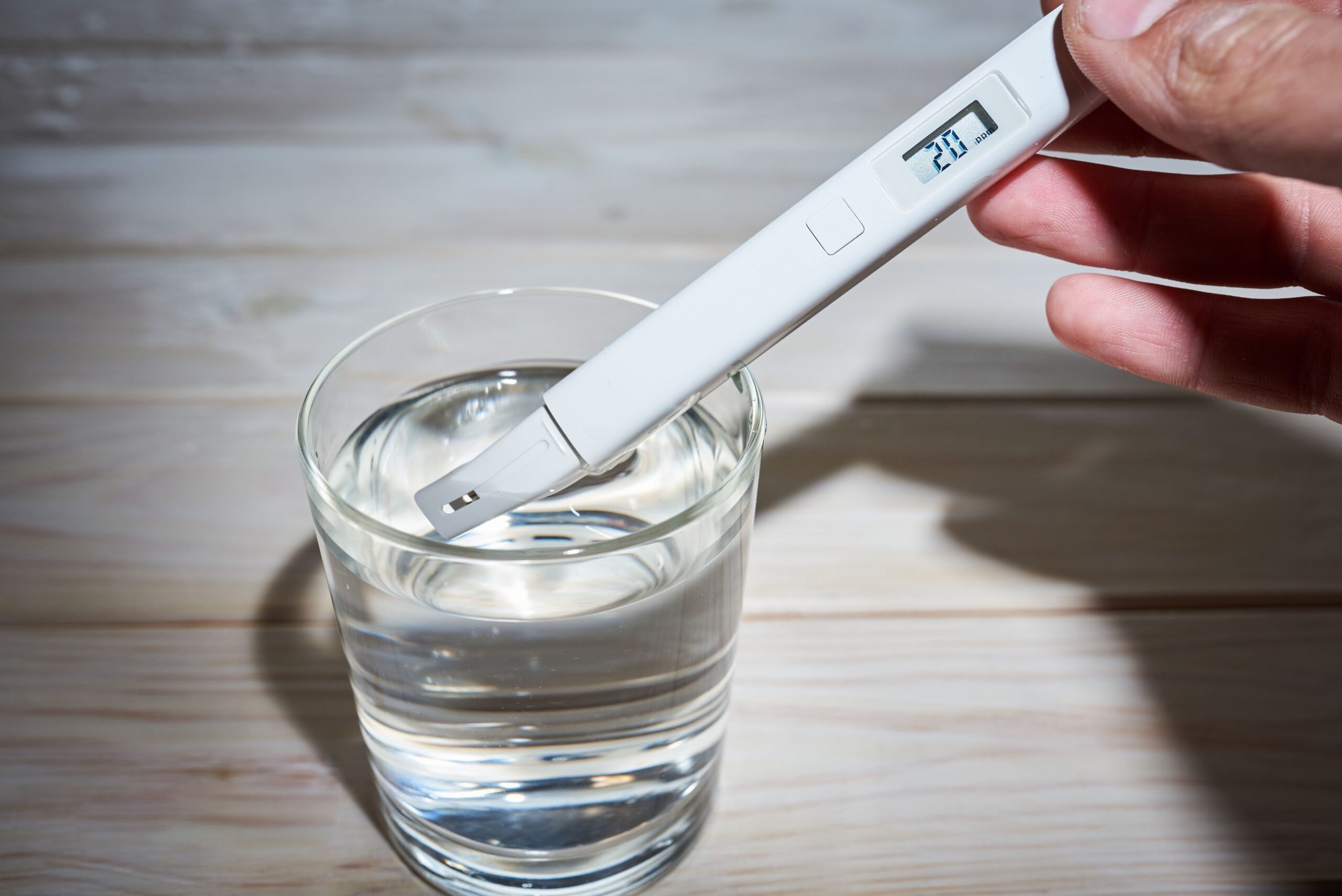
pH, EC, and alkalinity answer three different questions. pH describes acidity at that moment. EC estimates the total concentration of dissolved ions capable of carrying electrical current. Alkalinity describes acid-neutralizing capacity. None of the three identifies a complete fertilizer recipe.
An EC reading of 0.8 mS/cm could come from calcium and bicarbonate, sodium and chloride, sulfate salts, fertilizer contamination, or a mixture. Two waters can have the same EC and create very different root-zone problems. That is why EC is useful for screening and trend monitoring but laboratory ion analysis is needed when the source-water load is substantial or unexplained.
| Water Measurement | What the Number Actually Tells You |
|---|---|
| pH | Current acidity or basicity of the sample. Useful during mixing and for understanding chemical reactions, but it does not show the water’s buffering strength. |
| Alkalinity | Acid-neutralizing capacity, usually dominated by bicarbonate and carbonate. Useful for predicting long-term upward pH pressure and acid requirement. |
| Hardness | Primarily dissolved calcium and magnesium. Useful for fertilizer planning and scale risk, but it is not interchangeable with alkalinity. |
| EC | Total electrical conductivity from dissolved ions. Useful for comparing total ionic load, but it does not identify which ions are present. |
| Sodium and chloride | Specific ions that can contribute to salinity and toxicity. These need direct analysis because EC cannot separate them from useful nutrients. |
| SAR | The sodium adsorption ratio compares sodium with calcium and magnesium. It is most relevant to mineral soil structure and sodicity risk, not as a general hydroponic nutrient target. |
Important: Never use one number to stand in for the whole report. High pH is not automatically high alkalinity. High hardness is not automatically high sodium. High EC does not tell you whether the dissolved ions are useful nutrients or unwanted salts.
Understand What Source-Water Chemistry Changes in the Root Zone
Irrigation water is repeatedly delivered to the same root zone. Plants remove water through transpiration, evaporation removes more from exposed surfaces, and many dissolved ions remain behind until they are absorbed, exchanged, precipitated, leached, or physically removed with drainage. Water chemistry therefore matters cumulatively.
The effect is fastest in systems with small root-zone volumes, frequent irrigation, low buffering, limited rainfall, or recirculation. A large outdoor mineral-soil bed receiving seasonal rain behaves differently from a small rockwool block irrigated several times per day. The water report is the same, but the dose per unit of root-zone volume and the opportunity for salts to leave are not.
Cannabis Source Water: pH, EC, Alkalinity, and Hardness
Start with four questions. Does the water have enough alkalinity to push substrate pH over time? Does the starting EC leave enough room for the intended nutrient program? Does hardness supply meaningful calcium and magnesium or mainly create scale? Are sodium and chloride low enough that repeated irrigation will not create an unnecessary salt burden?
In mineral soil, buffering and exchange capacity can absorb some chemical change, while rainfall may dilute or leach soluble ions. In a container, the same alkalinity can accumulate its effect much faster. In low-buffer systems such as rockwool, the chemistry of the delivered solution and the frequency of fertigation become even more visible in the root-zone trend.
Source-water chemistry also influences what should be in the fertilizer. If the water contributes significant calcium and magnesium, adding the same supplementation used for reverse-osmosis water may be unnecessary. If the water contains very little calcium and magnesium, the nutrient formula must supply them. The useful decision is based on actual milligrams per liter, not on labels such as “hard,” “soft,” or “RO.”
EC, Sodium, Chloride, and Salinity Risk
Salinity describes the dissolved-salt load that makes water harder for roots to acquire. Sodium chloride is one source, but plant nutrients also contribute to EC. The difference matters because a high nutrient-solution EC can sometimes be deliberately managed within a controlled fertigation program, while sodium and chloride may accumulate without providing the nutrient balance the crop needs.
Drug-type Cannabis sativa has shown measurable responses to NaCl in controlled solution culture. A 2020 study found decreasing cannabinoid concentration as NaCl increased and reported negative growth and physiological effects at the highest hydroponic NaCl treatment. That experiment is useful evidence that sodium-chloride salinity can matter to cannabis. It is not a universal source-water sodium or chloride threshold for soil, coco, or every cultivar.
For source-water screening, general horticultural guidance is still useful when the evidence boundary is kept clear. Penn State’s irrigation-water guidance flags sodium above 50 mg/L as a concern and chloride above 100 mg/L for many plants, with some sensitive crops affected at lower chloride levels. Those values are not cannabis-specific limits. They are reasons to investigate the source, the medium, the irrigation frequency, and the trend before the water is accepted as routine.
Do not use a sodium-regenerated household softener as an automatic irrigation upgrade
Conventional ion-exchange softeners can replace calcium and magnesium with sodium. The water may produce less scale while becoming less suitable for repeated irrigation. If softened water is the available source, test sodium and the full irrigation chemistry rather than assuming the word “soft” means better for roots.
Alkalinity, Bicarbonate, and Acid Treatment Explained
Bicarbonate is usually the main reason high-alkalinity water keeps pushing container substrate pH upward. Acid treatment works by neutralizing part of that alkalinity. The management target is therefore not simply “make the tank read pH 5.8.” It is to reduce excessive acid-neutralizing capacity to a level that fits the crop, medium, fertilizer, container size, and irrigation frequency.
This distinction explains a common failure. A grower adds a small amount of pH reducer until a high-alkalinity source reaches the desired tank pH. The reading looks correct immediately, but enough bicarbonate remains that repeated irrigation continues to raise substrate pH. Another grower with low-alkalinity water may need very little acid to change the same number of pH units.
Acid requirement depends on the measured alkalinity, the acid being used, its concentration, the target residual alkalinity or pH, fertilizer chemistry, and system volume. University alkalinity calculators exist because the relationship is not a universal milliliters-per-gallon recipe.
Base acidification on measured alkalinity
Use a laboratory alkalinity result, an appropriate calculation method, compatible equipment, and a follow-up pH and alkalinity check after treatment.
Chasing source pH with a memorized acid dose
The same pH can require very different amounts of acid when alkalinity differs. A copied dose can under-treat one source and dangerously over-treat another.
Safety Note: Concentrated acids can cause severe chemical burns and can damage incompatible pumps, tubing, tanks, and fittings. Large-volume acidification should use appropriate safety procedures, personal protective equipment, compatible injection hardware, and qualified guidance. This resource does not provide a universal concentrated-acid mixing recipe.
Read and Order the Right Irrigation Water Tests
A basic pH and EC meter is useful for routine monitoring, but it cannot tell you whether a source-water EC problem comes from sodium, chloride, calcium, magnesium, sulfate, bicarbonate, or another dissolved ion. A laboratory report turns the screening numbers into a chemical profile.
How to Read an Irrigation Water Laboratory Report
Start by confirming the sample identity and units. A result reported in mg/L is numerically equivalent to ppm for dilute water solutions. EC may be reported as mS/cm, mmhos/cm, dS/m, or µS/cm. One mS/cm equals one mmhos/cm and one dS/m, while 1,000 µS/cm equals 1 mS/cm. Alkalinity may be reported as mg/L CaCO3, ppm CaCO3, meq/L, or bicarbonate concentration. The units must be understood before values are compared.
Next, read the report in groups rather than line by line. pH and alkalinity describe current acidity and buffering. Hardness, calcium, and magnesium describe mineral content and scaling/nutrient contribution. EC and TDS show overall dissolved load. Sodium, chloride, and SAR identify specific salinity or sodicity concerns. Iron and manganese can affect both plant chemistry and emitter clogging. Boron can be toxic at comparatively low concentrations for sensitive crops. Nitrate, ammonium, phosphorus, potassium, sulfur, and other nutrients should be counted as part of the fertilizer input if they are present at meaningful concentrations.
The source matters too. A municipal report may be useful for broad chemistry but may not reflect the exact water after a building softener, carbon filter, storage tank, or blending system. A well can change seasonally. Surface water can vary with rainfall, algae, sediment, and runoff. Reclaimed water needs additional chemical and microbiological attention beyond a routine tap-water panel.
Cannabis Irrigation Water Test: What to Measure
For a routine cannabis source-water chemistry baseline, ask for enough information to separate pH control, nutrient contribution, salinity, and equipment risk. The exact panel depends on the water source and growing system, but the following list covers the measurements that most often change the decision.
| Laboratory Measurement | Why a Cannabis Grower May Need It |
|---|---|
| pH | Provides the current acidity/basicity of the source. Interpret with alkalinity rather than using it alone to predict root-zone drift. |
| Total alkalinity and/or bicarbonate | Shows acid-neutralizing capacity and helps explain persistent upward substrate-pH pressure and acid requirement. |
| EC | Shows the starting ionic load before fertilizer is added. A high baseline may reduce management flexibility and requires ion identification. |
| Hardness, calcium, magnesium | Shows whether the source contributes useful Ca and Mg, creates scale, or changes the amount that must be supplied by fertilizer. |
| Sodium and chloride | Identifies specific ions that can accumulate and contribute to osmotic stress or direct ion toxicity. |
| SAR | Useful for repeated irrigation of mineral soil where sodium relative to calcium and magnesium may affect aggregation and permeability. |
| Boron | A micronutrient that can become toxic at relatively low concentrations in sensitive horticultural crops. Useful where groundwater chemistry warrants testing. |
| Iron and manganese | Can stain surfaces, precipitate, support deposits, and clog micro-irrigation equipment. Concentrations also influence nutrient planning. |
| Nitrate-N, ammonium-N, P, K, S | Background nutrients in the water should be counted as inputs rather than ignored when building a fertilizer program. |
| Microbial or contaminant tests when relevant | Surface water, reclaimed water, questionable wells, or storage systems may require microbiological or site-specific contaminant testing. A chemistry panel alone cannot certify biological safety. |
“My EC meter says 0.7 before I add nutrients. Is that hard water?”
Question sent by: Julia Schneider, via contact form.
EC 0.7 mS/cm tells you that the water contains a noticeable dissolved-ion load, but it cannot tell you whether those ions are mainly calcium and magnesium. Order or review hardness, Ca, Mg, alkalinity, sodium, and chloride. The same source EC can come from very different chemistry.
Cannabis Source Water Testing Guide
Test the water that actually reaches the irrigation system. If a home or facility has a softener, filter, reverse-osmosis unit, acid injector, blending valve, storage tank, or disinfectant system, the untreated source and the treated output are different samples. Label them separately.
For a new well or unfamiliar water source, laboratory testing should come before the fertilizer program is finalized. For an established source, periodic re-testing is useful because wells, surface water, municipal blends, and stored water can change. Penn State recommends regular irrigation-water testing, and Purdue notes that alkalinity can vary seasonally. A once-tested source should not be assumed chemically permanent.
Municipal growers can start with the utility report, but the report is not always a substitute for an irrigation sample. Utility reports may list ranges or annual averages, while the grow room receives water from a particular distribution zone and may also pass through building treatment equipment. A direct irrigation-water sample gives the chemistry that the plants actually see.
Reverse-osmosis water should also be tested periodically. Membrane performance changes with feed-water pressure, temperature, fouling, age, and maintenance. An RO label does not guarantee zero alkalinity, zero sodium, or zero EC. Monitor the product-water EC and confirm the broader chemistry when performance changes.
How to Test Water Before Feeding Cannabis
For routine in-house screening, begin with clean sampling containers and calibrated meters. Let a tap or irrigation outlet run long enough to clear stagnant water when the goal is to characterize the source. Kentucky’s irrigation-water laboratory, for example, instructs growers sampling source water from a tap to run the tap before collection. Follow the laboratory’s own instructions when submitting samples because bottle type, flushing, preservation, and shipping requirements can differ by test.
Measure temperature along with pH and EC when the meter supports it. Conductivity is temperature-sensitive, and many meters apply automatic temperature compensation. Temperature also affects root-zone behavior and dissolved oxygen, so recording it improves troubleshooting even when it is not the central chemistry problem.
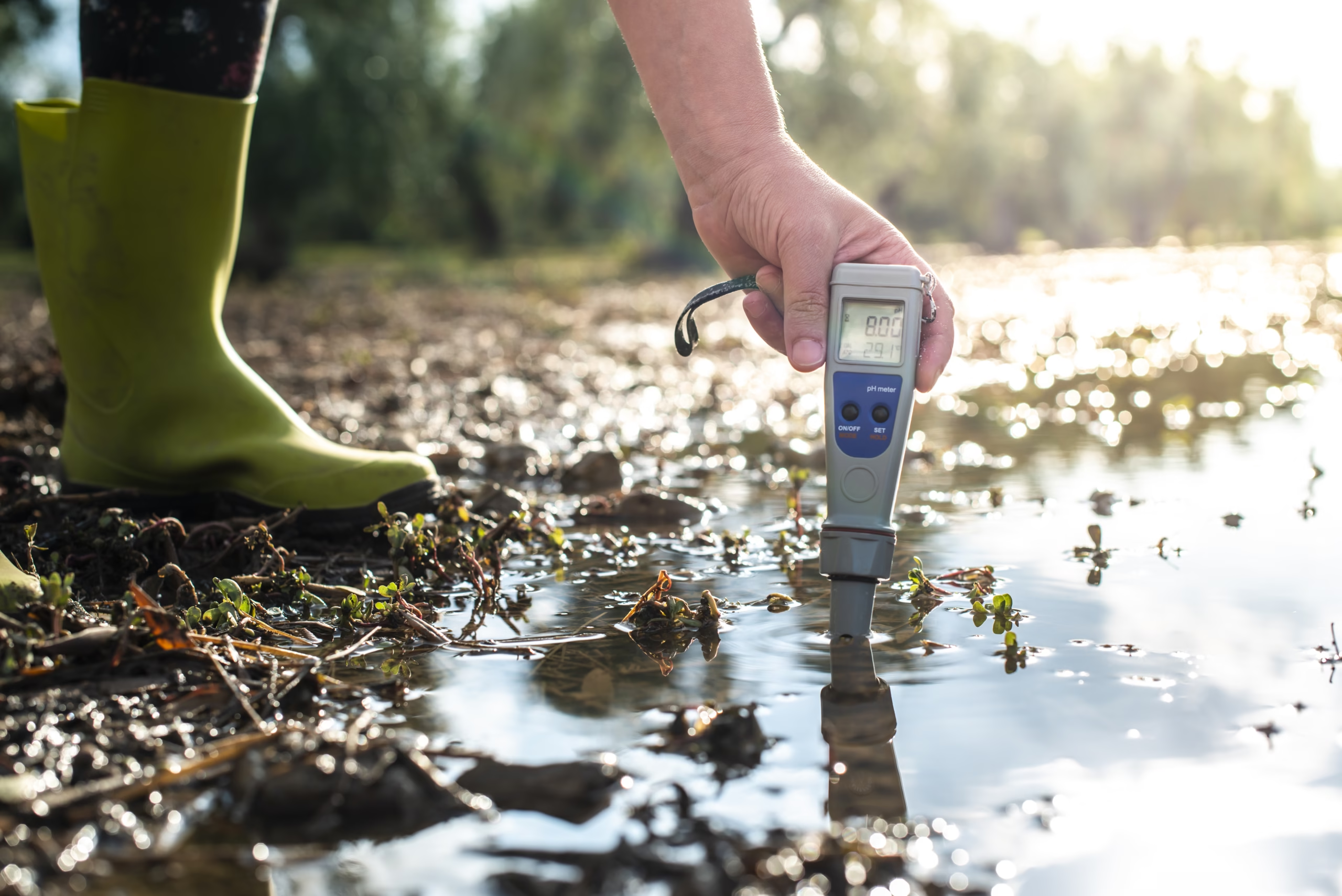
Calibrate pH meters with fresh standard buffers according to the instrument instructions. Rinse the probe between solutions and store the electrode correctly. EC meters should be checked against an appropriate conductivity standard. If a meter cannot return to its calibration solution reliably, do not use it to justify a major nutrient or acid correction.
Field Advice: Keep one baseline record for untreated source water, one for water after filtration or other treatment, and one for the final nutrient solution. This makes it much easier to see which stage changed when the root zone begins drifting.
The Same Water Behaves Differently in Soil, Coco, Rockwool, and Hydroponics
Water chemistry cannot be interpreted without the root-zone system. The same alkalinity and EC can create a slow trend in a large mineral-soil bed, a faster trend in a small peat container, and an immediate management problem in a recirculating reservoir. Container size, root mass, irrigation frequency, light, temperature, humidity, plant stage, drainage, and rainfall all change how quickly the chemistry is expressed.
Mineral soil can buffer chemistry, but repeated irrigation still matters
Clay, organic matter, carbonates, exchange sites, and the existing soil pH all influence how irrigation water changes mineral soil. Outdoor rainfall may dilute and leach soluble salts, while arid or covered systems receive far less natural flushing. High-sodium water adds another concern because sodium relative to calcium and magnesium can damage aggregation and permeability in susceptible soils.
Do not use a container-media alkalinity chart as a field-soil amendment prescription. For outdoor soil, combine the irrigation-water report with a representative soil test, salinity measurement where needed, drainage assessment, and local soil interpretation.
Peat-based and manufactured soilless mixes have limited root-zone volume
Peat mixes are usually limed and formulated to start within a defined pH range. Repeated high-alkalinity irrigation can progressively overpower that initial buffering and push pH upward, especially in small containers. Low-alkalinity water can create the opposite management challenge because acidic fertilizer programs may move substrate pH down more quickly.
For these systems, monitor substrate pH and EC with a consistent soilless-media method rather than relying only on feed pH. The Cannabis Indoor Growing Mediums guide explains why physical and chemical buffering differ among common substrates.
Coco adds cation exchange to a frequent-fertigation system
Coco is often treated as though it were chemically blank, but its exchange sites interact with calcium, magnesium, potassium, and sodium. Starting coco quality, washing, buffering, particle grade, source-water Ca/Mg, and fertilizer formulation therefore need to work together.
Hard water is not automatically ideal for coco simply because it contains calcium. The Ca:Mg balance, bicarbonate load, sodium, chloride, and total EC still matter. Likewise, low-mineral water is not automatically safer if the nutrient program does not replace the missing calcium, magnesium, and buffering behavior.
Rockwool exposes feed chemistry quickly
Rockwool has low chemical buffering compared with mineral soil or organic substrates. That makes fertigation chemistry and irrigation strategy closely linked. Small slabs or blocks can receive many irrigations per day, so even a moderate source-water contribution becomes a repeated input. Feed EC, feed pH, drainage fraction, dry-back, and root-zone EC must be interpreted together.
Recent controlled-environment cannabis research uses continuous monitoring of pH, EC, volumetric water content, and root-zone conditions precisely because the delivered nutrient solution and the root zone can diverge as plants take up water and nutrients. Those studies demonstrate the value of measurement but do not create one universal cannabis EC schedule for every system.
Recirculating hydroponics keeps returning the same ions
In deep-water culture and other recirculating systems, water and ions remain in a reservoir that is repeatedly altered by plant uptake, top-off water, evaporation, acid/base additions, fertilizer additions, temperature, and microbial processes. A source-water sodium or chloride load that seems modest in a single pass can become more important when the same solution is reused.
Measure reservoir pH and EC as trends, not isolated targets. Periodic ion analysis becomes more valuable when a recirculating system is repeatedly corrected by adding concentrate or top-off water. EC can remain within range while individual ion ratios drift.
| System Factor | More Buffered / Soil-Like Systems | Low-Buffer / Frequent-Fertigation Systems |
|---|---|---|
| Water pH | Often moderated by soil chemistry; still relevant to reactions and long-term trends. | Feed chemistry is expressed more quickly, especially in rockwool and solution culture. |
| Alkalinity | Can gradually alter pH, with effect modified by soil buffering, rainfall, and irrigation volume. | Repeated bicarbonate input can shift substrate or reservoir pH quickly in small root-zone volumes. |
| Hardness | Ca and Mg may contribute to soil fertility but can also create scale in irrigation equipment. | Directly changes how much Ca and Mg must come from fertilizer and how much scaling occurs in emitters. |
| Source EC | Must be interpreted with soil salinity and leaching conditions. | Directly reduces the available EC budget for the formulated nutrient solution and may accumulate rapidly. |
| Na / Cl | Can accumulate under limited leaching; sodium also raises sodicity concerns in susceptible mineral soils. | Can accumulate in containers or recirculating systems without contributing a balanced nutrient program. |
Use a Repeatable Sampling and Meter Routine
A water-chemistry diagnosis becomes much stronger when the same sample points are measured the same way each time. The goal is not to collect the maximum number of readings. It is to know exactly where each reading came from and what happened to the water between one point and the next.
Sample at four possible points
The first point is untreated source water. The second is water after any softener, filter, reverse-osmosis membrane, acidification system, or blend. The third is the final nutrient solution after all concentrates and amendments have been mixed and allowed to stabilize according to the fertilizer program. The fourth is the root-zone solution or drain sample collected with a defined method appropriate to the medium.
Not every grow needs all four points every day. A new system benefits from establishing all four baselines. Routine monitoring can then focus on the points most likely to change.
Calibrate before the number matters
Calibration is not a ceremonial step performed once when the meter is new. pH electrodes age, dry out, become contaminated, and drift. EC probes can collect deposits. Temperature sensors can also affect compensation. Follow the meter manufacturer’s calibration and storage procedure and use standards that bracket the expected measurement range when appropriate.
Record failed or difficult calibrations. A probe that takes increasingly long to stabilize or cannot return to a standard may be creating the apparent root-zone problem. Replace or service the instrument before correcting the crop around an unreliable number.
Control sample timing
Source-water samples should represent the water normally used for irrigation rather than stagnant water that sat in a hose or pipe for days. Nutrient-solution samples should be taken after complete mixing. Root-zone samples should be collected at a consistent interval relative to irrigation because the concentration can change substantially between the first runoff, peak saturation, and late dry-back.
For container substrates, choose one extraction approach and keep using it. A PourThru sample, saturated-media extract, 1:2 extract, and random runoff sample are not interchangeable measurements. If you change the method, start a new baseline instead of pretending the new number continues the old trend.
“My runoff EC is much higher than the feed. Should I flush immediately?”
Question sent by: Mason Clarke, via Facebook page.
Not from one random runoff sample. First confirm the sampling method, irrigation uniformity, dry-back, drain fraction, source-water EC, fertilizer strength, and whether the first drainage followed preferential channels through a dry medium. Repeat with a consistent method before changing several inputs at once.
Build a record that can explain cause and effect
A useful log includes date, source, source pH, source EC, alkalinity when available, final-feed pH and EC, irrigation volume, drainage or runoff method, root-zone pH and EC, water temperature, plant stage, and major environmental changes. For a well or surface source, note unusual drought, rainfall, flooding, or maintenance events.
Record treatment changes on the same page. If you switch fertilizer, blend in RO water, change acidification, replace a membrane, clean emitters, or increase irrigation frequency, mark the date. The root-zone trend becomes far easier to interpret when each chemistry change has a timestamp.
Remember: A number without a sampling method is difficult to compare. “Runoff EC 3.0” is incomplete. “PourThru EC 3.0 mS/cm, collected 30 minutes after irrigation using the same procedure as last week” can become a useful trend.
Separate Source Water, Feed Solution, and Root-Zone Accumulation
One of the most common interpretation errors is treating source-water EC, nutrient-solution EC, and root-zone EC as though they are three readings of the same thing. They are linked, but each represents a different stage in the system.
Source-water EC is the starting ionic load
Raw water EC shows what arrives before fertilizer. It helps determine how much chemical headroom remains and whether the source itself needs closer analysis. A low source EC usually gives the grower more control over the final recipe, but very low-mineral water also contributes little calcium, magnesium, or alkalinity.
Do not simply subtract source EC from final feed EC and call the difference “fertilizer EC” as though it were an exact nutrient mass. Conductivity is affected by ion species, concentration, temperature, and interactions in solution. The difference can be a useful operational trend when the same water and fertilizer are used, but it is not a complete chemical analysis.
Final-feed EC includes source ions plus fertilizer ions
The final nutrient solution is what enters the root zone. Cannabis nutrition research commonly reports feed pH and EC because both influence the experimental root-zone environment. However, studies use specific cultivars, fertilizers, substrates, irrigation frequencies, and environmental conditions. Their EC values should not be converted into one universal feed schedule.
Recent medical-cannabis research has also shown that simply increasing root-zone nutrient concentration does not necessarily increase yield or cannabinoid concentration. This is an important counterweight to the idea that a higher final EC always means more available “food.”
Root-zone EC reflects uptake, evaporation, dry-back, drainage, and distribution
Once solution enters the pot, slab, bed, or reservoir, plants selectively remove water and ions. Evaporation can concentrate salts. Poor irrigation uniformity can create hot spots. Severe dry-back can produce a concentrated solution in the remaining water. Adequate leaching can reduce accumulation, while poor drainage can trap salts.
A high root-zone EC therefore does not prove that the original feed EC was too high. It can come from inadequate irrigation volume, uneven emitters, low drain fraction, excessive dry-back, high source-water load, repeated high-alkalinity irrigation, sodium/chloride accumulation, or a combination.
Diagnose Common Water-Chemistry Failure Modes Before You Correct Them
Water problems often produce symptoms that look like nutrition problems because water chemistry controls nutrient availability, osmotic stress, and the chemistry of the root zone. The diagnosis should therefore move from the source to the delivery system to the medium rather than jumping from a leaf symptom to a supplement.
| Symptom or Pattern | Possible Cause | How to Confirm | Corrective Action | Prevention |
|---|---|---|---|---|
| Source pH is high, but substrate pH remains stable | High pH with modest or low alkalinity | Check total alkalinity rather than reacting to pH alone | Do not acidify automatically; monitor final feed and root-zone trend | Test pH and alkalinity together |
| Substrate pH keeps rising over several irrigations | High alkalinity / bicarbonate load | Laboratory alkalinity plus repeated substrate pH measurements | Review acidification, fertilizer acidity, blending, or lower-alkalinity source | Track alkalinity and substrate pH before chlorosis appears |
| White scale on emitters and tank surfaces | Hardness, carbonate precipitation, or concentrated salts | Hardness, Ca, Mg, alkalinity, pH, and visual inspection | Match treatment to chemistry; clean equipment appropriately and address precipitation cause | Routine water analysis and emitter maintenance |
| High raw-water EC with no fertilizer added | Mineral-rich water, sodium/chloride, sulfate, bicarbonate, or contamination | Full ion analysis | Blend, treat, or change source according to the actual ions | Keep a source-water baseline and re-test when it changes |
| Leaf margin burn with rising root-zone EC | Salt accumulation, high Na/Cl, excessive feed, uneven irrigation, or severe dry-back | Source analysis plus consistent root-zone EC and irrigation audit | Correct the identified salt source and irrigation cause rather than adding more fertilizer | Monitor source EC, Na, Cl, feed EC, and distribution |
| High runoff EC from a pot that was very dry | Concentrated first drainage or preferential flow | Repeat using a standardized extraction or consistent timing | Rewet evenly before making a chemistry correction | Avoid extreme dry-back and use consistent sampling |
| Some plants show high EC while others do not | Emitter variation, clogging, pressure differences, uneven wetting | Measure emitter output and sample multiple representative root zones | Repair distribution before changing the nutrient recipe | Regular uniformity and clogging checks |
High pH with low alkalinity is often overcorrected
A grower sees pH 7.8, assumes the water is strongly alkaline, and adds acid until the tank reaches a familiar number. If alkalinity is low, the water may have had very little buffering. The correction can overshoot once fertilizer is added or once the water contacts an acidic substrate.
Measure the final nutrient solution after mixing and monitor the root zone. The number that matters is the chemical environment the roots experience over time, not the emotional impact of a source pH above 7.
High hardness can be a fertilizer issue, an equipment issue, or both
If the water contains substantial calcium and magnesium, account for those nutrients before automatically adding a generic Ca/Mg supplement. At the same time, scaling can clog small emitters and reduce irrigation uniformity. The plant problem may then come from uneven water delivery rather than direct calcium toxicity.
Hardness treatment should match the actual chemistry. A sodium-regenerated softener may reduce scale but increase sodium. Acidification may reduce carbonate precipitation in some systems but should be based on alkalinity and professional calculations. Reverse osmosis can remove many dissolved ions but adds cost, reject water, maintenance, and the need to rebuild a nutrient profile from a lower-mineral baseline.
Uneven wetting can imitate a water-chemistry problem
Hydrophobic peat, dry coco pockets, channeling, clogged emitters, poor pressure regulation, and uneven hand watering can create zones with very different EC inside one container. A runoff sample may preferentially collect water from the easiest channel instead of representing the entire root zone.
Before blaming the source water, compare emitter volumes, pot weights, moisture distribution, and the position where the sample was collected. Chemistry cannot correct a distribution problem.
Very low-mineral water creates a different management problem
Rainwater and RO water can offer a clean starting point, but they contribute little hardness and alkalinity. That means the fertilizer must provide calcium, magnesium, and the desired buffering behavior. pH can also move quickly because the water itself has little resistance to change.
Do not “remineralize” low-EC water by guessing with multiple supplements. Start from a complete nutrient program designed for low-mineral water and confirm final Ca, Mg, EC, and pH behavior through the root-zone trend.
Do not solve a sodium or chloride problem with pH adjustment
Acid can neutralize alkalinity, but it does not make sodium or chloride disappear. If Na or Cl is the limiting water-quality factor, the solution may require dilution, reverse osmosis, a different source, or another treatment designed for those ions.
Pro Tip: When only one row of plants is struggling, test irrigation uniformity before rebuilding the nutrient recipe. Chemistry problems often affect the whole source; delivery problems frequently follow zones, emitters, pressure lines, or container positions.
Correct One Variable at a Time and Verify the Result
The strongest correction sequence is deliberately boring: observe the pattern, measure the source, identify the mechanism, change one major variable, and check what happens at the next irrigation events. This protects cause-and-effect information.
Step 1: identify which measurement is actually outside the plan
Do not begin with the treatment. Begin with the evidence. Is the problem high alkalinity, high raw-water EC, sodium, chloride, scale, low calcium/magnesium, root-zone accumulation, or simply an unstable pH meter? Write the suspected mechanism in one sentence.
Step 2: verify the source and the final feed separately
Recheck source pH and EC with calibrated meters. Review the laboratory report if alkalinity, hardness, Na, or Cl is involved. Then prepare the normal feed and measure it after complete mixing. If the feed is abnormal but the source is normal, the problem is downstream of the source-water chemistry.
Step 3: inspect irrigation delivery before changing chemistry
Confirm that emitters are delivering similar volumes, drainage paths are open, containers are wetting evenly, and the root zone is not severely dry or saturated. A clogged emitter can create a concentrated root zone even when the water chemistry is excellent.
Step 4: apply the smallest correction that addresses the mechanism
High alkalinity may call for controlled acidification, blending, or a fertilizer program that creates less upward pH pressure. High sodium or chloride may call for dilution, membrane treatment, or a different source. Very low-mineral water may require a complete nutrient program that supplies Ca and Mg. High hardness with scaling may need a treatment strategy focused on precipitation and equipment rather than a plant supplement.
If the source-water EC is already high, do not automatically raise the final feed EC to match a schedule written for low-EC water. The fertilizer program may need to account for what the source already contributes.
Step 5: verify at the next irrigation event
Measure the treated source or final feed again. Confirm that pH, EC, and treatment output match the new plan. If acidification was used, check that the change is reproducible rather than a one-time bucket result. If blending or RO was used, confirm the new source EC and key ions.
Step 6: watch the root-zone trend over several irrigations
A correction to irrigation water may not instantly reverse the chemistry already stored in a buffered substrate or saline root zone. Continue measuring with the same extraction method. Look for the direction of substrate pH and EC rather than expecting one irrigation to erase the history.
For long-cycle container crops, the cumulative effect of alkalinity is especially important. For recirculating hydroponics, the reservoir can respond quickly but individual ions may still drift despite an acceptable total EC.
Step 7: re-test the source when the result stops making sense
If a well that was stable for years begins behaving differently during drought, if a municipal utility changes source, if a membrane loses rejection efficiency, or if a storage system develops scale and deposits, repeat the laboratory analysis. Do not force an old report to explain new water.
Change the variable that matches the diagnosis
Neutralize alkalinity when alkalinity is the problem, reduce sodium or chloride when those ions are the problem, and fix irrigation distribution when chemistry is not the limiting factor.
Changing source, fertilizer, pH method, and irrigation schedule together
Multiple simultaneous changes can improve the plant while destroying the information needed to know which correction actually worked.
Use General Water-Quality References as Screening Tools, Not Cannabis Rules
University irrigation-water guidelines are useful because they identify values that deserve closer attention. They are not a substitute for cannabis-specific evidence, medium-specific interpretation, or the complete ion profile. The following values come from general greenhouse and nursery guidance and should be treated as screening references.
| Parameter | General Horticultural Screening Reference and Interpretation |
|---|---|
| Total alkalinity | Penn State commonly treats roughly 30 to 100 mg/L as a desirable general range and flags values above about 100 to 150 mg/L for closer management. Purdue emphasizes that crop, container, fertilizer, and substrate change the acceptable level. Do not present this as a cannabis-specific target. |
| Hardness | General greenhouse guidance often considers about 50 to 150 mg/L CaCO3 a useful working range, with higher values increasing scale risk. Hardness does not equal alkalinity. |
| Raw-water EC | Penn State flags raw-water EC above about 1.0 mS/cm for very sensitive plug systems and above about 1.5 mS/cm for many other greenhouse crops. These are raw-water screening values, not cannabis nutrient-solution EC targets. |
| Sodium | Penn State flags sodium above 50 mg/L for closer attention. Cannabis-specific source-water tolerance has not been established from this guideline. |
| Chloride | General guidance notes that many plants tolerate around 100 mg/L while sensitive species may be affected at lower levels. Use direct analysis and root-zone context rather than assuming cannabis shares one universal threshold. |
| SAR | A SAR above about 2 is treated as a concern in Penn State irrigation screening, especially when sodium is also elevated. This is most relevant to mineral-soil structure and permeability. |
| Calcium and magnesium | General greenhouse guides use source Ca and Mg to decide whether fertilizer supplementation is necessary. Cannabis nutrient demand must still be matched to the complete fertilizer program and medium. |
The value of these references is triage. If the report is comfortably within a general screening range and the root zone is stable, aggressive water treatment may offer little benefit. If one or more values are outside the range, investigate the specific ion, crop system, and root-zone response before choosing treatment.
Master Advice: Treat a water-quality table as a reason to ask better questions, not as a cannabis prescription. The same sodium concentration, alkalinity, or EC can produce different outcomes in outdoor soil, a small coco pot, rockwool, or a recirculating reservoir.
Build the Water Strategy Before the Next Feeding Decision
Water chemistry becomes manageable when every number has a job. pH helps describe the current solution. Alkalinity predicts acid-neutralizing pressure. Hardness describes calcium and magnesium mineral load. EC shows total dissolved ionic strength. Sodium, chloride, and SAR identify risks that EC alone cannot separate. The medium and irrigation method determine how quickly those inputs accumulate or are buffered.
Before You Build or Correct a Cannabis Irrigation Program
- Identify the real irrigation source: untreated tap, well, surface water, rainwater, stored water, RO product, softened water, reclaimed water, or a blend.
- Measure source pH and EC with calibrated meters.
- Obtain a laboratory baseline for alkalinity, hardness, calcium, magnesium, sodium, chloride, and other relevant ions.
- Use SAR when repeated irrigation of mineral soil makes sodicity a concern.
- Do not assume high water pH means high alkalinity.
- Do not assume hardness and alkalinity are interchangeable.
- Do not assume a low source EC means the fertilizer program is complete.
- Do not assume a high source EC is useful fertility until the ions are identified.
- Account for Ca, Mg, N, S, and other nutrients already supplied by the water.
- Check sodium and chloride directly when source salinity is suspected.
- Measure the final nutrient solution after all inputs are mixed.
- Use a root-zone sampling method appropriate to soil, peat, coco, rockwool, or hydroponics.
- Keep the root-zone method and sample timing consistent.
- Inspect emitter flow and wetting uniformity before blaming chemistry.
- Base acidification on alkalinity, not on a memorized pH-down dose.
- Use RO, blending, or another treatment only when it solves a measured source-water problem.
- Change one major variable at a time when troubleshooting.
- Verify the treated source and final feed at the next irrigation event.
- Track root-zone pH and EC trends over several irrigations before declaring the correction complete.
- Re-test wells, municipal sources, surface water, and treatment systems when their behavior changes.
FAQ: Cannabis Irrigation Water Chemistry
Should cannabis irrigation water always be adjusted to the same pH?
No. Soil, peat, coco, rockwool, and water culture do not share one universal management number, and source-water pH does not show alkalinity. Follow the nutrient and medium strategy, measure the final mixed solution, and track the root-zone response rather than forcing every source to one memorized value.
Is hard water bad for cannabis?
Not automatically. Hardness mainly reflects calcium and magnesium, which are essential nutrients. The source becomes difficult when the mineral load creates scale, contributes too much Ca or Mg relative to the fertilizer program, comes with high alkalinity, or is accompanied by problematic sodium, chloride, or EC. Read the whole report.
Do I need reverse osmosis if my tap-water EC is high?
First identify the ions. If the EC comes mostly from manageable calcium and magnesium, the fertilizer program may simply need adjustment. If sodium, chloride, boron, or another difficult ion dominates, blending, RO, or a different source may make more sense. RO has operating cost, reject water, membrane maintenance, and a low-mineral output that requires its own nutrient strategy.
Can I use runoff pH and EC to judge my source water?
No. Runoff has already interacted with fertilizer, substrate, roots, stored salts, and the irrigation path. Test the source directly. Use runoff or another root-zone extraction only as a separate measurement of what is happening after the water enters the medium.
Does lowering water pH also lower alkalinity?
Acid addition can neutralize alkalinity, but the amount neutralized depends on the water’s starting alkalinity and the amount and type of acid. A small pH change does not tell you how much bicarbonate remains. When high alkalinity is a recurring problem, verify alkalinity rather than judging treatment from pH alone.
Is ppm the same as EC?
No. EC is the measured conductivity. Many handheld “TDS” meters convert EC into an estimated ppm using a factor. Different meters can use different conversion scales, so two ppm readings may disagree even when the EC is identical. For grow logs and research comparisons, mS/cm is usually clearer.
How often should I test my source water?
Establish a laboratory baseline before building the program, then re-test when the source, season, treatment system, or plant response changes. Wells and surface sources can change with weather and groundwater conditions. Municipal supplies can change sources or treatment. RO systems lose performance with fouling and membrane age. A fixed calendar is less useful than combining periodic testing with event-based re-testing.
Choose Water by What It Carries and How Your Root Zone Responds
The central decision is simple: do not judge cannabis irrigation water by pH alone. Read pH together with alkalinity, hardness, EC, calcium, magnesium, sodium, chloride, and the other ions that matter to the source. Then interpret that chemistry through the medium, container volume, irrigation frequency, fertilizer program, drainage, and plant demand.
A source with high pH may need no special treatment if alkalinity is low and the root zone remains stable. A hard source can supply useful Ca and Mg. A low-EC RO source can be ideal for precise formulation but still requires a complete mineral program. A source with problematic Na or Cl cannot be repaired by pH adjustment. The right answer is conditional because the chemistry and the system work together.
Build a baseline, measure the final feed, monitor the root zone with a consistent method, and make one correction at a time. The best water strategy is not the one with the most equipment. It is the one where every treatment solves a measured problem and the next irrigation confirms that the root zone is moving in the intended direction.
Share this article
A quick overview of the topics covered in this article.
- Read Irrigation Water as a Chemistry Profile, Not a Single pH Number
- Understand What Source-Water Chemistry Changes in the Root Zone
- Read and Order the Right Irrigation Water Tests
- The Same Water Behaves Differently in Soil, Coco, Rockwool, and Hydroponics
- Use a Repeatable Sampling and Meter Routine
- Separate Source Water, Feed Solution, and Root-Zone Accumulation
- Diagnose Common Water-Chemistry Failure Modes Before You Correct Them
- Correct One Variable at a Time and Verify the Result
- Use General Water-Quality References as Screening Tools, Not Cannabis Rules
- Build the Water Strategy Before the Next Feeding Decision
- FAQ: Cannabis Irrigation Water Chemistry
- Choose Water by What It Carries and How Your Root Zone Responds
Follow us
Latest articles
October 24, 2026
October 24, 2026
October 24, 2026
October 24, 2026
