
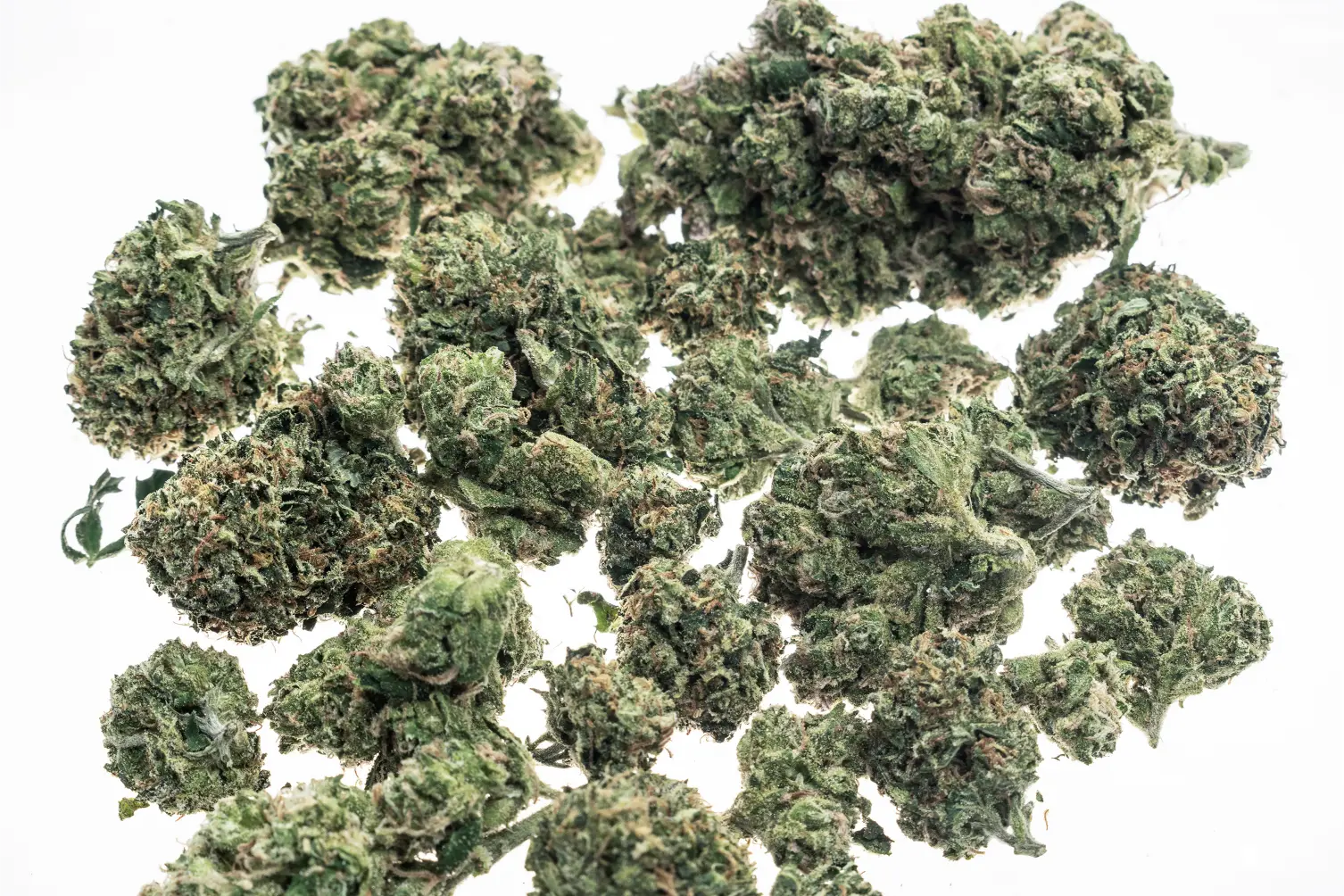
LA Kush Cake
LA Kush Cake – Strain Profile & Grow Guide
LA Kush Cake is a dense, resin-rich hybrid built around vanilla dough, mint, pepper and earthy fuel. It is commonly documented as Wedding Cake crossed with Kush Mints, and it carries recognizable traits from both sides: dessert sweetness, strong lateral branching, compact flower formation, cool mint and a physical effect that becomes heavier as the dose increases.
The strain is also known as Kush Cake #11 or Los Angeles Kush Cake in some records. Those names usually refer to the same cultivar family, but the exact selected cut matters. Some expressions remain short and stocky with close internodes. Others stretch closer to twice their vegetative height and produce longer side branches. This variation changes the correct flip height and support strategy.
LA Kush Cake can look structurally easy because the stems are thick and the plant remains relatively organized. The challenge arrives when the flowers harden. Dense tops, broad leaves and heavy resin reduce the airflow margin. A canopy that was comfortably spaced in week three may feel crowded in week seven as the rounded colas expand sideways.
The central cultivation goal is not simply to create the hardest possible buds. It is to produce dense flowers that remain clean inside and preserve vanilla-mint flavor after drying. Excess late nitrogen, compressed colas and warm post-harvest conditions turn the profile into heavy earth and pepper. The best flower keeps dough and mint visible above the gas.
Strain Features
| Feature | Details |
|---|---|
| Strain Type | Indica-dominant hybrid |
| Genetic Profile | Wedding Cake x Kush Mints |
| Common Aliases | LA Kush Cake, Los Angeles Kush Cake, Kush Cake #11 |
| THC | Commonly reported in the low-to-upper 20% range; selected batches may test higher |
| CBD | Usually very low |
| Dominant Terpenes | Limonene, beta-caryophyllene and myrcene are frequently reported; linalool and humulene may appear |
| Flavor / Aroma | Vanilla dough, sweet cake, mint, pepper, citrus, earth and fuel |
| Effect Character | Mood lift and calm mental pressure followed by deep physical relaxation |
| Flowering Time | Commonly around 8 to 10 weeks; many cuts finish near 8 to 9 |
| Stretch | Moderate in many cuts, often around 1.5 to 2 times; phenotype dependent |
| Plant Architecture | Compact-to-medium frame with strong laterals, broad leaves and tight-to-moderate internodes |
| Bud Structure | Dense, rounded and heavily frosted |
| Resin Production | High, including strong coverage on sugar leaves |
| Mold Risk | Moderate to high when dense flowers touch or humidity remains elevated |
| Feeding Behavior | Usually accepts steady moderate nutrition but can remain too leafy under excess nitrogen |
| Training Compatibility | Responds well to topping, branch spreading, SCROG and selective lollipopping |
| Grow Difficulty | Intermediate |
| Best Time of Use | Evening or late afternoon for most users |
Genetic Lineage
LA Kush Cake combines Wedding Cake with Kush Mints. The cross connects two modern lines already associated with dense resin, dessert flavor and strong physical effects.
Wedding Cake contributes vanilla, sweet dough, pepper, earth and compact flower formation. It also contributes a balanced effect that can begin cheerful and mentally engaged before becoming physically calm. Structurally, Wedding Cake influence can produce strong side branches and a medium stretch that fills an open canopy effectively.
Kush Mints contributes cool mint, fuel, lemon, pine and a heavier Kush-style body effect. It can also add thicker stems, broad leaves and high resin production. Certain Kush Mints-leaning plants remain stockier, while others stretch more strongly during transition.
The parents share overlapping ancestry, which may help explain why LA Kush Cake often feels coherent rather than like two unrelated profiles forced together. Vanilla, mint, pepper and gas appear as connected layers. The effect also moves smoothly from mood lift into body heaviness.
Phenotype variation remains important. Compact expressions may have close nodes, broad leaves and round flowers. Stretchier plants may develop longer branches, slightly more open spacing and a stronger gas or citrus character. Both can be legitimate expressions of the cultivar.
The aroma can divide into cake-dominant and mint-gas-dominant lanes. Cake-dominant plants show vanilla, sweet dough, pepper and cream. Mint-gas plants emphasize menthol, pine, citrus and fuel. Balanced keepers retain vanilla on the inhale and cool gas on the exhale.
Color varies from lime and dark green to purple or nearly black accents. Cooler healthy nights may reveal pigmentation, but severe cold is unnecessary. Color should never replace flavor, structural health or mature resin as a selection criterion.
The lineage produces a high calyx-to-leaf potential in well-selected plants, but broad fan leaves can still make the canopy feel heavy. The flower itself may be efficient to trim, while the plant surrounding it requires strategic leaf management during bloom.
Resin appears early enough that growers may assume the plant is ahead of schedule. LA Kush Cake should still be allowed to complete calyx swelling. Frost is a genetic strength, not proof that the flower is ready.
How the Parent Traits Separate Across Phenotypes
LA Kush Cake is often discussed as if every plant produces the same compact vanilla-mint flower. The recurring records are more varied. Wedding Cake-leaning expressions may produce thicker leaves, rounded flowers, pronounced vanilla dough and a peppery body effect. Kush Mints-leaning plants can show longer branches, stronger transition stretch, cooler menthol and a sharper fuel finish.
These differences affect room planning. A compact expression can be allowed to fill more of the horizontal screen before flowering. A taller cut should be flipped earlier and given more vertical support. Both may finish with dense flowers, so the taller plant is not automatically more open or safer from humidity.
Stem and petiole aroma can provide an early clue but not a guarantee. Sweet dough, mint, pepper and fuel may appear before flowering, while the final balance still changes during cure. The keeper should be chosen after comparing structure, late water use, cola health and cured flavor.
The parentage also explains why some plants seem to tolerate substantial nutrition early and then become sensitive later. Strong hybrid growth can support a productive vegetative and transition program. Once the canopy stops expanding and the flowers harden, water demand may fall quickly. A feed level that was appropriate in week three can become excessive in week seven without any change to the recipe.
Resin and Color Can Make the Plant Look Finished Too Soon
LA Kush Cake frequently develops visible frost before the final calyx swell. Purple or dark accents may also appear while the interior remains active. Harvest decisions based on resin coverage or leaf fade alone can therefore sacrifice density and leave the vanilla-mint profile less integrated.
Observe the change in flower shape. Immature tops often look sharp or leafier, with visible new pistils and space between individual calyx groups. Mature flowers become more rounded and unified. The aroma also shifts from green sweetness and pepper toward a clearer combination of dough, mint and gas.
A later harvest generally strengthens body relaxation and the earthy Kush finish. An earlier harvest can preserve more mental lift and sharper mint. The useful window is not the latest possible day. It is the point where the flower has finished expanding without losing the desired sweet-cooling top layer.
Effect Breakdown
LA Kush Cake is often described as deeply relaxing, but the first phase can remain mentally pleasant and socially usable at moderate doses.
The First Twenty Minutes
The onset commonly brings a clear mood lift, warmth behind the eyes and a reduction in emotional tension. Users may feel happier, more amused or more comfortable in conversation. The effect is not usually as sharp as a diesel sativa, but it is noticeable.
Some users report a focused calm. Attention may settle on one activity rather than jumping between tasks. This can work for music, a film, a quiet meal or relaxed creative work. Precise professional tasks are less reliable because the physical effect develops gradually.
The Middle Phase
Body relaxation begins in the shoulders, jaw and limbs. The strain can produce a smooth sense of physical pressure rather than immediate numbness. Moderate doses may remain functional, especially for experienced users.
Appetite often increases. The dessert aroma and physical calm can make food especially appealing. Dry mouth becomes more noticeable during this phase.
The Heavy Phase
At larger doses, the Kush influence takes control. The body feels heavier, movement less attractive and the eyes more tired. Short-term attention may decline. The user may remain mentally content while losing motivation to complete tasks.
This stage can become couch-locking in potent batches. People with low tolerance may experience dizziness or anxiety before the full body relaxation arrives.
Late Finish and Sleepiness
The late phase is usually quiet and physically settled. Sleepiness may increase, particularly with later-harvested flower. Some users experience next-stage grogginess if the dose was large or taken too late.
LA Kush Cake is usually better suited to late afternoon or evening than morning use. A light dose may remain social, but the cultivar’s natural direction is toward rest.
Dose and Harvest Variation
Earlier-harvested flower may feel brighter, slightly more citrus-forward and less sedating. Later harvest tends to deepen earth, mint and body heaviness. The exact difference depends on phenotype and cannabinoid profile.
Common unwanted effects include dry mouth, dry eyes, dizziness, anxiety and sleepiness. The smooth vanilla-mint flavor can make it easy to consume more than intended.
Flavor & Aroma Profile
LA Kush Cake’s aroma is often recognizable before the bud is broken. Vanilla frosting, sweet dough, mint gum and pepper can rise from the jar. A deeper layer of damp earth, pine and fuel sits underneath.
Grinding the flower usually increases the gas. Mint becomes sharper, pepper becomes drier and citrus peel may appear. Cake-dominant phenotypes can release a warm bakery aroma, while Kush-dominant plants smell more like menthol, pine resin and soil.
The inhale is commonly creamy and sweet. Vanilla, dough and soft citrus arrive first. The exhale becomes cooler and more serious, carrying mint, pepper and earthy gas. A well-cured sample may leave a faint sugary coating on the palate after the fuel fades.
The cultivar is sensitive to late nitrogen. A dark leafy plant can produce dense flowers but a greener, thicker smoke. Excess nitrogen also delays clean fade and keeps humidity around the buds.
Warm late-flower conditions reduce vanilla and mint clarity. Pepper and earth survive better, leaving a strong but less distinctive flower. Top-zone heat is especially important because dense dark buds can warm more than the room average suggests.
The drying room determines whether the cake and mint remain separate. Direct airflow removes vanilla quickly. A rapid dry can leave the outside crisp while the dense center remains moist, producing harshness and unstable cure.
The cure may begin with pepper and gas. Vanilla and mint often become smoother after several weeks. A balanced cured flower should smell sweet without becoming sugary and gaseous without becoming chemical.
Outdoor flower may develop deeper pine, soil and spice. Indoor flower often preserves cleaner dough and mint under stable conditions. Both can be excellent if the final climate is dry and the harvest is processed carefully.
Dominant Terpenes
LA Kush Cake terpene rankings vary across batches. The recurring profile usually includes limonene, beta-caryophyllene and myrcene, with secondary compounds shaping mint and cream.
| Terpene | Flavor and Aroma Role | Possible Contribution to the Experience |
|---|---|---|
| Limonene | Citrus brightness, sweet lift and part of the fresh mint impression | Often associated with the pleasant opening and less flat aroma |
| Beta-Caryophyllene | Black pepper, dry spice, wood and warm gas | May support the grounded physical character, though effects are not caused by one terpene alone |
| Myrcene | Earth, musk, ripe fruit and depth | May contribute to the heavier late body phase in some samples |
| Linalool | Floral cream, vanilla softness and perfume | Can smooth the cake profile and add emotional warmth |
| Humulene | Dry wood, hops and bitter herbs | Reinforces the Kush-like savory finish |
| Minor cooling volatiles | Mint, menthol and clean herbal sharpness | Help create the signature cool finish beyond the major terpene list |
Limonene often supports the transition between sweet cake and mint. It may not smell like pure lemon, but it gives the vanilla a brighter edge and prevents the profile from feeling heavy from the first moment.
Beta-caryophyllene supplies pepper and warmth. It remains noticeable in over-dried flower, which is why poor processing often produces a pepper-dominant result.
Myrcene deepens earth and body weight. Heavier phenotypes may show more musk and less bright citrus.
Linalool helps create creamy floral softness. It is one of the more fragile parts of the aroma and can disappear under heat or direct drying airflow.
Humulene adds dry wood and bitter Kush character. This keeps the cake sweetness grounded and contributes to the mature aftertaste.
The practical objective is balance. LA Kush Cake should preserve vanilla, mint and pepper together. Maximizing one terpene percentage is less important than protecting the full volatile profile.
The Main Environmental Decision
LA Kush Cake can be grown outdoors, but its dense flowers make the finishing climate more important than its general vigor. A warm dry region with moving air can produce large, richly flavored plants. A humid autumn with frequent dew can turn the same density into a liability.
The outdoor decision should be based on the last three weeks of expected weather, not only the summer. If nights become cool and wet before the cultivar normally matures, a protected structure or a different cultivar may be the more responsible choice. A cover must remain open enough for moisture to escape. A sealed rain shelter can create a greenhouse-like humidity pocket around the flowers.
Indoors, the challenge is not raw survival but maintaining a clean flower circumference. Fans above the canopy do not guarantee airflow through the cola zone. The center of the plant and the underside of the support net should remain visible. A grower who can see stem junctions and feel gentle movement between tops has a better chance of detecting problems early.
Indoor vs. Outdoor Growing
| Decision Point | Indoor Growing | Outdoor Growing |
|---|---|---|
| Height | Compact-to-medium plants fit many rooms, but stretchier cuts may double | Root space and long veg can produce a wide medium-large shrub |
| Canopy Density | Broad leaves and close flowers require selective thinning | Wide spacing and wind help, though the center still needs opening |
| Flower Quality | Climate control supports very dense, resin-rich flowers | Sun can deepen earth and mint, while late rain threatens density |
| Support | A first net shapes the canopy and a higher second layer supports colas | Cages and branch ties should be installed before bloom weight develops |
| Humidity | Dense rounded flowers require lower late-flower humidity and inspection | Dew and rain can remain inside dark flowers and contact points |
| Flavor | Stable temperatures preserve vanilla dough and cool mint | Hot finishes may leave pepper and earth; dry sunny conditions can add depth |
| Harvest | Indoor control allows the cultivar to complete its full window | Outdoor plants may need staged harvest before autumn weather |
| Best Fit | Intermediate growers focused on premium flower and resin | Warm, dry climates with airflow, privacy and a dependable finish |
Indoors, LA Kush Cake is attractive because its height is often manageable and the flowers are premium. The main difficulty is that compact structure encourages growers to use too many plants or fill the screen too completely.
A partially open screen allows moderate stretch to finish the canopy. The second support layer should be positioned above the developing flower zone, not pressed directly into it.
Outdoors, the cultivar can become broad and productive. Early topping and branch separation help light and air reach the center. Large root volume increases flower mass and water demand.
The outdoor finish should be dry. Dense dark colas can hide moisture damage. Temporary rain protection is useful only when the structure remains ventilated.
Outdoor growers should plan the drying room for large, resinous branches. A successful plant can overwhelm a small post-harvest space.
Strain-Specific Grow Guidance
Select the Canopy Plan After Reading the Cut
LA Kush Cake is often compact, but some expressions stretch significantly. Observe internode length and side-branch speed during vegetative growth. A tight Kush Mints-leaning plant can enter flower with more canopy fill. A longer Wedding Cake-leaning plant should be flipped earlier.
Document the first cycle. The strain name alone is not precise enough to determine plant count.
Top Once and Use the Side Branches
One early topping or main-stem bend usually creates enough primary branches. The plant commonly produces strong laterals that can fill a screen without repeated high-stress training.
Repeated topping can create too many close branches and a dense center. Keep the strongest arms and remove weak interior competition.
Leave Vertical Space Above the Screen
A net should organize the canopy, not compress it. LA Kush Cake flowers expand upward and sideways. Install the first screen for transition training and leave room for the tops to rise.
If a second screen is used, place it high enough to catch branches and colas without forcing the flowers against the mesh.
Open the Center Before the Buds Become Round
Remove inward-facing shoots and selected broad fan leaves near the end of stretch. A second lighter cleanup may be useful in mid-flower if the interior closes again.
The target is an open central zone where stems and lower branch junctions remain visible. This improves airflow and makes inspection possible.
Keep the Productive Zone Shallow
LA Kush Cake can frost lower sites, but shaded flowers often remain smaller and less mature. Remove branches that cannot enter strong light before flower set is advanced.
A shallow canopy produces more uniform dense buds and reduces the post-harvest difference between tops and lowers.
Manage Broad Leaves Without Overstripping
Large leaves can block multiple sites and press against developing flowers. Remove them selectively. Do not remove every broad leaf simply because the cultivar is leafy.
Healthy leaf area supports the late swell. Severe defoliation can slow recovery and reduce the plant’s ability to process strong light.
Reduce Nitrogen on Time
The plant can remain dark green under excess nitrogen. This creates a thick canopy and may delay clean flower definition. Begin transitioning nutrition as the stretch slows.
Watch for clawing, glossy leaves, burned tips and slow water use. These signs indicate more feed is not the answer.
Maintain a Predictable Irrigation Rhythm
A compact plant in a large container can remain wet longer than expected. Irrigate according to root demand and container weight rather than plant size alone.
Severe dryback during stretch can shorten branches and harden stems. Constant saturation reduces oxygen and slows flower development. Consistency is the target.
Support Branches Without Pressing the Flowers
LA Kush Cake’s stems may appear strong, but dense tops become heavy. Use a high support layer, soft ties or individual branch support.
Avoid pulling the mesh tightly across developing colas. Pressure creates flattened sides, damaged resin and humid contact points.
Inspect Mesh Contact Points
If a cola rests against a net, leaf or neighboring flower, the hidden side may remain wet. Check these surfaces during the final weeks.
A small gap around every main flower is more valuable than a perfectly geometric screen.
Control Late Humidity Before Maximum Density
Dense flowers change the airflow plan
Do not wait until the buds feel hard. Begin reducing humidity and improving air paths before the final swell. The interior environment becomes difficult to change once the flowers are fully dense.
Place environmental sensors at canopy and flower level. The room average may not represent conditions inside the colas.
Protect Vanilla and Mint From Heat
Stable top-zone temperature preserves the most distinctive flavors. Excess light and heat can bleach upper flowers and reduce vanilla before the plant shows severe general stress.
Monitor leaf edge posture, flower color and top aroma. A warm stressed plant may smell more peppery and less creamy.
Avoid Forcing Purple Color
Healthy cooler nights can reveal pigmentation in capable phenotypes. Severe cold is not necessary. Cold stress slows water use and can increase moisture risk.
Select the keeper by cured flavor, structure and effect rather than the darkest flower.
Harvest After Full Calyx Swelling
Resin appears early. Wait for calyx expansion, fewer fresh pistils and mostly cloudy trichomes on calyx tissue. Sugar-leaf trichomes should not control the decision.
Earlier harvest preserves more mental lift. Later harvest deepens body weight, earth and sedation. The ideal balanced window often sits before the flower becomes overwhelmingly sleepy.
Prepare a Size-Graded Dry
Large LA Kush Cake tops may need to be separated from medium branches. Drying every branch identically can leave small flowers too dry and large flowers too wet.
Grade branches by thickness, space them appropriately and monitor moisture rebound. A controlled dry protects both smoothness and minty vanilla aroma.
Irrigation Should Change When the Canopy Stops Expanding
LA Kush Cake may drink strongly during transition because the plant is extending branches and building leaf area. After the structure is complete, dense flowers continue to gain weight but total transpiration can slow. The container may remain heavy longer even while the tops look active.
Use this change as a signal to reassess irrigation frequency. A fixed schedule can keep the root zone wetter with every cycle, especially in a large container. The first visible symptoms may be heavy petioles, lower leaf discoloration, slow morning posture or a faint mineral edge at the leaf tips.
Do not immediately add supplements to every pale area. Check how long the medium is staying wet, compare input and runoff behavior when relevant and observe whether the plant perks up after the correct dryback. A saturated or concentrated root zone can create deficiency-like symptoms despite adequate nutrients.
Protect the Broad-Leaf Canopy From Its Own Success
The cultivar’s broad leaves are efficient light collectors, but they can overlap into a solid surface. Selective defoliation is most useful when it creates a continuous air path rather than simply exposing individual buds.
Stand at canopy level and look through the plant. If every line of sight ends in a leaf, air movement is probably limited. Remove the few leaves that block multiple paths. Preserve healthy leaves on the outer branches where they are not creating contact or shade problems.
A second inspection should happen after the flowers gain diameter. Leaves that were harmless during stretch may later become trapped against resinous bracts. Remove those leaves before they are difficult to extract without damaging the flower.
Read the Top Flowers for Light Stress
Dense resin can disguise early light stress. The first signs may be upright leaf edges, paling at the highest points, reduced aroma when the lights are strongest or calyx growth that becomes sharp and irregular. More intensity is not useful if the upper flowers are losing volatile quality.
Compare the top and middle flowers. When the middle canopy smells richer and shows healthier green tissue, the top zone may be receiving more energy than the environment can support. Raise or reduce the light, improve canopy temperature and confirm irrigation before adding nutrition.
Keep Support Away From the Flower Surface
Use the first net to direct stems and the second to catch weight. A loose second layer placed above the branch junctions is safer than a tight layer pulled across expanding flowers. Individual soft ties can solve isolated heavy branches without compressing the entire canopy.
Inspect where stems pass through the net. As branches thicken, a tight square can rub or restrict movement. Adjust support before the tissue becomes woody and the flowers become sticky.
Weedth Bud Flavor Tips
LA Kush Cake should taste like vanilla dough moving into mint, pepper and gas. If it tastes only earthy, the sweet and cooling layers have been lost.
Indoor growers should maintain stable late-flower temperatures and avoid chronic light stress. The dense flower already has enough genetic pressure toward hardness. Forcing additional intensity can reduce aroma.
Outdoor growers should harvest after dew dries and move branches into shade immediately. Direct sun on cut flowers strips volatile mint and vanilla quickly.
Use indirect circulation in the drying room. Dense tops should not rest against netting, walls or one another. Divide unusually large colas to prevent a wet core.
Do not dry based on the smallest branch. Grade the harvest. Smaller branches may be ready before the largest tops and should be moved into cure separately.
The early cure may smell peppery and earthy. Vanilla and mint often become clearer after several weeks. Cure cannot restore aroma lost to heat, so the flowering and drying environment remain decisive.
Store in small, cool, dark containers. Repeatedly opening one large container removes the delicate top notes. Handle flowers gently to preserve the thick resin layer.
Preserve Vanilla and Mint Through Moisture Grading
LA Kush Cake often contains several flower sizes on the same plant. Main colas can remain moist internally after secondary branches are ready for cure. Sort the harvest rather than forcing one end point.
Large tops may be divided if their cores are unusually thick. This reduces the risk of a dry shell around a wet center and also makes inspection easier. The cut surfaces should remain clean and the branches should be placed with enough space for indirect circulation.
A short sealed test can reveal moisture rebound. If the flower becomes soft and the container humidity rises quickly, return it to the drying space. Do not rely on a fixed number of days or one small stem. The cultivar’s density and the room conditions determine the real pace.
During early cure, pepper and gas may dominate. Vanilla dough and mint often become clearer after moisture equalizes. Excessive daily opening after stability has been reached removes those lighter notes. Burp for moisture management, not as a ritual with no diagnostic purpose.
Outdoor Harvest May Need to Be Selective
The upper and outer flowers may mature before shaded inner branches. In a stable dry climate, allowing the lower plant more time can improve uniformity. When rain is approaching, the safest choice may be to harvest the mature dense tops first and allow only the healthy less-dense branches to continue.
Staged harvest should be based on maturity and weather risk, not a desire to keep the plant alive at any cost. A clean slightly earlier flower is more valuable than a fully mature cola with internal damage.
Weedth Bud Boost Tips
Premium yield begins with a limited number of strong, evenly spaced branches. LA Kush Cake produces dense flowers naturally. More sites do not automatically produce more usable weight.
Indoors, allow the first screen to shape the transition and the second support layer to catch late branches. Keep the higher net loose enough that flowers do not become trapped.
Remove weak lower growth early. Dense resin on shaded buds can make them look valuable, but they often dry unevenly and dilute overall quality.
Stable roots and moderate nutrition support flower density better than aggressive bloom products. Salt stress can slow water use and create harsh smoke.
Strong light can increase density only when temperature and irrigation remain balanced. Watch the top flowers for bleaching and leaf-edge stress.
Outdoors, widen the plant early and support the branch junctions. Large root volume can produce heavy flowers, but late rain and branch leverage must be planned.
Do not use severe cold or drought as resin techniques. The cultivar already produces abundant trichomes. Healthy maturation protects more quality.
Allow the final swell when the environment is safe. Cutting early sacrifices calyx volume. Waiting through prolonged wet weather sacrifices cleanliness. Use maturity and risk together.
Yield Quality Depends on Flower Separation
The cultivar can produce impressive mass without carrying a large number of tops. Eight well-positioned branches may deliver more premium flower than sixteen crowded branches because each cola receives light, moving air and accessible support.
When planning the canopy, estimate the final diameter of the flowers rather than the width of the stems during vegetative growth. Leave gaps that appear excessive early. LA Kush Cake usually fills visual space as the rounded colas expand.
The lower productive zone should contain only branches capable of finishing within the same maturity window as the tops. Removing late weak shoots does not move their full potential into the main flowers magically, but it does reduce humidity, improve access and prevent the plant from maintaining low-value tissue.
A stable root zone is the strongest bud-building tool. Sudden drought, repeated saturation and late salt accumulation interrupt the final swell. Consistent irrigation matched to actual demand allows the existing genetic density to express without harshness.
Medical Uses & Benefits
LA Kush Cake is commonly selected for evening stress, physical tension and sleep preparation. These are reported user experiences rather than guaranteed treatments.
The initial mood lift may help some users temporarily disengage from low mood or repetitive worry. The effect is usually calmer than a sharp stimulant strain.
The later body relaxation may reduce the perceived intensity of muscle tension and everyday discomfort. Users often choose the cultivar after work or physical activity.
Appetite may increase during the middle and late phases. The dessert aroma can make food more appealing. Medical appetite concerns should be discussed with a qualified professional.
Sleepiness is common at higher doses or with later-harvested flower. The first phase can remain mentally active, so timing may matter for sleep preparation.
Dry mouth, dry eyes, dizziness, anxiety and next-stage grogginess are possible. Very low CBD provides little moderation for sensitive users.
LA Kush Cake should not be described as curing or treating a disease. Individual response depends on dose, tolerance and product chemistry.
Ideal User Profile
LA Kush Cake suits users who enjoy vanilla-mint dessert flavor with a heavy Kush finish. It is best matched to late afternoon and evening use.
Moderate-dose users may appreciate the pleasant mood lift and calm focus. Higher-dose users should expect stronger physical heaviness and reduced motivation.
Flavor-focused users should look for a cut that retains dough and mint after cure. Gas-dominant phenotypes may still be strong but less distinctive.
Growers should choose the cultivar when they can manage broad foliage, dense flowers and late support. It is attractive for premium flower and resin-focused processing where lawful.
The strain is less suitable for humid finishing rooms, tightly compressed screens or growers who use rigid irrigation schedules.
A careful beginner can succeed with a known compact cut, but intermediate experience is helpful because density and support decisions become important late.
Grower Notes and Feedback
Growers frequently describe LA Kush Cake as strong-branching, resinous and visually impressive. The plant responds well to topping and a screen.
Stretch reports vary. Some cuts remain compact, while others reach 1.5 to 2 times their height. The exact selection should determine flip timing.
A recurring problem is broad-leaf congestion. The plant can remain low while the center becomes humid. Early interior cleanup improves flower quality.
Dense flower development makes late humidity the main environmental risk. Growers who keep colas separated generally report cleaner finishes.
Feeding reports support moderate-to-strong nutrition during healthy growth, but excess nitrogen is a repeated concern. Dark leaves and slow fade often accompany a leafier harvest.
The flower can appear mature early because of resin and color. Allowing complete calyx swelling usually improves density and body effect.
The cure changes the aroma. Pepper and gas may dominate first, while vanilla and mint become smoother after several weeks.
Trimming is sticky but often efficient because selected plants show a favorable calyx-to-leaf ratio. Sugar leaves can carry heavy resin.
Additional Grower Pattern: The Most Productive Cut May Not Be the Best Roommate
Growers who run several cultivars together often discover that LA Kush Cake finishes best when its irrigation and canopy needs are not forced to match a faster-drying plant. Its broad leaves and dense flowers can reduce water use earlier than a tall open hybrid in the same room.
When all containers are watered together, the neighboring cultivar may be correct while LA Kush Cake remains too wet. Separating irrigation zones or lifting the slower-drying containers onto a different schedule can prevent a late root-zone problem without changing the entire room.
The same logic applies to harvest. A shared harvest date is convenient, but this cultivar should be cut when its calyxes and aroma are ready. Convenience is not a maturity signal.
Weedth Experience
The support mistake I do not repeat with LA Kush Cake
My most useful LA Kush Cake lesson came from a canopy that looked almost too orderly. I had used the first trellis exactly as intended during transition: branches were spread into even lanes, the light map was clean and the center of the plant remained open. The mistake was the second layer. I pulled it tight only a few centimeters above the forming tops because I wanted every branch held perfectly upright.
For the first part of flower, the room looked excellent from above. The tops were level, no branch was leaning and the developing colas appeared to be receiving the same intensity. That clean aerial view hid the problem. As the flowers expanded through the squares, several dense tops began pressing against the mesh instead of merely resting inside it.
By week seven, one side of those colas had flattened. Resinous bracts and small leaves were trapped against the net, while the exposed upper surfaces still looked healthy. I only understood what was happening when I placed my fingers behind a top and felt a cooler, softer strip of flower where the mesh blocked movement and held moisture.
I did not pull those flowers back through the net. LA Kush Cake resin is too valuable, and dragging a mature cola across plastic would have smeared gland heads and torn bracts. I cut the tight sections of mesh, supported the branches from below with soft ties and inspected every hidden contact surface. There was no major rot, but the compressed tissue was less firm and the aroma was already flatter.
The harvest was still worth keeping, yet the difference followed the flowers into the drying room. The compressed tops released moisture unevenly and needed more handling. They cured with heavier earth and pepper but less of the cool mint and vanilla cream that made the free-standing colas feel complete. The best jars came from flowers that had been supported without being touched.
On the next cycle, I kept the training net low and installed the support layer higher, looser and later. Its job was not to manufacture a flat canopy. It simply caught branches if their weight pulled them outward. The heaviest individual tops received soft ties, and I left enough clearance to move a hand around the full circumference of every main cola.
That small change made the late room feel completely different. Air could travel around each flower rather than only across the visible surface. The rounded bract structure stayed intact, resin was not rubbed into the net and the harvest separated into branches without a wrestling match. Drying was easier because the colas had developed symmetrically instead of hiding a damp compressed side.
LA Kush Cake taught me that a support system can be technically present and still be badly designed. This cultivar does not need help becoming dense. It needs the grower to preserve space around that density. I want the canopy organized but never imprisoned, with vanilla-mint tops standing on their own shape rather than being molded into the geometry of the net.
Weedth Score
Growing Experience 8.4/10 Strong structure and manageable height, with dense-flower spacing and support as the main challenges
Bud Structure & Visual Appeal 9.5/10 Exceptionally dense, frosty and premium-looking
Aroma Complexity 9.1/10 Vanilla, dough, mint, pepper, citrus and gas form a complete modern Kush profile
Flavor & Smoothness 8.8/10 Creamy and cool after a controlled finish; heat and salts reduce smoothness
Effects & High Experience 8.8/10 Pleasant mood lift develops into deep body relaxation and sleepiness
Overall Satisfaction & Recommendation 9.0/10 A high-quality cultivar for premium flower and evening use
Growing Experience – 8.4/10: The plant is responsive and structurally strong. The deduction reflects the late density, variable stretch and need to position support correctly.
Bud Structure & Visual Appeal – 9.5/10: LA Kush Cake produces some of the most attractive dense resinous flowers in its category. The structure is close to ideal, though it increases humidity risk.
Aroma Complexity – 9.1/10: Vanilla dough, mint, pepper, citrus and gas remain distinct. Some phenotypes lean too heavily toward earth or sweetness.
Flavor & Smoothness – 8.8/10: Properly cured flower is creamy, peppery and cool. Overfeeding and fast drying create a noticeably rougher result.
Effects & High Experience – 8.8/10: The mood-to-body progression is satisfying and well suited to evenings. High doses can become too sedating for daytime use.
Overall Satisfaction & Recommendation – 9.0/10: The cultivar combines visual quality, resin, flavor and a reliable heavy effect. It is strongly recommended for intermediate growers who respect density.
I would keep LA Kush Cake for the vanilla dough and mint that remain after the peppery gas, but I would support the branches without allowing a trellis to touch the flowers it is meant to protect.
The scores reflect a cultivar with exceptional flower potential but a smaller margin for late environmental error than its sturdy branches suggest. LA Kush Cake is not fragile. It is dense, and density changes the consequences of poor spacing, excessive nitrogen and wet finishing conditions.
FAQ
What is LA Kush Cake’s lineage?
LA Kush Cake is commonly documented as Wedding Cake crossed with Kush Mints. The cross combines vanilla cake, pepper, mint, gas and strong resin production.
Question sent by: Ethan, via e-mail.
Is LA Kush Cake the same as Kush Cake #11?
Kush Cake #11 and Los Angeles Kush Cake are commonly used as aliases for LA Kush Cake. Exact selected cuts can still differ in stretch, aroma and finish time.
How much does LA Kush Cake stretch?
Many cuts stretch around 1.5 to 2 times, while compact expressions may move less. Leave space on the first run and document the cut.
How long does LA Kush Cake flower?
Most records place it around eight to ten weeks, with many cuts finishing near eight to nine. Use calyx maturity and trichomes to confirm.
Does LA Kush Cake need a trellis?
A trellis is useful for training and support. The second layer should be high and loose enough that dense flowers do not press against the mesh.
Is LA Kush Cake prone to mold?
Its dense flowers can trap moisture, especially where colas, leaves or netting touch. Late humidity control and inspection are important.
Why does my LA Kush Cake taste earthy instead of like vanilla and mint?
Phenotype, excess nitrogen, canopy heat, rapid drying and insufficient cure can suppress vanilla and mint while leaving pepper and earth.
Does LA Kush Cake need heavy feeding?
It can support productive nutrition when healthy, but prolonged high nitrogen creates excess leaf mass. A steady moderate program is safer than aggressive late feeding.
When should LA Kush Cake be harvested?
Wait for full calyx swelling, fewer fresh pistils and mostly cloudy trichomes on calyx tissue. Earlier flower feels brighter, while later flower becomes heavier.
Is LA Kush Cake suitable for beginners?
A careful beginner can succeed, but intermediate experience is helpful. Dense flower management, support placement and humidity control are the main challenges.
Why are my LA Kush Cake leaves staying very dark in late flower?
The phenotype may naturally hold color, but persistent glossy dark leaves, clawed tips and slow water use often indicate excess nitrogen or root-zone concentration. Confirm irrigation demand before adding more nutrition.
Should LA Kush Cake be wet trimmed or dry trimmed?
The correct choice depends on drying humidity. In a dry room, leaving protective sugar leaf can slow the surface. In a humid room, removing large leaves and opening dense tops improves safety. Do not use one trim style regardless of environment.
Can LA Kush Cake be harvested in stages?
Yes. Staged harvest can be useful when upper dense tops are mature or threatened by weather while lower branches remain healthy and less developed. Keep the remaining plant clean and avoid unnecessary stress.
Why are my top flowers less aromatic than the middle canopy?
Excess light or canopy heat can reduce volatile expression at the highest points. Compare tissue color and leaf-edge posture, then adjust light distance, temperature and irrigation before changing feed.
Similar Strains
Wedding Cake: Shares vanilla dough, pepper, dense flower and balanced relaxation. Wedding Cake often feels slightly brighter and less mint-forward.
Kush Mints: Provides mint, fuel, resin and strong body effects. Kush Mints may stretch more and taste cooler, with less cake sweetness.
Ice Cream Cake: Matches dense dessert flower and evening heaviness. It usually leans more toward cream and dough with less minty gas.
Lava Cake: Shares vanilla, grape, mint and deep relaxation. Lava Cake is often more compact and fruit-dark, while LA Kush Cake is more peppery and Kush-forward.
Animal Mints: Offers cookie-mint aroma, resin and potency. Animal Mints can feel sharper and more herbal, with less vanilla cake.
Biscotti: Provides dense nutty dessert gas and evening calm. Biscotti is drier and more roasted, while LA Kush Cake is creamier and cooler.
Share this article
A quick overview of the topics covered in this article.
Follow us
Latest articles
October 23, 2026
October 23, 2026
October 23, 2026
