Phosphorus and Bloom Boosters for Cannabis: Requirements, Myths, and Excess
A flowering plant looks slower than the photograph on a nutrient bottle. Its grower reaches for a high-phosphorus booster, reasoning that flowers must need extra phosphorus. Yet a second plant in the same room receives an already complete fertilizer, and adding the booster merely changes the nutrient mix and raises the amount of fertilizer entering its pot. The correct decision depends on the phosphorus already available to functioning roots, not the size of the middle number printed on the package.
Cannabis needs phosphorus throughout growth and flowering. Correcting an actual shortage can restore growth and flower production, but supplying more phosphorus after the need is met does not reliably increase flower yield, cannabinoid concentration, aroma, or density. Controlled cannabis studies show both meaningful harm from restricted supply and little or no benefit from repeatedly raising already sufficient input. The practical task is to distinguish these two situations before changing a program.
This resource deals only with phosphorus, high-P bloom boosters, their chemical and diagnostic limits, and decisions based on measurements. For the complete nutrient system, start with the nutrients and fertilizers guide. For broader root-zone concepts, consult the soil and growing-media guide. Cultivation, product application, wastewater handling, and laboratory testing must comply with applicable local requirements.
Phosphorus Begins With Plant Physiology and Root-Zone Chemistry
Phosphorus is an essential element in nucleic acids, cell membranes, phosphorylated metabolites and ATP-associated energy transfer. Expanding roots, growing shoots and developing reproductive structures all depend on it. Phosphorus is not a magic flower-building ingredient reserved for one stage. A plant that has struggled to develop roots and leaves because of insufficient P may already have lost productive capacity before visible flowers begin to expand.
Roots mainly take up dissolved inorganic phosphate, commonly present as H2PO4- and HPO4(2-) in solution, with relative forms depending on pH. The roots cannot use the large middle number on a fertilizer label directly; the chemical species must reach active root surfaces in an appropriate water, oxygen and salinity environment. A sufficient reservoir of phosphate is only useful when transport and uptake remain functional.
Phosphorus is not the same as phosphate on the label
In markets using the conventional N-P-K labeling scheme, the middle number usually represents available phosphate expressed as P2O5 equivalent, not elemental phosphorus. For that reporting basis, elemental P is approximately 0.4364 times the P2O5 mass. A product labeled 10% P2O5 therefore contains the equivalent of roughly 4.36% elemental P by weight, not 10% elemental P. The label does not imply that solid P2O5 is actually present in the solution. Check the regulatory label and reporting basis in your market rather than assuming every region uses identical declarations.
An illustration, not a feeding recommendation: dissolving 1 gram of a hypothetical dry fertilizer containing 10% P2O5 equivalent in a final volume of 1 liter would provide about 43.6 milligrams of elemental P per liter if the stated phosphate is soluble and the mixture is correctly prepared. Real recipes must also account for every other fertilizer, source-water contribution, concentrate dilution and form of phosphorus. Some labels report elemental P directly; do not convert those twice.
Definition: Elemental phosphorus, phosphate, and P2O5 equivalent
Elemental P describes the mass of the nutrient itself. Phosphate names chemical species containing phosphorus and oxygen. P2O5 on many fertilizer labels is a historical reporting equivalent. These are not interchangeable measurements; always convert to a common basis before comparing a product with a research treatment or laboratory report.
How phosphate behaves around roots
Phosphate is chemically reactive. In mineral soils, calcium-associated compounds can restrict its availability in strongly alkaline conditions, while iron- and aluminum-associated reactions are often important in acidic soils. Sorption onto soil particles and biological immobilization influence how much remains in soil solution. It is inaccurate to say that the entire phosphorus supply disappears whenever pH moves slightly outside a grow chart; availability changes with soil composition, buffering, extraction method and exposure time.
In soilless substrates, availability is shaped by feed concentration, root-zone pH, irrigation and drainage, substrate chemistry and the presence of precipitates. A continuously mixed hydroponic reservoir is different again: its solution concentration can be sampled, but that sample may not represent what every root experiences as uptake, water replacement and pH drift proceed. A measured dissolved-P result is much more informative than EC alone, yet even that value needs root-condition context.
Highly concentrated stock fertilizers require an additional chemical check. Calcium-containing concentrates and phosphate-containing concentrates may form insoluble calcium phosphate if mixed in the same strong stock solution. Sediment or blocked emitters can then change the delivered formula. Separate incompatible concentrates according to the formulation guidance, dilute correctly and inspect the complete delivery system. This is a mixing problem rather than a reason to add still more booster.
Remember: An adequate fertilizer program, an adequate dissolved-P reading and an adequately supplied plant are related but different observations. Confirm what is supplied, what remains in the root zone and how the plant is responding before concluding that a booster will help.
The source of phosphorus is not evidence of a unique flower effect
Once available phosphorus reaches the root in an absorbable form, the plant does not recognize the marketing category that supplied it. A mineral phosphate salt, a correctly mineralized organic amendment and a hybrid program can all contribute P. They differ primarily in delivery speed, co-supplied elements, predictability, microbial dependence and effects on the medium. Claims that one source uniquely causes dense buds or specific flavors need controlled comparisons; a familiar ingredient name is not such evidence.
How Phosphorus Demand Changes With Stage, Medium, Water, and Environment
How Much Phosphorus Does Cannabis Really Need?
The most useful answer is not one universal ppm. Cannabis needs enough available P to maintain growth and flower production, but controlled trials do not agree on a single numerical requirement for every genotype and production method. In one 2021 study of two drug-type genotypes, supplied P of 5 or 15 mg/L restricted several growth and physiological measures, while different plants showed some additional yield response at higher tested supply. Another 2022 study of a high-CBD genotype found no significant flower-yield difference across its tested 25, 50 and 75 mg/L treatments. A 2025 closed hydroponic trial likewise found no yield or measured quality improvement across 15 to 90 mg/L P treatments.
Those concentrations describe the investigators’ treatments, not a prescription for soil or every hydroponic facility. Root-zone accumulation, genetic behavior, experimental endpoints and the rest of the nutrient formulation differed. The 2025 study is especially instructive: higher input increased measured phosphorus in leaf and flower tissue while yield and quality remained unchanged. Tissue accumulation can confirm that the nutrient entered the plant; it does not establish that the extra amount was productive.
Vegetative roots, flowering plants and the false bloom switch
Young plants must form functioning roots, membranes and leaves long before flowering. Deficiency at that time can impair later canopy capacity. During the vegetative-to-flowering transition, shoot extension, root activity and flower initiation overlap. Phosphorus remains essential; however, the appearance of pistils or a switch in photoperiod does not prove that the current program has suddenly become insufficient. The complete feeding guide explains the full elemental context without converting this article into another general nutrient schedule.
Compare a baseline feed, root-zone measurements and plant development across the transition. If the same complete feed maintains suitable growth and the measured root zone is not P-depleted, a newly marketed “flower week” is not by itself a reason to increase phosphate. If repeated measurements and plant response point to an actual shortfall, the correction should fit the entire N-P-K-Ca-Mg balance rather than just raising the middle number.
Genotype, light, biomass and production target
A vigorous plant creating new tissue at high light may have a greater absolute uptake than a small plant with limited light interception. That does not mean its required solution concentration rises proportionally. Water uptake, root volume, transpiration, nutrient replenishment and substrate retention also govern nutrient delivery. In a pot, a plant can receive a low concentration frequently or a high concentration intermittently; those programs do not create the same root-zone history.
Different endpoints also change the interpretation of research. A treatment that raises dry flower mass while diluting the percentage of a cannabinoid may still increase the total amount of that cannabinoid per plant. Conversely, an apparently stronger flower percentage after nutrient restriction can coexist with reduced harvest mass. Record the outcome relevant to the question instead of treating every reported rise in potency percentage as an improvement in flower production.
Medium, source water, irrigation and temperature
A soil test measures an extracted pool according to a named laboratory method; it does not report the full season-long release rate of every mineral and amendment. Peat, coco, living soil, native ground and water culture must be interpreted differently. Source water contributes alkalinity, calcium, magnesium and sometimes measurable phosphorus. Water pH alone is not alkalinity, and two water sources at the same pH can drive different root-zone changes.
Irrigation frequency affects how much nutrient enters a container and how much drains out. Very dry media may reduce diffusion of phosphate toward roots; saturated media can impair root oxygen and general uptake. Cool roots, damaged roots and weak light may reduce plant demand or activity even when feed analysis is correct. These conditions call for restoring root function and environmental stability, not automatically adding more phosphorus.
Field Advice: Record the same four things across a change of growth stage: the complete fertilizer recipe, the method-specific root-zone reading, water-use behavior and growth trend. A calendar alone cannot identify a phosphorus limitation.
Distinguishing Phosphorus Deficiency, Excess, and Look-Alike Problems
Visible symptoms answer the question “what changed?” but rarely answer “which ion caused it?” Phosphorus is relatively mobile within a plant, so established shortages may affect older tissue first as resources are redistributed. Yet symptoms vary with genotype, lighting, temperature and the severity and duration of the deficit. A leaf photograph without the nutrient and root-zone history is a weak diagnostic test.
What controlled cannabis phosphorus deficiency actually looked like
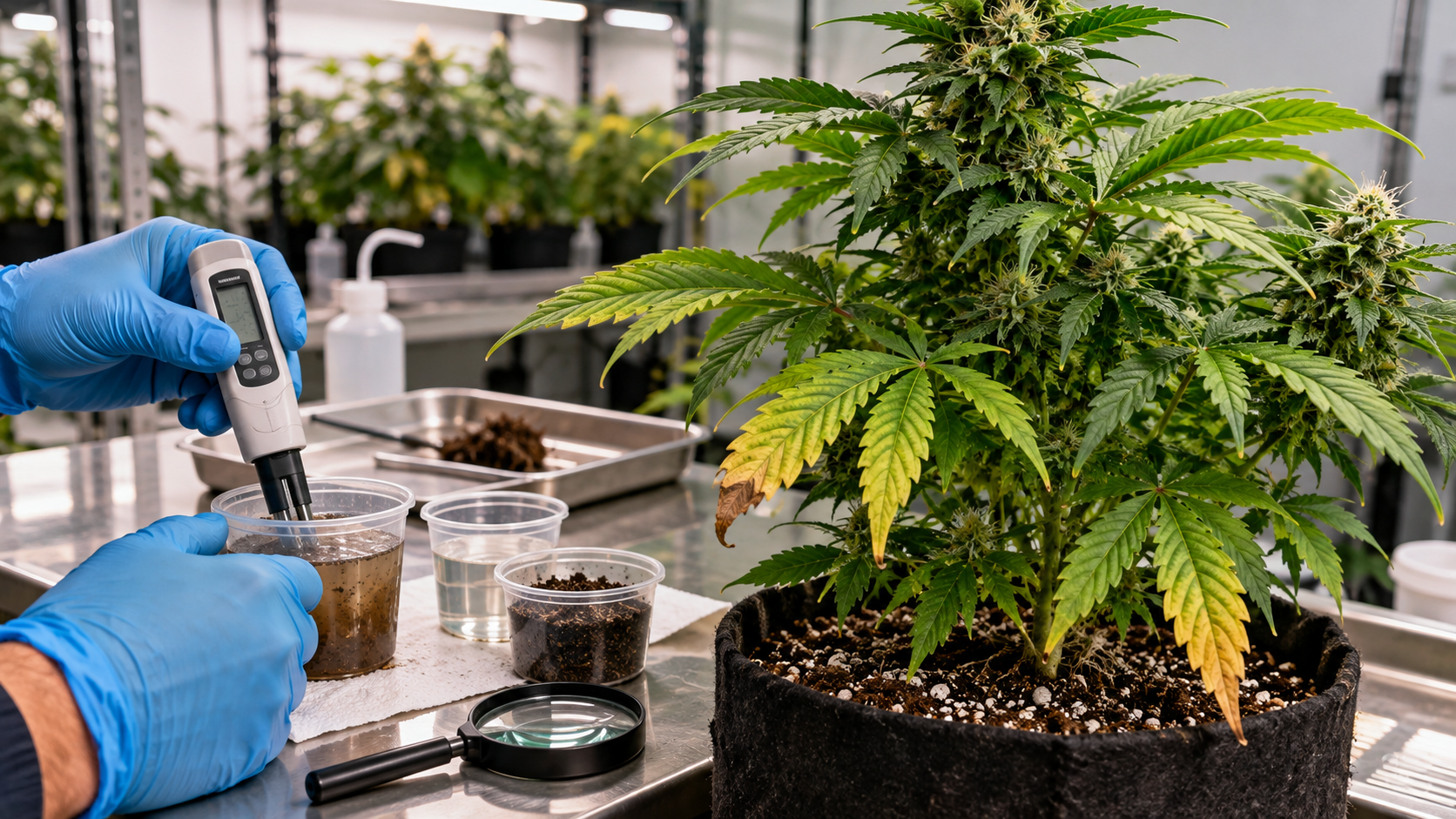
In a controlled single-element omission experiment in flowering cannabis, small chlorotic spots developed on lower fan leaves and progressed to larger necrotic lesions under prolonged P deprivation. Researchers reported only moderate purple coloration on some petioles and little of the strong leaf purpling often depicted in generic deficiency charts. That particular symptom sequence is evidence from one tested system, not a universal weekly timeline or a sign that every brown spot is phosphorus deficiency.
Other cannabis experiments show that low P can impair photosynthesis, transpiration, growth and inflorescence yield without reproducing every traditional symptom chart. Severe injury is often irreversible in the already damaged tissue. Diagnosis should focus on whether fresh tissue and overall growth stabilize after a verified correction, not whether a necrotic leaf becomes green again.
Why purple stems, dark leaves and spots mislead growers
Purple petioles and stems can be influenced by genetics, anthocyanin expression, cool conditions and developmental changes. Dark coloration can coexist with adequate nutrition. In lower leaves, magnesium deficiency, senescence and shading may resemble aspects of P shortage; discrete spots may instead come from insects, spray residues, mechanical injury or other nutrient problems. Strong light or temperature extremes can change pigmentation independently of a phosphorus diagnosis.
Do not use purpling alone as a trigger for a high-P booster. Identify whether older and newer leaves differ, whether the pattern repeats across plants receiving the same water and feed, and whether the medium or reservoir actually contains enough available P. When symptoms are aggressive or atypical, inspect pests and root health before attributing all damage to nutrition.
Warning: A deficiency chart cannot detect a blocked emitter
A plant at the end of a partly blocked line may show slower growth and unusual foliage while the stock-tank recipe looks normal. Confirm delivery volume, emitter function and root-zone conditions before changing fertilizer chemistry for the entire crop.
Excess phosphorus is often a chemistry and waste problem first
Excessive phosphorus does not reliably create an obvious cannabis-specific leaf-burn pattern. In multiple controlled cannabis studies, plants tolerated elevated P without characteristic visible toxicity while accumulating more P in tissues or leaving more P in the root zone and leachate. Absence of leaf injury therefore does not prove a booster is useful. A higher total fertilizer load can also elevate EC, and nutrient interactions may depend on other elemental supplies and genetic material.
High P is sometimes associated with micronutrient problems in horticultural systems, including concerns about iron and zinc. The cannabis-specific evidence is more nuanced: a controlled phosphorus trial showed element- and genotype-dependent tissue responses, not a universal “high P always locks out zinc” outcome. If new growth shows suspected iron or zinc deficiency, verify root-zone pH, the complete nutrient recipe and tissue results before declaring phosphate the sole cause.
Precipitation belongs in a different category. Cloudy concentrated stock, white sediment or blocked irrigation lines may indicate incompatible phosphate and calcium salts. In a mineral soil, low available P can reflect retention or reaction even with a high total-P pool. In an overwatered pot, low uptake can arise from damaged roots. Each problem needs a different correction; stacking booster onto all of them can worsen the diagnosis.
| Observation | What could explain it | Evidence needed before adding P |
|---|---|---|
| Older leaves develop persistent spots and growth slows | P shortage is possible; Mg, root damage, pests or localized injury remain possible | Check full feed analysis, repeated substrate/solution P assessment and comparable healthy plants |
| Purple petioles but otherwise vigorous growth | Genetic/developmental pigmentation or environmental response | Compare cultivar history, temperature, new growth and root-zone data |
| Newer leaves become chlorotic following booster use | Micronutrient imbalance, pH change, salinity or another cause | Check inputs, root-zone pH/EC and laboratory tissue profile; do not diagnose P toxicity by sight |
| Sediment forms after mixing products | Concentrate incompatibility or poor dissolution | Check product compatibility and mixing order; inspect emitters and delivered feed |
| Leaves look normal but drain solution contains high P | More P is entering or remaining than plants require in this system | Confirm a standardized leachate test and nutrient assay; assess waste and reduce unnecessary inputs |
Do / Avoid: The first diagnostic decision
Do establish where symptoms began, whether growth changed and what the roots actually receive. Avoid identifying P deficiency from a purple stem, diagnosing excess solely from one yellow leaf, or using EC as an elemental phosphorus test.
What to Measure Before Adding or Removing a Bloom Booster
Measurement is the difference between an informed adjustment and product stacking. Begin with what enters the root zone, assess the medium or reservoir using a comparable method, then inspect the plant and, when necessary, test tissue. Not every small grow needs a laboratory test at every irrigation, but a high-cost persistent problem is a poor place to substitute guessing for analysis.
Measure your entire input, not the booster bottle alone
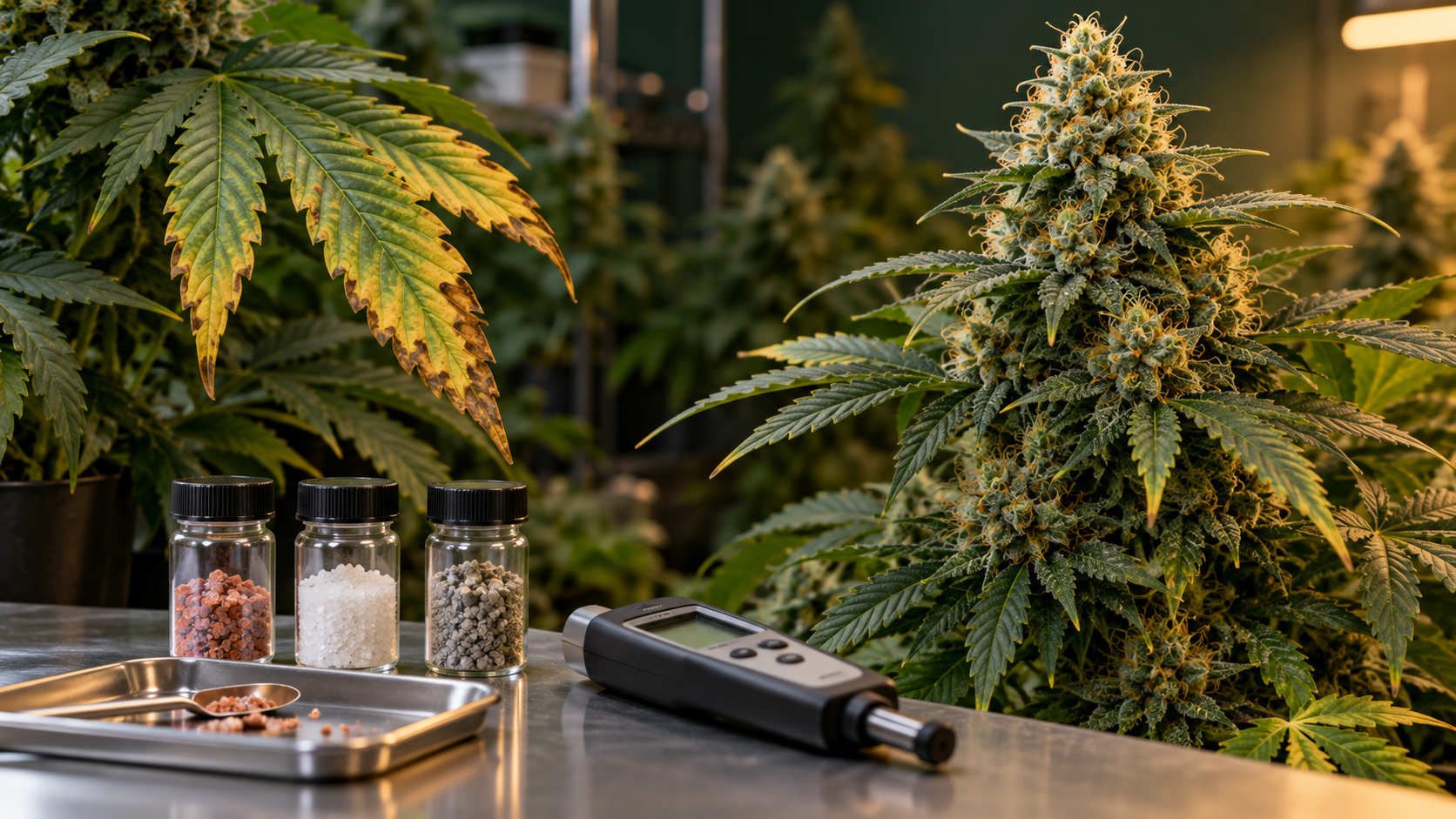
Keep the label and dose for the base fertilizer, bloom formula, cal-mag product, pH-adjustment chemistry and any optional booster. Identify whether the middle fertilizer number is P2O5 equivalent or elemental P, then put all products on one elemental basis. A phosphorus-bearing acid used to control alkalinity can be an additional input that is easy to miss. Never assume a product labeled “PK” contributes only P or that the larger of the two label numbers is an elemental mg/L concentration.
Write down the final prepared volume and either weighed dry mass or the manufacturer-supported liquid concentration/density used for your calculation. A liquid product’s volume cannot be converted to mass accurately without density; if the analysis is inadequate, obtain a complete guaranteed analysis or request technical clarification. Sample the fully mixed and diluted irrigation solution, not two concentrate bottles considered separately.
EC and pH answer different questions
Electrical conductivity indicates how strongly a solution conducts electricity due to all dissolved ions. It does not tell you the separate phosphorus, nitrogen, potassium, calcium or magnesium concentrations. A high-EC reading could reflect salts unrelated to P, and phosphate accumulation might be substantial without a distinctive change in foliage. Measure feed EC and pH consistently; use lab analysis or appropriate ion-specific testing when the question is actual P concentration.
pH affects chemical forms and interactions, but a single runoff pH result is not a universal root-surface measurement. Understand whether the number came from a clean reservoir, freshly prepared irrigation solution, a standardized PourThru sample, a saturated media extract or another extraction. Those methods are not numerically interchangeable, particularly for EC and nutrient concentrations.
How to compare root-zone and leachate results
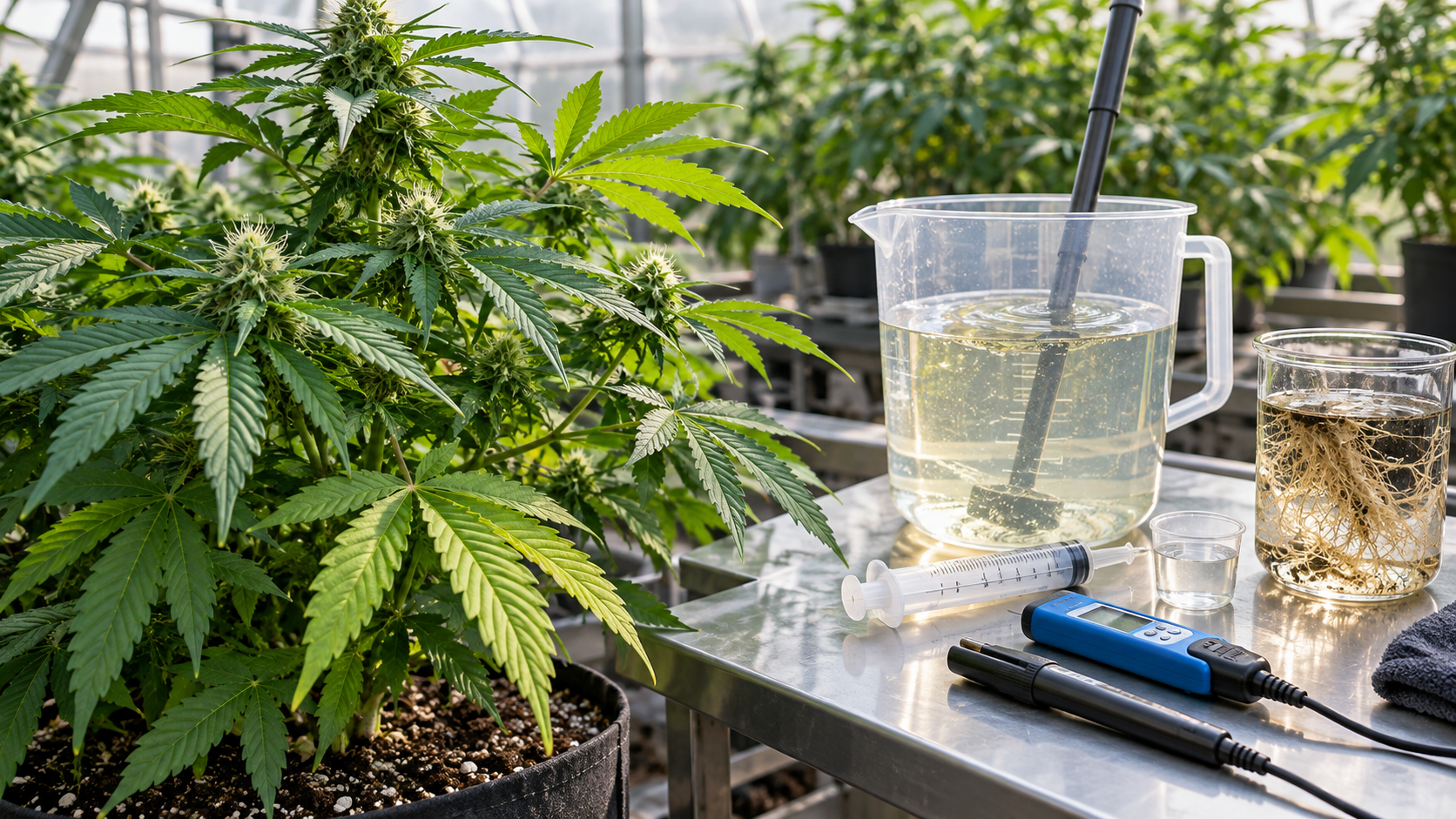
In recirculating systems, monitor reservoir concentration and trend together with top-up water and fertilizer additions. In drain-to-waste containers, choose a documented sampling protocol and repeat it at the same point in irrigation and with the same extraction method. Random first-drip and last-drip samples may differ even from the same pot. A lab can determine phosphorus, calcium, magnesium and potentially problematic ions on the same basis. Use paired samples from a normally performing plant and a symptomatic plant when feasible.
Native soil requires a regional soil-testing method with interpretations appropriate for that soil, not a hydroponic ppm target. Request available-P results and note which extractant the lab used. A very high soil-test P reading may mean more P fertilizer is unnecessary, but the numeric class belongs to that laboratory method and soil context. A soilless media assay and a field-soil extract cannot be directly ranked against one another.
When tissue analysis changes the diagnosis
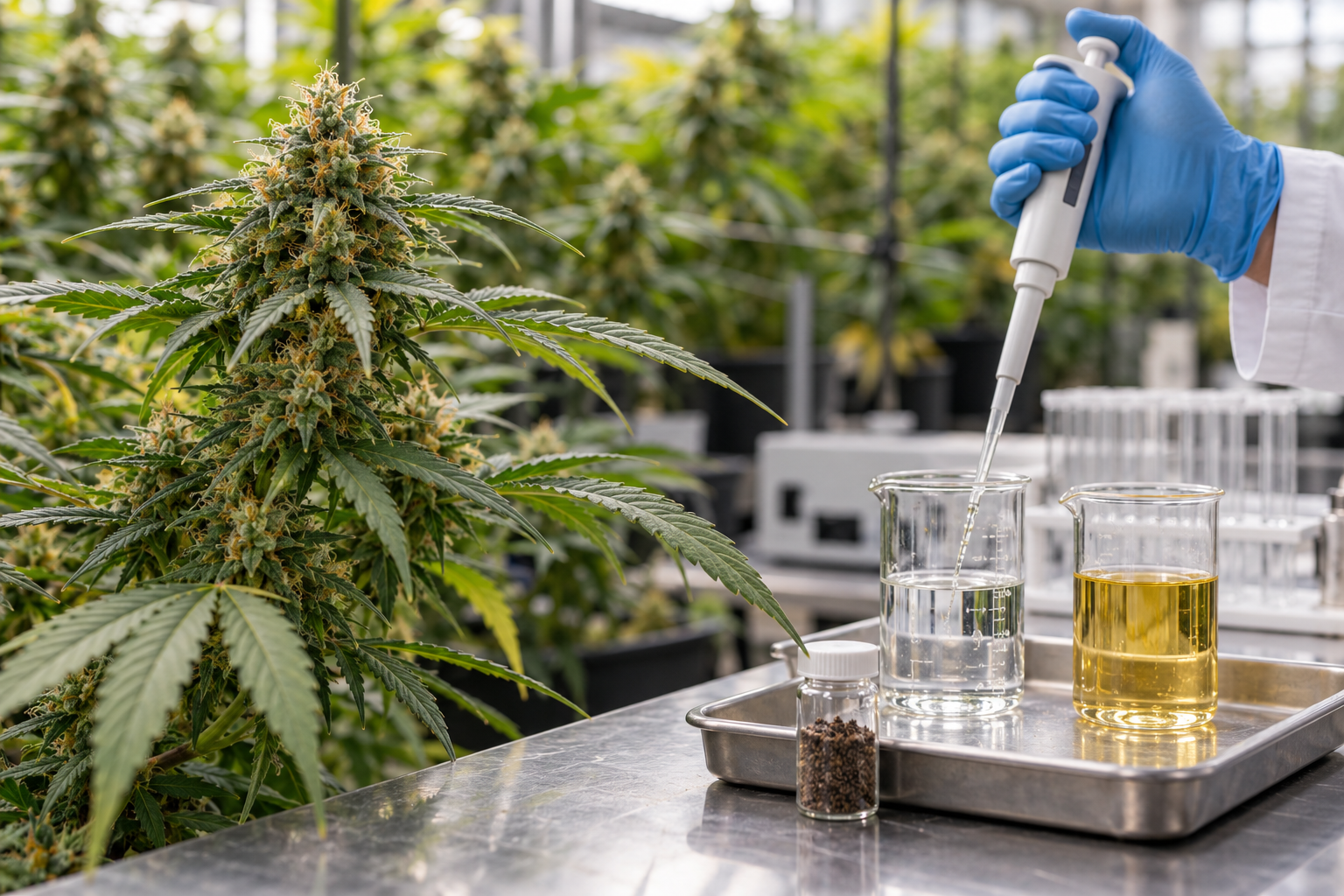
Tissue sampling can distinguish a repeatedly low internal P level from a leaf-color suspicion, but only if the sample includes the specified organ and stage and the lab uses appropriate reference material. Sample similarly aged leaves from comparable plants and disclose any recent spray or nutrient treatment. An excessively high tissue-P reading can confirm accumulation without proving direct toxicity. Compare a whole elemental profile, especially where iron, zinc, magnesium or calcium symptoms are being considered.
For harvest quality, keep dry flower mass, tested cannabinoid concentration and total compound yield separate. A higher flower P concentration is a tissue-analysis outcome, not an aroma score. Most fertilizer studies do not establish sensory flavor or inhalation safety, so do not advertise those conclusions from nutrient-assay data alone.
| Question | Minimum useful measurement | What it cannot prove |
|---|---|---|
| How much P is being supplied? | Full product analysis, source-water report, final dilution and common elemental P basis | That functioning roots absorb it all |
| Are total salts accumulating? | Matched feed and method-specific root-zone EC time series | That phosphorus is the specific salt |
| Is the medium making P available? | Appropriate available-P assay with pH and extraction method | The same ppm target applies in every soil or medium |
| Does the plant contain enough P? | Stage- and organ-matched tissue assay with full element panel | That more P increases yield or flavor |
| Did the booster help? | Comparable baseline, harvestable dry yield, quality testing and resource/waste records | A universal response from one uncontrolled plant |
Pro Tip: Before changing a recipe, save a dated record of the actual label, dilution, meter calibration, sampling method and photograph of the same plant sites. A later improvement cannot be interpreted if five other variables changed at once.
Comparing Phosphorus Sources and Bloom-Booster Approaches
The meaningful comparison is not organic versus synthetic branding. It is how predictably phosphorus becomes available, which other elements accompany it, how the system handles salt accumulation and whether the additional input addresses a verified shortfall. Under a satisfactory base program, the best-performing booster may be no booster at all.
The High-Phosphorus Bloom Booster Myth
A high middle label number looks persuasive because phosphorus is involved in energy metabolism and developing tissues. But a plant does not respond to label contrast; it responds to available nutrient supply and its own limiting factors. Controlled cannabis experiments repeatedly report no improvement in yield or cannabinoid concentration after phosphorus was increased above adequate treatment levels. The studies do not claim phosphorus is optional. They show why increasing a sufficient nutrient should not be confused with correcting its shortage.
Other bottlenecks include genetics, light interception, carbon supply, temperature, root oxygen, irrigation, pests and lost photosynthetic leaf area. A booster cannot recover photons that an overly shaded canopy did not capture, and it cannot replace a damaged root system. An unusually heavy flower may still need physical support and a sound drying process; neither outcome is generated by buying a larger P number.
Mineral salts and complete soluble bloom formulas
Soluble phosphate salts can provide measurable P rapidly when the diagnosis and recipe justify them. Their drawback is that they also supply counter-ions and affect the final total chemistry. A complete bloom formula may lower nitrogen and raise P relative to a vegetative formula, but its completeness depends on all supplied elements, not the bottle’s phase name. Compare the combined recipe against the existing baseline instead of adding a booster on top without subtracting the nutrients it duplicates.
Dry-salt concentrates demand correct weighing, dilution and stock separation. Do not premix concentrated calcium salts with phosphates when the formulation calls for separate tanks. If precipitates have already formed, adding fresh salts to the same cloudy reservoir may not restore the intended balance; assess and remake according to the product guidance, inspect filtration and verify the delivered final solution.
Organic amendments, compost and hybrid programs
Compost, manures, bone meal and other organic materials can contain phosphorus, but their nutrient analyses and release depend on source, processing, moisture, temperature and biology. An amendment incorporated before planting behaves differently from an emergency surface application during late flower. A soil already high in available P may not need another amendment even if an organic product is labeled bloom-specific.
Hybrid programs combine pre-amended soil with soluble inputs. They can be practical if the grower counts both reservoirs. A rich mix plus routine liquid bloom feed plus several additives may create a large cumulative phosphorus load without any single bottle appearing extreme. Test the medium, inspect water quality and prioritize a complete, documented program rather than treating “organic” as an exemption from excess.
Foliar phosphorus, microbial products and marketing claims
Foliar feeding has application-specific constraints and does not automatically correct root-zone chemistry. Spraying flowering material can introduce residue, moisture, contamination and worker-safety concerns. Do not use late-flower foliar phosphorus as a generic rescue or assume any sprayed additive is acceptable on an inhaled product. Check local legality and product label, and seek a qualified crop adviser when residue or disease risk is involved.
Mycorrhizal organisms and other microbes can affect phosphorus acquisition in suitable systems, but inoculant claims require credible tests under the actual conditions. Their performance depends on species, existing microbial communities, substrate P supply and plant roots. A microbial label is not proof that a heavily fertilized crop will yield more or that conventional nutrient diagnosis can be skipped.
“My base feed already contains phosphorus. Should I add a PK booster when the first flowers appear?”
Question source: Common grower question.
Not based on flower appearance alone. Total the elemental P already supplied by every product, check root-zone history and observe whether the plant is actually limited. If the base feed is adequate and growth remains normal, published cannabis trials do not support an automatic additional P increase. Keep the rest of the nutrient program complete.
A Repeatable Phosphorus Troubleshooting and Verification Sequence
Troubleshooting should produce a defensible decision even when the answer is “do not add phosphorus.” The sequence below separates supply problems from uptake problems, checks whether corrective action created a new imbalance and defines what evidence would justify escalation. Avoid interpreting one irrigation or one damaged leaf as proof of success.
Step 1: Decide whether the plant actually needs a correction
Record where the first signs appeared, how quickly they spread and whether similarly managed plants show the same pattern. Check flowering stage, temperatures, water use, moisture, rooting condition and pest activity. If a plant has discolored stems but steady new growth and no measured P shortage, the information does not justify a booster. If tissue lesions expand alongside weak growth, continue gathering evidence rather than assuming one deficiency.
Step 2: Audit the combined phosphorus input
Compare the complete guaranteed analyses, mixed volume, dosing records and source-water report. Convert the label basis to elemental P where appropriate. Include nutrient supplied by liquid amendments and pH-adjustment chemicals. If a recent booster was added, reconstruct the before-and-after recipe; do not assume that the earlier base feed disappeared. Record the initial and current EC and pH, but keep in mind neither meter provides a phosphorus-specific result.
Step 3: Inspect water delivery, roots and medium chemistry
Confirm that each plant actually receives the intended amount. Look for blocked emitters, sediment, uneven irrigation, waterlogging, prolonged dry-down and root damage. Obtain a method-appropriate available-P test if the problem remains uncertain. If source water has high alkalinity or the medium is strongly reactive, correct the underlying water or substrate management according to sound analysis rather than multiplying booster doses.
Step 4: Choose a single proportionate action
If documented phosphorus supply is deficient while root function and the rest of the recipe are stable, adjust the complete feed to restore adequacy. If the medium already tests high in P or repeated runoff data suggest unnecessary accumulation, discontinue redundant inputs and re-evaluate the base formulation. If total EC is elevated, first identify the actual ions and irrigation issue before applying an unplanned leaching treatment. Avoid simultaneously changing phosphate, potassium, calcium, pH additives and watering frequency without records.
For mineral soil, recommendations must be based on appropriate soil-test interpretation. For hydroponic systems, a changed input formula should be verified in the delivered solution and followed over time as water is replaced. Do not copy a study’s mg/L concentration into unrelated soil, coco or water sources. If symptoms continue despite a plausible correction, obtain matched tissue and media tests or professional diagnostic help.
Do / Avoid: Correct the cause, not the calendar
Do confirm feed chemistry, active roots and repeatable phosphorus measurements. Avoid adding a bloom booster just because the third flower week arrived, using purple stems as a dose meter or piling amendments onto a high-P soil.
Step 5: Verify the response without mistaking old damage for failure
Retest with the same sample method after enough irrigation and new growth have occurred to reveal a meaningful trend. On affected plants, follow the expansion of healthy tissue, water uptake and whether new lesions continue to appear. Older necrotic areas will not regenerate, so document progression rather than expecting cosmetic reversal. If delivered P increased but plant growth did not recover, revisit light, root health and other nutrients instead of increasing P again.
At harvest, use consistent drying and weighing methods to compare usable flowers. Keep plant-to-plant and area yield distinct, and do not use cannabinoid percentage as a substitute for dry flower yield. Record amount of fertilizer applied, the cost of the additional P and drainage or discharged waste. A treatment that increases nutrient concentration in tissue but not productive yield has not demonstrated a bloom benefit.
| Decision point | Proceed when | Pause or escalate when |
|---|---|---|
| Diagnosis | Repeated growth symptoms and input/root-zone data suggest genuine P limitation | Only purple pigmentation or one leaf is abnormal |
| Correction | Complete recipe can be adjusted without hidden duplicate inputs | Source water, mixed dose, root function or precipitation is unknown |
| After correction | New growth stabilizes and comparable tests support restored adequacy | Lesions expand, EC rises or symptoms appear in additional plants |
| End-of-cycle claim | Matched harvestable dry yield and relevant tested quality improve | Only larger buds in a photograph or higher tissue P is observed |
“The leaves stayed spotted after I corrected the feed. Does that mean the plant needs even more phosphorus?”
Question source: Common grower question.
Not necessarily. Previously necrotic tissue will not return to green. Check whether new lesions stop appearing, roots resume normal water use and new growth develops normally. Repeat the same nutrient and root-zone tests; if deterioration continues, investigate other causes before increasing the dose.
What Cannabis Research Actually Shows About Bloom Boosters and Quality
Bloom Boosters and Excess Phosphorus
The experimental distinction is between relieving true deficiency and applying progressively more phosphorus to plants already in a sufficient range. Shiponi and Bernstein (2021) showed impaired function at their two lowest P treatments and increasing dry flower mass through an adequate supply, with genotype-dependent response at the upper end. Westmoreland and Bugbee (2022) found no significant yield or measured cannabinoid benefit from increasing P from 25 to 75 mg/L in their high-CBD system, while leachate P increased about twelvefold. Hershkowitz and colleagues (2025) found no yield or measured quality benefit from increasing supplied P across 15 to 90 mg/L in a closed hydroponic trial even though tissue P rose substantially.
A 2021 response-surface experiment in one high-THC cultivar modeled an N-by-P yield response in deep water culture, but its fitted optimum was specific to the tested nutrient combinations and conditions, not a universal formula. Another earlier flowering study found genotype-dependent effects up to the upper P treatments. Together these findings show why an absolute assertion that additional P never helps would also be inaccurate. The key question is where an individual crop lies on its response curve and whether another factor is actually limiting.
Dry flower yield, cannabinoid percentage and total output are different
One study found inflorescence cannabinoid concentration declined as phosphorus treatment and flower mass rose; the researchers interpreted part of this as a dilution relationship while total cannabinoid per plant increased. Other trials reported no significant change in cannabinoid concentration across their tested range. These findings are not identical because genotype, input concentrations, system, sampling and outcomes differ. A higher compound percentage in a smaller stressed harvest cannot be advertised as more total production.
Claims about terpene profile, subjective taste, combustibility, ash color or inhalation safety require outcome-specific evidence. Most phosphorus trials measure growth, tissues, cannabinoids, limited chemical profiles and leachate. They do not show that a named booster improves perceived flavor, makes flowers safer to inhale or guarantees density across cultivars. Avoid turning research on nutrient efficiency into sensory marketing.
The environmental cost is directly measurable
Unlike a subjective bud-size impression, phosphate escaping in drain water can be measured. One high-CBD cannabis trial observed a roughly twelvefold increase in leachate P when supplied P was raised threefold, with no significant yield or cannabinoid benefit. The environmental interpretation depends on the wastewater pathway, but unnecessary nutrient loss matters: phosphorus transported into waterways can contribute to eutrophication and harmful algal blooms. Collect and dispose of nutrient wastewater according to local requirements; do not route concentrated drainage into stormwater systems.
Closed-loop systems can also accumulate phosphorus if replenishment exceeds removal. Increasing reservoir EC without gaining yield is not evidence of efficiency. Assess fertilizer usage and output as well as plant appearance. Where the root zone is already sufficient, reducing avoidable excess can be beneficial even if the foliage never exhibited an obvious toxicity sign.
A comparison framework for a booster claim
To test a booster credibly, compare genetically comparable plants under equivalent light, irrigation, environment, baseline nutrition and harvest timing. Change phosphorus treatment deliberately while holding other nutrient effects as stable as the formulation allows. Record replicates, dry flower mass, grade/usable fraction, appropriate laboratory compound concentration, total compound yield and drainage phosphorus. A booster that simultaneously increases potassium, changes nitrogen and alters irrigation cannot demonstrate which ingredient caused a difference.
Ordinary growers may lack the plant numbers required for a controlled trial. In that case, do not sell an uncontrolled side-by-side photograph as proof. Treat it as a record of your own conditions. For most decisions, stable root-zone measurements, a complete feed and non-deficient growth give a stronger reason to avoid unnecessary addition than a marketing claim based on a single impressive cola.
Important: No universal cannabis P dose is established by these experiments
Published treatment concentrations cannot be transferred unchanged between genotypes, soil, coco, drain-to-waste and recirculating systems. Their nutrient concentrations, endpoints and measured root-zone histories differ. Do not invent a guaranteed flower-week booster schedule or a universally optimal elemental-P target.
Master Advice: The strongest bloom-booster decision is a diagnosis. Correct verified shortage, stop redundant excess, and judge the result by sustained growth, usable dry yield, appropriate quality tests and nutrient losses rather than by bottle strength.
Final phosphorus decision checklist
- I know whether my labels report P2O5 equivalent or elemental P and have counted every source of phosphorus.
- I have checked source-water chemistry, mixed-solution pH/EC and a method-appropriate root-zone assessment.
- I have separated true P deficiency from root oxygen, irrigation, pH, temperature, pest and other nutrient problems.
- I am not using purple stems, a flowering week or bud size as a stand-alone deficiency test.
- I will adjust one defined factor at a time and confirm delivery and subsequent plant response.
- I understand that more tissue P or higher cannabinoid percentage does not automatically mean higher usable yield.
- I have a plan for handling nutrient-rich leachate without contaminating nearby waterways.
For the broad formulation and feeding framework, return to the nutrients and fertilizers guide. For the related element that must remain available during flowering, read the nitrogen-specific guidance in the verified parent guide. The next practical step is to audit your existing inputs and sample the root zone, not to add a booster by default.
Educational content. Always follow your local laws.
Share this article
A quick overview of the topics covered in this article.
- Phosphorus Begins With Plant Physiology and Root-Zone Chemistry
- How Phosphorus Demand Changes With Stage, Medium, Water, and Environment
- Distinguishing Phosphorus Deficiency, Excess, and Look-Alike Problems
- What to Measure Before Adding or Removing a Bloom Booster
- Comparing Phosphorus Sources and Bloom-Booster Approaches
- A Repeatable Phosphorus Troubleshooting and Verification Sequence
- What Cannabis Research Actually Shows About Bloom Boosters and Quality