Change One Grow Variable at a Time: A Controlled Troubleshooting Method
A declining cannabis plant can tempt you to do everything at once: increase fertilizer, adjust pH, water again, move the light and remove the damaged leaves. Even if the plant improves, that sequence leaves an unanswered question. Which change addressed the problem, which was unnecessary, and which may create the next one?
When conditions are safe and the problem is not rapidly escalating, identify the strongest supported cause, record a baseline, change one controllable factor, keep other major inputs consistent, and check a predetermined response. This is a troubleshooting discipline, not a claim that a crop has only one problem or that a before-and-after comparison proves causation. When an urgent hazard, suspected contagious disease, unsafe equipment or rapidly deteriorating root zone demands several protective actions, protect the crop and people first. Document those actions as an emergency response rather than presenting the result as a one-variable experiment.
The purpose here is a reusable decision method for lawful indoor and outdoor cannabis cultivation. Detailed nutrient diagnoses, soil and water testing, specific irrigation repairs and disease treatment belong in their own resources. This guide shows how to investigate a plausible cause, choose a correction with interpretable consequences and know when the original hypothesis failed.
What Changing One Variable Actually Means
One variable means one deliberate management factor is altered to test a specific explanation. It does not mean ignoring changes in weather, plant growth, irrigation demand or pathogen pressure. Those background conditions must be monitored because they may influence the result even if you never touched their controls.
Change One Input at a Time
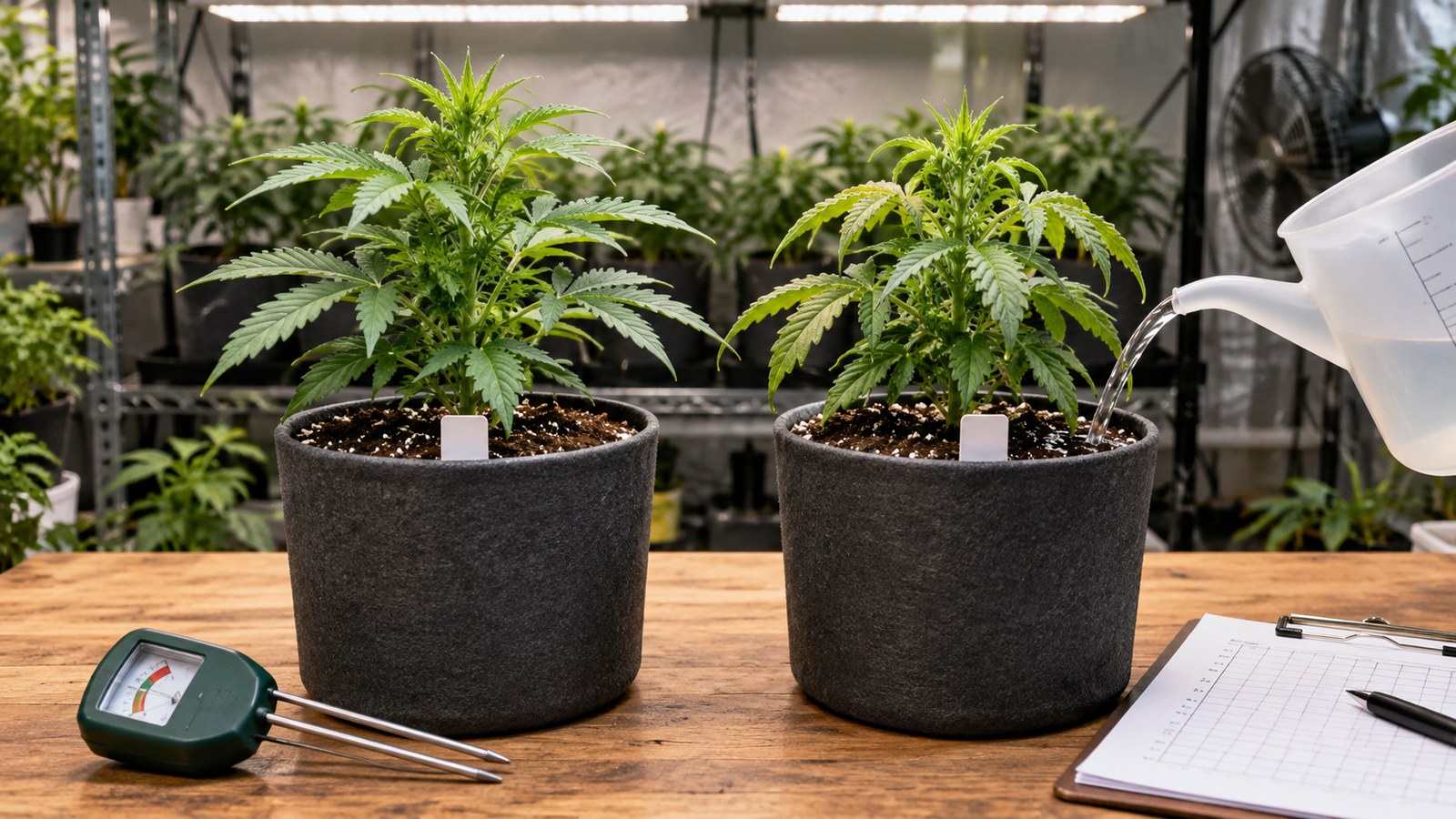
Consider a fertigated container with pale growth and a root zone that has remained unusually wet. Increasing feed concentration changes fertilizer strength. Delaying the next irrigation changes irrigation timing. Moving the plant to a warmer place changes its environment. All three might affect uptake, but changing all three together prevents you from learning which one mattered. If the evidence first supports prolonged saturation, correct the inappropriate irrigation schedule while leaving the fertilizer recipe and other safe conditions stable. Measure moisture and water use again before considering a nutrition change.
One factor can contain several linked settings. For example, changing to a different fertilizer brand may alter nitrogen form, potassium, calcium, magnesium, micronutrients, acidifying potential and total concentration together. Calling that switch one product change does not make it a one-variable test. Likewise, a reservoir replacement may change several ion concentrations even if EC is matched. Define the variable at the level of plant function, not the number of bottles you handled.
How to Change One Grow Variable at a Time
Write the suspected cause and expected response before intervening: “I suspect the root zone remains saturated because irrigation starts again before this container has used enough water. If I adjust the timing, moisture at the lower sampling depth should stop remaining persistently saturated, and subsequent new growth and water use should stabilize.” The statement links a mechanism to a testable observation. A vague plan such as “make the plant happier” does not.
Choose the smallest reasonable correction that addresses the documented problem without creating a fresh one. Follow product labels and system-specific guidance for any fertilizer, chemical, light or irrigation adjustment. The purpose is not to deliberately expose plants to unsafe extremes. It is to isolate a plausible corrective action within an otherwise sound management program.
A single plant observed before and after a change can show whether its trajectory improved, but cannot by itself establish that the intervention caused the improvement. A genuine comparative trial needs an appropriate control, comparable experimental units, replication and often randomization. This resource helps you make better management decisions without claiming the rigor of a replicated experiment.
What should remain unchanged?
Hold safe, relevant conditions as consistent as feasible: source water, fertilizer composition, cultivation stage, sampling method, measuring device, sensor placement, irrigation delivery and photo angle. Do not hold an unsafe condition constant merely to protect the experiment. If the root zone is visibly collapsing or electrical equipment is hazardous, restore safety immediately. Record any unavoidable concurrent changes, such as a heat wave, rainfall, equipment repair or transition into flowering.
What the rule cannot do
Two causes may operate together: excessive salts can injure roots while prolonged wetness limits oxygen; a pest outbreak may follow weakened plants; cold roots can reduce uptake even with a complete fertilizer program. A one-variable correction may solve only one layer of the problem. Conversely, normal growth can resume without your intervention as weather improves. The result must therefore be interpreted as evidence that supports or weakens a hypothesis, not a declaration that every other cause has been excluded.
Field advice: If you cannot name the suspected mechanism and the observable change you expect, do not reach for another product yet. Measure the system first.
Why Several Simultaneous Corrections Hide the Cause
Plants integrate conditions over time. Light determines part of the potential growth demand, water moves nutrients, roots need oxygen and suitable temperature, and fertilizers alter the root-zone solution. A canopy symptom may therefore reflect a limitation elsewhere in the plant or a previous management event. Several simultaneous changes add confusion to a system that was already difficult to read.
Confounding: when different causes move together
Suppose yellowing appears after a strong feeding, followed by a cold night and another heavy irrigation. The grower then flushes, increases light and adds calcium-magnesium solution. Green new growth appears later. Was the initial problem salt concentration, root oxygen, cold roots, nutrient supply or something else? Did weather improve independently? The answer cannot be extracted from the outcome alone because several plausible causes and treatments changed together. In research this is a confounded comparison.
Confounding also occurs when the “comparison plant” is a different cultivar, grows in another medium, receives more sunlight or is at a different stage. A healthy plant is useful context, but it is not a fair control merely because it stands nearby. Choose comparisons that match the suspected exposure as closely as possible and write down the remaining differences. If everything is different, use the plant as a visual reference rather than a causal control.
Natural recovery, delayed injury, and regression toward normal
Some transient symptoms improve after a hot afternoon, irrigation error or mechanical injury has passed. Old damaged leaves may never return to normal appearance even after the mechanism is corrected. A new problem can also become visible after the original stress occurred, especially if the affected tissue developed earlier. A remedy given just before normal recovery can receive credit it has not earned.
Assess the trend in comparable new tissue, root-zone behavior and the rate of new injury rather than expecting necrotic areas to reverse. Take photographs of the same marked plants, from the same distance and under comparable light. Avoid comparing a yellow leaf in warm morning light with a different leaf under a violet lamp and calling the color change recovery.
Single-factor comparison versus repeated guessing
A clean comparison has a specific question, an identifiable treatment, a defined measurement, a baseline and a control or reference where one is feasible. A repeated guess changes an input, watches briefly, dislikes the appearance and adds another treatment without recording the first response. The second pattern can accumulate excess fertilizer, salts, root disturbance, unnecessary sprays and management stress while destroying the information needed to stop.
Formal research guidance advises comparing one factor while holding the rest as equal as possible, and using controls and true replication to guard against natural variability. Those principles improve a grower’s log even when running a replicated trial is impractical. A single intervention can be a useful decision, but it should not be advertised as proof of a universal crop response.
Do not delay action for an electrical hazard, a leaking chemical, unsafe structural support, visibly contaminated irrigation or rapidly spreading suspected disease just to keep the experiment “clean.” Stop the dangerous exposure, isolate suspect material where appropriate and follow applicable professional, product and local requirements. Document every action and accept that the resulting case may not support a single-cause conclusion.
Choose the Variable, Comparison, and Measurements
The best starting point is usually the smallest set of observations that separates two plausible explanations. If leaves are pale, both insufficient nitrogen and poor root function remain possible. Measuring the delivered feed, active root-zone conditions, irrigation history and pattern of affected plants may narrow the choice. If a leaf shows clear feeding damage and insects are present, a fertilizer experiment is poorly targeted from the outset.
Start with the pattern and recent history
Map the problem before treating: one leaf, a single plant, one irrigation line, one light zone, one cultivar or the entire crop. Record the first noticed date, earliest affected tissue, whether symptoms spread, and major changes during the preceding period. Look for shared exposures. A room-wide sudden change following a new nutrient batch points toward common inputs; one isolated container that never drains warrants local inspection first. Neither pattern alone identifies a chemical or organism.
Choose a leading hypothesis and a serious alternative
Write a short competing explanation next to the preferred one. “The plant looks underfed because the input is too dilute” competes with “the plant looks underfed because waterlogged roots cannot use the nutrients already present.” Identify the measurement most likely to distinguish them. The alternative guards against tuning your observation to whatever you already believe.
Use a test-selection framework when a laboratory result would change the decision. A water test can characterize incoming chemistry, a medium test describes a specified root-zone sample under its method, and tissue analysis describes accumulated nutrients in sampled tissue. None independently proves the cause of a leaf symptom. The broader Nutrients & Fertilizers Guide covers fertilizer interpretation; this resource covers how to control and evaluate a change once the likely problem is defined.
Build a baseline before making the adjustment
Record the current condition at the same time and location you intend to remeasure. For fertigation, note the source, actual finished-feed pH and EC, irrigation volume, drainage or reservoir state, and measurement method. For water management, note container mass or moisture at comparable depths, actual delivered water and weather or room climate. For canopy problems, mark the plant, the affected growing point, its exposure and an accessible unaffected comparison. For pests, identify the organism where possible, count or describe the same sampling unit and document beneficials and injury trend before considering a crop-legal action.
Never compare measurements that use different extraction methods or units as though they were one continuous trend. A casual runoff EC, standardized growing-media extract and reservoir EC describe different samples. EC summarizes conductivity, not the concentration of a particular element. Calibrate sensors and note battery, placement or probe issues before accepting a striking reading as a genuine crop change.
| Suspected variable | Baseline to record | Deliberate change | Verification signal |
|---|---|---|---|
| Irrigation timing | Moisture or pot-mass trend, actual delivery, root condition and plant water use | Adjust the timing appropriate to the measured medium; leave safe feed composition unchanged | Root zone returns toward its intended moisture cycle without new wilting or persistent saturation |
| Fertilizer concentration | Complete recipe, source water, input EC, standardized root-zone result and growth pattern | Correct documented concentration while preserving recipe balance when feasible | Subsequent measured chemistry and new growth move in the expected direction without salt injury |
| Light exposure | Actual canopy measurement or mapped sun exposure, leaf temperature, height and position | Correct the documented exposure issue within equipment and crop safety guidance | New leaves and temperature or light measurements improve without new bleaching, stretching or heat stress |
| One emitter or irrigation line | Measured delivery, blockage, affected plant map and matched line comparison | Restore the faulty emitter or supply component | Delivery and root-zone wetting normalize; same-location symptoms stop progressing |
| Root-zone pH or source-water chemistry | Calibrated input and suitable root-zone samples; water report where relevant | Correct the demonstrated chemical cause using a suitable procedure | Method-matched follow-up chemistry stabilizes and plant response is consistent with improved uptake |
| Pest management | Confirmed identification, life stage, same-unit counts, damage and natural enemies | Use an appropriate lawful targeted intervention if the observed risk warrants it | New injury and relevant life stages decline under the same scouting method |
These are measurement categories, not universal targets. The appropriate numerical range depends on the medium, crop stage, cultivar, instrument, jurisdiction and the decision being tested. An observation should be specific enough to repeat without pretending that one target applies everywhere.
One plant, one group, or a real comparison?
For one valuable plant, an interrupted before-and-after record may be all that is ethical or practical. Repeated observations strengthen the description of its trajectory but cannot eliminate changing weather and developmental effects. If several similar plants exist, compare a corrected group with the established safe standard using comparable genetics, root volume, stage, light, irrigation and pest exposure. Do not deliberately withhold necessary care from a sick plant to manufacture a control. For a formal experiment, independently assigned plants or plots, replicated units and randomized placement may be required; several photos or leaves from one pot are not independent plant replicates.
“Two plants look pale. Can I feed one more and leave the other unchanged to prove the cause?”
Question sent by: Madison Hayes, via email.
Only if the comparison is safe and reasonably matched, and the result is framed cautiously. First rule out root damage, different container moisture, emitters and cultivar differences. Record both baselines and monitor both. If either plant needs urgent correction, do not deny care to preserve a demonstration.
A Repeatable Controlled Troubleshooting Protocol
Use the same sequence each time, with adaptations for the specific risk. The protocol creates a decision record: what was wrong, why you selected one action, what happened next and whether the outcome justified another change.
Step 1: define a problem that can actually be observed
Write “the lower foliage of containers on irrigation line B has become progressively pale while line A remains stable,” not simply “the crop looks bad.” Name how many comparable plants are affected, the organ and age of the first symptom, and whether the pattern appeared suddenly or gradually. Compare with the plant’s normal developmental changes. Expected late-season senescence, shade-related lower-leaf loss and natural flower-transition morphology are not automatically treatment targets.
Step 2: perform a no-treatment safety and system check
Before changing inputs, confirm there is no immediate human hazard, equipment fault, collapsing support, suspected serious contagion or unmistakable need for containment. Verify the meter, irrigation operation, reservoir mixing and sampling procedure. An unplugged pump or blocked emitter is a repair, not a mystery deficiency. If urgent action is required, act and document every necessary change; resume controlled troubleshooting after the hazard is contained.
Step 3: select the smallest discriminating measurement
Ask what evidence would make you abandon your first idea. Suspect nutrient deficiency? Compare full feed and root-zone data with moisture, water use and root health. Suspect light injury? Measure canopy exposure and temperature, then compare symptom position and recent light changes. Suspect a pathogen? Inspect signs and relevant tissue, and use qualified diagnostics when identification changes sanitation, disposal or permitted treatment. Select tests for the question, not because a device is available.
Step 4: document a baseline and select the correction
Record the date, plant IDs, stage, hypothesis, alternative, instrument units, sample method and measurements. Photograph fixed locations. Choose an intervention that directly addresses the most supported mechanism. Write the new setting or management action precisely: “repair emitter at line B, position 3” or “return the mixed feed to the last verified safe recipe.” “Add boosters” is not a defined correction. Also record what you will deliberately not change during the observation period.
Some repairs necessarily change linked quantities. Fixing an emitter changes local water delivery and therefore the root-zone moisture trend, which is the intended causal chain. That is acceptable; record the intervention and expected downstream responses. Replacing a complete fertilizer, changing substrate and increasing light simultaneously are distinct management factors with multiple unrelated mechanisms. Do not disguise those changes as one intervention.
“Did restoring measured delivery to the blocked emitter resolve the local moisture deficit and stop new wilt?” Identify the response and sampling point before repairing.
Do not decide the treatment “worked” because some different feature later improved while the original symptom or measurement continued to deteriorate.
Step 5: make the controlled change and log exceptions
Use appropriate protective equipment and follow manufacturer instructions. Apply the correction only to the affected component, plant or group when this is safe and consistent with its mechanism. Avoid a whole-crop nutrient change to fix one blocked irrigation outlet. Record the exact intervention time, products or settings, calibrated before-and-after readings and any accidental spill, weather event, pruning or unrelated equipment change. If several actions were required, state that the case is no longer a clean one-factor comparison.
Step 6: decide when the next observation is meaningful
Match follow-up to the mechanism instead of using a universal 24-hour or seven-day recovery rule. Delivery pressure or emitter volume can be checked immediately after a repair. Moisture distribution becomes interpretable after water has moved through the medium and during the next normal irrigation cycle. New plant tissue takes longer to express a nutritional or growth response. A suspected pest or disease may require shorter checks because spread can outpace normal growth. Decide the checkpoint from crop risk, expected physiology, severity and the amount of information the measurement can provide.
During the observation period, continue essential routine care. Do not let a plant dry catastrophically or leave it in hazardous conditions in the name of consistency. Note unavoidable changes such as rain, flowering transition or warm weather, then qualify your interpretation accordingly.
Step 7: compare the correct outcome and keep or reject the hypothesis
First check whether the intervention changed the intended intermediate condition: did the dripper deliver the expected flow, did the root-zone concentration move as measured, or did the light map change? Then check plant response: did newly formed tissue look healthier, water use return, new lesions stop appearing, or symptom spread slow? A better meter number without better plant function is not enough. A plant improvement without a changed intermediate condition weakens the proposed mechanism.
Classify the outcome as supported, unresolved, contradicted or unsafe. Supported means the intermediate measurement and relevant trajectory agree, with remaining uncertainty acknowledged. Unresolved means the result is too soon, the measurement failed or confounders changed. Contradicted means the expected intermediate or plant response did not occur, so collect better evidence instead of repeating the same action automatically. Unsafe means a new hazard or rapid decline requires immediate protective response.
| Checkpoint | Question | Evidence to keep | Decision |
|---|---|---|---|
| Before action | Is the diagnosis sufficiently supported to justify a specific correction? | Pattern, history, reliable measurements, alternatives, risk screen | Act on a supported mechanism or collect more evidence |
| Immediately after technical repair | Did the component or intended input actually change? | Flow, mixed-feed measurement, sensor reading or physical inspection | Fix implementation error before assessing the plant |
| Next meaningful root-zone or scouting event | Is the affected condition trending toward a normal and safe pattern? | Method-matched moisture, chemistry or organism observations | Continue monitoring, or reassess if it worsens |
| New growth or relevant development | Has additional injury stopped and function improved? | Marked growing points, water use, new tissue, disease or pest spread | Keep the correction if supported, or reopen diagnosis |
| Next management cycle | Did the apparent recovery persist without creating another problem? | Stable records and any unintended effects | Document the local result without claiming universal proof |
A worked example: yellow leaves in a persistently wet container
A container has pale older leaves and reduced growth. Input fertilizer was unchanged and a consistent medium test does not support a sudden nutrient shortage, but the pot remains unusually heavy and its lower zone stays wet between irrigations. The leading hypothesis is oxygen-limited roots from inappropriate irrigation timing; alternatives include damaged roots, salt concentration and disease. The grower records moisture at two depths, pot mass, water use, growth points, irrigation schedule and root observations without destroying the root ball.
The correction is a measured adjustment to irrigation timing appropriate to that medium while retaining the established safe nutrient recipe. The first check verifies that the lower root zone no longer remains saturated; the later checks assess water use and new growth. If wetness normalizes yet decline continues, repeating the timing adjustment more aggressively is not justified. Reinspect roots and chemistry and consider disease diagnostics. This is an illustrative reasoning example, not a universal cannabis watering schedule or an account of a real crop.
“I corrected the moisture problem yesterday, but the yellow leaves are still yellow. Should I increase nitrogen today?”
Question sent by: Tyler Morrison, via contact form.
Not solely because damaged tissue did not regain its color. Check whether the root-zone correction actually worked, whether new damage has stopped and whether new growth is developing normally. Reassess nitrogen supply if independent measurements still support a shortage. There is no universal day-after-correction deadline.
Common Mistakes, Look-Alikes, and Exceptions
The method is strongest when its limitations are stated openly. Watch for the following traps before calling a correction successful or failed.
Changing a product while changing several nutrient elements
Switching from one multi-part fertilizer to another is a whole-program comparison, not a clean test of nitrogen, phosphorus or potassium. A booster may add salts and acidifying ingredients as well as its advertised element. If a product substitution is unavoidable, list the changes in elemental input, total concentration and root-zone response. Never infer which ingredient helped from the product name alone.
Correcting a meter reading rather than its source
A pH number outside your intended plan could reflect probe calibration, different sample material, source-water alkalinity, fertilizer chemistry or real root-zone drift. Similarly, high EC could involve fertilizer concentration, evaporation, sodium-rich water or sampling differences. If readings are not comparable, a single-variable trial built on them is invalid. Repeat the correct method before changing the crop.
Failing to notice that plant demand changed
Weather, canopy size, roots and developmental stage affect water and nutrient demand even when the grower’s controls stay fixed. An outdoor plant may dry faster after a windy spell; an indoor crop may use less water after lower light or a root injury. Holding irrigation frequency absolutely constant may be harmful and does not keep physiological water availability constant. Keep the decision rule consistent while meeting essential crop needs, and record the actual irrigation volume and environment.
Confusing an intervention with a measurement
Calibrating a faulty meter is measurement repair, not a plant treatment. Removing a leaf so you can inspect an underside may itself change the canopy. Digging out a root ball for diagnosis can injure roots and alter the next response. Prefer low-disturbance measurements first; if inspection changes the system, write it into the intervention log.
Choosing a comparison that was never comparable
Two seeds may differ genetically even when sold under the same cultivar name. Root volume, initial health and sunlight also affect response. If one pot starts healthier or receives a different dose, later differences do not isolate your proposed cause. Formal studies use matching, replication and randomization to reduce this bias. In ordinary troubleshooting, at minimum document the mismatch and avoid a strong causal claim.
Waiting too long for an infectious or hazardous problem
Unexplained progressive flower decay, a rapidly expanding lesion, suspected contaminated propagation material or shared-water root collapse may require containment and diagnostic escalation immediately. Do not keep a potentially infectious plant in unrestricted contact with the rest of the crop for a neat control period. Likewise, avoid unlawful or unapproved pesticide applications; crop registration and label directions vary by jurisdiction, and an apparently natural product does not bypass residue or worker-safety questions.
New systemic wilting, progressive root or crown decay, spreading flower rot, unsafe water chemistry, equipment danger or an unexpected exposure invalidates the original low-risk observation plan. Protect people and plants, isolate material where appropriate, seek qualified diagnostic advice and record the combined actions. A clean experiment is never more important than preventing serious harm.
Using an arbitrary waiting interval
A set number of days is not a universal recovery threshold. An emitter repair should correct flow at once; a new leaf requires time to form; damaged flower tissue will not repair into usable product; disease may progress in the meantime. Set the next measurement around the mechanism and risk. If the expected signal cannot yet be present, label the observation “too early” rather than failed.
Maintain safe routine care, use comparable sampling and document weather, stage and neighboring crop events.
Emergency containment or multiple necessary repairs take priority. The result is then documented as a multi-action rescue, not a one-factor test.
Verify Recovery and Decide What the Result Means
After the correction, require two levels of confirmation: the proposed cause was measurably altered, and the plant’s relevant trajectory stopped deteriorating or improved. One good-looking leaf or one idealized meter number does not close a diagnosis. Records are useful precisely because they reveal when those two levels disagree.
Check the mechanism before judging the canopy
If the correction targeted a plugged emitter, compare measured output at that outlet with the intended supply. If it targeted nutrient concentration, retest the correctly mixed solution and root-zone trend by the same method. If it targeted inadequate lighting, map the relevant canopy position under comparable conditions. If it targeted a pest, scout the same species, life stage and plant part. This first check tests whether your intervention reached its intended target.
Judge recovery on new behavior, not irreversible scars
Record the appearance and expansion of new tissue, absence of new lesions, stabilizing water use, root firmness when visible without damage, and whether symptoms spread to previously unaffected plants. Old necrotic leaf margins, damaged buds and dead roots do not regenerate merely because a condition improves. A plant can stabilize but remain smaller than unaffected plants after earlier injury. Name the achieved outcome accurately: arrested progression, partial recovery or return of normal growth.
What if the correction helped only partly?
Check whether the intermediate measurement fully changed, whether an independent second cause is plausible and whether the plant had irreversible structural or root injury before treatment. For instance, relieving wetness may restore oxygen availability but cannot automatically remove an established root pathogen. A gradual improvement may be real while another issue remains. Reopen the diagnostic question rather than layering a nutrient, pesticide and growth stimulant together.
What if nothing changed?
Check implementation first: wrong emitter, inaccurate meter, unmixed solution, sensor in the wrong location or insufficient observation time can all make a sound idea appear ineffective. Next examine whether the predicted measurement was actually tied to the problem. If both intervention delivery and measurement were correct yet the predicted condition remains unchanged, reduce confidence in the hypothesis and investigate the next plausible cause. Repeating a failed remedy at higher intensity without new evidence increases risk rather than knowledge.
When a laboratory or professional diagnosis is the next variable
Choose a laboratory test when its result will change a decision. An appropriate water analysis helps identify specific ions and alkalinity; standardized soil or medium testing addresses root-zone chemistry; matched tissue results describe nutrient accumulation; a plant diagnostic clinic investigates suspected pathogen causes using appropriate samples. The problem determines the panel. Do not interpret a generic fertility test as pathogen identification, contamination clearance or proof that roots have adequate oxygen.
If a valuable propagation line, numerous plants or shared irrigation system are affected, professional advice may be the most efficient next step. Preserve the original samples and change log and follow the receiving laboratory’s collection and shipping rules. An unresolved diagnosis is an acceptable conclusion; an invented certainty is not.
“My new growth improved after I adjusted pH. Have I proved the deficiency was caused by pH?”
Question sent by: Claire Bennett, via Facebook page.
You have supporting evidence if the relevant root-zone measurement changed as predicted and the new growth improved without important competing changes. You have not proved a universal mechanism from a single plant. Keep the record, review other possible causes and repeat a fair comparison only when safe and useful.
Remember: A controlled correction is useful even when it disproves your favorite diagnosis. That result tells you what not to repeat and where to investigate next.
The Final One-Variable Troubleshooting Checklist
Use this checklist before the first adjustment, at the next meaningful checkpoint and after recovery. The goal is to produce a decision a second grower could follow from your notes, not a promise that the same response will occur in every cultivar, season or grow system.
- Confirm legal access, worker safety and whether urgent containment or repair overrides normal troubleshooting.
- Describe the symptom, affected unit, earliest date, plant stage and progression without naming a cause prematurely.
- Review recent weather, water, fertilizer, equipment, pest and handling events.
- Write one leading explanation, one plausible alternative and the result that would distinguish them.
- Calibrate or verify the relevant device; record source, sampling method, units and a healthy comparator where valid.
During the intervention
- Select one reasonable correction matched to the evidence and describe it precisely.
- Keep other safe management inputs stable when feasible; never preserve a hazardous condition for experimental purity.
- Document dose, timing, location, plants, operator, environmental events and any unavoidable concurrent changes.
- Set a mechanism-based check and a later plant-response check; do not invent a universal recovery deadline.
When reviewing the result
- Verify the correction reached the intended physical, chemical or biological target.
- Compare method-matched measurements, newly formed tissue, water use and spread rather than old damaged leaves alone.
- Classify the result as supported, unresolved, contradicted or unsafe, with limits on causal certainty.
- Escalate new hazards, infectious suspicions or persistent decline instead of stacking untested remedies.
- Keep the dated log and carry only defensible, system-specific lessons into the next crop.
A good troubleshooting record can end with “we do not know yet.” It should not end with five new inputs, one appealing photograph and no way to tell which action was justified.
Educational content. Always follow applicable cultivation laws, safety requirements and product instructions.
Share this article
A quick overview of the topics covered in this article.
- What Changing One Variable Actually Means
- Why Several Simultaneous Corrections Hide the Cause
- Choose the Variable, Comparison, and Measurements
- A Repeatable Controlled Troubleshooting Protocol
- Common Mistakes, Look-Alikes, and Exceptions
- Verify Recovery and Decide What the Result Means
- The Final One-Variable Troubleshooting Checklist
Follow us
Latest articles
October 11, 2026
October 11, 2026