Harvest Before Rain or Wait? A Risk Matrix
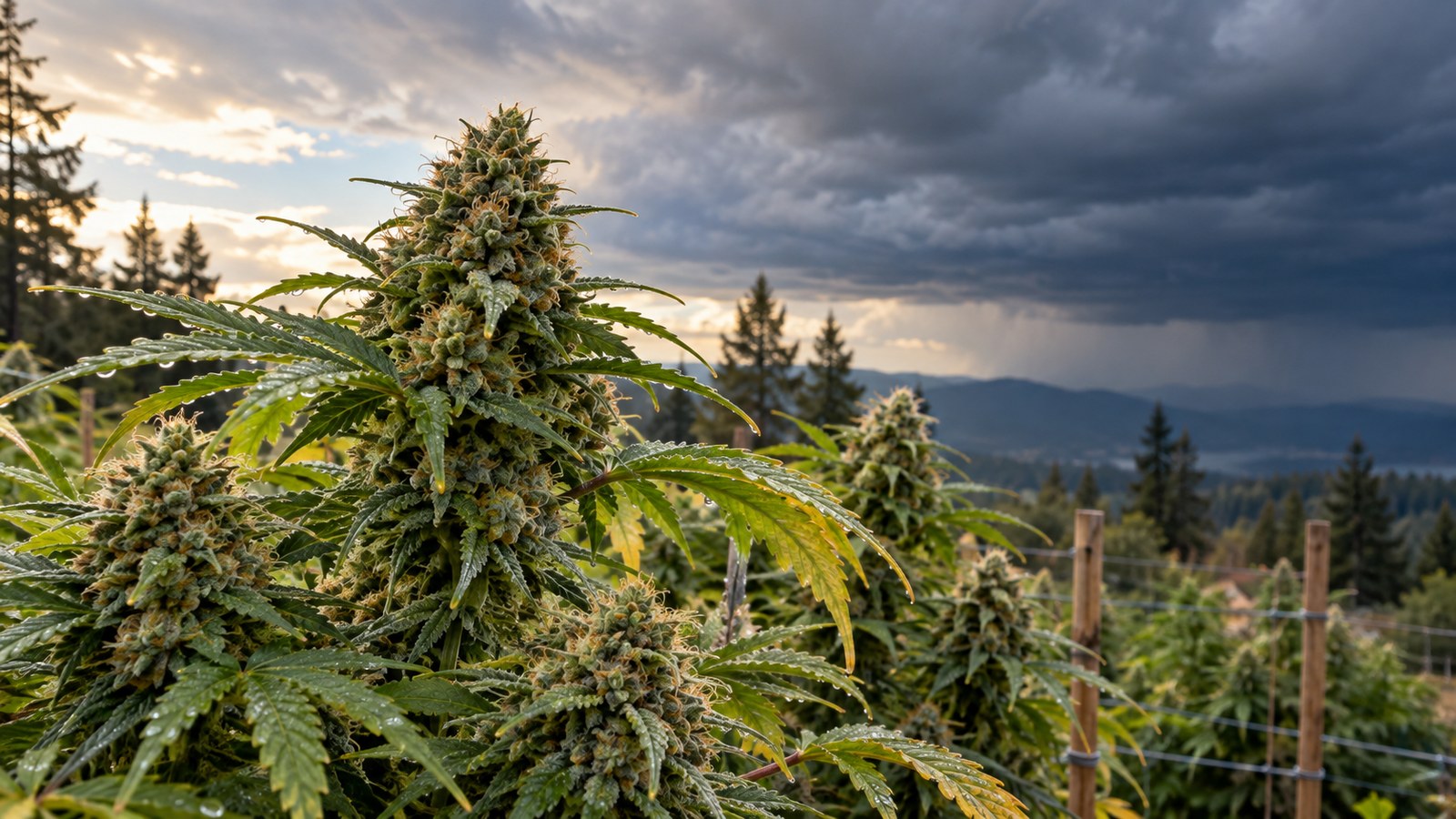
Rain close to harvest creates a real tradeoff, but it does not create a universal harvest rule. A mature outdoor cannabis plant facing several wet, cool days is a different decision from an immature plant facing one brief shower followed by sun and drying wind. The useful question is not simply whether rain is forecast. It is whether the expected weather meaningfully raises the probability of losing clean flower before the crop gains enough additional maturity to justify waiting.
The decision becomes clearer when you separate five variables: current flower maturity, existing disease evidence, expected wetness pattern, the plant’s ability to dry, and your capacity to harvest and dry the crop safely. None of these variables should be treated as a magic cutoff. Together, however, they create a repeatable risk matrix that is more useful than either “always harvest before rain” or “never harvest early because of weather.”
Define the Decision: Maturity Risk vs Weather Risk
The harvest-before-rain decision has two competing risks. Harvest risk is the quality or yield you may give up by cutting before the crop reaches the maturity window you intended. Weather risk is the probability that waiting exposes the flowers to prolonged wetness, internal humidity, disease progression, structural damage, contamination, or a harvest so wet that the drying system cannot handle it well.
Neither side should be exaggerated. A plant does not become mature because the forecast turns wet. At the same time, a biologically mature crop does not become more valuable merely because it remains standing for several additional days while disease pressure is rising. The practical target is to harvest when the expected gain from waiting becomes smaller than the expected loss from weather exposure.
Risk matrix
A risk matrix combines several observations into a decision category rather than relying on one signal. In this article, the categories describe relative harvest pressure, not universal biological thresholds.
Start with maturity, not the weather app
Before looking at rain totals, decide where the crop sits within its normal finish window. Use several representative flowers and look at flower development, bract swelling, pistil progression, glandular trichomes on flower tissue rather than only sugar leaves, whole-plant progression, and the cultivar’s recent rate of change. Breeder dates can provide context, but they should not replace direct observation.
A crop that is clearly immature has more to lose from an early cut than a crop that is already within the grower’s intended harvest window. Conversely, a crop that is already mature has less to gain from waiting through a deteriorating forecast.
Important: Do not convert one trichome percentage into an automatic harvest command. Sample comparable flower tissue across the plant and repeat the observation over time.
Then define the weather event
“Rain” can mean a fifteen-minute shower, repeated showers across several days, an all-day cold rain, a tropical system with wind, or a pattern of rain followed by fog and high overnight humidity. Those events do not create the same biological or structural risk.
For harvest decisions, the useful forecast questions are:
- How long are flowers likely to remain wet or humid, not simply how many millimeters or inches are forecast?
- Will there be sun, lower humidity, and moving air afterward?
- Will nights remain cool and damp?
- Is the event repeated over multiple days?
- Will wind or heavy wet flowers create branch-load problems?
- Can the site be inspected safely after the event?
Research on cannabis and hemp supports the importance of this distinction. Wet and humid conditions favor flower disease, and measurements inside cannabis inflorescences show that the internal flower microclimate can remain more humid than the surrounding air. That means an ambient forecast cannot tell you exactly how quickly a dense flower will dry.
Existing disease changes the matrix immediately
A healthy crop entering a wet period and a crop with active bud rot are not in the same decision class. Existing localized browning, abruptly dead sugar leaves emerging from otherwise healthy flowers, soft internal tissue, gray fungal growth, collapse, or a musty odor deserves closer inspection before you decide to wait.
Visible mold changes the question from quality optimization to safety
Do not smoke, vaporize, process, or deliberately blend visibly moldy flower into clean material. A weather decision does not make contaminated flower safe.
If suspicious tissue is found, separate the questions. First decide whether the affected tissue is safe to retain. Then inspect neighboring flowers and the rest of the crop. Finally decide whether the remaining clean material can safely remain outside. Do not assume that cutting the whole plant automatically solves an active disease problem.
The first version of the matrix
| Crop condition | Incoming weather | What waiting may gain | What waiting may risk | Default direction |
|---|---|---|---|---|
| Clearly immature, clean, open flowers | Brief rain with strong dry-down afterward | Meaningful additional maturation | Usually limited if flowers dry promptly | Often wait and reinspect |
| Near intended finish, clean | Short wet event followed by drying weather | Small to moderate maturation gain | Depends on density and site dry-down | Inspect, then consider staged harvest |
| Within intended finish window | Repeated cool wet days or poor dry-down | Usually smaller incremental gain | Increasing disease and handling risk | Harvest pressure rises |
| Near finish with suspicious or confirmed disease | Any prolonged wet pattern | Limited benefit from waiting | Progression and spread may accelerate | Prioritize clean material and safety |
| Immature but already diseased | Persistent wet conditions | Potential maturity gain if tissue survives | Crop loss may increase quickly | Escalate inspection; a forced harvest may be necessary |
This table is intentionally qualitative. A scientifically defensible universal rule such as “harvest if more than X millimeters of rain are forecast” or “harvest after Y hours of leaf wetness” is not available for all cannabis cultivars and outdoor systems.
Sample the Crop Before You Judge the Forecast
A risk matrix is only as good as the observations entered into it. Looking at the prettiest top cola and checking a weather app is not enough. Large outdoor plants can contain flowers at different maturity levels and very different moisture risk. Upper exposed tops, shaded interior flowers, dense side colas, windward flowers, and flowers close to leaf masses can behave differently.
Choose representative flower sites
Before a major late-season weather event, identify repeatable sampling positions. You do not need to inspect every flower with magnification, but you should avoid sampling only one zone. A practical set can include:
- an upper exposed flower that receives strong sun and wind,
- a dense upper or mid-canopy flower,
- an interior flower with slower air movement,
- a lower representative flower if lower sites are part of the intended harvest, and
- any location that previously stayed wet longer than the rest of the plant.
Mark or photograph the same positions so you can compare them after the weather event. The purpose is not to manufacture statistical precision. It is to stop your decision from drifting toward whichever flower happens to look best or worst that day.
“The top buds look ready, but the inside of the plant looks younger. Should I harvest everything before rain?”
Question sent by: Ava Mitchell, via email.
A staged harvest can be more rational than forcing the whole plant into one maturity category. Compare the clean, mature sites with the less mature sites and with your drying capacity. If only part of the crop has reached the intended finish window, harvest pressure does not automatically apply equally to every branch.
Inspect flower tissue, not only sugar-leaf trichomes
Sugar leaves can mature visually at a different rate from the bracts that make up the harvested flower. If trichome observation is part of your maturity system, keep the tissue type and canopy zone consistent. Compare like with like over several checks.
Pistil color can support the assessment but can also change because of heat, pollination, physical contact, spraying, or other stress. Flower swelling and whole-plant progression add context. No single cue should override clear disease evidence or a strongly unfavorable weather pattern.
Inspect inside dense flowers carefully
Bud rot and other flower deterioration may begin internally. A dry-looking exterior does not prove that the center has dried. Without crushing the flower, inspect suspicious areas for localized brown or gray tissue, softening, collapse, abruptly dying sugar leaves, or tissue that separates unusually easily.
If the crop has just been rained on, do not repeatedly pry apart every wet flower. Excess handling can damage trichomes and can move contaminated material from one site to another. Target the highest-risk locations first and sanitize tools when cutting suspect material.
Sample the site as well as the plant
Record whether the site actually dries after ordinary rain. Morning sun exposure, wind access, nearby walls, fences, tree lines, valleys, fog, and canopy crowding can all change the effective wetness period. Two growers receiving the same rainfall total can face very different disease pressure.
| Sampling point | What to record | Why it matters |
|---|---|---|
| Representative flower | Maturity, density, visible damage | Estimates what is gained or lost by waiting |
| Dense interior flower | Internal dryness, abnormal browning, dead sugar leaves | Finds risk hidden from exterior inspection |
| Site after rain | Time to visible surface dry-down, sun, wind, lingering dew | Shows how the real microclimate behaves |
| Forecast sequence | Repeated rain, night humidity, temperature, wind | Distinguishes one shower from a prolonged wet pattern |
| Drying room | Available hanging space, air exchange, monitoring capacity | Prevents a large emergency harvest from becoming a post-harvest moisture problem |
Read the Numbers and Visual Cues Without False Precision
The strongest harvest decision combines biological maturity with environmental risk. Both are easier to misuse when a grower searches for one number that removes uncertainty.
Rainfall amount is not the same as flower wetness
A larger rainfall total can fall quickly and be followed by rapid drying. A smaller amount can arrive repeatedly across cool, cloudy days and keep flowers wet for longer. Rain gauges remain useful because they tell you what actually reached the site, but rainfall depth should not be treated as a direct measure of disease risk.
For flower health, the sequence around the rain often matters more: wetting, temperature, humidity, air movement, sun exposure, and how long the flower microclimate remains favorable to fungi.
Relative humidity outside the flower can underestimate internal conditions
Published cannabis measurements have found higher relative humidity inside mature inflorescences than in the surrounding greenhouse environment. That finding does not create a universal outdoor threshold, but it explains why dense flowers can remain risky even when the ambient air appears to have improved.
Remember: The weather station measures air. Your harvest decision concerns the microclimate inside real flowers on your plant.
Use forecast duration and recovery weather together
Instead of asking only “How much rain?”, ask “What happens after the rain?” A warm, bright, breezy recovery period can shorten surface wetness. A cold cloudy day followed by fog or dew may not. A temporary cover can help only if it prevents direct wetting without creating stagnant humid air around the canopy.
Do not use greenhouse fan studies to prescribe outdoor fan speeds or a universal air-velocity target. The transferable lesson is narrower: air movement and lower flower humidity can reduce conditions favorable to microbial buildup. The exact outdoor result depends on site geometry and weather.
Maturity cues are comparative, not absolute
Glandular trichome appearance is useful when sampled consistently, but no universal percentage of cloudy or amber heads guarantees one chemical profile or one subjective effect across all genotypes. Likewise, a breeder’s finish date is a planning reference, not proof of biological maturity on your site.
If your plant was moving steadily toward its intended finish and the latest observations show only small additional change, the value of waiting may be declining. If flowers are still rapidly expanding and most sampled flower trichomes remain clearly immature relative to your chosen target, the cost of harvesting early is higher.
Do
Compare the same representative flower sites before and after the forecast period.
Avoid
Turning one trichome count, one pistil percentage, or one rainfall total into a universal harvest threshold.
Disease signs outrank cosmetic finish cues
A little more amber color is not worth deliberately carrying active rot deeper into a prolonged wet period. Conversely, ordinary late-flower leaf fade or harmless surface discoloration should not be mislabeled as mold and used to justify a premature harvest.
If the diagnosis is uncertain, isolate the suspicious flower, inspect the tissue pattern carefully, and use a plant diagnostic laboratory when the result materially changes what you will do with the crop. The risk matrix works only when “disease present” means more than fear of disease.
Cultivar, Site, Harvest Size, and Drying Capacity Change the Answer
The same weather forecast can produce different decisions for two cultivars in the same garden. Flower structure, leaf density, branch architecture, finish timing, and the site’s ability to dry all alter the balance between waiting and cutting.
Dense flowers reduce your margin for error
Dense inflorescences create protected spaces where humidity can remain elevated. Cannabis research has also linked genotype and inflorescence morphology with differences in total yeast and mold populations. This does not mean every dense cultivar must be harvested early. It means density should increase inspection priority when wet weather overlaps late flower.
Open structure can buy time, but it is not immunity
An open cultivar with separated flowers and good morning sun may dry faster than a compact plant in a sheltered corner. That can reduce the pressure to cut because of one modest weather event. Repeated cool rain, persistent fog, or established disease can still overwhelm an otherwise favorable structure.
“My cultivar is sold as mold resistant. Can I ignore a rainy harvest week?”
Question sent by: Daniel Foster, via contact form.
No cultivar label makes dense mature flower immune to prolonged moisture. Treat resistance as one variable in the matrix. Your actual flowering-season performance, internal flower condition, and site dry-down are stronger evidence than a marketing label.
Harvest size can turn a field decision into a drying problem
Suppose a large crop is mature enough to harvest and several wet days are approaching. Cutting everything may reduce field exposure, but it can create a new problem if the drying room does not have enough hanging space, air exchange, environmental control, or inspection access for the incoming wet biomass.
The correct harvest volume is therefore constrained by post-harvest capacity. A staged harvest can sometimes protect the most mature or highest-risk flowers without packing the drying room so densely that moisture is trapped after cutting.
Do not solve outdoor moisture risk by overcrowding the drying room
An emergency harvest only protects quality if the harvested material can be spaced, monitored, and dried safely. Wet flowers pressed together indoors can preserve the same moisture problem you were trying to escape outside.
Trim style changes post-harvest water loss
Wet trimming, branch drying, and whole-plant hanging expose different amounts of plant surface and retain different amounts of stem and leaf mass. They also change handling intensity. Research on commercial cannabis has found differences in microbial levels associated with post-harvest handling methods, but that does not justify one universal trim method for every harvest.
For a rain-forced harvest, the useful question is whether the chosen method allows even moisture removal without excessive handling or overcrowding. A method that works well for a small dry indoor harvest may behave differently when large outdoor branches arrive carrying more water.
Root-zone saturation is a separate risk
Heavy rain can also saturate soil, loosen containers or anchors, reduce root-zone oxygen, and increase the chance of structural failure. These problems matter to the harvest decision because a crop may become unsafe or impractical to leave standing even when flowers themselves have not yet developed disease.
Do not confuse root-zone saturation with flower disease. Record both. One may recover quickly while the other continues to worsen.
Failure Modes: What You Are Actually Trying to Avoid
A useful risk matrix names the losses it is designed to prevent. Otherwise “bad weather” becomes a vague reason to harvest early.
Bud rot progression
Cool wet field conditions can support severe Botrytis outbreaks in cannabis and hemp. Once susceptible flower tissue is infected, waiting for a cosmetically perfect maturity target can allow a local problem to become a larger crop-quality problem. This is why current disease evidence carries heavy weight in the matrix.
Hidden internal wetness
Flowers can appear surface-dry while dense internal tissue remains humid. This is especially relevant after repeated rain or heavy dew. Checking only leaf surfaces or the outside of the largest cola can create false confidence.
Structural breakage from wet flower weight
Wet flowers are heavier. Wind acting on a heavy late-season canopy can increase leverage at branch unions and support points. A rain event with high wind may therefore justify a different decision from the same rain event in still conditions.
Structural support should already be in place before this point. Late emergency ties are not a substitute for a stable support system.
False readiness caused by weather stress
Cold, drought, physical damage, disease, pollination, or other stress can alter leaves and pistils. A plant that looks “finished” after a storm may actually be stressed rather than mature. Recheck flower tissue and recent progression before converting stress symptoms into a harvest signal.
Harvesting too early
Weather fear can create its own quality loss. A clearly immature crop can lose substantial development if harvested simply because a modest rain event appears in the forecast. The matrix is designed to prevent this mistake as much as it is designed to prevent waiting too long.
Overloading the drying environment
A forced harvest can fail after cutting if the drying room becomes too crowded, too warm, poorly ventilated, or impossible to inspect. Outdoor material that arrives with higher water load deserves more, not less, attention to spacing and monitoring.
Case hardening and aroma loss from overcorrecting
Trying to remove rain moisture as fast as possible with excessive heat or direct high-speed airflow can dry exposed surfaces much faster than the interior. That can leave flowers unevenly dried while increasing aroma loss. The goal after a wet-weather harvest is controlled, even moisture removal, not emergency surface dehydration.
“Can I just blast wet harvested branches with a fan so they dry faster?”
Question sent by: Brooke Sullivan, via Facebook page.
Use room-level air exchange and enough spacing to remove moisture evenly. Direct aggressive airflow can overdry exposed surfaces while thicker flower interiors remain wetter. If the harvest was forced by rain, monitor it more closely rather than trying to compensate with extreme drying.
A Step-by-Step Harvest-Before-Rain Risk Matrix
The following procedure is designed to be repeated whenever a meaningful wet period enters the late-flower forecast. It does not depend on a fixed week number or one cultivar.
Step 1: Establish the current maturity class
Sample the same representative flower zones you have been following. Classify the crop as:
- Clearly immature: substantial development remains relative to your planned finish criteria.
- Approaching finish: several maturity signals are progressing, but meaningful development is still occurring.
- Within finish window: the crop already satisfies the maturity criteria you defined before the weather threat.
- Past preferred window: you are already holding the crop beyond the point you originally intended.
These are operational categories, not laboratory maturity stages.
Step 2: Classify disease status
Use three classes:
- No suspicious signs found after targeted inspection.
- Suspicious but unconfirmed tissue that requires isolation or closer diagnosis.
- Confirmed active disease in one or more flowers.
If disease is present, record whether it is localized or appearing in multiple canopy zones. Do not count visibly moldy tissue as harvestable yield.
Step 3: Classify the wet-weather sequence
Instead of one rainfall number, use the whole sequence:
- Low pressure: brief wetting with a strong drying period expected.
- Moderate pressure: repeated showers or humid nights, but some drying opportunities remain.
- High pressure: prolonged or repeated cool wet weather with poor sun, weak air movement, fog, or little recovery time.
- Severe weather: damaging wind, flooding, hail, or conditions that make garden access unsafe.
Safety overrides crop optimization. Do not work outdoors during dangerous wind, lightning, flooding, or other hazardous conditions.
Step 4: Score real dry-down ability
Use your own site history. After previous rain, did mature flowers become surface-dry by late morning or afternoon? Did shaded inner flowers stay damp? Does a wall block morning wind? Does fog return before the canopy fully dries?
If you have no site history, treat uncertainty as uncertainty. Do not automatically classify the garden as fast-drying because the regional forecast says humidity will fall.
Step 5: Check post-harvest capacity
Confirm that you can actually process the harvest you are considering. Check hanging space, branch spacing, environmental monitoring, electricity reliability where relevant, and the ability to inspect material during drying.
If capacity is limited, identify the highest-priority portion of the crop rather than creating an unsafe drying bottleneck.
Step 6: Use the action matrix
| Maturity | Disease | Weather / dry-down | Drying capacity | Action direction |
|---|---|---|---|---|
| Clearly immature | None found | Low pressure, fast dry-down | Adequate | Wait; inspect after the event |
| Approaching finish | None found | Moderate pressure | Adequate | Compare gain from waiting; staged harvest may be reasonable |
| Within finish window | None found | High pressure, slow dry-down | Adequate | Strong case for harvesting clean mature material before the wet period |
| Within finish window | Suspicious signs | Moderate or high pressure | Adequate | Escalate inspection; protect clean material rather than chasing extra days |
| Any stage | Confirmed active mold | High pressure | Adequate | Remove unsafe tissue; consider forced harvest of clean material based on spread risk |
| Near finish | None found | High pressure | Inadequate | Do not harvest more than can be dried safely; prioritize highest-risk mature material |
| Any stage | Any status | Severe weather / unsafe access | Any | Human safety first; secure what can be secured before conditions deteriorate |
Step 7: If you wait, define the reinspection point before the rain starts
Do not simply decide to “see what happens.” Write down when and what you will reinspect. The useful follow-up is usually after conditions are safe and the canopy has had a realistic chance to dry.
Return to the same marked flowers. Check whether external moisture cleared, whether dense interiors remain abnormal, whether suspicious areas progressed, whether branches shifted, and whether maturity changed enough to alter the decision.
Do
Write the next inspection trigger before choosing to wait.
Avoid
Letting “one more day” repeat indefinitely while the weather pattern worsens.
Step 8: If you harvest, label it correctly
Record whether the harvest was:
- normal maturity harvest,
- weather-advanced harvest,
- staged harvest, or
- forced harvest because disease or severe conditions removed the option to wait.
This distinction becomes valuable when choosing cultivars and sites next season. A cultivar that repeatedly requires a weather-forced early cut at your location may be a poor climate fit even if its indoor reputation is excellent.
Quality-First Finish: Protect Clean Flower and Record the Decision
The best harvest-before-rain decision does not maximize one variable. It protects the highest amount of clean, appropriately mature flower that can be dried safely.
Do not harvest directly into a moisture bottleneck
Prepare the drying area before cutting. Outdoor flowers harvested around wet weather may carry more water than a typical indoor crop. Provide spacing and room-level air exchange, keep batches identifiable, and inspect high-density flowers during drying.
If flowers are merely surface-wet from clean rain and conditions allow them to dry safely on the plant before cutting, that may reduce incoming water load. If disease pressure or severe weather makes waiting unsafe, the priority changes to protecting clean material and handling it carefully after harvest.
Separate questionable material
Do not bury suspicious flowers inside a large drying batch. Keep questionable material physically separate while you determine whether it is diseased or contaminated. Visible mold is not corrected by drying.
Field Advice: Drying preserves a clean harvest. It does not sanitize a moldy one.
Protect aroma by avoiding panic drying
A weather-forced harvest can tempt growers to add heat or point strong fans directly at flowers. Controlled moisture removal is safer for quality than trying to make the outside feel dry as fast as possible. Monitor the room and the flower rather than treating speed as the objective.
Document enough to improve next season
Record the date, cultivar, maturity status, weather sequence, disease observations, whether the crop was harvested normally or early, and how the drying room handled the load. After drying, note whether the decision preserved quality or whether you would have preferred to wait or cut earlier.
This record turns a stressful weather call into local evidence. Over several seasons, you can identify which cultivars consistently finish before your wet period, which parts of the site dry poorly, and how much material your drying space can handle without crowding.
Final harvest-before-rain checklist
- Sample several representative flowers, not one top cola.
- Decide whether the crop is immature, approaching finish, or already within your finish window.
- Inspect dense internal flower sites for disease, not only the exterior.
- Judge the entire wet-weather sequence, including drying weather afterward.
- Use your site’s real dry-down history whenever possible.
- Increase caution for dense flowers and repeated cool wet conditions.
- Check branch support and root-zone stability if wind or saturation is expected.
- Confirm drying capacity before committing to a large emergency harvest.
- Do not consume or process visibly moldy or contaminated flower.
- If you wait, define exactly when you will reinspect.
- If you harvest early, record it as a weather-advanced or forced harvest rather than redefining maturity.
Educational content. Always follow applicable cultivation laws and safety requirements.
Share this article
A quick overview of the topics covered in this article.
- Define the Decision: Maturity Risk vs Weather Risk
- Sample the Crop Before You Judge the Forecast
- Read the Numbers and Visual Cues Without False Precision
- Cultivar, Site, Harvest Size, and Drying Capacity Change the Answer
- Failure Modes: What You Are Actually Trying to Avoid
- A Step-by-Step Harvest-Before-Rain Risk Matrix
- Quality-First Finish: Protect Clean Flower and Record the Decision
Follow us
Latest articles
October 11, 2026
October 11, 2026