Watering Cannabis Under High Light Intensity
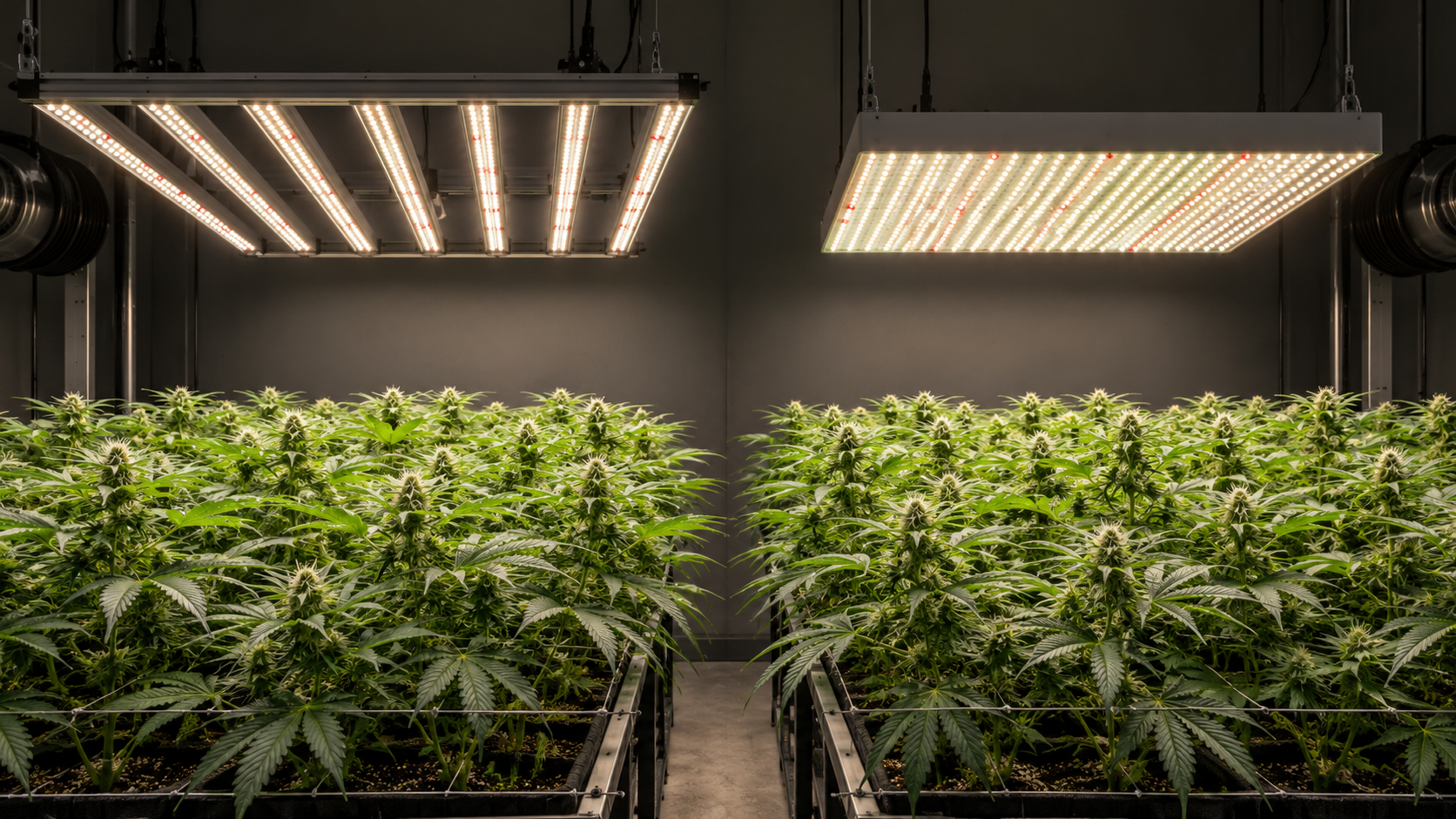
Operating commercial grow lights at high photosynthetic photon flux densities fundamentally alters how water and dissolved mineral ions behave within the cannabis root zone. When canopy irradiance surpasses 800 to 1,200 μmol/m²/s, transpirational pull triples, accelerating substrate dryback rates and dramatically narrowing the margin for irrigation error. Applying traditional low-light watering schedules under high-intensity fixtures leads to rapid root desiccation, severe osmotic salt spikes, hydrophobic channeling, and catastrophic crop stall. Mastering high-light irrigation requires shifting from infrequent heavy soakings to precision crop steering governed by volumetric water content and electrical conductivity metrics.
- Core Root-Zone Measurements: Water Volume, Frequency, Moisture, and Chemistry
- How Substrates, Container Volume, and Environmental Factors Change Irrigation Demand
- Repeatable Precision Irrigation Procedure: Meter Calibration and Data Logging
- Separating Source-Water Chemistry from Fertilizer Strength and Root Salt Buildup
- Diagnosing Irrigation Failures: Hydrophobic Channels, Clogged Emitters, and False Runoff
- Systematic Correction Sequence: Single-Variable Recovery Protocol
- Practical Thresholds, Decision Checklist, and Companion Weedth Resources
Core Root-Zone Measurements: Water Volume, Frequency, Moisture, and Chemistry
Watering cannabis under intense photon bombardment is not an art based on the weight of a lifted container; it is an exact biophysical discipline governed by nine quantifiable parameters. When light levels climb above 900 μmol/m²/s Photosynthetic Photon Flux Density (PPFD), stomatal conductance reaches near-maximal levels, turning the plant into a high-throughput evaporative pump. To keep pace with this demand without drowning root hairs or concentrating toxic salts, growers must track volumetric water content, irrigation frequency, input and runoff electrical conductivity (EC), pH, alkalinity, total hardness, sodium, chloride, and root-zone temperature.
From a fundamental soil physics perspective, the availability of water to cannabis root hairs is governed by total water potential (\Psi), which is the sum of matric potential (\Psi_m) and osmotic potential (\Psi_s): $$\Psi_{total} = \Psi_m + \Psi_s$$ Matric potential represents the capillary and adhesive forces binding water molecules to substrate particles, while osmotic potential represents the suction tension created by dissolved fertilizer salts. Under low light, substrate drydown is slow, allowing matric potential to remain near zero while roots absorb water effortlessly. Under 1,000+ PPFD, rapid transpirational extraction quickly drains macro-pores, forcing roots to exert immense negative suction pressure to extract water from narrowing capillary pore necks. If dissolved fertilizer salts are simultaneously concentrated by water loss, total water potential plummets, making water physically inaccessible to root hairs even when the substrate appears damp.
Furthermore, root-zone cellular respiration is heavily dependent on dissolved oxygen availability, which responds directly to temperature. The temperature coefficient ($Q_{10}$) for root metabolic respiration is approximately 2.0, meaning that for every 10°C (18°F) increase in substrate temperature caused by overhead fixture radiation, root oxygen demand doubles. If container media remain saturated with stagnant water during peak lights-on hours, oxygen diffusion drops to near zero, starving root mitochondria of ATP required for active ion uptake and causing rapid root tip dieback.
Under high light, daily water consumption increases from a baseline of 0.25 gallons per plant up to 0.8 to 1.2 gallons (3.0 to 4.5 liters) per plant during peak floral bulking. However, delivering this massive volume in a single daily flood drowns root respiration during early morning hours and leaves roots bone-dry by late afternoon. Instead, high-intensity watering requires high-frequency pulsing: dividing daily volume into multiple small shots delivered while the lights are operating at peak power.
Volumetric Water Content (VWC) and Pore Water EC
Volumetric Water Content (VWC) represents the percentage of total substrate volume occupied by liquid water, measured using time-domain reflectometry (TDR) or capacitance soil sensors. Pore Water Electrical Conductivity ($EC_{pw}$) represents the actual salt concentration experienced directly by root hair membranes within substrate capillary pores. Under high PPFD, pore water EC can surge to double the input feed EC within hours if drybacks become excessive.
Water chemistry becomes exponentially more influential under intense lighting. Because high-transpiration canopies absorb immense volumes of liquid, any background contaminants in source water: such as sodium ($Na^+$), chloride ($Cl^-$), or excessive calcium carbonate alkalinity: accumulate in the root zone at accelerated rates. A background water source with 150 PPM of dissolved sodium may be harmless in a low-light setup where plants drink 1 liter daily, but under 1,200 PPFD where plants drink 4 liters daily, sodium ions quickly overwhelm potassium uptake sites, triggering severe marginal leaf necrosis.
Fundamental Irrigation Law: High light intensity magnifies both the speed of plant growth and the severity of root-zone errors. You cannot run commercial photon levels without measuring substrate volumetric water content and pore-water electrical conductivity continuously.
How Substrates, Container Volume, and Environmental Factors Change Irrigation Demand
No single irrigation schedule applies universally across different growing media. The physical structure of the substrate dictates its water holding capacity, capillary action, and aeration porosity, directly determining how the root zone responds to high light intensity.
Substrate Characteristics: Rockwool, Coco Coir, and Living Soil
In commercial rockwool blocks and slabs, capillary action is exceptionally uniform, holding up to 80% volumetric water content at field capacity while retaining 15% air-filled porosity. Under 1,000+ PPFD, rockwool can be safely pulsed 6 to 12 times per day with micro-shots (50 to 100 mL per pulse), maintaining steady moisture without waterlogging roots. Coco coir offers similar high-frequency flexibility, holding roughly 60% to 65% water while providing natural cation exchange capacity (CEC) that requires careful calcium pre-buffering to prevent potassium displacement under heavy feeding.
Conversely, living organic soil and peat-based potting mixes possess higher water-holding capacity but far lower air-filled porosity. Pulsing organic soil 8 times a day under high light collapses aerobic microbial activity, creating anaerobic root rot (Pythium). In living soil, cultivators must use larger container volumes (15 to 30 gallons) that serve as expansive thermal and moisture buffers, watering more deeply once every 24 to 48 hours to preserve soil gas exchange while mulching heavily to prevent surface crusting from intense LED heat.
The physical movement of water through soilless substrates under rapid dryback conditions obeys Darcy’s Law for unsaturated hydraulic conductivity: $$q = -K(\theta) \nabla H$$ where $q$ is flux density, $K(\theta)$ is unsaturated hydraulic conductivity as a function of volumetric water content, and $\nabla H$ is the hydraulic head gradient. In fibrous substrates like horticultural rockwool and long-fiber coco coir, $K(\theta)$ remains relatively linear across a wide range of moisture levels, allowing water applied at the top surface to spread horizontally via capillary tension before moving downward. In dense peat or unamended soils, however, $K(\theta)$ drops exponentially as moisture falls below 35% VWC, causing liquid to bypass dry patches completely and funnel straight down container sidewalls.
Container geometry also plays a profound role in root-zone hydrodynamics. In every freely draining container, gravity creates a perched water table (capillary fringe) at the bottom, where substrate remains 100% saturated regardless of container volume. In shallow, wide containers, this saturated zone represents a large percentage of total root volume, creating high risk for root rot under high light watering. In tall, narrow containers, gravity exerts a stronger downward suction head, elevating the well-aerated unsaturated zone and providing roots with an expansive volume of oxygenated media to sustain rapid transpirational uptake.
| Substrate Type | Optimal Container Size | Irrigation Frequency (Lights-On) | Target Daily Dryback (%) | Target Runoff Volume (%) |
|---|---|---|---|---|
| Hydroponic Rockwool | 1 – 2 Gallons (6-inch cubes) | 6 to 12 Micro-Pulses | 10% – 15% (Veg) / 20% – 25% (Bloom) | 15% – 20% Runoff |
| Buffered Coco Coir | 2 – 3 Gallons | 4 to 8 Irrigation Events | 15% – 20% (Veg) / 25% – 30% (Bloom) | 15% – 25% Runoff |
| Peat / Perlite Soilless | 3 – 5 Gallons | 2 to 4 Irrigation Events | 20% – 30% | 10% – 15% Runoff |
| Living Organic Soil | 15 – 30+ Gallons | 1 Event Every 24 – 48 Hours | 10% – 15% (Avoid dryout) | 0% – 5% (Minimal Leachate) |
Environmental Amplifiers: Temperature and Vapor Pressure Deficit
Substrate drying rate is driven by two interdependent environmental forces: PPFD at the canopy and atmospheric Vapor Pressure Deficit (VPD). When PPFD reaches 1,100 μmol/m²/s and room air temperature is maintained at 83°F (28.3°C) to support Rubisco kinetics, an atmospheric VPD of 1.4 kPa pulls water through the xylem at maximum velocity. If relative humidity drops to 45% (spiking VPD to 1.8 kPa), root uptake cannot keep up with transpiration, regardless of how wet the medium is, causing rapid mid-day wilting. Aligning light intensity, ambient VPD, and substrate moisture prevents hydraulic collapse.
The Small Container / High Light Trap
Placing mature flowering cannabis plants in 1-gallon pots under 1,100 μmol/m²/s PPFD creates extreme vulnerability. A root-bound 1-gallon container can completely deplete its available capillary moisture within 3 hours during peak midday irradiance. Once the medium dries past permanent wilting point, root hairs desiccate and die within minutes, releasing stress ethylene and triggering irreversible lower-canopy leaf drop. Ensure container volume provides at least a 4-hour safety buffer against automated dripper failure.
Repeatable Precision Irrigation Procedure: Meter Calibration and Data Logging
To implement precision irrigation under high light intensity, cultivators must follow an automated, multi-phase shot schedule based on crop steering principles. The irrigation day is partitioned into three distinct operational windows: P1 (Ramping), P2 (Maintenance), and P3 (Dryback).
Phase 1 (P1): Morning Saturation and Field Capacity Ramp
Do not irrigate immediately when the grow lights switch on. Allow the crop 1 to 2 hours of light exposure to warm the canopy, open stomata, and initiate steady transpiration. Initiating shots into cold, dark root zones saturates the medium before active transpiration begins, causing hypoxia and root tip dieback.
Once transpiration is established (typically 90 to 120 minutes after lights-on), deliver the P1 ramp shots. Apply 3 to 6 consecutive pulses spaced 15 to 25 minutes apart. Each pulse should deliver 3% to 5% of container volume. Continue pulsing until the medium reaches maximum field capacity and the first drops of runoff appear at the container base (10% to 15% total runoff). This flushes residual salts accumulated from the previous night and establishes uniform root-zone moisture.
Phase 2 (P2): Maintenance Micro-Pulsing
During the middle 6 hours of the photoperiod, light intensity and transpiration are at their peak. Deliver small maintenance pulses (1% to 2% container volume) spaced 45 to 90 minutes apart. The objective during P2 is to maintain substrate moisture within a tight 3% to 5% VWC window, replacing exactly the volume of water transpired without generating heavy additional runoff. This keeps root-zone electrical conductivity perfectly stable during maximum photosynthetic carbon fixation.
Phase 3 (P3): The Overnight Dryback Window
Shut off all irrigation 2 to 3 hours before lights-off. This allows the plant to consume moisture during the final photoperiod hours, pulling substrate VWC down into the target dryback zone before dark. Overnight, in the absence of light, plants respire and transpire very slowly. The overnight dryback aerates the root zone, drawing oxygen into macropores and stimulating fine root hair elongation. In vegetative growth, target a 10% to 15% overnight dryback; in generative floral bulking, steer the crop with an aggressive 20% to 25% overnight dryback.
Separating Source-Water Chemistry from Fertilizer Strength and Root Salt Buildup
A critical point of failure in high-light cultivation is the inability to distinguish between source-water mineral content, input fertilizer strength, and cumulative root-zone salt accumulation. When a runoff meter reads 3.5 mS/cm, growers often assume they are over-fertilizing, when in reality the issue stems from source-water hardness or excessive transpirational dryback.
Source-Water Alkalinity and Residual Sodium
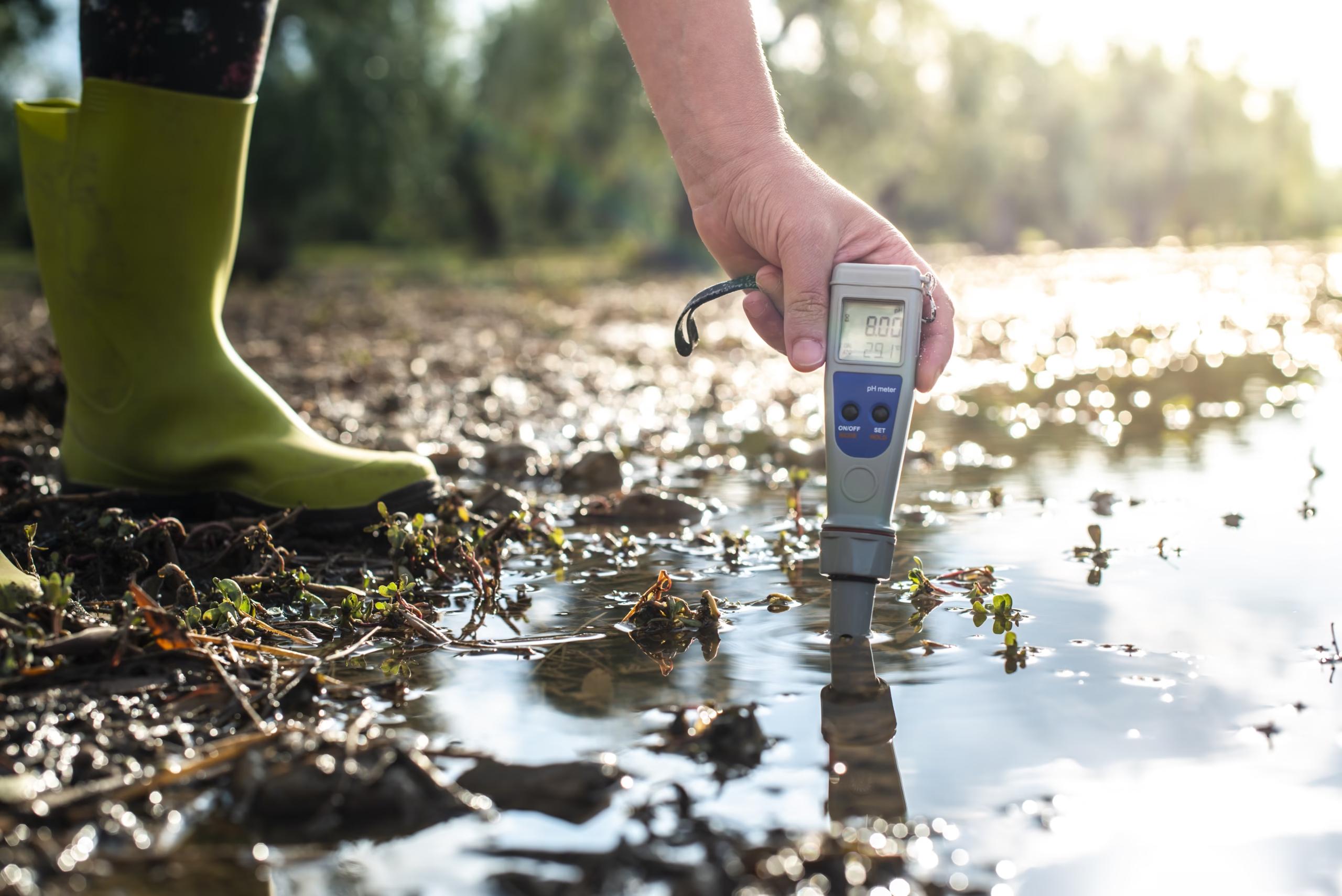
Municipal tap water and untreated well water contain dissolved mineral ions, primarily calcium carbonate, magnesium bicarbonate, sodium, and chloride. Total alkalinity measures the water buffering capacity: its resistance to pH change. If source water possesses high alkalinity (above 100 mg/L $CaCO_3$), the grower must add large amounts of acid (phosphoric or nitric acid) to bring input pH down to 5.8.
However, under 1,100 PPFD, as the plant drinks massive volumes of water, carbonate ions accumulate in the substrate, neutralizing root-zone acidity and causing medium pH to climb steadily above 6.8. At this elevated pH, iron ($Fe^{2+}$), manganese ($Mn^{2+}$), and phosphorus ($H_2PO_4^-$) precipitate into insoluble mineral forms. The grower observes severe interveinal chlorosis and adds more fertilizer, worsening the salt crisis. For high-light facilities, filtering source water through Reverse Osmosis (RO) to achieve an input baseline below 30 PPM (0.05 EC) and alkalinity below 20 mg/L is essential for repeatable control.
The chemical neutralization of source-water alkalinity occurs via proton donation: $$\text{HCO}_3^- + \text{H}^+ \rightarrow \text{H}_2\text{O} + \text{CO}_2$$ When raw water with high bicarbonate alkalinity is acidified using phosphoric acid, significant quantities of elemental phosphorus are added as a byproduct ($H_3PO_4 \rightarrow H^+ + H_2PO_4^-$). In low-light environments, this extra phosphorus is easily tolerated. Under 1,000+ PPFD, however, where plants consume 4 liters of acidified water daily, this unmeasured phosphorus accumulation can induce severe micronutrient antagonism, competing directly against zinc ($Zn^{2+}$) and iron ($Fe^{2+}$) absorption sites on root cortical membranes.
Another critical metric in source-water analysis is the Sodium Adsorption Ratio (SAR): $$\text{SAR} = \frac{[\text{Na}^+]}{\sqrt{\frac{[\text{Ca}^{2+}] + [\text{Mg}^{2+}]}{2}}}$$ When source water contains elevated sodium relative to divalent calcium and magnesium (SAR > 3.0), sodium ions displace calcium along root cell walls and substrate cation exchange sites. Under high transpiration rates, excess sodium rushes into the xylem stream, accumulating at leaf margins and causing severe edge necrosis that growers mistakenly diagnose as potassium deficiency.
Diluting Feed Strength to Support Transpiration Volume
Under high light, the relationship between water consumption and mineral uptake obeys stoichiometric mass flow. Because the plant drinks water roughly twice as fast as it assimilates dissolved ions, the input fertilizer concentration must be diluted. If a cultivar flourishes at 2.4 EC under 600 PPFD, stepping up the lighting to 1,100 PPFD requires lowering input EC to 1.8 to 2.0 EC. Diluting the solution ensures the plant receives adequate total elemental milligrams daily through higher liquid throughput without leaving surplus ions to crystallize in the root zone.
Diagnosing Irrigation Failures: Hydrophobic Channels, Clogged Emitters, and False Runoff
High irradiance accelerates physical failures within the substrate that deceive even experienced cultivators. Recognizing these mechanical and hydraulic anomalies prevents misdiagnosis and crop destruction.
Hydrophobic Channeling and False Runoff
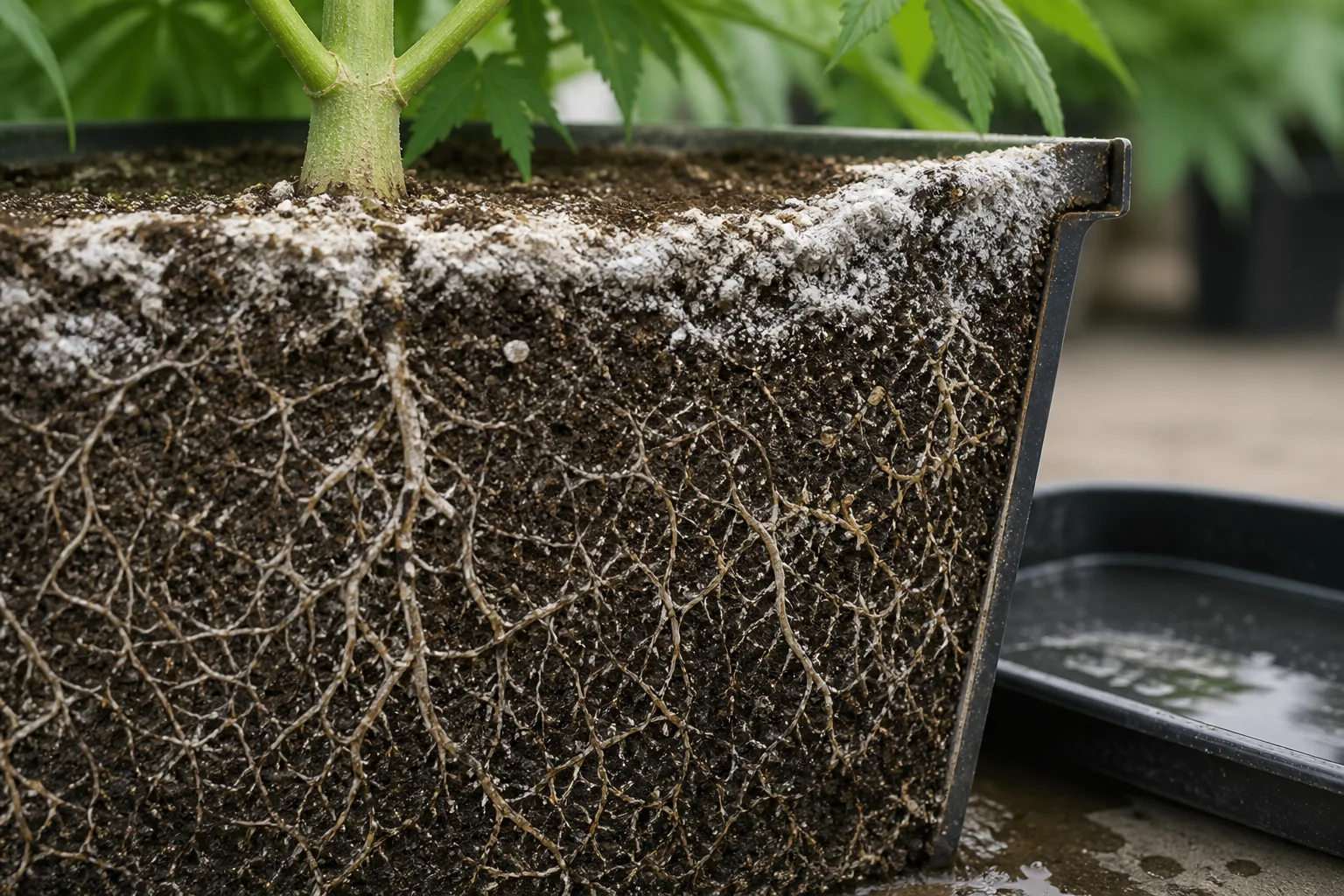
When peat or coco coir dries out beyond 30% VWC under intense LED heating, organic particles shrink, pulling away from container walls and forming deep cracks through the root ball. When the automated drippers fire, the water follows the path of least resistance: cascading down perimeter cracks and exiting container drainage holes immediately.
The grower observes 20% runoff within 60 seconds and assumes the medium is thoroughly saturated. In reality, the core of the root ball remains bone-dry (hydrophobic), and the runoff collected is pure, unabsorbed input water. The plant exhibits severe drought stress despite regular irrigation events. To fix hydrophobic channeling, apply an organic yucca-based surfactant or horticultural wetting agent, and execute a slow bottom-up soak to rehydrate compressed peat fibers.
Clogged Drip Emitters and Canopy Non-Uniformity
In automated drip systems, small 0.5-gallon-per-hour (GPH) pressure-compensating emitters easily clog with precipitated mineral salts, calcium carbonate, or biofilm. Under high light intensity, a plant with a clogged emitter will show severe wilting and yellowing within 24 hours. Operators often mistake this single-plant distress for root rot or genetic weakness. Always install at least two emitters per container to provide redundant flow if one emitter becomes obstructed, and audit emitter flow rates weekly using a graduated measuring cylinder.
The False Runoff Catastrophe: How 1,100 PPFD Baked a Commercial Coco Canopy
In an Oklahoma medical grow facility running 60 high-efficiency 720W LED fixtures delivering 1,100 μmol/m²/s across 3-gallon coco pots, the head grower followed a traditional two-soak daily schedule. By week 4 of bloom, upper leaves began curling inward, tips burned severely, and flower sites stalled. The grower checked runoff: EC was a staggering 5.2 mS/cm (input was 2.2 EC), and runoff volume appeared normal at 20%.
The investigation: We inspected the containers physically. The top two inches of coco were hot and crusty, and the pots were surprisingly light despite recent watering. We inserted TDR moisture needles into the center of the root ball: while the perimeter was 55% VWC, the inner root core was an arid 14% VWC. The intense light had baked the core into an impenetrable hydrophobic block; water simply ran down the inside wall of the plastic pot.
The recovery: We immediately drenched every container by hand with a mild wetting agent and 1.4 EC nutrient solution until root cores fully expanded and re-absorbed moisture. We then transitioned irrigation controllers to an 8-pulse daily micro-shot schedule delivering 120 mL per pulse, capping overnight drybacks at 18%. Within four days, runoff EC dropped to a stable 2.3 mS/cm, canoeing leaves flattened, and the room recovered to harvest 2.25 grams per watt.
When auditing automated drip systems under high photon flux, cultivators must analyze emitter flow coefficient variation. Standard non-pressure-compensating drippers exhibit up to 25% flow disparity between the beginning and the terminus of a 50-foot irrigation manifold. Under low light, this flow variance is harmless because container moisture buffers compensate for minor volume differences. Under 1,000 PPFD, however, a 25% deficit causes containers at the end of the line to suffer chronic underwatering and severe salt accumulation within 72 hours.
Furthermore, substrate temperature interacts directly with dissolved oxygen solubility in the irrigation stream. As intense grow lights warm the upper root zone, container substrate temperatures can climb above 75°F (23.9°C). At warm temperatures, dissolved oxygen in water drops below 6.5 mg/L while root cellular respiration rates double, suffocating fine root tips. Delivering oxygenated irrigation water (8 to 10 mg/L DO) chilled to 66°F to 68°F buffers root zones against radiant thermal loading, ensuring active mineral transport remains fully energized.
Do
Pulse Water in Multiple Small Daily Shots
Divide daily irrigation into 4 to 8 micro-pulses during the photoperiod to maintain steady root-zone volumetric moisture and prevent extreme EC spikes.
Avoid
Flood Root Zones Immediately at Lights-On
Never irrigate cold pots before the canopy warms and begins actively transpiring; wait 90 to 120 minutes after lights-on before firing the first P1 ramp shot.
Systematic Correction Sequence: Single-Variable Recovery Protocol
When root-zone monitoring indicates toxic salt accumulation or severe transpirational dehydration under high light, panic reactions ruin crops. Cultivators who simultaneously flush with pure water, change nutrient brands, crank down dimmers, and blast fans create multi-variable chaos. Follow this disciplined single-variable correction sequence.
Step 1: Observe and Collect Empirical Baseline Data
Before altering any controller setting, measure and record exact data points across five representative containers: input EC, input pH, runoff EC, runoff pH, runoff volume percentage, and root-zone VWC. If runoff EC is more than 1.0 mS/cm higher than input EC, the plant is consuming water faster than salts, indicating transpirational salt concentration.
Step 2: Dilute Input Solution (Never Flush with Pure Water)
Do not flush soilless coco or rockwool with 0.0 EC reverse-osmosis water. Pure water causes severe osmotic shock, stripping the root cortex of divalent cations and inducing sudden calcium and magnesium lockout. Instead, dilute your balanced nutrient solution to 50% strength (1.0 to 1.2 EC) with correct pH (5.8 to 6.0). Apply consecutive gentle pulses until runoff EC matches the target input range, gently displacing residual salts without shocking root biology.
To calculate the exact leaching volume required to reset root-zone electrical conductivity without drowning roots, agronomists utilize the steady-state Leaching Fraction ($LF$) equation: $$LF = \frac{EC_{input}}{EC_{drain}}$$ When drainage EC climbs to 4.0 mS/cm under an input of 2.0 mS/cm, the effective leaching fraction has dropped to 50% of requirement. To reset the root zone safely, apply an initial irrigation volume equal to 25% of total container capacity using a 1.2 EC solution, allow 15 minutes for osmotic equilibration across capillary pores, and follow with a second 15% pulse to wash out the concentrated leachate.
Step 3: Temporarily Relieve Photon Pressure
While the root system recovers its hydraulic balance, dim your grow lights by 20% to 25% (e.g., dropping from 1,100 down to 800 μmol/m²/s). Reducing photon pressure immediately relieves transpirational demand, allowing stomata to relax and damaged root hairs to regenerate new lateral roots without desiccation stress.
Step 4: Verify Next-Day Stabilization Before Ramping
Allow 24 to 48 hours for root recovery. Track container dryback rates. Once runoff EC stabilizes within 0.3 mS/cm of input solution and upper foliage uncurls and displays healthy turgor, return lighting intensity to full commercial levels incrementally over a 3-day ramp.
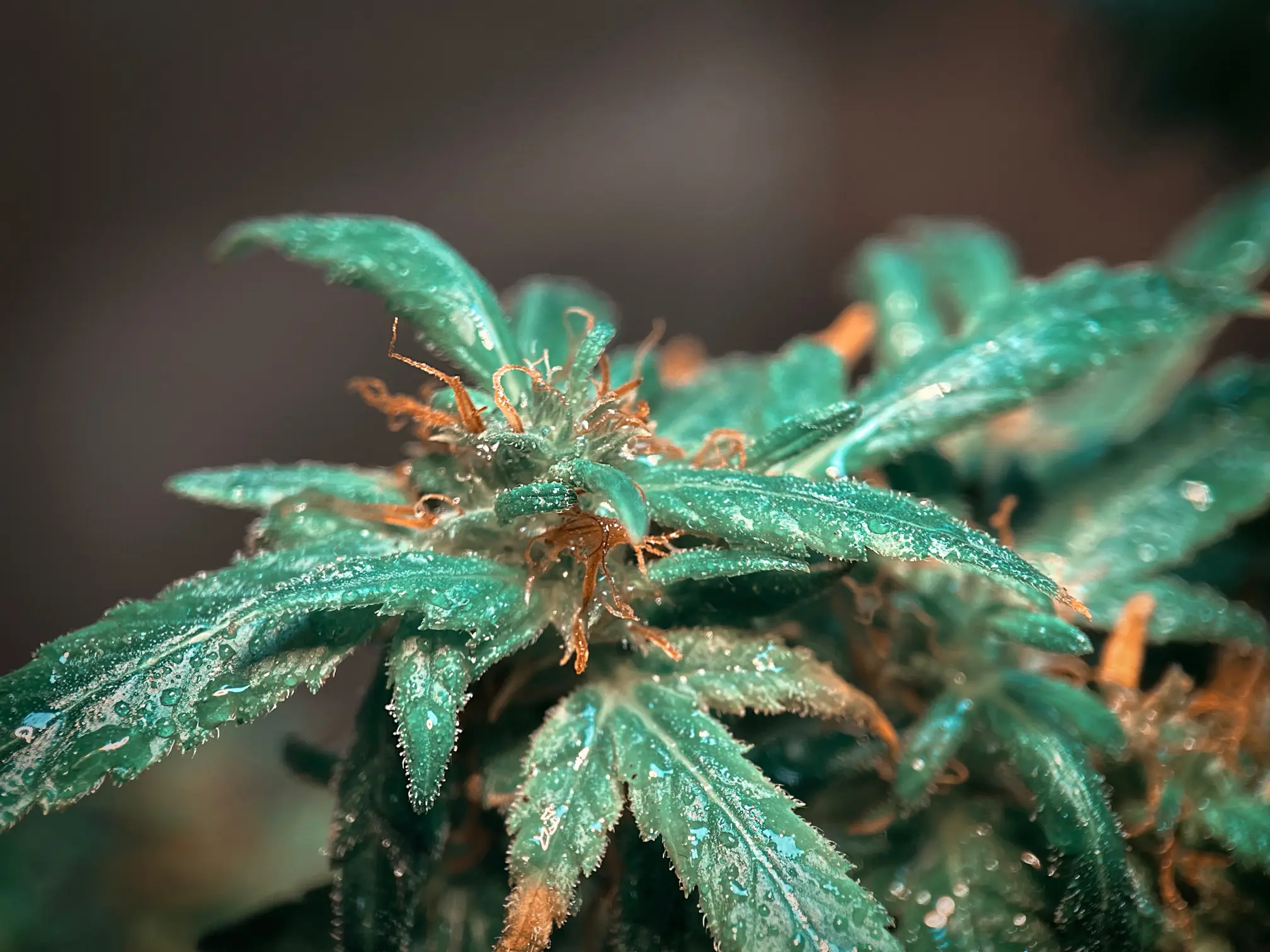
Can I tell if my cannabis plants need water simply by looking at whether the top leaves are praying?
Question sent by: Brett Hawkins, via email.
Leaves praying upward at a 45-degree angle indicates active photosynthesis and healthy turgor pressure. However, praying alone does not tell you root-zone water content. Under high PPFD, plants will pray aggressively even as the substrate approaches dangerously low moisture thresholds. Rely on calibrated TDR moisture sensors or precision container scale load cells rather than leaf angle to determine exact irrigation timing.
Practical Thresholds, Decision Checklist, and Companion Weedth Resources
Before elevating light intensities or adjusting automated irrigation controllers, verify your root-zone management against this operational checklist:
High-PPFD Irrigation Operational Checklist
- Deploy digital TDR substrate sensors to track volumetric water content and pore-water electrical conductivity in real time.
- Delay the first daily irrigation shot until 90 to 120 minutes after lights-on to allow the canopy to warm and initiate transpiration.
- Divide daily water volume into 4 to 10 micro-pulses during peak lights-on hours rather than delivering one heavy flood.
- Maintain a 10%-15% overnight dryback in vegetative growth and 20%-25% in generative floral bulking to ensure root-zone oxygenation.
- Dilute input fertilizer EC by 15% to 25% when increasing lighting levels beyond 900 μmol/m²/s PPFD to prevent salt accumulation.
- Filter source water through Reverse Osmosis to reduce starting background EC below 0.05 mS/cm and alkalinity below 20 mg/L.
- Audit drip emitters weekly; install at least two pressure-compensating emitters per container to prevent drought stalls from clogs.
- Never flush salt-stressed soilless media with pure water; apply diluted 1.0 EC balanced nutrient solution to displace salts safely.
Watering cannabis under high light intensity transforms cultivation from passive gardening into precision bioclimatic engineering. By synchronizing irrigation frequency with overhead photon flux, growers eliminate osmotic stress, sustain rapid transpirational cooling, and unlock the record-breaking harvest yields promised by modern horticultural lighting.
Final Verdict: Photons set the tempo; water delivers the fuel. Keep the root zone hydrated, aerated, and chemically balanced, and your crop will convert intense light into dense, resinous floral colas.
To expand your technical cultivation foundation with our companion foundational guides, continue exploring Weedth resources below.
Share this article
A quick overview of the topics covered in this article.
Follow us
Latest articles
October 29, 2026

October 29, 2026