
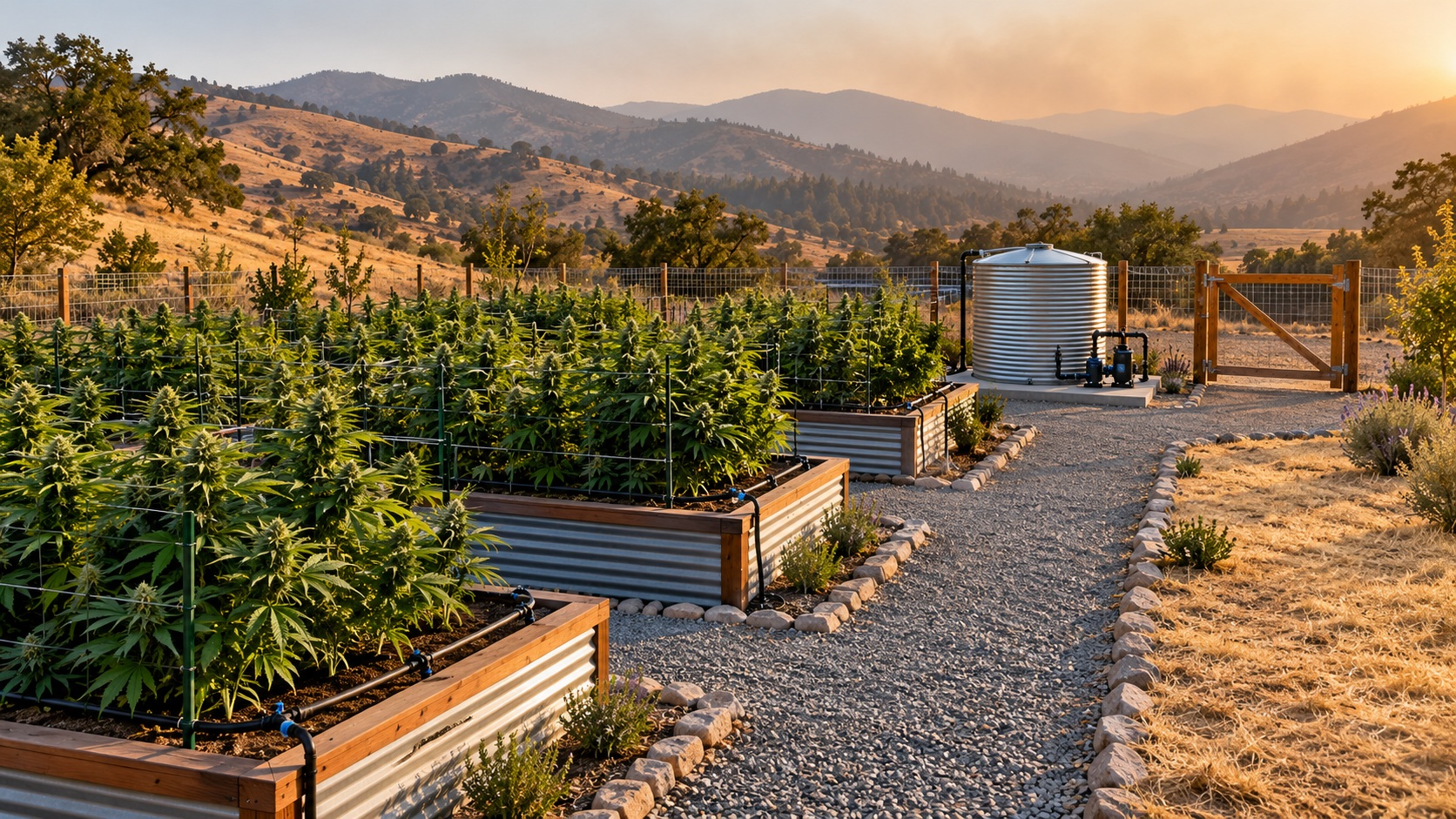
Wildfire Smoke and Ash on Outdoor Cannabis
Wildfire smoke and drifting ash create a distinct triple stress event for outdoor cannabis: simultaneous light attenuation (often dropping midday PPFD by 25 to 60 percent), fine particulate deposition (PM2.5 and coarser alkaline charcoal ash) across leaves and resin glands, and rapid shifts in temperature, Vapor Pressure Deficit (VPD), and ambient ozone. When smoke arrives during vegetative growth or early stretch, plants slow down but usually recover cleanly once skies clear; when thick plumes settle over sticky mid-to-late flower resin, airborne particulates and smoke-borne volatile phenols bind directly into trichome heads and cannot simply be rinsed away without careful hygiene and testing.
Treating wildfire smoke like ordinary garden dust or spraying every bud aggressively with cold water often causes a worse secondary disaster: Botrytis bud rot inside wet, compacted colas. This field guide explains how smoke alters outdoor cannabis physiology, how to distinguish ash residue from mildew or necrotic tissue, when gentle misting helps versus harms, and how to document smoke-exposed harvests responsibly.
How Wildfire Smoke Changes Light, Air Chemistry, and Transpiration
Dense wildfire haze acts like an unpredictable cloud layer mixed with airborne carbon, altering photosynthetic demand before a single flake of ash lands on a leaf.
Diffuse Radiation vs Total PPFD Drop Under Smoke Plumes
Smoke aerosols scatter incoming blue wavelengths more strongly than red wavelengths, turning harsh direct sun into flat orange or amber diffuse light. While diffuse light penetrates lower canopy leaves slightly better than raw beam radiation, heavy wildfire smoke cuts total Photosynthetically Active Radiation (PAR) and Daily Light Integral (DLI) dramatically, often dropping noon PPFD from 1,600+ umol/m2/s down below 600 umol/m2/s.
Lower daytime peak irradiance also cools daytime canopy leaf temperatures by 2 to 6 C while trapping nocturnal longwave warmth underneath the inversion layer. Combined with lower afternoon stomatal conductance, plants suddenly consume 20 to 45 percent less water per day than the preceding clear-sky heatwave.
Stomatal Occlusion, Ozone Injury, and Irrigation Trap
Many outdoor growers keep watering on their normal mid-summer heat schedule during dark, smoky days simply because weather forecasts still show dry air. With lower PAR driving slower transpiration, saturated native soil or raised beds quickly turn hypoxic, mimicking nutrient deficiency just as fine soot begins coating stomata.
Elevated ground-level ozone generated inside photochemical wildfire plumes also causes pinpoint bronze or white stippling on upper sun-exposed leaves. Always check root-zone moisture weight or tensiometer readings before irrigating under prolonged smoke.
Vegetative Foliage vs Glandular Trichome Resin Adhesion
On vegetative plants or early-flower crops without dense exposed calyces, smooth waxy leaf cuticles shed coarse ash fairly easily with light breeze or scheduled foliar maintenance, and all contaminated early leaves will eventually senesce or sit well below harvestable flower. Once stalked capitate trichomes begin secreting lipophilic terpenes and cannabinoids in Weeks 4 through 9 of flower, however, hydrophobic resin acts like sticky flypaper for airborne soot, polycyclic aromatic hydrocarbons (PAHs), and smoke-borne volatile phenols such as guaiacol and syringol.
Wildfire Smoke Taint Adhesion
The irreversible chemical binding of airborne smoke volatile phenols, micro-soot (PM2.5), and alkaline wood ash into hydrophobic cannabis trichome lipids and waxy cuticles; unlike surface leaf dust, smoke volatiles absorbed into oil glands cannot be removed by ordinary water rinsing.
Evaluating weather windows, site airflow, and stage of flower dictates every protective response before ash builds up.
Outdoor growers facing regional wildfire inversions frequently ask how thick smoke plumes change irrigation math and foliar health.
“Can I wash ash off flowering outdoor buds with plain garden hose water once the wildfire smoke clears?”
Question sent by: Caleb Conti, via email.
Spraying flowering buds with a hose forces alkaline ash salts deep into compact bracts and traps free moisture that triggers Botrytis bud rot within 48 hours. Keep flowers dry in the field, gently shake off loose dry debris in bright breezy afternoon air, and inspect internal bract cleanliness at harvest rather than soaking standing colas.
Evaluating plant response calmly after addressing the primary mechanism protects wildfire smoke and ash on outdoor cannabis outcomes over the days ahead.
Measuring Site Exposure, Ash Reactivity, and Crop Vulnerability
Two outdoor gardens only ten miles apart can suffer sharply different smoke impacts depending on topography, valley inversions, and structural proximity.
Valley Airsheds, Inversions, and Urban-Wildland Ash Hazards
Smoke behaves like cold water at night: dense particulate plumes slide downhill after sunset and pool inside valley bottoms, river corridors, and walled yards until morning thermal mixing breaks the inversion. Gardens perched on open hillsides clear earlier in the morning, whereas fenced basins stay submerged in stagnant PM2.5 for 14+ hours daily.
Just as critically, distinguish forest-biomass fires from Wildland-Urban Interface (WUI) fires that burn structures, vehicles, treated lumber, plastics, and asphalt. Ash originating from structural fires carries elevated heavy metals, dioxins, and synthetic residues that pose genuine consumer and worker hazards far beyond woody charcoal.
Alkaline Wood Ash pH Shock on Wet Leaf Surfaces
Fresh wood ash is strongly alkaline, routinely measuring pH 9.5 to 12.0 because potassium hydroxide and calcium carbonate salts dissolve instantly on contact with moisture. When morning dew or careless overhead misting wets dry ash sitting on a cannabis leaf, it generates a brief caustic alkaline film that can etch leaf margins and temporarily spike localized phyllosphere pH.
Distinguishing dry inert grit from caustic wet ash buildup helps prevent mistaking chemical leaf burn for disease.
Separating Ash Accumulation From Mildew and Pest Stippling
Under overcast smoke light, pale gray-white potassium ash flecks on green leaves look remarkably similar to early powdery mildew spots or spider-mite stippling. Always examine suspect leaves under a 20x hand lens in neutral bright work lighting before reaching for any spray tank.
| Observation on Leaf or Bud | Physical & Microscopic Behavior | Likely Cause | Corrective Action |
|---|---|---|---|
| Loose gray-black gritty specks sitting atop fan leaves | Gritty non-living particles brush off cleanly leaving intact green cuticle | Coarse wildfire wood ash | Shake branches gently with dry PPE or clear vegetative leaves only when dry weather returns |
| Soft circular white patches with radiating filaments | Fungal hyphae and spore chains adhere to epidermal surface; returns after wiping | Powdery mildew (Golovinomyces spp.) | Isolate affected tissue, avoid misting, and follow localized pathogen containment |
| Fine pale pinpricks on upper leaf with dark specks underneath | Sub-epidermal chlorotic stippling and mobile mites/eggs on abaxial surface | Two-spotted spider mites or russet mites | Inspect abaxial leaf surfaces with 20x-40x magnification; manage mites directly |
| Dull greasy darkening inside sticky calyxes without loose flakes | Trichome heads coated in fine PM2.5 oil/soot film; harsh acrid campfire odor | Smoke-borne volatile phenol absorption | Assess laboratory contaminant testing; do not rely on aggressive washing to remove adsorbed volatiles |
Once you confirm what is settling on the crop, seasonal timing and cultivar architecture dictate your containment plan.
Combining structured field cues with clean environmental benchmarks separates primary triggers from harmless look-alikes.
Protective Setup and Response Plan by Growth Stage
Interventions that protect vegetative plants in August can trigger bud rot in October, so response tactics must match the plant stage.
Temporary Shade Cloth, Hoop Filters, and Pre-Smoke Hygiene
For vegetative or early-flower plants in small hoop houses or portable frameworks, hanging clean breathable horticultural fleece (20 to 30 percent shade cloth or woven row cover) over the windward side intercepts drifting coarse ash flakes while letting breeze pass through. Avoid sealing outdoor plastic greenhouses airtight during hot smoke waves without active intake filtration and cooling, because unvented hoops trap midday heat above 38 C and spike nighttime dew formation.
Pre-prune low interior suckers before local peak fire season arrives. Open canopies shed drifting ash more cleanly and dry twice as fast after morning dew.
When Gentle Rinsing Helps vs When Water Trapping Backfires
Never spray a heavy hose stream onto thick, dense late-stage colas sitting in smoky stagnant humidity. Trapped water plus ash salts inside compact bracts creates an ideal alkaline nutrient pocket for Botrytis cinerea gray mold within 24 to 48 hours.
Water rinsing is reserved strictly for vegetative plants or pre-pistil early stretch crops on bright, breezy mornings once the smoke plume has lifted and outdoor relative humidity is dropping below 55 percent. Even then, flush gently using clean, slightly acidified neutral water (pH 6.0 to 6.5) to neutralize alkaline ash salts without forcing water into leaf axils, followed immediately by shaking excess droplets off branches.
Dry Mechanical Removal and Airflow Assisted Clearing
During ongoing smoke episodes in flower, keep water away from buds entirely. Gently shake stems while wearing an N95/P100 particulate respirator early in the afternoon when relative humidity is lowest, or use low-velocity clean air from a battery leaf blower held well back (at least 1.5 to 2 meters from the canopy) purely to dislodge dry loose ash flakes without bruising trichome stalks.
Field Advice: Never use high-pressure nozzles or cold nighttime misting to ‘wash’ ash off flowering plants. Dry ash plus stagnant water inside tight bracts almost always causes more crop loss from Botrytis than the ash itself.
Knowing the exact safety boundaries for post-smoke bud handling prevents risky salvage attempts after severe fires.
Reviewing connected site and crop factors helps lock in consistent results across harvests.
Before misting dusty plants under stagnant smoky air, consider how trapped humidity interacts with loose ash deposits.
“Why did my outdoor plants suddenly look overwatered and droopy even though smoke blocked half the sun?”
Question sent by: OkanaganAshWatch, via X.
Thick smoke slashes noon Photosynthetically Active Radiation and leaf temperature, dropping daily canopy transpiration by up to 40 percent while soil stays cool. Continuing your clear-sky summer watering schedule under heavy haze saturates root-zone pore space and starves roots of dissolved oxygen.
Verifying environmental and physical checkpoints before layering a second intervention avoids compounding preventable crop stress.
Decision Matrix: Triage, Washing Limits, and Safety Boundaries
Matching remediation effort to ash origin and floral maturity ensures unsafe batches never reach drying racks.
Hoop House Intake Filtration vs Open Field Reality
Growers running mechanical greenhouse fans can fit MERV-13 pleated pre-filters across motorized intake louvers during smoke advisories, cutting indoor fine soot infiltration substantially provided fan static pressure capacity handles the added resistance. Open-field plants lack filtration, making stage-based triage and rigorous inspection the decisive control points.
Why Cold-Water Bud Washing Fails Smoke Taint and Heavy Metals
Submerging harvested branches in plain water or dilute lemon juice/baking soda buckets after harvest removes loose surface dirt, hair, and coarse charcoal grit, but it cannot extract lipid-soluble PAHs, pyrogenic benzene derivatives, or smoky guaiacol phenols already dissolved inside trichome oil. Worse yet, stirring wet ash into unbuffered wash water leaves dirty mineral slush lodged inside tight bracts if rinse cycles are rushed.
Wildland-Urban Interface Contamination and Laboratory Screening
Any outdoor crop exposed to heavy fallout from neighborhood, industrial, or vehicle-heavy WUI fires should be treated with extreme caution. Submit representative cured samples to an accredited state or provincial cannabis testing laboratory for heavy metals (lead, arsenic, cadmium, mercury), microbials, and pesticide/PAH screens rather than judging safety by appearance or smell.
| Crop Stage & Fire Type | Recommended Field Action | Post-Harvest Handling | Safety Boundary / Rejection Trigger |
|---|---|---|---|
| Vegetative plants + forest biomass smoke | Pause foliar sprays; reduce irrigation frequency; wait for clear dry breeze | Gentle water rinse allowed once skies clear; infected older fans shed naturally | Do not overwater cool, shaded soil beds while DLI is suppressed |
| Early flower (Weeks 1-3) + light wood ash | Gently shake loose dry ash during afternoon low-RH hours; thin crowded lowers | Monitor clean new bract growth over subsequent weeks | Discard lower heavily ash-encrusted leaves cleanly into bagged waste |
| Mid-to-late flower (Weeks 4-9) + heavy wildland smoke | Keep colas completely dry; avoid overhead wetting; run gentle outdoor oscillation where safe | Dry cautiously; evaluate smoky aroma, ash inside bracts, and lab screen | Reject and safely dispose of flower carrying heavy structural ash or moldy decay |
| Any flower + Urban-Industrial (WUI) fallout | Cover immediately if pre-harvest; protect workers with P100/N95 masks and eyewear | Mandatory accredited heavy metal and PAH contamination lab screening | Do not consume, extract, or distribute untested WUI-ash-coated flower |
Post-smoke field recovery also depends on protecting workers, adjusting late-season feeding, and preventing compounding root errors.
Remember: Concentrating smoke-tainted or urban-ash-contaminated cannabis does not purify it; lipid-soluble PAHs and volatile smoke phenols concentrate alongside trichome resins during extraction.
Keeping clear operational boundaries prevents well-intentioned shortcuts from compounding small mistakes.
Once smoke clears in late September or October, flower quality questions shift quickly from light loss to volatile smoke taint and testing.
“Is harvested flower still usable if it absorbed a distinct campfire smell during late September smoke?”
Question sent by: Nolan Bergstrom, via contact form.
A persistent acrid campfire aroma after curing indicates volatile smoke phenols (such as guaiacol and syringol) dissolved directly into trichome oil glands. Even if loose surface ash is brushed away, adsorbed phenols stay inside resin, so avoid assuming curing or simple bucket washing removes smoke taint.
Keeping clear field measurements across consecutive checks ensures adjustments track the real root cause accurately.
Common Smoke-Season Mistakes and Post-Event Recovery
Misreading smoke-induced slowdowns triggers unnecessary fertilizer drenches and moisture disasters right before autumn harvest.
Overfeeding Stressed Plants While Sunlight Is Blocked
When heavy smoke dims the sun for five consecutive days, lower photosynthetic carbon fixation slows nitrogen and potassium demand accordingly. Dumping extra bloom boosters or humic drenches into slow-draining soil during a smoke inversion spikes root-zone EC right as water uptake stalls, burning leaf tips unnecessarily.
Applying Sticky Oil Foliar Sprays During Smoke Advisories
Never apply horticultural neem oil, potassium fatty acid soaps, or resinous bio-pesticides while smoke haze is active. Oil films cement airborne soot permanently onto the leaf cuticle, clog stomata completely, and trigger rapid leaf scorching once clear bright sunlight breaks back through the atmosphere.
Mistaking Ozone/Heat Stipple for Calcium or Fungal Spotting
Photochemical smog and ozone levels often triple downwind of large fires, stippling sun-exposed upper leaves with pinpoint bleached necrosis. Because lower shaded leaves remain clean, compare upper vs lower canopies before diagnosing calcium deficiency or fungus.
Disciplined Smoke-Response Habits
Wear fitted N95 or P100 respirators during smoky outdoor scouting; reduce irrigation intervals to match depressed PAR and transpiration; use 20x magnification to verify loose ash versus fungal hyphae; keep mid-to-late flowers completely dry during smoke advisories.
Compounding Post-Fire Crop Errors
Avoid misting late-stage sticky buds while ambient smoke or nighttime humidity traps moisture inside bracts; avoid applying oil-based foliar sprays while airborne soot is settling; avoid consuming or concentrating flower coated in structural/urban fire fallout without full lab screening.
Combining structured canopy inspections with disciplined moisture tracking turns chaotic fire weather into clear crop decisions.
Documented canopy checkpoints and baseline equipment readings make follow-up evaluation fast and objective.
Wildfire Smoke Season Inspection Checklist and Verification
Verify soil moisture, air quality advisories, worker respiratory safety, and trichome cleanliness in a repeatable weekly sequence.
Daily Air Quality Index (AQI) and Stomatal Recovery Tracking
Log local AQI/PM2.5 values alongside daily soil tensiometer or pot weight checks until clear skies return. Plants typically regain full noon transpiration rates 48 to 72 hours after haze lifts and bright sun restores stomatal aperture.
Pre-Harvest Tissue Inspection and Extraction Caution
Before hanging harvested branches, split three representative dense colas from windward and leeward sides under bright white inspection LEDs to check inner bracts for trapped charcoal dust or secondary Botrytis decay. Note that solvent or rosin extraction concentrates lipid-soluble hydrocarbons and smoke phenols along with cannabinoids, so never use concentrated extracts as a ‘workaround’ for smoke-contaminated flower.
Field Verification Routine During and After Wildfire Smoke
- Check local AQI, PM2.5, and whether fires involve wildland timber only or urban/industrial structures before entering the field.
- Equip garden workers with properly sealed N95 or P100 particulate respirators and eye protection during heavy haze.
- Cut irrigation frequency by 20 to 40 percent when dense smoke attenuates daytime light and slows transpiration.
- Halt all oil-based or soap-based foliar sprays immediately until skies clear and airborne ash stops settling.
- Inspect white surface specks with a 20x loupe to separate brushable mineral ash from filamentous powdery mildew.
- Avoid overhead misting or hose washing on flowering crops; clear dry loose ash gently only with low-velocity air or light shaking.
- Submit WUI-exposed or heavily smoky cured flower to an accredited laboratory for heavy metals, PAH, and microbial verification.
Applying consistent verification habits protects both your lungs during seasonal fire weather and the integrity of your final harvest.
Planning ahead for an entire smoke season starts with deciding which triage checks actually save usable harvest.
“What should I check first when a wildfire burned nearby houses two ridges away from my outdoor garden?”
Question sent by: WillametteSmokeLog, via Instagram.
Structural fires deposit heavy metals, synthetic polymers, and polycyclic aromatic hydrocarbons rather than clean wood ash. Protect workers with P100 masks, avoid disturbing dried ash without wet dust suppression on walkways, and test cured flower at an accredited laboratory for heavy metals and contaminants before any use.
Consistent routine tracking keeps long-term crop hygiene and quality repeatable from harvest to harvest.
Scientific References
- Kalies, E., et al. (2022). Wildfire smoke impacts on agricultural crop photosynthesis, diffuse PAR fraction, and stomatal conductance. Agricultural and Forest Meteorology.
- Krstic, M. P., Johnson, D. L., & Herderich, M. J. (2015). Review of smoke taint chemistry and volatile phenol glycosides in exposed botanical crops. Australian Journal of Grape and Wine Research.
- California Department of Cannabis Control (DCC) & Oregon Department of Agriculture. Guidance on wildfire ash, heavy metals, and environmental particulate testing in outdoor cannabis.
- Eteng, A., et al. (2023). Alkaline pH reactivity of wood ash particulates and effects on foliar cuticular integrity. Journal of Environmental Horticulture.
Share this article

Advertisement · Affiliate link
Weedth may earn a commission at no extra cost to you.
A quick overview of the topics covered in this article.
Follow us
Latest articles
November 26, 2026
November 26, 2026
November 26, 2026