
Cannabis Nutrient Basics
Cannabis plants build roughly 94 percent of their dry biomass out of just three non-mineral elements drawn from air and water: carbon (C), hydrogen (H), and oxygen (O) fixed through photosynthesis. The remaining 6 percent of plant dry weight consists of 14 essential mineral elements absorbed through the root zone as dissolved inorganic ions – yet if even a single trace micronutrient like boron or iron is locked out, enzymatic metabolism and flower development grind to a halt.
Understanding cannabis nutrient basics does not require a chemistry degree, nor does it require buying a dozen expensive booster bottles. Once you grasp what each macro- and micronutrient physically builds inside the plant, why mobile deficiencies appear on old bottom leaves while immobile deficiencies strike new top shoots, and how root-zone pH and watering control uptake, you can feed any cultivar with calm confidence.
How Cannabis Roots Actually Absorb Nutrients (Ions, Not Food)
The most liberating realization in plant nutrition is that fertilizer is not ‘plant food’ in the human sense; light is the plant’s caloric energy source, while mineral nutrients are the structural nuts, bolts, and spark plugs.
Why Both Organic and Synthetic Nutrients Enter Roots as Identical Ions
Plant root hairs cannot absorb whole fish proteins, kelp fronds, or humic molecules directly across their semi-permeable lipid membranes. Whether you feed bottled mineral salts in coco coir or top-dress bat guano and alfalfa meal onto living soil, nitrogen only crosses the root epidermal membrane after it is dissolved in pore water as inorganic nitrate (NO3-) or ammonium (NH4+) ions (along with small quantities of simple amino acids).
In a mineral salt system, those ions are already pre-dissolved in water for immediate osmotic uptake; in an organic soil system, you feed the rhizosphere bacteria, fungi, and protozoa, and those microbes mineralize organic matter into the exact same inorganic ions at a steady biological pace.
Mass Flow vs Diffusion at the Root Surface
Dissolved nutrients travel to the root surface primarily through two physical mechanisms: mass flow and diffusion. As stomata open on leaf undersides and transpire water vapor into the tent air, the continuous water column inside the xylem pulls pore water (and dissolved calcium, nitrate, and magnesium) toward the root like a straw – a process called mass flow.
When environmental VPD is too low (for example, 80 percent humidity with zero airflow) or the substrate is bone-dry, transpiration stops, mass flow halts, and calcium transport to rapidly dividing top shoots fails even when plenty of calcium sits in the soil.
Liebig’s Law of the Minimum: Plant growth and yield are dictated not by the total abundance of nutrients supplied, but by the single scarcest essential resource (whether light, CO2, water, root oxygen, or a single locked-out mineral ion).
Practical questions from home cultivators often center on how these thresholds behave in real-world tents and small rooms.
“Why do I have to wait between adding liquid potassium silicate and adding my Cal-Mag and base nutrients to the water?”
Question sent by: Liliana Davenport, via reader Q&A form.
Liquid potassium silicate is strongly alkaline (often pH 10 to 11 in the bottle) and rapidly polymerizes into insoluble cloudy silica gel or calcium silicate precipitate if it contacts concentrated calcium or acid before being fully diluted. Always add potassium silicate to plain water first, stir vigorously for two minutes, optionally bring the high pH down toward 6.5 with a few drops of pH Down, wait 10 to 15 minutes, and only then add Cal-Mag, Part A, and Part B.
If your reservoir water ever turns milky white and cloudy right after mixing, dump that batch out and remix in the proper dilution order.
Primary Macronutrients: Nitrogen (N), Phosphorus (P), and Potassium (K)
Every fertilizer label displays three hyphenated numbers (N-P-K) representing the primary macronutrients consumed in the largest quantities (50 to 250 mg/L or PPM in solution).
Nitrogen (N) and Potassium (K): The Vegetative and Osmotic Engines
Nitrogen (absorbed as NO3- and NH4+) is the core building block of amino acids, structural proteins, nucleic acids, and the porphyrin ring at the center of every chlorophyll molecule. Vegetative cannabis demands high nitrogen (120 to 180 PPM elemental N) to drive leaf expansion and stem branching; during mid-to-late flowering, nitrogen should be tapered down to 60 to 100 PPM so excess vegetative leaf growth does not crowd bracts or leave harsh chlorophyll in cured buds.
Potassium (absorbed as K+) never forms permanent structural tissue; instead, it acts as the master electrolyte and osmotic regulator inside plant cells. Potassium opens and closes guard-cell stomata, activates over 60 photosynthetic and starch-synthesizing enzymes, and drives phloem sugar translocation into swelling flowers from week 1 to harvest (requiring 150 to 250 PPM elemental K).
Phosphorus (P) Realities vs the High-PK Booster Myth
Phosphorus (absorbed as H2PO4- and HPO4 2-) forms the sugar-phosphate backbone of DNA and RNA, builds phospholipid cell membranes, and powers every metabolic reaction inside the cell via adenosine triphosphate (ATP). Because legacy fertilizer companies marketed ’10-50-10′ or ‘0-50-30’ bloom boosters, many growers mistakenly believe flowering cannabis needs massive doses of phosphorus.
Modern university tissue and leachate research on drug-type Cannabis sativa shows that optimal floral yield and cannabinoid synthesis occur at just 30 to 60 PPM of elemental phosphorus (up to 75 PPM peak in mid-flower). Dumping 150+ PPM of phosphorus into the root zone precipitates insoluble calcium phosphate, locks out iron and zinc, and burns leaf tips without increasing bud weight.
| Nutrient Element | Category & Phloem Mobility | Primary Ionic Form Absorbed | Core Physiological Role in Cannabis |
|---|---|---|---|
| Nitrogen (N) | Primary Macro (Mobile) | NO3- (Nitrate), NH4+ (Ammonium) | Chlorophyll synthesis, amino acids, vegetative leaf & stem growth |
| Phosphorus (P) | Primary Macro (Mobile) | H2PO4- (Dihydrogen phosphate) | ATP cellular energy transfer, root division, DNA/RNA, floral bract set |
| Potassium (K) | Primary Macro (Mobile) | K+ (Potassium cation) | Stomatal turgor regulation, sugar translocation, stem wall rigidity |
| Calcium (Ca) | Secondary Macro (Immobile) | Ca2+ (Calcium cation) | Pectin cell-wall cementing, membrane stability, apical meristem growth |
| Magnesium (Mg) | Secondary Macro (Mobile) | Mg2+ (Magnesium cation) | Central atom of every chlorophyll molecule; RuBisCO enzyme activator |
| Sulfur (S) | Secondary Macro (Immobile/Low) | SO4 2- (Sulfate anion) | Cysteine/methionine amino acids, volatile sulfur aroma compounds & terpenes |
| Iron, Mn, Zn, B, Cu, Mo | Micronutrients (Immobile) | Chelated Fe2+/3+, Mn2+, Zn2+, H3BO3 | Electron transport, auxin synthesis, pollen/calyx formation, nitrate reductase |

Right behind N-P-K in quantitative demand sit the three secondary macronutrients that hold cell walls and chlorophyll together.
Secondary Macronutrients (Ca, Mg, S) and Essential Micronutrients
Under modern high-output full-spectrum LEDs, cannabis consumes nearly as much elemental calcium and magnesium as nitrogen and phosphorus.
Calcium (Ca), Magnesium (Mg), and Sulfur (S)
Calcium (Ca2+, targeted at 100 to 160 PPM) cross-links pectin chains in the middle lamella of every new cell wall and acts as a secondary messenger during heat and mechanical stress. Because calcium moves strictly upward in the xylem transpiration stream and cannot be relocated once deposited in a leaf, any interruption in water uptake or calcium supply immediately stunts and spots new top leaves.
Magnesium (Mg2+, targeted at 40 to 75 PPM) sits at the exact center of the chlorophyll molecule and bridges ATP to enzymes; without sufficient Mg, lower leaves turn yellow between green veins as the plant strips old chlorophyll to build new tops. Sulfur (SO4 2-, targeted at 60 to 120 PPM) is indispensable for synthesizing aromatic terpenes and volatile sulfur compounds during flowering.
Why Part A and Part B Base Nutrients Come in Separate Bottles
New growers often ask why mineral base nutrients are sold in two separate bottles (Part A and Part B) rather than one convenient jug. In concentrated liquid form, combining high concentrations of calcium ions (Ca2+) with sulfate (SO4 2-) or phosphate (PO4 3-) ions causes an immediate chemical reaction that precipitates solid gypsum (calcium sulfate) and rock phosphate snow at the bottom of the bottle.
By keeping calcium nitrate and iron chelates in Bottle A, and keeping potassium/magnesium phosphates and sulfates in Bottle B, both concentrates remain 100 percent liquid for years. When mixing your reservoir, always fill your bucket with water first, stir in Cal-Mag and Part A thoroughly until diluted, and only then add Part B.
Do
- Fill your mixing bucket with water first, stir in Cal-Mag and Part A completely, and add Part B and pH adjusters last.
- Diagnose whether a leaf symptom starts on lower old leaves (mobile N, P, K, Mg) or upper new growth (immobile Ca, Fe, S, B).
- Check root-zone pH, runoff EC, pot moisture, and LED distance before adding extra fertilizer to fix a visual deficiency.
- Maintain moderate elemental phosphorus (30-60 PPM) in flower rather than overdosing heavy PK boosters that lock out calcium and micronutrients.
Avoid
- Mixing concentrated Part A and Part B nutrient liquids directly together before diluting them in water, which precipitates solid gypsum.
- Assuming every yellow leaf needs more Nitrogen without checking whether root-zone pH or overwatering is locking out iron or sulfur.
- Stacking multiple overlapping bloom boosters that skew potassium-to-calcium ratios and cause mid-flower tip burn.
- Flushing coco coir with plain unbuffered tap or RO water mid-cycle instead of resetting with a mild 0.8-1.0 EC balanced solution.
Knowing which nutrients can move inside the plant and which are cemented in place turns every leaf symptom into a clear map.
“Do I need to buy bottled sugars or molasses in hydroponics or coco to ‘make the buds sweeter and heavier’?”
Question sent by: Liliana Thornton, via grow journal submission.
Plant roots do not absorb external sucrose or molasses to build bigger flowers; a healthy cannabis canopy manufactures 100 percent of its own simple sugars internally through photosynthesis using light, carbon dioxide, and water. In organic living soil, adding 1 teaspoon per gallon of unsulfured blackstrap molasses feeds beneficial rhizosphere bacteria and fungi (plus trace potassium, calcium, and iron), which helps mineralize organic soil amendments. In sterile DWC hydroponics or mineral drain-to-waste coco, pouring molasses into the reservoir simply feeds heterotrophic bacteria and biofilm slime in your lines.
If you want maximum resin and sugar production in coco or hydro, invest in optimal canopy PPFD, stable VPD, and adequate sulfur and magnesium rather than bottled carbohydrates.
Mobile vs Immobile Nutrients: Reading the Canopy Map
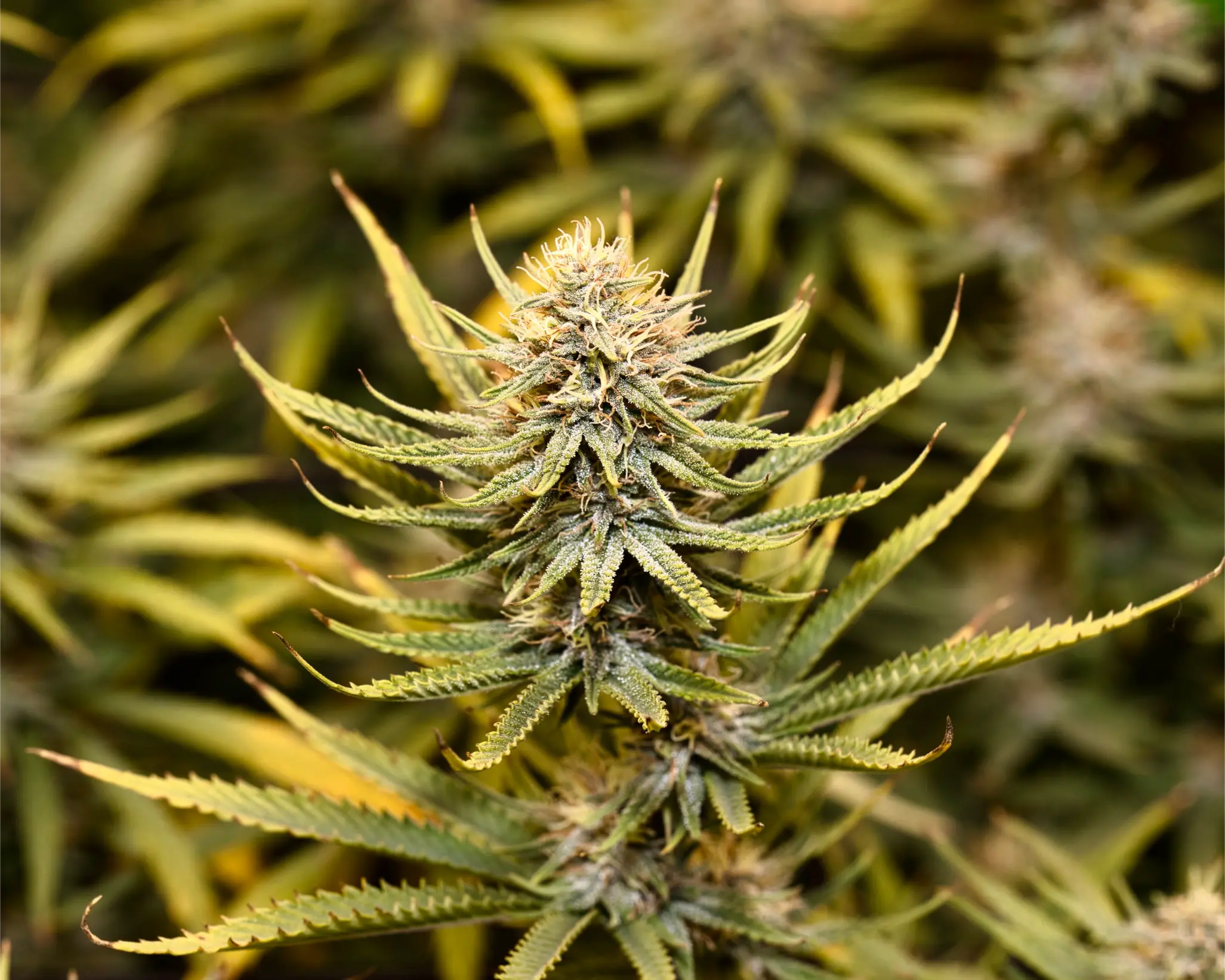
Before reaching for any bottle to fix a yellow or spotted leaf, look at where on the plant the symptom started: the bottom old fan leaves or the brand-new top shoots.
Mobile Elements Show Deficiencies on Lower Old Leaves First
Nitrogen (N), Phosphorus (P), Potassium (K), and Magnesium (Mg) are phloem-mobile elements. When root uptake of a mobile element falls short of what the growing apical meristems demand, the plant enzymatically disassembles that element out of its oldest lower fan leaves and pumps it up through the phloem to keep new top shoots green and growing.
Consequently, a true Nitrogen deficiency always starts as a uniform pale lime-green yellowing of the lowest, oldest leaves at the bottom of the skirt, while a Magnesium deficiency starts as interveinal yellowing on mid-to-lower fan leaves while leaf veins stay green.
Immobile Elements Show Deficiencies on Upper New Growth First
Calcium (Ca), Iron (Fe), Sulfur (S), Boron (B), Manganese (Mn), Zinc (Zn), and Copper (Cu) are phloem-immobile elements. Once the xylem deposits calcium or iron into an older fan leaf, it is locked into that tissue permanently and cannot be mobilized to rescue new growth.
Therefore, if your lower fan leaves remain dark green while brand-new top leaves emerge bright lemon-yellow from the petiole outward, you are looking at an immobile Iron or Sulfur lockout (almost always caused by root-zone pH climbing above 6.8 or cold, overwatered roots) rather than a nitrogen shortage.
| Canopy Location of Symptom | Visual Leaf Pattern | Most Likely Element Involved | First Diagnostic Check Before Adding Fertilizer |
|---|---|---|---|
| Lower / Oldest Fan Leaves | Uniform pale yellowing from tip toward petiole | Nitrogen (N) – Mobile | Check feed EC and confirm plant is not simply in late-flower senescence |
| Lower to Mid-Tier Leaves | Yellowing between green veins; edges stay intact | Magnesium (Mg) – Mobile | Verify root-zone pH (Mg locks out below 5.7 in coco and below 6.2 in soil) |
| Lower to Mid Leaf Margins | Rusty/bronzed serrated edges turning crispy necrotic | Potassium (K) – Mobile | Check runoff EC for salt buildup or excessive calcium antagonism |
| Upper / Mid High-Light Leaves | Pinpoint brown rust spots with yellow halos | Calcium (Ca) – Immobile | Check VPD airflow, coco Cal-Mag buffering, and root-zone moisture |
| Brand-New Apical Shoots | Bright yellow new leaves from base outward; green veins | Iron (Fe) or Sulfur (S) – Immobile | Check for high root-zone pH (>6.8) or cold, waterlogged anaerobic roots |
To compare nutrient lines accurately, you also need to know how fertilizer labels convert oxide weights into true elemental PPM.
Cultivation Warning
Roughly 80 percent of visual ‘nutrient deficiencies’ in indoor gardens are actually nutrient lockouts caused by out-of-range root-zone pH, chronic overwatering, or salt accumulation. Pouring double-strength nutrients onto a locked-out root zone spikes osmotic salinity and burns the remaining root hairs.
Practical questions from home cultivators often center on how these thresholds behave in real-world tents and small rooms.
“What is the difference between chelated micronutrients (EDTA, DTPA, EDDHA) and standard mineral sulfates?”
Question sent by: Liliana Kingsley, via email.
Unprotected metal micronutrient ions like Iron (Fe2+/Fe3+), Manganese, and Zinc readily react with hydroxide and phosphate ions in water above pH 6.2, precipitating into insoluble rust that roots cannot absorb. A chelating agent (from the Greek word for ‘claw’) is an organic ring molecule that wraps around the metal ion to shield it from precipitation until it reaches the root membrane. Iron EDTA stays soluble up to pH 6.0-6.3, Iron DTPA stays soluble up to pH 7.0, and Iron EDDHA remains soluble even in alkaline soils above pH 7.5.
Quality hydroponic and coco nutrients use a blend of EDTA and DTPA iron chelates so iron remains fully available across the entire 5.5 to 6.5 pH window.
Decoding N-P-K Fertilizer Labels and Oxide Conversion Math
By archaic 19th-century fertilizer law, the N-P-K percentages printed on every bottle do not represent pure elemental Nitrogen, Phosphorus, and Potassium.
Elemental N vs P2O5 and K2O Label Percentages
On a fertilizer label reading 4-8-7, the first number (4) is indeed 4 percent elemental Nitrogen (N) by weight. However, the second number (8) represents 8 percent phosphate oxide (P2O5), and the third number (7) represents 7 percent potash oxide (K2O). Because oxygen atoms make up more than half the molecular weight of P2O5, multiplying P2O5 by 0.4364 reveals true elemental Phosphorus (P), and multiplying K2O by 0.8301 reveals true elemental Potassium (K).
That means a ‘4-8-7’ bloom bottle actually contains 4.0 percent elemental N, only 3.49 percent elemental P (8 x 0.4364), and 5.81 percent elemental K (7 x 0.8301) – a much more balanced 1.1 : 1.0 : 1.6 elemental ratio than the raw label suggests.
Why Complete Base Nutrients Beat 10-Bottle Additive Programs
A well-formulated 2-part or 3-part mineral base nutrient (or a balanced dry water-soluble salt blend like a modified Hoagland/hydroponic formulation plus Calcium Nitrate and Magnesium Sulfate) already contains every single one of the 14 essential mineral elements in balanced Mulder’s Chart proportions.
Stacking three different PK boosters, enzyme bottles, and secret carbohydrate tonics on top of a complete base formulation skews ionic ratios, drives up electrical conductivity (EC), and leaves you guessing which bottle caused leaf tip burn.
Positively charged cations compete for transport proteins at the root membrane: excessive Potassium (K+) directly blocks Calcium (Ca2+) and Magnesium (Mg2+) uptake, while excessive Ammonium (NH4+) blocks Calcium. Keeping total EC moderate and balanced always outperforms mega-dosing a single ion.
When a nutritional issue does appear, follow a disciplined four-step diagnostic sequence before changing your feed recipe.
The 4-Step Root-Zone Diagnostic Sequence Before Changing Feeds
Whenever foliage loses its uniform green color, walk through environment, irrigation, pH, and EC in order before opening a nutrient bottle.
Step 1 & 2: Verify Canopy Environment and Watering Rhythm
First, check canopy PPFD, leaf-surface temperature, and VPD. An LED hanging 20 centimeters too close to the upper canopy bleaches chlorophyll and drives local calcium/magnesium demand higher than roots can supply, mimicking a deficiency only on the top branches directly under the fixture.
Second, lift the pot and check substrate moisture and root temperature. Overwatered soil below 17 degrees Celsius starves roots of oxygen and blocks phosphorus and iron uptake regardless of how much fertilizer is in the pot.
Step 3 & 4: Measure Input vs Runoff EC and pH
Third, calibrate your pH and EC meters and test both your input nutrient solution and a sample of runoff or slurry from the bottom of the pot. If you feed coco at EC 1.4 mS/cm and pH 5.8, but the runoff comes out at EC 3.1 mS/cm and pH 5.1, salt buildup has acidified the root zone and locked out calcium and magnesium.
In that scenario, the cure is flushing the container with 2 to 3 pot volumes of balanced, mild nutrient solution (EC 1.0 mS/cm at pH 5.9) to reset the root zone – not adding extra Cal-Mag on top of a 3.1 EC salt buildup.
Field Verification Checklist
- Confirm your base nutrient formula (plus Cal-Mag if in coco/RO water) supplies all 6 macronutrients and 6 trace micronutrients.
- Mix nutrients in the exact dilution order: Silica (if used) -> wait 10 min -> Cal-Mag -> Part A -> Part B -> pH adjustment.
- Inspect lower old foliage and upper new shoots twice weekly to spot mobile vs immobile visual cues early.
- Test and log both input and runoff pH and EC once a week so salt accumulation or pH drift is caught before leaves spot.
- Taper nitrogen ratios down after week 3 of flowering while keeping potassium, calcium, magnesium, and sulfur steady through ripening.
Keep the reference rules and five-step checklist below beside your mixing bench to keep plant nutrition simple and predictable.
“How can I tell the difference between normal late-flower autumn fade (senescence) and a problematic mid-flower nitrogen deficiency?”
Question sent by: Liliana Halvorsen, via contact form.
Timing and flower maturity tell the story. If lower fan leaves begin turning pale yellow during week 2, 3, or 4 of an 8-week flowering cultivar and the yellowing creeps rapidly up into the middle canopy while white pistils are still actively multiplying, the plant is genuinely short on nitrogen and yield will suffer if you do not increase base feed slightly. Conversely, when upper fan leaves slowly fade to gold, purple, or red during weeks 7 and 8 while trichomes are turning cloudy and bracts are fully swollen, that is healthy natural senescence as the plant uses up stored leaf chlorophyll before harvest.
Never hit a week-7 or week-8 ripening plant with heavy vegetative nitrogen to fix fading leaves; enjoy the smooth, chlorophyll-free harvest that natural fade produces.
Scientific References
- Bevan, L., Jones, M., & Zheng, Y. (2021). Optimisation of nitrogen, phosphorus, and potassium for soilless production of Cannabis sativa in the flowering stage using response surface analysis. Frontiers in Plant Science, 12, 764103.
- Cockson, P., Landis, H., Smith, T., Hicks, K., & Whipker, B. E. (2019). Characterization of nutrient disorders of Cannabis sativa. Applied Sciences, 9(20), 4432.
- Marschner, P. (Ed.). (2012). Marschner’s Mineral Nutrition of Higher Plants (3rd ed.). Academic Press.
- Saloner, A., & Bernstein, N. (2021). Nitrogen supply affects cannabinoid and terpenoid profile in medical cannabis (Cannabis sativa L.). Industrial Crops and Products, 167, 113516.
Share this article
A quick overview of the topics covered in this article.
Follow us
Latest articles

November 9, 2026

November 9, 2026

November 9, 2026
November 9, 2026
