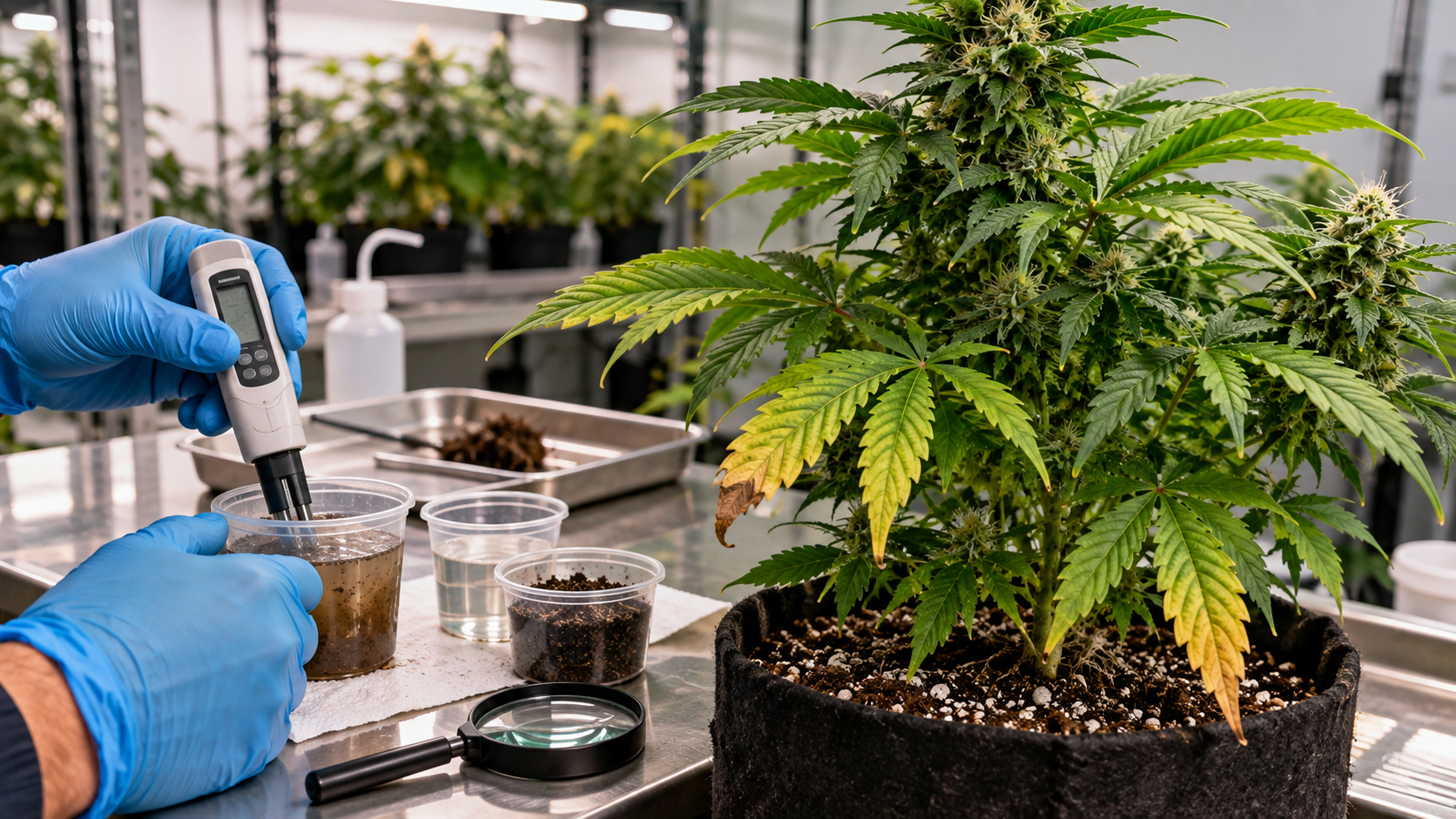
Nutrient Demand Under Higher PPFD
Increasing photosynthetic photon flux density is the most reliable method for accelerating biomass accumulation in cannabis, but light cannot synthesize tissue out of thin air. For every mole of photons absorbed by the canopy, the plant requires a stoichiometric supply of essential mineral ions to construct Rubisco enzymes, synthesize chlorophyll, replicate DNA, and reinforce cell walls. However, scaling nutrient delivery under high PPFD does not mean dumping concentrated fertilizers into your reservoir. Because high light dramatically accelerates transpirational water uptake, improper feeding leads to rapid root-zone salt accumulation, severe nutrient antagonisms, and self-induced crop failure. Mastering plant nutrition under high irradiance requires balancing elemental ratios and managing mass flow dynamics.
- Plant Physiology and Root Chemistry: How Photons Drive Elemental Ion Demand
- How Growth Stage, Substrate, Source Water, and Environment Alter Nutritional Demand
- Nutrient Antagonism, Salt Buildup, and pH-Driven Lockout Under High PPFD
- What to Measure: Input EC, Runoff, Elemental PPM, and Plant Sap/Tissue Analysis
- Comparing Fertilizer Formulations: Dry Mineral Salts, Liquids, Organics, and Foliar Sprays
- Systematic Troubleshooting Sequence: Single-Variable Root Recovery
- Evidence Check, Final Decision Checklist, and Companion Weedth Resources
Plant Physiology and Root Chemistry: How Photons Drive Elemental Ion Demand
The relationship between light intensity and nutrient demand is rooted in fundamental plant biochemistry. Photosynthesis utilizes light energy to split water molecules and fix atmospheric carbon dioxide into three-carbon carbohydrates. These simple sugars form the carbon skeletons of the plant. However, converting these carbon skeletons into structural cellulose, amino acids, nucleic acids, phospholipids, terpenes, and cannabinoids requires twelve essential mineral nutrients absorbed through root cell membranes.
When Photosynthetic Photon Flux Density (PPFD) is increased from a moderate 500 μmol/m²/s to a high commercial level of 1,000 to 1,400 μmol/m²/s, the light-dependent reactions produce an abundance of ATP and NADPH. To utilize this high-energy chemical currency, the plant must expand its photosynthetic machinery. Specifically, the plant requires substantial additional nitrogen ($N$) to synthesize the carbon-fixing enzyme Rubisco (which accounts for up to 30% of total leaf nitrogen content) and magnesium ($Mg$) to serve as the central coordinating ion in each chlorophyll molecule.
From a cellular physiology perspective, the assimilation of absorbed inorganic nitrogen into functional proteins is regulated directly by light signaling. When incident photons activate phytochrome and cryptochrome photoreceptors in the foliage, a systemic hormonal signal is transmitted downward to the root cortex, stimulating the gene expression and catalytic activation of the enzyme nitrate reductase (NR). Nitrate reductase catalyzes the initial reduction of absorbed nitrate ($NO_3^-$) into nitrite ($NO_2^-$), which is subsequently transported into chloroplasts and converted into ammonium ($NH_4^+$) by nitrite reductase. This ammonium is rapidly incorporated into amino acids via the glutamine synthetase-glutamate synthase (GS-GOGAT) cycle. Under high PPFD, the GS-GOGAT pathway operates at maximum velocity; however, if the supply of molybdenum ($Mo$) or iron ($Fe$): which serve as essential metallic cofactors for nitrate reductase: is deficient, toxic unreduced nitrate accumulates in leaf vacuolar storage, causing leaf margins to curl and dark green toxicity symptoms to develop even under intense light.
However, cultivators frequently confuse total elemental mass demand with fertilizer solution concentration (EC). Under high light intensity, the plant transpires between two and three times more water per day than under low light. Because water moves into root hairs primarily via passive mass flow driven by transpirational suction, while mineral ions are transported via active carrier proteins requiring metabolic energy, the plant takes up water faster than it absorbs dissolved salts. If a grower attempts to fulfill higher nutrient demand by raising the concentration of the fertilizer reservoir (for example, from 2.0 to 3.0 mS/cm EC), the plant drinks the water, leaving unabsorbed mineral salts behind in the root zone. Within days, substrate electrical conductivity climbs past 5.0 mS/cm, triggering acute osmotic root dehydration, tip burn, and vascular collapse.
Mass Flow vs Active Ion Transport and Elemental PPM
Mass Flow is the passive movement of dissolved nutrient ions toward root surfaces driven by the stream of water pulled into the plant by transpirational pull. Active Ion Transport is the energy-dependent pumping of ions against electrochemical concentration gradients across root cortical cell membranes via ATP-powered carrier enzymes. Elemental Parts Per Million (PPM) measures the exact weight in milligrams of a specific elemental ion (such as pure $N$, $P$, or $K$) per liter of solution, distinct from generic manufacturer PPM conversion scales.
The key to feeding cannabis under high PPFD is to deliver more total milligrams of nutrients per day through higher irrigation volume and frequency using a moderated or slightly diluted nutrient solution concentration. High-light nutrition is an exercise in hydraulic throughput, not salt concentration.
Fundamental Nutritional Rule: Photons accelerate the plant engine, increasing total fuel consumption. But you satisfy that fuel demand by giving the plant a larger fuel line (more frequent irrigation volume), not by pouring sludge into the tank (higher salt EC).

How Growth Stage, Substrate, Source Water, and Environment Alter Nutritional Demand
Nutrient demand under high PPFD shifts dynamically across the life cycle of the crop and is heavily modulated by substrate physics, source-water chemistry, and atmospheric vapor pressure deficit.
Stage-Specific Elemental Dynamics
During the vegetative stage under 600 to 800 PPFD, the priority is rapid leaf area expansion and vascular stem development. The crop requires high nitrogen (160 to 200 PPM elemental $N$), primarily in nitrate form ($NO_3^-$), alongside balanced potassium (180 to 220 PPM $K$) and calcium (140 to 180 PPM $Ca$). Nitrate supports cellular protein synthesis without acidifying the rhizosphere.
During the transition and early flowering stretch (weeks 1 to 3 of 12/12) under 800 to 1,000 PPFD, cell elongation and internodal formation peak. Maintaining adequate nitrogen is essential to prevent premature lower leaf yellowing, but excessive ammonium ($NH_4^+$) must be avoided to prevent uncontrolled internodal stretch. Calcium demand surges to construct structural pectins within rapidly dividing floral meristems.
During peak floral bulking (weeks 4 to 7) under 1,000 to 1,400 PPFD, photosynthetic carbon assimilation is directed into calyx expansion and resin synthesis. Potassium demand peaks (240 to 300 PPM $K$) because potassium is the primary osmoticum regulating stomatal guard cells and driving carbohydrate translocation from source leaves into sink flowers. Nitrogen is gradually stepped down (100 to 120 PPM $N$) to discourage leafy bud structure while phosphorus is maintained at steady, moderate levels (50 to 70 PPM $P$).
This shifting demand requires continuous oversight of the electrochemical cation-anion balance within root cells: $$\sum \text{Cations} (K^+, Ca^{2+}, Mg^{2+}, NH_4^+) = \sum \text{Anions} (NO_3^-, H_2PO_4^-, SO_4^{2-}, Cl^-)$$ When nitrate uptake decreases during late bloom while potassium uptake remains elevated, root cortical cells absorb more positive charges than negative charges. To preserve electrical neutrality across their plasma membranes, root cells synthesize and accumulate internal organic acid anions (primarily malate and citrate) while extruding hydrogen ions ($H^+$) into the surrounding solution. In unbuffered soilless media, this metabolic extrusion can drive root-zone pH down from 6.0 to 4.8 within 48 hours, locking out calcium and magnesium unless buffered by continuous potassium silicate or bicarbonate additions.
| Element (Pure Ion) | Low PPFD (400 μmol/m²/s) | Medium PPFD (700 μmol/m²/s) | High PPFD (1,100+ μmol/m²/s) | Physiological Function Under High Irradiance |
|---|---|---|---|---|
| Nitrogen ($N$) | 110 – 130 PPM | 140 – 170 PPM | 160 – 190 PPM (Bloom: 100-120) | Synthesizes Rubisco enzymes, light-harvesting proteins, and nucleic acids |
| Phosphorus ($P$) | 35 – 45 PPM | 45 – 60 PPM | 50 – 70 PPM | Powers ATP/NADPH energy transfer and membrane phospholipid synthesis |
| Potassium ($K$) | 140 – 170 PPM | 180 – 220 PPM | 240 – 290 PPM | Regulates stomatal opening, enzymatic activation, and sugar loading into flowers |
| Calcium ($Ca$) | 100 – 120 PPM | 130 – 160 PPM | 160 – 200 PPM | Forms calcium pectate in cell walls, providing rigidity against high transpiration |
| Magnesium ($Mg$) | 40 – 50 PPM | 55 – 70 PPM | 65 – 85 PPM | Central coordinating atom of chlorophyll ring; activates Calvin cycle enzymes |
| Target Input EC | 1.2 – 1.5 mS/cm | 1.6 – 2.0 mS/cm | 1.7 – 2.1 mS/cm | Kept moderate to prevent root salt toxicity under heavy daily water uptake |
Nutrient Antagonism, Salt Buildup, and pH-Driven Lockout Under High PPFD
When pushing high light intensity, the margin for elemental disproportion shrinks dramatically. The chemical relationships between dissolved ions obey competitive transport principles described by Mulder’s Chart of nutrient interactions.
The Potassium-Calcium-Magnesium Cation Competition
Potassium ($K^+$), calcium ($Ca^{2+}$), and magnesium ($Mg^{2+}$) are positively charged cations that compete for the same non-specific transport channels across root cell membranes. Because potassium is a monovalent cation with a smaller hydrated ionic radius, it is absorbed by roots far more rapidly than divalent calcium or magnesium.
Cultivators who apply aggressive “bloom booster” additives loaded with massive quantities of soluble potassium (such as $0-50-30$ PK spikes) under 1,100 PPFD create severe competitive inhibition. The excess potassium floods root transport proteins, completely blocking calcium and magnesium absorption. Within 72 hours, the grower notices severe interveinal chlorosis on mid-canopy leaves (magnesium lockout) and necrotic brown spotting on upper sugar leaves (calcium lockout). Guided by visual symptoms alone, the grower adds more cal-mag supplement, driving total reservoir EC to toxic levels and worsening the osmotic crisis.
Rhizosphere pH Drift: Ammonium versus Nitrate Uptake
Under high light, root ion uptake directly alters the pH of the root zone. When cannabis roots absorb positively charged ammonium ($NH_4^+$) or potassium ($K^+$), they extrude hydrogen ions ($H^+$) into the medium to maintain internal electrical neutrality, causing substrate pH to drop rapidly. When roots absorb negatively charged nitrate ($NO_3^-$), they extrude bicarbonate ($HCO_3^-$) or hydroxide ($OH^-$), driving substrate pH upward.
If root-zone pH falls below 5.5 in coco or rockwool, calcium, magnesium, and phosphorus availability drops sharply. If pH climbs above 6.5 under high PPFD, iron ($Fe$), manganese ($Mn$), and zinc ($Zn$) precipitate out of solution, causing severe interveinal bleaching at the shoot apical meristem that mimics light bleaching. Maintaining root-zone pH between 5.8 and 6.2 is mandatory for continuous micronutrient bioavailability under high photon flux.
The Bloom Booster Precipitation Trap
Dumping concentrated phosphorus bloom boosters into your reservoir alongside calcium nitrate causes chemical precipitation. In concentrated solution or at pH levels above 6.3, divalent calcium ions bind with orthophosphate to form calcium phosphate ($Ca_3(PO_4)_2$), an insoluble white mineral precipitate that drops out of solution. Both calcium and phosphorus become biologically unavailable to the crop, and irrigation drippers clog with mineral scale. Always mix fertilizer concentrates in separate stock tanks and keep working reservoir phosphorus levels below 80 PPM.

What to Measure: Input EC, Runoff, Elemental PPM, and Plant Sap/Tissue Analysis
Managing nutrition under high photon density requires moving beyond simple EC meters to comprehensive quantitative testing protocols.
In-House Daily Metrics: Input and Leachate EC/pH
Every single day, collect and log four core numbers for each irrigation zone: input EC, input pH, drainage runoff EC, and drainage runoff pH. Runoff EC serves as an empirical barometer of plant water-versus-nutrient consumption:
- Runoff EC matches Input EC (±0.2 mS/cm): The plant is consuming water and dissolved mineral ions in exact balance with supply. Maintain current irrigation frequency and feed strength.
- Runoff EC is 0.5+ mS/cm higher than Input EC: The plant is consuming water faster than salts, concentrating fertilizer in the root zone. Increase daily irrigation volume or dilute input feed EC by 10% to 15%.
- Runoff EC is 0.4+ mS/cm lower than Input EC: The plant is assimilating nutrients rapidly while transpiration is moderate. Input feed strength can be safely increased.
Laboratory Analysis: Dry Tissue vs Plant Sap Analysis
In commercial facilities operating at scale, visual inspection is too slow; by the time a deficiency shows on leaves, yield has already been penalized. Operators utilize two diagnostic laboratory tests:
Dry Leaf Tissue Analysis: Measures the total historical mineral accumulation in fully expanded fan leaves, expressed as dry-weight percentages (for example, target leaf $N$ is 3.5% to 4.5% in veg, dropping to 2.5% to 3.0% in late bloom; calcium target is 1.5% to 2.2%). Tissue analysis reveals cumulative nutritional history over weeks.
Real-Time Plant Sap Analysis: Extracts and analyzes liquid xylem and phloem sap from newly expanding top leaves and older bottom leaves simultaneously. By comparing nutrient levels between young and old leaves, sap analysis reveals real-time nutrient mobility and impending deficiencies days before visual symptoms emerge, allowing instantaneous adjustment of reservoir recipes.
Calculating True Elemental PPM from Guaranteed Fertilizer Labels
To formulate custom feeding regimes under high PPFD, cultivators must bypass misleading manufacturer PPM charts and calculate exact elemental milligrams per liter directly from guaranteed analysis labels. The formula for converting fertilizer percentage into elemental parts per million ($PPM$) is: $$\text{Elemental PPM} = \text{Guaranteed Percentage} \times \text{Grams per Liter Added} \times 10$$ For example, if a dry calcium nitrate fertilizer contains 19.0% water-soluble calcium ($Ca$) and you dissolve 0.9 grams per liter of water, the resulting calcium contribution is: $$19.0 \times 0.9 \times 10 = 171.0\text{ PPM } Ca$$ By applying this simple stoichiometric equation across your calcium nitrate, potassium nitrate, monopotassium phosphate, and magnesium sulfate inputs, you can dial in the exact elemental targets required to match your canopy photon flux with laboratory precision.
Comparing Fertilizer Formulations: Dry Mineral Salts, Liquids, Organics, and Foliar Sprays
The choice of fertilizer delivery system determines how effectively a cultivator can respond to the high-throughput metabolic demands imposed by modern LED fixtures.
Dry Mineral Hydroponic Salts vs Bottled Liquid Nutrients
In professional commercial facilities running 1,000+ PPFD, fully soluble technical-grade dry mineral salts (calcium nitrate, potassium nitrate, monopotassium phosphate, magnesium sulfate, and chelated trace elements) are the industry gold standard. Dry salts provide 100% elemental bioavailability, zero organic stabilizers, and complete flexibility to formulate precise elemental PPM ratios tailored to specific genetic cultivars at a fraction of the cost of bottled liquid fertilizers.
Pre-mixed bottled liquid nutrients offer convenience for smaller growers, but many formulations contain fixed ion ratios that cannot be modified independently. If a high-light crop demands additional calcium without additional nitrogen, a two-part bottled line forces the grower to apply extra nitrogen along with the calcium, resulting in dark green, hooked leaves and delayed flowering.
The Limits of Living Organic Soil Under High Irradiance
Living organic soil relies on soil microbes and mycorrhizal fungi to mineralize complex organic matter (bone meal, feather meal, compost) into bioavailable inorganic ions ($NO_3^-$, $H_2PO_4^-$, $K^+$). Under high light (1,100+ PPFD), cannabis biomass accumulation outpaces the biological mineralization rate of cool root zones. While organic soil produces exceptional terpene profiles in moderate lighting (500 to 750 PPFD), pushing living soil to ultra-high light levels without mineral top-dresses or soluble organic teas frequently causes severe mid-bloom nitrogen and potassium starvation.
The 3.0 EC Misconception: How Diluting Fertilizer Rescued an Oregon LED Room
We consulted for a tier-2 commercial facility in Southern Oregon that had recently upgraded from double-ended HPS to 800W multi-bar LED fixtures delivering 1,150 μmol/m²/s PPFD across 3-gallon coco coir tables. The head grower believed that more light required more fertilizer, cranking input feed strength from 2.2 EC up to 3.1 EC (roughly 1,550 PPM 500-scale).
The consequence: By week 5 of flower, every plant showed severe clawing, crispy copper-colored leaf margins, and stunted floral clusters. Runoff EC had spiked to a lethal 5.8 mS/cm. The grower assumed the lights were burning the plants and began dimming fixtures to 50% power.
The turnaround: We took immediate corrective action. The LED fixtures were returned to 1,100 PPFD, but the input nutrient solution was diluted to 1.7 mS/cm (a 45% reduction in salt concentration) with an adjusted elemental profile: 110 PPM N, 55 PPM P, 260 PPM K, 170 PPM Ca, and 75 PPM Mg. We increased daily irrigation events from two heavy soaks to six micro-pulses, generating 20% daily runoff. Within 96 hours, runoff EC dropped to 2.0 mS/cm, leaf margins flattened and softened, and the facility harvested a stellar 2.3 grams per watt of premium flower.
When analyzing commercial nutrient management under high PPFD, cultivators must evaluate the electrochemical mobility of specific micronutrients, particularly iron and manganese. In high-output LED environments where plants assimilate massive quantities of nitrate ($NO_3^-$), the continuous extrusion of hydroxyl and bicarbonate ions from root cells can create localized rhizosphere alkalization right at the root-soil interface. Even if your input reservoir is calibrated to pH 5.9, the microclimate adjacent to the root hair can rise above pH 6.6, causing synthetic iron EDTA chelates to destabilize and drop iron out of solution. Utilizing high-stability chelating agents, such as iron DTPA or iron EDDHA, ensures that iron remains fully soluble and bioavailable across shifting root-zone pH gradients.
Additionally, silica supplementation plays a vital mechanical role when feeding crops under high photon irradiance. Soluble monosilicic acid ($H_4SiO_4$) or potassium silicate absorbed through root membranes is transported via the xylem stream and deposited as amorphous biogenic opal within the silica-cellulose matrix of epidermal cell walls. This polymerized silica layer reinforces the structural rigidity of stems and leaf petioles, allowing broad fan leaves to remain oriented perpendicular to overhead light arrays without wilting or drooping under the intense transpirational tension generated by high PPFD.
Do
Deliver Nutrient Mass Through Irrigation Volume
Keep input feed EC moderate (1.7 to 2.1 mS/cm) and satisfy higher elemental demand by increasing daily irrigation frequency and transpirational throughput.
Avoid
Spike Reservoir EC to Compensate for High Light
Never crank nutrient feed EC above 2.5 mS/cm under high PPFD; rapid transpirational water uptake will cause lethal root-zone salt accumulation.
Systematic Troubleshooting Sequence: Single-Variable Root Recovery
When canopy symptoms appear under intense grow lights, avoid making multiple frantic adjustments simultaneously. Follow this disciplined four-step recovery sequence.
Step 1: Audit Runoff EC and pH to Confirm Root Status
Collect leachate from representative plants across your room. If runoff EC is greater than 1.0 mS/cm above input EC, salt concentration in the substrate is your primary bottleneck. If runoff pH has drifted below 5.5 or above 6.5, nutrient availability is compromised by chemical precipitation.
Step 2: Reset the Substrate with Half-Strength Balanced Solution
Never flush soilless media with zero-EC pure water; pure water strips cation binding sites and shocks root hairs. Instead, prepare a fresh nutrient batch diluted to 1.0 to 1.2 mS/cm EC with pH dialed to 5.9. Irrigate until runoff volume reaches 30% to 40%, displacing concentrated root salts while maintaining adequate calcium and magnesium buffers in the pore water.
Step 3: Moderate Photon Intensity by 20%
Temporarily reduce light fixture output by 20% (e.g., dropping from 1,100 to 850 μmol/m²/s). This immediately reduces transpirational suction pull and eases photochemical stress on damaged chloroplasts, giving root systems 48 hours to regenerate new root hairs.
Step 4: Verify Single-Variable Recovery Before Ramping
Allow two full photoperiods for the canopy to stabilize. Once runoff EC stabilizes within 0.2 mS/cm of input solution and newly emerging leaf tips show bright green growth without necrosis, return light output to full intensity incrementally.
Rhizosphere Inoculation and Microbial Mineralization
To support high-throughput mineral absorption under 1,000+ PPFD without risking root rot, commercial cultivators inoculate soilless root zones with beneficial rhizobacteria, specifically Bacillus subtilis, Bacillus amyloliquefaciens, and Trichoderma harzianum. These beneficial microbial consortia colonize root epidermal surfaces, establishing a biological shield against opportunistic pathogens like Pythium and Fusarium. Furthermore, these bacteria exude organic phytases and phosphatases that solubilize bound phosphorus complexes, converting insoluble precipitates into bioavailable orthophosphate ions directly at the root hair boundary layer without elevating bulk reservoir EC.

Do I need to double my Cal-Mag feed when switching from HPS to high-intensity LED lights?
Question sent by: Sean Connolly, via email.
No. You do not need to double cal-mag concentrations in your reservoir. While cannabis canopies grown under LEDs do exhibit roughly 15% to 20% higher calcium demand due to rapid cell division and the absence of radiant infrared heating, dumping heavy doses of calcium-magnesium supplements into your reservoir simply adds unnecessary nitrogen and salt load. Instead, ensure your daytime air temperature is elevated to 82°F to 84°F to drive transpirational pull, maintain elemental calcium between 160 and 190 PPM, and keep elemental magnesium at 65 to 80 PPM in a balanced formula.
Evidence Check, Final Decision Checklist, and Companion Weedth Resources
Separating commercial plant nutrition science from fertilizer manufacturer marketing claims is essential for running a profitable cultivation operation.
Evidence Check: Mineral Science vs Marketing Folklore
Academic research in plant physiology (including peer-reviewed cannabis nutrition studies by Bugbee, Bernstein, and others) consistently disproves several pervasive grower myths:
- Myth: Cannabis requires extreme phosphorus (P > 150 PPM) during flowering. Science confirms that cannabis tissue phosphorus saturates at 50 to 70 PPM. Excess phosphorus provides zero yield advantage, pollutes runoff waterways, and locks out zinc, iron, and calcium.
- Myth: High light requires high EC (> 3.0 mS/cm). Peer-reviewed trials demonstrate that maximum photosynthetic assimilation and dry flower yield peak between 1.8 and 2.2 mS/cm EC in soilless culture when transpirational demand is fulfilled through automated irrigation.
- Myth: Flushing with pure water removes minerals from cured buds. Element analysis shows that elemental mineral content within floral tissue is bound inside structural cell walls and organic proteins; pure water flushing starves the plant of water potential but does not strip minerals from flowers.
High-PPFD Nutrient Management Checklist
- Maintain input fertilizer concentration between 1.7 and 2.1 mS/cm EC even under 1,100+ μmol/m²/s PPFD.
- Scale elemental mass delivery through increased daily irrigation frequency (4 to 8 pulses) rather than higher EC.
- Formulate balanced elemental PPM targets: 160-190 N (veg), 50-70 P, 240-290 K (bloom), 160-200 Ca, and 65-85 Mg.
- Filter source water through Reverse Osmosis to reduce starting background EC below 0.05 mS/cm and alkalinity below 20 mg/L.
- Track input and runoff EC/pH daily; ensure runoff EC remains within 0.3 mS/cm of input solution.
- Maintain root-zone pH between 5.8 and 6.2 in soilless media to prevent micronutrient precipitation.
- Elevate daytime room air temperature to 82°F-84°F under LEDs to drive the transpirational mass flow required for calcium transport.
- Never flush salt-stressed plants with pure RO water; reset root zones using a balanced 1.0 to 1.2 EC nutrient solution.
Mastering nutrient demand under high PPFD transforms indoor cannabis cultivation into a predictable, high-yield biological manufacturing process. By aligning elemental ion ratios with overhead photon flux and transpirational throughput, growers eliminate toxic salt spikes, maintain pristine root health, and capture the full genetic yield and cannabinoid potential of their cultivars.
Final Verdict: Light powers the factory; nutrients provide the raw materials; water is the conveyor belt. Never speed up the conveyor belt with high light without tuning the chemistry of the raw materials flowing across it.
To expand your technical cultivation foundation with our companion foundational guides, continue exploring Weedth resources below.
Share this article
A quick overview of the topics covered in this article.
Follow us
Latest articles

October 29, 2026

October 29, 2026