
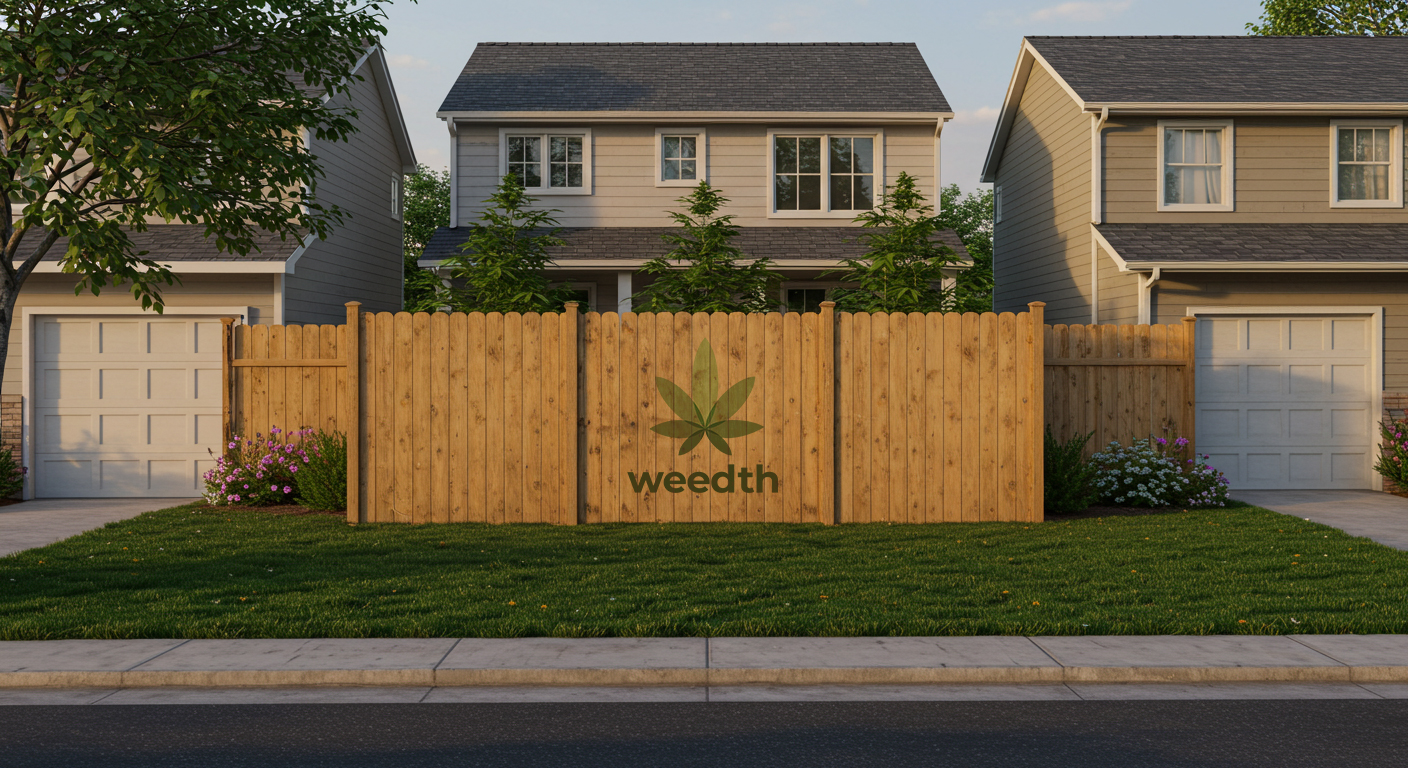
Child- and Pet-Safe Cannabis Garden Design
A cannabis garden can be legal, healthy, and well managed and still be poorly designed for a home shared with children or animals. The plant itself is only one part of the risk. Nutrients, pesticides, pruning tools, irrigation hardware, harvested flower, homemade products, drying branches, open water containers, electrical equipment, and even the way a gate closes can matter just as much.
The safest approach is not to rely on constant supervision. People get distracted. Dogs squeeze through gaps. Cats climb. Children grow tall enough to reach a latch that was out of reach last season. A good garden assumes that somebody will eventually make a mistake and then uses layout, barriers, storage, and routine to keep that mistake from becoming an exposure.
For this resource, child- and pet-safe design means creating layers between the household and the grow. The first layer is choosing the right site. The second is controlling access. The third is storing cannabis and garden products separately from the garden itself. The fourth is checking the system again as the plant, season, children, and animals change.
This page stays tightly focused on that safety procedure. It does not repeat the complete outdoor cultivation process. If you need the broader seasonal, soil, watering, training, and flowering framework, use the complete outdoor cannabis growing guide as the parent resource.
Do not treat cannabis as harmless because it is a plant
Cannabis products should be kept locked and out of sight and reach of children and pets. Cannabis sativa is also listed as toxic to dogs, cats, and horses because of THC exposure. If a child or pet may have consumed cannabis, contact the appropriate medical, poison-control, or veterinary service promptly rather than waiting for symptoms to become severe.
Resource Navigation
In This Resource
- Define the outdoor decision in terms of site, season, climate, legal access, and plant risk
- Measure the site: sun path, shade, temperature, humidity, wind, drainage, water access, cold pockets, or contamination as relevant
- Seasonal timing: latitude, photoperiod, weather windows, and cultivar behavior
- Practical setup/response plan with materials, placement, inspection points, and a backup option
- Failure modes: stagnant air, trapped moisture, heat load, frost, wind damage, water shortage, security, or neighbor impact
- Legal/safety boundary without guessing local rules or recommending dangerous traps
- Pre-season and weekly checklist that turns the article into a repeatable field procedure
Define the outdoor decision in terms of site, season, climate, legal access, and plant risk
The first decision is not which lock to buy. It is whether the garden can be placed where children and animals do not naturally need to go.
If the only sunny spot is directly beside the sandbox, dog run, back door, or path everyone uses to reach the shed, you begin with a conflict. Every later safety measure has to fight against the way the household already uses the space. Sometimes a fence can solve that. Sometimes moving the garden ten or twenty feet solves more than adding hardware.
Walk through the yard as if you were not the grower. Where does a child run when a ball rolls away? Where does the dog patrol the fence line? Where does the cat jump up to look over a wall? Where do visitors walk without asking? Where do delivery people, gardeners, maintenance workers, or utility staff sometimes need access?
Those paths matter because a child- and pet-safe grow works best when the cannabis garden is outside the normal traffic pattern.
Design around access before plant performance
Outdoor growers naturally look for sun first. That is sensible, but this article adds a second filter: the best horticultural location is not automatically the best household location.
Suppose the south side of the garden receives beautiful sun, but it is also where a toddler plays every afternoon. A more distant position with slightly less perfect exposure may become the better overall site if it allows a secure boundary, a locking gate, clear visibility for supervision, and a clean separation between the grow and the family area.
This does not mean sacrificing the plant completely. It means evaluating safety and cultivation together instead of pretending one does not affect the other.
Layered garden safety
Layered safety uses several independent protections instead of relying on one perfect barrier. A safe location, controlled access, locked product storage, clear household rules, and repeated inspection support one another. If one layer fails, another still reduces the chance of exposure.
Separate four different exposure problems
It helps to stop talking about “the cannabis garden” as though everything inside it has the same risk. It does not.
The live plant is one exposure point. Animals may chew leaves or flowers, and children may handle plant material because it looks interesting. Harvested flower and cannabis products are a separate and more concentrated storage problem. Garden chemicals such as pesticides, fertilizers, pH adjusters, cleaning products, and concentrated additives bring their own hazards. Physical garden equipment creates risks such as sharp blades, stakes, hoses, cords, buckets, unstable trellis structures, and gates.
The best design handles each category differently.
A locked garden gate may reduce access to the plant, but it does not make a bottle of concentrated nutrient safe if that bottle is left on a patio table. A locked cabinet can protect garden chemicals, but it does not stop a dog from entering an unfenced bed. A child-resistant package helps with storage, but child-resistant does not mean child-proof.
Remember: Do not ask, “Is my garden fenced?” and stop there. Ask, “Can a child or animal reach the plant, the harvest, the chemicals, the tools, or the water system?” Those are five different questions.
Use real household behavior, not ideal behavior
A safety plan built around “my child knows not to touch it” or “my dog usually listens” is too fragile. Education and training matter, but they are not physical controls.
Young children explore. Dogs may behave differently when bored, stressed, excited, or left alone. A visiting child does not know your household rules. A new puppy has different habits from an older trained dog. A cat may access a location nobody expected because the top of a fence is simply another route.
Design for the behavior you can realistically expect on the busiest day of the season, not for the quiet afternoon when you are standing beside the plant.

My dog has never tried to eat garden plants. Do I still need to keep him away from cannabis?
Question sent by: Ethan Brooks, via email.
Yes. Past behavior is useful information, but it is not a physical barrier. Cannabis is listed as toxic to dogs, and behavior can change when flowers become aromatic, branches fall, pruning waste is left on the ground, or another animal attracts the dog into the area. The safer design is to prevent unsupervised access rather than wait to find out whether your dog is interested.
Legal access and safe access are related, but not identical
Some jurisdictions require cannabis plants to be out of public view, enclosed, locked, inaccessible to minors, or grown only in particular parts of a property. Other places regulate home cultivation differently or prohibit it entirely.
Those legal requirements must be checked locally. Do not assume that a garden is compliant because a friend in another city uses the same setup.
At the same time, compliance should be treated as the floor rather than the complete safety plan. If local law requires a locked enclosure but your dog can dig under it or a child can climb nearby furniture and reach the latch, you still have a design problem even if the gate technically has a lock.
Plant risk changes with size
A seedling inside a container may be easy to keep out of reach. A large late-season plant is another object entirely. Branches can extend beyond the original footprint. Flowers become more aromatic. Supports and ties spread outward. Fallen leaves and broken material become more common. Harvest creates temporary piles of fresh plant material that may leave the secure grow area.
So when you choose the site, imagine the mature canopy, not the small plant you have today.
Measure the site: sun path, shade, temperature, humidity, wind, drainage, water access, cold pockets, or contamination as relevant
A child- and pet-safe garden still has to function as a garden. If safety barriers create deep shade, trap humidity, block drainage, or make watering so inconvenient that the grower starts leaving gates open, the design will eventually work against itself.
This is where measurement helps. We are not measuring for the sake of numbers. We are checking whether the safety layout remains usable.
Map the household before you map the sun
Start with a simple sketch of the outdoor space. Mark the house, doors, paths, play areas, animal areas, gates, sheds, fences, pools or ponds, utility access, and the proposed garden.
Then walk those routes at the times they are normally used. A path that looks quiet at noon may become the main route when children come home from school. A dog may ignore one side of the yard during the day but patrol it every evening.
The garden should ideally sit where access can be controlled without constantly interrupting normal household movement.
Check the sun after the barrier is included
If the grow will use fencing or privacy screening, evaluate the final structure rather than the empty site.
A tall solid fence can cast a long shadow, particularly when the sun is lower in spring or autumn. The exact shadow changes with latitude, season, fence height, and orientation. You do not need a complicated equation to notice the result. Mark the proposed fence line and observe the sun at several times of day.
If the plant would sit in shade for a large part of the useful light window, move the bed farther from the barrier or rethink the enclosure.
This is one reason a secure garden should not automatically mean a small solid box around the plant. Safety, light, and airflow must coexist.
Check for climbable objects around the boundary
Children rarely experience a fence as an engineering drawing. They experience it as something to climb.
Look around the outside of the barrier. Is there a chair, storage box, compost bin, raised planter, rain barrel, wood pile, bicycle, bench, or decorative structure close enough to act as a step?
Then look inside. A trellis can also become a climbing aid. So can a stack of pots.
Move climbable objects away from the access boundary where practical. The purpose is not to make the yard look empty. It is to avoid building a secure gate and then placing a convenient ladder beside it.
Create a clean access zone
Keep the gate and immediate fence line clear enough that the latch, ground gap, hardware, and surrounding area can be inspected easily.
Building a ladder beside the lock
Do not place chairs, bins, stacked pots, trellises, or other climbable objects where they defeat the access barrier you are relying on.
Measure gaps for the animal you actually have
A fence that contains a large calm dog may do nothing for a small terrier. A rigid vertical barrier may stop a dog but not a cat. A puppy may fit through a gap that an adult dog cannot.
Instead of copying a universal fence measurement, inspect the animal’s real behavior and body size. Look at gaps below gates, spaces between fence elements, corners where flexible mesh can lift, and places where soil can be dug away.
If wildlife fencing is also part of the garden design, remember that wildlife exclusion and household pet exclusion may require different details. Solve them separately rather than assuming one barrier automatically solves both.
Watch drainage around gates and fence lines
Safety structures change water movement. Fence footings can divert runoff. A gate threshold can become a shallow dam. A low mesh skirt can trap leaves and soil. A raised edge added to stop digging may also trap irrigation water.
After heavy watering or rain, inspect the secure area. Water should not pool where children or pets might encounter it later, and the cannabis root zone should not remain saturated because the safety barrier altered drainage.
If the garden uses buckets, reservoirs, or storage containers for irrigation, keep them covered or otherwise inaccessible when not in active use. The safer system is one that does not leave open containers of water as permanent garden furniture.
Measure heat inside enclosed areas
A solid fence can create a warm protected pocket. Sometimes that is helpful. Sometimes it becomes excessive.
Place a thermometer where the canopy will actually develop and compare that reading with the open yard during hot afternoons. If the enclosed area consistently runs much hotter, consider whether the barrier is reducing airflow or reflecting heat.
The same applies to pets. A dog should never be expected to remain inside a hot grow enclosure as part of a security plan. The secure cannabis area should be a restricted plant area, not an animal pen.
Humidity and airflow still matter
Late in the season, the inside of a dense canopy may remain wet after the rest of the garden dries. A fully solid enclosure can make that worse if air exchange is poor.
Check the inner canopy after morning dew and after rain. If moisture remains trapped, adjust plant spacing, surrounding vegetation, or barrier design. Do not solve child safety by creating a disease chamber around the flowers.
Field Advice: A safe garden should be easy to inspect from outside and easy for the responsible adult to enter. If the enclosure is so awkward that you start leaving the gate open during watering, pruning, or cleanup, redesign the workflow.
Check water access without creating hose hazards
A hose stretched across a family path is easy to trip over. So is irrigation tubing pulled through a doorway or gate.
Plan the water route so the grow can be irrigated without leaving a long-term trip hazard. Where possible, route irrigation along edges rather than across walking paths. If a hose must cross a path temporarily, put it away after use rather than leaving it as a permanent obstacle.
Drip lines inside the secure area should also be checked for chewing if pets could reach them during supervised access. Damaged lines can create leaks, puddles, and unreliable watering.
Contamination includes more than soil
A child- and pet-safe design should also consider what is applied to the garden.
If pesticides are used, follow the product label exactly, keep children and pets away for the required period, and store the product in its original container. Do not pour chemicals into beverage bottles or unmarked jars. The label is part of the safety system because it carries use, storage, first-aid, and re-entry information.
Fertilizers and pH products deserve the same discipline even when their packaging looks less alarming. Concentrated garden products belong in a locked storage location, not on the ground beside the plant.
I keep nutrients in the locked garden. Is that enough if my kids cannot enter?
Question sent by: Rachel Adams, via contact form.
It is better than leaving them in an open area, but I would still separate chemical storage from the grow itself. A locked cabinet or secure utility storage location keeps the product protected even when the garden gate is open for watering or maintenance. Keep products in their original labeled containers and do not store them with food, animal feed, or household drinks.
Seasonal timing: latitude, photoperiod, weather windows, and cultivar behavior
Safety design changes through the season because the garden does not stay the same size.
Early in the year, a plant may be barely visible. In late flower, it can extend over the barrier, smell much stronger, attract more attention, and create far more pruning and harvest material. Children grow, animals learn routines, and garden furniture moves. A safety system that passed in spring can fail in autumn without anything actually “breaking.”
Spring is the easiest time to correct the layout
Use the early season to test gates, barriers, watering routes, and storage before the plant fills the space.
Open and close the gate while carrying a watering can. Can you latch it with one hand? Does it swing shut reliably? Does the dog rush toward the opening every time? Can a child stand near the gate while you work without being inside the grow?
These ordinary movements reveal more than staring at the hardware.
If the garden needs a different layout, change it now. Moving a container or modifying a fence is easier before stems, support lines, and a large root system make the area crowded.
Summer changes access and heat
By midsummer, foliage expands and the sun angle is different. The barrier may cast less or more useful shade depending on orientation. The inside of an enclosure can also become hotter than expected.
At the same time, children may spend more hours outside and pets may spend more time in the yard. The garden is now both larger and exposed to more household activity.
Recheck the entire access boundary rather than assuming the spring test still applies.
Flowering changes the exposure profile
As photoperiod-sensitive cannabis transitions into flowering, two things become more important for household safety: aroma and plant material.
Flowers may become more noticeable to visitors and neighbors. Sticky plant material may fall during pruning or support work. Broken branches contain more cannabinoid-rich tissue than young vegetative leaves. Harvest is approaching, which means the grower will soon move material from the controlled garden into another part of the property.
This is the moment to confirm the post-harvest safety plan, not the day you cut the plant.
Plan the dark period around safety lighting
Security lights can be useful around a property, but outdoor photoperiod-sensitive cannabis responds to the natural light-dark cycle. A very bright light shining directly on the plant during the night can interfere with normal flowering behavior in some circumstances.
You do not need to make the yard dangerous or completely dark. Instead, position lighting so pathways, gates, and household access remain visible without unnecessarily flooding the canopy all night.
Motion-activated lighting may be a better fit in some situations than continuous intense illumination, but local security needs and electrical safety still come first.
Seasonal safety drift
Seasonal safety drift is the gradual loss of protection as the plant, household, and garden layout change. A gate can stay locked while branches grow over it, a chair moves beside it, a puppy learns to dig, or harvested material begins moving through the house. Rechecking the system prevents those small changes from becoming access failures.
Autoflowering plants compress the timetable
Day-neutral or autoflowering cannabis can reach flowering and harvest much sooner than a full-season photoperiod plant. That can be useful in some climates, but it also means the safety plan needs to be ready from the beginning.
There is less time to say, “I will build the storage cabinet later” or “I will fix that gap before flowering.” The crop can move through developmental stages quickly.
The practical lesson is simple: finish the safety infrastructure before the plant depends on it.
Harvest week deserves its own safety plan
Harvest is when a well-controlled garden can suddenly spread plant material through the property.
Branches may travel from the garden to a drying room. Scissors become sticky and are set down on tables. Trim accumulates. Gloves, bags, stakes, and waste move in and out. Doors may stay open while the grower carries large branches.
If children or pets live in the home, decide the transport route and drying location before cutting begins. Keep harvested cannabis secured and inaccessible, and clean up fallen material rather than leaving it for later.
Is the garden still the main risk once the plants are harvested?
Question sent by: Jason Marshall, via email.
No. After harvest, the risk shifts. Fresh branches, drying flower, trim, stored flower, homemade products, and waste can all leave the fenced growing area. That is why a child- and pet-safe design needs a locked post-harvest storage plan as well as a secure garden. The safe boundary follows the cannabis, not just the soil bed.
Practical setup/response plan with materials, placement, inspection points, and a backup option
The best child- and pet-safe setup is usually straightforward. You are not building a fortress. You are creating a controlled zone that the responsible grower can use easily and everyone else does not enter casually.
Start with a controlled garden boundary
Where children or animals share the outdoor space, a physical boundary is usually the most reliable first layer.
The exact structure depends on local law, the property, the animals involved, and the garden. It may be a fence, a locked enclosure, a separately gated section of the yard, or another compliant barrier.
The boundary should do four things:
- Reduce unsupervised access.
- Remain functional as the plant grows.
- Allow the grower to inspect and maintain the crop without defeating the barrier.
- Avoid creating new horticultural problems such as severe shade, stagnant humidity, or dangerous heat buildup.
Those four conditions are more useful than copying one universal fence design.
Make the gate the strongest part of the routine
Many access systems fail at the gate because that is the part humans operate repeatedly.
A gate can be structurally excellent and still fail if it is frequently left open. Choose a latch or locking method that is appropriate to your legal requirements and household, and make closing it part of every garden visit.
If the gate tends to swing open by itself, fix that. If it sticks and requires both hands while you carry water, fix that too. Convenience matters because inconvenient safety systems get bypassed.
Pro Tip: After every garden task, make “tools away, chemicals locked, gate closed” the final three steps. A short closing routine is easier to remember than a long safety speech.
Create an air gap between the plant and the boundary
Do not let a mature canopy press through the fence where a child, pet, visitor, or neighboring animal can reach it from the other side.
Leave enough interior clearance for branch growth and inspection. The exact distance depends on plant size and training style, but the practical test is simple: if someone outside the secure area can touch the plant without opening the barrier, the boundary is no longer performing its job.
That clearance also improves airflow and makes it easier to inspect both the plant and the fence line.
Use a separate locked chemical-storage point
Garden products should not live on the soil beside the cannabis plant simply because the plant area is fenced.
Use a locked cabinet, shed, or other secure storage location suitable for the product. Keep pesticides in their original containers with the label intact. Follow label storage instructions. Do not store chemicals near food, animal feed, medical supplies, or household drinks.
If you mix a product for use, make only what you need and clean the work area afterward. Never leave a mixed solution in an unlabeled beverage container.
Child-resistant does not mean child-proof
Do not rely on a cap or package alone. Keep pesticides, concentrated nutrients, pH products, and other garden chemicals locked and inaccessible. If a label gives a re-entry period after application, keep children and pets out of the treated area for that period.
Keep cutting tools under adult control
Pruning shears, scissors, knives, wire cutters, stakes, and sharp trellis hardware should not be left inside the garden where a child may enter during an access failure or where an animal can knock them over.
Bring tools in for the task and remove them when you finish. A dedicated toolbox or high locked storage point makes this easy.
The same principle applies to metal plant labels, broken stakes, exposed wire ends, and zip-tie tails. The safest garden is not only chemically safe. It is physically tidy.
Plan irrigation without open containers
Water storage can simplify outdoor growing, but open buckets and reservoirs add a household hazard. Use secure lids or another protected design where water is stored.
Keep hoses and irrigation lines out of common walking paths. Inspect fittings for leaks that create puddles. If a pet likes chewing tubing, keep it behind the garden boundary rather than relying on training alone.
Handle fertilizers and compost carefully around pets
Some animals investigate strong-smelling soil amendments, organic fertilizers, compost, bone-based products, or other garden materials. Even when a product is useful horticulturally, it does not belong where a pet can eat it.
Follow the product label, incorporate materials appropriately, clean spills immediately, and keep bags or containers inaccessible.
Do not assume that “organic” means safe to ingest.
Create a plant-waste routine
Pruning waste should not accumulate on the ground where a dog can chew it or a child can pick it up.
Have a container ready before pruning. Collect removed leaves and branches as you work. Dispose of unwanted cannabis in a way that prevents accidental consumption and follows local waste rules.
After harvest, pay particular attention to trim and broken flower material. The more resinous the material becomes, the more important controlled cleanup becomes.
Make emergency information easy to find
Accidental exposure is exactly the time when nobody wants to search the internet for a phone number.
Save the appropriate local poison-control number, emergency service, veterinarian, and animal poison service in your phone. Make sure other caregivers know where that information is.
If a pet may have consumed cannabis, contact a veterinarian or animal poison service promptly. If a child may have ingested cannabis, contact your local poison-control or emergency medical service according to the situation. Do not delay care because you are embarrassed about the crop.
Should I make my dog vomit if I think he ate cannabis?
Question sent by: MapleGrower, via Facebook page.
Do not improvise a home treatment. Contact your veterinarian or an animal poison service and follow professional instructions. The correct response depends on what was consumed, how much, when it happened, the animal’s size, and current symptoms. The safest garden plan includes knowing whom to call before an exposure happens.
Add one backup when the normal barrier cannot be used
Every secure garden has moments when the gate must stay open: moving a large container, repairing irrigation, bringing in soil, or carrying harvest branches.
Plan for those moments.
The backup may be another adult supervising the yard, temporarily keeping pets indoors, using a second interior door or gate, or scheduling the task when children are not in the outdoor area.
This is a good example of layered safety. You are not expecting the primary barrier to do a job it physically cannot do while open.
Use a simple zone system
For many homes, it helps to think of the property in three zones.
| Zone | Purpose |
|---|---|
| Green zone | Normal family or pet area. No cannabis products, garden chemicals, sharp grow tools, or pruning waste should be left here. |
| Controlled zone | The secured cannabis garden. Access is limited and the plant remains inside the boundary with enough clearance that it cannot be reached from outside. |
| Locked storage zone | Separate secure storage for harvested cannabis, garden chemicals, concentrates, pesticides, sharp tools, and other items that should remain inaccessible even when the garden gate is open. |
This does not require signs around the yard. It is simply a planning method that stops cannabis, tools, and chemicals from gradually migrating into family space.
Failure modes: stagnant air, trapped moisture, heat load, frost, wind damage, water shortage, security, or neighbor impact
A safety system is most useful when you know how it is likely to fail.
The obvious failure is an unlocked gate. The less obvious failures are gradual: a branch grows through the fence, a dog digs under one corner, a storage box is moved beside the latch, a nutrient bottle is left outside after mixing, or harvest waste sits unattended for an hour.
Those are the problems worth checking because they are ordinary enough to happen.
The gate is locked, but the plant grows outside the secure zone
This is one of the easiest failures to miss.
A branch extends through mesh or over the top. Somebody outside the grow can now touch flower material without ever entering the secure area.
Train or support the canopy back inside the controlled zone. If the plant has outgrown the space, modify the enclosure safely rather than continuing to tie branches into an increasingly crowded center.
The dog digs under the fence
If a dog shows digging behavior, inspect the ground line regularly. Look especially at corners, gates, soft recently disturbed soil, and shaded areas where an animal may spend time.
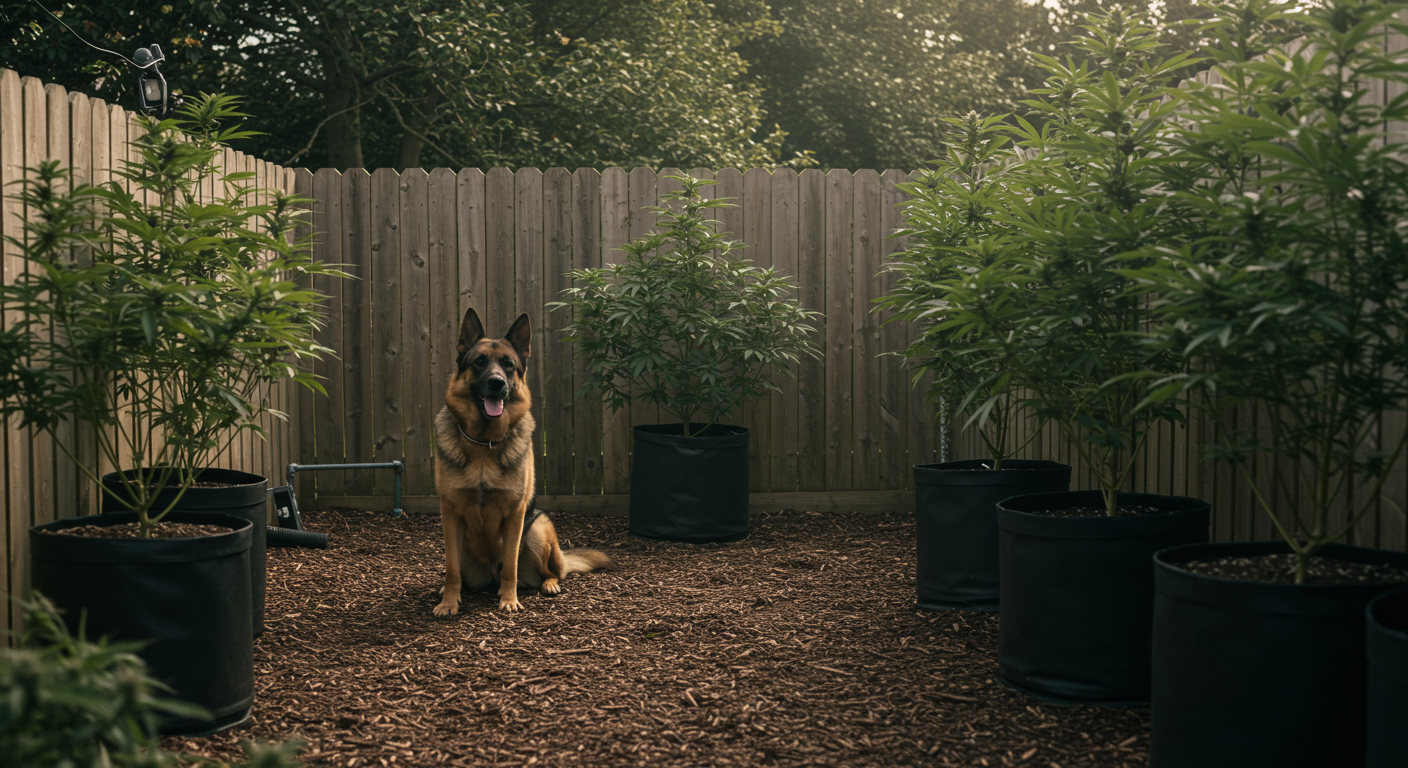
The solution should be humane and compatible with drainage. Do not create hidden sharp barriers or improvised traps below the soil. Use safe physical exclusion appropriate to the animal and the property.
Do not protect the garden with injury-producing traps
Do not use hidden wire, sharp stakes, broken glass, improvised electrification, toxic bait, chemical irritants, spring traps, or other devices intended to hurt a child, animal, visitor, intruder, or wildlife. Use lawful passive barriers and ordinary property security instead.
A child learns the latch
A latch that was inaccessible two months ago may not remain inaccessible. Children grow and learn very quickly.
Test the gate from the outside periodically. Consider the reach of the youngest children who use the property and visiting children as well as your own household.
If local regulations specify the type or location of the lock, follow those rules. Beyond compliance, make sure the mechanism still works for the actual household.
Privacy screening creates stagnant air
A solid screen can keep the plant out of view but also trap humid air. If late-flower foliage remains wet, do not ignore that because the barrier is serving a safety function.
Adjust the layout while preserving access control. Increase spacing between plant and barrier, open safe airflow paths, manage surrounding vegetation, or use a different compliant screening strategy where local rules allow it.
Safety and plant health should support each other.
The enclosure becomes dangerously hot
Small solid enclosures can accumulate heat. This stresses the plant and creates a bad environment for any person or animal that enters.
Do not use the cannabis enclosure as a place to leave a pet while you work elsewhere. A pet should have its own appropriate shade, water, ventilation, and living space separate from the restricted grow.
If the garden repeatedly overheats, change the barrier design or location rather than relying on constant emergency watering.
Wind damages the barrier
A privacy screen can act like a sail. High winds may loosen panels, bend posts, or create gaps.
Inspect the boundary after severe weather, even if the plant looks fine. The garden may remain horticulturally intact while the access-control system has failed.
Repair loose hardware before children or animals return to the area unsupervised.
Water shortage creates unsafe shortcuts
When watering becomes difficult, growers improvise. They may leave a gate propped open while carrying buckets, keep a reservoir uncovered because the lid is inconvenient, or store chemicals beside the hose so they are easier to reach.
These are workflow failures.
Improve the water route so safe practice remains the easy practice. The design should not require you to choose between irrigating the plant and maintaining the access boundary.
Pesticide application and re-entry are forgotten
If a pesticide is used, the label controls how it should be applied and when people or animals can re-enter the treated area.
Do not let a dog back into the garden immediately because the spray looks dry unless the label permits it. Do not assume an “organic” pesticide needs no precautions. Read the instructions each time.
After use, return the product to locked storage immediately.
Harvest material crosses into the family zone
This is a common seasonal failure. The garden itself remains secure, but branches are carried through the patio, trim is left on a table, or finished flower sits in an unlocked drying area.
Create a controlled harvest route. Keep doors closed behind you. Use containers for loose trim. Move finished material directly to secure drying and storage areas.
Neighbor or visitor access changes unexpectedly
A contractor, gardener, utility worker, houseguest, or visiting child can change the safety situation for a day.
If someone needs access near the grow, keep the cannabis zone secured and explain only the safety boundary they need to know. There is no reason for visitors to enter the cultivation area unless their work legitimately requires it and local rules permit it.
My cat can climb almost any fence. Does that make a secure outdoor garden impossible?
Question sent by: Sophie, via X.
Not impossible, but it means a standard vertical fence may not be a complete pet barrier for your household. Treat the cat’s real climbing ability as a design variable. A fully enclosed or otherwise cat-resistant garden may be needed, or the cat may need to be kept out of that part of the property. Do not rely on the fence simply because it works for the dog.
Use the observe, isolate, correct, verify sequence
When you find a safety weakness, resist the urge to add several fixes at once.
First observe exactly what failed. Then isolate the exposure while you correct it. If a gate is not closing, keep children and pets away from the area until it is repaired. If a dog has opened a gap below the fence, do not leave the animal outside unsupervised while you “see whether it happens again.”
Make one clear correction and then test the same failure point under normal use.
A repaired gate should close while you are carrying water. A modified fence should survive normal weather. A relocated chemical cabinet should actually be locked after each use. A new harvest route should keep plant material out of family space.
Verification is what turns a safety intention into a functioning system.
Legal/safety boundary without guessing local rules or recommending dangerous traps
Home-grow laws vary sharply by jurisdiction. Some places allow limited personal cultivation. Some impose enclosure, visibility, locking, age, property, or plant-count requirements. Others prohibit home cultivation altogether.
This resource cannot tell you what is legal at your address, and it should not pretend to.
Check the rule where you actually live
Before building the garden, verify the current law through official sources at every level that can affect the property.
Depending on the jurisdiction, that can include national or federal law, state or provincial rules, municipal bylaws, zoning, fire codes, tenancy agreements, condominium or homeowners’ association rules, and property-specific restrictions.
Health Canada, for example, explicitly advises home growers to follow relevant provincial, territorial, and municipal laws and local bylaws. Other countries use completely different legal structures.
Do not copy a legal setup from another region without checking yours.
Rules about children may be more specific than general garden rules
Some legal frameworks require plants to be inaccessible to minors or secured in a locked area. Others use different language.
If your law specifies an enclosure, lock, visibility requirement, height, location, or access rule, that legal requirement takes priority over a general design recommendation from this article.
Record the source and date when you check it. Cannabis rules change.
Rental and shared-property rules can add another layer
A legal right to cultivate under regional law does not automatically mean a landlord, building, condominium, or shared property allows the same setup.
Balconies, shared gardens, common yards, and multifamily properties create additional problems because children or pets who do not belong to the grower may use the surrounding space.
Do not place a cannabis garden in shared space without clear legal permission and a design that satisfies applicable access rules.
Do not use traps as “security”
Child- and pet-safe design and dangerous traps are fundamentally incompatible.
A barrier should prevent access, not punish it.
Use lawful fencing, gates, locks, ordinary alarms, cameras where legal, lighting, and responsible supervision. Do not use concealed devices designed to injure someone or an animal.
This applies even when theft is a concern. A child, firefighter, utility worker, pet, wildlife animal, or household member can encounter the same hazard.
Use passive access control
Use appropriate fencing, a locking gate, ordinary property security, controlled storage, and clear household routines.
Using pain as a deterrent
Avoid traps, hidden sharp objects, toxic bait, improvised electrification, or any device intended to injure a person or animal.
Keep harvested cannabis locked away
A fenced garden does not solve storage.
Health authorities recommend storing cannabis locked, out of sight, and out of reach of children and pets. Edibles deserve particular caution because they can resemble ordinary food. Homemade products should be clearly labeled and stored separately from normal food and drinks.
If your household uses cannabis products, the locked storage system should exist independently of the grow. Do not leave harvested flower in a garden shed simply because the shed has a door.
Pet exposure deserves a real veterinary response
ASPCA poison-control information lists Cannabis sativa as toxic to dogs, cats, and horses, with THC identified as the toxic principle. Reported signs can include depression, poor coordination, sleepiness or excitation, drooling, altered body temperature, low blood pressure, and more serious neurologic effects.
If exposure is suspected, contact a veterinarian or animal poison-control service promptly. Do not wait for the animal to become severely impaired.
In a child exposure, contact the appropriate local poison-control or emergency medical service. Children can become very ill from THC-containing products, particularly edibles.
Pre-season and weekly checklist that turns the article into a repeatable field procedure
The final step is turning the design into a routine.
You do not need to inspect every screw every morning. What you need is a predictable schedule that catches the changes most likely to defeat your safety layers.
Before the season: perform the access test
Close and lock the garden. Then approach it from the outside as a child, dog, cat, or visitor might.
Can you reach the plant through the barrier? Can you move the bottom edge? Is there a gap at the gate? Are climbable objects nearby? Is the latch easy to reach? Can an animal dig beneath a corner? Does the fence depend on one loose temporary tie?
Correct those weaknesses before planting.
Perform the grower workflow test
Now use the garden as the grower.
Carry water in. Bring tools. Open the gate. Close it. Move around the plant. Reach the back of the bed. Imagine pruning a large branch. Imagine carrying that branch out at harvest.
If the safety system makes normal work unnecessarily difficult, improve the workflow now. You want a design that naturally returns to a safe state after each task.
Perform the chemical-storage test
Open the place where nutrients, pesticides, pH products, and garden chemicals will live.
Are they locked? Are they still in original labeled containers? Are they separated from food and animal feed? Could a leaking bottle contaminate a drain or water source? Do you know where the first-aid instructions are?
Do not wait until you have already bought a collection of products to figure out where they belong.
Perform the harvest-route test
Choose the path from the garden to the drying area.
Can you move branches without passing through a child’s bedroom, pet feeding area, or busy family room? Can the drying location be secured? Is there a place for trim and waste? Can you keep doors closed during the process?
Plan this route while the plant is still small enough that you can think clearly about it.
Child- and Pet-Safe Garden Setup Checklist
- Confirm home cultivation and outdoor placement are legal at the exact property.
- Choose a site outside normal child play areas, pet runs, and household traffic routes where practical.
- Use a compliant physical boundary where children or pets could otherwise access the plants.
- Test the gate, lock, latch, ground gap, corners, and surrounding climbable objects.
- Leave enough clearance that mature branches cannot be reached through or over the boundary.
- Check that the enclosure still provides enough sun and airflow for the plant.
- Confirm that fence lines and thresholds do not trap irrigation or rainwater.
- Route hoses and irrigation lines away from common walking paths.
- Keep water reservoirs and storage containers secure and inaccessible when not in use.
- Store pesticides, nutrients, pH products, and other chemicals separately in a locked location.
- Keep all chemicals in original labeled containers and follow label re-entry instructions.
- Store pruning tools, wire cutters, stakes, and other sharp equipment securely after use.
- Collect pruning waste immediately instead of leaving plant material on the ground.
- Plan a secure route from harvest to drying and locked storage.
- Save local poison-control, emergency, veterinary, and animal poison-service contacts before the season begins.
- Create a backup plan for periods when the primary gate must remain open during maintenance or harvest.
Weekly: inspect the boundary before the plant
Once a week, walk the outside of the enclosure first.
Look for digging, bent mesh, loose hardware, storm damage, soil erosion, objects moved beside the fence, and branches growing through the boundary.
Only then enter and inspect the plant.
This order is useful because you see the safety system from the same side a child or pet would encounter it.
Weekly: inspect the inside as a housekeeping problem
Inside the garden, look for fallen leaves, pruning waste, open containers, tools left behind, damaged irrigation, standing water, loose ties, and sharp hardware.
The safest grow area is usually the tidiest one.
That does not mean sterile. Soil is soil. Leaves fall. Outdoor growing is messy. The difference is that risky materials are not allowed to accumulate.
After every pesticide or chemical application: run a separate check
Do not wait for the weekly routine after chemical use.
Confirm the product is back in locked storage, the treated area is inaccessible for the required period, spills are cleaned according to the label, measuring tools are put away, and household members know not to enter.
If the label specifies personal protective equipment, disposal, or re-entry conditions, follow them exactly.
After storms: inspect access control again
A storm can change the fence even when the cannabis plant survives.
Check posts, gate alignment, mesh tension, privacy panels, locks, and anything that could have fallen against the boundary. Recheck the ground line if heavy rain caused erosion.
Do this before children or animals return to the yard unsupervised.
Before flowering: expand the inspection radius
As the canopy enlarges, look beyond the original garden footprint.
Can a branch now be touched from outside? Is aroma increasing enough that visitors are more likely to notice the garden? Is the plant pressing against a privacy screen? Has airflow decreased? Do you need to move a support before flowers become heavy?
Keep the plant inside the safety design rather than allowing the design to become smaller than the crop.
Before harvest: switch from garden safety to material-control safety
Confirm that the drying area is ready and secure. Confirm that storage containers are available. Prepare a trim-waste container. Put sharp tools where only the responsible adult can access them.
During harvest, do not leave branches unattended in family space.
Once the garden is empty, continue the same safety discipline around drying and stored cannabis. The plant may be gone from the soil, but the exposure risk has moved indoors.
How often should I recheck the garden if the fence already feels solid?
Question sent by: Natalie Brooks, via contact form.
A weekly boundary check is a good practical rhythm during the season, with extra checks after storms, construction, landscaping changes, or whenever you notice new animal behavior. The point is not that a strong fence suddenly becomes weak every seven days. It is that the environment around it changes: soil erodes, furniture moves, branches grow, gates shift, and animals learn.
Use a simple pass, watch, act system
If you like simple field records, use three categories.
Pass: the barrier works, storage is locked, the plant remains inside the boundary, tools are put away, and no new access path is developing.
Watch: a condition is changing but access is still controlled. Examples include a branch approaching the fence, a puppy beginning to dig near one corner, a latch becoming stiff, or a privacy screen beginning to loosen.
Act: access control has failed or a hazardous product is exposed. Examples include an unlocked or broken gate, a branch outside the enclosure, open chemical storage, cannabis material left in family space, or a pet entering the grow.
An “act” condition should be isolated immediately. Do not postpone it to the weekend.
Verify every correction under normal use
After repairing a problem, recreate the situation that exposed it.
If you changed the latch, open and close the gate while carrying water. If you blocked a digging gap, observe the dog near the area again under supervision. If you moved a climbing object, walk around the boundary and check whether another route now exists. If you changed the irrigation path, use it and confirm that the hose is no longer left across the family walkway.
This is the final principle behind a child- and pet-safe cannabis garden: do not assume a correction works because it looks better. Test the real behavior.
Design for the household you have, not the garden you imagine
A safe cannabis garden is not defined by one fence height, one lock, or one perfect product. It is defined by whether the household can live around it without routine access to the plant or the materials used to grow it.
If there are children, build for curiosity. If there is a dog, build for digging and chewing if those behaviors are realistic. If there is a cat, assume vertical access may be different from a dog’s. If grandparents, babysitters, gardeners, or visitors use the property, make the boundary obvious and the safe routine easy to explain.
Then keep cannabis products and chemicals locked separately even when the outdoor garden itself is secure.
That combination gives you something much stronger than a fence. It gives you a system that continues protecting the household when somebody forgets, the season changes, or the plant becomes larger than expected.
Share this article
A quick overview of the topics covered in this article.
Follow us
Latest articles
October 24, 2026
October 24, 2026
October 24, 2026
October 24, 2026
