
How Much Space Does One Cannabis Plant Need?
In controlled environment agriculture and indoor craft cannabis cultivation, spatial planning is the primary physical constraint governing lighting efficiency, airflow dynamics, plant health, and harvest yield. When setting up a new grow tent or dedicating a spare room to horticulture, novice cultivators frequently ask how much space a single cannabis plant requires. The answer, however, is not a fixed universal constant; rather, the spatial footprint of a cannabis plant is a dynamic physical variable dictated by container volume, vegetative training style, genetic morphology, and available vertical headroom.
Left entirely untrained in a five-gallon container of rich organic soil, a single photoperiod cannabis plant will naturally express its evolutionary apical dominance: growing into a narrow, pyramidal, Christmas-tree-like structure occupying approximately two feet by two feet of horizontal floor space while stretching four to six feet in vertical height. Conversely, that exact same genetic clone subjected to intensive high-stress and low-stress training (topping, super-cropping, and horizontal screen-of-green trellising) can be manipulated to fill a massive four-foot by four-foot (sixteen square feet) horizontal canopy plane while remaining under thirty inches in height.
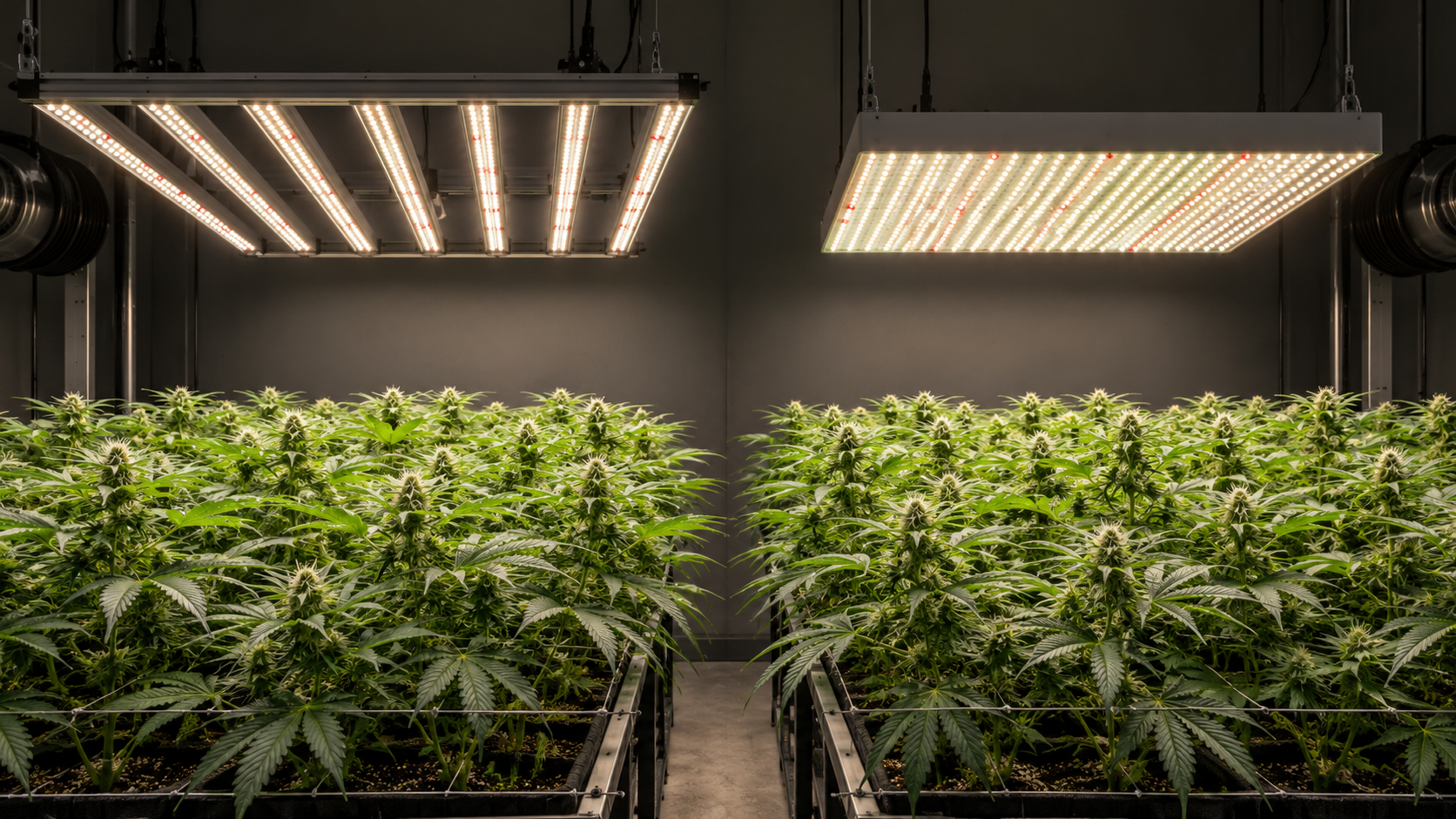
Furthermore, cultivators must view spatial allocation as a three-dimensional volume rather than a two-dimensional floor measurement. A common beginner catastrophe is budgeting adequate horizontal floor area inside a grow tent while completely ignoring vertical head clearance. Once you subtract the physical height of the drainage saucer, the nursery container, the minimum hanging distance required by high-intensity LED fixtures, and the overhead space occupied by carbon filters and inline fans, an apparently spacious six-foot-tall grow tent provides only three to four feet of usable vertical plant growth space.
Minimum, Comfortable, and High-Yield Footprint Per Cannabis Plant
Failing to Budget Adequate Spatial Buffers Results
Failing to budget adequate spatial buffers results in severe canopy overcrowding: foliage presses tightly against reflective tent walls, creating stagnant microclimatic pockets of high humidity where powdery mildew and botrytis flourish. Lower branches become completely starved of photosynthetically active radiation (PAR), producing loose, unmarketable undergrowth (larf) that drains metabolic energy away from upper colas. In this comprehensive engineering guide, we dissect the biological, mechanical, and architectural parameters governing single-plant spatial allocation, providing exact footprint equations, container sizing ratios, and tent layout blueprints for indoor and outdoor growers.
The Photonic Inverse-Square Law and Vertical Headroom Budget
Vertical spatial budgeting must account for the physical laws of light attenuation. According to the inverse-square law, photon irradiance decays exponentially with distance from point-source and bar-style luminaires. In an indoor grow tent, your total vertical height must be mathematically divided into four non-negotiable operational zones: (1) Container and Saucer Height (12 to 16 inches); (2) Maximum Plant Canopy Height (24 to 48 inches); (3) Optimal Fixture Hanging Clearance (12 to 24 inches of clearance between LED diodes and top colas to prevent thermal leaf bleaching); and (4) Ceiling Ventilation and Filter Equipment (12 to 16 inches occupied by overhead carbon filters, fan mounts, and ducting). In a standard 72-inch (6-foot) tall tent, the true maximum allowable plant height is strictly limited to 28 to 36 inches from substrate surface to apical tips.
Understanding the Vertical Headroom Budget Fundamentally Reshapes
Understanding the vertical headroom budget fundamentally reshapes how a cultivator approaches vegetative duration and plant training. Photoperiod cannabis varieties undergo a dramatic hormonal transformation when switched from an 18/6 vegetative schedule to a 12/12 flowering regime. During the initial three weeks of bloom, known as the flowering stretch, stem cells elongate rapidly under elevated gibberellin synthesis, causing the plant to double or even triple in vertical height before vegetative elongation ceases.
“Can I grow a single photoperiod cannabis plant inside a 2×2-foot tent that is only 48 inches tall if I top it early?”
Question sent by: Gavin Pemberton, via contact form.
You can, but a 48-inch ceiling leaves a razor-thin vertical margin once you subtract 10 inches for a container and riser, 6 inches for the top-mounted LED board, and 12 inches of minimum photon clearance. That leaves barely 20 inches for the entire mature plant architecture.
To succeed in a 4-foot-tall tent, use a wide, shallow 3-gallon fabric pot, top the main stem at the fourth node, anchor lateral branches flat to the pot rim, and flip to 12/12 when the vegetative canopy is no more than 8 to 10 inches tall.
A novice cultivator who allows an untrained photoperiod plant to reach thirty inches in height before initiating the 12/12 flip will inevitably watch in horror as the plant explodes to sixty or seventy inches by week four of bloom. The upper colas will grow directly into the LED diodes, suffering severe photon bleaching, chlorosis, and heat desiccation, while the lower two-thirds of the plant is plunged into deep shade. To prevent this, indoor growers must initiate flowering when plants reach approximately forty to fifty percent of their maximum allowable final vertical height.
Vertical Headroom Budget: Pot Height, Canopy Stretch, and LED Hang Distance
Physical Plant Training Techniques
Physical plant training techniques provide total architectural sovereignty over this vertical expansion. By implementing low-stress training (LST) and lateral trellising early in vegetative growth, growers redirect auxins from the dominant apical shoot into dormant lateral branches. This transforms a naturally tall, columnar plant into a broad, multi-topped bush, allowing a single plant to efficiently capture every photon delivered by a horizontal lighting grid without outgrowing vertical headroom.
Screen of Green (SCROG) Space Efficiency: One Plant vs. Multiple Plants
A foundational tenet of modern indoor agronomy is that total harvest yield per square foot is governed by photosynthetic light interception across a uniform canopy plane, not by the sheer number of plant stems protruding from the soil. A single vigorous photoperiod plant vegged for seven to eight weeks beneath a horizontal Screen of Green (SCROG) nylon mesh can be trained to fill a complete 4×4-foot (16 square feet) canopy, producing 30 to 40 identical, evenly spaced colas yielding 16 to 24 ounces of premium dry flower. Conversely, packing four smaller plants into that same 4×4 tent vegged for only three to four weeks produces virtually the exact same 16 to 24 ounces of total yield. One plant requires more vegetative time but significantly lower seed costs and simplified irrigation, whereas four plants save three weeks of vegetative electricity at the expense of higher plant counts and crowded maintenance.
The Operational Trade-off between Plant Count
The operational trade-off between plant count and vegetative training time highlights why single-plant spatial planning is so crucial. Cultivators operating under strict regional plant-count limits (such as state laws permitting only one or two mature plants per adult) can achieve commercial-scale harvest yields from a single plant simply by providing adequate horizontal footprint and extending vegetative growth. When granted sufficient root volume and vegetative training, a single cannabis plant has virtually limitless horizontal expansion potential.
“Why do the leaves touching my reflective Mylar tent walls develop wet patches and rust-colored necrotic spots?”
Question sent by: OkanaganSunGrown, via contact form.
When fan leaves press flat against cold Mylar tent walls, boundary-layer airflow drops to zero and transpired water vapor condenses directly into liquid water films between the leaf cuticle and the fabric. Under high-intensity LEDs, those trapped moisture pockets disrupt local calcium transport and invite foliar fungal colonization.
Maintain a 3- to 4-inch open perimeter air channel between your outer branch tips and the tent walls so vertical air currents can sweep transpired moisture upward toward the exhaust intake.
In contrast, commercial Sea of Green (SOG) setups operate on the opposite end of the spatial spectrum. In an SOG configuration, cultivators deploy multiple small clones packed tightly together, allocating as little as one square foot (12×12 inches) of floor space per plant in small one-gallon containers. Flipped to flowering after only seven to ten days of vegetative rooting, these single-stem plants produce a single dominant cola without lateral branching. While SOG maximizes harvest turnover speed, it requires managing dozens of containers, making it legally impractical for home growers subject to plant-count restrictions.
How Container Volume and Root Mass Control Horizontal Canopy Spread
For Home Hobbyists and Craft Cultivators Seeking
For home hobbyists and craft cultivators seeking the optimal balance between labor efficiency, legal compliance, and yield, allocating between four and nine square feet (a 2×2 to 3×3-foot area) per individual plant represents the ideal golden mean. This spatial footprint allows the plant to develop robust lateral branching, facilitates comfortable physical access for defoliation and watering, and ensures excellent airflow penetration through the inner canopy.
The Primary Physical Governor of Single-plant Spatial Expansion
Beyond training techniques, the primary physical governor of single-plant spatial expansion is subterranean container volume. Plant root systems and above-ground vegetative canopies exist in a constant biological state of allometric balance. Plant roots synthesize cytokinins, phytohormones that travel upward through vascular xylem tissue to stimulate lateral shoot branching and leaf expansion. In return, mature leaves synthesize auxins that move downward to promote new root tip development.
“How much extra floor space do I need outside or inside the tent for a dehumidifier and irrigation reservoir?”
Question sent by: Gavin Gillingham, via email.
Plan for at least 4 to 6 square feet of dedicated utility floor space outside the grow tent rather than placing bulky appliances on the tent floor. A 35- to 50-pint compressor dehumidifier placed inside a small 3×3 tent consumes 20 percent of the plant footprint and dumps sensible waste heat directly onto adjacent lower branches.
Conditioning the lung room outside the tent keeps your entire interior floor footprint available for root containers and allows incoming air to enter at a stable temperature and vapor pressure deficit.
When container volume is restricted, root growth slows as root tips encounter container boundaries. As root density peaks within a confined volume, cytokinin production declines, signaling the above-ground meristems to restrict lateral branch elongation. In a compact one-gallon nursery container, root confinement naturally limits maximum canopy spread to approximately 12 to 16 inches in diameter, regardless of how long the plant is maintained in vegetative growth.
SCROG vs. Untrained Canopy Space Efficiency for Single Plants
Transplanting That Same Plant into a 5-gallon
Conversely, transplanting that same plant into a 5-gallon, 7-gallon, or 10-gallon fabric container provides expansive root volume, allowing the root system to build a massive capillary network capable of supporting a vast canopy spread of three to four feet in diameter. Fabric aeration pots (such as Smart Pots or Root Pouch containers) dramatically improve spatial root efficiency through natural air pruning: when root tips reach the breathable porous fabric wall, exposure to dry air dehydrates the root tip, triggering prolific secondary root branching rather than the destructive root circling typical of smooth plastic containers.
Field Advice: Root-to-Shoot Allometry: Substrate Volume Determines Canopy Spread. In soilless and containerized living soil cultivation, the relationship between container size and horizontal canopy spread follows established agronomic allometric ratios. As a reliable operational benchmark: (1) A 1-gallon container supports a 1×1-foot canopy footprint (ideal for SOG setups); (2) A 2-to-3-gallon container supports a 2×2-foot canopy footprint (standard for small grow tents and autoflowers); (3) A 5-to-7-gallon container supports a 3×3-foot to 4×4-foot canopy footprint (optimal for medium-to-large indoor SCROG setups); and (4) A 15-to-30-gallon fabric bed supports a 5×5-foot or larger canopy (common in living soil no-till systems and outdoor gardens). Matching container volume to your available grow tent dimensions prevents either under-utilizing valuable footprint or suffering severe root-bound stress during late flowering.
Selecting the Appropriate Container Volume
Selecting the appropriate container volume requires evaluating your watering frequency capabilities alongside your spatial targets. Smaller containers (such as two-gallon pots filled with high-porosity coconut coir) dry out rapidly, requiring automated high-frequency fertigation three to five times daily. This delivers massive growth rates in a compact footprint because the root zone is continually refreshed with oxygenated nutrient solution. Larger containers (such as seven-gallon soil pots) hold substantial moisture reserves, requiring watering only once every three to four days, providing a wider buffer against operational errors at the expense of floor space. Furthermore, container geometry influences vertical root development: tall, narrow pots encourage a deeper vertical taproot and upright growth, whereas wide, shallow squat pots encourage expansive horizontal lateral root branching that directly mirrors and supports a broad, wide-spreading horizontal SCROG canopy.
Autoflowering cannabis cultivars present unique spatial considerations due to their fixed chronological lifecycle. Because day-neutral ruderalis genetics begin flowering automatically around day twenty-one to twenty-eight post-germination, the plant possesses a finite window for vegetative canopy expansion. An autoflower rarely achieves the massive four-foot spread of an extended photoperiod plant; instead, most modern autoflowering hybrids naturally occupy between 1.5×1.5 feet and 2×2 feet of horizontal space, reaching twenty-four to thirty-six inches in height.
Perimeter Airflow Clearance and Microclimate Boundary-Layer Protection
Planting a Single Autoflower Inside a Spacious
Consequently, planting a single autoflower inside a spacious 4×4-foot grow tent results in severely wasted light and floor footprint. To achieve maximum space efficiency with autoflowers, cultivators typically deploy four plants in three-gallon fabric containers inside a 3×3 tent, or four to six plants inside a 4×4 tent, ensuring that the light footprint delivered by the overhead fixture is completely intercepted by photosynthetic leaf area.
“Can I grow a single high-yielding cannabis plant in a small 2×2-foot grow tent with a 5-foot ceiling?”
Question sent by: Gavin Ashworth, via email.
Yes, you can absolutely cultivate an exceptional, high-yielding cannabis crop with a single plant inside a 2×2-foot grow tent with a 5-foot (60-inch) ceiling, but you must strictly engineer your vertical headroom and training protocol. In a 60-inch-tall tent, your vertical budget is extremely tight: subtract 12 inches for your 3-gallon pot and saucer, 14 inches for your LED light fixture and hanging ratchets, and 14 inches for safe light-to-canopy clearance, leaving you with precisely 20 inches of total usable plant height.
To succeed without burning your colas, you should execute three mandatory techniques: (1) Top your plant early above the third or fourth node to break apical dominance; (2) Install a horizontal SCROG trellis screen 10 inches above the pot rim, weaving lateral branches outward to fill the entire 24×24-inch floor footprint horizontally before flipping to bloom; and (3) Flip your lighting to a 12/12 photoperiod after no more than four weeks of vegetative growth, or select a compact Indica-dominant or dwarf autoflower cultivar with minimal flowering stretch. Managed properly, this single-plant 2×2 setup will produce 4 to 8 ounces of dense, boutique-grade dry flower.
Calvins Inquiry Illustrates the Fundamental Challenge
Calvin’s inquiry illustrates the fundamental challenge of micro-growing and compact tent cultivation. When floor space and vertical ceiling height are constrained, the cultivator must proactively dictate plant architecture rather than allowing genetics to dictate growth form. The horizontal SCROG screen acts as an architectural boundary, converting vertical upward surge into horizontal outward spread.
Single-Plant Space Allocation Matrix by Tent Size and Grow Style
To Assist Growers in Configuring Standard Hobby
To assist growers in configuring standard hobby tent footprints, the following operational matrix details the optimal balance between tent dimensions, recommended plant counts, container sizing, and required LED lighting capacity.
| Tent Footprint | Total Floor Area | Single Plant Strategy | Multi-Plant Strategy | Recommended Pot Size | Target LED Wattage |
|---|---|---|---|---|---|
| 2×2 Feet (60×60 cm) | 4 sq ft (0.36 m²) | 1 Plant (Full SCROG canopy fill) | Not Recommended (Overcrowding) | 3 to 5 Gallon | 100 – 150 Watts |
| 3×3 Feet (90×90 cm) | 9 sq ft (0.81 m²) | 1 Large Plant (Extended 6-week veg) | 2 to 4 Plants (Moderate 3-week veg) | 5 to 7 Gallon (Single) / 3 Gal (Multi) | 240 – 320 Watts |
| 4×4 Feet (120×120 cm) | 16 sq ft (1.44 m²) | 1 Massive Plant (Extended 8-week SCROG) | 4 Plants (Optimal commercial balance) | 7 to 10 Gal (Single) / 5 Gal (Multi) | 480 – 650 Watts |
| 5×5 Feet (150×150 cm) | 25 sq ft (2.25 m²) | Not Efficient (Requires 10+ week veg) | 4 to 9 Plants (Even grid distribution) | 5 to 7 Gallon | 650 – 1000 Watts |
| Outdoor Raised Bed | 36 – 100 sq ft (3.3 – 9.3 m²) | 1 Massive Tree (Full summer season) | Spaced 6 to 8 feet on center | 30 to 100+ Gallon / Native Soil | Natural Solar Radiation |
While maximizing canopy coverage across your tent footprint is essential for high yield, cultivators must never commit the error of packing foliage so tightly that leaves press firmly against the reflective Mylar tent walls. Maintaining an intentional perimeter air buffer around the entire circumference of the plant is one of the most vital secrets of professional indoor crop health.
When dense fan leaves make continuous physical contact with cold tent walls, transpiration dynamics break down. Water vapor transpired through foliar stomata becomes trapped against the non-porous Mylar surface, causing localized relative humidity to reach 100 percent saturation. Droplets of condensed water accumulate along leaf margins and tent walls, creating the ideal germination environment for airborne fungal spores such as powdery mildew (Podosphaera macularis) and Botrytis cinerea.
Furthermore, leaves pushed tightly against tent walls curl, fold, and overlap, shading adjacent foliage and restricting internal air movement. Stagnant microclimatic air pockets develop within the lower canopy where carbon dioxide levels become depleted, severely slowing photosynthetic Calvin-cycle activity. To prevent these localized failures, growers must enforce the 4-inch perimeter air buffer rule throughout the entire flowering cycle. Additionally, compressed foliage traps sensible heat radiating from high-intensity fixtures, elevating localized leaf temperatures well above ambient room air. This localized thermal stress causes stomata to close defensively, shutting down transpirational cooling and inducing leaf margin canoeing even when the central tent temperature appears optimal.
Remember: The 4-Inch Perimeter Air Buffer Rule: Protecting Boundary Layer Dynamics. In all indoor cultivation tents, maintain an unbroken 4-inch (10-centimeter) perimeter air buffer between the outermost leaf margins and the interior reflective walls. This empty spatial corridor serves two critical agronomic functions: (1) Aerodynamic Boundary Layer Stripping: It allows upward convective airflow generated by lower intake louvers and oscillating fans to sweep smoothly up the sides of the tent, continuously evacuating transpired moisture and heat; and (2) Photonic Cross-Reflection: Highly reflective 600D Diamond Mylar requires several inches of distance to bounce diffuse photons back into lower lateral colas. If leaves touch the wall, they block reflection, creating dead zones of total shadow. Prune, tuck, or tie back any lateral branches that breach this 4-inch perimeter zone.
Enforcing This Perimeter Buffer
Enforcing this perimeter buffer requires regular, disciplined canopy maintenance. During the second and third weeks of flowering, after the initial vertical stretch concludes, cultivators should execute a systematic defoliation pass commonly known as lollipopping or lower canopy pruning. Remove all small, spindly undergrowth, shaded sucker branches, and lower fan leaves occupying the bottom third of the plant.
Stripping away this unproductive undergrowth eliminates loose, fluffy larf buds before they can develop, redirecting vital transpirational pressure, mineral nutrients, and carbohydrates directly into the top colas positioned in the high-PAR zone. Furthermore, clearing the lower third of the plant opens expansive, unobstructed air corridors beneath the canopy, allowing floor-level circulation fans to push fresh, carbon-dioxide-rich air upward through the root zone and inner foliage.
In Outdoor Cultivation, Spatial Requirements Expand Dramatically.
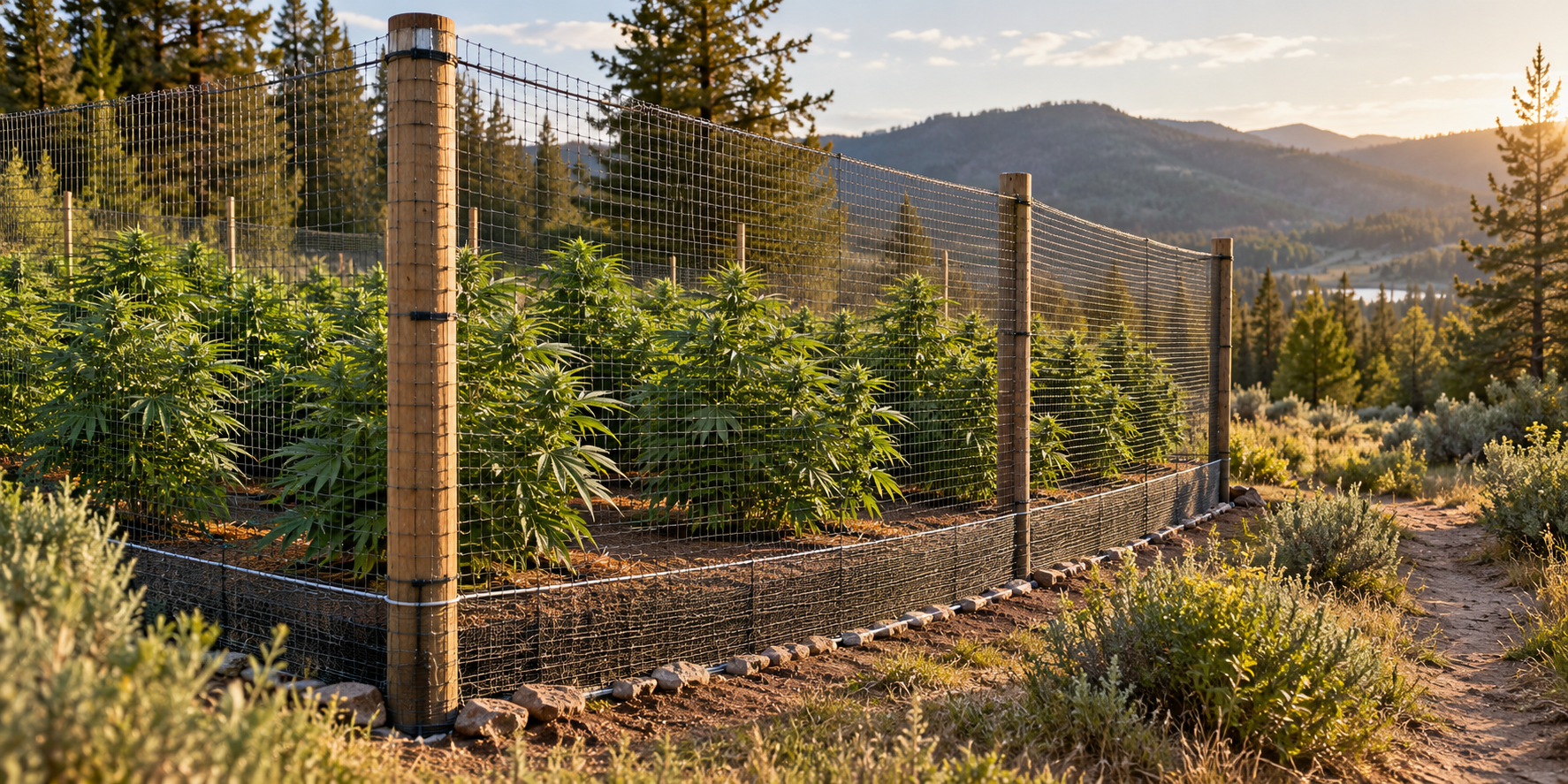
In outdoor cultivation, spatial requirements expand dramatically. Under unrestricted natural sunlight and planted into native living soil or large 100-gallon fabric smart pots, a single cannabis plant has virtually zero root-zone or photonic boundaries. Fueled by 50 to 60 moles of daily solar DLI and a deep subterranean taproot, a single photoperiod plant vegged from April through July can easily reach eight to ten feet in height and eight to ten feet in horizontal diameter, yielding between three and eight pounds of dry flower.
Outdoor cultivators must space plants at least six to eight feet apart on center. Crowding outdoor plants creates a catastrophic moisture trap during late autumn rains: dense, touching canopies prevent wind from penetrating the interior branches, allowing morning dew and rainwater to linger for hours inside heavy colas and triggering widespread gray mold epidemics. Generous outdoor spacing also allows full 360-degree sunlight penetration as the sun arcs across the southern sky, ensuring uniform flower development on all quadrants of the plant.
Furthermore, wide outdoor spacing provides essential physical access for season-long garden maintenance. As outdoor plants expand during the July stretch, growers must be able to walk completely around each plant with backpack sprayers to apply biological pest controls (such as Bacillus thuringiensis) and inspect internal branch forks for stem borer entry holes. Staking each outdoor plant with an engineered wire cage or heavy-duty bamboo teepee framework prevents massive outer branches from snapping under the heavy weight of autumn rain and dense floral mass.
Pre-Planting Space and Clearance Verification Checklist
Before transplanting seedlings into final containers or commissioning your grow tent, verify that your physical layout satisfies this comprehensive spatial and headroom audit checklist.
Field Verification Checklist
- Total Vertical Headroom Budgeted: Subtract container height (12-16 in), light clearance (12-18 in), and ceiling exhaust gear (12-16 in) from total tent height to calculate true usable plant space.
- Substrate Container Sized to Footprint: Match pot volume to target canopy spread (3-gal for 2×2 ft, 5-gal for 3×3 ft, 7-10 gal for 4×4 ft single-plant SCROG).
- Flowering Stretch Factor Anticipated: Plan to initiate 12/12 photoperiod flip when vegetative canopy reaches 40 to 50 percent of maximum allowable vertical height.
- 4-Inch Perimeter Buffer Maintained: Verify that lateral branches and fan leaves maintain an unbroken 4-inch gap from all reflective Mylar tent walls.
- Circulation Fan Corridor Established: Position oscillating fans to sweep unobstructed airflow both above the canopy and beneath the cleared lower lollipopped stems.
- Comfortable Physical Access Verified: Confirm that you can comfortably reach the back corners of the container and trellis screen for watering, runoff testing, and defoliation without damaging stems.
Managing the physical transition between these developmental milestones requires synchronizing your container volume with plant vegetative age. Prematurely potting a tiny seedling into a massive 10-gallon container creates vast zones of stagnant, cold, uncolonized substrate that dry out sluggishly, inviting anaerobic root rot. Conversely, delaying container up-potting leads to root-bound circling that permanently suppresses lateral canopy branching.
As the plant transitions into the intensive flowering stretch, cultivators must adjust LED luminaire heights daily. Raising fixtures in synchronized increments ensures that apical meristems receive consistent target photon flux densities (between 700 and 900 micromoles per square meter per second) without experiencing photobleaching. Installing a secondary horizontal trellis layer twelve inches above your initial SCROG screen provides essential structural scaffolding, holding heavy floral colas perfectly vertical as calyxes swell during late bloom.
To assist with chronological planning, the following timeline calendar outlines the progressive space requirements of a single cannabis plant across each successive developmental life stage.
| Developmental Life Stage | Chronological Window | Physical Plant Dimensions | Required Spatial Footprint | Primary Canopy Action |
|---|---|---|---|---|
| Seedling Stage | Weeks 1 – 2 | Height: 2 – 4 in | Width: 2 – 4 in | 0.5 x 0.5 Feet (Propagation Dome) | Gentle low-intensity lighting (200 PPFD); protect fragile taproot. |
| Early Vegetative | Weeks 3 – 4 | Height: 6 – 10 in | Width: 8 – 12 in | 1.5 x 1.5 Feet (1-Quart to 1-Gal Pot) | Transplant into nursery container; top apical shoot above 4th node. |
| Mid Vegetative (Training) | Weeks 5 – 6 | Height: 12 – 18 in | Width: 18 – 24 in | 2.0 x 2.0 Feet (Final 5-Gal Pot) | Install horizontal SCROG trellis screen; begin low-stress lateral training. |
| Late Vegetative (Full Fill) | Weeks 7 – 8 | Height: 18 – 24 in | Width: 30 – 36 in | 3.0 x 3.0 to 4.0 x 4.0 Feet | Tuck shoots beneath screen to fill 75% of trellis; initiate 12/12 flip. |
| Flowering Stretch | Weeks 9 – 11 (Bloom 1-3) | Height: 28 – 36 in | Width: 36 – 48 in | Full Tent Footprint (4×4 Feet) | Continue tucking runaway shoots; lollipop lower third; enforce perimeter buffer. |
| Floral Bulking & Ripening | Weeks 12 – 17 (Bloom 4-9) | Height: 32 – 40 in (Fixed) | Colas Swell | Full Tent Footprint (Rigid Colas) | Support heavy colas with secondary trellis netting; maximize airflow. |
Mastering single-plant spatial allocation transforms indoor cannabis cultivation from a chaotic, overgrown battle against tent zippers into an orderly, highly productive agricultural science. When each plant is granted exactly the volume of root substrate, vertical headroom, horizontal photon distribution, and perimeter airflow it requires, the plant responds with synchronized vigor, outstanding calyx density, and exceptional harvest yields.
By respecting the physical dimensions of your cultivation environment and deploying proactive training techniques like topping and SCROG trellising, you extract the absolute maximum productivity from every square inch of your garden. Whether cultivating in a modest 2×2 micro-tent or engineering a multi-tent craft facility, intelligent spatial design is the foundational framework upon which connoisseur-quality cannabis is consistently grown. Forward-thinking cultivators evaluate spatial efficiency through the metric of volumetric yield: calculating grams produced per cubic foot of cultivation volume rather than simple square footage alone. By fully utilizing vertical headroom while maintaining generous perimeter air corridors, you achieve maximum resource efficiency while protecting your crop from mold, heat stress, and light degradation cycle after cycle.
Scientific References
- Bernstein, N., Gorelick, J., Zerahia, R., & Koch, S. (2019). Impact of environmental conditions on secondary metabolite production in Cannabis sativa L. Industrial Crops and Products, 139, 111467.
- Bugbee, B. (2016). Toward an optimal spectral quality for plant growth and development: The importance of green light and far-red radiation. Acta Horticulturae, 1134, 1-12.
- Eaves, J., Eaves, O., & Chandra, S. (2020). The economics of indoor cannabis cultivation: Energy, labor, and production efficiency. Agricultural and Resource Economics Review, 49(3), 478-498.
- Handreck, K. A., & Black, N. D. (2002). Growing Media for Ornamental Plants and Turf (3rd ed.). UNSW Press, Sydney, Australia.
- Poorter, H., & Sack, L. (2012). Pitfalls and possibilities in the analysis of plant allocation: Allometric equations and biomass allocation. Frontiers in Plant Science, 3, 259.
- Taiz, L., Zeiger, E., Møller, I. M., & Murphy, A. (2015). Plant Physiology and Development (6th ed.). Sinauer Associates, Sunderland, MA.
- Zheng, Y. (Ed.). (2021). Handbook of Cannabis Production in Controlled Environments. CRC Press, Boca Raton, FL.
Share this article
A quick overview of the topics covered in this article.
Follow us
Latest articles
November 7, 2026
November 7, 2026
November 7, 2026

November 7, 2026
