
Wet Trim vs Dry Trim for Outdoor Cannabis
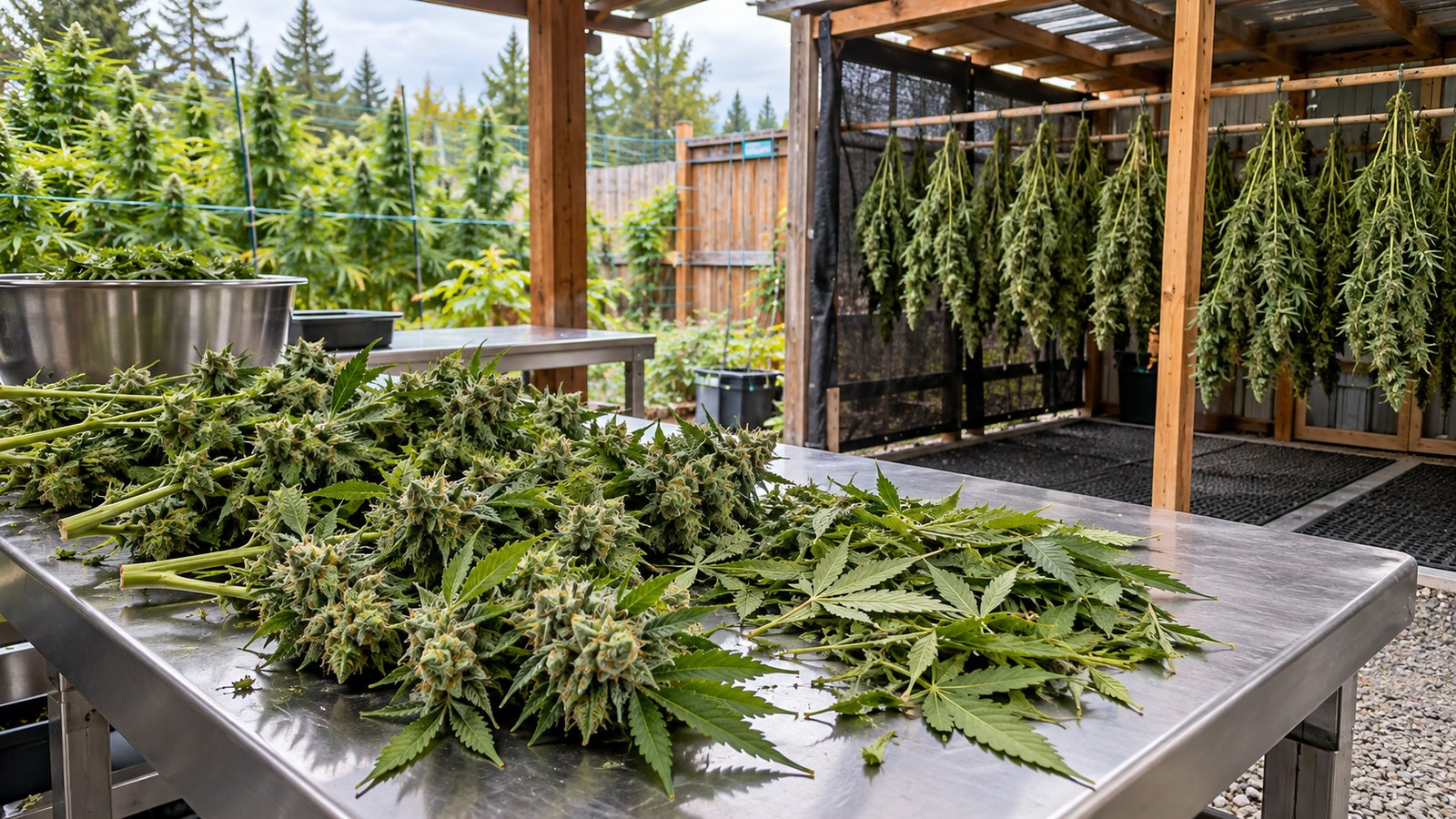
An outdoor harvest can arrive at the trimming table in very different conditions. One batch may have dry, open flowers and a controlled drying room ready to receive it. Another may have dense colas, rain-wetted outer leaves and a room already working at capacity. Choosing whether to remove the small flower leaves before or after drying changes surface exposure, handling, labor and the way the batch must be monitored. It cannot repair a contaminated flower or make an unsuitable drying space safe.
Choose wet trimming when a clean harvest needs a manageable pre-drying reduction in leaf material and the receiving system can prevent rapid surface drying. Choose dry trimming when the clean flowers can hang or dry with retained leaves without creating crowded, slow-drying pockets, and the room can support a later trimming pass. A selective partial trim is a valid third option when neither extreme fits the batch. The choice belongs to the specific lot and drying conditions, not a rule about outdoor cannabis always needing one technique.
This comparison concerns when small leaves around otherwise sound flowers are removed. It does not decide whether to harvest before rain, whether to cut a whole plant or individual branches, or when to jar or cure. For the broader outdoor sequence, see the outdoor growing guide. For drying-environment fundamentals rather than trim timing, see the drying rule explained, while treating its numerical rules of thumb as starting concepts rather than universal release criteria. Cultivate and process cannabis only where permitted, using the hygiene, testing and disposal rules applicable to the operation.
Define Wet Trim, Dry Trim, and the Quality Decision
Wet trimming removes most selected flower-adjacent leaves shortly after harvest, before the main drying period. Dry trimming leaves those smaller leaves attached while the material dries and removes them afterward. Both methods should begin with a separate quality and sanitation decision: contaminated, visibly decaying or otherwise suspect material must be isolated rather than hidden inside a clean lot. The timing label does not say whether a flower was hand trimmed or machine trimmed, hung on a branch or spread on a rack, or dried with good moisture control.
Separate trimming time from drying configuration
A grower can lightly wet trim individual branches and hang them, or retain the small leaves on detached flowers placed on trays. In an industrial operation, wet trimming may mean a mechanical machine followed by rack drying, while dry trimming may occur after intact stems have hung. Those bundled practices cannot be compared as if timing were the only changed variable. Write down three decisions separately: leaf removal time, drying configuration and degree of physical handling. Without that distinction, an apparent advantage of dry trim might actually come from hanging on stems or avoiding a machine.
Large fan leaves that obscure inspection or are damaged are not the same as resin-bearing sugar leaves embedded in otherwise sound flowers. Many growers remove selected large leaves before drying in both approaches. A complete wet manicure, a light wet trim and a dry trim with some large leaves removed are different treatments. State precisely which tissue stays on the flower, rather than using a broad label to describe several operations.
Three distinct decisions
Trim timing: remove small leaves before or after drying. Trim extent: remove outer tips, most exposed leaves or all selected visible leaves. Drying format: whole plant, separate stems/branches or detached flowers on trays. The best comparison changes one of these at a time.
Define success before the scissors come out
Decide whether the batch is being evaluated for sound, usable flower, aroma, chemical composition, manageable labor or consistent finished appearance. These goals overlap but are not identical. A more manicured wet-trimmed flower may look finished sooner but require more manipulation while fresh. A leafier hanging branch may keep exposed surfaces from drying too quickly yet increase the amount of plant material the room must accommodate. Neither observation proves that a final cured product will taste better.
Use comparable finished outcomes: sound dry flower weight excluding stalks and discarded leaves, trimming hours, rejected flower mass, appropriately measured moisture or water activity, and laboratory chemistry or microbiology where available. A wet-trimmed batch weighs less immediately after cutting because it contains less leaf; this is not evidence of a lower cannabinoid yield. A dry-trimmed branch weighs more before final manicuring because the leaves and stem are still present. Comparing those two fresh weights would answer the wrong question.
Remember: Choose a trim method for the batch you can safely dry and inspect. A method that looks attractive on the trimming table can fail if it overwhelms the room receiving the flowers.
There is no single quality winner across all outcomes
Controlled chemistry and microbial studies offer valuable clues but do not supply a universal wet-versus-dry champion. One cannabis study found different chemical outcomes for a mild wet trim and a post-dry trim. Another found different microbial counts between two commercial handling systems in which trimming time, machinery and drying format changed together. Those are distinct experimental questions. The practical decision must account for the cleanliness of the incoming material and the ability to move water out of the lot without excessive heat, damage or delay.
Inspect the Outdoor Harvest and Drying Space Before Choosing
The first useful inspection happens before any branch is placed in a pile. Outdoor flowers may carry dust, insects, rainwater, wounded leaves or internal decay despite similar appearance from a distance. The drying room can also be more limiting than the plant: an excellent harvest becomes difficult to handle if branches overlap or the room cannot remove the incoming moisture load. Inspect both sides of that equation.
Sort clean, questionable, and rejected material at intake
Label harvested plants or branch groups with a lot identifier and note whether the flowers were dry at cutting, visibly wet from weather, bruised or exposed to questionable water. Assess upper, sheltered and dense interior flowers. Look for unusual brown tissue spreading inside a flower, fuzzy growth, collapsed areas and musty or otherwise suspicious odors. A single brown pistil or normally ageing exposed sugar leaf is not by itself a diagnosis; examine surrounding bracts and the direction of change without crushing or shaking suspect flowers.
Do not trim moldy flowers into a clean batch. Keep suspect material separate, limit agitation and follow the applicable diagnostic, laboratory and disposal procedure. If the site experienced contaminated flooding or chemical exposure, trimming cannot remove an unknown hazard from flower tissues. Do not rely on rinsing, drying, curing, extraction or a second trim to make visibly moldy or contaminated flowers suitable for consumption.
Warning: A faster dry is not a salvage method.
Wet trimming can expose leaf surfaces and change moisture removal, but it cannot reverse established rot, validate an untested batch or guarantee destruction of toxins. Address the material disposition decision before optimizing appearance or aroma.
Record the outdoor moisture history without turning rain into a diagnosis
Document recent rainfall, dew, persistent humidity, sheltered canopy wetness, and whether the flowers themselves were still visibly wet when harvested. A weather app icon does not report the conditions inside a dense inflorescence. Outdoor flowers can be externally dry while interior tissue remains damp, and a wet surface does not automatically mean Botrytis is present. Check representative intact flowers with minimal disturbance and recheck anything that had a different exposure history.
If the crop is still attached after a storm, the post-storm inspection guide covers the whole-plant assessment. This page begins at the clean harvest intake and asks whether timing of small-leaf removal can be matched safely to the receiving system. Avoid retelling the complete rain-versus-harvest calculation here.
Match flower architecture to the available room, not a strain label
Compact flowers, large bract clusters and dense sugar-leaf pockets may have a different drying pattern from open, thin flowers. A large cola with several overlapping branches is also different from a detached small flower. Evaluate actual size, density, leaf abundance and access to sheltered surfaces. The labels indica, sativa and hybrid do not quantify retained moisture or establish a safe trim method. Two plants sold under the same name may require different drying positions after different weather histories.
Separate high-risk flower groups from naturally airy and already drier material so inspection and drying adjustments remain possible. A dry-trim plan on one clean branch group does not require treating every branch in the harvest the same way. Sorting prevents the wettest flower from setting the exposure of a smaller, already drier batch.
Check the real receiving capacity
Walk through the drying space before harvest is complete. Is there a place for each hanging branch where flowers will not touch a wall, floor or another plant? Are trays food- or crop-appropriate, clean and arranged to prevent thick piles? Are humidity and temperature measurements available in several representative positions? Can the room remove the additional moisture without creating stagnant areas or blowing air directly onto sensitive flowers? Is there enough labor to finish a wet trim without leaving harvested plants waiting in warm heaps?
A meter in the center of the room tells you about the air near that instrument, not the sheltered interior of a dense hanging cluster. Use actual room behavior and flower checks together. The familiar 60/60 rule is a discussion aid for drying design, not a validated guarantee that all flower surfaces are safe at one reading. Water activity, where appropriately measured on representative equilibrated material, gives a different kind of information from ambient relative humidity.
“Rain stopped yesterday, and my outdoor colas look dry on the surface. Should I wet trim all of them to prevent mold?”
Question sent by: Ethan Brooks, via email.
No automatic trim decision follows from yesterday’s weather. Inspect sound and suspect flowers separately, note which areas are still wet, and verify that the drying space can handle the incoming crop. A light pre-dry trim may make selected leaves easier to remove, but visible internal decay calls for isolation and disposition, not faster manicuring.
Compare What Each Method Changes and What Research Actually Shows
Trimming changes exposed leaf surfaces, contact events and processing sequence. Its effect cannot be understood without the drying environment, the time the flowers spend in it and what is being measured at the end. Research helps identify plausible tradeoffs, but unusually specific laboratory conditions should not become universal outdoor handling instructions.
Wet trimming can reduce attached leaf material but add fresh-tissue handling
Wet trimming takes place while leaves and stems remain flexible, making small leaves easier to reach and reducing the foliage entering the drying room. More exposed flower surfaces may lose moisture differently, and completely removing leaves can change drying rate and ease inspection. However, fresh tissue is also wounded and manipulated during the initial handling period, and a rushed manicure may squeeze bracts or transfer material from one lot to another. Less foliage does not mean no moisture risk in the interior of the remaining flower.
Plan for what has been exposed. Small detached flowers laid on racks can lose moisture faster than the same flowers on stems, but that change may reflect separation and tray arrangement as much as trimming. If room air is already dry or warm, a heavily wet-manicured batch can become externally brittle before larger flowers have equilibrated. Avoid compensating for poor workflow by placing the fresh flowers in thick layers.
Dry trimming reduces the first manipulation pass but carries foliage through drying
Dry trimming leaves selected sugar leaves on the flower until drying has progressed. Keeping the material on intact branches may reduce early direct flower handling, preserve an inspectable branch identity and make it easier to hang without individual bud contact. Retained leaves may influence moisture movement and shield some surfaces, but excess attached foliage can also overlap, close around flowers as it shrinks, and make interior inspection harder. If the room is overcrowded, waiting to trim can turn a manageable harvest into a patchwork of damp pockets.
The later trimming pass has its own cost. Dried leaf tips can crumble and handling can detach trichome heads, especially with aggressive equipment. Do not assert that all dry trimming is gentler or harsher than all wet trimming. Tool type, worker technique, degree of manicure and material dryness matter. A dry-trim label alone provides none of those details.
What the 2024 direct trimming experiment actually tested
A peer-reviewed 2024 experiment examined the Gen12 medicinal cannabis chemovar under controlled-atmosphere drying conditions. Its three groups received a mild wet trim, an aggressive wet trim or post-dry trimming; the study standardized final trimming appearance before analysis. Mild wet trimming gave the highest measured total cannabinoid concentration in the tested comparison, while post-dry trimming yielded higher concentrations for most of the measured mono- and sesquiterpenes. Individual compounds differed, and the researchers explicitly noted the need to test additional chemovars.
These are concentrations in particular laboratory samples, not evidence that mild wet trimming creates more total saleable flower or that dry trimming always tastes better. The experiment used one genetic material and a specialized very-low-humidity controlled atmosphere, not a representative range of outdoor weather histories and ordinary drying rooms. Proposed stress or precursor-transfer explanations are hypotheses, not a reason to deliberately wound a crop. Its useful message is that trim timing and extent can matter chemically and that different quality metrics may favor different treatments under the tested conditions.
What the microbial research can and cannot isolate
A 2023 study collected thousands of samples across a commercial greenhouse operation to investigate total yeast and mold (TYM). In one comparison, wet-trimmed, mechanically handled flowers dried on racks showed higher TYM counts than material dried on hanging stems and trimmed afterward. The researchers also observed that microbial levels on hanging material could rise early in drying before declining as moisture was removed. None of the compared samples should be interpreted as guaranteed sterile.
Crucially, the compared systems differed in trim timing, machine use, flower detachment and drying configuration. The study cannot assign all of the measured difference to whether a leaf was cut before or after drying. TYM measures a broad cultivable population and does not by itself identify every hazardous organism or prove that a particular sample is safe to consume. The operational lesson is to minimize unnecessary injury and contamination opportunities, control drying and use appropriate batch testing, not to treat dry trim as a microbiological clearance certificate.
Outdoor-grown drying research is relevant but answers a different question
A 2026 industrial-scale experiment used outdoor-grown cannabis harvested in Quebec and compared tray with hang air-drying systems. Tray drying showed faster moisture removal than conventional hanging under that facility’s conditions. The comparison involved the drying format and harvest moisture history, not a clean experiment isolating wet versus dry leaf trimming. It reinforces why changing stems, spacing and receiving system together makes trim-time conclusions unreliable. Neither a six-day observation nor a facility’s climate settings should become a universal finish date.
| Decision factor | Wet trim or light pre-trim | Dry trim |
|---|---|---|
| Incoming leaf mass | Reduces selected foliage before drying; requires fresh-tissue handling. | Retains selected small leaves during drying; later removal remains necessary. |
| Drying configuration | Works with hanging or racks; cannot predict rate without format and room. | Works with hanging or racks; stem and flower spacing still govern moisture escape. |
| Room already dries too fast | Heavy wet manicure may add rapid surface exposure; consider less aggressive handling. | Leaf retention may be reasonable if clean and adequately spaced; verify interior conditions. |
| Room struggles with moisture | May reduce foliage but cannot compensate for overloaded or stagnant space. | Retained leaves need careful spacing and rechecks; do not crowd material to slow it. |
| Trichome and aroma claims | One-chemovar study favored mild wet trim for measured cannabinoid concentration. | The same study favored post-dry trim for most measured terpenes; no universal flavor winner. |
| Microbial outcome | One commercial system had higher TYM; machinery and rack drying were confounded. | The compared hanging system had lower TYM; neither method guarantees safety. |
| Labor and traceability | More work at intake; less finishing work later if sufficiently manicured. | Shorter first pass; later trim requires keeping lots identifiable and staff available. |
Field Advice: Record trim timing, trim extent, dry format and handling method as separate fields. A single “wet” or “dry” checkbox cannot explain why two batches differ.
Choose a Full, Partial, or Post-Dry Trim and Run the Workflow
A repeatable process begins with a condition assessment and ends with a documented receiving position. Select the least complicated workflow that keeps sound lots separate, allows moisture to leave uniformly and avoids unnecessary flower contact. The following method is a decision procedure, not a claim that one cut pattern is biologically optimal for every cultivar.
Step 1: establish lot identity and a clean receiving path
Label plants or branch groups before mixing material. Clear and clean work surfaces, containers, hangers, scissors and drying positions according to the site’s sanitation procedure. Arrange a separate path for waste and suspect material. Set up racks or hanging locations and confirm the room has environmental monitoring and space for inspection. If fresh flowers must wait while a large crew finishes cutting, the workflow is already too large for the receiving system; reduce batch size rather than stacking warm, damp plant material.
Step 2: sample representative flowers and decide by lot
Inspect outer, central, dense and airy flowers from each distinct lot. Note rain exposure, visible residual water, leaf abundance, contact damage and any suspicious tissue. Identify materials that must be isolated or rejected. For remaining sound flower, check whether large fan leaves obscure access and whether smaller sugar leaves are strongly interlocked with the bracts. Avoid forcing a deep manicure through dense flower tissue merely because an infographic defines wet trim as removing every leaf.
Step 3A: use wet trim only when the room can accept exposed flowers
Remove appropriate large leaves and the selected visible flower leaves using clean, sharp tools and light support of the branch rather than repeated squeezing of the flower itself. Work by lot and maintain clear hand, tool and surface hygiene. Avoid cutting into bracts, tugging on embedded leaves or creating unnecessary wounds. Transfer material immediately into its planned drying position. Space small flowers on suitable breathable trays without overlapping and inspect every exposed side; if hanging, keep branches separated and retain branch identity.
Check the first drying response rather than walking away because the trim is complete. If thin material becomes brittle while thick material remains damp, segregate by size and address the actual air or tray arrangement. Do not increase humidity blindly if any lot already shows signs of microbial deterioration. A clean, rapid drying procedure and an uncontrolled quick dry are not the same operation.
Step 3B: use dry trim only when retained foliage remains inspectable
Remove damaged or obstructive large fan leaves as needed for condition and access. Hang sound branches with space between flowers and enough clearance to inspect sheltered sides. Keep leaves from sealing multiple wet flowers together. Avoid assuming that a branch protected by foliage must be safe because it dries slowly; gently inspect representative interiors without tearing apart every flower. Reposition or separate overly crowded branches when observation shows the initial layout prevents adequate moisture removal.
When the lot meets the operation’s independently verified drying endpoint, remove remaining selected sugar leaves with minimal contact. An arbitrary day count or a brittle fan leaf is not enough to establish that the flower core is ready for packaging. Maintain lot separation through finishing and collect trim in a way that does not contaminate flower. Do not recover dust, floor debris or suspect cuttings as consumable product.
Step 3C: a partial trim can be more precise than either extreme
A partial approach removes larger or visibly obstructive leaves before drying while retaining some intact sugar leaves for later finishing. It can also use different treatment groups within one harvest when clean flower architecture and moisture differ markedly. This is not permission to intermingle rejected and clean flowers; sorting happens first. Write exactly what was removed at intake and what will be removed afterward so the method remains reproducible.
Partial trimming may help a grower who needs early inspection access but wishes to avoid a complete fresh manicure. Its benefit is plausible operational flexibility, not a scientifically validated universal compromise. Avoid claiming that half of every sugar leaf should always be removed. The mild-wet treatment in a published trial was a specific research treatment, not a general trimming prescription.
Do: Set a batch size your clean receiving space can accept, distinguish trim timing from hanging or tray format, and inspect the outcome after placement.
Avoid: Cutting the full harvest first and deciding where to put it afterward, or using a wet trim to conceal questionable tissue.
Step 4: record the first response and adjust one operational variable
Record the start time, initial flower condition, trim extent, hanging or rack position, initial room readings and any unusually wet or compact flowers. Recheck representative locations early enough to detect crowding and uneven moisture loss before the batch reaches its end state. If one rack dries quickly but the center of a hanging cluster remains damp, make a targeted spacing or placement correction and record it. Avoid simultaneously changing trim, airflow, temperature and room humidity, then crediting an unexplained outcome to one method.
“My outdoor flowers are clean, but the drying room is already close to full. Would wet trimming let me squeeze the rest in?”
Question sent by: Julia Schneider, via contact form.
Removing leaves does not create reliable room capacity if the flowers must still overlap or the environment cannot manage the water load. Process a smaller identifiable lot, create a properly monitored second receiving space or adjust the harvest schedule where feasible. Do not turn overcrowding into a trim-method decision.
Recognize Mold, Uneven Drying, and Misleading Rules of Thumb
Most mistakes occur when a visible convenience is treated as a biological outcome. A neat wet-trimmed bud is not necessarily uniformly dry; an intact dry-trimmed branch is not necessarily preserving terpenes; a clean-looking lot is not necessarily free from hazardous fungi. Identify the specific failure before changing the method.
Look-alike: crisp outer tissue with damp flower interiors
Exposed surfaces can dry before the center of a compact flower. A crisp edge or an easily snapping thin stem does not prove uniform internal moisture. The opposite also occurs: a flexible leaf can remain attached after a neighboring small flower is already very dry. Use a representative sampling plan and, where possible, an appropriate moisture or water-activity measurement on equilibrated representative material. Compare lots and sample locations under the same protocol. Do not seal bulk material on the assumption that one sample describes every dense cola.
Failure: slow dry is automatically described as flavor preservation
Leaving leaves on can alter exposure and the observed rate of drying, but longer is not automatically better. Dense overlapping plant material may retain moisture and favor microbial problems. Likewise, dry trimming after an excessively prolonged process cannot restore volatile compounds that were already lost or make established contamination disappear. The useful endpoint is sound, reasonably uniform material within a controlled operation, not a trophy number of drying days.
Failure: wet trimming is marketed as automatic mold prevention
Removing foliage may improve visibility and change the drying arrangement, but a wet-trimmed flower remains biologically wet and vulnerable if crowded. Fresh wounds and repeated contact may introduce additional contamination opportunities. A study that compared mechanically wet-trimmed, rack-dried buds with stem-hung, post-trimmed buds cannot isolate leaf-cut timing; presenting the microbial difference as a universal rule would mislead readers. A sound intake sort, adequate drying, sanitation and relevant testing are still required for either method.
Failure: dry trim always protects the trichomes
Retaining leaves can reduce some direct early flower handling, yet rough finishing of dry material may dislodge trichome heads. Cannabis microscopy research found more intact glands after hand trimming than after mechanical trimming in a particular genotype and comparison. That speaks to handling method and intensity, not proof that every wet hand trim is better than every dry machine trim or vice versa. Use stable supports, sharp clean tools and minimal contact through both passes.
Failure: one number from a sensor is treated as a safe product release
Room RH and temperature describe the air at a location and time. Flower water activity is a different measurement; it reflects the availability of water in the sampled material after the appropriate measurement procedure. Moisture percentage is yet another quantity. These are related but not interchangeable. If safety or legal release depends on water activity, microbial testing or other specifications, follow the applicable method, representative sampling and validated limits rather than estimating them from a room display or an online rule.
Even low water activity does not remove pre-existing mycotoxins or certify that contaminated material is safe. A passing total yeast-and-mold number also has method and pathogen limitations. Document the measurement method, lot and sampling location, and escalate suspicious tissue for appropriate evaluation. Do not recommend smoking, vaping, processing or blending visibly moldy material.
Warning: Disposition comes before quality optimization.
Visible mold, progressive internal rot, chemical contamination or floodwater contact are not flavor problems. Keep suspect material away from sound lots, limit agitation and follow applicable testing and disposal requirements. Neither a quick dry nor a later manicure validates it.
What to do when the problem is the room, not the trim
If unrelated branches from both trim groups are drying unevenly at the same end of a room, inspect sensor placement, airflow distribution, crowding and the capacity to remove moisture before blaming either method. If only thick flowers fail while small flowers dry appropriately, stratify by flower size and position. If the problem tracks a particular outdoor plant with damaged tissue, return to material quality and diagnostic questions. The pattern often distinguishes process failure from a trim-timing effect better than a one-day subjective aroma comparison.
Do: Trace each symptom to its lot, flower class, intake history, position and measuring method; remove suspect material from the clean workflow.
Avoid: Adding heat, strong direct fans, humidity packs, washing or cosmetic trimming to disguise progressive decay or compensate for untested storage readiness.
Verify Drying Progress, Handling Loss, and Final Lot Quality
A trim decision is a testable hypothesis only when the grower measures the right outcome and keeps other influences visible. The goal is not to turn a single harvest into a scientific trial, but to avoid mistaking freshness, stem mass or room variation for a trim advantage. Record comparable clean lots, then see whether the outcome matches the original aim.
Compare like with like rather than mixing entire harvest totals
Where the harvest is large enough for a useful comparison, select sound branch groups with similar cultivar, flower size, harvest timing and weather exposure. Assign distinct identifiers to wet, partial and dry treatments. Keep the same drying format, room region and handling intensity where feasible if the goal is to isolate trim timing; otherwise explicitly mark the combined method being compared. An observational split cannot remove every difference between branches. For a causal claim, properly replicated randomized work and reliable analytical endpoints are needed.
Keep labor records as well as chemistry notes. Measure time spent at intake, time spent at finishing and the number of additional handling events. Final dry, usable flower weight must be measured on the same defined basis after all intended trimming and after rejection of unsuitable material. If the grower counts untrimmed sugar leaves as finished flower in only one group, the weight comparison is biased.
Follow representative positions throughout drying
Establish at least a map rather than a universal sample count: position groups for thick and thin flowers, sheltered and exposed locations, hanging and rack configurations, and every separate harvest date. Use consistent temperature and RH recording, note when equipment cycles or doors open and measure suspected hot or damp spots independently. Recheck the actual flower group instead of taking a new convenient sample each time. A sharp decline in overall room RH can coexist with a sheltered pocket that remains moist.
When product specifications require instrumental moisture or water activity, use an appropriate calibrated device or validated laboratory method and a sampling protocol that represents the lot. Do not infer water activity directly from air RH at an arbitrary time. For legal commercial products, the release decision may also require microbiology and other compliance testing. This article does not supply a universal aw, RH, temperature, microbial or drying-day threshold suitable for every product and jurisdiction.
Track handling loss and trim contamination honestly
Record obvious flower abrasion, dust accumulation, gland detachment visible under consistent magnification where useful, dropped material and rejected trim. Compare on the same basis, not by selectively photographing the least damaged bud. Maintain a clean waste stream and label what leaves the finished flower category. A machine may offer throughput but also impose abrasion; a slow hand trim may be gentler but still damage material if workers repeatedly squeeze flowers or use dirty scissors.
Use chemical and microbial results for what they actually measure
If laboratory analysis is available, compare separately reported terpene compounds, cannabinoid concentration and defined total usable flower mass. A difference in percentage does not automatically represent more total cannabinoids in the harvest, and an elevated single terpene does not prove a superior sensory experience. For microbial results, distinguish broad total yeast-and-mold counts from species-specific assays, and note the required test protocol and legal acceptance criteria. A batch may be visibly clean yet fail appropriate testing; a familiar aroma does not prove release readiness.
| What happened | Possible explanation | Next check |
|---|---|---|
| Small wet-trimmed buds feel brittle; large ones are still damp | Size-dependent drying or overly exposed small material | Separate size groups; verify representative interior material and room pattern. |
| Dry-trimmed branches look leafy and retain wet pockets | Crowding, foliage overlap, dense flower microclimate | Reinspect sound interiors, increase physical separation and verify conditions. |
| Both methods develop the same damp side of the room | Room distribution or receiving-capacity problem | Compare sensor locations, spacing and equipment response. |
| One group has more broken glands or leaf dust | Handling intensity, machine contact or excessive dryness | Compare standardized hand/machine operations and dryness at trimming. |
| A lot has musty odor or spreading tissue breakdown | Potential contamination or decay, not cosmetic trim failure | Isolate; follow diagnostic, testing and disposal procedures. |
| One method seems heavier immediately after cutting | Different retained leaf and stem mass | Compare defined finished, sound dry flower weight after uniform final trim. |
| A laboratory result differs but no other variables were controlled | Cultivar, flower position, environmental or drying-format confounding | Review paired lot design and assay basis before causal attribution. |
Make the next-cycle adjustment narrowly
Suppose the wet-trimmed small buds became excessively dry while similarly sized dry-trimmed samples reached a more uniform endpoint. Do not immediately declare dry trimming the winner for every future harvest. Review whether the wet group was detached, spread on a different rack, exposed to stronger air or handled for longer before placement. Repeat a controlled comparison with one change at a time when feasible. Conversely, if retained leaves repeatedly create uninspectable damp clusters, change spacing or trim extent and verify that the problem resolves.
“My dry-trimmed batch smells stronger than last season’s wet-trimmed flowers. Does that prove dry trimming preserves terpenes?”
Question sent by: Liam Foster, via Facebook page.
No. The comparison also changes season, incoming crop, weather, cultivar expression and possibly drying conditions. Record subjective aroma as an observation, then compare matched material under similar conditions and use compound-specific laboratory testing if a chemical claim is needed. A study on one chemovar cannot validate every personal crop comparison.
Make the Final Trim Decision With a Repeatable Checklist
The decision is conditional rather than ideological. If sound flowers arrive with many obstructive leaves and the room has the capacity to dry exposed surfaces gently, a wet or light pre-trim can simplify intake and improve inspection access. If clean flowers can remain separated and visible on stems and the room supports a monitored drying process, dry trimming may be a practical choice when later labor is available. If conditions differ among branches, a labeled partial strategy is more informative than forcing every flower through an identical workflow.
The strongest reason to stop is not a preference for wet or dry trimming but an unresolved safety or capacity problem. A grower should not cut more than the receiving system can handle, process suspect flowers alongside clean ones or package material simply because a calendar says the trim is due. The next action must follow direct observation and the appropriate sampling or testing method.
- Confirm cultivation, handling and disposal are lawful for the site and operation.
- Sort and identify clean, suspect and rejected material before either trimming process.
- Document flower density, recent outdoor wetness, damage and leaf abundance by lot.
- Check whether the receiving room has real space, moisture-removal capacity and several inspection positions.
- Select wet, partial or dry timing and separately record hanging versus tray format and hand versus machine method.
- Use clean tools and a predictable receiving path without piles or repeated flower contact.
- Record intake timing and first drying observations, then recheck the same representative flower classes and positions.
- Use appropriate moisture, water-activity and compliance testing where the product specification requires them.
- Compare final sound dry flower, discarded material, labor and quality results on the same basis.
- Escalate suspicious mold or contamination; never use a trim method as a safety clearance procedure.
Keep the record small enough that it will actually be repeated: lot, trim time and extent, drying format, handling method, initial condition, room position, verified endpoint, discarded amount and final quality observations. This turns a strongly held trimming preference into a decision supported by the next harvest, without claiming that one set of conditions determines every future crop.
Educational content. Always follow applicable cultivation laws and safety requirements.
Share this article
A quick overview of the topics covered in this article.
Follow us
Latest articles
October 11, 2026
October 11, 2026
October 11, 2026
October 11, 2026