Living Soil Moisture Management: Soil Water Potential, Microbial Respiration, and Capillary Irrigation
In biological cannabis horticulture, living soil represents a complete philosophical and agronomic departure from inert soilless hydroponics. In coco coir or stone wool rockwool, irrigation serves primarily as a vehicle for delivering dissolved mineral ions directly to bare root surfaces under aggressive wetting and drying cycles. In living soil systems, the cultivator is not feeding the plant directly: the cultivator is maintaining an underground aerobic bio-reactor composed of billions of beneficial bacteria, actinomycetes, saprophytic fungi, mycorrhizal hyphae, protozoa, nematodes, and epigeic earthworms. This diverse subterranean web, collectively known as the soil food web, relies entirely on continuous capillary moisture films to move, metabolize organic amendments, cycle organic nitrogen, and solubilize phosphorus into plant-available orthophosphate forms. When living soil is subjected to the deep 20% to 30% dry-backs common in commercial hydroponic crop steering, delicate fungal filaments desiccate, aerobic bacteria enter dormant spore states, earthworms retreat into estivation, and nutrient mineralization grinds to a complete halt. Conversely, heavy, soaking irrigations that flood the soil profile displace gaseous pore space, pushing the rhizosphere into anaerobic fermentation that produces phytotoxic hydrogen sulfide and root-rotting pathogens. Mastering living soil moisture management requires maintaining an unwavering steady-state capillary plateau governed by strict soil water potential metrics. This comprehensive guide details the biophysical mechanisms, instrumentation protocols, and automated delivery systems necessary to optimize living soil hydration, linking seamlessly with our foundational resources on watering cannabis in soil, cannabis dry-back and VWC targets, and cannabis watering frequency and volume.
Physical and Biological Baseline: Soil Water Potential, Matric Suction, and the Soil Food Web
To operate a living soil bed effectively, cultivators must understand the thermodynamic relationship between moisture films and subterranean biological activity:
- Matric Potential (Ψm) in Organic Soil: Matric potential quantifies the physical tension by which soil aggregates, compost humus, and peat fibers cling to water molecules. Expressed in negative hydrostatic pressure units of kilopascals (kPa) or centibars (1 cbar = 1 kPa), matric potential determines the energy expenditure required for both plant roots and soil bacteria to extract water. In a living soil bed at ideal field capacity, matric tension measures between -8 kPa and -15 kPa (-8 to -15 cbar). At this optimal tension, capillary water forms a contiguous, microscopic film across soil particles without blocking macroscopic aeration channels.
- Microbial Motility and Aquatic Thin Films: Bacteria and protozoa do not walk or fly through soil: they are aquatic organisms that swim through continuous capillary water films coating soil aggregates. Flagellated beneficial bacteria (such as Bacillus subtilis and Pseudomonas putida) require a minimum water film thickness of 1.5 micrometers to navigate the rhizosphere, colonize root exudation zones, and deliver solubilized nutrients. When matric tension falls below -30 kPa (drying soil), water films break into isolated, disconnected droplets, halting bacterial motility and suppressing enzyme secretion.
- The Rhizosphere Priming Effect and Exudate Transport: Cannabis roots invest up to 20% to 30% of their daily photosynthetically fixed carbon into the root zone as carbon-rich exudates (simple sugars, amino acids, malic acid, and citric acid). In living soil, these exudates serve as chemical signals and energy fuel for native mycorrhizosphere bacteria. Under steady capillary moisture, organic exudates diffuse smoothly outward into the surrounding soil matrix, priming dormant microbes to secrete phosphatase and phytase enzymes that unlock insoluble mineral calcium and rock phosphate. In desiccated soil, diffusion coefficients drop by orders of magnitude, trapping exudates at the root surface where they cannot reach the wider soil microbial population.
- Mycorrhizal Hyphal Integrity and Glomalin Production: Arbuscular mycorrhizal fungi (AMF, such as Rhizophagus irregularis) extend microscopic fungal threads (hyphae) yards beyond the root zone, channeling water and insoluble phosphorus back to the host plant in exchange for photosynthetic carbon. Furthermore, healthy mycorrhizal hyphae produce glomalin, a persistent hydrophobic glycoprotein that binds silt, sand, and clay particles into stable macro-aggregates. While mature mycorrhizal networks enhance plant drought tolerance, their fine hyphal tips possess minimal structural cuticles. Subjecting living soil to severe, repetitive dry-backs desiccates and fractures these external hyphal bridges, causing aggregate collapse and forcing the plant to expend substantial metabolic energy constantly regrowing damaged symbiotic structures.
Unlike inert hydroponic media where root zones can dry down aggressively to stimulate generative hormones, living soil demands steady-state moisture stability. Maintaining capillary tension within the narrow biological window of -10 to -20 cbar protects the delicate microbiological workforce that drives organic cannabis yield and terpene synthesis.
The Agronomic Law: Why Living Soil Must Never Undergo Hydroponic Dry-Backs
In modern commercial hydroponics, growers enforce aggressive 15% to 25% volumetric dry-backs to hormonally steer plants. Applying this crop-steering philosophy to living organic soil is an ecological disaster. In hydroponics, nutrients are pre-dissolved mineral ions suspended in liquid; when coco dries, the ions remain readily bioavailable upon the next irrigation. In living soil, nutrients are locked inside insoluble raw organics (kelp meal, crab meal, feather meal, rock dust). Plants cannot absorb these meals directly: they require active microbial digestion, mineralization, and nitrification. Severe dry-backs kill off beneficial soil biology, collapse nitrogen mineralization, and create severe organic nutrient lockouts that take weeks to remediate.
The Capillary Plateau: Maintaining Steady-State Moisture Without Anoxic Collapse
Managing living soil moisture requires understanding the balance between gravitational percolation and capillary retention across large bed volumes:
- The Tri-Phasic Equilibrium: A premier living organic soil blend (such as the classic Coots mix: 1/3 Canadian sphagnum peat moss, 1/3 high-grade thermal compost or worm castings, and 1/3 aeration pumice or lava rock) is engineered to maintain a permanent 50/50 balance between solid matter and pore space. At field capacity, roughly half of that pore volume should be filled with capillary water films, while the remaining half remains filled with atmospheric air. This state provides maximum biological activity: roots and microbes obtain saturated hydration alongside continuous atmospheric gas exchange.
- The Danger of Anoxic Waterlogging: When a grower dumps massive volumes of water onto a living soil bed, gravitational head pressure forces liquid down through macropores. If the bed is over-irrigated or lacks adequate bottom drainage, macropores remain filled with stagnant water for days. Within 24 to 48 hours of total saturation, dissolved molecular oxygen is completely consumed by microbial respiration. Obligate aerobic organisms die or enter dormancy, allowing facultative and obligate anaerobic bacteria (such as Clostridium species) to proliferate. Anaerobic fermentation reduces sulfates into toxic hydrogen sulfide (H2S), emitting a rotten-egg stench, turning the root zone acidic, and rotting root cortical sheaths. Review our clinical manual on root rot vs overwatering to diagnose anaerobic root decay.
- Defining the Capillary Plateau: The ideal operational state for living soil is the capillary plateau: a dynamic equilibrium where moisture is replenished at the exact rate it is lost through plant transpiration and light surface evaporation. Rather than swinging between soaking wet and bone dry, volumetric water content (VWC) in a living soil bed should fluctuate within a narrow band of 40% to 50% VWC, corresponding to tensiometer readings between 8 and 18 cbar.

Flowering cannabis canopy rooted in deeply biological raised beds displaying robust floral clusters under stable soil water tension.
Testing and Telemetry: Irrometer Tensiometers, Blumat Digital Meters, and Gravimetric Indexing
Because living soil beds and large fabric containers (15 to 100+ gallons) cannot be lifted by hand, cultivators cannot rely on the simple pot-lift test used for small nursery containers. Precision living soil management requires specialized diagnostic instrumentation:
1. Irrometer Vacuum Tensiometers (Dial and Digital Transducers)
Irrometer tensiometers represent the gold standard for living soil moisture monitoring. A sealed, water-filled acrylic tube equipped with a porous ceramic tip is installed permanently at root depth. As soil dries, matric suction pulls water out through the ceramic tip, generating a measurable vacuum inside the tube that is registered on an analogue gauge or digital 4-20mA transducer. Tensiometers measure actual soil suction (cbar / kPa) directly, completely independent of substrate salinity, compost organic matter, or humic acid levels.
2. Blumat Digital Moisture Sensors
Blumat Digital moisture meters operate on the exact same ceramic tensiometer principle but feature a compact digital LCD readout. When inserted 6 to 8 inches into a raised bed, the digital display outputs soil suction in millibars (1 mbar = 0.1 cbar). In living soil beds, optimal reading ranges are crystal clear: 80 to 120 mbar indicates perfect moisture; 150 to 200 mbar indicates the ideal replenishment threshold; and readings above 250 mbar indicate dangerous microbial desiccation.
3. Soil Core Sampling and Visual Aggregate Inspection
Professional living soil facility managers supplement digital telemetry with physical core inspections. Using a stainless steel T-handle soil soil probe, extract a 12-inch core from between plant sites. A healthy living soil profile displays consistent, rich dark chocolate coloration, a clean forest-floor earthy aroma (geosmin produced by beneficial Actinomyces), uniform moisture distribution from top to bottom, visible white fungal mycelium, and zero foul sulfurous odors or stagnant water tables at the bed base.
| Living Soil System Volume | Optimal VWC % Range | Target Soil Suction (cbar / kPa) | Ideal Daily Delivery Method | Leaching Fraction / Runoff Protocol |
|---|---|---|---|---|
| 15-Gallon (57 L) Fabric Smart Pot | 42% – 50% VWC | 10 – 20 cbar (100 – 200 mbar) | 1.5 L – 2.5 L daily pulse or dual Blumat cones | 0% runoff (preserve organic soil amendments) |
| 30-Gallon (114 L) Fabric Container | 44% – 52% VWC | 10 – 18 cbar (100 – 180 mbar) | 3.0 L – 5.0 L daily pulse or Blumat drip ring | 0% runoff; saucer remains completely dry |
| 4×4 ft Raised Bed (100-150 Gal / 500 L) | 45% – 52% VWC | 12 – 16 cbar (120 – 160 mbar) | Automated pressure-compensated drip grid (Netafim) | Strictly 0% runoff (closed-loop biological bed) |
| 4×8 ft Commercial Bed (300 Gal / 1100 L) | 45% – 50% VWC | 10 – 15 cbar (100 – 150 mbar) | Sub-surface drip tape (DripWorks) or Blumat Maxi grid | Zero runoff; bottom bed liner catches zero perched water |
The parameters established in Table 1 define the narrow physiological envelope required to keep living soil functioning as a productive aerobic ecosystem. However, growers transitioning from conventional bottled-nutrient potting soil frequently bring aggressive soaking habits with them, resulting in profound root-zone metabolic crises.
Why did my living soil develop a sour, sulfur smell after I watered it deeply like a normal potted plant?
Question sent by: Julian Morales, via email.
“I recently set up a 4×4 living soil bed with a high-end organic super soil. I followed the standard rule I learned in pots: water until saturated to make sure the whole bed gets wet. Three days later, my cannabis plants are drooping with dark clawed leaves, and the soil smells like rotten eggs and sour swamp water. What happened, and can I fix it?”
You have triggered severe anaerobic sulfate reduction and root hypoxia by treating a massive living soil bed like a small nursery pot.
In small 3-gallon containers, potting soil has a high surface-area-to-volume ratio, allowing lateral evaporation to dry the medium back within a couple of days. A 4×4 raised bed holds between 150 and 200 gallons (over 1,200 pounds) of high-density organic compost, peat, and rock dust. When you saturated that entire bed volume at once, gravitational drainage slowed down due to the sheer depth of the medium. The macropores filled with water, completely sealing off atmospheric oxygen exchange.
Because living soil is packed with billions of oxygen-hungry aerobic bacteria, those microbes consumed all dissolved oxygen in the water within hours. When oxygen levels hit zero, anaerobic bacteria (specifically Desulfovibrio species) took over. These anaerobic microbes obtain metabolic energy by reducing organic sulfates (from gypsum, epsom salt, and elemental sulfur), generating hydrogen sulfide gas (H2S). Hydrogen sulfide is highly phytotoxic: it smells like rotten eggs and chemically strips root cortical cell membranes, causing immediate leaf epinasty (drooping claws) and severe nutrient blockage.
To rescue the bed, you must immediately re-introduce oxygen. First, cease all watering completely. Second, insert a clean bamboo stake or aeration probe vertically into the soil at 6-inch intervals across the bed to create mechanical aeration chimneys. Third, place high-velocity oscillating fans blowing across the bed surface to accelerate evaporation. Once the bed dries back to 15 to 18 cbar on a tensiometer, top-drench with an aerobic compost tea teeming with beneficial aerobic bacteria to outcompete the anaerobes, and never saturate the bed in a single heavy deluge again.

Rich organic composted soil aggregate blends teeming with active microbial mineralization and fungal hyphae networks.
System Architecture and Tradeoffs: Fabric Raised Beds vs Large Containers, Mulch, and Capillary Systems
The physical engineering of a living soil garden determines how easily a cultivator can sustain the capillary plateau without manual labor errors:
- Raised Fabric Beds vs. Individual Large Containers: While individual 15-to-30-gallon containers are common in residential tents, commercial living soil facilities overwhelmingly prefer large contiguous fabric beds (4×4 ft, 4×8 ft, or larger). Contiguous soil volumes create massive thermal and biological mass: moisture fluctuates far more slowly, buffer capacity against temperature swings is vast, and fungal networks can span uninterrupted across multiple root systems, sharing water and chemical signaling between neighboring plants. Individual containers suffer from rapid edge drying and root heat stress along container perimeters.
- The Living Mulch Blanket and Organic Straw Layer: Uncovered living soil exposed to direct high-intensity LED light fixtures desiccates rapidly at the top 2 inches, killing the epigeic organisms that live in the biological “O-horizon.” Applying a 2-to-3-inch layer of clean barley straw, seedless oat straw, or planting a living mulch cover crop (such as white Dutch clover and crimson clover) creates an insulated microclimate. The mulch layer prevents evaporative crusting, keeps topsoil temperatures 5 °C to 8 °C cooler, and provides constant food for composting red wiggler earthworms (Eisenia fetida).
- Capillary and Gravity-Fed Irrigation (Blumat, Tropf Blumat, Olymbec): Manual hand-watering living soil beds with a hose and wand requires exceptional grower discipline and frequently creates localized compaction and dry bypass pockets. Automated capillary systems, such as Tropf Blumat, utilize ceramic sensory cones that adjust their own valves via mechanical hydrostatic tension. When soil dries slightly, the ceramic sensor pulls a rubber diaphragm open, releasing slow, continuous micro-drips through surrounding capillary distribution drippers. When moisture returns to the optimal setpoint, the diaphragm closes. Capillary systems maintain the soil on a permanent, uninterrupted capillary plateau with zero electrical pumps or timers.
The Agronomic Shield: Living Mulch and Epigeic Earthworm Dynamics
In virgin forest ecosystems, bare soil never exists: topsoil is permanently protected beneath a dense layer of decomposing leaf litter. In living cannabis beds, an organic straw mulch layer or clover cover crop performs this vital ecological role. Beneath the straw blanket, relative humidity remains near 100%, creating an ideal habitat for epigeic composting earthworms. As earthworms consume decomposing mulch and organic top-dresses, they excrete vermicompost packed with humic acids and beneficial microbes. Their sub-surface burrowing channels create permanent biological macropores that enhance aeration percolation without disturbing delicate root architecture.
The ecological synergy between mulch layers, earthworms, and soil biology thrives when moisture is delivered with absolute consistency. In high-performance commercial facilities, manual watering with a hose and breaker wand presents substantial biological risks: high-velocity water droplets compact topsoil aggregates, displace fungal hyphae, and inevitably cause human error through uneven application. To automate this delicate equilibrium without human error or electrical dependency, biological cultivators overwhelmingly transition to gravity-fed capillary sensor systems. Operating on natural hydrostatic head pressure (generating approximately 0.433 psi per foot of reservoir elevation), gravity-driven ceramic sensors deliver moisture in microscopic pulses that match transpiration drawdown exactly, prompting practical operational questions regarding setup and calibration.
How do Blumat gravity-fed capillary cones work in living soil beds, and do they overwater the roots?
Question sent by: Tyler Vance, via email.
“I am setting up Tropf Blumat sensors in my 30-gallon living soil containers. Because the system is connected to an elevated gravity reservoir 24/7 without a timer, I am terrified it will malfunction and drown my root zone. How does the valve know when to stop, and what is the proper calibration procedure?”
Tropf Blumat systems operate entirely on passive hydraulic pressure balance and will never overwater your plants if calibrated correctly.
Each Tropf Blumat unit consists of a hollow ceramic cone filled with water and capped with a flexible rubber diaphragm valve. When you insert the saturated ceramic cone into moist living soil, the water inside the cone is held in equilibrium with the moisture in the surrounding earth. As the cannabis plant transpires water from the soil, matric suction rises. The dry soil exerts negative hydrostatic suction, drawing microscopic amounts of water out through the ceramic walls. This creates a vacuum inside the cone that pulls the rubber diaphragm downward, opening the silicone pinch valve on the water delivery line. Gravity pushes water through the dripper onto the soil.
As the dripping water slowly saturates the root zone around the cone, soil matric tension relaxes. Capillary suction drops back to near zero. Water stops exiting the ceramic cone, the internal vacuum collapses, the rubber diaphragm springs back up, and the delivery line is completely pinched shut. The plant literally waters itself on demand. To calibrate properly: soak the soil bed to your desired ideal moisture level (approximately 120 mbar on a digital moisture meter). Soak the ceramic cones in water for 15 minutes, fill them to the brim, screw on the caps tightly under water, and insert them into the bed. Connect to your elevated reservoir (placed 4 to 6 feet above bed height). Turn the brown calibration dial until a hanging water droplet forms on the dripper, then turn the dial clockwise exactly two triangles (or markings) tighter. That locks the valve at your current ideal moisture baseline, ensuring continuous, fail-safe hydration.
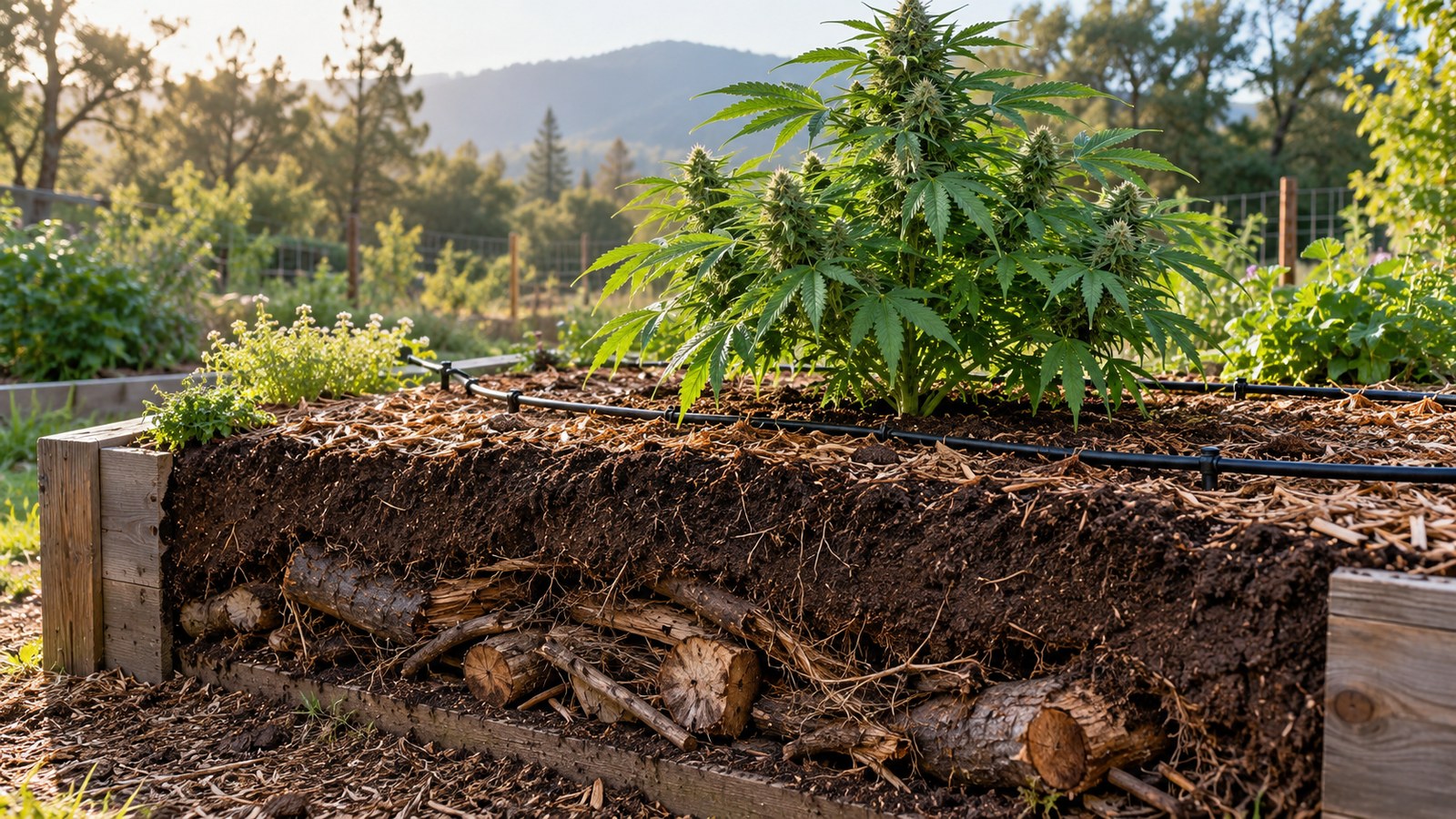
Living organic soil bed incorporating heavy organic straw mulch and sub-surface moisture retention dynamics.
Biological and Hydrological Failure Modes: Anaerobic Fermentation, Dry Pockets, and Mycorrhizal Desiccation
Because living soil functions as a living biological engine, hydrological imbalances manifest in unique physical and biochemical failure modes. When a bed remains over-saturated, the absence of molecular oxygen initiates a cascading thermodynamic decline known as redox reduction. Aerobic respiration operates at a high redox potential (+350 to +500 mV). As oxygen is depleted, facultative microbes sequentially utilize alternative terminal electron acceptors: first reducing nitrate into nitrous oxide gas (denitrification), then reducing oxidized manganese (Mn4+ to Mn2+) and iron (Fe3+ to Fe2+), before obligate anaerobes reduce sulfate into highly phytotoxic hydrogen sulfide gas below -150 mV. This biochemical shift not only starves the plant of nitrogen but releases toxic concentrations of soluble iron and manganese that scorch root epidermal cells.
Conversely, severe desiccation shatters the biological matrix. When volumetric water content falls below 32% (matric suction exceeding -35 cbar), capillary water films collapse. Beneficial bacteria form protective endospores or die, saprophytic fungi stop secreting chitinase and cellulase enzymes, and the production of glomalin ceases, causing granular soil aggregates to dissolve into loose, unstructured silt that channels water straight to the bottom without absorption. Table 2 details how living soil responds to moisture extremes compared to the optimal biological plateau:
| Diagnostic Metric | Optimal Aerobic Living Soil Plateau | Over-Saturated Anaerobic Soil | Desiccated Hydrophobic Living Soil |
|---|---|---|---|
| Soil Matric Tension | -10 to -18 cbar (100 – 180 mbar) | 0 to -5 cbar (0 – 50 mbar; flooded macropores) | >-35 cbar (350+ mbar; broken capillary films) |
| Volumetric Water Content | 42% – 50% VWC (continuous capillary plateau) | >58% – 65% VWC (complete saturation) | <32% VWC (critical desiccation boundary) |
| Rhizosphere Redox Potential | Positive: +350 to +500 mV (highly oxidative) | Negative: -100 to -250 mV (strongly reductive) | Neutral to positive, but zero electron transport |
| Microbial Population Status | Diverse aerobic bacteria, active fungal hyphae | Anaerobic bacteria dominate; fungal dieback | Fungal hyphae desiccate; bacteria sporulate |
| Soil Aroma Profile | Clean, rich, earthy forest floor (geosmin) | Sour, rotting vegetation, rotten eggs (H2S) | Dusty, baked earth; zero biological aroma |
| Canopy Foliar Response | Vibrant leaf praying turgor, dark green color | Downward petiole epinasty (thick, clawed leaves) | Flaccid, paper-thin wilting, brittle lower leaves |
Systemic Biological Hydration Strategy: Resetting Aeration, Surfactants, and Living Mulch Integration
When living soil hydrology has failed, cultivators must implement systematic rehabilitation protocols to restore aerobic bio-activity without destroying the subterranean food web:
1. Remediating Severe Hydrophobicity in Large Soil Beds
If a living soil bed has been neglected and dried past the critical 30% VWC threshold, peat moss and compost humic acids re-orient their hydrophobic aliphatic chains outward, resisting water penetration. Review our master protocol on rewetting hydrophobic cannabis soil without water channeling. Deploy this specialized biological restoration procedure:
- Apply Saponin-Rich Surfactant Drenches: Mix 1/8 teaspoon of organic Yucca schidigera extract powder or Quillaja saponin per gallon of dechlorinated water. Saponin surfactants break water surface tension, allowing water molecules to penetrate hydrophobic organic coatings. Drench the bed surface with a fine misting wand in 3 separate passes spaced 20 minutes apart.
- Incorporate Low-Volume Deep Probe Injections: Use a sub-surface root watering probe attached to a gentle siphon mixer. Insert the probe 6 to 8 inches into the dry root core, pulsing small bursts of yucca-treated water directly into dry pockets to re-establish internal capillary bridges from the inside out.
2. Rebuilding Microbial Populations Following Hydrological Trauma
Whether living soil suffered hypoxic drowning or severe desiccation, subterranean biology is severely depleted following the event. Once soil matric tension is restored to the safe 12 to 15 cbar window, re-inoculate the rhizosphere immediately:
- Aerated Actively Brewed Compost Tea (AACT): Brew a high-oxygen compost tea using 2 cups of biodynamic thermal compost or forest fungal humus, 2 tablespoons of unsulfured blackstrap molasses, 1 tablespoon of soluble kelp meal, and 1 tablespoon of fish hydrolysate in 5 gallons of dechlorinated water bubbled vigorously for 24 hours with an air pump and diffuser stones. Apply the finished tea at full strength to immediately re-populate aerobic bacteria, protozoa, and beneficial fungal spores.
- Top-Dress with Fresh Vermicompost: Spread a 1/2-inch layer of fresh earthworm castings directly beneath the straw mulch layer. Earthworm castings provide immediate, water-soluble fulvic acids and enzymatic biology that kickstarts biological nitrogen and phosphorus cycling.
Living Soil Hydration and Bed Setup Checklist
Verify these essential engineering and management parameters before establishing or maintaining a living soil cannabis bed:
- Bed construction incorporates 1/3 volume coarse aeration (pumice, lava rock, or rice hulls) that resists biological decomposition.
- Permanent vacuum tensiometers or digital moisture sensors are installed at 6-inch and 12-inch depths in representative bed zones.
- Moisture baseline is managed on a steady-state capillary plateau between 10 and 18 cbar (42% to 50% VWC).
- Aggressive hydroponic-style dry-backs (>25 cbar / <35% VWC) are strictly avoided to protect soil microbes and earthworms.
- Heavy single-event deluges that create bottom runoff are eliminated: beds are watered via micro-pulses or automated capillary systems.
- Topsoil is permanently shielded beneath a 2-to-3-inch mulch layer of seedless barley straw or active clover cover crops.
- Source water is rigorously filtered to remove chloramines, chlorine, and heavy metals that sterilize beneficial soil microbiology.
- Gravity-fed capillary systems (Tropf Blumat) are calibrated to maintain steady-state moisture without over-saturating the base.
- Soil aroma is inspected weekly to verify fresh, earthy forest-floor scents and confirm complete absence of anaerobic sulfides.
- Aerated compost teas and fresh vermicompost top-dresses are integrated monthly to replenish biological mineralization power.
Scientific References
- Brady, N. C., & Weil, R. R. (2016). The Nature and Properties of Soils (15th ed.). Pearson, New York.
- Hillel, D. (2004). Introduction to Environmental Soil Physics. Academic Press, San Diego, CA.
- Ingham, E. R. (2000). The Soil Biology Primer. USDA Natural Resources Conservation Service, Washington, DC.
- Kramer, P. J., & Boyer, J. S. (1995). Water Relations of Plants and Soils. Academic Press, San Diego, CA.
- Lowenfels, J., & Lewis, W. (2010). Teaming with Microbes: The Organic Gardener’s Guide to the Soil Food Web (Revised ed.). Timber Press, Portland, OR.
- Marschner, H. (2012). Marschner’s Mineral Nutrition of Higher Plants (3rd ed.). Academic Press, London.
- Paul, E. A. (2014). Soil Microbiology, Ecology and Biochemistry (4th ed.). Academic Press, Burlington, MA.
- Zheng, Y. (2021). Handbook of Cannabis Production in Controlled Environments. CRC Press, Boca Raton, FL.
Share this article
A quick overview of the topics covered in this article.