
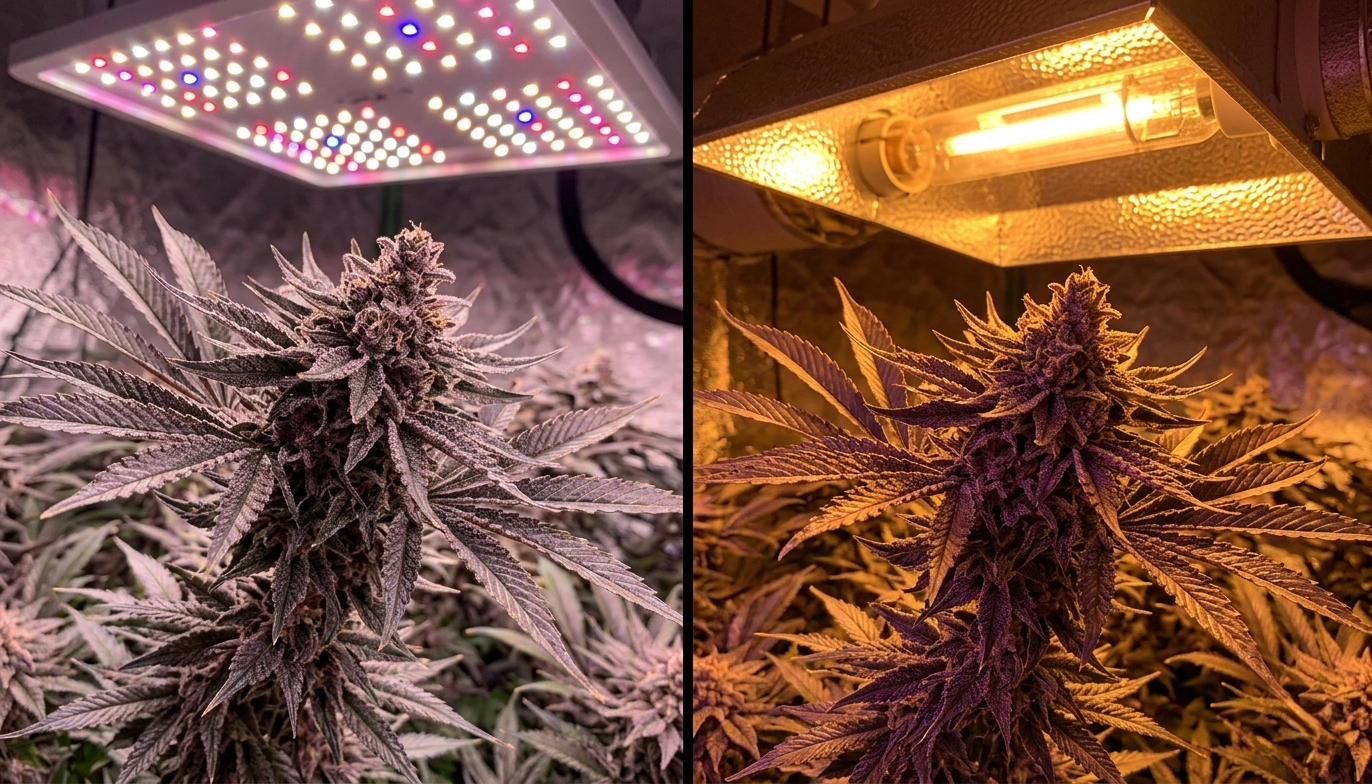
Used Grow Lights: What to Inspect Before Buying
A used grow light can be a good purchase when the discount reflects real condition, remaining service life, and support risk. It can also be an expensive way to inherit somebody else’s overheated driver, damaged cable, worn HID lamp, corroded connector, missing parts, or light output that no longer matches the original specification.
The safest approach is not to ask only whether the fixture turns on. Verify the exact model, inspect it while unpowered, check its electrical and mechanical condition, test every function, measure what it actually delivers, and price the uncertainty into the deal. A fixture that still produces light may still be a poor buy if its output is weak, its safety history is unclear, the warranty does not transfer, or replacement parts are unavailable.
This resource focuses only on evaluating second-hand grow lights. For broader light selection, metrics, spectrum, and canopy planning, use the complete cannabis grow-light guide. If you are still comparing new fixtures and trying to separate specifications from marketing, start with the cannabis grow-light buying guide.
The Used-Light Buying Rule: Verify Before You Pay
A second-hand fixture should be judged as a piece of electrical equipment with an unknown history, not as a discounted version of a new product. The seller may be completely honest and still be unable to tell you how hot the driver ran, how often the light was moved, whether it operated in high humidity, whether it experienced power problems, or how much output has changed since new.
The central question is therefore not, “Does it work?” It is, “Can I verify enough about this exact unit to know what I am buying and what risks I am accepting?” A strong used-light purchase usually has identifiable model information, intact safety labels, original or credible performance documentation, undamaged wiring and connectors, stable operation, useful measured output, reasonable service support, and a price low enough to compensate for reduced certainty.
Remember: A light that turns on has passed only the first test. It has not yet proved safe condition, rated output, remaining life, dimming stability, or value.
Separate four kinds of evidence
Before making an offer, separate what you know into four groups: identity, physical condition, operating behavior, and performance. Identity tells you what the product is. Physical condition tells you whether it has obvious damage. Operating behavior tells you whether the electronics and controls function normally. Performance tells you whether the fixture still delivers useful photons across the intended canopy.
These categories solve different problems. A perfect-looking fixture can have poor output. A bright fixture can have a damaged cord. A seller can provide a genuine specification sheet for a model that is not the exact revision sitting in front of you. The decision becomes stronger when the evidence agrees across all four categories.
| Evidence | What to Verify | Why It Matters |
|---|---|---|
| Identity | Model, revision, serial number, input rating, original driver or ballast, safety label. | Prevents comparing the unit with specifications for a different product. |
| History | Purchase date, approximate use, environment, repairs, parts replaced, reason for sale. | Helps explain wear but does not independently prove remaining life. |
| Condition | Cords, connectors, frame, bars or boards, sockets, reflector, driver housing, hangers. | Reveals damage that may make further testing inappropriate. |
| Operation | Startup, dimming, channels, fans if present, flicker, unusual noise, fault behavior. | Checks whether every intended function still works. |
| Performance | Actual input power and repeatable PPFD measurements under known geometry. | Shows whether the used fixture still serves the intended canopy. |
| Support | Warranty transfer, replacement driver or lamp, connectors, controller, service documentation. | Changes the financial risk if the fixture fails later. |
Why Used Grow Lights Age Unevenly
Grow lights do not age as one uniform object. An LED fixture combines LED packages, driver electronics, printed circuit boards or light bars, thermal interfaces, wiring, connectors, optics, seals, mechanical supports, and sometimes fans or control electronics. HID systems add a replaceable lamp, socket, reflector, ignition components, and ballast. Each part can age through a different mechanism.
This matters because a single lifetime number can hide the real failure path. LED packages can gradually lose photon output, while a driver can fail electronically. A connector can loosen or corrode. A fan can wear out. An HID lamp can depreciate while the ballast still starts it. A reflector can become dirty or oxidized even though the lamp itself is functional.
LED output maintenance is not the same as fixture survival
IES LM-80 and TM-21 are useful for characterizing and projecting light-output maintenance of LED light sources under defined conditions. They do not prove how long every complete horticultural fixture will survive. The Illuminating Engineering Society specifically warns against treating LED source maintenance as the lifetime of the entire luminaire because drivers, optics, and other components introduce additional failure mechanisms.
For a used fixture, that means a seller saying “the LEDs are rated for 50,000 hours” does not answer the most important question. You still need to inspect the complete product and test the exact unit.
Photon flux maintenance
Photon flux maintenance describes how much of a light source’s initial photon output remains after operating time under defined conditions. It is a maintenance metric, not a guarantee that every driver, connector, fan, control board, seal, or complete fixture will remain functional for the same number of hours.
Temperature can change the aging rate
LED and driver reliability are strongly connected to thermal conditions. Driver manufacturers commonly publish lifetime information against case temperature, and those curves can decline substantially as operating temperature rises. The exact relationship is product-specific, but the practical lesson is broad: two fixtures with the same calendar age may have very different service histories if one ran cool and the other spent years in a hot, poorly ventilated room.
You usually cannot reconstruct that history from appearance alone. Dust packed into heatsink channels, browned materials, brittle cable jackets, discolored connectors, or a seller reporting chronic high-room temperatures can increase concern, but the absence of visible damage does not prove a cool operating history.
“The seller says the LEDs are rated for 50,000 hours. Does fixture age still matter?”
Question sent by: Ethan Brooks, via E-mail.
Yes. A source-maintenance claim does not reveal the condition of the complete used fixture. Ask about operating history, then inspect the driver, wiring, connectors, thermal condition, controls, and actual canopy output. Treat the lifetime number as documentation to interpret, not as a remaining-life countdown for that individual unit.
Verify the Exact Fixture Before You Meet the Seller
The easiest used-light problems to avoid are the ones you can identify before you travel or exchange money. Ask the seller for clear photographs of the product label, model number, serial number where present, driver or ballast label, plug, connectors, dimmer or controller, hanging hardware, and the entire fixture from both sides.
Then find the manual, specification sheet, warranty terms, and any relevant safety or qualification listing for that exact model or revision. Do not assume a current product page describes an older unit with the same marketing name. Manufacturers sometimes change drivers, diode layouts, connectors, power levels, or revisions without changing the family name dramatically.
Match the label to the documentation
Check input voltage, frequency, rated current or power, environmental rating, model suffixes, and any separate driver part number. If the seller provides a PPFD map or PPF figure, confirm that the documentation belongs to the same configuration. A different spectrum option, driver, wattage version, or generation can produce different results.
If the label has been removed, painted over, damaged, or replaced with an unexplained sticker, the uncertainty rises sharply. That does not automatically prove the fixture is unsafe, but it makes electrical ratings, certification status, and performance claims harder to verify.
Check recalls and safety notices
Search the manufacturer’s safety notices and the recall database appropriate to your country before buying. In the United States, the Consumer Product Safety Commission maintains a searchable recall database and explicitly advises buyers of new and used products to check whether a product has been recalled. Other jurisdictions have their own recall systems.
Use the exact model and serial or date code when available. A recall affecting one production window does not necessarily apply to every similar-looking fixture. If a recall requires a repair or replacement, verify that the remedy was completed before treating the unit as cleared for purchase.
Do not buy a recalled electrical product simply because it appears to work
A product can operate normally while still carrying a documented fire, shock, mechanical, or other safety hazard. Resolve the recall status and required remedy first.
Ask for useful history, not a perfect story
Useful seller questions include when the light was purchased, whether it was bought new, approximate hours or grow cycles, typical dimmer setting, whether it ran in a tent or open room, whether the driver or ballast was remote-mounted, whether any parts were replaced, whether the unit ever overheated or shut down, and why it is being sold.
Do not turn these answers into fake precision. “Three grows” can mean very different operating hours and temperatures. Runtime is supporting context. The exact unit still needs inspection and measurement.
Pro Tip: Ask for the original invoice or order confirmation when available. It can help verify age, exact model, purchase channel, and whether any remaining warranty could be relevant. Never assume a warranty is transferable until the written terms confirm it.
Inspect the Fixture While It Is Unpowered
Start the physical inspection with the unit disconnected from power. This is the moment to decide whether it is appropriate to proceed to an operating test. If you find damaged insulation, exposed conductors, melted connectors, serious corrosion, a cracked plug, loose mains wiring, evidence of water inside electrical parts, or a deformed driver or ballast enclosure, stop. Do not energize the fixture just to see whether it still works.
OSHA guidance for cord-and-plug equipment uses the same basic safety principle: equipment showing damage that could expose someone to injury should be removed from service until repaired and tested. Local rules vary, but a used grow light should not receive a lower safety standard because it is being sold privately.
Inspect the cord, plug, connectors, and strain relief
Look along the full accessible length of the power cord. Check for cuts, crushed sections, heat damage, hardened or cracked insulation, improvised splices, missing ground pins where grounding is required, damaged plug blades, and cable entry points that no longer hold the cord securely.
Inspect low-voltage connectors and detachable driver leads for discoloration, melted plastic, bent pins, corrosion, looseness, damaged locking tabs, or signs that incompatible connectors were forced together. A connector can carry current while developing excessive resistance and heat, so visible browning or deformation deserves more concern than a cosmetic scratch on the frame.
Inspect the driver, ballast, and control hardware
The housing should be intact and securely mounted. Look for swelling, cracks, leaking potting material, burned areas, missing covers, stripped screws, unexplained holes, heavy corrosion, or evidence of internal modification. Do not open a sealed driver or ballast during a casual inspection. Internal capacitors and high-voltage sections can present hazards even after power is removed.
If the driver was remote-mounted, verify that the cable and connector arrangement matches the manufacturer’s supported configuration. An improvised extension may change voltage drop, EMC behavior, connector loading, or environmental protection even when the lamp still turns on.
Inspect the frame, bars, boards, optics, and hanging points
Check for bent bars, twisted frames, cracked circuit-board supports, loose light engines, missing fasteners, broken folding hinges, damaged lenses, detached diffusers, and hanger points that have elongated or cracked. A fixture suspended above plants must remain mechanically trustworthy, not merely electrically functional.
Dust and residue are common on used lights. A thin removable layer is different from baked-on deposits, corrosion, or sticky unknown residue around electronics. If the fixture came from a room with foliar sprays or heavy pest pressure, clean the exterior according to the manufacturer’s instructions before bringing it into your grow. Do not spray liquid cleaner into drivers, sockets, fans, vents, or connectors.
| Inspection Area | Acceptable Finding | Walk-Away or Escalation Sign |
|---|---|---|
| Power cord and plug | Intact jacket, secure strain relief, correct plug, no heat damage. | Cuts, melted sections, improvised splice, exposed conductor, damaged grounding. |
| Connectors | Clean, secure, matching, undamaged locking features. | Browned plastic, corrosion, melted pins, loose fit, forced mismatch. |
| Driver or ballast | Intact housing, secure mounting, readable label, no obvious deformation. | Swelling, burn marks, cracks, water ingress, open or modified enclosure. |
| Light engine | Straight bars or boards, secure mounting, normal surface appearance. | Loose board, severe discoloration, warped bar, cracked support, missing fasteners. |
| Hanging hardware | Complete and mechanically sound. | Cracked eyelet, stripped thread, bent bracket, improvised unsafe suspension. |
| HID lamp and socket | Correct lamp type, intact envelope, secure socket and reflector. | Cracked lamp, heavily burned socket, loose contacts, unknown ballast-lamp match. |
Inspect before energizing
Use the unpowered inspection to decide whether a powered test is appropriate. Stop when damage involves wiring, connectors, water ingress, grounding, or the driver or ballast enclosure.
Do not “test through” visible damage
A damaged fixture does not become safe because it lights for thirty seconds. Electrical defects should be repaired and tested appropriately before use.
Power It Up Safely and Test Every Function
Only proceed when the fixture, cord, plug, connectors, and installation appear intact and compatible with the available supply. Use the product at its rated voltage and normal configuration. If the electrical setup is uncertain, if the fixture requires permanent wiring, or if damage was found, the appropriate next step is professional inspection rather than an improvised test.
Stand clear of the fixture during startup and watch for normal operation. Do not leave an unfamiliar used light running unattended during its first test.
Check startup behavior and stability
A healthy fixture should start in a way consistent with its design and remain stable. Watch for repeated resets, cycling, sudden shutdown, delayed restart, erratic dimming, abnormal flicker, intermittent bars, dead sections, rapidly changing brightness, or unusual noise. Some drivers and HID systems have normal startup behavior, so compare what you see with the manual rather than assuming every delay is a fault.
If the fixture has active cooling, confirm that each fan starts and runs smoothly without grinding, stalling, or excessive vibration. A failed fan can be both a thermal and reliability problem even when the LEDs continue operating during a short test.
Test the dimmer and every independent channel
Move through the intended dimming range and watch whether output changes smoothly and repeatably. For fixtures with independently controlled channels, verify each one. A dimmer knob that produces dead zones, jumps, random flicker, or intermittent shutdown can reveal controller or driver problems that a full-power test misses.
Do not assume the printed knob percentage equals the same percentage of PPF or input power. The purpose of this test is first to confirm stable control. If accurate scaling matters, measure power and PPFD at the settings you plan to use.
Let the unit reach a stable operating state
Short startup tests can miss heat-related problems. Allow an intact fixture to operate long enough to reach a reasonably stable state before final measurements, following the product’s normal operating guidance. Watch for thermal shutdown, smell of overheated insulation, increasing flicker, fan problems, or connectors becoming abnormally hot.
Do not use your hand as a calibrated safety instrument and do not touch exposed electrical parts. Surface temperature alone also cannot prove whether internal components are within specification. If a manufacturer provides case-temperature measurement points or service procedures, those belong to a competent technical assessment rather than an improvised marketplace test.
“Every diode lights up. Is that enough to call the fixture healthy?”
Question sent by: Julia Schneider, via contact form.
No. All diodes illuminating is useful, but it does not verify rated output, driver stability, dimming behavior, connector condition, thermal reliability, or canopy distribution. Continue with a stable powered test and repeatable PPFD measurements.
Measure Output Instead of Guessing from Appearance
Human vision is poor at judging horticultural photon output. Your eyes adapt to brightness, and two fixtures can look similarly bright while producing different PPF, spectra, or canopy distributions. A used LED can also lose output gradually without developing an obvious visible fault.
The most useful field check is a repeatable PPFD measurement under defined geometry. Ideally, map several points across the footprint at a known fixture-to-sensor distance and fixed dimmer setting. Record the exact setup so the result can be repeated.
Compare like with like
If the manufacturer provides an original PPFD map, match the test conditions as closely as practical: height, footprint, fixture setting, walls or open-room condition, and sensor orientation. A home measurement does not become an accredited laboratory test, and a mismatch does not automatically prove degradation. Different reflective surroundings, sensors, grid positions, electrical voltage, thermal state, or product revision can change the result.
Use the comparison as a screening tool. A large, repeatable shortfall under reasonably matched conditions is a reason to investigate further or reduce the price you are willing to pay. A close match increases confidence but still does not prove the internal condition of every component.
Field Advice: Record minimum, average, and maximum PPFD across the same footprint. A used fixture can maintain a strong center while developing a weak section, failed bar, dirty optic, or distribution problem that one center reading will miss.
Use actual wattage as a diagnostic companion, not a performance substitute
If it can be measured safely with appropriately rated equipment, input power adds context. A fixture drawing substantially less power than its documented operating state may be dimmed, misconfigured, faulting, or simply a different revision. A fixture drawing the expected watts still has not proved expected photon output.
The actual wattage versus equivalent wattage guide explains why electrical input and plant-light output must be kept separate. For a used purchase, compare both when credible data exist.
Do not reverse-engineer fixture life from one PPFD reading
Suppose your measurement is lower than the published map. That result can reflect source depreciation, dirt, optical damage, a different sensor, voltage differences, driver settings, height error, reflective-wall differences, or an inaccurate original map. It cannot tell you by itself how many hours the fixture has left.
If you want to integrate a full numerical PPFD map over an area, the PPFD-map photon-flux guide explains what that calculation can and cannot prove. Keep the result labeled as incident flux on the mapped plane rather than calling it laboratory fixture PPF.
“Can I compare my meter readings directly with the manufacturer’s old PPFD map?”
Question sent by: Noah Campbell, via Facebook page.
Yes, but only as a controlled comparison when height, footprint, dimmer setting, room conditions, and sensor method are reasonably matched. Treat differences as evidence to investigate, not as an automatic percentage of fixture degradation.
LED, HID, and Fluorescent Used-Light Risks
Used-light inspection changes with technology. The general safety sequence stays the same, but the parts most likely to age or require replacement differ. If you are unsure which technology makes sense for the canopy, use the broader grow-light guide for background rather than treating the cheapest second-hand unit as automatically suitable.
Used LED fixtures
LED systems deserve close attention to driver condition, connectors, dimming, thermal design, dead or discolored diode groups, damaged bars or boards, fan operation where active cooling is used, and evidence of moisture exposure. Long source-maintenance projections should be read as standardized performance evidence, not a promise about the complete used unit.
Current horticultural qualification systems such as DLC V4.0 include whole-product requirements beyond initial efficacy, including long-term photon maintenance, driver lifetime, warranty, safety, and controllability. A used fixture does not automatically retain every practical benefit of those requirements because warranty coverage may not transfer and the individual unit has an operating history. Still, the original documentation can give you a stronger baseline than an anonymous fixture with no test record.
Used HPS, MH, and CMH systems
With HID systems, ask separately about lamp age and ballast age. The lamp is a consumable light source, while the ballast, socket, reflector, and wiring form the rest of the system. A fixture may start normally while the lamp has lost meaningful output. Replacement cost should therefore be included in the purchase price unless lamp age and performance are well documented.
Inspect lamp envelopes for damage, sockets for heat discoloration, reflectors for corrosion or permanent staining, and ballast housings for damage. Make sure the lamp type and wattage are correct for the ballast. Do not mix unknown lamps and ballasts simply because the bases fit. High-voltage starting circuits and hot lamps make HID systems a poor place for casual internal repair.
Used fluorescent and CFL systems
Older fluorescent systems can be inexpensive, but the used value depends heavily on lamp condition, ballast condition, socket integrity, reflector condition, replacement-lamp availability, and whether the fixture still makes sense for the intended intensity. Darkened lamp ends, brittle sockets, buzzing, difficult starting, and intermittent operation deserve attention.
Because efficient modern LED fixtures can deliver more horticultural photons per unit of electricity than older technologies, a very cheap fluorescent or HID setup can still be expensive to operate. Compare total purchase price, replacement parts, electricity, heat management, and expected usable output rather than the sticker price alone.
| Technology | Used-Buy Focus | Extra Cost to Price In |
|---|---|---|
| LED | Driver, connectors, dimming, bars or boards, fans if present, output uniformity, documentation. | Replacement driver, controller, proprietary cable, lost warranty, uncertain output maintenance. |
| HPS / MH / CMH | Lamp age, ballast match, socket, reflector, ignition stability, heat damage. | Fresh lamp, ballast or ignitor service, higher operating and cooling cost. |
| Fluorescent / CFL | Lamp and socket condition, ballast, starting behavior, reflector, replacement availability. | New tubes or lamps, ballast replacement, lower photon efficiency relative to newer options. |
Price the Remaining Usefulness, Not Just the Discount
A used fixture is not automatically a bargain because it costs half of its original retail price. Original retail can be irrelevant if newer fixtures now deliver better efficacy, better distribution, safer controls, stronger warranty coverage, or cheaper replacement parts.
Compare the used price with the cost of a credible current alternative that serves the same canopy. Then subtract the risks you are accepting: no return policy, uncertain hours, non-transferable warranty, worn lamp, old driver, proprietary controller, missing hanging hardware, discontinued parts, or weaker efficiency.
Build a simple risk-adjusted price
Start with the used asking price. Add any immediate costs you already know, such as a replacement HID lamp, missing controller, new approved cable, new hangers, or professional electrical assessment. Then consider the cost of one likely major failure that would make the fixture uneconomical to repair. You do not need a precise actuarial model. The purpose is to stop treating the discount as pure savings.
A lightly used, documented, testable fixture with available parts may justify a higher percentage of current replacement cost than an anonymous older light with no manual, no warranty path, unknown repairs, and no credible performance baseline.
Master Advice: The right used-light price is not based on how expensive the fixture used to be. It is based on what the exact unit can still do, how confidently you can verify it, and what it will cost if the next major component fails.
Warranty and parts can be worth more than a small discount
Read the warranty rather than accepting “still under warranty” as a seller statement. Some warranties require the original purchaser, proof of purchase, registration, an authorized sales channel, or specific operating conditions. Others may be transferable. Terms vary, so do not invent a transfer rule.
Also check whether common service parts remain available. A replaceable driver is useful only if a compatible part can actually be sourced. Proprietary connectors, network controllers, dimming adapters, or mounting hardware can turn a cheap fixture into an awkward system if the manufacturer has discontinued them.
Common Used-Light Buying Mistakes
Most poor second-hand purchases are not caused by obscure lighting science. They happen because the buyer skips one basic layer of verification.
Buying from photographs alone
Photos can confirm general appearance, but they cannot demonstrate stable operation, dimming, input power, PPFD distribution, intermittent faults, fan condition, or heat-related shutdown. If the price is meaningful, an in-person or live operating test is worth more than polished listing images.
Trusting the center PPFD number
A strong center reading can hide weak edges, a failed bar, uneven diode output, dirty optics, or a footprint that is smaller than the seller claims. Measure a grid, not one impressive point.
Assuming visible cleanliness means safe history
A fixture can be cleaned before sale. Cosmetic cleanliness does not reveal previous high-temperature operation, electrical events, internal repair, or moisture exposure. Use labels, history, physical inspection, and operating measurements together.
Buying a discontinued fixture without checking parts
Discontinued equipment is not automatically bad. The risk is that one small proprietary failure can make the whole fixture difficult to repair. Check drivers, connectors, dimmers, controllers, hanging hardware, and lamps before deciding the discount is sufficient.
Ignoring sanitation because the product is electrical
Used grow-room equipment can carry dust, dried spray residue, debris, and potentially hitchhiking pests on external surfaces. Clean the fixture exterior using methods allowed by the manufacturer before it enters a clean grow area. Keep liquid away from electrical openings and do not use aggressive chemicals that can damage seals, plastics, coatings, or optics.
Unknown internal repairs change the risk category
If the seller has opened a driver, replaced mains wiring, bypassed a connector, defeated grounding, changed a fuse specification, or modified a ballast without documented qualified service, do not treat the fixture as an ordinary used purchase. Have it professionally assessed or walk away.
Verify the Fixture Again After Installation
A successful marketplace test is not the end of verification. Installation changes hanging height, reflective surroundings, airflow, supply conditions, cable routing, and canopy geometry. Once the used fixture is mounted in its real grow space, create a baseline that you can repeat later.
Record the installed baseline
Record the model, serial number, date purchased used, dimmer setting, actual fixture-to-canopy or fixture-to-sensor height, room configuration, representative PPFD readings, and input power if measured safely. Take photographs of the label, connectors, cable routing, and overall installation.
That baseline becomes useful months later. If the canopy seems dimmer, one bar begins to fail, or a driver is replaced, you can repeat the same measurements instead of relying on memory.
Recheck after the first operating period
After the fixture has operated through normal cycles, inspect accessible connectors and cables again while the unit is safely de-energized. Look for new discoloration, loosening, unusual smell, fan noise, intermittent control, or output drift. A connection that looked acceptable during a short test may reveal itself only after repeated heating and cooling.
If measured performance remains stable, the electrical and mechanical condition remains sound, and the fixture fits the canopy, you now have evidence that the used purchase is functioning as intended in your room. That is far more useful than the seller’s estimate of remaining life.
Remember: Verification is not a hunt for perfect numbers. It is a way to notice meaningful change before a weak connection, failing driver, dead light section, or declining canopy coverage becomes a larger problem.
Final Used Grow Light Inspection Checklist
A good used-light decision should be explainable in one sentence: you know exactly what the fixture is, you found no unresolved safety defects, its controls operate normally, its measured output fits the intended canopy, and the price compensates for the remaining uncertainty.
Used Grow Light Decision Checklist
- Photograph and verify the exact model, revision, serial number, driver or ballast, and input rating.
- Find the manual, original specification sheet, warranty terms, and recognized safety documentation.
- Search the relevant national recall database and manufacturer safety notices.
- Ask about purchase date, approximate use, environment, repairs, replacement parts, and reason for sale.
- Inspect the cord, plug, grounding, connectors, strain relief, housing, frame, boards or bars, hangers, and controls while unpowered.
- Do not energize a fixture with exposed conductors, melted connectors, serious corrosion, damaged grounding, water ingress, or a compromised driver or ballast enclosure.
- Test startup, dimming, control channels, fans, and operating stability only when the unit is safe and compatible with the supply.
- Map representative PPFD points at a known height instead of judging brightness by eye or one center reading.
- Compare actual input power with documentation when it can be measured safely.
- Price in replacement lamps, drivers, controllers, proprietary cables, missing hardware, and uncertain warranty coverage.
- Clean the exterior using manufacturer-compatible methods before moving used grow-room equipment into a clean cultivation space.
- Create an installed baseline and recheck the fixture after normal operating cycles.
If several important pieces of evidence are missing at once, the correct decision is often to walk away rather than invent certainty. There will always be another fixture. The broader grow-light buying guide can help compare the used option with a new fixture using the same specification framework.
Share this article
A quick overview of the topics covered in this article.
- The Used-Light Buying Rule: Verify Before You Pay
- Why Used Grow Lights Age Unevenly
- Verify the Exact Fixture Before You Meet the Seller
- Inspect the Fixture While It Is Unpowered
- Power It Up Safely and Test Every Function
- Measure Output Instead of Guessing from Appearance
- LED, HID, and Fluorescent Used-Light Risks
- Price the Remaining Usefulness, Not Just the Discount
- Common Used-Light Buying Mistakes
- Verify the Fixture Again After Installation
- Final Used Grow Light Inspection Checklist
Follow us
Latest articles

October 28, 2026
October 28, 2026
October 28, 2026
October 28, 2026
