
UVA for Cannabis: Possible Effects, Limits, and Safety
As commercial solid-state lighting advances beyond standard visible photosynthetic wavebands, long-wave ultraviolet radiation (UVA) has emerged as an active area of horticultural interest. While ultraviolet B (UVB) has been largely discredited as a reliable tool for boosting THC potency, ultraviolet A (spanning 315 to 400 nanometers) presents fundamentally different photobiological interactions. UVA photons carry lower quantum energy than destructive UVB, allowing them to stimulate plant photoreceptors and secondary metabolic pathways without immediately destroying chlorophyll reaction centers.
In natural outdoor environments, solar irradiance delivers substantial quantities of UVA, representing roughly 7% to 9% of total natural sunlight. Cannabis plants evolved sophisticated sensory mechanisms, specifically cryptochrome and phototropin photoreceptors, that monitor ambient UVA levels to regulate leaf cuticle thickness, stomatal conductance, and the synthesis of protective phenolic antioxidants. Translating these natural responses into indoor cultivation requires understanding the precise mechanisms, physiological saturation thresholds, and equipment limits of UVA supplementation.
However, commercial marketing frequently conflates potential photomorphological benefits with unrealistic promises of massive cannabinoid increases. While supplemental UVA can enhance terpene accumulation, deepen purple pigmentation, and strengthen epidermal cell walls, excessive or uncalibrated exposure generates harmful reactive oxygen species (ROS), induces photoinhibition, and poses serious chronic health risks to cultivators working inside unshielded grow rooms.
This guide provides a comprehensive, research-based examination of UVA radiation in cannabis cultivation. It establishes the physical and biological boundaries separating UVA from UVB, evaluates empirical research regarding terpene synthesis and flower density, outlines safe operational dosing guidelines, addresses critical human occupational safety protocols, and provides a structured evaluation framework for growers considering supplemental ultraviolet fixtures.
Direct Answer: What UVA Can and Cannot Do for Cannabis
Ultraviolet A radiation is not a magic potency booster, but it is an effective photomorphological regulator when delivered within strict biological limits. Controlled research indicates that modest supplemental UVA (typically 10 to 20 micromoles per square meter per second) can enhance the concentration of aromatic terpenes, stimulate protective anthocyanin pigments, and increase leaf cuticle wax thickness. However, it does not substantially raise THC percentages, nor does it replace the fundamental need for high-intensity photosynthetic PAR light.
Ultraviolet A (UVA Radiation)
The long-wave band of ultraviolet radiation spanning 315 to 400 nanometers, positioned immediately adjacent to visible violet light (400 nm). In modern horticultural LEDs, UVA supplementation typically centers around 365 nm (mid-UVA) or 385 to 395 nm (near-visible UVA).
When indoor cultivators evaluate UVA supplementation, they must separate realistic physiological outcomes from marketing exaggerations:
- What UVA Can Do: Upregulate protective flavonoid synthesis (cannflavin A and B), increase specific monoterpenes and sesquiterpenes (such as myrcene, caryophyllene, and pinene), thicken epidermal leaf cuticles to improve pest and drought resistance, and stimulate cryptochrome-mediated stomatal opening.
- What UVA Cannot Do: Override genetic cannabinoid limitations, turn low-potency cultivars into 30% THC flower, act as a primary driver of dry floral biomass, or eliminate the need for integrated pest management (IPM).
Remember: UVA photons carry slightly more energy than visible blue light, but they are converted into chemical energy with lower photosynthetic quantum efficiency. Supplementing with UVA is an optimization strategy for terpene expression and plant robustness, not a primary driver of heavy yield.
UVA vs UVB: Physical Differences, Photoreceptors, and Biological Pathways
Cultivators frequently blur the distinction between ultraviolet sub-bands, referring generically to “UV lighting.” In biological reality, UVA (315-400 nm) and UVB (280-315 nm) operate through entirely separate physical mechanisms, interact with different plant photoreceptors, and present vastly different risk profiles.
Photoreceptor Mediation: Cryptochromes vs UVR8
Plants detect ultraviolet radiation through distinct protein sensors:
- UVA Photoreception: Long-wave UVA is absorbed primarily by cryptochromes (CRY1 and CRY2) and phototropins (PHOT1 and PHOT2). These are the exact same flavoprotein photoreceptors that mediate blue light absorption (400-500 nm). Because cryptochromes evolved to respond to natural dawn daylight, absorbing UVA triggers photomorphogenic development, circadian synchronization, and stomatal opening without triggering acute DNA damage.
- UVB Photoreception: Shortwave UVB is detected specifically by the UVR8 (UV Resistance Locus 8) photoreceptor. Absorption of UVB causes the UVR8 homodimer to dissociate into active monomers, initiating an emergency cellular stress signaling cascade designed to halt cell division, trigger DNA repair enzymes, and activate photoprotective sunscreen synthesis.
Photochemical Signal Transduction via Cryptochromes
To understand why UVA alters cannabis morphology without causing immediate DNA disruption, one must examine the internal structure of cryptochrome photoreceptors. Cryptochromes contain a light-capturing chromophore known as flavin adenine dinucleotide (FAD). When resting FAD absorbs a photon in the UVA or blue waveband (320 to 450 nm), an electron is transferred across a conserved triad of tryptophan amino acid residues, reducing the flavin cofactor into an active radical state (FADH).
This conformational shift alters the protein structure, enabling the cryptochrome to interact with key nuclear transcription factors, including COP1 (Constitutive Photomorphogenic 1) and HY5 (Elongated Hypocotyl 5). This signaling pathway directly controls gene expression responsible for inhibiting excessive stem elongation, activating protective flavone glycosides, and synchronizing circadian metabolic rhythms.
Verify Wavelength Before Purchasing “UV” Fixtures
Many commercial lamps marketed as “UV enhance bars” emit predominantly near-visible UVA at 385 nm to 395 nm, while others emit hazardous shortwave UVB at 290 nm to 310 nm. Operating unshielded UVB lamps under the assumption that they are mild UVA poses severe risks of corneal photokeratitis and foliar tissue necrosis. Always demand accredited integrating sphere spectral reports specifying peak nanometer emission.
Penetration and Cellular Targets
Because UVA photons carry less quantum energy than UVB, they do not directly photolyze DNA base pairs or break covalent protein bonds. Instead, UVA penetrates deeper into leaf mesophyll tissue, where it excites accessory pigments and stimulates the cellular antioxidant defense network. This fundamental physical distinction explains why plants can tolerate sustained, moderate UVA irradiance without developing the severe chlorosis and yield loss characteristic of UVB exposure.
Secondary Metabolites: Does UVA Stimulate Terpenes and Flavonoids?
The most compelling commercial argument for UVA supplementation is its potential to increase aromatic terpene concentration and enhance secondary metabolite synthesis. While cannabinoid increases remain marginal, peer-reviewed plant science demonstrates that UVA radiation directly upregulates the phenylpropanoid and isoprenoid metabolic pathways.
Upregulation of the Phenylpropanoid Pathway
When cannabis leaves absorb UVA photons, cryptochromes stimulate the activation of phenylalanine ammonia-lyase (PAL), the gateway enzyme responsible for synthesizing phenolic compounds. This leads to increased concentrations of:
- Cannflavins A and B: Potent anti-inflammatory prenylated flavonoids unique to cannabis, which accumulate in foliar and bract epidermal cells to absorb excess ultraviolet radiation.
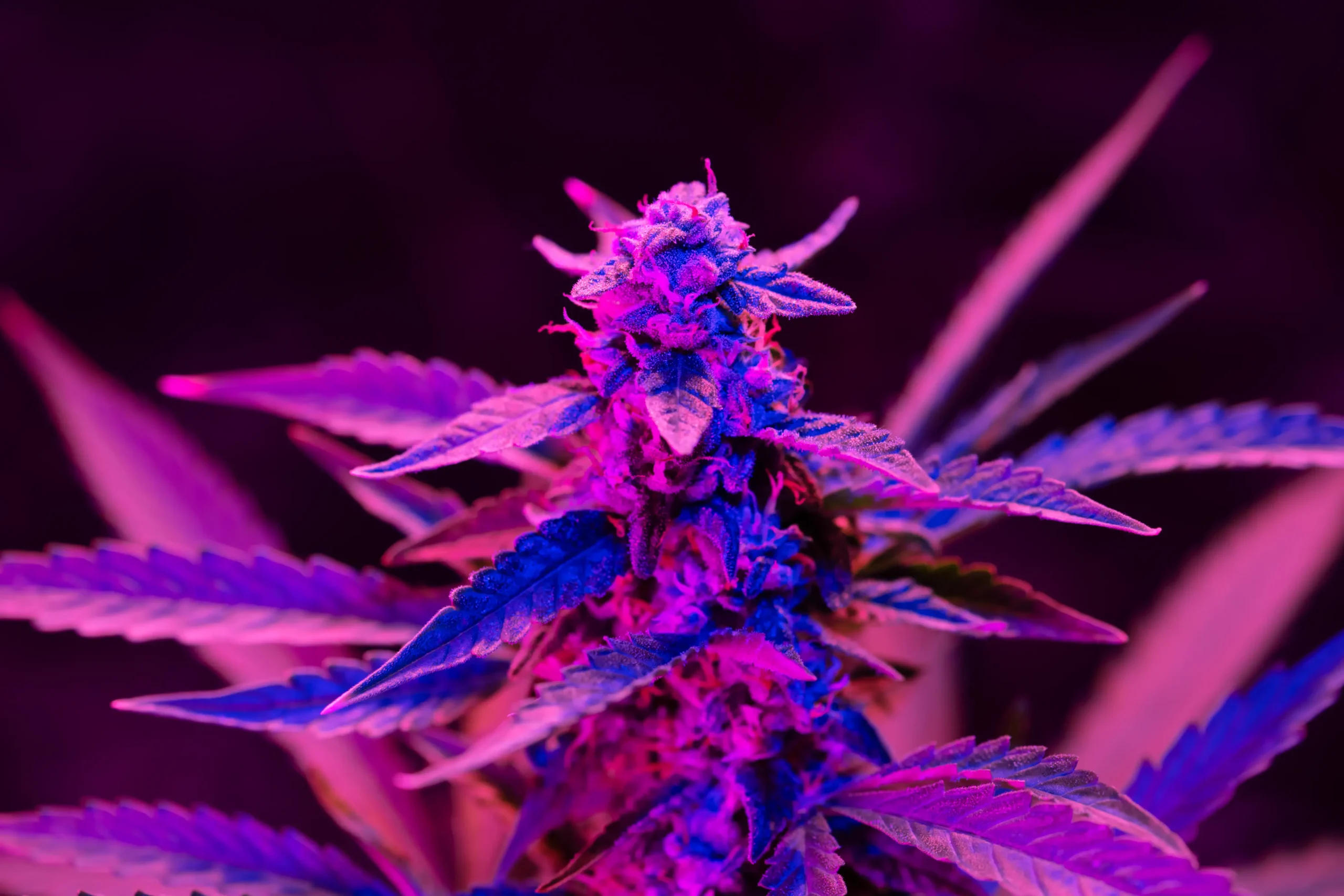
- Anthocyanins: Flavonoid pigments responsible for purple, violet, and deep red coloration in floral bracts. Supplementing with UVA accelerates anthocyanin expression in genetically predisposed cultivars, enhancing visual appeal and bag appeal.
The Terpene Volatilization Paradox: Protecting What You Stimulate
While supplemental UVA upregulates the enzymatic synthesis of volatile terpenes in glandular trichome heads, cultivators often fail to preserve those gains during harvest due to uncontrolled environmental temperatures. Monoterpenes, which constitute the brightest aromatic notes in fresh cannabis flowers, have exceptionally low boiling points and high vapor pressures:
- Beta-Myrcene: Begins volatilizing rapidly into the ambient air at temperatures above 24°C (75°F).
- D-Limonene: Exhibiting a citrus profile, limonene experiences accelerated vapor loss when leaf surface temperatures exceed 26°C (79°F).
- Alpha-Pinene: Highly volatile pine aroma that dissipates under excessive convective airflow and radiant room heat.
If an indoor cultivator supplements with UVA to stimulate terpene synthesis but operates a warm flowering room (e.g., 28°C to 30°C / 82°F to 86°F), the radiant heat from lighting and air currents will volatilize the newly synthesized monoterpenes faster than the plant can replace them. To capture the full economic benefit of UVA, drop late-flowering ambient temperatures to 22°C to 24°C (72°F to 75°F) during the final three weeks of bloom.
Will adding UVA lights make my buds smell noticeably stronger?
Question sent by: Ethan Brooks, via email.
In cultivars with rich genetic terpene potential, yes. Analytical chromatography testing shows that adding 15 to 20 umol/m2/s of 365 nm to 385 nm UVA during mid-to-late flowering can increase total terpene concentration by 10% to 25%, particularly elevating volatile monoterpenes like myrcene, limonene, and caryophyllene. However, if your room air temperatures exceed 26°C (79°F) during late bloom, those extra volatile terpenes will simply evaporate into the exhaust air. To preserve the aroma gained from UVA, maintain cool room temperatures and gentle airflow during ripening.
The reference matrix below summarizes the primary differences in physiological impact between UVA and UVB radiation across commercial cannabis canopies:
| Parameter | Ultraviolet A (UVA: 315-400 nm) | Ultraviolet B (UVB: 280-315 nm) |
|---|---|---|
| Primary Plant Photoreceptor | Cryptochromes (CRY1, CRY2), Phototropins | UVR8 Monomer Dissociation |
| Impact on Cannabinoid Potency (THC) | Negligible to minor (+/- 0.5% variance) | No statistically significant increase |
| Impact on Terpenes & Flavonoids | Measurable increase (10% to 25% upregulation) | Inconsistent; often obscured by phototoxicity |
| Impact on Harvest Yield | Neutral (no yield penalty under proper dosing) | Negative (5% to 15% yield loss from chlorosis) |
| Foliar Damage Risk | Low under controlled thresholds (<30 umol/m2/s) | Very high (rapid bronzing, necrosis, stunting) |
| Human Occupational Hazard | Chronic eye strain, cataracts, photoaging | Acute photokeratitis (cornea burn), skin cancer |
| LED Diode Lifespan (L70) | 20,000 to 35,000 hours (385-395 nm) | 3,000 to 8,000 hours (rapid chip degradation) |
Field Advice: Notice that UVA delivers the secondary metabolite and terpene stimulation growers originally hoped to achieve with UVB, but without the crippling foliar burn, yield depression, and acute eye hazards associated with shorter wavelengths.
Morphological Adaptations: Cuticle Thickness and Photosynthetic Acclimation
In addition to stimulating aromatic chemistry, UVA radiation drives valuable structural and photomorphological adaptations that improve overall plant health and resilience in controlled environments.
Epidermal Cuticle Thickening
Cannabis foliage grown in indoor environments lacking ultraviolet radiation develops relatively thin epicuticular wax layers compared to outdoor plants exposed to natural sunlight. When supplemented with moderate UVA throughout vegetative and early flowering stages, plants upregulate wax synthase enzymes, producing a denser, thicker cuticular wax layer across upper leaf surfaces.
A thickened cuticle provides three immediate agronomic advantages:
- Enhanced Resistance to Foliar Pathogens: Impedes fungal spore germination (such as Botrytis cinerea and powdery mildew) by presenting a tougher physical barrier to penetration hyphae.
- Reduced Arthropod Feeding: Deters piercing-sucking pests (two-spotted spider mites, thrips, and aphids) from establishing feeding sites on upper leaf laminas.
- Reduced Cuticular Water Loss: Improves water retention during periods of high transpirational demand, protecting plants from sudden wilt episodes.
Canopy Acclimation and Photosynthetic Protection
UVA radiation pre-conditions the photosynthetic apparatus to tolerate higher visible light intensities. By stimulating the synthesis of protective carotenoids and inducing non-photochemical quenching (NPQ) enzymes, UVA allows cannabis leaves to absorb high PPFD levels (800 to 1,200 umol/m2/s) during peak bloom with reduced risk of photo-oxidative bleaching.
Supplementing 385 nm UVA Across an 8-Week Flowering Cycle
In a controlled side-by-side run over two identical 4×4 flood tables running a terpene-rich Gelato cross, I installed two 30-watt UVA bar modules (peaking at 385 nm) over Table A, delivering approximately 18 umol/m2/s of UVA for 8 hours daily during the 12-hour photoperiod from Week 3 to Week 7. Table B received standard high-efficacy broad-spectrum white LED lighting only.
The takeaway: Both tables yielded nearly identical dry flower weights (585 grams vs 590 grams), and HPLC testing showed negligible THC differences (24.1% vs 23.8%). However, gas chromatography terpene analysis confirmed a 18% increase in total monoterpenes on the UVA table, specifically boosting beta-caryophyllene and limonene. Furthermore, the leaves on the UVA table developed a noticeably waxy sheen with zero foliar burning. UVA proved to be a valuable quality-enhancement tool, provided expectations are centered on aroma and resin density rather than extra harvest weight.
Safe Dosing and Saturation Limits: How Much UVA Is Beneficial?
Horticultural photobiology operates under the principle of dose dependency. While moderate UVA irradiance stimulates beneficial secondary metabolism, excessive exposure saturates protective pathways and induces photoinhibition. Establishing safe operational parameters prevents growers from wasting electricity or damaging their canopy.
Target Photon Flux Densities for UVA
Controlled greenhouse and indoor trials suggest the following operational target ranges for cannabis:
- Vegetative Stage: 5 to 10 umol/m2/s of UVA (roughly 1% to 2% of total PPFD). Builds strong cuticular wax and compact petiole architecture without stressing young foliage.
- Mid-to-Late Flowering (Weeks 3 to 7): 15 to 25 umol/m2/s of UVA (roughly 2% to 3.5% of total PPFD). Maximizes terpene synthesis, flavonoid accumulation, and resin maturation.
- Saturation Threshold: Irradiance exceeding 30 to 35 umol/m2/s of UVA produces diminishing returns, wasting power and increasing the risk of upper leaf chlorosis and reactive oxygen species accumulation.
Do
Deliver UVA Concurrently with High Visible PAR
Operate supplemental UVA fixtures during peak lights-on hours alongside intense visible light (minimum 600+ umol/m2/s) to ensure active photorepair mechanisms are fully engaged.
Avoid
Blast Seedlings or Cuttings with High UVA
Do not expose unrooted clones or tender early seedlings to supplemental ultraviolet light, as undeveloped root systems and thin foliar cuticles cannot tolerate oxidative stress.
Photoperiod Scheduling for UVA Supplementation
Unlike main photosynthetic lighting that operates for the entire 12-hour flowering cycle, UVA supplementation is most effective when delivered for a 4 to 8-hour window centered during the middle of the photoperiod. This mimics natural solar irradiance, where ultraviolet levels peak during midday sun, allowing plants to recover during the shoulder hours of the light cycle.
Should I run UVA LEDs throughout the entire grow cycle or only in late bloom?
Question sent by: MapleGrower, via Facebook page.
For maximum return on investment, focus UVA supplementation primarily during the middle to late flowering stage (Weeks 3 to 7). While running low-dose UVA during late vegetative growth does thicken the cuticle and tighten internodes, the primary economic benefit of UVA is aromatic terpene and flavonoid synthesis in developing flower bracts. Starting UVA at Week 3 of flower stimulates resin chemistry when trichome heads are actively forming, while saving hundreds of hours of diode operating life compared to running them through every vegetative week.
Pro Tip: Run supplemental UVA bars on a separate digital timer scheduled to energize two hours after main lights turn on and de-energize two hours before main lights turn off. This 8-hour exposure window maximizes secondary metabolic signaling while reducing fixture operating hours and heat generation.
Because ultraviolet light functions as an environmental stress signal rather than a standalone photosynthetic driver, its use must be harmonized with your primary lighting spectrum and operating budget. Exploring our companion technical guides provides essential context on fixture selection and photon delivery:
When balanced within an evidence-based cultivation framework, strategic UVA supplementation enhances secondary metabolite expression while avoiding excessive operating costs or canopy heat stress.
Worker Safety and Eye Protection: Chronic Exposure Risks and PPE
While UVA does not cause the rapid, excruciating corneal burns associated with shortwave UVB, it presents insidious chronic health hazards for indoor cultivators. Because human eyes cannot perceive ultraviolet light as brightness, the pupillary reflex does not constrict the pupil, allowing high-energy UVA photons to penetrate deep into the ocular lens and retina without triggering natural blinking.
Chronic Ocular and Dermatological Hazards
- Accelerated Cataract Formation: UVA photons penetrate the human cornea and are absorbed by crystalline lens proteins, generating free radicals that cause protein cross-linking and permanent lens clouding over years of repeated exposure.
- Retinal Phototoxicity: High-intensity near-visible UVA radiation can reach the macular region of the retina, contributing to chronic photochemical maculopathy.
- Skin Photoaging and Elastosis: UVA penetrates deep into the dermal skin layers, degrading collagen and elastin fibers, causing premature skin wrinkling and contributing to long-term skin cancer risks.
Mandatory Personal Protective Equipment (PPE)
Cultivators working inside grow rooms equipped with active UVA lighting must implement strict personal safety protocols:
- Certified Optical Safety Eyewear: Wear safety glasses certified to ANSI Z87.1 (U.S.) or EN 166 (Europe) with complete UV400 protection ratings that block 99.9% of radiation up to 400 nm. Ensure glasses feature wraparound side shields to prevent peripheral light entry.
- Manual Override Switch: Wire UVA fixtures to a prominent manual disconnect switch near the entrance of the grow room, allowing workers to de-energize UV circuits completely before conducting pruning, trellising, or IPM scouting.
- Protective Clothing: Wear long-sleeved work shirts and gloves during prolonged canopy maintenance under operating fixtures.
Do standard green grow room glasses block UVA radiation?
Question sent by: Julia Schneider, via contact form.
Not necessarily. Inexpensive colored plastic glasses designed to neutralize “blurple” light are formulated to balance human color vision, not to filter high-energy ultraviolet photons. Unless the manufacturer explicitly certifies UV400 or ANSI Z87.1 compliance, colored lenses can actually increase eye damage: the dark tint causes your pupils to dilate wider, allowing more unfiltered UVA radiation to enter the lens and retina. Always verify certified UV filtration ratings before relying on protective eyewear.
LED vs Fluorescent UVA: Diode Lifespans, Efficacy, and Heat
When selecting UVA hardware, cultivators must choose between legacy fluorescent discharge tubes (such as T5 or T8 specialty blacklight lamps) and modern solid-state ultraviolet LEDs. Understanding the engineering trade-offs between these two technologies dictates operating costs and equipment lifespan.
Solid-State UVA LEDs (365 nm vs 385-395 nm)
Modern horticultural fixtures utilize indium gallium nitride (InGaN) semiconductor diodes. These diodes are manufactured in two distinct spectral bands:
- 365 nm Diodes (True UVA): Deliver pure ultraviolet photons well below the visible spectrum. Highly effective for secondary metabolite stimulation, but more expensive and exhibit lower electrical efficiency (approximately 25% to 35% radiant wall-plug efficiency).
- 385 nm to 395 nm Diodes (Near-Visible UVA): Closer to the violet boundary. Significantly more electrically efficient, cheaper to manufacture, and offer longer operating lifespans (30,000+ hours to L70), making them the dominant choice in commercial multi-bar fixtures.
Fluorescent UVA Tubes: High Degradation Rates
While fluorescent T5 blacklight tubes are inexpensive to purchase upfront, their phosphors degrade rapidly under continuous operation. A T5 UVA lamp loses 25% to 40% of its initial ultraviolet output within the first 1,500 hours of operation, requiring frequent tube replacements that quickly erase any initial equipment savings. High-grade LED bars, utilizing silicone or quartz encapsulants rather than epoxy resins that yellow under UV exposure, provide stable photon delivery across multiple years of commercial production.
The comparative hardware matrix below outlines the operational differences between fluorescent tubes and solid-state LED modules for UVA deployment:
| Technology | Peak Wavelength | Useful Operating Lifespan | Electrical Radiant Efficiency | Thermal Management | Commercial Recommendation |
|---|---|---|---|---|---|
| Fluorescent T5 UVA | 350 – 365 nm (Broad) | 1,000 – 2,000 Hours (Rapid Decay) | Low (High heat per UV photon) | High convective heat output | Budget hobby use; frequent bulb swaps needed |
| 365 nm LED Bar | 365 nm (Narrow) | 15,000 – 25,000 Hours | Moderate (25% – 35% radiant flux) | Requires aluminum heat sink backing | High-end craft terpene optimization |
| 385 – 395 nm LED Bar | 385 – 395 nm (Near-Visible) | 30,000 – 40,000 Hours | High (40% – 50% radiant flux) | Runs relatively cool on passive bars | Current commercial standard for reliability and ROI |
Master Advice: Avoid cheap UV LED strip lights encapsulated in transparent epoxy resin. Ultraviolet photons rapidly photolyze epoxy polymers, causing the coating to turn brown and cloudy within several hundred hours, blocking up to 80% of emitted UV light. Demand fixtures constructed with optical-grade silicone or quartz glass lenses.
The UVA Implementation Framework: A Practical Deployment Checklist
Growers intending to integrate supplemental UVA radiation into an existing indoor production room should follow a structured deployment sequence to maximize secondary metabolite gains while maintaining complete crop and human safety.
Tip: When first introducing UVA to a garden, run your fixtures on half-duration (2 to 3 hours daily) for the first five days, observing the topmost leaves closely for any signs of upward margin curling before stepping up to the full 6 to 8-hour exposure window.
UVA Deployment and Operational Verification Protocol
- Obtain third-party spectral reports confirming fixture emission centers between 365 nm and 395 nm, with zero hazardous UVC radiation (<280 nm).
- Install dedicated digital timers to restrict UVA operation to a 4 to 8-hour window centered during the middle of the flowering photoperiod.
- Measure canopy-level UVA irradiance using a calibrated UV spectrometer or UVA radiometer: confirm target levels of 10 to 20 umol/m2/s.
- Install an external manual cutoff switch outside the room entrance to allow de-energizing UV circuits before workers enter the space.
- Equip all cultivation staff with certified ANSI Z87.1 UV400 wraparound safety glasses and enforce protective eyewear rules.
- Introduce UVA gradually during flowering: start at 4 hours daily during Week 3, increasing to 6-8 hours daily through Week 7.
- Monitor upper fan leaves for localized bronzing or photo-oxidative stress; adjust fixture hanging height if margins curl upward.
- Maintain flower-room temperatures below 26°C (79°F) during late bloom to prevent volatilization of newly synthesized aromatic terpenes.
Implementing this structured audit sequence enables commercial cultivators to harness UVA photobiology with complete operational repeatability. By treating near-ultraviolet photons as a precision chemical trigger rather than an indiscriminate light source, facilities capture measurable aromatic terpene gains without sacrificing photon efficacy or risking worker safety.
Furthermore, maintaining strict documentation of cultivar-specific terpene profiles through accredited third-party certificates of analysis (COAs) ensures that every supplemental diode watt delivers verifiable commercial value on the dispensary shelf.
Weedth Verdict: Long-wave ultraviolet radiation (UVA 385 to 395 nm) is a legitimate photobiological tool for commercial cannabis cultivators seeking to maximize secondary metabolite concentration. Unlike destructive UVB, moderate UVA doses stimulate protective flavonoid and terpene synthesis through cryptochrome-mediated pathways without inducing severe photosynthetic inhibition or biomass loss. However, successful implementation demands strict irradiance boundaries, active canopy temperature suppression to prevent terpene volatilization, and rigorous occupational eye safety protocols for all facility personnel.
Cultivating top-shelf cannabis requires harmonizing light quality, environmental dynamics, and plant physiology into a unified system. When you respect the biological boundaries of plant photoreceptors, your garden reaches its full genetic potential in potency, aroma, and commercial yield.
To continue your technical cultivation journey with our companion foundational guides on indoor grow mediums, cannabis morphology, and canopy care, explore our core resources below:
Share this article
A quick overview of the topics covered in this article.
Follow us
Latest articles
October 28, 2026
October 28, 2026
October 28, 2026
October 28, 2026
