
Well Water for Cannabis: Testing, Hardness, Minerals, and Treatment Decisions
Well water can be an excellent irrigation source for cannabis, but the word “well” tells you almost nothing about the chemistry that reaches the roots. Groundwater can arrive with useful calcium and magnesium, high bicarbonate alkalinity, iron or manganese, sodium and chloride, nitrate, boron, dissolved salts, sediment, or contaminants linked to local geology and land use. Some wells remain fairly stable for years. Others change with aquifer drawdown, drought, flooding, repairs, or seasonal pumping.
The right decision is therefore not “well water is good” or “well water needs reverse osmosis.” The useful sequence is: sample the actual source correctly, measure the constituents that matter, compare the raw water with the finished irrigation solution and root-zone behavior, treat only the parameter that creates a real problem, and then verify the treated water. That process is especially important indoors, where repeated irrigation can concentrate the same source-water chemistry in a small container or recirculating reservoir.
This resource focuses only on private or site-specific well water as an irrigation input. For the broader relationship between irrigation timing, volume, dry-back, runoff, and plant demand, use the existing Weedth watering guides rather than treating water chemistry as a complete watering strategy by itself.
In This Resource
How to test and manage well water without guessing
Well Water for Cannabis
Yes, cannabis can be irrigated successfully with well water. A good well may provide consistent access, useful calcium and magnesium, and a low operating cost once the system is established. The problem is that groundwater chemistry is controlled by the aquifer, rock, soil, land use, well construction, plumbing, and any treatment equipment between the borehole and the grow. Clear water is not the same as chemically simple water.
Well Water for Cannabis
Start by asking whether the well is suitable for the actual growing system rather than whether it looks or tastes acceptable. Soil-style containers can buffer some chemistry for a while. Coco and rockwool expose repeated irrigation chemistry more directly. Recirculating hydroponics concentrates every ion that enters the reservoir unless the plant removes it, the grower dumps it, or a treatment system removes it first.
A useful baseline includes pH, alkalinity or bicarbonate, EC, hardness, calcium, magnesium, sodium, chloride, iron, manganese, and often sulfate, nitrate and boron. Local geology or contamination history may justify arsenic, lead, other metals, pesticides, volatile compounds, or microbial testing. The correct panel is therefore partly horticultural and partly site-specific.
Important: Do not buy treatment equipment from the label “well water.” Buy treatment only after the report identifies a parameter that your growing system cannot manage economically or reliably.
What a single EC reading can and cannot tell you
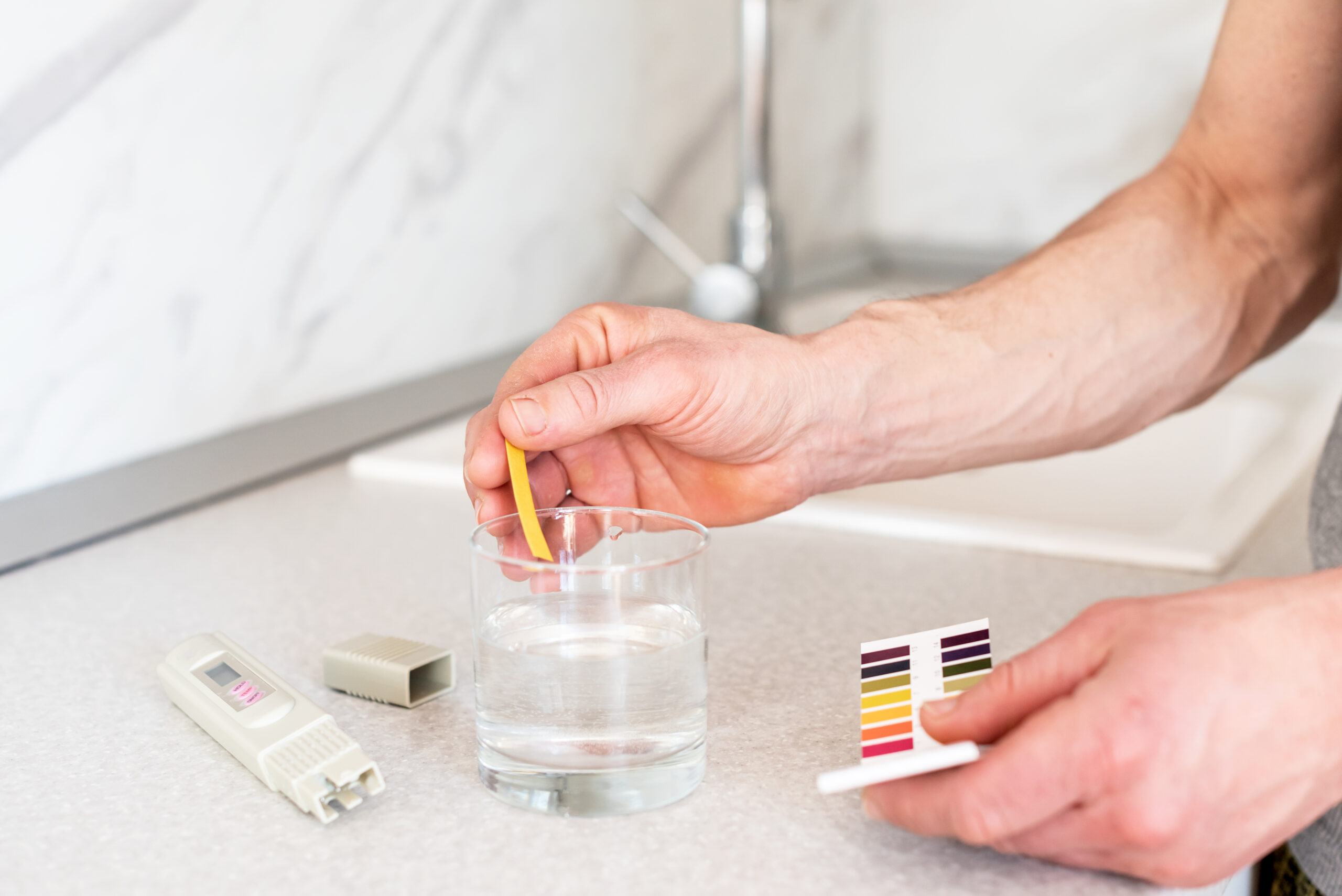
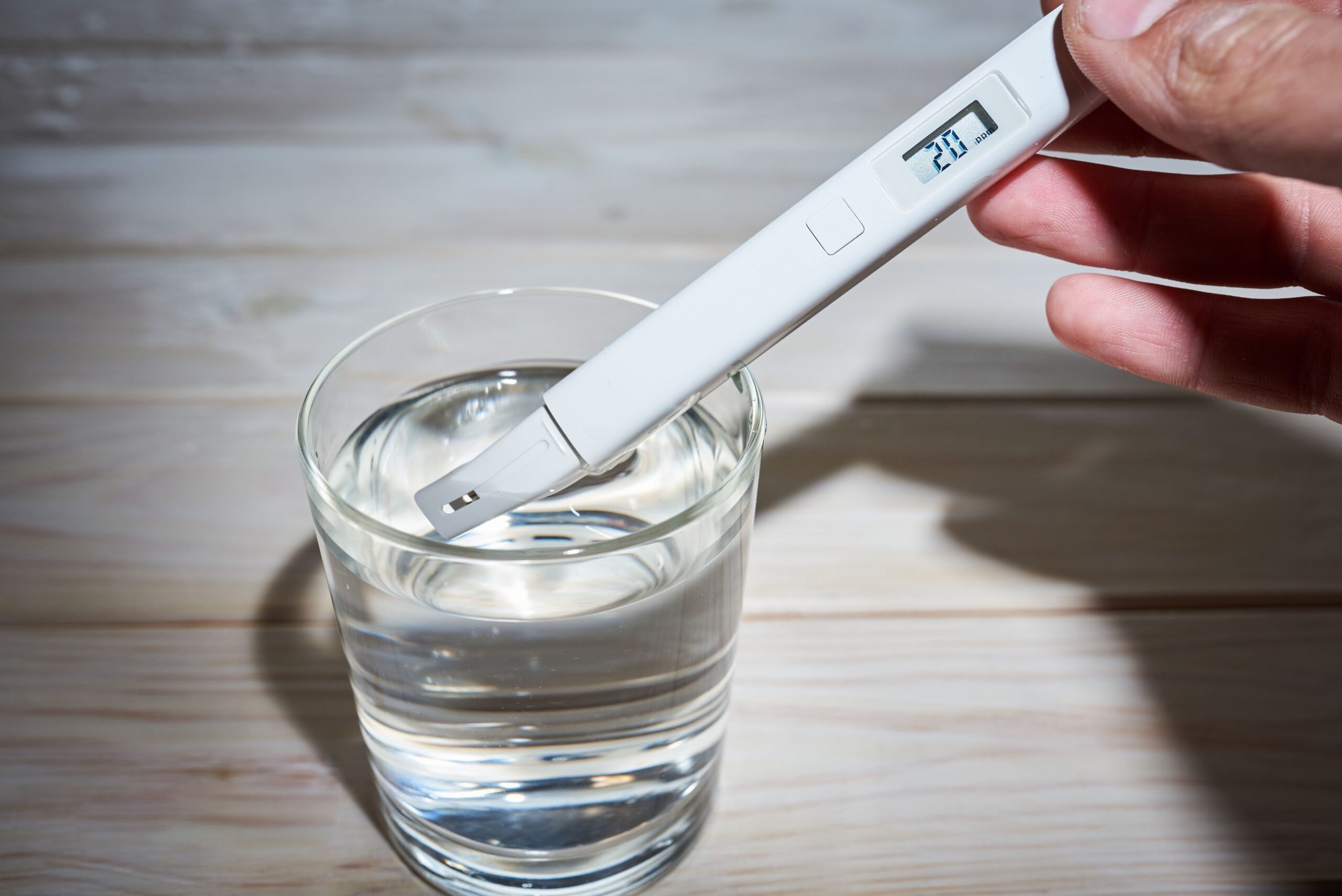
A handheld EC meter is useful because it quickly shows the total conductivity of dissolved ions. It is not a mineral analyzer. A source EC of 0.6 mS/cm could reflect mostly calcium, magnesium and bicarbonate, or it could include enough sodium, chloride or sulfate to change the nutrient and salinity decision. Two wells can therefore have similar EC values and require very different management.
Use source EC as a trend marker. If a well that normally measures 0.35 mS/cm begins reading 0.65 mS/cm under the same sampling method, investigate the change. Do not assume the extra conductivity is useful nutrition.
“My well water is clear and the EC is low. Is that enough to call it safe for the grow?”
No. Low EC tells you that total ionic conductivity is low, but it does not rule out a specific contaminant at a concentration that matters. Build a baseline lab report, then use the handheld meter to watch for change. If the well is also used for drinking, follow local private-well testing requirements separately.
Question sent by: Ethan Brooks, via email.
What Can Be in Well Water?
Groundwater is water in contact with geology. That contact dissolves minerals and can also carry materials introduced by septic systems, agriculture, road salt, mining, industry, fuel, flooding, or damaged well infrastructure. For cannabis irrigation, the most common management questions involve hardness, alkalinity, salinity, sodium, chloride, iron, manganese, nitrate, boron, and suspended or precipitated material.
Hardness: mostly calcium and magnesium
Hardness mainly describes dissolved calcium and magnesium, usually expressed as calcium carbonate equivalent. Those are plant nutrients, so hardness is not automatically a defect. Moderately mineralized groundwater may reduce how much calcium or magnesium the fertilizer must provide.
The limitation appears when hardness increases background EC, interacts with high alkalinity, promotes scale, or creates a calcium-magnesium balance that does not fit the fertilizer. A hardness number also does not tell you how much of the total is calcium versus magnesium. For feeding decisions, the individual Ca and Mg results are more useful than hardness alone.
Hardness is not alkalinity
Hardness mainly reflects calcium and magnesium. Alkalinity measures acid-neutralizing capacity, commonly from bicarbonate and carbonate. Limestone aquifers often produce both, so they can rise together, but one measurement cannot replace the other.
Alkalinity and bicarbonate: the long-term pH pressure
Source-water pH is a snapshot. Alkalinity describes how strongly the water neutralizes acid. Well water moving through carbonate-bearing rock can carry substantial bicarbonate even when its pH looks ordinary. Repeated irrigation with high-alkalinity water can gradually push the root-zone pH upward, especially in small containers and soilless systems.
If a grower repeatedly adjusts every tank to the same final pH but the medium keeps drifting upward, alkalinity is a more useful next measurement than another bottle of pH down. The correction may involve fertilizer choice, calculated acidification, blending, or a different source. The correct response depends on the actual alkalinity and the system, not on the raw-water pH alone.
Sodium, chloride, EC, and salinity
Well water can accumulate sodium and chloride naturally or through road salt, saline intrusion, wastewater, drilling brines, or other local sources. These ions add to EC and can create osmotic stress or specific ion problems when applied repeatedly. Sodium also matters in mineral soils because high sodium relative to calcium and magnesium can damage soil structure and infiltration.
General horticultural screening values can help decide when a source deserves closer investigation, but they are not cannabis-specific toxicity thresholds. A 2024 hemp salinity experiment showed that Cannabis sativa can respond to sodium-chloride irrigation with reduced growth and nutrient imbalance as salinity rises, but the experimental NaCl solutions should not be converted into a universal private-well limit for drug-type cannabis.
Iron and manganese: chemistry and hardware problems
Iron and manganese are common groundwater issues. Water may leave the well clear and develop orange-brown iron particles or darker manganese deposits after exposure to oxygen. Dissolved and oxidized forms behave differently, which is why the same “iron problem” may require different treatment hardware.
For growers using drip irrigation, iron and manganese can matter before they become directly toxic to the plant because precipitates and biofilms may restrict emitters. Penn State irrigation guidance uses iron above about 0.30 mg/L and manganese above about 0.05 mg/L as micro-irrigation clogging screening points. Those are general irrigation-equipment references, not cannabis tissue-toxicity limits.
Nitrate, boron, sulfate, and local groundwater contaminants
A well can contribute nutrients the fertilizer program did not plan for. Nitrate and sulfate are common examples. Boron has a narrow margin between plant requirement and toxicity in many horticultural crops, so it deserves individual analysis where groundwater boron is a regional concern.
Other constituents are not primarily fertilizer questions. Private wells may require testing for coliform bacteria, arsenic, lead, pesticides, volatile organic compounds, radium, or other contaminants based on geology and nearby land use. If the water is used for drinking, an irrigation analysis is not a substitute for certified drinking-water testing and local health guidance.
Do not treat a horticultural water test as a drinking-water safety certificate
Private wells are not monitored like municipal supplies in many jurisdictions. If household drinking safety is relevant, use the certified testing program and contaminant panel required or recommended by your local health authority. A plant-oriented irrigation panel may not include pathogens or health contaminants.
Using Well Water for Indoor Cannabis
Using Well Water for Indoor Cannabis
Indoor cultivation magnifies source-water consistency because rainfall does not dilute the chemistry and the root zone is usually small. Every irrigation repeats the same alkalinity, Ca, Mg, sodium, chloride, iron, manganese, sulfate, and nitrate profile unless treatment changes it. That does not make well water unsuitable. It means the water report becomes part of the nutrient formula and irrigation design.
The indoor decision depends on medium, container size, irrigation frequency, runoff strategy, reservoir design, root mass, temperature, humidity and light. A hand-watered soil container with periodic drainage can manage a different source than a high-frequency coco system or a recirculating deep-water reservoir.
Soil and soil-style mixes
Soil and compost-rich mixes can buffer moderate chemistry, but that buffering can hide slow accumulation. High alkalinity may gradually push pH upward. Sodium and chloride can accumulate when the system has little drainage. Hard groundwater may also add enough Ca and Mg that an automatic calcium-magnesium supplement becomes unnecessary or excessive.
Do not compensate for high source-water EC by simply reducing all fertilizer equally. First identify which ions account for the source EC. Useful calcium is not managed the same way as problematic sodium.
Coco coir
Coco is chemically active and frequently fertigated. The source-water Ca, Mg, K, Na and alkalinity profile therefore matters quickly. A hard well can work in coco when the fertilizer is designed around it, but adding a standard Cal-Mag dose on top of already calcium-rich water may distort the balance.
Because coco is usually managed with regular drainage and EC monitoring, source-water consistency is especially valuable. If well EC changes seasonally, the same fertilizer dose may no longer create the same finished solution.
Rockwool and low-buffer substrates
Rockwool and other low-buffer substrates respond quickly to changes in the irrigation solution. High alkalinity can create repeated pH-management work. High source EC reduces the amount of conductivity available for fertilizer. Iron, manganese, carbonate scale, or suspended solids may also matter operationally because small emitters are sensitive to clogging.
Recirculating hydroponics
Recirculating systems make the ion budget visible. Sodium and chloride that enter with source water can remain in the reservoir even while the plant removes nitrate, potassium, calcium and water at different rates. A source that is manageable in drain-to-waste coco may become awkward when the same ions accumulate in recirculation.
For hydroponics, a treatment such as blending or reverse osmosis may therefore be justified at a lower source-water burden than in a buffered soil container. The correct reason is not that RO water is “cleaner.” It is that the grower needs more control over the starting ion inventory.
A Repeatable Well-Water Testing Procedure
Good well-water management begins with a representative sample. A sample collected from stagnant plumbing, a dirty reservoir, or after a treatment device tells a different story from raw groundwater. Decide what question the sample is answering before you fill the bottle.
Step 1: map the water path
Write the flow path from borehole to plant: well pump, pressure tank, sediment filter, softener, iron filter, carbon, RO, storage reservoir, dosing system, pump, tubing and emitters. Mark the points where you can collect samples.
For a new source, the most useful pair is often raw well water before treatment and the actual point-of-use water after treatment. If an equipment problem is suspected, a third sample after the relevant device may identify where the change occurs.
Step 2: collect a representative raw-well sample
Water standing in a well bore or plumbing may not represent the aquifer. Utah State University’s irrigation sampling guidance recommends pumping before well sampling so stagnant borehole water is displaced. Follow the laboratory’s directions and the well professional’s instructions for the specific system. Do not create an arbitrary universal “run the tap for five minutes” rule because well volume, pump rate and plumbing differ.
When the lab supplies a container, preservative or microbial sampling protocol, that protocol overrides a general irrigation-water routine. Samples for nitrate, bacteria, metals or volatile compounds may have different collection and shipping requirements.
Step 3: measure field pH, EC and temperature
Calibrate meters with fresh standards and record the date. Measure source water before nutrients, acid, base or supplements are added. Use the same meter, units and sampling point over time. The purpose is trend detection, not the last decimal place.
Temperature is worth recording because EC compensation and root-zone response can change with temperature. Deep well water may be cool even when the room is warm. If the source water is stored to temper it, remember that storage adds a new sanitation and biofilm control point.
Step 4: order the irrigation chemistry panel
For a first well assessment, request pH, alkalinity or bicarbonate, EC, hardness, Ca, Mg, Na, Cl, sulfate, nitrate, boron, Fe and Mn. SAR can be useful when the water will be applied repeatedly to mineral soil. Add trace metals or other constituents when local geology, mining, industrial land, road salt, agriculture, septic systems, coastal intrusion or previous testing suggests a reason.
For private-well health safety, use the certified local testing program. CDC guidance in the United States recommends annual private-well testing for total coliforms, nitrate, total dissolved solids and pH, with additional contaminants chosen according to local risk. That recommendation is a drinking-water safety framework, not a cannabis nutrient target.
| Parameter | Why It Matters | Main Risk | What to Compare | Best First Use |
|---|---|---|---|---|
| pH | Current acid-base condition | Misleading when interpreted without alkalinity | Raw water, finished feed, root-zone trend | Mixing and trend context |
| Alkalinity / bicarbonate | Acid-neutralizing capacity | Long-term upward media-pH pressure | Fertilizer acidity and root-zone pH | Decide whether acidification or blending deserves evaluation |
| EC | Total ionic conductivity | High background salt load | Individual ions and final feed EC | Baseline and change detection |
| Hardness, Ca, Mg | Mineral contribution | Scale, precipitation, nutrient duplication | Base fertilizer Ca/Mg contribution | Choose hard-water or low-mineral nutrient strategy |
| Na, Cl | Specific salinity ions | Accumulation and osmotic or ion-specific stress | Root-zone EC, drainage, recirculation | Blend, membrane treatment, or alternate source decision |
| Fe, Mn | Groundwater metals | Precipitation, staining, emitter clogging, high-level toxicity | Raw vs treated water and emitter flow | Choose oxidation, filtration, or specialist treatment |
| Nitrate, sulfate, boron | Hidden nutrient or salt contribution | Formula imbalance or toxicity at excessive levels | Fertilizer inputs and local guidance | Count source-water contribution before supplementation |
Step 5: sample at more than one time when the well can change
One test creates a baseline, not a lifetime certificate. Groundwater can change with drought, recharge, pumping depth, seasonal drawdown, flooding, well repair, nearby land use or treatment-equipment condition. Utah State irrigation guidance recommends sampling when a source is first developed and again when major source changes occur, and notes that early- and late-season chemistry can differ.
For a home grow, the practical version is simpler: test before building the nutrient program, repeat after a treatment change, and retest when field EC, scale, staining, odor, taste, emitter flow or plant response changes unexpectedly. If the source is known to vary seasonally, schedule at least one comparison during the period most likely to concentrate minerals.
Field Advice: Keep the raw-water report beside the nutrient log. A fertilizer recipe without the source-water baseline hides how much Ca, Mg, nitrate, sulfate, sodium and chloride entered before the bottle was opened.

How to Read a Well-Water Report
A laboratory report becomes useful only when every number answers a decision. Do not grade a well as “good” or “bad” from one line. Read the chemistry as a set of interacting loads.
Start with EC, then identify what creates it
Source EC is the quickest summary of dissolved-ion burden. Next read calcium, magnesium, sodium, chloride, bicarbonate, sulfate and nitrate to learn what creates the conductivity. High EC dominated by useful hardness has a different treatment path from high EC dominated by sodium and chloride.
General greenhouse references from Penn State flag source EC, sodium, chloride, hardness and individual minerals at levels where plant or irrigation-management problems become more likely. Use those as screening references for further evaluation, not as cannabis-specific pass-fail lines.
Read alkalinity before chasing source-water pH
A pH of 7.8 with modest alkalinity can be easier to manage than a pH of 7.4 with a large bicarbonate load. Alkalinity tells you how much acid-neutralizing capacity arrives at every irrigation. That is why an acid dose should be calculated from the water analysis, acid product and desired residual alkalinity rather than copied from another grower’s milliliters-per-gallon recipe.
Read hardness, calcium and magnesium together
Hardness is useful for scale screening. Calcium and magnesium are useful for nutrition. If the well already contributes substantial calcium, the grower may need a hard-water formulation or less supplemental Ca. If Mg is low relative to the complete nutrient plan, that is a different problem from “hardness is high.”
Do not soften irrigation water with a conventional sodium-regenerated softener and assume the problem is solved. Ion-exchange softening removes Ca and Mg by replacing them with sodium. That may improve household scale while making irrigation chemistry worse.
“My house has a water softener. Should I use the softened line for cannabis because the hardness is lower?”
Not by default. Conventional softeners commonly exchange calcium and magnesium for sodium. Sample the raw well and the softened outlet separately. For irrigation, the softened water may have less scale but a worse sodium profile. Use a dedicated untreated line, blending, or another treatment only after the report shows what is needed.
Question sent by: Julia Schneider, via contact form.
Read iron and manganese as treatment-design numbers
Iron and manganese treatment depends on concentration, pH and whether the metals are dissolved, oxidized or associated with biological fouling. Orange or black staining tells you to test, not which filter to buy. Water that begins clear and develops particles after air exposure often contains dissolved reduced forms that oxidize after pumping.
Penn State notes that water softeners may remove limited dissolved iron or manganese under specific conditions, while oxidized material can foul the resin. Oxidation and filtration are common approaches at higher concentrations. Manganese removal can require different pH conditions than iron. Treatment therefore needs the actual analysis and system flow rate.
Keep potable-water contaminants in a separate safety lane
Arsenic, bacteria, nitrate, lead, volatile compounds and other contaminants can require treatment even when they have little effect on the plant’s appearance. If the well supplies household drinking water, involve the appropriate health authority and certified laboratory. A cannabis crop is not a remediation device for unsafe household water.
Read raw and treated samples side by side
Compare the well before treatment with the water that actually reaches the reservoir. This shows what the softener, iron filter, RO membrane or blending system really changed.
Judging the treatment by taste or a lower TDS number
A treatment can lower hardness while increasing sodium, or lower EC while leaving a specific contaminant unresolved. Verify the constituent that justified the treatment.
Separate Source Water, Fertilizer Strength, and Root-Zone Accumulation
Three EC values answer three different questions: raw well EC, finished-feed EC, and root-zone or drainage EC. Mixing them together is one of the easiest ways to misdiagnose a mineral-rich well.
Raw well EC is the starting load
Measure before fertilizer. This tells you how much conductivity the source contributes. When comparing nutrient recipes, subtracting or at least recording that starting point shows whether the fertilizer or the well created the difference between batches.
Finished-feed EC is the combined load
After nutrients are mixed according to the product’s instructions, the feed EC represents source minerals plus fertilizer ions. It does not tell you whether precipitation occurred or whether every nutrient remains available, so visual clarity and mixing order still matter.
Root-zone EC is the accumulated result
The root zone reflects water use, fertilizer uptake, evaporation, drainage, substrate chemistry and previous irrigations. A high root-zone EC can develop even when the well itself has moderate EC. Conversely, a high source EC does not prove that the root zone is accumulating salts if irrigation and drainage are well managed.
Use the same root-zone extraction or runoff method when comparing trends. A random first runoff sample from one irrigation should not be treated as a universal soil test.
Do not respond to high source EC by stripping fertilizer blindly
A high well-water EC may contain calcium and magnesium that should be counted, or sodium and chloride that should be reduced. Identify the ions first. Cutting nitrogen, phosphorus and potassium without knowing the source chemistry can create deficiencies while the original salinity problem remains.
Compare input and root-zone trends after the same number of irrigations
Record raw-water EC, final-feed EC, input pH, irrigation volume, drainage volume when used, and the chosen root-zone EC method. If EC rises cycle after cycle, ask whether the source, fertilizer concentration, dry-back, leaching fraction, uneven wetting or water loss is responsible.
Pro Tip: When the source water changes, do not adjust three fertilizer bottles, pH target and irrigation volume on the same day. Change the variable that the data identifies, then watch the next comparable irrigation.
Diagnose Well-Water Problems Before Treating Them
Well-water problems often appear first as equipment behavior or root-zone trends rather than as a unique leaf symptom. Use the pattern to choose the next measurement.
| Symptom | Possible Cause | How to Confirm | Corrective Action | Prevention |
|---|---|---|---|---|
| White scale on emitters or reservoir hardware | Hardness plus alkalinity and precipitation | Check raw hardness, Ca, Mg, alkalinity, pH and deposit location | Treat scale chemistry or clean hardware using a compatible maintenance method | Design treatment around source chemistry and inspect flow routinely |
| Orange-brown deposits | Iron precipitation, corrosion, or iron-associated biofouling | Test Fe; compare raw and oxidized appearance; inspect plumbing and biofilm | Use treatment designed for the measured iron form and concentration | Maintain filters and avoid stagnant dirty storage |
| Black staining or particles | Manganese or other deposits | Laboratory Mn test and treatment-system inspection | Use oxidation/filtration or specialist treatment based on chemistry | Retest after treatment and monitor emitter flow |
| Root-zone pH keeps rising | High alkalinity, fertilizer mismatch, lime reserve, measurement error | Measure alkalinity and medium pH using a repeatable method | Adjust alkalinity management rather than chasing source pH | Count water alkalinity in the fertility program |
| High EC with marginal leaf injury | Na/Cl accumulation, excessive fertilizer, poor drainage, dry-back concentration | Analyze Na/Cl and compare source, feed and root-zone EC | Reduce the identified salt source and restore appropriate leaching or solution management | Track source chemistry and root-zone trends |
| Uneven plant size along a drip line | Mineral scale, Fe/Mn deposits, sediment, emitter variation | Measure emitter discharge into identical containers | Correct filtration, treatment, pressure or emitter blockage | Run periodic flow-uniformity checks |
Orange slime is not a diagnosis
Orange or rust-colored material can be oxidized iron, corrosion products, iron bacteria, other biofilm, or a mixture. Iron bacteria can contribute to slime and clogging in wells and plumbing, but appearance alone does not establish a species or treatment plan. Sample the water, inspect the well and storage system, and involve a qualified well professional when biofouling is suspected.
“I have orange slime in the reservoir. Is that definitely iron bacteria?”
No. Iron, corrosion, sediment and several biofilms can create similar-looking deposits. Test iron and manganese, inspect the well and treatment equipment, and check whether the material forms before or after storage. If iron bacteria or well biofouling is suspected, use a qualified well professional rather than dosing the grow reservoir by guesswork.
Question sent by: CedarRoute, via Facebook page.
A mineral deposit can be an equipment problem without being a plant toxicity problem
A drip emitter can lose flow from precipitation at concentrations that do not visibly injure the crop. This is why uniformity testing belongs in well-water diagnosis. Collect each emitter’s discharge for the same amount of time and compare volumes. If plants at the end of the line receive less water, solve the hydraulic or clogging problem before changing nutrient concentration.
Choose Treatment for the Measured Problem
Treatment should have a target. “Improve the water” is not specific enough. The options below solve different problems and can create new ones if used blindly.
| Treatment Decision | What It Can and Cannot Do |
|---|---|
| No treatment | Correct when the well is chemically compatible with the grow. A stable well with manageable alkalinity, salinity, Fe/Mn and nutrient contributions may need only routine monitoring. |
| Sediment filtration | Removes particles according to filter rating. It does not remove dissolved hardness, bicarbonate, sodium, chloride or most dissolved metals. |
| Oxidation plus filtration | Common approach for dissolved Fe/Mn when chemistry permits. Performance depends on pH, concentration, oxidant, contact time and filter media. |
| Acidification | Neutralizes alkalinity and can reduce carbonate scaling. It does not remove sodium, chloride or all hardness. Dose must be calculated from alkalinity, acid strength and target residual alkalinity. |
| Blending | Can lower alkalinity, hardness, Na, Cl and EC proportionally when a reliable low-mineral source exists. Verify the blended chemistry rather than assuming a mixing ratio. |
| Reverse osmosis | Reduces many dissolved ions and creates a low-mineral starting point. It also removes useful Ca/Mg and alkalinity, produces reject water and requires maintenance. |
| Ion-exchange softening | Reduces Ca/Mg hardness. Sodium-regenerated softeners commonly add sodium and are often a poor irrigation solution unless the treated chemistry is specifically evaluated. |
| Disinfection / UV / well treatment | Targets microbial problems when properly designed. It does not correct salinity or hardness. Well disinfection and potable-water safety should follow local professional guidance. |
When no treatment is the best treatment
If the well provides useful Ca and Mg, manageable alkalinity, low Na/Cl, acceptable Fe/Mn and stable chemistry, filtration equipment may add cost, waste water and maintenance without improving the crop. The cleanest system is often the one with the fewest components needed to solve documented problems.
When sediment filtration is enough
Visible particles, sand or oxidized material can damage pumps and clog emitters. Mechanical filtration is appropriate when the problem is particulate. Choose filter size around the irrigation hardware and particle distribution, not around a generic household filter label.
A sediment filter cannot remove dissolved bicarbonate or sodium. If the field EC is high after the filter, that is expected because the dissolved ions remain.
When iron and manganese need oxidation and filtration
Dissolved Fe and Mn are often converted to particulate oxides and then filtered. Aeration, oxidizing media, chlorine or other oxidants may be used depending on chemistry. Manganese is often more difficult to remove than iron and may require pH adjustment. A specialist should size the process around flow rate and measured concentrations.
Do not copy a household shock-chlorination recipe into the irrigation reservoir. Treat the well or water-treatment system at the correct control point and follow safe, local instructions.
When high alkalinity points toward acidification
Acid can neutralize bicarbonate and reduce long-term upward pH pressure, but acid dosing is a chemical calculation and a safety task. The required amount depends on alkalinity, acid concentration, water volume and the desired residual alkalinity. The source-water pH alone cannot determine the dose.
Safety Note: Concentrated acids can cause severe burns and dangerous reactions. Use appropriate PPE, ventilation, compatible dosing equipment and local workplace guidance. Never mix concentrated acids with incompatible chemicals, and never copy an acid dose from another water source.
When blending is simpler than removing everything
If a reliable low-mineral source is available, blending can reduce hardness, alkalinity, EC, Na and Cl without running the entire volume through RO. The blended result should be tested because a 50:50 volume mix does not guarantee that every practical problem is solved, especially when the second source has its own chemistry.
When reverse osmosis earns its place
RO becomes attractive when the source contains a combination of dissolved salts that cannot be managed well through fertilizer selection, acidification or blending. High sodium and chloride, excessive background EC, or a precision recirculating system may justify the control it provides.
RO is not maintenance-free. Track membrane performance, rejection, prefilters, storage sanitation and product-to-waste ratio. After RO, the nutrient program must supply the Ca, Mg and buffering that the membrane removed.
Why sodium-softened water can be a trap
A conventional household softener solves scale by exchanging Ca and Mg for sodium. That is often useful for plumbing and poor for irrigation. The treated water can have less visible scale while adding a sodium load the root zone did not need.
If the grow must use water from a treated household system, test after the softener. Do not infer the sodium result from the raw well report.
Choose one treatment target
State the problem in measurable terms: lower alkalinity, reduce Na/Cl, remove particulate iron, improve emitter flow, or establish microbial control. Then verify that exact parameter after treatment.
Stacking treatments because the water is “hard”
Softener, acid, carbon and RO solve different problems. Adding all of them without a report can waste water, remove useful minerals, add sodium, destabilize pH and create unnecessary maintenance.
Verify the Decision and Retest
Role A ends with verification. A treatment is not successful because the filter was installed or the pH number changed. It is successful when the measured problem improves and the irrigation system becomes more stable.
Immediately after treatment changes
Collect raw and treated samples under normal flow. Measure EC and pH, then send the treated sample for the constituent that justified the treatment. If the goal was Fe removal, verify Fe. If the goal was alkalinity reduction, verify alkalinity. If the goal was Na/Cl control, verify those ions.
At the next irrigation event
Prepare the nutrient solution exactly as before unless the treatment deliberately changes the nutrient formulation. Record source EC, finished EC, final pH, water temperature, irrigation volume and any drainage measurement normally used. Watch for precipitation in the reservoir and changes in emitter flow.
After several comparable irrigations
Check whether the root-zone trend moved in the intended direction. High alkalinity correction should reduce repeated upward pH pressure. Lower source salinity should create more room for fertilizer and reduce salt accumulation when irrigation is otherwise correct. Fe/Mn treatment should reduce deposits and improve flow consistency.
Do not expect damaged leaves to become perfect again. Judge recovery by new growth, stable root-zone measurements, restored irrigation uniformity and the absence of continued symptom progression.
Retest after the conditions that can change a well
Retest after flooding, well repair, pump changes, major drawdown, a new treatment system, sudden staining or odor, unexplained EC change, or a known seasonal shift. If the well is used for drinking water, maintain the separate health-testing schedule required for private wells in your location.
Before relying on well water for a cannabis crop
- Map the raw-water and treated-water sampling points.
- Establish raw pH and EC with calibrated meters.
- Obtain alkalinity, hardness, Ca, Mg, Na, Cl, Fe, Mn and the locally relevant extended panel.
- Keep drinking-water safety testing separate from the plant-irrigation assessment.
- Count source-water nutrients before adding supplements.
- Check whether a household softener is adding sodium.
- Measure emitter flow if deposits or uneven plant size appear.
- Choose treatment for one measured problem rather than for the word “well.”
- Test the treated water at the actual point of use.
- Verify the result in the root zone over several comparable irrigations.
- Retest when the well, season, treatment equipment or plant response changes.
Master Advice: The best well water is not the water with the lowest EC. It is the source whose chemistry is known, stable enough to manage, compatible with the nutrient program, and verified at the point where it reaches the roots.
Common Well-Water Mistakes That Create New Problems
Assuming mineral-rich means nutritionally complete
Groundwater minerals are not a balanced cannabis fertilizer. A well can provide substantial Ca and still be low in Mg, or contain high sulfate with little nitrate. Nutrient management still requires a complete formula built around the source-water contribution.
Adding Cal-Mag because the water is hard
Hard water may already supply significant calcium and magnesium. Adding a standard supplement without reading the actual Ca and Mg values can raise EC and distort ratios. Read the report and the fertilizer label together.
Buying RO because the pH is high
High source-water pH does not prove high alkalinity, sodium, chloride or excessive EC. A well with pH 8 and moderate alkalinity may be easy to manage. Treatment should follow the chemistry that persists after mixing and irrigation.
Ignoring the household water softener
The plumbing route matters. A raw-well analysis can look suitable while the grow tap receives sodium-softened water. Sample at the point the reservoir is filled.
Treating iron stains with more fertilizer acid
Acidification can influence iron chemistry and scale, but it is not a universal iron-removal strategy. Identify whether the problem is dissolved iron, oxidized particles, corrosion, biofouling or an irrigation maintenance issue.
Using one old laboratory report forever
A well is not a sealed nutrient bottle. Aquifer conditions, pumping depth, drought, recharge, land use and treatment equipment can change. The old report is a historical baseline, not proof of today’s chemistry.
Well Water for Cannabis FAQ
Does well water always need reverse osmosis for cannabis?
No. Many wells are usable without RO. Use RO when dissolved ions create a measured problem that cannot be managed more simply through fertilizer choice, blending, acidification or targeted filtration. RO should solve a documented limitation.
Can hard well water replace Cal-Mag?
Sometimes it can contribute meaningful Ca and Mg, but hardness alone does not tell you the individual concentrations or their balance. Compare the laboratory Ca and Mg results with the complete fertilizer program before deciding whether a supplement is needed.
Is iron in well water good because cannabis needs iron?
Not automatically. Cannabis needs iron in trace amounts, but groundwater iron can precipitate, stain equipment, clog emitters and interact with pH. A high Fe reading is not an efficient micronutrient program. Manage it as source-water chemistry first.
Should I let well water sit before irrigation?
There is no universal need. Well water normally does not contain a municipal chlorine or chloramine residual unless it has been disinfected or treated. Storage can temper water and create operational convenience, but it also introduces biofilm, dust, algae and sanitation risk. Store only when the system has a reason and keep the reservoir clean.
How often should a well be tested for cannabis irrigation?
Test before designing the nutrient program, after treatment changes, and whenever EC, staining, odor, emitter performance or plant response changes. Wells known to vary seasonally deserve comparison during different source conditions. If the same well supplies drinking water, follow the separate local health-testing schedule as well.
Build a Well-Water Baseline Before You Build a Treatment Train
Well water is valuable because it can be consistent, accessible and mineralized in useful ways. It becomes difficult when the grower manages the label instead of the analysis. Hardness can be useful. Alkalinity can be manageable. Iron and manganese can often be treated. Sodium and chloride may justify blending or membranes. None of those decisions should be made from water clarity, taste, pH, hardness, or EC alone.
Start with representative raw and point-of-use samples. Read the well report beside the nutrient program and the growing medium. Change the variable that is actually limiting the system. Then test again. That repeatable loop is more reliable than installing every filter available, and it preserves useful minerals when the well already provides them.
Share this article
A quick overview of the topics covered in this article.
Follow us
Latest articles
September 27, 2026
September 27, 2026

September 27, 2026
September 27, 2026