
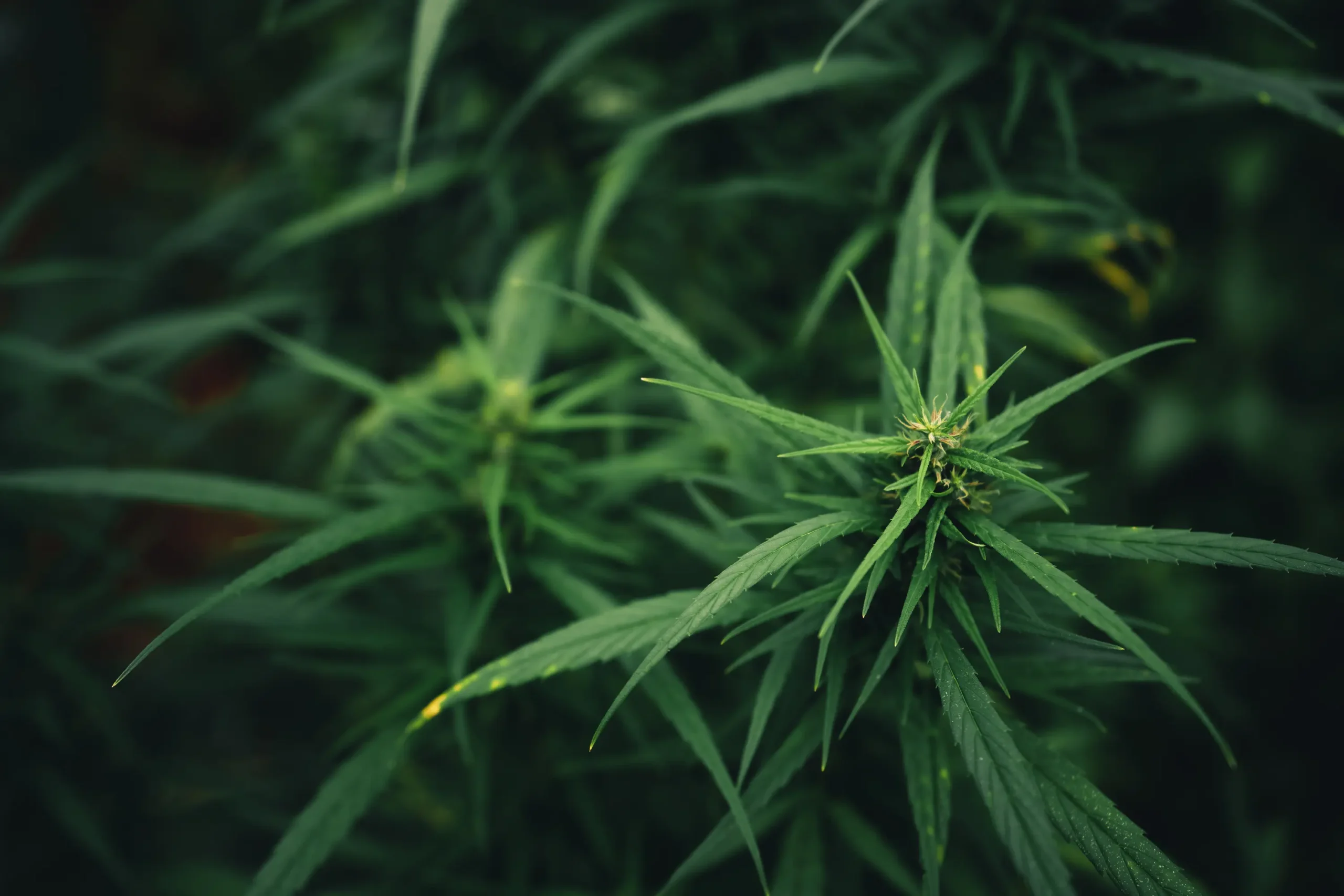
Training Autoflowers Outdoors
Training an autoflower outdoors is less about choosing the most impressive technique and more about protecting a limited developmental window. An autoflower does not wait for the grower to decide when flowering should begin. Photoperiod-insensitive cannabis can move into reproduction without the shortening days that trigger conventional photoperiod plants, so time spent recovering from a poorly timed intervention cannot simply be replaced by extending vegetative growth.
That does not mean autoflowers should never be trained. It means every intervention needs a reason. A healthy outdoor autoflower may benefit from gentle branch positioning when one shoot dominates the structure, interior growth becomes difficult to inspect, or a container plant needs a lower profile before wind and flower weight increase. The same plant may gain nothing from topping, repeated bending, heavy defoliation, or dramatic reshaping if its natural architecture already fits the site.
The practical question is therefore not, “Can autoflowers be trained?” It is, “Does this plant have enough vigor and developmental runway for this specific intervention to solve a real outdoor problem?” The answer changes with genetics, establishment quality, planting date, root volume, weather, branch flexibility, and how close the plant is to reproductive transition.
What Training Changes in an Outdoor Autoflower
Autoflowering changes the timing problem before it changes the training problem. Genetic studies now support what growers have long observed: photoperiod-insensitive cannabis can initiate flowering without relying on the shortening-day signal that controls conventional photoperiod cultivars. Research has identified more than one major locus associated with this trait, which also helps explain why “autoflower” should not be treated as one perfectly uniform growth type.
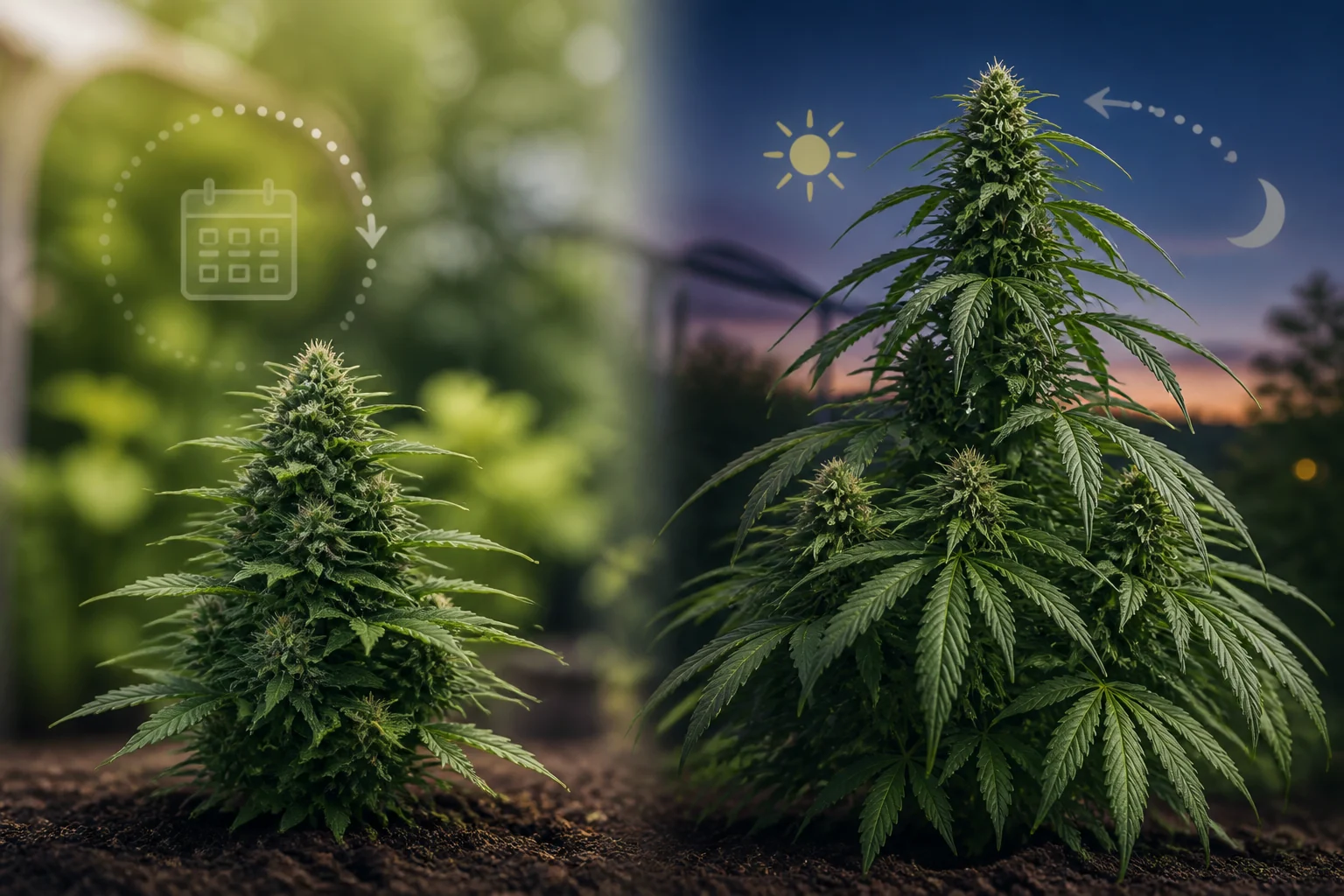
The practical consequence is simple. A photoperiod plant can often be kept vegetative while a damaged branch recovers, a canopy fills, or a training mistake is corrected. An autoflower’s developmental clock is less negotiable. If early growth is slowed by transplant shock, root-zone problems, cold weather, drought, nutrient injury, or a high-stress training event, flowering may still approach while the plant is rebuilding.
Developmental runway
The healthy growth time still available before reproductive development becomes the plant’s dominant priority. It is not a fixed number of days for every autoflower. Genetics, establishment, weather, planting date, and plant condition all affect how much useful runway remains.
Training changes architecture, not the genetic clock
Training can change branch position, relative shoot dominance, canopy width, inspection access, and the way later flower weight is distributed through the plant. It does not give an autoflower a new vegetative phase. A branch bent outward may reorient toward light. A topped plant may redirect growth toward lateral shoots. A selectively opened canopy may become easier to inspect and support. None of those changes stop the underlying transition toward flowering.
This distinction matters outdoors because sunlight is not a fixed overhead lamp. The sun moves through the sky, leaves continually adjust orientation, and an open site can provide useful light from changing angles throughout the day. Flattening an autoflower into an indoor-style tabletop canopy is therefore not automatically beneficial. The outdoor goal is often better described as separation, access, stability, and manageable exposure rather than perfect canopy flatness.
Outdoor training solves different problems from indoor training
Indoors, height control and lamp distance can dominate architecture decisions. Outdoors, there is usually no ceiling and there may be no reason to suppress a naturally compact plant. Instead, useful training targets may include keeping a container plant below a visibility or wind-exposure limit, opening a dense center for inspection, separating branches that rub against one another, or creating a structure that can later be supported without tying heavy flowers together.
That is why a technique can be biologically possible yet strategically unnecessary. If a healthy autoflower already has good branch spacing, stable roots, useful sun exposure, and a structure you can inspect, leaving it alone may be the lower-risk decision.
Train to solve a visible structural problem
Use gentle positioning when you need better branch separation, access, height control, or a clearer support path.
Train because every autoflower “should” be trained
A naturally balanced plant may lose more from unnecessary stress than it gains from a fashionable canopy shape.
Low-stress and high-stress methods are not equivalent
Low-stress training changes position while retaining the main growth tissue. Topping removes the apical meristem. FIMing partially damages the developing apex. Supercropping intentionally deforms internal stem tissue. These methods can all change architecture, but their repair cost is not the same.
For an autoflower, intervention severity should therefore be part of the decision before technique preference. A vigorous plant with flexible branches may need only a soft tie. A weak plant that is already flowering does not become a better candidate for topping simply because topping is an established cannabis technique.
| Training option | What it changes and the main outdoor autoflower tradeoff |
|---|---|
| Gentle LST | Changes branch angle and relative canopy position without removing the growth tip. Usually the lowest-recovery architecture intervention, but ties can still girdle stems, destabilize pots, or split rigid branches. |
| Leaf tucking or minor repositioning | Temporarily improves access or light exposure without removing tissue. It may be enough when the problem is a few blocking leaves rather than whole-canopy architecture. |
| Topping | Removes the dominant shoot tip and redistributes subsequent growth. The tradeoff is a real wound and a recovery demand that cannot be compensated by extending the vegetative phase on command. |
| FIMing | Partially damages the apex rather than removing it cleanly. Outcome is less predictable than internet diagrams imply, and autoflower-specific controlled evidence is limited. |
| Supercropping | Redirects a branch by controlled stem deformation. It carries more structural and recovery risk than ordinary bending, especially outdoors where wind can load the injured point. |
Remember: With an autoflower, the smallest intervention that solves the real problem is usually more valuable than the most advanced technique you know how to perform.
Best Timing and Plant Condition Before Training
Autoflower timing should be read from the plant, not copied from a calendar. “Day 14,” “week three,” or “the fifth node” may describe one grower’s plant, but they do not prove that another cultivar growing through different weather and root conditions has the same developmental runway.
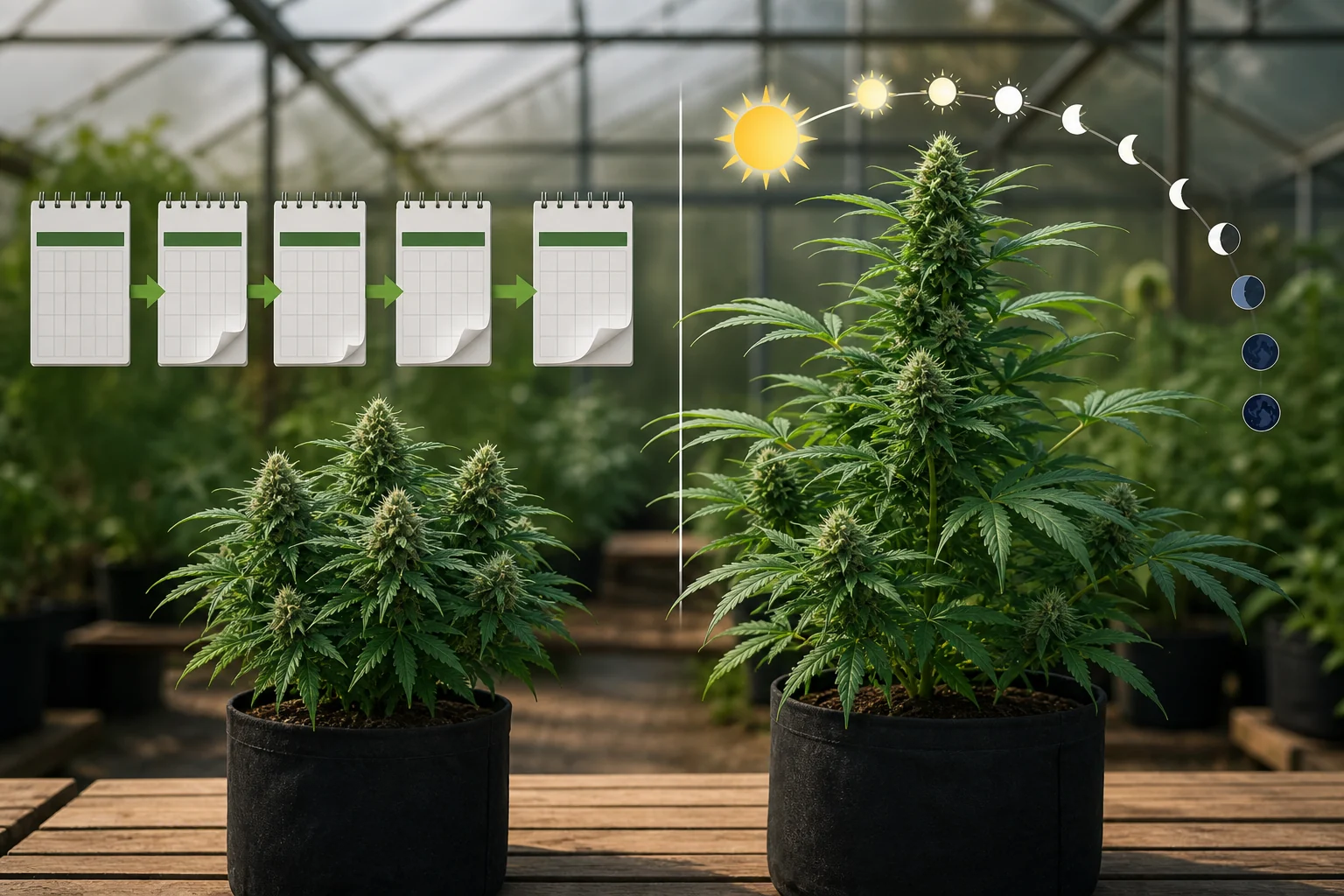
Research on day-neutral hemp reinforces that point. In outdoor field trials, planting date altered the yield of day-neutral cultivars, and genetic studies show substantial variation in flowering time among photoperiod-insensitive material. Those studies are not training trials, but they demonstrate why a universal autoflower training date is scientifically weak.
Start with establishment, not node count
Before training, the plant should be actively establishing new growth rather than merely surviving. Look for an expanding canopy, functioning leaves, a stem that is thickening normally, and a root zone that is cycling water predictably. A plant that has just recovered from severe overwatering, nutrient injury, pest pressure, cold nights, wind damage, or transplant disturbance already has a recovery debt.
Node count can help describe plant development, but it should not override plant condition. Two plants with the same number of nodes can differ dramatically in stem thickness, root stability, branch flexibility, leaf area, and reproductive development.
Check whether reproductive transition has already started
Do not assume long summer days mean an autoflower is still safely vegetative. That assumption belongs to photoperiod plants. On an autoflower, inspect the shoot tips and nodes for clear reproductive development. As flowering becomes obvious, the value of major architecture rebuilding falls because the plant is increasingly allocating resources to reproductive tissues.
This does not mean every tie must be removed the moment pistils appear. Gentle support and minor positioning may remain useful. The key change is that training should shift from building architecture to protecting architecture.
Do not use daylight length to decide whether an autoflower is still in veg
Photoperiod-insensitive plants can initiate flowering under long days. Read the plant’s reproductive development directly instead of assuming midsummer daylight guarantees a long training window.
Stem flexibility is a physical checkpoint
For bending methods, flexibility matters more than a named week. A young, actively elongating stem can often be redirected with modest force. As secondary growth advances, stems become thicker and less forgiving. The same bend that gently changes a young branch angle can crack or split a rigid flowering branch.
Test flexibility gradually. Support the branch near its base, apply minimal pressure, and watch how the stem responds. If you need escalating force to create the desired angle, the branch may already be beyond low-stress territory. Do not turn LST into accidental supercropping simply because the canopy plan says the branch should move.
Root-ball stability matters outdoors
A tie creates leverage. On a small outdoor container, pulling the main stem sideways can rotate the root mass, tilt the whole pot, or make the container easier for wind to overturn. In loose native soil, a young plant can also shift at the crown if the anchor point pulls harder than the established roots can resist.
Before tightening any tie, ask where the reaction force goes. If one side of the plant is being pulled outward, the opposite side may need a counter-tie or a stable external anchor. The goal is to reposition the shoot, not wrench the crown or make the root ball absorb every gust.
“My autoflower is growing fast but has already started showing flowers. Is it too late for LST?”
Question sent by: Ethan Brooks, via email.
Not automatically, but the objective should change. If branches are still flexible, a small positioning adjustment may improve separation or support without asking the plant to rebuild its architecture. Avoid treating early flower as permission for aggressive reshaping. Once stems are stiffening and reproductive growth is clearly advancing, stability usually matters more than canopy redesign.
Weather can close the training window early
Outdoor timing is not only developmental. A healthy flexible branch can still be a poor training candidate before strong wind, heavy rain, a cold spell, or a period when you cannot inspect the plant. Fresh tie points and recently redirected stems deserve follow-up. If weather is about to impose its own mechanical load, avoid adding an unnecessary structural experiment immediately beforehand.
Field Advice: A good training day is not merely a date on the plant’s age chart. It is a moment when the plant is vigorous, the stem is workable, the root system is stable, flowering has not advanced too far, and you can inspect the result again soon.
A Step-by-Step Outdoor Training Method
A repeatable autoflower workflow should begin with the problem, not the technique. The plant may need no intervention at all. If intervention is justified, start with the least injurious option capable of solving it.
Step 1: Define the problem in one sentence
Examples include: the main stem is creating excessive height, two branches are crossing and rubbing, the interior is becoming difficult to inspect, one side of a container plant is catching too much wind, or future flower-bearing branches have no clear support path.
If you cannot define the problem, do not cut or bend simply to “increase yield.” Training without a measurable target is difficult to evaluate afterward.
Step 2: Decide whether position alone can solve it
Before considering topping or another high-stress intervention, test whether leaf tucking, branch separation, a wider plant spacing, a soft tie, or a support stake solves the issue. Autoflowers are particularly good candidates for this hierarchy because each avoided wound preserves more of the limited developmental window.
Step 3: Choose a safe anchor system
Use broad, soft material that does not behave like wire against expanding stems. The tie should spread pressure over a larger surface and remain visible enough to inspect. Anchor to a stable pot rim, stake, cage, or external support rather than to something that can shift with the plant.
Do not tie wet stems tightly, bury ties inside dense foliage, or create loops that become hidden as the branch thickens. A tie that looks loose today can become a constriction point later.
Counter-tie
A stabilizing tie placed in the opposite direction from a training pull. Its purpose is to keep the crown, main stem, container, or root ball stable while another tie changes branch position.
Step 4: Move in increments
With LST, the first adjustment does not need to create the final architecture. Change the angle until the branch is clearly repositioned but the tissue remains intact and the plant remains stable. If the desired position requires one abrupt bend, consider whether the goal is too aggressive for the tissue stage.
After repositioning, check the branch union, the bend area, the crown, the pot, and the anchor. A successful-looking canopy means little if the root ball has rotated or the tie is cutting into a stem.
Step 5: If you are considering a cut, raise the evidence bar
Topping and FIMing should not be treated as mandatory autoflower steps. Direct controlled evidence comparing modern high-cannabinoid autoflowers under outdoor topping regimes remains sparse. Research on cannabis architecture shows that pruning can alter branching, light distribution, biomass, and chemical uniformity, but those results come largely from other production systems and genotypes.
If a grower chooses a cutting technique, the plant should be exceptionally vigorous and the structural problem should justify the added recovery demand. Do not copy a fixed node rule or a promised recovery duration from another crop. The plant’s subsequent growth is the verification.
Escalate intervention only when the problem requires it
Try positioning and support before tissue removal when both can solve the same structural issue.
Stack multiple stressors because the plant looks vigorous today
Topping, defoliation, transplanting, feeding changes, and hard bending performed together make failure harder to diagnose and increase the recovery burden.
Step 6: Record the intervention
Photograph the whole plant and the trained branch from the same angle. Record the date, visible reproductive stage, weather, and what changed. The purpose is not documentation for its own sake. It gives you a baseline for answering the only question that matters later: did the intervention improve structure without costing unacceptable growth?
Step 7: Reinspect before adjusting again
Do not keep training merely because the branch moved upward again. Upward reorientation is a normal plant response. First check whether the new angle has already solved the original problem. A branch can rise toward the light and still remain better separated from the canopy than it was before.
| Decision checkpoint | What to look for outdoors |
|---|---|
| Before training | Active new growth, stable root zone, workable stem, no major unresolved stress, enough access for follow-up, and no advanced reproductive development that makes rebuilding a poor trade. |
| Immediately after | Intact outer tissue for LST, stable crown and pot, no tie cutting into the stem, no branch union tearing, and the intended structural problem actually improved. |
| Next inspection | Continued tip expansion, normal leaf function, branch reorientation without progressive collapse, stable anchors, and no new mechanical damage after wind or watering. |
| Before another adjustment | Previous intervention is no longer creating an active recovery problem, the new adjustment solves a specific need, and reproductive development has not made further redesign unnecessary. |
Recovery Signs vs Failure Signs
Autoflower recovery should be evaluated by direction of change, not by waiting a universal number of days. A minor tie adjustment and a topping cut are different injuries. A warm, vigorous plant and a cold, root-stressed plant are different biological starting points. One fixed recovery window cannot honestly cover both.
Recovery means the plant resumes useful growth
Useful recovery signs include continued expansion at active tips, stable leaf posture relative to normal daily movement, a branch that reorients without worsening damage, and no progressive constriction or splitting at the training point. On a cut plant, healthy lateral growth matters more than the cosmetic appearance of the cut surface.
Recovery also has a structural component outdoors. A trained branch that looks healthy in still weather but repeatedly collapses or twists in normal afternoon wind has not reached a stable end state.
Temporary response is not the same as failure
A recently bent shoot may change orientation over the next light period. Leaves may reposition. Growth may look asymmetrical while the plant recalibrates. These observations are not automatically failure.
Failure is more concerning when the pattern progresses: a branch remains limp beyond ordinary daily leaf movement, a crease opens into a split, tissue above a damaged point loses function, the tie begins girdling, the crown shifts in the medium, or new growth stops while the rest of the plant continues normally.
A trained branch should not be judged in isolation
Compare it with the rest of the plant and with its own baseline. Whole-plant drought, hot midday droop, cold stress, and root-zone problems can mimic a training failure.
Separate training injury from root-zone and weather stress
If the entire plant wilts, the tie may not be the main problem. Check irrigation, drainage, root temperature, recent feeding, and weather. If only tissue above one bend or cut deteriorates while the rest of the plant remains functional, localized mechanical or vascular damage becomes more plausible.
This is where same-angle photographs help. Memory is poor at judging slow progression. A marked branch photographed before and after training makes it easier to distinguish normal reorientation from a worsening lesion or constriction.
“My main stem stood back up after I tied it down. Did the LST fail?”
Question sent by: Julia Schneider, via contact form.
Not necessarily. Upward reorientation is expected. Recheck the original goal. If the main stem is still lower, side branches have more space, and the tie is safe, the plant may be responding exactly as expected. Do not keep tightening the tie simply to force a permanently horizontal stem.
Do not stack a second intervention onto uncertain recovery
If the plant’s response is ambiguous, pause. Adding another bend, pruning event, or heavy cleanup destroys your ability to identify what caused the slowdown. Autoflowers make this especially costly because the developmental clock continues while you troubleshoot.
Master Advice: Recovery is not “the plant survived.” Recovery is that the plant has returned to useful growth and the trained structure is stable enough that another intervention is not needed to rescue the previous one.
When to Stop Training an Autoflower Outdoors
The best autoflower training plans have an exit condition. Without one, training becomes a habit and the grower keeps manipulating a plant after architecture has stopped being the limiting factor.
Stop redesigning once reproductive growth becomes the priority
As flowering advances, the cost-benefit balance changes. The plant is no longer primarily building a vegetative framework. Stems begin carrying reproductive mass, branch unions become more important, and the value of another dramatic canopy correction falls.
There is no honest universal “stop at week X” rule. Autoflowering accessions differ in flowering timing, and outdoor weather can accelerate or suppress vegetative performance before flowers appear. Use developmental signs rather than a package calendar.
Stop bending when the stem tells you the method has changed
If a branch requires force that threatens cracking, the technique is no longer low stress. A late rigid branch can often be supported or gently repositioned a small amount, but forcing it toward an early-vegetative canopy shape creates a new failure point.
Stop when the original problem is solved
This is one of the most overlooked rules. If branch separation is good, inspection access is clear, height is acceptable, and future support can be installed, more training does not automatically make the plant better. Autoflowers reward restraint because every unnecessary adjustment consumes attention and can create new mechanical risk.
Stop high-stress work when the plant is already paying another recovery cost
Drought recovery, pest damage, root-zone oxygen problems, nutrient injury, storm damage, and transplant disturbance all compete with architecture management. The grower does not need to decide whether the plant can theoretically survive one more intervention. The better question is whether the intervention solves a problem important enough to justify adding another recovery demand.
“Should I top a small outdoor autoflower because it is already too tall for my space?”
Question sent by: MapleGrower, via Facebook page.
Height pressure is a real reason to consider training, but topping is not automatically the best correction. If the stem is still flexible, a supported gradual bend may reduce height with less tissue loss. If flowering is already advancing or the plant is stressed, changing the site, support, or visibility strategy may be safer than asking the plant to rebuild its apex.
Weather can convert a reasonable bend into a bad decision
A branch newly pulled sideways exposes a different surface area to wind. A container plant with a widened canopy develops more leverage. A tie anchored to the pot can turn the entire container into part of the load path. Stop major training when incoming weather means you cannot verify the new structure under safe conditions.
Yield Claims vs Reality
Training discussions often jump from architecture to yield as though every additional exposed branch becomes additional harvest. The evidence does not support that shortcut, especially for autoflowers outdoors.
Architecture can redistribute opportunity
Cannabis research outside the autoflower-specific context shows that architecture affects light penetration, spatial chemical uniformity, and biomass distribution. Pruning and branch removal can change where productive tissue develops. That supports the mechanism behind training, but it does not establish that every training method raises total yield in every genotype or environment.
An autoflower adds another constraint: the intervention must repay its recovery cost before the developmental window moves on. A technique that would eventually improve a long-vegetative photoperiod canopy may not have enough time to pay back the same cost in a rapidly transitioning autoflower.
Outdoor sun changes the canopy equation
Indoors, a fixed overhead fixture creates a strong reason to equalize distance from the light. Outdoors, light direction changes continuously and there is no lamp-height ceiling. Training can still improve separation and reduce self-shading, but the indoor argument for a perfectly flat canopy should not be copied automatically.
Field research on day-neutral hemp also shows that planting date itself can change floral biomass. That is a useful reminder that outdoor outcome may be dominated by seasonal timing before a training technique ever enters the equation. The study involved industrial hemp cultivars in Georgia, not modern high-THC retail autoflowers, so its yield values should not be transferred. The principle is what matters: the available season is part of the yield system.
Genotype can change the response
Autoflowering is not one genetic background. Research has identified multiple loci associated with photoperiod insensitivity, and flowering-time variation exists among photoperiod-insensitive material. Modern high-cannabinoid autoflowers also differ from older day-neutral hemp references used in much of the academic literature.
That is why claims such as “autoflowers always hate topping” and “this cultivar always doubles yield when trained” belong in the same caution category. Both claim more certainty than the direct evidence supports.
Important: A cleaner canopy, more visible flower sites, or more branch tips is not the same measurement as greater final dry flower yield. Do not use appearance as proof of a yield gain.
Measure whether training solved the intended problem
If the goal was height control, measure height. If the goal was branch separation, photograph the canopy and inspect whether previously hidden junctions are accessible. If the goal was support readiness, check whether each major branch now has a clear load path. These are defensible outcomes even when final yield is influenced by dozens of other variables.
This approach also makes future grows more useful. Instead of remembering that “LST worked,” you can record what problem it solved, at what stage, on what plant shape, under what weather, and whether the plant maintained normal development afterward.
Late-Season Support, Inspection, and Weather
Outdoor autoflower training should end by making the plant easier to finish, not harder. As flowers gain mass, the architecture you created earlier becomes a structural system exposed to wind, rain, daily irrigation movement, and repeated inspection.
Training ties are not automatically support ties
A tie used to pull a young branch outward may be poorly positioned to support that branch later. It may pull from the wrong direction, sit too close to a swelling stem, or transfer load into an unstable pot rim. Reassess every early training tie as the branch thickens.
Some ties should be loosened or removed. Others can be replaced with support that carries flower weight without constricting the stem. Do not assume the original training hardware should remain untouched until harvest.
Watch the root ball as the canopy widens
A low, wide plant can catch wind differently from an upright plant. In a container, this increases leverage at the pot and crown. Counter-ties, stakes, cages, or external supports should stabilize the plant without pulling the root mass in competing directions.
For an outdoor autoflower, this is often a more valuable late-stage use of “training” than trying to keep flattening the canopy. The job has changed from shaping growth to managing load.
Preserve inspection access
Training that creates a beautiful dense mat of branches but prevents inspection is a poor outdoor outcome. Flowers need to be reachable after rain, branches need to be checked at unions and tie points, and interior tissue must remain visible enough to spot pests, dieback, or mechanical damage.
In humid or rainy conditions, prioritize access and dry-down over cosmetic symmetry. A branch placed slightly higher or farther apart may be preferable if it prevents flowers from resting against one another and lets you inspect the interior after wet weather.
Separate training damage from storm damage
When a trained branch fails after wind, do not automatically blame the technique or the storm. Inspect the actual failure point. Did the stem split at a training crease? Did a tie constrict or saw into tissue? Did the anchor pull the whole pot? Did a healthy branch fail at a natural union under exceptional load?
This distinction matters because the correction is different. A weak training point may change how you manipulate future plants. A poor anchor may require a better support system. An exceptional storm may simply exceed what a healthy plant could reasonably resist.
Do not convert late flower into another high-stress training phase
Heavy flowers and rigid stems change the risk profile. Late work should prioritize support, separation, access, and damage prevention rather than rebuilding the plant’s architecture.
A final outdoor verification sequence
At the end of active training, walk around the plant instead of viewing it from only one angle. Confirm that major branches are separated, no tie is hidden against swelling tissue, the crown is stable, the plant cannot lever its container over easily, and flowers will remain accessible for inspection.
Then revisit the original reason for training. If the problem is solved and the plant is moving normally into flower, the best next action may be no further training at all.
Before You Train an Outdoor Autoflower Again
- Define the structural problem before choosing a technique.
- Confirm active growth and a stable root zone.
- Check reproductive development directly rather than relying on day length.
- Test stem flexibility with minimal force.
- Choose positioning before cutting when both can solve the same problem.
- Use soft visible ties and stable anchors.
- Check the crown and root ball after every pull.
- Photograph the trained area so recovery can be compared.
- Pause if the previous intervention is still causing uncertain recovery.
- Stop redesigning architecture as flowering advances and stems stiffen.
- Replace training ties with true support when flower weight changes the load.
- Keep enough space to inspect flowers, branch unions, and the plant interior.
- Judge success by the problem solved, not by a promised yield percentage.
Use the next section to turn the related background into a specific follow-up decision.
Share this article
A quick overview of the topics covered in this article.
Follow us
Latest articles
September 26, 2026
September 26, 2026
September 26, 2026
September 26, 2026