
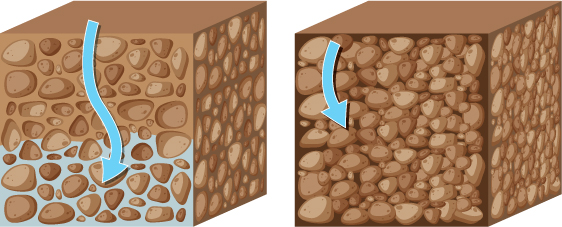
Infiltration vs Drainage vs Percolation
Water can disappear from the surface and still leave a cannabis root zone too wet. It can also enter slowly at the surface while the deeper soil drains reasonably well once water gets through. Those situations are easy to misread because infiltration, percolation, and drainage describe different parts of the same water-moving event.
Infiltration is water entering the soil or growing medium at the surface. Percolation is water moving downward through the profile after it has entered. Drainage is the broader removal of excess water from the root zone or growing system, whether that water moves deeper than the active roots, moves laterally away from the planting area, or exits through container drainage holes.
The practical decision is not which process is “best.” The useful question is where water movement is actually failing. If water cannot enter, work on infiltration. If it enters but stalls at a restrictive layer, investigate percolation through the profile. If the root zone remains saturated because water has nowhere to leave, investigate drainage. Correcting the wrong process can waste amendments, worsen structure, or hide the real problem for another watering cycle.
Resource Guide
In This Resource
- Separate the Three Processes Before Diagnosing the Root Zone
- Follow One Watering Event From Surface Entry to Root-Zone Exit
- Diagnose an Infiltration Problem at the Surface
- Diagnose a Percolation Problem Through the Profile
- Diagnose a Drainage Problem at the Root-Zone Boundary
- Run a Repeatable Water-Movement Check
- Separate Common Failure Modes and Look-Alikes
- Verify the Correction Instead of Assuming It Worked
Separate the Three Processes Before Diagnosing the Root Zone
The three terms overlap in ordinary gardening language, which is why growers often use “drainage” to describe almost every water problem. For diagnosis, that shortcut is too broad. Each term points to a different location in the water pathway and therefore to a different set of measurements.
USDA-NRCS guidance defines infiltration as water entering the soil through the surface and percolation as the subsequent downward movement through the profile. NRCS also distinguishes deep drainage as water percolating beyond the effective root zone. In a container, growers usually use drainage more practically to describe excess water leaving the medium through an outlet after the medium has been wetted.
Infiltration
Infiltration is the entry of water through the surface of soil or growing medium. Surface crusting, compaction, water repellency, irrigation rate, existing moisture, aggregation, roots, and continuous pores can all change how quickly and evenly that entry occurs.
Percolation and Drainage
Percolation is water moving through the soil profile after infiltration. Drainage describes the removal of excess water from the root zone or system. Deep percolation can therefore become one form of drainage, but the terms are not interchangeable.
| Term | What the Grower Is Actually Observing |
|---|---|
| Infiltration | Does applied water enter the surface evenly, pond, run away, or bypass dry areas through cracks and edge channels? |
| Percolation | After water enters, does the wetting front continue downward through the profile, or does movement slow sharply at a dense, fine-textured, compacted, or layered zone? |
| Drainage | After the root zone becomes wet, can excess gravitational water leave the active root zone or container, or does the lower zone remain saturated because of a restrictive layer, high water table, blocked outlet, shallow container geometry, or standing runoff? |
Remember: A fast surface intake rate does not prove that the lower root zone drains well. It only proves that water found a way through the surface during that observation.
Why the distinction matters for cannabis roots
Cannabis roots need both water and gas-filled pore space. After irrigation or heavy rain, large pores normally lose gravitational water first and begin to refill with air. If the profile remains saturated, gas diffusion slows sharply and the root zone can become oxygen-limited. The plant may then show reduced vigor, drooping, weak nutrient uptake, or root disease symptoms even though the original failure was physical water movement rather than a feeding problem.
The same visible plant symptom can result from different pathways. A container that stays wet because the outlet is blocked is not the same problem as a hydrophobic potting mix that sheds water down the sidewall. A native soil with a sealed surface is not the same problem as a soil with a permeable topsoil over dense subsoil. The correction should follow the mechanism.
“Water disappears from the surface quickly. Does that mean my outdoor soil has good drainage?”
Question sent by: SoilAndCoffee, via email.
No. Fast entry may reflect good structure, but it can also reflect cracks, worm channels, old root channels, or a loose upper horizon. Check deeper moisture after the event and inspect whether water is accumulating above a restrictive layer. Good infiltration is useful, but it is only the first part of the pathway.
Follow One Watering Event From Surface Entry to Root-Zone Exit
The cleanest way to compare these processes is to follow a single irrigation or rainfall event. Water first meets the surface, then moves through pores and around aggregates, then redistributes through the profile. Some is retained, some is taken up later by roots, and some may move below or out of the active root zone.
Stage 1: water reaches the surface
At the beginning of watering, a relatively dry structured soil may accept water quickly through open pores and cracks. As the profile wets, the entry rate often slows because pores are already filled and the deeper profile must transmit water away from the surface. NRCS guidance notes that infiltration commonly declines toward a steadier rate as soil becomes wetter.
If irrigation is applied faster than the surface can accept it, water ponds or runs off. That is an application-rate and infiltration mismatch. It does not automatically mean the deeper soil is poorly drained.
Field Advice: Watch the first few minutes of irrigation. Surface ponding that starts almost immediately tells you something different from water that infiltrates well at first but begins to pond only after the profile has become wet.
Stage 2: the wetting front moves downward
Once water has entered, percolation depends on the continuity and size of pores, hydraulic conductivity, layering, soil structure, and the current moisture state. Large continuous pores can move water rapidly. Fine pores move water differently and can slow gravitational flow. A compacted horizon or abrupt textural boundary can become the bottleneck even when the surface looks excellent.
This is why a garden can absorb a downpour without obvious runoff and still develop a saturated band around the root zone. The surface solved the infiltration problem. The profile did not solve the percolation problem.
Stage 3: excess water leaves or remains
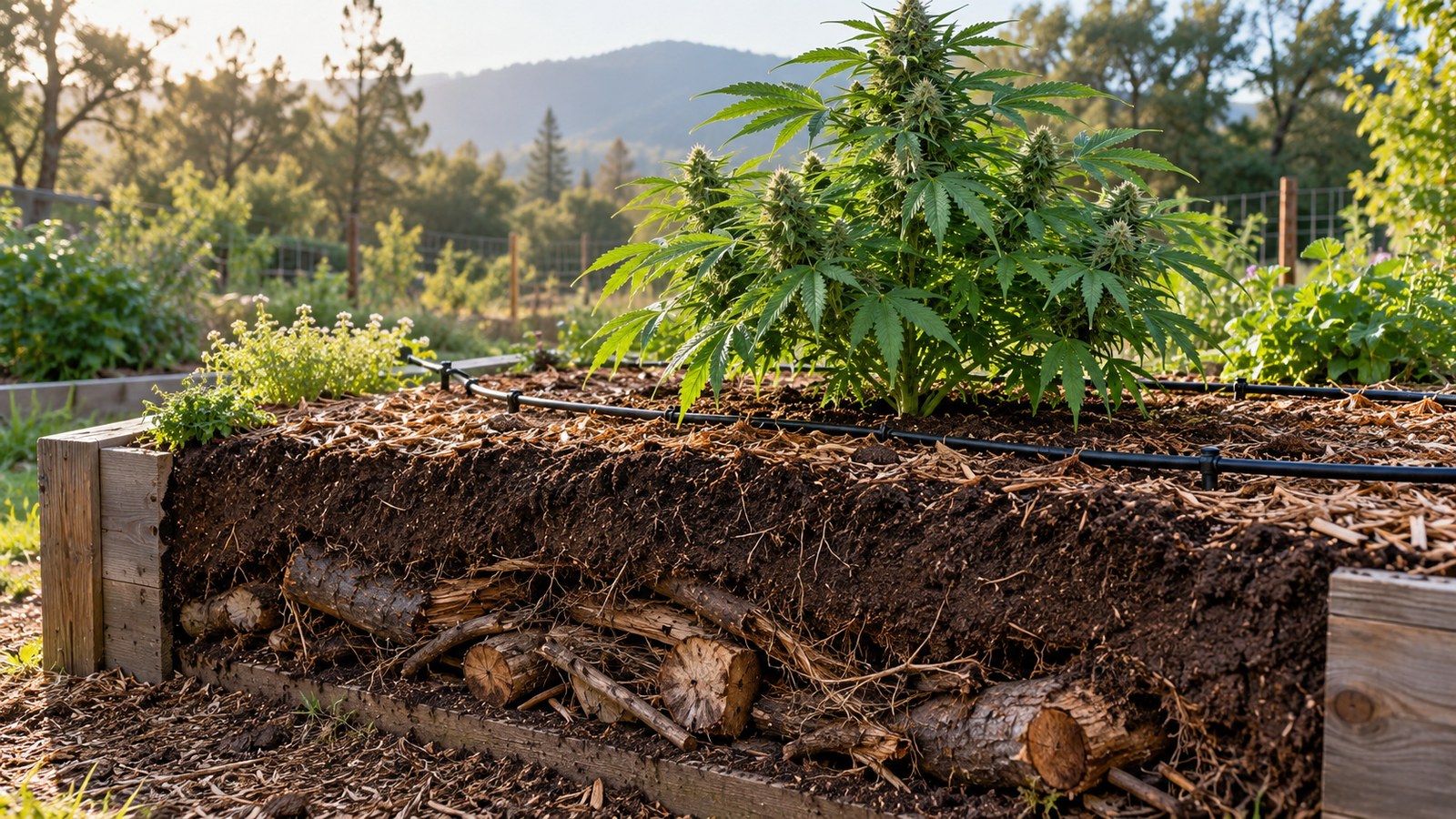
Drainage becomes the practical question after the root zone is wet. In native ground, excess water may move downward beyond the main rooting depth, laterally along a slope or restrictive layer, or remain because the water table is high. In a raised bed, water must also cross the interface between the imported bed material and the native soil below. In a container, it must travel through the medium and reach open drainage holes without the pot sitting in standing runoff.
What remains after free gravitational drainage is not automatically “bad water.” A functional root zone retains plant-available water in smaller pores while larger pores regain air. The goal is not to make every drop disappear as fast as possible. The goal is a root zone that wets evenly, sheds excess water, then dries at a rate the plant and environment can support.
Follow the whole water pathway
Observe entry at the surface, moisture movement at depth, and what remains after gravity has had time to act.
Calling every wetness problem drainage
Surface sealing, hydrophobic bypass, restrictive horizons, high water tables, and blocked pot outlets require different corrections.
Dry-back is not drainage
Growers also use the word dry-back when tracking how a root zone becomes lighter or drier between irrigations. Dry-back includes plant water uptake and evaporation after gravitational drainage has largely finished. A pot that becomes lighter over two days may be losing water mostly through plant demand, not still “draining” for two days.
This distinction matters when comparing cultivars or container sizes. A vigorous plant can produce a fast dry-back even in a medium that initially drains poorly. Conversely, a small plant in a large airy container may drain freely but still take a long time to use the retained water.
Important: Do not use time-to-dry as a direct substitute for drainage quality. Plant size, canopy demand, temperature, humidity, container volume, and root density all affect dry-back.
Diagnose an Infiltration Problem at the Surface
An infiltration problem is present when the surface cannot accept water evenly at the rate it is being supplied. In native soil this may appear as ponding, runoff, erosion, or water moving preferentially into cracks. In containers it may appear as water skating across a dry surface, running down the pot wall, or exiting rapidly from the bottom while the center of the medium remains dry.
Surface crusting and compaction
Bare fine-textured soil can form a crust after rain or repeated overhead irrigation. Foot traffic, vehicle traffic, repeated work when wet, or dense surface packing can also reduce pore continuity. Water then accumulates at the surface even if the deeper profile would transmit it reasonably well once it entered.
Do not respond by digging aggressively around an established cannabis root system every time ponding appears. First determine whether the restriction is only at the surface, whether the soil is already saturated underneath, and whether the irrigation application rate itself is too high.
Water repellency and hydrophobic channels
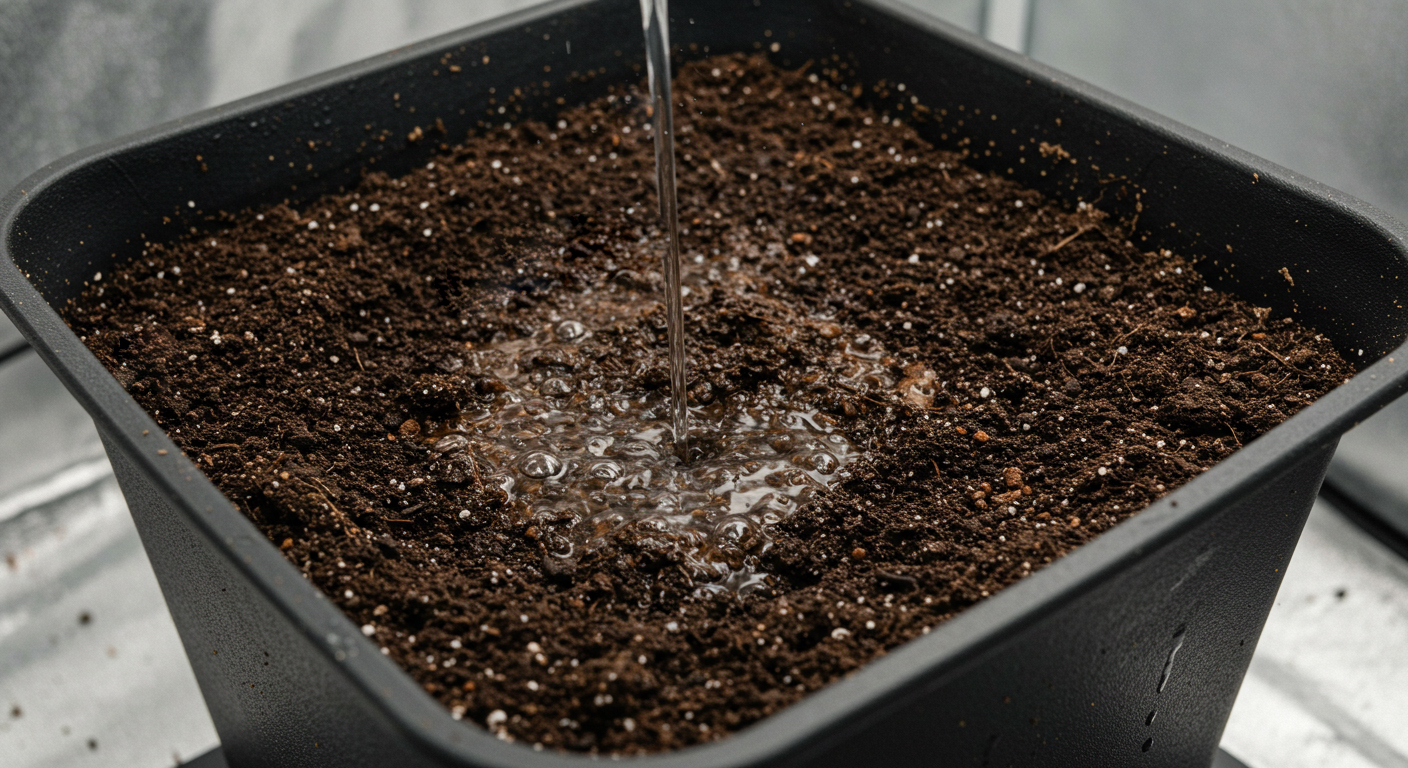
Very dry organic potting mixes, peat-rich mixes, and dry surface layers can become difficult to rewet evenly. Water may find a few pathways and rush downward while other areas remain dry. The grower sees runoff and assumes the container is draining beautifully. In reality, much of the root ball may never have been wetted.
In this case, slower staged irrigation can be more informative than one large pour. Apply a small amount, allow it to spread, then continue gradually. If the same volume that previously raced out begins to wet the profile more uniformly after staged application, the original problem was at least partly infiltration and rewetting, not excessive drainage.
Pro Tip: In containers, compare pot weight before watering, immediately after a thorough even watering, and after free drainage. Very early runoff with little gain in container weight is a strong clue that water bypassed part of the medium.
Application rate can create a false infiltration diagnosis
Even healthy soil can pond if water arrives faster than it can enter. A hard hose stream concentrated in one spot is not the same test as slow rainfall, drip irrigation, or a gentle watering wand. When comparing sites or media, keep the application method consistent.
Surface slope matters too. Water may leave a sloped bed before it has time to enter, particularly when soil is bare or crusted. That is a surface water-management problem even if the soil itself has adequate pore space.
Do not diagnose infiltration from runoff alone
Runoff can result from crusting, compaction, slope, water repellency, already saturated soil, or irrigation being applied faster than the surface can accept it. Check moisture below the surface before changing the entire root-zone mix.
A simple comparative infiltration check
A ring or cylinder test can help compare two areas of native soil when used consistently, but a home test should not be presented as a laboratory measurement of saturated hydraulic conductivity. Use the same ring diameter, insertion depth, pre-wetting approach, water depth, and timing procedure at each location. The value is strongest as a repeatable comparison between areas or before and after a management change.
Pre-wetting matters because a bone-dry cracked soil can accept water very differently from the same soil after a wet period. If your actual concern is performance during a rainy flowering season, testing only under extreme drought conditions may answer the wrong question.
“My fabric pot produces runoff almost immediately, but the plant still looks thirsty later. Is the mix too fast-draining?”
Question sent by: CedarAndSoil, via contact form.
Not necessarily. Early runoff can be caused by channeling through a dry or shrunken medium. Rewet slowly in stages and compare the final pot weight. If the pot accepts substantially more water and stays evenly moist after staged watering, the original problem was poor wetting uniformity rather than simply excessive drainage.
Diagnose a Percolation Problem Through the Profile
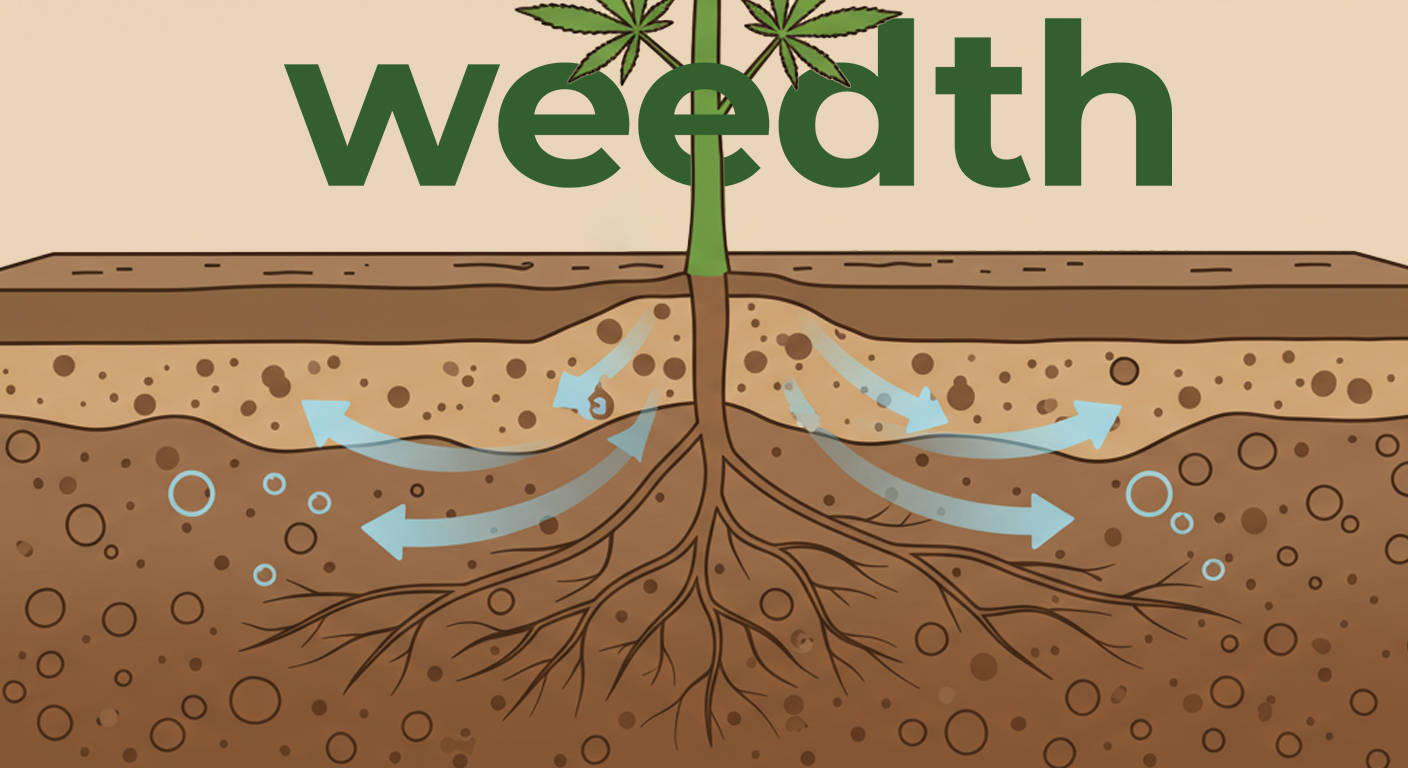
Percolation becomes the main diagnostic target when water crosses the surface but does not continue through the profile as expected. The restriction may sit a few centimeters below the surface or much deeper than the active root zone. This is one reason a surface infiltration test cannot describe the whole site.
Restrictive horizons change the result
A loose topsoil over compacted subsoil can look excellent during light watering. Once the upper layer fills, water encounters the lower restriction and begins to accumulate. Dense clay, platy structure, a traffic pan, construction compaction, abrupt textural changes, and naturally restrictive layers can all reduce downward movement.
On sloping ground, water can also move laterally along a restrictive horizon. One plant may stay wet while another a few meters away remains normal. That pattern is useful evidence because the irrigation and weather may be identical while the subsurface flow path differs.
Field Advice: After a meaningful rain or full irrigation, inspect moisture at more than one depth and more than one position. A wet band above a consistently denser layer is more informative than the appearance of the surface.
Macropores can create misleadingly fast movement
Earthworm channels, old roots, cracks, and coarse pathways can carry water downward quickly. This preferential flow is real, but it does not mean the entire soil matrix is wetting evenly. Nutrients can also move through preferential pathways differently from the surrounding soil.
If a test hole drains quickly because water found one large crack, the result may exaggerate how uniformly the root zone transmits water. Repeat observations in several nearby spots and under wetter initial conditions before making a major site decision.
Percolation that is too fast can also matter
Rapid downward movement is not automatically desirable. Very coarse sandy profiles can transmit water beyond the main roots before the plant has much opportunity to use it, especially when large irrigation volumes are applied at once. Nutrient ions that move readily with water may also be lost more quickly from low-retention root zones.
This does not mean slow percolation is better. It means the useful target is a profile where water can move through without prolonged saturation while enough moisture remains available between irrigations.
Weedth Verdict: “Faster” is not the goal. The better root zone accepts water, distributes it through the active profile, releases excess gravitational water, and retains enough moisture for the interval before the next irrigation.
Why a hole test is not the same as an infiltration test
The common garden hole test is often called a percolation or drainage test. It can be useful as a field screening method because the hole is filled, allowed to pre-wet the surrounding soil, then refilled and observed. But once you have excavated the surface and placed water inside a hole, you are no longer measuring normal surface infiltration through the undisturbed topsoil.
The result integrates water movement through the exposed sides and bottom of the hole and is influenced by the particular horizon reached. Use it to screen site drainage and subsurface transmission, not to claim a precise infiltration rate for the natural surface.
Diagnose a Drainage Problem at the Root-Zone Boundary
Drainage problems are easiest to recognize when the root zone becomes thoroughly wet and then remains wetter than the system can tolerate because excess water cannot leave. The limiting boundary may be below the roots, at a raised-bed interface, at the base of a container, or outside the planting area where groundwater or runoff keeps returning.
Native ground: drainage depends on more than topsoil texture
A loamy surface does not guarantee a well-drained site. The water table, slope position, subsoil structure, compacted layers, and nearby runoff sources can dominate what the root zone experiences. Low areas may remain saturated because water arrives from surrounding ground even when the local surface infiltrates well.
Watch the site after prolonged rain, not only after one dry-season hose test. Seasonal water tables and repeated storms can expose drainage limits that are invisible during a short test in midsummer.
Remember: A site that passes one dry-weather hole test can still be seasonally poorly drained. Match the observation period to the conditions that matter for the crop.
Raised beds: the lower interface still matters
A raised bed can provide a deeper, more aerated rooting volume, but imported soil does not make the native ground disappear. If the underlying site is compacted or seasonally saturated, water can accumulate near the interface. Bed height, soil structure, slope, and the path available for excess water all influence the result.
When a raised bed stays wet, check whether the entire mix is dense, whether irrigation volume is excessive, or whether the bed is draining into a saturated base. Adding one aeration amendment to the upper layer will not correct a landscape drainage problem below it.
Containers: outlet drainage and media drainage are separate checks
A container needs open outlets, but open holes do not guarantee that the medium itself transmits water well. A dense garden soil can remain saturated above perfectly open holes because the pore structure inside the pot is unsuitable for the shallow container environment. University extension guidance generally recommends purpose-built potting media rather than native garden soil for this reason.
Container height also changes how much of the root zone is affected by retained water near the bottom. A short, wide container can have a larger proportion of its volume in a wetter lower zone than a taller container filled with the same medium.
A gravel layer does not repair a dense cannabis potting mix
Adding stones, gravel, LECA, or other coarse material as a thick bottom “drainage layer” can create a textural boundary and reduce usable root volume. Build drainage through the whole medium and keep the actual drainage holes open instead.
Standing runoff defeats a good container
A pot can have an excellent medium and open holes yet still behave poorly if it sits in a deep saucer of runoff or on a surface that seals the bottom outlets. Elevation does not need to be dramatic. The requirement is simply that excess water has a clear exit and does not remain in contact with the container base for prolonged periods.
Tip: When diagnosing a wet container, check the easiest mechanical failures first: blocked holes, compacted material over the outlets, standing runoff, a pot sitting flat against an impermeable surface, and a root mass that has changed the way water moves through the medium.
The Same Symptom Means Different Things in Native Soil, Raised Beds, and Containers
Water behavior cannot be interpreted without the geometry of the growing system. Native ground has a continuous profile and landscape context. Raised beds add an engineered layer above that profile. Containers sharply limit depth and create an artificial bottom boundary. The same observation can therefore point to a different mechanism.
| Growing System | How to Read Infiltration, Percolation, and Drainage |
|---|---|
| Native ground | Check surface entry, deeper horizons, slope, compaction, water-table behavior, and runoff arriving from outside the planting area. A single surface test rarely describes the entire root zone. |
| Raised bed | Check the bed mix and the native-soil interface. Fast infiltration through the bed can still end in slow percolation or poor drainage at the base. |
| Plastic container | Check wetting uniformity, media structure, container height, root density, drainage holes, and whether the base sits in runoff. |
| Fabric container | Sidewall evaporation and air exchange can change dry-back, but the medium can still become hydrophobic, channel water, compact, or stay wet if the container is oversized for the root system. |
| Coco or other soilless media | Interpret water movement according to the substrate system and irrigation strategy rather than applying native-soil assumptions. Runoff timing alone does not describe how evenly the root zone was wetted. |
Master Advice: Diagnose the system you actually have. A correction that helps compacted native clay may be unnecessary or harmful in coco, peat-based potting media, or a shallow raised bed.
Antecedent moisture changes nearly every test
A dry profile and a wet profile can produce very different results. Dry cracks can make initial intake look extremely fast. A hydrophobic organic medium can make initial wetting look very slow. Once saturated, the same soil may be limited by its deepest restrictive horizon.
Record whether the root zone was dry, moderately moist, or recently saturated before each test. If you are comparing two sites, test them under similar initial moisture whenever possible.
Roots change pore structure over time
Roots create channels, stabilize some aggregates, compress other zones, and eventually fill much of a container. A test performed before planting may not perfectly describe the same pot at peak canopy. Root density can change both where water travels and how quickly the plant removes retained water.
This is another reason to treat water movement as a repeated observation rather than a one-time certification.
Run a Repeatable Water-Movement Check
A good home procedure does not try to turn simple observations into laboratory hydraulic measurements. Its job is to locate the likely bottleneck and create a baseline that can be repeated after one meaningful correction.
Step 1: define the failure you are testing
Write one sentence before changing anything. Examples include: “Water ponds at the surface during normal irrigation,” “the topsoil wets but the 20 to 30 cm zone stays saturated,” or “the container produces early runoff while the center remains dry.” A precise problem statement keeps the test from becoming a vague search for “better drainage.”
Step 2: record the starting condition
Record recent rain or irrigation, approximate root-zone moisture, the irrigation method, slope, container size where relevant, and any obvious compaction or crusting. If comparing two areas, use the same observation format for both.
Step 3: observe surface entry
Apply water at the same rate you normally intend to use. Watch whether the surface accepts it evenly. Note the time or irrigation volume at which ponding, runoff, or edge-channeling begins. You do not need a universal pass/fail number. You need a reproducible baseline for your own system.
Pro Tip: If you change the watering device, flow rate, and soil amendment at the same time, you lose the ability to tell which change solved the problem. Keep the test simple enough to interpret.
Step 4: inspect the moisture profile
After irrigation, check more than the top few centimeters. In native ground or a bed, use a narrow soil probe, hand trowel, or small inspection point away from the main stem. In containers, use weight, a clean moisture probe where appropriate, and careful checks at different depths near the sidewall. Avoid repeatedly damaging the main root mass.
Ask whether the wetting front is reasonably continuous or whether you have a dry center, wet lower band, saturated interface, or isolated channels.
Step 5: observe what happens after free drainage
Recheck after the immediate gravitational drainage period has passed. The exact timing varies by medium, depth, container geometry, and water volume, so avoid declaring a universal number of minutes. In a container, confirm that runoff has stopped and the pot is not sitting in drainage water. In native ground, check whether the root zone remains saturated or whether excess water continues moving away.
Step 6: recheck after the next environmental cycle
For outdoor soil, the strongest verification may come after the next meaningful rain rather than another artificial hose test. For a container, it may come after one or two normal irrigation cycles. Record whether the same failure returns under comparable conditions.
“Should I time how long a test hole takes to empty and use that as my cannabis drainage number?”
Question sent by: PrairieRoots, via Facebook page.
Use the time as a local screening measurement, not a universal cannabis threshold. Repeat the same method, pre-wet consistently, inspect the horizons around the hole, and combine the result with what the site does after real rain. The number becomes useful when its conditions are recorded.
Repeat one controlled comparison
Keep application method, initial moisture, measurement points, and timing as consistent as practical.
Chasing one universal rate
General horticultural screening rates are not cannabis-specific pass/fail thresholds and may not describe the whole profile.
Separate Common Failure Modes and Look-Alikes
The three processes can fail together, which is why diagnosis should start with pattern recognition. A compacted soil may infiltrate slowly and percolate slowly. A hydrophobic container may infiltrate unevenly but drain rapidly through the few channels that become wet. A raised bed may infiltrate and percolate well until water reaches saturated native soil beneath it.
Compaction
Compaction reduces larger pore spaces and can restrict both entry and internal movement. If the compaction is only at the surface, infiltration may be the most obvious symptom. If it forms a deeper pan, the topsoil may infiltrate while percolation stalls lower down.
Hydrophobic channeling
Water repellency can mimic extremely fast drainage because water appears at the bottom early. The tell is uneven wetting: dry pockets remain, container weight does not increase as expected, or water consistently follows the same edges and cracks.
Salt buildup
Salt stress can cause wilting, leaf injury, reduced water uptake, and poor growth without being a drainage failure. Excessive salts and poor water movement can also coexist. Do not assume every stressed plant in a wet root zone needs more drainage material. Check water quality, root-zone EC where appropriate, and the actual moisture pattern.
Root disease and oxygen stress
Poor drainage can create conditions that favor root decline, but once roots are damaged the plant may remain weak even after water movement improves. The correction of the physical root zone and the recovery of the plant are two different timelines.
Important: Old damaged leaves are not a drainage meter. Verify the root-zone behavior directly, then judge recovery from new growth, water use, root condition where visible, and the recurrence or absence of saturation.
Container too large for the current root system
A large pot can drain freely and still stay wet for a long time because a small plant cannot remove much of the retained water. This is a water-balance and root-volume mismatch, not automatically a failure of outlet drainage.
Blocked drainage holes
This is one of the simplest true drainage failures. Roots, compacted medium, a saucer, floor contact, debris, or a liner can restrict the exit. Correct the mechanical blockage before redesigning the entire medium.
Do not keep adding amendments without locating the restriction
Perlite, pumice, compost, biochar, sand, and other amendments change several physical properties at once. Adding one blindly can alter water retention, pore continuity, nutrient behavior, and container volume without correcting a high water table, blocked outlet, or compacted subsoil.
Field Advice: Before rebuilding a root zone, ask whether the failure is at the surface, inside the profile, or at the exit boundary. That single question prevents many unnecessary amendments.
Correct the Process That Is Failing
Once the bottleneck is reasonably identified, change the smallest meaningful variable that addresses it. This is more useful than trying to make the entire root zone “drain faster” without defining the failure.
If infiltration is failing
Match irrigation rate to surface intake, protect soil structure, reduce traffic and crusting, and rewet hydrophobic media gradually. Organic surface cover can help protect native soil from sealing under repeated rain, but it should not be used to hide an already saturated root zone. If the lower profile is wet, adding more water slowly is still adding more water.
Tip: If the surface is the only restriction, improving entry should change ponding before it changes the deeper drainage behavior. That is a useful verification clue.
If percolation is failing
Investigate restrictive horizons, compaction, abrupt layering, and the depth at which water begins to accumulate. In an unplanted site, structural remediation or a raised bed may be options. Around established roots, aggressive deep cultivation can cause more damage than benefit. In some sites the correct decision is to move the planting area rather than fight a persistent subsurface restriction.
If drainage is failing
Restore a real exit path. In containers, keep holes open and prevent standing runoff. In raised beds, evaluate the base and surrounding grade. In native ground, consider slope position, water table, inflow from roofs or hard surfaces, and whether the area is simply unsuitable during the wet season.
If all three appear poor
Dense, degraded soil can fail at the surface, through the profile, and at the site boundary. That is a system problem. Correcting only one layer may create a temporary improvement without giving roots a reliable water-air balance.
For a new cannabis site, the lower-risk choice may be to build a raised bed with a known root-zone mix, use a clean large container, or choose another legal location rather than forcing a problematic native profile to behave like a container medium.
Master Advice: A correction is successful only when the next comparable irrigation or rain event produces a better water pattern. The amendment itself is not the result.

Verify the Correction Instead of Assuming It Worked
Verification should repeat the same observation that exposed the original failure. If the problem was surface ponding, compare ponding under a similar application rate. If the problem was a saturated band, recheck that depth. If the problem was early container runoff with a dry center, compare wetting uniformity and post-watering weight.
Use a simple baseline and recheck log
Record the date, starting moisture condition, irrigation or rain event, surface behavior, deeper moisture pattern, drainage observation, correction made, and next comparable result. The log can be brief. Its purpose is to stop memory from turning one unusually dry or wet day into a false conclusion.
Remember: Compare like with like. A test after three dry weeks and a test the morning after heavy rain do not measure the same starting condition.
Useful checkpoints for containers
Check during watering, after free runoff has stopped, later the same day if saturation was the concern, and again before the next irrigation. Container weight and moisture at more than one depth help separate free drainage from later plant-driven dry-back.
Useful checkpoints for native soil and beds
Observe during irrigation or rain, after the surface event ends, later as the wetting front redistributes, and after the next meaningful rain. If the original problem occurred only during multi-day storms, a short hose test is not enough to prove the site has been corrected.
Pro Tip: Photograph the same inspection point or soil profile with a ruler or depth marker. Visual records make it easier to compare where saturation or dry zones reappear.
When the test result is still ambiguous
If water behavior remains inconsistent, stop adding variables. A laboratory soil analysis can describe texture and chemical conditions but does not automatically measure site drainage. Professional soil evaluation, infiltration testing, hydraulic conductivity testing, or landscape drainage assessment may be appropriate when the decision involves major earthwork, structural drainage, or a chronically saturated site.
For a home grower, the practical boundary is clear: you do not need to solve soil physics mathematically to notice that a site repeatedly stays saturated. You do need enough evidence to distinguish a surface-entry problem from a deeper transmission or exit problem before changing the root zone.
Before You Call the Root Zone Well Drained
- Water enters the surface at the intended irrigation rate without persistent runoff or bypass.
- The wetting front reaches the active root zone instead of leaving major dry pockets.
- No repeatable saturated band forms above a restrictive horizon after normal watering.
- Excess gravitational water has a real exit path from the root zone or container.
- The container does not sit in standing runoff and drainage holes remain open.
- A raised bed is not simply draining into a persistently saturated native base.
- Fast runoff has not been mistaken for uniform wetting.
- Slow dry-back has not automatically been labeled poor drainage without considering plant size and demand.
- The correction has been tested again under a comparable irrigation or rainfall event.
Questions Growers Commonly Mix Up
Can soil have fast infiltration and poor drainage?
Yes. Water can enter through an open or cracked surface and then accumulate above a restrictive subsoil layer or high water table. Fast infiltration describes entry, not the final condition of the root zone.
Can soil have slow infiltration but acceptable deeper drainage?
Yes. A sealed or compacted surface can limit entry while the subsoil transmits water reasonably well once it reaches that depth. Correcting the surface may reveal that the deeper profile was not the main problem.
Does runoff mean the soil is compacted?
Not by itself. Runoff can also occur because the soil is already saturated, the irrigation rate is too high, the surface is hydrophobic, or the site is sloped. Compaction is one possible cause.
Does fast runoff from a cannabis pot mean the mix drains well?
Not necessarily. Water can channel around a dry root ball or along the container wall. Check how much the pot weight increased and whether moisture reached the center before calling the mix fast-draining.
Is percolation always good?
No. Percolation is simply water movement through the profile. Too little movement can leave roots saturated. Very rapid movement through a coarse low-retention profile can move water and soluble nutrients below the main roots more quickly than intended.
Should I use a thick stone layer to improve drainage?
No. Build a suitable pore structure through the medium and maintain open outlets. A coarse layer at the bottom can create an abrupt textural boundary, reduce usable root volume, and fail to correct a dense medium.
Build the Fix Around the Part of the Water Path That Fails
Infiltration, percolation, and drainage are connected, but they answer different questions. Infiltration asks whether water can enter. Percolation asks how it moves through the profile. Drainage asks whether excess water can leave the active root zone or growing system.
For a cannabis grower, the most useful diagnosis comes from following one watering event from the surface to the lower boundary. Watch where water ponds, where the wetting front slows, where saturation remains, and how the root zone changes after free drainage. Then correct that part of the pathway and repeat the same observation.
A root zone is not proven by how quickly water disappears. It is proven by how evenly the roots are wetted, how reliably excess water leaves, and whether the same behavior holds during the conditions the plant will actually face.
Share this article
A quick overview of the topics covered in this article.
Follow us
Latest articles
October 19, 2026
October 19, 2026

October 19, 2026
October 19, 2026
