
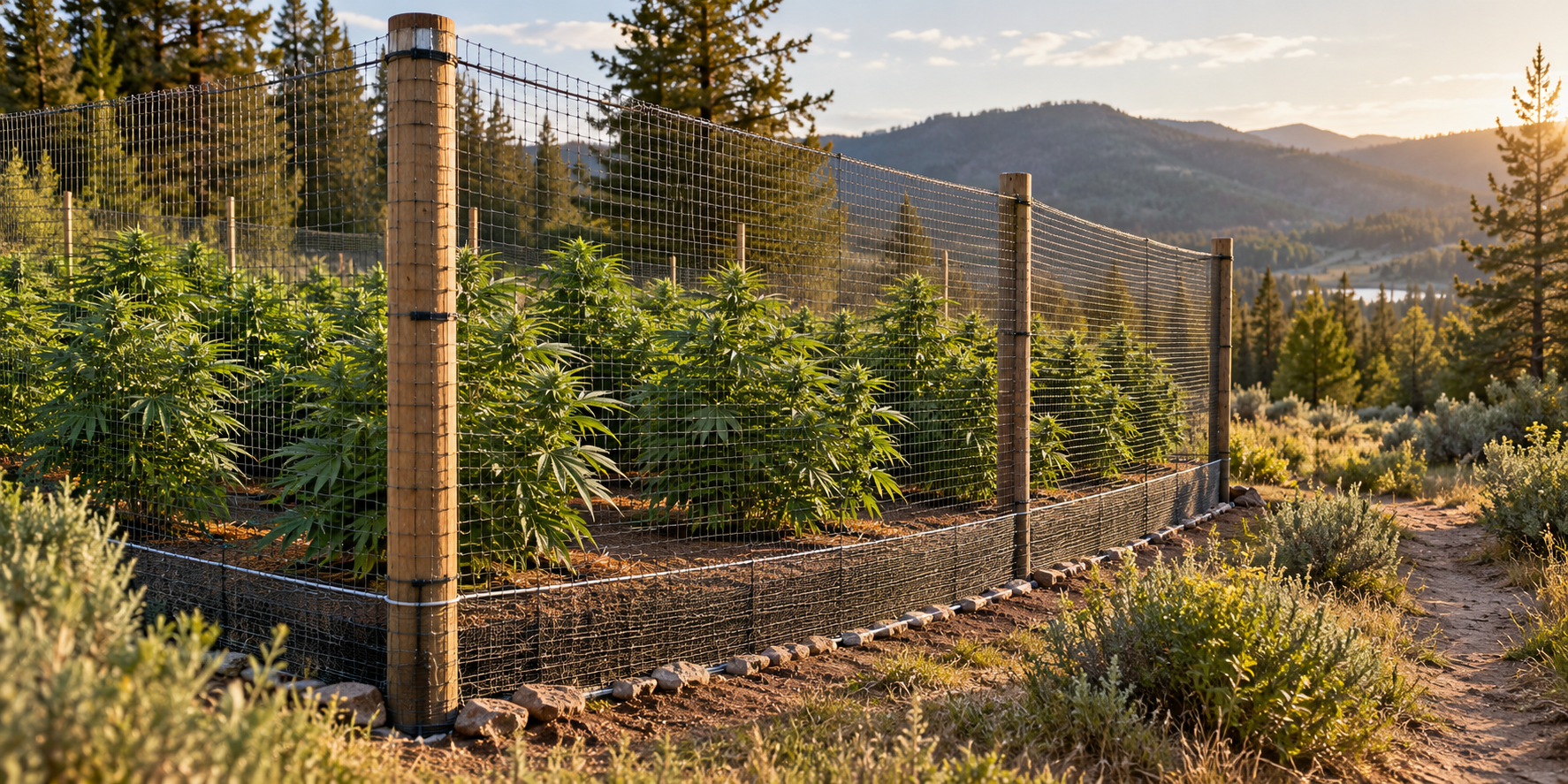
Wildlife-Safe Fencing and Netting
The safest way to protect an outdoor cannabis garden from wildlife is to identify the animal and its entry route, protect only the area that needs protection, and install a barrier that does not trap or injure animals. A deer fence, rabbit skirt and bird net have different jobs. Combining their names into one shopping list can produce a fence that excludes nothing reliably while putting birds, bats, reptiles and young mammals at risk.
A garden fence can keep a hungry animal away from a crop, but it can also interrupt a route to water, separate a young animal from its mother, or create an invisible collision line. Loose plastic netting is a different hazard: an animal may push through an opening, catch a wing or limb, and become increasingly entangled as it struggles. The grower’s job is to reduce crop access without creating a new welfare problem.
This resource covers wildlife evidence, selection, installation, inspection and correction for lawful outdoor cultivation. It does not decide whether a fence is legally required for privacy or access control. The separate outdoor cannabis fence decision guide covers that question, while the complete outdoor growing guide provides broader site and crop planning. Wildlife protection becomes a separate design problem only after the actual species, legal constraints and maintenance capacity are understood.
Decide What Needs Excluding and What Must Keep Moving
The first decision is whether an animal is damaging the crop, merely passing through, or providing a useful ecological service. A bird perched nearby, a pollinator visiting adjacent flowers or a lizard crossing a path does not establish a crop problem. A newly severed stem with fresh rabbit tracks is different. A barrier is justified by a verified conflict or a credible immediate risk, not by the presence of wildlife itself.
Use a working sequence: confirm the conflict, map its location, decide whether individual-plant protection is enough, establish a wildlife-safe passage around the protected area, then choose a design that can be maintained. If these decisions are reversed, an oversized perimeter can cut across a movement corridor even though only two young plants required protection. An underbuilt fence can be worse: repeated breaches cause growers to add loose netting, extra wire and improvised patches without reviewing the original design.
Separate crop exclusion from wildlife passage
Crop exclusion means an animal cannot enter the protected crop space. Wildlife permeability means animals can cross a fence or continue through the landscape. A low, smooth-wire range fence designed to permit deer and pronghorn passage cannot reliably exclude those same animals from an enclosed crop. A tall, continuous deer-exclusion fence may protect a garden, but wildlife must be able to bypass it without losing access to a water source or essential habitat.
The solution is often a small, continuous exclosure around the crop within a larger permeable property. Keep established routes and natural water access outside the exclosure when possible. Avoid placing a new fence across a stream bank, wetland edge, narrow gully or heavily used animal trail merely because the ground is convenient for posts. If sensitive habitat cannot be avoided, consult the relevant wildlife or land-management authority before design.

Exclosure versus wildlife-friendly crossing fence
An exclosure intentionally keeps a target species outside a defined plot. A wildlife-friendly crossing fence intentionally lets selected species pass over, under or through. Both can reduce harm when used in the correct place, but they have incompatible dimensions when the same animal must be excluded.
Apply four possible decisions before buying anything
No barrier: the evidence shows no relevant damage and no legal requirement calls for one. Continue observing. Plant-level barrier: one seedling, container or bed is vulnerable, but the wider property should remain open. Small plot exclosure: damage is repeated across several plants and complete exclusion is feasible. Redesign or relocate: the only proposed fence would block essential habitat, cannot be inspected often enough or would create unacceptable entanglement risk.
Document the choice rather than describing the fence as universally necessary. Record the protected footprint, observed species, frequency of damage, date, season and responsible inspector. This makes future modifications accountable: if the original issue was rabbit browsing, a later proposal for a much taller solid wall needs fresh evidence.
Keep legal crop security distinct from animal welfare
Some jurisdictions require cannabis cultivation to be enclosed, screened or secured. Other places regulate fence height, proximity to boundaries, structures and protected habitat. The exact obligations depend on the jurisdiction, property and licence. A legally required security enclosure is not automatically an effective deer barrier, and a wildlife-safe garden net is not automatically an approved security structure.
Resolve any access or visibility rule using current official guidance, then assess the animal-facing surfaces independently. When the same structure must perform both jobs, choose a lawful professional design with no concealed hazards. Never improvise sharp objects, snares, poison bait, trip lines or electrified household wiring. Local wildlife protection and trapping rules can apply even to an animal damaging a privately owned crop.
Define the measurable outcome
Write a concise objective such as: “Prevent repeat low-stem browsing of the two plants while keeping the deer trail beyond the bed open and causing no entanglement.” That objective has testable parts. The grower can compare new damage before and after installation, check the lower edge for entries, and record animal crossings around the bed.
Do not assign an invented success percentage to the design. No observed damage for a few days might reflect seasonal food availability, weather or the animal not returning. Verification should combine crop inspection, structural inspection and continued wildlife observation. Absence of a carcass near the fence is not proof that no collision or injury occurred.
Field Advice: Draw the animal’s route first and the crop boundary second. A smaller exclusion zone is often easier to inspect and leaves more of the property available for wildlife movement.
How Fences and Nets Change Animal Movement and Injury Risk
Animals encounter barriers differently. A deer may jump, push, crawl beneath a low edge or follow a fence until it finds a gate. A rabbit usually challenges a low opening or the soil line. A groundhog can climb and dig. Birds and bats can collide with hard-to-see materials; snakes and lizards may become caught in an unsecured mesh loop. Material choice makes sense only when matched to these behaviors.
Understand snagging, collision and containment as separate failures
Entanglement occurs when feet, wings, horns, heads or bodies pass partly through a hole or loop and cannot withdraw. Thin monofilament strands, slack folds and torn panels can tighten as an animal struggles. Collision occurs when a moving animal strikes a barrier it did not see or could not clear. Containment occurs when an animal enters a fenced plot and cannot locate an exit, potentially injuring itself during repeated escape attempts.
These risks require different controls. Small-aperture, visible, taut netting supported away from plants reduces loose-loop and large-opening hazards. Visible fence surfaces and marking may help birds detect collision lines in suitable habitats. A complete gate survey and a sweep of the enclosure before closing it reduce the chance of trapping an animal inside. None of these controls makes a material literally risk-free.
Why large-hole or loose bird netting can become a trap
Netting sold for horticulture can have openings large enough to admit a bird’s head or a bat’s wing, even when the product sounds appropriate for fruit protection. If the net hangs directly on foliage, it forms pockets and folds. Leaves or flowers touching the mesh can also be reached through it, which can prompt an animal to climb or pull at the net and further deform the openings.

Australian wildlife agencies recommend fine mesh of no greater than 5 × 5 mm at full stretch for certain fruit-tree and garden applications, preferably visible, durable material held taut. That number is a published wildlife-safety design reference and a legal requirement in some Australian jurisdictions, not a universal cannabis-specific regulation or guarantee. Other agricultural netting systems have different engineered specifications and local rules. Inspect the aperture as installed, not just the packaging label.
Do not drape loose, large-aperture mesh over a cannabis canopy
If a bird, bat, snake or small mammal can push a body part through the mesh or become enveloped in a fold, the installation presents an avoidable hazard. Remove and replace unsuitable netting rather than assuming that a label reading “bird net” makes it wildlife-safe.
Why a wildlife-crossing fence can also injure animals
Range-management guidance commonly favors smooth top and bottom wires, a visible upper line, adequate separation between wires and enough lower clearance for selected animals to pass. For example, Colorado and USDA guidance describes an illustrative layout with a top wire at roughly 42 inches (about 107 cm), 12 inches (30 cm) between upper wires and 16 inches (41 cm) of bottom clearance. These dimensions aim to support movement of particular North American species on particular landscapes.
Do not copy those crossing dimensions into a deer- or rabbit-exclusion fence. A bottom gap intended to admit pronghorn would be an obvious wildlife entrance, not a flaw in the crossing design. Conversely, a full-height crop exclosure must be routed so animals can pass around it. Study species, terrain and nearby habitat before transferring either example to another region.
Account for fawns, young animals and nesting seasons
Young animals may not negotiate barriers in the same way as adults. A route that an adult deer crosses can leave a fawn separated or trapped. Construction near an active nest introduces a different risk: placing a net over the area or clearing vegetation can trap birds or disrupt protected nesting activity. The presence of a nest is not permission to move it for the convenience of planting.
Survey before clearing or tensioning a barrier and repeat the check when work has been delayed. If animals are using the proposed line for travel or nesting, revise the location or seek guidance from the appropriate authority. Where active protected nests are involved, follow current local requirements and do not handle nests, eggs or wildlife without authorization.
Recognize that a barrier changes the crop environment too
Close mesh can collect debris, reduce airflow or increase shade depending on its weave and position. Solid or dense screening changes wind exposure, and an enclosure can make the center of a wet canopy harder to reach for inspection. These are site-dependent physical consequences, not automatic proof that every small-mesh net increases mold.
Leave accessible space between the mature flowers and the net. After rain or irrigation, compare how quickly flowers near the barrier and flowers away from it lose surface moisture. If contact persists, move or enlarge the frame, support the plant or reconsider netting. A wildlife measure that prevents browsing but damages flowering tissue has not met the full design objective.
Survey the Wildlife, the Site and the Growing Season Before Building
A useful site assessment begins before the damage becomes severe. Walk the crop perimeter, then look beyond the plants to where animals may be entering, feeding, sheltering or moving toward water. Observe without approaching dens, nests, young animals or injured wildlife. If the site is remote, plan for inspection at a frequency that can detect a trapped animal promptly; an occasional crop visit is not an adequate operating plan for a net that can entangle animals between visits.
Identify the animal from several clues, not one damaged leaf
Fresh browsing height, bite shape, tracks, droppings and the position of damaged plants help narrow the possibilities. In general gardening references, deer often leave ragged or torn stems because their teeth and feeding method differ from rabbits. Rabbits typically leave a cleaner, angled cut on low tender growth. Groundhogs may browse near their burrows, climb and dig; voles often leave small gnaw marks or surface runs.
These are clues, not laboratory-style species diagnoses. A human may cut a stem, a storm may snap one, caterpillars may leave irregular feeding holes, and a leaf can disappear after falling. A single clean stem in an otherwise undamaged garden does not justify installing a deer perimeter. Seek tracks after soft soil or dew, document new damage on the same plant, and consult a local extension service or wildlife officer if the identification remains uncertain.
| Observation | Possible explanation | Confirm before design | Do not assume |
|---|---|---|---|
| Low stems clipped cleanly | Rabbit or another incisive-feeding mammal | Browse height, tracks, droppings, repeated timing | A tall deer fence is needed |
| Ragged higher browsing | Deer or other larger browser | Footprints, entry route, local species and new events | The same height applies to every deer species |
| Fresh soil displaced at a fence | Digging mammal, erosion or routine maintenance | Burrow pattern, tracks, soil movement after rain | A taller wall fixes a ground-level breach |
| Seedling toppled or root crown gnawed | Small mammal, insect, wind or tool injury | Tooth marks, soil tunnels, root inspection and weather | The bird on a nearby pole caused it |
| Birds seen on the canopy | Resting, feeding on insects or possible crop interaction | Directly observe damage and its cause | Every bird is eating the crop |
| Repeated tears in a net | Animal pressure, wind, abrasion or brittle material | Examine tear position and record the weather | A stronger but equally loose net is safe |
Make a simple wildlife movement map
Mark the plant positions, existing fences, gates, water sources, paths, dense cover and obvious travel routes on a sketch. Note slopes and gullies, because a fence that appears low on one side may be effectively much higher from a downslope approach. Mark existing barriers that already provide some protection; do not enclose the entire property because a single unprotected corner exists.
Where practical, revisit from the same publicly accessible or permitted observation points at different times. Tracks show where an animal passed, not whether the proposed route is its only access to water or shelter. If the site crosses a known migration route, a stream corridor or habitat for a protected species, stop design and seek appropriate land-management guidance. A garden crop should not displace an essential wildlife route.
Measure the plant and the barrier separately
Record the present and expected mature canopy footprint, expected height, working access and service route. A cover sized to a small vegetative plant may press directly into flower clusters later. That contact can abrade tissue, complicate monitoring and give an animal access to material through a mesh that otherwise excludes it.
Measure the proposed barrier’s height relative to the animal’s approach side, not from the easiest flat patch of soil. Measure the gate’s bottom and side gaps, and check dips along the ground. For netting, note the actual installed aperture at full stretch, the largest visible hole after tensioning, frame clearance from foliage and any unsupported span that can sag in rain or wind.
Track weather and vegetation changes
Early summer and late flowering may produce very different conditions. Vegetation beside a boundary may become a climbing aid; snow or accumulated mulch can alter effective fence height; storm debris may sag the net; a fast-growing canopy can touch previously well-separated mesh. Local drought or changes in available wild forage can increase browsing pressure, but these are influences to monitor rather than a calendar that predicts animal behavior precisely.
Place scheduled checks on the calendar before installation. Include a pre-season survey, observation after the first damaging event, checks after storms and a review when the crop enters flowering. For a net capable of trapping wildlife, inspect at least daily as a conservative practice reflected in wildlife-agency guidance, and more often if local conditions demand it. If daily checking is not feasible, choose a lower-risk solid guard or an alternative site rather than installing unattended loose netting.
Consider people, pets and neighboring land without changing the article’s purpose
Determine whether children, domestic pets, livestock, public paths, property lines or neighboring gardens will interact with the installation. A wildlife fence’s narrow aperture does not replace an appropriate household safety barrier. A cat or dog may chase an animal toward a net, and a gate left ajar may admit the very species the fence was built to exclude.
Keep access paths unobstructed and avoid setting posts on land where permission is missing. Check underground utilities before digging. If fencing changes drainage, creates a trip hazard or blocks an existing emergency route, correct those problems before planting. For the separate access-control question, use the child- and pet-safe cannabis garden guide rather than trying to solve it through improvised wildlife traps.
Tip: Date one photograph of the damaged stem, one of the whole plant and one of the suspected entry point. Return to the same positions after the fence is installed to distinguish old damage from new browsing.
Choose the Smallest Reliable Design for the Target Animal
There is no single mesh size or fence height that excludes every garden visitor safely. Designs must satisfy three simultaneous requirements: the target animal cannot readily enter; non-target wildlife can bypass the protected area; and the structure does not injure animals through loose loops, sharp edges or hard-to-see wires. Where two target species have different entry routes, a layered but compact structure may be needed. That does not justify adding hazardous features indiscriminately.
Deer: height, visibility and complete perimeter
Deer browse leaves and tender stems and may jump or push past low barriers. University and state wildlife guidance commonly describes properly built deer exclosures in roughly the 6- to 8-foot range (about 1.8-2.4 m), with the taller end often used for more persistent pressure or larger open enclosures. Those are species- and site-specific reference designs, not automatic cannabis requirements, building codes or proof that a given fence will never be crossed.
Large animals need a visibly defined barrier and a route around the enclosure. Avoid flimsy bird netting stretched between sparse posts as a deer fence: Oregon State University explicitly warns that it will not withstand a hungry deer’s size and force. Consider sturdy, professionally appropriate deer fencing for the necessary footprint. Check whether a smaller bed enclosure or relocation would protect the crop while preserving the existing deer trail.
Deer may investigate low gaps rather than jumping immediately. Walk the entire bottom line and gate threshold. Choose a mesh or panel arrangement that avoids hazardous head-sized openings, exposed sharp ends and protruding posts. Large deer fencing also faces significant wind loads; structural support and safe installation are necessary, especially where the fence is tall and exposed.
Rabbits: close the lower edge without overbuilding the upper fence
Rabbits usually require a low but continuous barrier with appropriately small openings and attention at ground level. University gardening references describe roughly 2 feet (60 cm) of fence above ground, small mesh and a buried or firmly pinned lower edge for common rabbit exclusion. A recent Oregon Extension response described 1-inch (about 2.5 cm) or smaller stout mesh to keep juvenile rabbits from squeezing through, with additional buried or outward apron protection where digging occurs.
Choose the details for local rabbits, the soil and the observed breach. A flexible fabric that can be pushed aside at the bottom is not equivalent to a secured rigid mesh panel. If installation requires excavation, avoid slicing through the crop root zone or damaging irrigation lines. Smooth or cap exposed cut wire and verify that a small animal cannot enter a gap and become trapped between overlapping layers.
Groundhogs and other digging climbers: address both directions of entry
Groundhogs can dig under and climb over conventional garden fences. Rutgers guidance for a high-value garden describes a robust fence with an outward-facing buried L-shaped skirt and an outward or unsupported upper section designed to deter climbing. These details are a species-specific example. The required depth and height depend on local conditions and should not be copied for an unidentified animal.
Observe an existing burrow or tunnel without blocking it while an animal or dependent young might be inside. Never seal an occupied den as a quick solution. If there is evidence of a resident or protected burrow, contact the local wildlife authority or a qualified humane-conflict specialist. Soil excavation and apron installation should also preserve drainage: an edging trench that redirects stormwater against a bed can turn a browse solution into a root-zone problem.
Small rodents: protect the vulnerable plant rather than promising a rodent-proof perimeter
Small animals may squeeze through apertures, climb supports or reach plants from nearby structures. Garden references describe hardware cloth and individual protective cylinders for vulnerable shoots, bulbs and small trunks. A rigid plant-level guard is often easier to inspect than a large perimeter that has dozens of unavoidable small gaps.
Select a mesh that excludes the correctly identified species without rubbing the stem or trapping the animal inside. Some rodents can gnaw through plastic. Avoid loosely wrapping fabric or fine line around the stalk, which can constrict a growing plant or leave loops accessible to wildlife. If the problem involves a burrow under a building or protected wildlife, seek a locally appropriate response rather than generalizing from vegetable-bed fencing.
Birds and bats: use netting only for a verified above-ground problem
Birds can eat insects, perch or investigate exposed plant material. Seeing a bird in a cannabis plot does not establish a reason for full-canopy netting. When direct observation confirms a problem that genuinely requires overhead exclusion, select purpose-designed wildlife-safer netting and mount it over a rigid or adequately engineered frame. Keep it away from branches and flowers, tension it evenly and close the bottom so wildlife cannot enter behind it.
Use the Australian small-aperture guidance as a useful reference where relevant: durable, visible netting with holes no larger than 5 × 5 mm at full stretch reduces entanglement risk compared with loose large-hole garden nets. Some guidance also specifies stronger woven or knitted strands, and warns against thin monofilament material. Confirm local specifications rather than substituting a fine-looking weave that stretches into large holes under load.
If netting would interfere with the site’s required airflow or inspections, or if the grower cannot check it daily, do not install it simply to feel protected. A small framed enclosure may work for a few plants; a large overhead canopy introduces structural loads, difficult access and more maintenance. Netting does not guarantee that airborne cannabis pollen or tiny insects will be excluded, and it does not solve every plant-health problem.
Pets and livestock: plan for their actual strength and behavior
A small rabbit barrier may fail against a dog that paws at a post or a large animal leaning against a panel. Pet and livestock containment must account for the individual animal, lawful property rules and human access. Use standard, visible and secure gates. Do not add concealed sharp wires or a homemade shock system because a pet crossed the wildlife barrier once.
For households, consider a separate inner plant enclosure if lawful and necessary, so animals can retain ordinary yard access. Do not rely on an untested repellant as a substitute for a dependable physical separation where ingestion or trampling could cause harm. Keep water containers and irrigation fittings from becoming new animal hazards around the fence.
| Verified conflict | Starting design concept | Primary failure check | Wildlife and evidence boundary |
|---|---|---|---|
| Deer browsing across several plants | Compact, visible, appropriately robust complete deer exclosure | Gate, bottom gaps, approach-side height, impact damage | 6-8 ft is context-dependent gardening guidance; preserve bypass route |
| Low rabbit clipping | Small-mesh low fence or individual plant guard | Juvenile-sized gaps and under-edge entry | About 2 ft applies to common rabbit designs, not all mammals |
| Confirmed groundhog breach | Climb-resistant fence with site-appropriate outward ground apron | Burrows, corners and climbing aids | Do not trap dependent young or obstruct occupied dens |
| Small mammal chewing a seedling | Rigid plant-level guard suitable for identified species | Gap around stem, gnawed panels, animal inside guard | Plastic mesh may be chewed; no universal rodent-proof material |
| Verified bird access damaging crop | Fine-aperture, taut, framed, visible netting | Tears, folds, entry behind net, trapped wildlife | Australian 5 × 5 mm reference is not worldwide law or a safety guarantee |
| Passing wildlife without damage | No new barrier; maintain monitoring | Check whether damage actually develops | Unnecessary fencing creates potential habitat and injury costs |
Protect the smallest workable area
Use verified species evidence to choose the height, lower edge and mesh, then leave animal routes around the exclosure open where lawful and feasible.
Mix incompatible fence specifications
A wildlife-crossing bottom gap cannot exclude rabbits, and flimsy bird netting cannot safely substitute for a robust deer fence.
Install and Commission the Barrier as a Repeatable Field Procedure
Installation should be a controlled sequence rather than a one-afternoon race to put up as much fencing as possible. Work from the mapped animal route to the crop footprint, then to materials, structural layout, edge details and a final safety sweep. Have the correct access permission and any required wildlife or construction approvals before breaking ground.
Step 1: mark the protected footprint and bypass route
Place temporary stakes around only the plants or bed that require protection. Walk the proposed line with the site map. Identify the route by which wildlife can continue outside the exclosure to existing cover and water. Look for paths that would now terminate in a corner or funnel animals toward traffic, dogs or a steep drop. Moving a line a short distance before installation is much easier than correcting a permanently blocked corridor.
Check the boundary against the plant’s mature spread. Include access for watering, inspection, support and removal of damaged foliage without pressing through a net. If a legal property boundary and a wildlife corridor conflict, do not quietly choose the shortest alignment. Ask the landowner or competent authority how to meet both obligations, or select another planting location.
Step 2: choose posts and frame strength for the real loads
A barrier must tolerate ordinary wind, rainfall, its own weight, reasonable animal contact and routine access without falling into the plant. A tall deer fence and a fine-mesh overhead enclosure impose different loads. Use a suitable structural design and competent installation for larger spans. Do not interpret this guide’s animal-exclusion measurements as an engineering specification for post depth, cable tension or allowable wind speed.
Frame-supported netting is easier to keep away from foliage than loosely draped mesh, but the frame itself must not have exposed sharp post ends, unsecured pipes or loose guy lines that trip people or snag wildlife. Where necessary, cap hollow posts to prevent small birds entering them. Keep guy wires visible and assess whether they create a new collision hazard. After a major storm, approach only when there are no overhead, electrical or structural hazards.
Step 3: finish the lower boundary without making a snare
For a species that enters beneath the fence, follow the appropriate species guidance on ground contact, burial or an outward-facing apron. Check corners and gate hinges where two panels meet. The edge should be secure without becoming a curled wire loop, a long line of abandoned staples or a pocket that admits animals but blocks their exit. If the soil is rocky or roots prevent a safe skirt, reconsider the location or choose a plant-level guard rather than installing a visibly incomplete perimeter.
Before digging, identify buried utility and irrigation routes. Backfill and stabilize excavated soil so a trench does not collect runoff or turn into an erosion channel. Ground-hugging mesh across a natural stream or drainage line can accumulate debris and act as a dam. Do not force it across watercourses without the required site-specific environmental approval.
Step 4: fit the gate as part of the exclusion surface
Inspect a closed gate from the same low viewing angle an animal might use. A beautiful perimeter can fail through a bottom gap, hinge-side opening or latch that does not engage. Use ordinary reliable hardware and an opening wide enough for maintenance so staff do not leave the gate open during routine work. For a home or licensed operation that requires locking, ensure lawful access for authorized people and emergencies.
If the gate’s opening creates a risk of a deer or another large animal entering, do not rely on a person chasing it out. Arrange a safe, unhurried professional response plan before commissioning the site. A wildlife-safe exclosure should not become a holding pen, and no grower should put themselves between a frightened large animal and its exit.
Step 5: tension netting without deforming its aperture
Stretch each fine-mesh panel smoothly over a support that keeps it off the plant. Secure all edges so nothing hangs loose at ground level or around corners. Check the installed aperture where the material is most stretched and where panels join. If a hole enlarges past the chosen wildlife-safety specification, change the attachment or material rather than tightening it further.
Ensure the net cannot sag into flowers when wet, become a loose bag if one fastening breaks or flap into a neighboring path. Do not create a tunnel with an open end that admits birds but prevents them from finding the way out. If a net is used overhead, access must allow a complete sweep of the interior before every closure. Close the entrance fully after checking for animals.
Never close a netted enclosure around an animal
If a bird, bat, snake, mammal or other wildlife is inside the proposed enclosure, stop. Keep people and pets back, do not drive the animal into a mesh wall, and seek local wildlife assistance when safe exit cannot be provided without handling or risk.
Step 6: remove construction leftovers immediately
Collect offcuts, tie ends, scrap wire, broken clips, string, packaging and unused netting. Long-lived loose mesh can continue trapping animals long after the crop is harvested. Dispose of damaged material according to local waste rules, preferably secured inside a bag or covered container so it cannot become entangled with wildlife during collection. Reusable panels should be rolled and stored indoors or in a secure enclosure.
Use smooth finished edges, but avoid leaving unsecured sharp wire tips bent outward toward wildlife or people. A fastener is complete only if it remains secure under normal weather and does not create a snag point. Walk the outside as well as the inside; most installation work is viewed from the crop-facing side, while animals encounter the other side first.
Step 7: perform commissioning checks before calling the installation finished
Test the gate through several ordinary maintenance entries. Walk the fence at ground level and inspect corners, seams and post bases. Observe the barrier from the likely animal approach direction, including in subdued light where safe. Check the net for draped folds, damaged strands, holes and contact with foliage. Inspect inside the enclosure to confirm no animal was enclosed. Verify that the crop can still be examined and reached without pulling mesh across flowers.
Make a baseline photo set: the entire enclosure, each gate, each known former breach, the lowest edge and the closest canopy-to-net point. Note the date, observed animal evidence, any current plant damage and planned follow-up. If an observed defect could trap or injure wildlife, do not leave the structure in service while waiting for a convenient repair day.
Pro Tip: Use the installation photographs as your repair map. A later image of the same gate corner can show whether an animal opened a gap or the ground settled beneath an otherwise intact fence.
Diagnose Breaches, Crop Problems and Wildlife Hazards Separately
When damage continues, the usual reflex is to add height, more layers or another deterrent. That can miss the cause entirely. A deer may use an unlatched gate, a rabbit may find a low corner, and netting can fail when fasteners deteriorate rather than because its advertised mesh is wrong. Repeat the original evidence collection instead of changing several variables at once.
New browse damage after fencing: locate the actual route
First confirm that the injury is new. Photograph fresh edges and compare the marked plant with the installation baseline. Search for tracks and gaps along the outer edge without disturbing wildlife. Check whether the gate was left open or whether a section has collapsed. For a tall fence, examine the approach terrain and evidence that animals have pushed or crossed at one particular location.
Correct only the demonstrated route at first, provided the original design was otherwise safe. Close and test a gate, stabilize a loose panel or correct a localized lower gap. If the animal keeps returning by different routes, reassess the entire system and consider a different location or a more suitable professionally designed exclosure. Do not respond by adding barbed wire, snaring loops or poison.
An animal is inside but the fence appears intact
Containment is an urgent welfare concern, not proof of successful exclusion. An animal may have entered during construction, followed a person through the gate or passed through an opening that later closed. Stay away from the frightened animal and clear the area of pets and bystanders. Contact qualified local wildlife responders when assistance is needed, especially for large mammals, bats, snakes and protected species.
Once professionals or safe natural departure have resolved the incident, inspect for the entrance and redesign the closure routine before resuming normal use. An animal released without removing the entry problem may return, while the same arrangement could trap another animal overnight.
Mesh remains intact but wildlife keeps getting caught
Visible entanglement demonstrates a failed welfare outcome even if crop damage has stopped. Immediately take the installation out of service when this can be done safely without approaching the animal. Obtain appropriate rescue assistance. Examine installed aperture, material type, tension, folded edges, dangling repairs and nearby vegetation; an intact panel can still be unsuitable if its holes and placement create loops.
Do not reuse the same material after simply cutting out an entangled animal or a damaged area. Replace the hazardous arrangement with a validated finer mesh on a sound frame or abandon netting in favor of an alternative barrier. Keep the defective net securely stored for safe disposal so it cannot trap animals elsewhere.
Flowers rub on the net or stay wet longer beside it
Check the canopy-to-net distance, wind-driven contact, dead leaves caught in the mesh, condensation, and whether leaves remain wet longer after rain than a comparable unnetted plant section. Do not assume a wet flower proves that mesh caused a specific pathogen. Contact and moisture retention are risk signals requiring adjustment and crop assessment, while actual disease identification needs its own evidence.
Enlarge or relocate the support frame where practical, improve access and remove trapped debris. Retest the same marked flowering sites after a comparable wet period. If a dense enclosure cannot maintain acceptable access and separation under local weather, abandon that design before resorting to constant handling of vulnerable flowers. A wildlife barrier should not force crushing buds to make an inspection possible.
A barrier tears repeatedly after wind or heavy rain
Map the tear locations. Repeated damage at the same post indicates abrasion or an attachment problem; broadly sagging sections suggest structural span or load issues; a hole with disturbed soil may indicate animal pressure. This is a practical differential, not a precise diagnosis from a single photograph. Check whether the planned structure was rated or engineered for the local conditions.
Replace brittle, UV-damaged or fraying panels. Do not build a web of patch string that creates loops. If safe tension cannot be maintained, use a more robust structure, reduce the protected footprint or temporarily remove the net and employ a lower-risk alternative. After a severe storm, verify personal safety before entering the site.
Too much exclusion can remove helpful wildlife and habitat
A completely netted garden may also keep out predatory insects or birds that previously fed on crop pests. The actual effect depends on mesh aperture, surrounding habitat and the organism, so avoid claiming that all netting either helps or harms pest management. Monitor pest evidence rather than assuming total exclusion makes pesticide use unnecessary or inevitable.
Keep the protected footprint modest, avoid destroying unrelated habitat for a fence line, and retain vegetation outside the crop that does not create a genuine risk. If a barrier blocks a known wildlife trail or water access, move it or seek expert guidance. A locally convenient fence can create a landscape-scale problem if it seals an entire corridor for a very small crop.
| Failure observed | Inspect first | Correction | Verification |
|---|---|---|---|
| Fresh clipping inside rabbit guard | Soil line, corners, gate, juvenile-sized holes | Repair verified access point; check for trapped animal | No new clipping at marked plants across subsequent checks |
| New upper browsing inside deer fence | Open gate, approach side, terrain, impact points | Restore complete appropriate exclosure or relocate | Gate works and new browsing stops when deer return |
| Bird trapped behind intact net | Entry gaps, incomplete closure, folds | Obtain rescue; retire hazardous setup until redesigned | Full enclosure sweep and repeated animal-free checks |
| Leg or wing caught in mesh | Actual aperture, slack loops, thin strands | Professional rescue and net replacement | Safer material, correct tension and no recurrence observed |
| Flowers repeatedly touching net | Frame clearance, wind, crop growth | Increase separation or choose different barrier | Comparable weather no longer causes contact |
| Persistent tears after storms | Attachment points, loads, brittleness | Correct design, replace panels, reduce spans | Post-weather walk finds no defects |
Retest the failure you observed
Mark the breach or collision point, document the correction, and return to the same position after normal animal activity or weather.
Keep stacking deterrents
Extra loose netting, improvised wire and repeated repellents can add hazards without closing the original route or proving why damage occurred.
Verify the Outcome, Respect Wildlife Law and Respond to Entanglement
Commissioning a fence proves only that it looked functional on the installation day. The real test is whether the protected plants stop receiving fresh animal damage and whether the barrier continues to operate without harming wildlife. These outcomes must be checked separately. An exclosure can succeed horticulturally and fail ethically if an animal is injured on it, and a harmless-looking fence may still fail its original purpose if a gate is repeatedly left open.
Use a fixed inspection route and a dated record
Start outside the protected area at the original animal trail. Walk the animal-facing perimeter, look at the fence top and lower edge, then test the gate and inspect the inside. Check every net panel for folds, stretched openings, tears, trapped animals, contact with plants and loose offcuts. Finish by examining marked plants for fresh damage and comparing the canopy with an unnetted reference area where that is meaningful and available.
Use a simple log with date, weather, species evidence, new crop damage, barrier defect, wildlife injury or entrapment, corrective action and recheck result. Record negative observations accurately as “none seen during this inspection,” not “no wildlife ever affected.” When a fault is found, photograph it from a safe position and mark the exact place for repair. Recheck that place after the next relevant weather event or when the animal returns.
Set inspection frequency from the hazard, not convenience
Wildlife agencies in Australian netting guidance recommend checking fruit-tree nets daily because animals can still become caught even in properly installed systems. Use at least daily physical inspection as a prudent baseline for an outdoor crop net that poses entanglement risk. Check again after storms, strong wind, branch movement, maintenance work or any sign of an animal interacting with the structure. A large commercial installation needs an assigned responsible person and documented procedures, not reliance on an unspecified passerby.
For a sturdy open fence without netting, an inspection schedule can reflect local risk and use, but assess the fence during every regular site visit and after damaging weather. A grower who cannot access a remote site frequently should not install a structure that requires daily welfare checks. Prefer an appropriate solid guard, a smaller planting footprint, or a different location if dependable monitoring cannot be arranged.
Measure three outcomes rather than one
Crop outcome: is there fresh browsing, severed growth or a new entry trail? Wildlife outcome: is there any observed entanglement, injury, blocked movement or animal contained inside? Structure outcome: do the latch, posts, mesh apertures, tension, lower edge and flower clearance remain sound? A good crop outcome alone does not cancel a welfare or structural failure.
Document the number and location of new damage events rather than inventing a universal percentage reduction that proves success. If observed browsing stops while there is evidence the animal simply has not visited, describe the result as provisional. If an animal is injured, however, the need to stop and reassess the hazardous barrier is immediate, even if the crop is intact.
“Why not leave a gap underneath so deer can pass through my cannabis fence?”
Question sent by: Olivia Bennett, via contact form.
That gap belongs to a wildlife-crossing fence, not an exclosure intended to keep deer outside the crop. A sound compromise is usually a smaller, complete crop enclosure with a clear route around it, subject to property rules and local wildlife advice. Do not mix the lower-wire clearance from range-fence guidance with crop-exclusion specifications.
What to do when wildlife is trapped or injured
Keep people, pets and other animals away. Do not crowd, chase, pull, lift, sedate or attempt to handle a distressed animal. Contact the local wildlife rescue organization, authorized rehabilitator or wildlife authority and give the species if known, location, type of netting or fence, visible condition and any immediate hazards. If an animal is caught in a large fence, near water or at height, do not climb or cut structural components while someone could be struck or trapped by the falling material.
Birds, bats, snakes and large mammals can injure themselves or a rescuer during improvised removal. Some species also carry relevant zoonotic risks. Follow local health advice after any bite or scratch and inform the wildlife responder about the exposure. A rescued animal may require professional assessment even if it appears able to move; releasing it immediately after cutting a net is not necessarily a safe outcome.
Once the scene has been resolved, retire the defective installation, inspect why the incident occurred, and replace or redesign the hazard before reuse. A note that “the bird got free” is not sufficient closure. Record the injury report where appropriate and update the maintenance procedure so another animal is not caught in the same place.
Do not attempt a hands-on rescue of bats, snakes or large distressed animals
Contact appropriately trained and authorized wildlife professionals. Keep children and pets away, observe from a safe distance and follow local medical advice if a bite or scratch occurs. Do not treat an apparently successful release as proof that the animal is uninjured.
Confirm the current rules for cannabis, netting and protected wildlife
Lawful cannabis cultivation, structure height, building permits, habitat disturbance, nest protection and wildlife handling are separate legal questions. The United States Migratory Bird Treaty Act protects covered birds and restricts unauthorized take, and the U.S. Fish and Wildlife Service explains that active nests require careful treatment. Regulations can change; the precise species and circumstances matter, so verify current local requirements before nest disturbance or wildlife handling.
Netting rules also vary. In the Australian Capital Territory, government guidance requires mesh no larger than 5 × 5 mm for specified fruit-tree and vegetable-garden uses, while Victoria has its own household fruiting-plant provisions. These are examples of local welfare law, not permission to build any cannabis structure in Australia or an assertion that every country adopts identical mesh specifications. Some conservation areas, riparian zones and threatened-species habitats have stricter conditions or require professional review.
Do not replace proper exclusion with poisons, traps, concealed wires or improvised electrical systems. If a professionally designed electric agricultural fence is being considered, the decision belongs to qualified local advice and relevant electrical, wildlife and fencing rules. This resource does not supply an energizer layout or a do-it-yourself electrical installation procedure.
Questions that change the design
Is fine mesh alone enough to make netting wildlife-safe? No. Aperture, thickness, visibility, frame, tension, complete enclosure, condition and inspection all matter. A fine mesh loosely draped into pockets or left torn can still cause harm. Wildlife agency guidance explicitly notes that animals sometimes become entangled even when a net is set up correctly, which is why checks remain necessary.
Does a fence that stops deer also stop rabbits? Not necessarily. Deer exclusion prioritizes height and structural strength; rabbits can use lower gaps or large mesh openings. A combined design must address both mechanisms while avoiding dangerous layers and leaving other wildlife a bypass around the protected plot.
Can a net keep all insects or cannabis pollen outside? Do not assume so. The result depends on actual aperture, seals, organism size and air movement. Netting is not a substitute for identifying a pest or managing pollen sources, and an overhead mesh structure may alter access for beneficial insects. State only the exclusion performance that the product and site can demonstrate.
What if the crop is undamaged but an animal is repeatedly caught? Stop using the hazardous barrier and redesign it. Wildlife injury is a failure of the installation regardless of crop performance. Releasing one animal without changing the conditions leaves the underlying hazard in place.
“My net is labelled wildlife-friendly. Do I still need to check it every day?”
Question sent by: Lucas Morgan, via X.
Yes. An appropriate mesh reduces certain risks but cannot eliminate a torn seam, open entry, storm-created fold or unexpected animal interaction. Follow the product instructions and local wildlife guidance, use daily checks as a conservative baseline for animal-entangling netting, and choose a different protection method if that inspection commitment is impossible.
Build a Wildlife-Safe Barrier and Keep It That Way
The final decision is not whether a fence looks substantial. It is whether a clearly identified conflict can be controlled with a barrier that stays effective through plant growth and weather without obstructing essential wildlife movement or placing animals in danger. For some gardens, that means a small rigid guard; for others, a sound deer exclosure or framed fine-mesh canopy. Where there is no demonstrated conflict or no capacity to inspect the design, no new barrier may be the responsible choice.
Pre-installation decision checklist
Complete the following checks before buying or installing material. If wildlife access to critical habitat, an active protected nest, lawful permission or the ability to inspect an entanglement-prone installation remains unresolved, postpone construction and seek appropriate advice.
Before setting posts
- Confirm the cultivation site and proposed structure are lawful and authorized.
- Photograph fresh damage, record date and verify the likely animal from more than one clue.
- Decide whether no fence, a plant guard, a small exclosure or relocation fits the conflict.
- Map trails, water access, nesting areas, slopes, gullies and wildlife bypass routes.
- Mark the smallest protected footprint plus mature canopy and service clearances.
- Choose height, aperture, lower-edge details and strength from the actual target species.
- Distinguish crossing-fence guidance from full crop-exclusion specifications.
- Check for utilities, irrigation lines, roots, drainage paths and permit requirements.
- Choose visible, durable netting with safe aperture and a supporting frame where justified.
- Assign an inspector and confirm that regular and post-storm checks can actually occur.
Commissioning: test every way a barrier can fail
After construction, inspect both sides and the enclosed area. Measure the relevant ground gaps and installed net openings. Confirm the gate closes and latches without relying on memory or a propped-open access route. Confirm no wildlife is inside. Check that the frame keeps mesh clear of flowers and that no material hangs in loose folds. Remove offcuts, sharp ends and unnecessary string. Photograph the whole installation and the known former breach.
Do not declare the setup ready when its most hazardous component cannot be inspected safely. A large unsupported net, a flimsy deer barrier or an opening that admits birds behind the net should be corrected before leaving the site. A complete installation record includes the defect, the person responsible for fixing it and the evidence used to close it.
Daily and event-triggered wildlife checks
For nets that can entangle animals, carry out the conservative daily check and repeat it after a storm or any animal incident. Begin outside, then inspect seams, top lines, lower edges, gates, ground folds and inside corners. Look for caught animals before doing crop maintenance. Mark new feeding injuries and compare with the baseline. During flowering, pay special attention to rapidly decreasing clearance between the canopy and the net.
For sturdy non-netted fences, inspect on routine visits and after weather or new browsing. Repair failures promptly. If evidence suggests an animal is inside, stop ordinary maintenance and seek a safe response. If a system repeatedly requires emergency patching, revisit the overall design rather than treating repeated failure as normal.
End-of-season removal and recordkeeping
Remove temporary fencing and netting once the crop-protection purpose has ended unless a separate lawful need remains. The British Deer Society warns that abandoned lightweight mesh and slack inactive fence tape can remain hazards. Roll reusable material securely; contain damaged mesh and discarded ties for lawful waste disposal. Do not leave a net stretched across a winter garden merely because it might be useful next year.
Record which animal was confirmed, where entry occurred, what modification worked, whether any non-target wildlife was affected, and how often the barrier actually needed attention. Use those observations to decide whether next season needs a smaller exclosure, different material or no structure at all. A good design learns from both the crop and the wildlife living around it.
Master Advice: Protect the crop without turning the rest of the landscape into an obstacle course. A small, visible, maintainable exclosure and an open wildlife bypass are often more defensible than enclosing every available square meter.
Share this article
A quick overview of the topics covered in this article.
Follow us
Latest articles
October 24, 2026
October 24, 2026
October 24, 2026
October 24, 2026
