Root Health as a Limit on High-Light Growth
Indoor cannabis cultivators frequently treat lighting as an isolated accelerator, assuming that escalating Photosynthetic Photon Flux Density (PPFD) will automatically yield proportional gains in floral biomass. In botanical reality, the true ceiling on high-light performance is dictated not by the ceiling fixtures, but by the physical health, oxygenation, and hydraulic conductivity of the subterranean root zone. When an aggressive photon flux drives transpirational demand beyond the absorption capacity of the root architecture, the plant experiences acute vascular cavitation, root-zone hypoxia, and sudden canopy collapse. Maximizing return on high-irradiance lighting requires establishing an equally high-performance root environment.
- Direct Answer: Why the Root Zone Dictates the High-Light Growth Ceiling
- Core Biological Mechanisms: Hydraulic Conductivity, Respiration, and Gas Exchange
- Variables That Alter the Ceiling: Substrate Aeration, Temperature, and Pathogens
- Repeatable Step-by-Step Inspection and Root-Zone Optimization Protocol
- Common Cultivation Mistakes: Waterlogging, Chilled Media, and Over-Fertilization
- Field Verification: Measuring Root Dry Weight, DO Levels, and Uptake Velocity
- Final Decision Checklist and Companion Weedth Resources
Direct Answer: Why the Root Zone Dictates the High-Light Growth Ceiling
The physiological engine of the cannabis plant operates on a strict mass-balance relationship between the aboveground canopy and the subterranean root system. High light intensity (PPFD exceeding 900 to 1,400 μmol/m²/s) acts as an unrelenting demand signal. Photons striking Photosystem II reaction centers split water molecules into protons, electrons, and oxygen, while stomatal guard cells open wide to capture carbon dioxide for the Calvin cycle. To sustain this photochemical turnover and dissipate absorbed heat via evaporative cooling, the canopy must transpire between 2.5 and 4.5 liters of water per plant per day.
Every single milliliter of that transpired water: alongside every atom of nitrogen, phosphorus, potassium, calcium, and magnesium: must enter the plant across the microscopic membranes of unsuberized root hairs. If root mass is restricted by container volume, if roots are damaged by salt crystallization, or if root cell respiration is paralyzed by low dissolved oxygen, the root system cannot deliver the required hydraulic volume. When root delivery falls behind canopy demand, the plant suffers hydraulic failure: stomata slam shut, leaf temperatures spike, and photosynthetic carbon assimilation halts entirely, regardless of how many thousands of dollars of lighting are operating overhead.
To quantify this biological bottleneck, plant physiologists model water transport through the Soil-Plant-Atmosphere Continuum (SPAC) using an electrical Ohm’s Law analog: $$J_v = \frac{\Delta \Psi}{R_{total}} = \frac{\Psi_{substrate} – \Psi_{leaf}}{R_{substrate} + R_{root} + R_{xylem} + R_{leaf}}$$ Where $J_v$ represents transpirational volume flux, $\Delta \Psi$ is the water potential gradient driving flow, and $R_{total}$ is the sum of hydraulic resistances in series. Empirical measurements demonstrate that radial root resistance ($R_{root}$) accounts for 50% to 70% of total whole-plant hydraulic resistance. Because root cortical cells represent the narrowest constriction point in the entire fluid pipeline, any physiological impairment at the root level: whether caused by compaction, pathogens, or cold shock: causes total plant resistance to skyrocket. When $R_{root}$ surges under 1,200 PPFD, the leaf water potential ($\Psi_{leaf}$) plunges below the critical threshold for stomatal turgor loss (-1.5 to -1.8 MPa), forcing protective stomatal closure to avoid lethal xylem cavitation.
Root Hydraulic Conductivity ($L_p$) and Root-to-Shoot Ratio
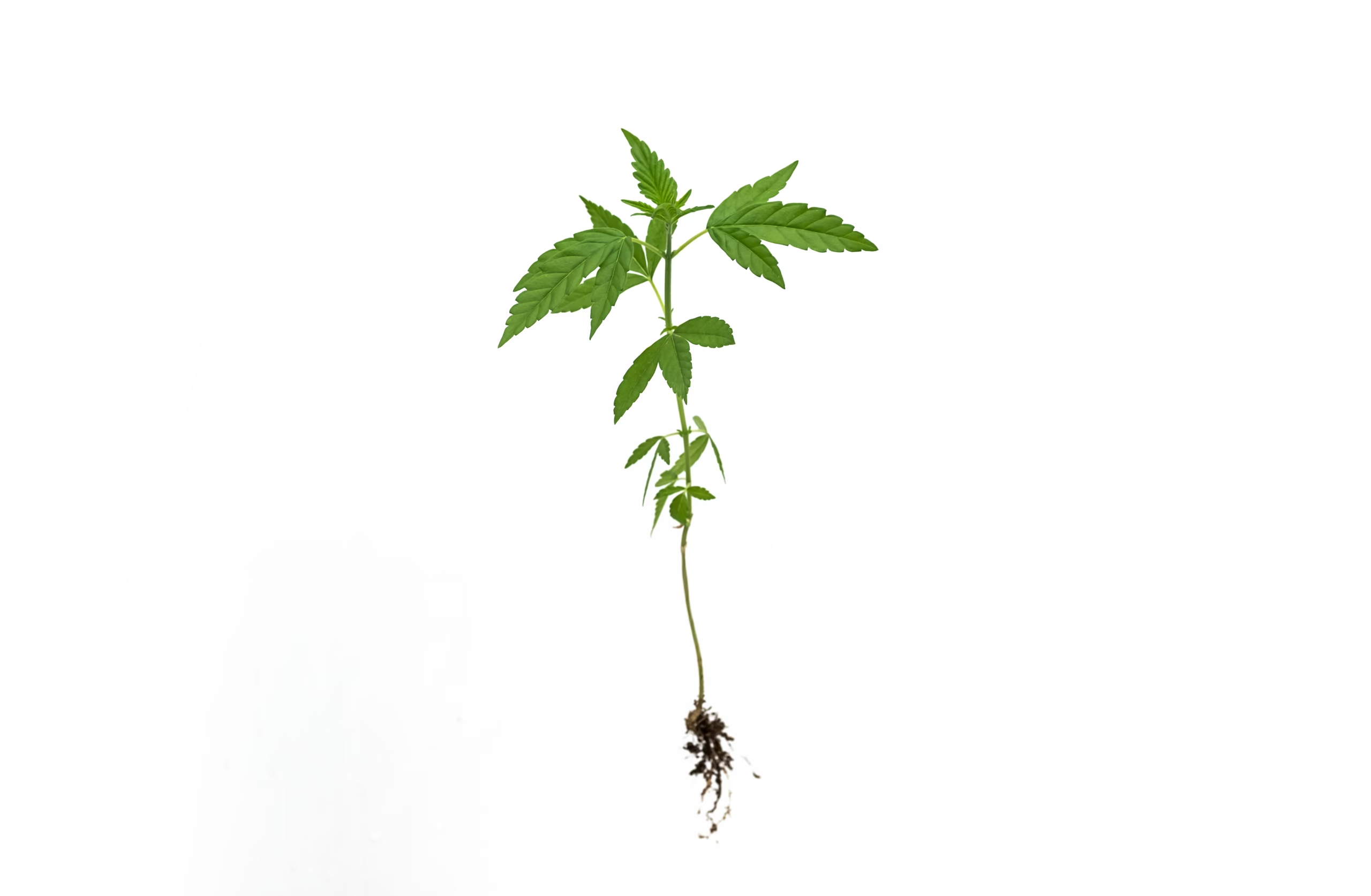
Root Hydraulic Conductivity ($L_p$) measures the ease with which liquid water moves through root cortical tissues into the central xylem vascular cylinder per unit pressure gradient, expressed in $\text{m}\cdot\text{s}^{-1}\cdot\text{MPa}^{-1}$. The Root-to-Shoot Ratio ($R:S$) represents the balance between subterranean root dry biomass and aboveground vegetative and floral tissue weight. Under high light, a compromised root system creates an unfavorable $R:S$ imbalance, triggering transpirational drought stress in saturated media.
Cultivators who attempt to push high light without prioritizing root health experience mysterious tip burn, sudden mid-day wilting, slow nutrient uptake, and severe yield penalties. Pushing 1,200 PPFD onto a compromised root system is equivalent to installing a twin-turbocharged racing engine onto a chassis with a severed fuel line.
Fundamental Botanical Axiom: The canopy cannot outperform the roots. You can only give the top of the plant as much photon energy as the bottom of the plant has the hydraulic and respiratory capacity to support.
Core Biological Mechanisms: Hydraulic Conductivity, Respiration, and Gas Exchange
Understanding why root health acts as an absolute physical limit on high-light growth requires examining the cellular biophysics of water transport, aquaporin regulation, and aerobic root respiration.
Aquaporin Channels and Radial Water Transport
Water moving from the substrate into the plant xylem follows two distinct pathways across the root cortex: the apoplastic pathway (movement through porous cell wall matrices) and the cell-to-cell (symplastic) pathway. At the endodermis, the waterproof Casparian strip forces 100% of water and dissolved minerals to cross living plasma membranes through specialized protein water channels called aquaporins.
Aquaporin gating is highly sensitive to root cellular energy status. When root cells have access to abundant dissolved oxygen, ATP synthesis powers plasma membrane proton pumps ($H^+$-ATPases), maintaining the transmembrane electrochemical gradient required to keep aquaporin channels open. If the root zone becomes waterlogged or anaerobic, cellular ATP collapses. Lacking energy, aquaporins close, reducing root hydraulic conductivity ($L_p$) by up to 70% within 30 minutes. Even if the container is swimming in water, the canopy experiences immediate physiological drought.
The precise biochemical mechanism governing this closure is driven by cytosolic acidification. Under normoxic conditions, healthy root cortical cells maintain an internal cytosolic pH of approximately 7.2 to 7.5. When dissolved oxygen drops below critical levels, oxidative phosphorylation halts, and root cells initiate anaerobic lactic acid fermentation. The rapid accumulation of lactic acid causes cytosolic pH to plunge to 6.5 or lower within minutes. This rapid drop in pH protonates a specific, highly conserved histidine amino acid residue (His193) located on loop D of the plasma membrane intrinsic protein (PIP2) aquaporin channel. Protonation alters the steric electrostatic charge of the channel entrance, physically collapsing the protein gate across the pore and terminating water transport instantaneously.
The Oxygen Penalty of Warm Root Zones
Under high light intensity, overhead luminaires and ambient air setpoints (typically 82°F to 84°F under LEDs) warm container substrates. The temperature coefficient ($Q_{10}$) for root cellular respiration is approximately 2.0: for every 18°F (10°C) increase in substrate temperature, root metabolic demand for oxygen doubles.
However, physics imposes an opposite physical constraint: the solubility of dissolved oxygen (DO) in water decreases as temperature rises. At 65°F (18.3°C), water holds roughly 9.5 mg/L of dissolved oxygen; at 78°F (25.5°C), saturation drops to 7.8 mg/L. Therefore, just as root oxygen consumption doubles under high light, the oxygen carrying capacity of the moisture decreases. If substrate drainage and aeration are inadequate, roots quickly enter a state of severe hypoxia.
The physiological barrier governing selective ion filtration at the endodermal junction is the Casparian strip: an impervious radial band of suberin and lignin deposited within primary cell walls. Under balanced transpirational flow, the Casparian strip acts as an essential checkpoint, preventing toxic heavy metals and excess sodium from passively flooding the central vascular bundle. However, when high light intensity forces rapid transpiration across an oxygen-deprived root zone, endodermal cell membranes lose ATP-driven selective permeability. Uncontrolled apoplastic bypass flow occurs, allowing non-essential ions like sodium and chloride to enter the xylem stream, where they are carried straight to leaf margins, compounding the symptoms of light stress with severe elemental toxicity.
Gas transport through soilless substrate pores obeys Fick’s First Law of diffusion: $$J_{O_2} = -D_{eff} \frac{dC}{dx} = -D_0 \left(\frac{\theta_a^{10/3}}{\theta_t^2}\right) \frac{dC}{dx}$$ Where $D_0$ is oxygen diffusivity in free air, $\theta_a$ is air-filled porosity, and $\theta_t$ is total substrate porosity. Notice the exponential sensitivity: diffusion flux ($J_{O_2}$) scales with air-filled porosity to the 3.33 power! When excessive watering or root-bound compaction reduces air porosity by half (for example, from 20% down to 10%), the rate of oxygen diffusion into the root zone does not drop by half: it collapses by over 85%. Under 1,000+ PPFD, this massive reduction in oxygen replenishment starves the inner root ball within hours, causing widespread root cortex dieback while only the outer container edges remain alive.
Variables That Alter the Ceiling: Substrate Aeration, Temperature, and Pathogens
The severity of root-zone limitations depends heavily on substrate physical porosity, root temperature management, and biological pathogen pressure.
Air-Filled Porosity in Rockwool, Coco, and Soil
The percentage of container volume occupied by air after gravitational drainage has ceased is known as Air-Filled Porosity (AFP). Under high PPFD, crops require high AFP to supply continuous oxygen to fast-respiring roots. Horticultural rockwool blocks provide an exceptional 15% to 20% AFP at full saturation, allowing cultivators to pulse irrigation 8 to 12 times per day without suffocating roots. Coarse-grade coco coir offers 12% to 15% AFP, provided fine coir dust (peat) is screened out.
Dense peat potting soils and unamended living soils, however, frequently drop below 8% AFP when saturated. In these media, attempting to deliver the high liquid volume demanded by 1,100 PPFD leads to persistent waterlogging, anaerobic fermentation, and root suffocation. In living soil, high PPFD can only be sustained by incorporating 25% to 35% coarse volcanic pumice or perlite to maintain macro-pore aeration channels.
| Root-Zone Parameter | Optimal High-Light Range | Critical Warning Threshold | Physiological Consequence Under High PPFD |
|---|---|---|---|
| Substrate Temperature | 66°F – 72°F (18.9°C – 22.2°C) | Above 76°F (24.4°C) | Doubles root oxygen consumption while DO solubility drops; triggers Pythium |
| Air-Filled Porosity (AFP) | 15% – 22% Volumetric Air | Below 10% Volumetric Air | Closes aquaporins; blocks radial water flux; causes transpirational collapse |
| Dissolved Oxygen (DO) | 8.0 – 12.0 mg/L (ppm) | Below 5.0 mg/L (ppm) | Starves root cortical mitochondria of ATP; halts active ion transport |
| Pore Water EC ($EC_{pw}$) | 2.0 – 3.2 mS/cm | Above 4.5 mS/cm | Exerts extreme osmotic suction; dehydrates root hairs; induces tip burn |
Opportunistic Pathogen Invasion: Pythium and Fusarium
When roots experience hypoxia under high light, cortical cells begin anaerobic fermentation, producing ethanol and lactic acid as metabolic byproducts. These volatile exudates act as chemical homing beacons for swimming zoospores of water mold pathogens, predominantly Pythium ultimum and Fusarium oxysporum.
Once zoospores encyst on weakened root tips, fungal hyphae secrete cellulase and pectinase enzymes, digesting the root cortex and stripping the vascular stele (damping off / root rot). Within 48 hours, root hydraulic conductivity drops to near zero. While an uninfected plant under 600 PPFD might survive mild root rot, that same plant under 1,100 PPFD suffers fatal, irreversible canopy wilting within a single photoperiod.
The High-Light Anaerobic Crash
Never increase lighting intensity to full power while root zones are waterlogged or suffering from root rot. Under intense photon bombardment, canopy transpiration will outpace the damaged root system absorption capacity within hours, forcing permanent vascular collapse. If roots show brown discoloration or slime, reduce lighting by 40% immediately while executing root recovery protocols.
Repeatable Step-by-Step Inspection and Root-Zone Optimization Protocol
To verify that root systems are robust enough to sustain commercial high-light cultivation, operators must execute a repeatable diagnostic inspection sequence.
Step 1: Visual and Tactile Root Examination
Inspect root systems weekly across representative containers. Gently slide the root ball out of its container or inspect drainage slits at the bottom of rockwool slabs:
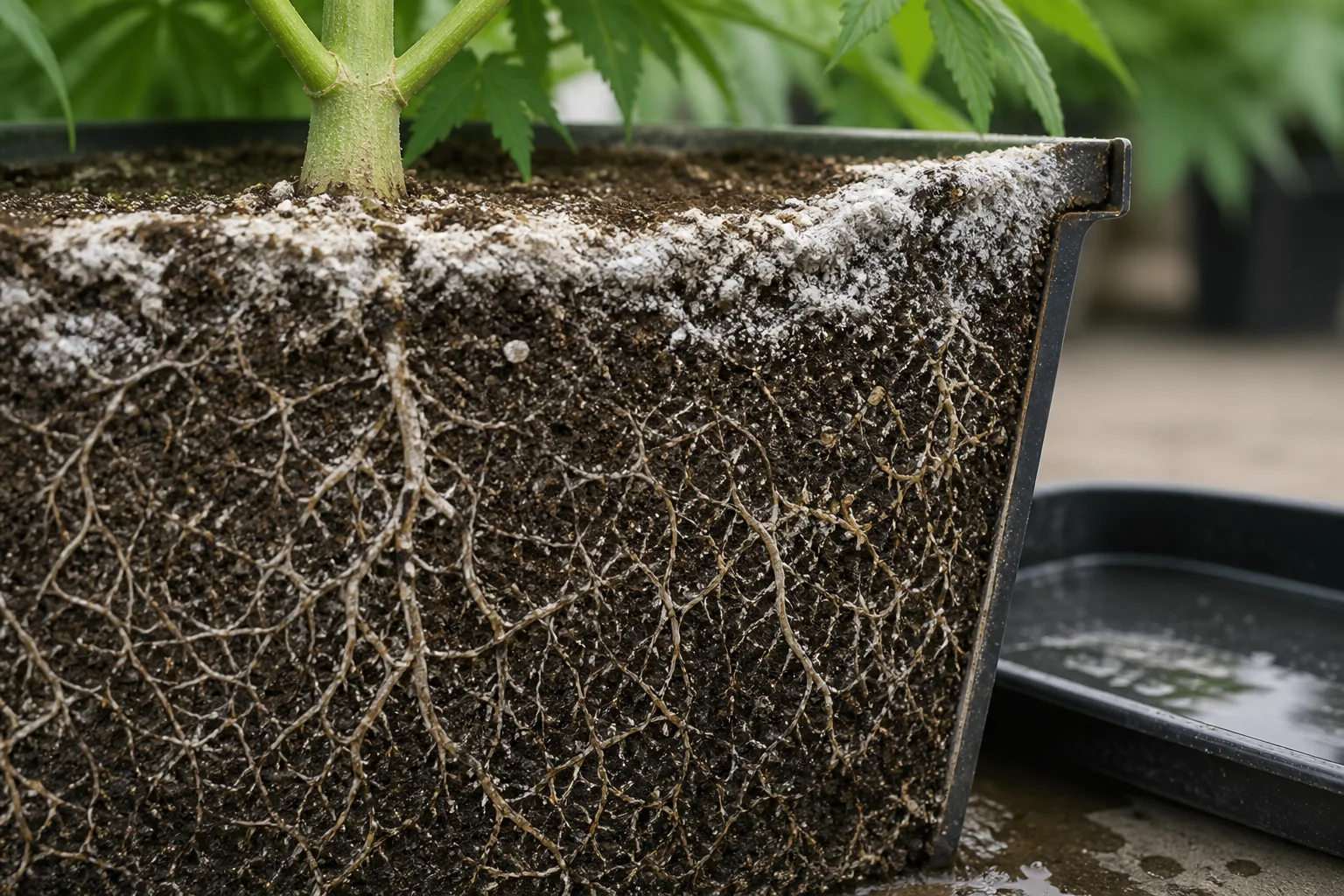
- Healthy High-Light Roots: Crisp, bright white or ivory coloration; abundant fuzzy root hairs; firm turgid texture; pleasant earthy aroma; extensive branching reaching all container margins.
- Compromised Roots: Dull tan, brown, or grayish coloration; slimy, stringy texture where root cortex sloughs off the central stele when gently pulled; sour, swampy, or anaerobic odor; root dieback concentrated at container bottom.
Step 2: Substrate Temperature Auditing
Insert a calibrated digital penetration soil thermometer 3 to 4 inches into the root core of multiple containers during peak lights-on hours. If container substrates exceed 74°F (23.3°C), implement immediate thermal buffering: raise pots off hot concrete floors using drainage grates, wrap plastic containers with reflective thermal wraps, or lower room floor-level temperatures.
Step 3: Biological Inoculation with Beneficial Consortia
Inoculate the root zone from clone through mid-flower with high-potency beneficial microbial strains: specifically Bacillus amyloliquefaciens, Bacillus subtilis, and Trichoderma harzianum. These beneficial organisms physically outcompete pathogenic water molds, colonize root entry points, and secrete antibiotic lipopeptides (such as surfactin and iturin) that lyse fungal cell walls.
Quantitative Root Viability Testing: The TTC Staining Assay
In commercial genetic benchmarking labs and analytical facilities, agronomists do not rely solely on visual inspection to judge root health; they quantify metabolic viability using the 2,3,5-triphenyltetrazolium chloride (TTC) reduction assay. Fresh root tip samples (100 mg) are incubated in a 0.4% aqueous TTC phosphate buffer solution at 95°F (35°C) for two hours in darkness. Active dehydrogenase enzymes within respiring root mitochondria reduce colorless TTC into water-insoluble red triphenylformazan (TF). Extracting the formazan in 95% ethanol and measuring absorbance on a spectrophotometer at 485 nm yields an exact quantitative index of root mitochondrial respiratory activity ($mg\text{ TF} / g\text{ dry root}\cdot\text{hr}$), definitively proving whether roots possess the enzymatic capacity to handle high-irradiance lighting ramps.
Common Cultivation Mistakes: Waterlogging, Chilled Media, and Over-Fertilization
Cultivators attempting to push high PPFD frequently commit critical root management errors that compromise the entire crop.
Mistake 1: Flooding Pots Early in the Morning
Firing heavy irrigation shots right as the grow lights switch on is a major operational blunder. Before lights turn on, root zones are cold and transpiration is near zero. Soaking the root ball when the plant is not drinking suffocates root hairs for 2 to 3 hours, closing aquaporins just as the midday photon ramp begins. Always wait 90 to 120 minutes after lights-on before delivering your first P1 ramp irrigation shot.
Mistake 2: Chilled Irrigation Water Shock
Irrigating warm root zones (72°F) with cold municipal tap water or unheated reverse-osmosis water (55°F to 60°F) induces acute thermal shock. Cold water constricts root cell membranes, thickens xylem sap viscosity, and halts water uptake for several hours. Under 1,000 PPFD, this sudden cessation of water delivery leads to immediate upper-canopy wilting and leaf margin scorching. Always temper irrigation solutions to 66°F to 69°F (18.9°C to 20.5°C).
Mistake 3: Stacking Fertilizers into Stressed Roots
When high light causes leaves to yellow or develop necrotic spots due to root hypoxia, growers frequently assume the plant is hungry, dumping high-EC fertilizers into the root zone. Adding mineral salts to a suffocated root system increases osmotic tension, stripping the damaged roots of their remaining moisture. Never increase fertilizer strength on a root system that is not drinking actively.
Reinforcing Root Architecture with Bioavailable Silicon
To fortify root cellular structures against the mechanical shearing forces created by high transpirational suction, commercial cultivators supplement nutrient solutions with stabilized monosilicic acid ($H_4SiO_4$). Absorbed through root epidermal cells, silicon is deposited directly into the secondary thickening of root cortical and endodermal cell walls as solid amorphous silica ($SiO_2\cdot nH_2O$). This mineral deposition creates a flexible, rigid structural scaffold that prevents root cortical collapse during steep drybacks and increases the root cortex resistance against enzymatic penetration by pathogenic Pythium zoospores.
The Chilled Reservoir Stall: How 56-Degree Water Paralyzed a 1,200 PPFD Facility
A commercial cultivation facility in Maine upgraded to top-tier 800W multi-bar LED fixtures delivering 1,200 μmol/m²/s PPFD across 2-gallon rockwool slabs. During winter, their fresh reverse-osmosis water entered the facility from an uninsulated underground tank at a chilled 52°F to 56°F. The automated drip system delivered this freezing water to the slabs four times daily.
The failure: By week 3 of flowering, the canopy exhibited bizarre, catastrophic symptoms: every plant wilted severely 20 minutes after each watering event, leaf edges turned crispy brown, and floral sites stopped developing entirely. The grower assumed the lights were too powerful and dialed them down to 40% power.
The discovery: We inspected root-zone temperatures with an insertion probe. The rockwool slabs dropped from 72°F down to 55°F with every irrigation pulse. The cold shock paralyzed root aquaporin channels, halting water uptake while 1,200 PPFD continued pulling moisture out of the leaves, causing severe acute desiccation.
The turnaround: We installed commercial inline titanium water heaters on the main fertigation line, holding irrigation temperature strictly at 68°F. Within 48 hours of feeding with tempered water, post-irrigation wilting vanished completely, root tips resumed bright white lateral growth, and the grower ramped lights back to 100% power, completing the harvest at 2.3 grams per watt.
When evaluating root hydraulic limits in commercial substrates, cultivators must understand the critical role of root suberization. Suberin is a complex, waxy biopolymer deposited in the radial and transverse cell walls of older root endodermal and hypodermal layers. While suberization protects root axes from mechanical damage and pathogen ingress, it renders cell walls virtually impermeable to water and dissolved mineral ions. In plants subjected to chronic severe drybacks or high salt stress, suberization advances aggressively toward the root tip, reducing the total functional surface area of unsuberized, highly permeable absorbing tissue. Maintaining consistent, moderate substrate drybacks preserves expansive zones of juvenile, unsuberized root hairs that sustain rapid transpirational mass flow under 1,000+ PPFD.
Additionally, mycorrhizal fungal symbiosis significantly expands effective root absorption geometry in organic and semi-organic cultivation systems. Endomycorrhizal fungi (predominantly Glomus intraradices, now classified as Rhizophagus irregularis) penetrate cortical cells, extending an extensive microscopic hyphal network that radiates feet into the surrounding media. These fungal hyphae possess an average diameter of only 3 to 5 micrometers: less than one-tenth the diameter of cannabis root hairs: allowing them to penetrate microscopic substrate pores that plant roots cannot physically enter. Under high light intensity, this mycorrhizal network acts as an auxiliary hydraulic pipeline, channeling water and immobile phosphorus ions directly into root cortical cells and insulating the crop against acute transpirational stress.
Do
Maintain Substrate Temperature Between 66°F and 72°F
Ensure root-zone temperatures support vigorous aerobic respiration without depressing dissolved oxygen solubility or promoting Pythium outbreaks.
Avoid
Irrigate with Freezing Water Under High Light
Never deliver nutrient solution below 64°F to warm, high-light canopies; thermal shock paralyzes aquaporin channels and triggers instant transpirational wilting.
Field Verification: Measuring Root Dry Weight, DO Levels, and Uptake Velocity
To verify that root function is not choking high-light performance, commercial operators implement quantitative field verification protocols.
Tracking Real-Time Substrate Dryback Velocity
Deploy digital bench scales or continuous load cells connected to your facility data logger beneath representative containers. Under tuned 1,000 PPFD, a healthy root system in full bloom should consume water at a steady, linear rate: pulling container weight down by 2.5% to 4.5% per hour during the middle 6 hours of the photoperiod. If container weight loss plateaus or declines below 1.5% per hour despite intense light, root hydraulic conductance is compromised, signaling immediate investigation of root health.
Measuring Irrigation Dissolved Oxygen (DO)
Audit dissolved oxygen levels in your fertigation holding tanks and at the dripper emitter tip using a calibrated optical dissolved oxygen meter. Ensure dissolved oxygen measures at least 8.0 to 10.0 mg/L. If DO measures below 6.0 mg/L, install nanobubble oxygen generators or high-output venturi aeration nozzles in stock reservoirs to super-saturate irrigation lines with bioavailable oxygen.
Validating Vascular Flux via Thermal Sap Flow Sensors
Advanced agricultural research facilities quantify root hydraulic throughput directly using non-invasive thermal sap flow sensors (such as Dynagage stem gauges or thermal dissipation Granier probes) clamped around the main stalk of mature cannabis plants. By applying a constant heat pulse to the vascular cylinder and measuring upstream versus downstream temperature dissipation, the sensor calculates instantaneous sap mass flow ($g\text{ water / hr}$). Under 1,100 PPFD and optimal root conditions, sap flow climbs smoothly to 150 to 250 g/hr during midday. If sap velocity plateaus or drops precipitously while lighting operates at full output, the plant is experiencing root-induced hydraulic restriction, warning operators days before leaf chlorosis appears.
Can hydrogen peroxide be used to clean roots without killing beneficial bacteria under high light?
Question sent by: Marcus Campbell, via email.
Hydrogen peroxide ($H_2O_2$) is a non-selective oxidizing agent. While applying 34% commercial-grade peroxide diluted to 1 to 2 mL per gallon will oxidize organic slime and kill swimming Pythium spores, it will also kill 100% of your beneficial Bacillus and Trichoderma inoculants. Peroxide is an emergency chemical reset tool, not a maintenance additive. If you use peroxide to halt an acute pathogen outbreak, flush thoroughly 48 hours later and re-inoculate the root zone immediately with beneficial microbial consortia to re-establish biological protection.
Final Decision Checklist and Companion Weedth Resources
Before stepping up lighting intensity or installing higher-wattage luminaires, verify your root-zone infrastructure against this operational decision checklist:
High-Light Root Health Operational Checklist
- Maintain substrate temperatures strictly between 66°F and 72°F (19°C-22°C) during the photoperiod.
- Verify substrate air-filled porosity (AFP) provides at least 15% volumetric aeration after full drainage.
- Temper irrigation feed water to 66°F-69°F to prevent cold-shock aquaporin closure under intense lighting.
- Delay morning irrigation until 90 to 120 minutes after lights-on to allow canopy transpiration to establish.
- Monitor hourly dryback rates with digital load cells; confirm continuous 2.5% to 4.5% hourly container weight loss.
- Inoculate root zones regularly with beneficial Bacillus and Trichoderma consortia to prevent Pythium colonization.
- Audit fertigation dissolved oxygen levels; maintain at least 8.0 to 10.0 mg/L DO at the emitter discharge tip.
- Never ramp lighting power onto root systems exhibiting root rot, browning, or severe salt crystallization.
Furthermore, maintaining root health under high light requires executing clean container resets between vegetative and flowering cycles. In root-bound containers where fibrous roots circle plastic sidewalls, radial resistance increases while aeration drops. Stepping up container volume or using breathable fabric pots and air-pruning containers stimulates continuous root branching, preventing thick root mats from forming impenetrable barriers to oxygen diffusion.
Mastering root health as the governing limit on high-light cultivation aligns botanical reality with facility engineering. By nurturing an expansive, well-aerated, and thermally buffered subterranean root system, commercial cultivators unlock the full photochemical potential of modern lighting, harvesting record-breaking yields with pristine plant vigor.
Final Verdict: The roots are the foundation; the canopy is the reflection. Build a world-class root zone, and your plants will harness every photon you give them with explosive growth and floral density.
To expand your technical cultivation foundation with our companion foundational guides, continue exploring Weedth resources below.
Share this article
A quick overview of the topics covered in this article.
Follow us
Latest articles
October 29, 2026

October 29, 2026