
What Does Full-Spectrum Grow Light Really Mean?
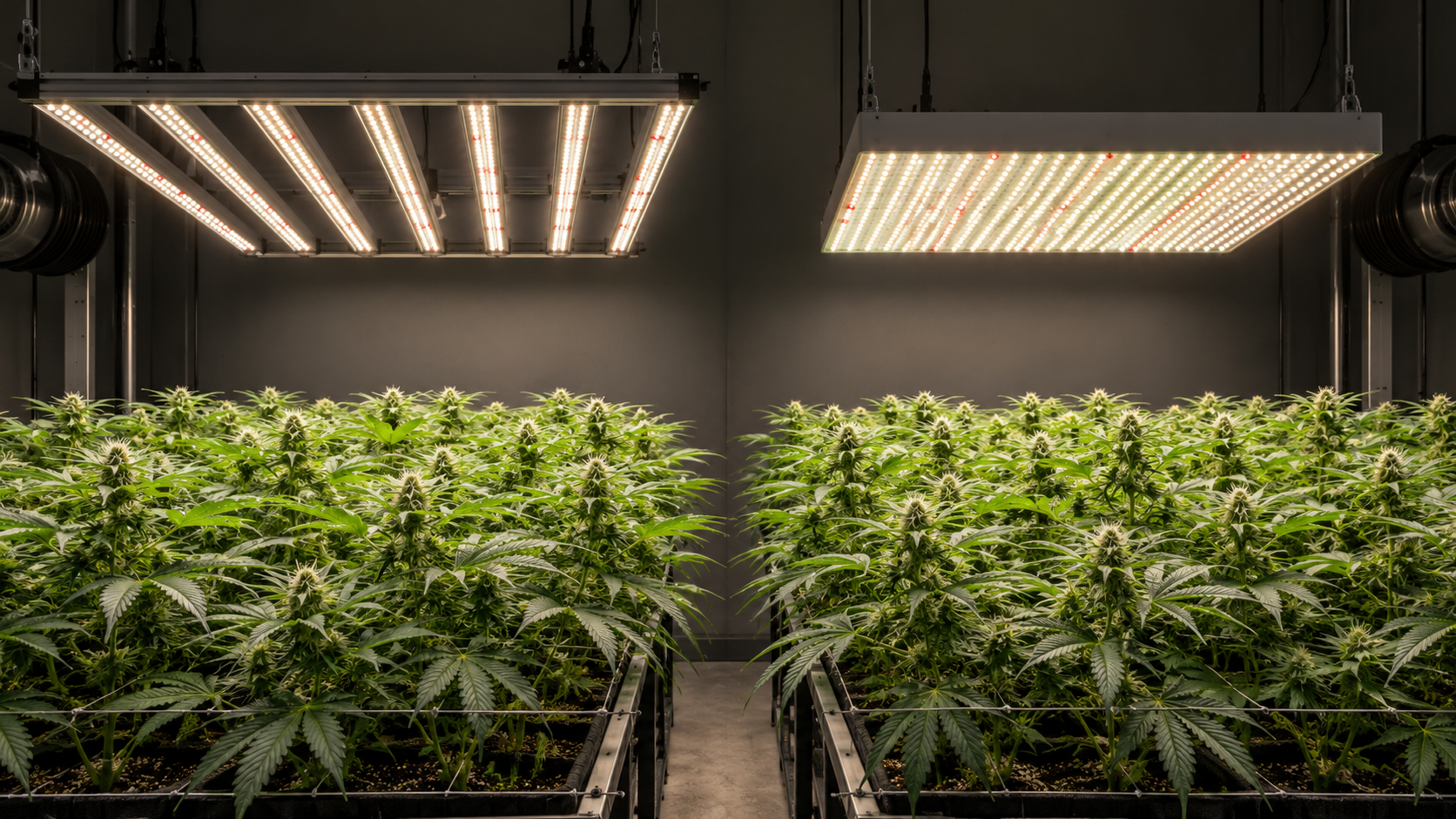
Walk into any indoor cultivation facility, browse an online horticultural equipment distributor, or read the side of an LED luminaire shipping box, and you will encounter the term “full spectrum.” Manufacturers slap this phrase across entry-level desk lamps, residential grow tent fixtures, and multi-thousand-dollar commercial greenhouse arrays alike. In commercial marketing, full spectrum is presented as a magic bullet: an all-encompassing promise that the fixture perfectly replicates natural outdoor sunlight, delivers every wavelength a cannabis plant could ever desire, and guarantees dense, resin-encrusted colas regardless of cultivation skill.
The biophysical reality of horticultural lighting is substantially more nuanced. From a strict scientific standpoint, the phrase full spectrum has no universally enforced legal, regulatory, or photobiological definition. A fixture producing an inefficient slurry of yellow and amber photons can legally be labeled full spectrum, just as easily as an engineered commercial array delivering precision-tuned photon ratios across the 400 to 750 nanometer waveband. Marketing literature frequently blurs the boundaries between human visual perception (lumens, color temperature, and color rendering index) and photosynthetic plant physiology (micromoles of photons, action spectra, and photosystem excitation kinetics).
To make informed capital investments and maximize grams harvested per kilowatt-hour of electricity, indoor cannabis growers must decode what a luminaire actually emits. You must understand why the early era of narrow-band pink and purple (“blurple”) LEDs failed, how modern phosphor-converted white diodes generate broad-spectrum light from monochromatic blue pumps, why green photons are essential for deep canopy light penetration, and how adding targeted deep red and far-red wavelengths turns an ordinary light into an elite horticultural engine.
This comprehensive guide deconstructs full-spectrum grow lights from the physics of solid-state semiconductors to canopy carbon assimilation. We explore the transition from early chlorophyll absorption charts to modern whole-canopy action spectra, evaluate Correlated Color Temperature (CCT) and Color Rendering Index (CRI) for plant production, teach you how to read a laboratory Spectral Power Distribution (SPD) graph, debunk widespread spectral marketing myths, and provide a verifiable field procurement checklist for your next lighting upgrade.
Direct Answer: The Marketing Myth vs The Biophysical Reality of Full Spectrum
In plain language, when an indoor grow light is marketed as “full spectrum,” the manufacturer usually means it emits continuous white light containing photons from across the entire visible spectrum (400 to 700 nanometers), rather than isolated monochromatic bands of purple, red, or blue. To the human eye, the fixture appears clean white, neutral, or slightly warm, closely resembling midday sunlight or commercial indoor architectural lighting.
Broad-Spectrum Horticultural Lighting
A continuous spectral photon distribution covering the traditional Photosynthetically Active Radiation waveband (400 to 700 nm) and extended ePAR waveband (400 to 750 nm). Unlike monochromatic or dual-band light sources, broad-spectrum horticultural luminaires deliver balanced photon ratios of blue, green, yellow, deep red, and far-red light to support both upper-leaf carbon fixation and deep-canopy photon penetration.
However, the critical distinction that commercial growers must grasp is that plants do not require sunlight-identical light to achieve peak productivity. Sunlight is an evolutionary baseline, not an engineered horticultural optimum. Terrestrial sunlight contains an immense quantity of green, yellow, and infrared radiation that represents lower photosynthetic efficiency per watt of energy expended. An optimal horticultural spectrum is an engineered blend: it provides enough blue for photomorphogenic control, enough green to penetrate into lower canopy foliage, and a dominant concentration of highly efficient deep red and far-red photons to drive carbon fixation at maximum photosynthetic photon efficacy (PPE).
Remember: A fixture does not need to duplicate every continuous nanometer of solar radiation to be extraordinarily effective. What cannabis requires is a balanced, continuous spectral diet that matches the absorption kinetics of intact leaves while minimizing wasted electrical energy.
The Historical Blurple Era: Why Narrow Red-Blue Fixtures Disappointed Growers
To appreciate why modern white broad-spectrum LED luminaires dominate the commercial cannabis sector, one must understand the failure of the first-generation LED revolution: the era of the “blurple” light.
The In Vitro Chlorophyll Absorption Trap
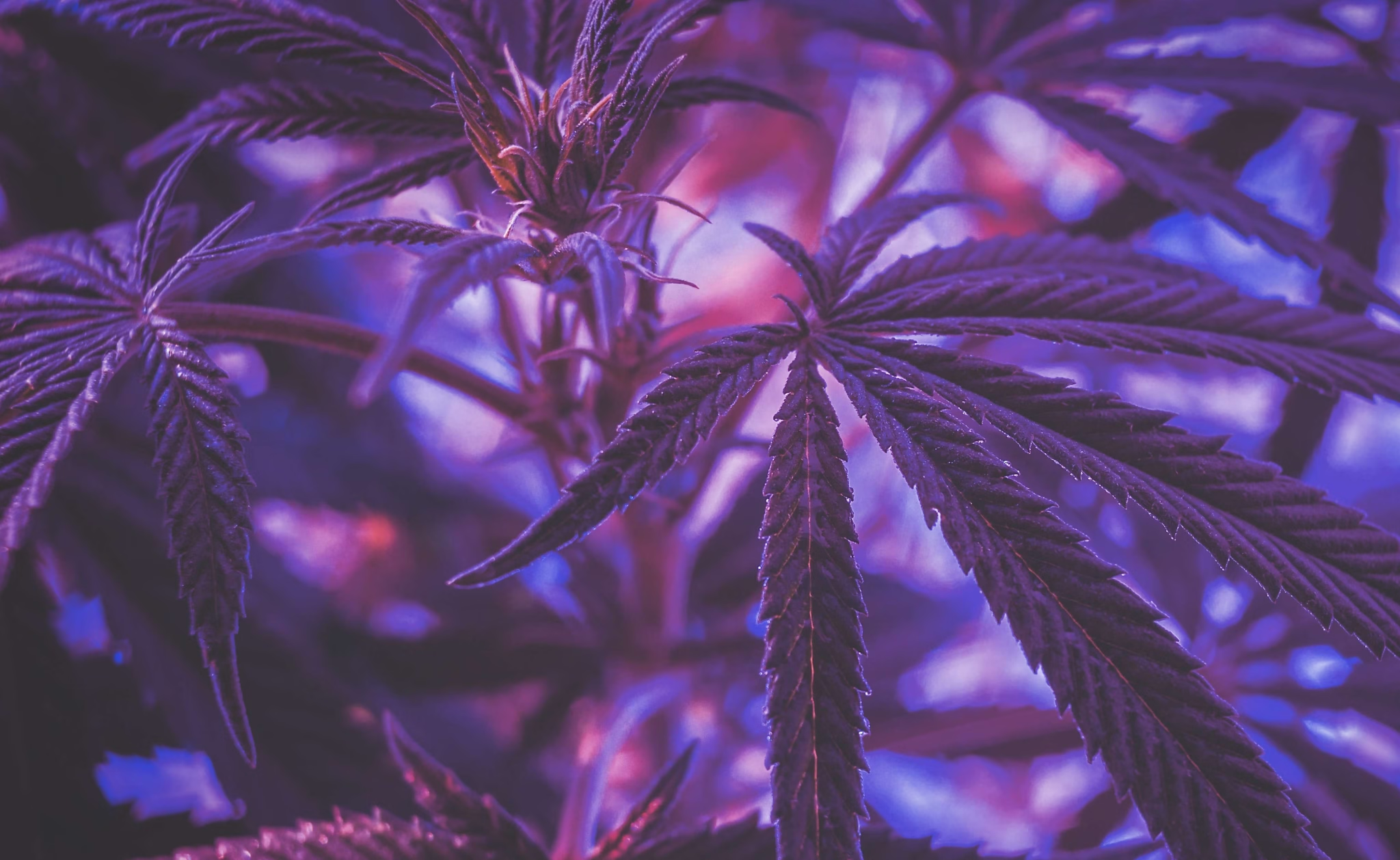
In the early 2000s, lighting manufacturers designed early horticultural LED panels based on extracted chlorophyll absorption curves. In laboratory test tubes, purified chlorophyll a and chlorophyll b dissolved in chemical solvents display dramatic optical absorption peaks centered almost exclusively in the blue (430 and 450 nm) and red (640 and 660 nm) regions, with near-zero absorption in the green region (500 to 600 nm). Lighting engineers concluded that any electrical energy spent generating green or yellow light was completely wasted. They assembled panels using strictly monochromatic royal blue (450 nm) and deep red (660 nm) diodes, producing an eerie magenta or purple glow.
Why Blurple Failed in Living Canopies
While the extracted chlorophyll chart was scientifically accurate in a cuvette, it proved catastrophic when applied to an intact, multi-layered living plant canopy:
- Upper Canopy Light Saturation: Blue and deep red photons have exceptionally high absorption coefficients in plant tissue. When focused downward onto a canopy, the uppermost single layer of leaf cells absorbs nearly 95% of incoming red and blue photons, quickly saturating their Photosystem II reaction centers and dissipating excess energy as wasteful heat through non-photochemical quenching (NPQ).
- Lower Canopy Starvation: Because upper leaves absorbed virtually all red and blue light, virtually zero usable photosynthetic photons penetrated below the top two inches of foliage. Lower branches and interior bud sites yellowed, senesced, and produced airy, low-potency larf.
- Severe Visual Inspection Limitations: Magenta light distorts color perception, making it nearly impossible for cultivators to detect early spider mite infestations, powdery mildew outbreaks, or nitrogen chlorosis without wearing specialized color-correcting glasses or switching on auxiliary white flashlights.
Tip: The failure of early blurple fixtures taught the horticultural industry a fundamental lesson: the optical properties of an intact leaf and a multi-layered canopy are vastly different from isolated chlorophyll molecules suspended in a solvent.
Phosphor-Converted White LEDs: How Modern Horticultural Light is Generated
The breakthrough that made modern high-efficiency grow lights possible occurred outside the horticultural industry: the mass-market development of phosphor-converted white LEDs for commercial architectural lighting. Unlike incandescent or fluorescent bulbs, a solid-state light-emitting diode is a semiconductor that inherently generates a single narrow band of monochromatic light. There is no such physical semiconductor material that naturally emits native white light.
The InGaN Blue Pump and Phosphor Chemistry
Modern broad-spectrum white LEDs (such as the Samsung LM301B, LM301H, and Lumileds Luxeon chips) generate white light through down-conversion fluorescence:
- The Monochromatic Blue Pump: At the heart of each white LED chip lies an Indium Gallium Nitride (InGaN) semiconductor die that emits highly efficient, narrow-band blue light centered at approximately 450 nanometers.
- The Phosphor Coating: The blue semiconductor die is coated with an engineered microscopic layer of phosphor ceramic crystals, most commonly Cerium-doped Yttrium Aluminum Garnet (YAG:Ce), often supplemented with nitride or oxynitride phosphors.
- Stokes Shift Down-Conversion: As high-energy 450 nm blue photons exit the semiconductor die, a portion of them strike the phosphor crystals. The phosphor absorbs the high-energy blue photons and re-emits them at lower energy, longer wavelengths across a broad continuous continuum spanning green (500-550 nm), yellow (560-580 nm), and amber/red (590-630 nm).
- The Resulting White Beam: The unabsorbed blue photons that pass directly through the phosphor mix with the broad re-emitted wavelengths, creating a rich, continuous white photon stream that human eyes perceive as natural light.
The Essential Role of Green Light in Plant Canopies
The broad phosphor hump supplies a high concentration of green photons (500 to 600 nm), which research led by Dr. Bruce Bugbee at Utah State University and Dr. Ichiro Terashima at the University of Tokyo proved to be indispensable for commercial cannabis production:
- The Sieve Effect and Light Guides: Because green light is absorbed less intensely by surface chlorophyll, green photons are repeatedly reflected and refracted through spongy mesophyll cell walls like light inside an optical fiber. Green photons penetrate deeply into lower canopy tiers, illuminating secondary foliage and lower floral bracts that red and blue photons cannot reach.
- High Whole-Canopy Quantum Yield: Under high-intensity cultivation (PPFD above 800 μmol/m²/s), when upper leaves are light-saturated, green light drives carbon assimilation in lower canopy layers with higher quantum efficiency than additional red or blue light, producing denser floral clusters from the top of the canopy to the trellis net.
Beware of the Green Light Myth
Old gardening lore claimed that green light is useless to plants because leaves appear green to human eyes. In reality, healthy cannabis leaves reflect only 5% to 15% of green photons; the remaining 85% to 95% is absorbed and used for photosynthesis. Eliminating green light from your spectrum severely limits lower canopy biomass and overall harvest yield.
Color Temperature (CCT) and CRI: Human Metrics vs Photosynthetic Utility
When examining the specifications of broad-spectrum white LEDs, cultivators routinely encounter two lighting metrics: Correlated Color Temperature (CCT) measured in Kelvin (K), and Color Rendering Index (CRI) scored from 0 to 100. Both metrics were developed strictly to describe how lighting affects the human eye, yet they provide valuable indirect insights into a fixture spectral balance.
Correlated Color Temperature (CCT) in Cannabis Cultivation
CCT describes the color appearance of white light by comparing it to the light emitted by an idealized incandescent black-body radiator heated to a specific temperature in Kelvin:
- Warm White (3000K to 3500K): Contains a lower proportion of blue photons (roughly 12% to 15%) and a heavy concentration of yellow, orange, and red photons. This spectrum creates a reddish-gold glow. It is highly favored for the flowering phase because red photons drive carbon fixation efficiently and support floral swelling.
- Neutral White (4000K): Provides a balanced, middle-ground distribution with approximately 18% to 22% blue photons and an even spread of green and red. It functions as an exceptional all-purpose spectrum for single-source facilities running seed-to-harvest cycles in the same room.
- Cool White (5000K to 6500K): Contains a prominent blue peak (25% to 35% of total photon flux) with reduced red emission, appearing crisp white or slightly blueish. High blue fractions trigger cryptochrome photoreceptors, suppressing gibberellin synthesis to keep internodal spacing tight and stems thick, making 5000K-6500K ideal for mother plants, seedling propagation, and vegetative canopy development.
Color Rendering Index (CRI): Does High CRI Mean Higher Yield?
Color Rendering Index (CRI) measures how accurately an artificial light source renders the colors of eight standardized pastel color swatches compared to natural daylight or an incandescent reference. A CRI of 90+ means human eyes see natural, undistorted colors.
While a high CRI (>85 or >90) makes pest scouting, fungal detection, and trichome maturity inspection significantly easier for facility staff, high CRI does not equate to higher photosynthetic efficiency. In fact, achieving a CRI of 95 often requires adding extra red-shifted phosphors that slightly reduce the fixture electrical photon efficacy (micromoles per joule). A fixture with CRI 80 that delivers 2.8 μmol/J will produce more total cannabis dry biomass than a fixture with CRI 95 that delivers only 2.3 μmol/J, assuming equal electrical wattage.
The comparative reference table below breaks down the spectral characteristics of common color temperatures alongside natural sunlight and legacy lighting:
| Light Source / CCT | Blue % (400-500nm) | Green/Yellow % (500-600nm) | Red % (600-700nm) | Far-Red % (700-750nm) | Primary Horticultural Role |
|---|---|---|---|---|---|
| 3000K Warm White | 12% – 15% | 40% – 45% | 38% – 42% | 3% – 5% | Flowering specialist; drives floral expansion |
| 4000K Neutral White | 18% – 22% | 42% – 46% | 32% – 36% | 3% – 5% | Full-cycle balanced engine; veg and bloom |
| 5000K Cool White | 25% – 30% | 45% – 48% | 20% – 25% | 2% – 4% | Vegetative and mother room; suppresses stretch |
| Midday Sunlight | 20% – 24% | 36% – 40% | 26% – 30% | 8% – 12% | Evolutionary baseline; high total energy |
| Legacy Blurple LED | 15% – 25% | 0% – 5% | 70% – 85% | 0% – 2% | Obsolete; poor canopy penetration, eyestrain |
Targeted Monochromatic Additions: Deep Red, Far-Red, and Ultraviolet
If modern phosphor-converted white LEDs are so versatile, why do top-tier commercial horticultural luminaires incorporate dedicated monochromatic diodes scattered across their light bars? The answer lies in semiconductor physics and photosynthetic optimization.
The Phosphor Red Hole and 660 nm Hyper Red Diodes
Standard commercial white LEDs (optimized for human offices and streetlights) have an optical limitation: their phosphor emission curve drops sharply above 640 nanometers. However, the quantum absorption peak of chlorophyll in intact cannabis leaves reaches its highest efficiency at 660 nanometers (deep red).
To solve this mismatch, horticultural lighting manufacturers blend high-efficiency monochromatic 660 nm deep red chips (such as Osram Oslon Square Hyper Red, San’an, or Samsung LH351H) alongside primary 3000K or 4000K white diodes. Modern 660 nm diodes achieve exceptional electrical conversion efficiency, producing up to 3.8 to 4.2 micromoles of photons per joule of energy. Injecting 660 nm photons into broad white light creates the characteristic “horticultural white” spectrum: it elevates overall fixture photosynthetic photon efficacy (PPE) while directly stimulating the P680 reaction centers of Photosystem II.
Adding Far-Red (730 nm) for Emerson Enhancement
As explored in our companion resource on far-red light, radiation between 700 and 750 nanometers drives Photosystem I excitation. Incorporating 3% to 8% far-red photons alongside 660 nm deep red unlocks the Emerson enhancement effect, clearing intermediate thylakoid electron transport bottlenecks and increasing canopy-wide carbon assimilation.
Adding Ultraviolet (UVA 385-395 nm) for Secondary Metabolites
While visible photons drive the primary photosynthetic motor, near-ultraviolet photons act as photomorphogenic and chemical defense triggers. Supplementing low doses of UVA (10 to 30 μmol/m²/s) stimulates cryptochrome and phototropin photoreceptors, activating phenylpropanoid enzymatic pathways that increase protective flavonoid synthesis and volatile terpene production without degrading flower yield.
Why do manufacturers advertise full spectrum if they still have to add dedicated red diodes?
Question sent by: Ethan Brooks, via email.
Because it creates the best of both worlds. The white phosphor-converted LEDs provide the broad continuous spectral foundation, delivering blue for structural plant guidance and green for deep multi-layered canopy penetration. The dedicated 660 nm deep red and 730 nm far-red diodes fill in the critical photosynthetic absorption peaks at maximum electrical efficiency. Combining broad white diodes with supplemental red chips produces a fixture that outperforms either spectrum operated in isolation.
Because full-spectrum lighting represents the baseline foundation of modern indoor horticulture, understanding how individual wavebands behave across specialized applications provides valuable commercial leverage. Exploring our companion deep-dive guides connects fixture hardware choices to whole-canopy plant responses:
When evaluated together, spectral engineering, biological photoreceptor mechanics, and electrical operating costs allow cultivators to select luminaires that maximize grams harvested per kilowatt-hour of energy consumed.
Reading a Spectral Power Distribution (SPD) Chart Like a Lighting Engineer
The only reliable method to evaluate what a grow light actually emits is to review its laboratory Spectral Power Distribution (SPD) chart. An SPD graph plots relative radiometric radiant power (or photon flux) on the vertical Y-axis against wavelength in nanometers (spanning 380 to 780 nm) on the horizontal X-axis.
Key Anatomical Landmarks of an Elite Horticultural SPD Chart
When examining an SPD chart for a high-performance commercial cannabis fixture, look for these four distinct structural landmarks:
- The Blue Peak (445-455 nm): A sharp, defined spike representing the InGaN semiconductor blue pump die. In a flowering-oriented fixture, this peak should represent roughly 12% to 16% of total area under the curve. In a vegetative fixture, it will be significantly taller (20% to 30%).
- The Green/Yellow Phosphor Continuum (500-600 nm): A wide, smooth rolling hump generated by the down-converting phosphor layer. This broad plateau indicates that the fixture will penetrate deeply into dense leaf canopies and provide comfortable, accurate visibility for garden tasks.
- The Deep Red Crest (655-665 nm): A prominent, narrow peak towering above the yellow-green phosphor hump. This spike confirms the inclusion of dedicated 660 nm monochromatic diodes designed to drive Photosystem II at maximum efficiency.
- The Far-Red Tail or Shoulder (720-740 nm): A gentle shoulder or small secondary peak extending past 700 nm into the near-infrared. This indicates the presence of 730 nm diodes powering the Emerson enhancement effect.
The Danger of Comparing Fixtures by Wattage Instead of SPD
Several seasons ago, a cultivation client asked me to evaluate two 650-watt LED fixtures from different manufacturers. Fixture A was an unbranded “commercial full-spectrum” light costing $350; Fixture B was an engineered horticultural array costing $750. Both drew an identical 645 watts at the wall receptacle, and to the naked eye in an empty room, both appeared brightly white.
The takeaway: When we tested both fixtures with a laboratory spectroradiometer, the mystery vanished. Fixture A was built using cheap, high-CCT industrial warehouse LEDs: its SPD showed an enormous, glaring 450 nm blue spike, an excessive yellow phosphor valley, and almost zero emission beyond 640 nm. It achieved an efficacy of only 1.9 μmol/J. Fixture B utilized a calibrated blend of 3500K mid-power diodes paired with top-bin 660 nm and 730 nm chips, delivering an impressive 2.85 μmol/J. In identical 5×5 flowering tents, Fixture B produced 28% more dry flower mass with tighter bud structure. Never buy a grow light based on advertised wattage alone: demand the laboratory SPD chart.
Field Advice: Watch out for normalized versus absolute SPD graphs. A normalized graph scales the highest peak to 1.0 (or 100%), which can make a low-powered, inefficient light look identical in spectral shape to an elite commercial powerhouse. Always check total photosynthetic photon flux (PPF in μmol/s) and efficacy (PPE in μmol/J) alongside the spectral graph.
Can I use a cheap household daylight LED floodlight as a full-spectrum grow light?
Question sent by: Julia Schneider, via contact form.
Technically, a household daylight LED (5000K or 6500K) produces broad-spectrum white light that will keep a vegetative seedling alive. However, household bulbs are engineered for human visual brightness (lumens), not plant photon volume (PPFD). They have low electrical photon efficacy (typically 1.2 to 1.6 μmol/J), lack dedicated 660 nm deep red wavelengths, and use narrow plastic diffusers that concentrate heat. Attempting to flower cannabis under household floodlights yields loose, wispy buds and wastes significant electricity compared to an engineered horticultural fixture.
Common Misconceptions, Marketing Traps, and Equipment Look-Alikes
Because the term full spectrum carries strong marketing appeal, equipment manufacturers frequently exploit scientific misunderstandings to sell inferior lighting hardware. Cultivators should be vigilant against these pervasive industry claims:
Myth 1: Sunlight Replication Equals Horticultural Perfection
Marketing literature often boasts that a fixture replicates the exact spectral output of Mediterranean midday sunlight. While natural sunlight evolved terrestrial plants, terrestrial sunlight contains massive amounts of yellow photons (which have lower photosynthetic efficiency per photon) and abundant near-infrared thermal energy that raises leaf surface temperature. An engineered horticultural spectrum delivers higher grams per kilowatt-hour than pure sunlight replication because it selectively weights the most energetically efficient wavebands.
Myth 2: Higher CRI Always Means a Better Grow Light
As discussed, Color Rendering Index is a human visual standard. A fixture claiming CRI 98 often utilizes heavy red-fluorescent phosphors that suffer from significant Stokes shift energy loss, dropping fixture efficacy from 2.8 μmol/J down to 2.2 μmol/J. Unless your facility primary goal is taking high-end photography without supplemental lighting, prioritize Photosynthetic Photon Efficacy (PPE) over CRI.
Myth 3: Autoflowers Need a Specialized Spectrum
Some manufacturers sell separate vegetative and flowering lights for autoflowering cannabis. In reality, day-neutral cannabis cultivars thrive under the same balanced broad-spectrum horticultural white (3500K-4000K with supplemental 660 nm) from germination through harvest. Because autoflowers run under long photoperiods (18 to 20 hours), a high-efficacy broad-spectrum light delivers optimal Daily Light Integral without requiring spectral adjustments.
Do
Verify DLC Horticultural Qualified Products Listing
Ensure any commercial luminaire is certified on the DesignLights Consortium (DLC) Horticultural QPL, which independently verifies photon flux, spectral output, and minimum efficacy.
Avoid
Rely on Equivalent Wattage or Lumen Ratings
Never purchase a cannabis grow light based on equivalent bulb claims (e.g. 1000W equivalent) or lumen output, which measures human eye brightness rather than plant photosynthetically active photons.
Can a full-spectrum LED grow light cause light bleaching on top colas?
Question sent by: MapleGrower, via Facebook page.
Yes. Light bleaching occurs when the total photon intensity (PPFD) exceeds the plant capacity to dissipate absorbed energy, leading to photo-oxidation and chlorophyll degradation. Even a perfectly balanced full-spectrum light will turn top floral tips bright white if hung too close to the canopy (delivering PPFD above 1,200 to 1,400 μmol/m²/s without supplemental carbon dioxide). Maintain recommended hanging distances (typically 18 to 24 inches for commercial bar fixtures) or dim the fixture to prevent optical photobleaching.
The reference comparison table below contrasts true horticultural broad-spectrum fixtures against common commercial lighting look-alikes:
| Fixture Category | Typical Diode Configuration | Typical Efficacy (PPE) | Canopy Penetration | Commercial Cannabis Suitability |
|---|---|---|---|---|
| Engineered Horticultural White | 3000K/4000K white + 660nm deep red + 730nm far-red | 2.6 – 3.2 μmol/J | High (balanced green continuum) | Optimal; highest yield, potency, and electrical efficiency |
| Generic White LED Floodlight | 5000K/6500K industrial white only (no supplemental red) | 1.4 – 1.9 μmol/J | Moderate | Poor for flowering; acceptable only for early seedling/veg |
| Legacy Dual-Band (Blurple) | Monochromatic 450nm royal blue + 660nm deep red | 1.2 – 1.8 μmol/J | Very Low (upper canopy saturation) | Obsolete; produces low lower-canopy biomass and severe eyestrain |
| Ceramic Metal Halide (CMH) | High-intensity discharge gas arc tube (broad continuous) | 1.6 – 1.9 μmol/J | High (natural broad SPD) | Good quality but high thermal heat and lower electrical efficiency |
The Full-Spectrum Purchasing and Field Audit Protocol: A Step-by-Step Guide
To protect your cultivation capital and ensure you acquire luminaires that maximize grams harvested per kilowatt-hour, follow this repeatable four-step procurement and verification sequence:
Step 1: Audit Independent Integrating Sphere Test Reports
Never purchase commercial luminaires based on manufacturer marketing brochures alone. Demand an independent laboratory integrating sphere test report (such as an NVLAP-accredited LM-79 report). Verify the following metrics:
- Photosynthetic Photon Efficacy (PPE): Ensure the fixture achieves an independently verified PPE of at least 2.5 μmol/J (with modern tier-one fixtures delivering 2.8 to 3.2 μmol/J).
- Total Photon Output (PPF): Verify that total micromoles per second (μmol/s) match your canopy footprint requirements (e.g., approximately 1,600 to 1,900 μmol/s for a 4×4 or 5×5 commercial flowering area).
- Actual Wall Draw: Confirm measured electrical consumption in watts at your operating voltage (120V, 240V, or 277V) and verify a power factor (PF) of 0.95 or higher.
Step 2: Inspect Diode Architecture and Brand Pedigree
High-efficiency broad-spectrum performance requires premium solid-state semiconductors. Inspect the bill of materials for tier-one diode manufacturers (Samsung, Osram, Lumileds, Seoul Semiconductor) and confirm diode density. Fixtures with higher diode counts run each semiconductor at lower drive currents, generating less convective heat, preserving long-term photon efficacy (Q90 lifetimes exceeding 50,000 hours), and delivering superior electrical efficiency.
Step 3: Evaluate Spectrum Composition for Your Operating Cycle
Match spectral balance to your facility workflow:
- Single-Source Seed-to-Harvest: Select a balanced 3500K or 4000K broad-spectrum white engine with 15% to 20% blue, balanced green, and integrated 660 nm deep red.
- Dedicated Bloom Room: Select a warm 3000K spectrum heavily supplemented with 660 nm deep red (comprising 35% to 42% of total photon flux) and 3% to 5% far-red to maximize the Emerson effect during floral swelling.
- Dedicated Vegetative / Mother Room: Select a cool 5000K spectrum with high blue content to maintain compact internodes and vigorous branching.
Step 4: Field Verification with a Calibrated Spectroradiometer
Once installed, verify canopy irradiance using a quantum sensor or portable spectroradiometer. Map the canopy at multiple grid points across the trellis to ensure uniform photon distribution, confirming that edge-to-center variance does not exceed 15% to 20%.
Full-Spectrum Grow Light Purchasing and Field Verification Sequence
- Obtain third-party LM-79 integrating sphere test reports from an accredited laboratory.
- Verify fixture efficacy meets or exceeds 2.6 μmol/J across the full 400 to 700 nm waveband.
- Confirm the presence of top-bin phosphor-converted white LEDs combined with dedicated 660 nm deep red diodes.
- Inspect the published Spectral Power Distribution (SPD) to verify continuous green/yellow output (500-600 nm) for canopy penetration.
- Ensure driver power factor (PF) exceeds 0.95 with total harmonic distortion (THD) under 15%.
- Verify the fixture is listed on the DesignLights Consortium (DLC) Horticultural Qualified Products List.
- Match fixture color temperature (3000K bloom, 4000K full-cycle, 5000K veg) to your room developmental phase.
- Perform a multi-point canopy PPFD grid mapping after commissioning to verify uniform photon distribution across trellises.
Following this procurement and field verification sequence protects commercial cultivators from misleading packaging claims. Demanding third-party test reports, auditing diode architecture, and measuring whole-canopy photon distribution on an ePAR scale ensures that every dollar invested in horticultural lighting delivers verifiable biomass accretion.
Furthermore, standardizing fixture commissioning protocols across every flowering room allows head growers to eliminate thermal hotspots, balance photon delivery across horizontal trellises, and establish consistent operational baselines across successive production cycles.
Weedth Verdict: A genuine full-spectrum grow light is not a mystical recreation of outdoor sunlight. It is an engineered horticultural engine combining phosphor-converted broad-spectrum white diodes for deep canopy penetration with high-efficiency 660 nm deep red and far-red chips for maximum carbon fixation. When you judge lighting by photon physics, integrating sphere data, and canopy penetration rather than retail marketing buzzwords, your garden achieves peak photosynthetic efficiency, superior flower density, and lower electrical operating costs.
Horticultural excellence is built on evidence rather than commercial folklore. By looking past retail labels and evaluating luminaires through the lens of semiconductor physics and canopy photobiology, you ensure your cultivation facility operates at peak biological and electrical efficiency.
To continue expanding your cultivation knowledge with foundational guides on indoor grow mediums, cannabis plant morphology, and environmental setup, explore our educational resources below:
Share this article
A quick overview of the topics covered in this article.
Follow us
Latest articles
October 28, 2026
October 28, 2026
October 28, 2026
October 28, 2026
