
Root Aphids on Cannabis: Identification, Containment, and Control
Root aphids on cannabis can remain hidden until a plant loses vigor, irrigation demand changes, or winged adults begin appearing around the base of the crop. Those observations justify a root-zone inspection, but they do not identify the pest by themselves. Fungus gnats, springtails, root disease, saturation, high substrate EC, and irrigation failure can produce overlapping clues.
In North American indoor cannabis, the best-documented root-feeding aphid is the rice root aphid, Rhopalosiphum rufiabdominale. It can colonize cannabis roots in soil, soilless media, hydroponic systems, and aeroponic production. Wingless forms usually remain below the surface, while winged forms can leave crowded colonies and move to new hosts.
This guide explains how to confirm a root aphid population, distinguish aphids from fungus gnats and other root-zone organisms, contain movement, choose controls that fit the crop and production system, and verify that reproduction has actually stopped.
What Root Aphids Are
“Root aphid” describes aphids that feed primarily on roots or at the crown. It is not one universal species. On cannabis, the rice root aphid is especially important because peer-reviewed work has confirmed Cannabis sativa as a host and documented colonies on roots in indoor production.
Rice root aphid
Rhopalosiphum rufiabdominale, a small sap-feeding aphid that lives mainly on roots in indoor cannabis production. Wingless adults and nymphs colonize the root zone, while winged adults can disperse to new plants and alternative hosts.
The feeding site makes the infestation difficult to see
Root aphids insert piercing-sucking mouthparts into root tissue and remove plant sap. Much of the population can remain inside a root ball, beneath a container, around drainage openings, or on exposed roots in a hydroponic or aeroponic chamber. A canopy inspection can therefore miss the pest even when the colony is established.
Heavy feeding is associated with reduced vigor, slow growth, yellowing, wilting, and weak root development. Those are consequences of impaired root function, not diagnostic signatures. A plant can display the same response when roots lack oxygen, salts are excessive, pH is unsuitable, irrigation delivery is uneven, or root tissue is diseased.
Indoor populations can reproduce without a mating cycle
In protected cannabis production, rice root aphids can reproduce through live-bearing females without mating. Nymphs resemble smaller versions of the wingless adults and remain close to the feeding colony. Overlapping generations can develop below the surface while the canopy shows only gradual loss of vigor.
Population growth is affected by temperature, host condition, crowding, natural enemies, and production system. A generation time or doubling rate measured under one experimental condition should not be treated as a universal cannabis threshold.
Winged adults are a dispersal stage
Winged aphids, called alates, can appear when colonies are crowded or host conditions change. Cannabis observations have reported large numbers emerging from the root zone as plants approach maturity. Alates may walk up stems, land on leaves, collect near lights, or become trapped on sticky cards.
A winged aphid on a card is important evidence, but it does not reveal which root ball is colonized or how much injury is occurring. Confirm the insect, trace activity back toward the root zone, and inspect plants connected by propagation source, irrigation, benches, tools, and nearby alternative hosts.
Important: “Root aphid” is a location and feeding description until the organism is identified. Do not assume every aphid near a pot is the rice root aphid or that every weak root system is aphid-damaged.
How to Identify Root Aphids on Cannabis
Strong identification connects an aphid body form with a belowground colony and a compatible crop pattern. Start with the roots and container, then use traps and canopy observations to map movement. Preserve specimens when the identification will determine an expensive or crop-wide response.
Inspect the crown, root-ball edge, and drainage openings
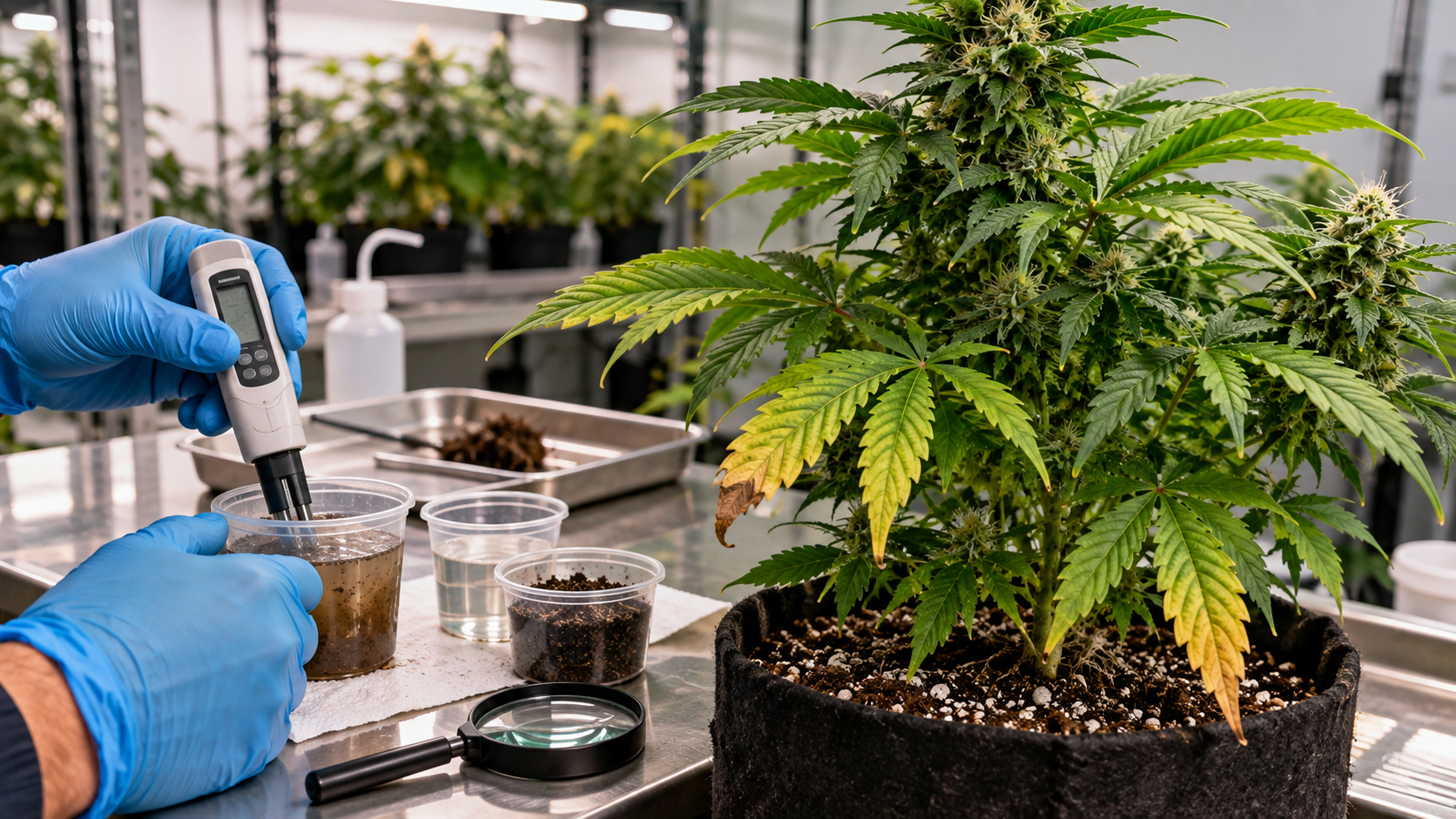
Examine the media surface around the stem, the underside of the container, drainage holes, exposed roots, and the outer edge of the root ball. In hydroponic or aeroponic systems, inspect root masses, net pots, channels, rafts, lids, return points, and sheltered surfaces above the solution line.
Wingless rice root aphids are generally small, soft-bodied, and rounded to oval. Color can range from olive or greenish tones to darker brown forms, so color alone is unreliable. Nymphs are smaller and may be more difficult to distinguish from mites, springtails, and other organisms without magnification.
Look for a colony, not one ambiguous speck
A colony may include adults, smaller nymphs, pale cast skins, and waxy material around roots. Individuals can move slowly across the root surface or media when disturbed. Finding multiple life stages feeding together carries more weight than seeing one unidentified organism after irrigation.
Do not tear apart every plant. Begin with suspect containers and compare them with healthy plants from the same cultivar, age, and irrigation zone. If removing a plant from its container would damage valuable stock, inspect accessible edges and drainage openings first or contact a diagnostic service about a representative sample.
Use magnification for aphid structures
Aphids have a pear-shaped to oval body and a pair of cornicles near the rear of the abdomen. In rice root aphids, these structures are relatively short and may not be obvious with a basic hand lens. Winged aphids have a compact aphid body beneath the wings rather than the slender, mosquito-like form of a fungus gnat.
Cornicles can help separate aphids from flies, mites, and springtails, but species-level identification may require a microscope and an entomological key. Photograph the dorsal and side views beside a scale, retain several winged and wingless specimens, and ask a qualified extension or diagnostic service when certainty matters.
Use traps to map flight, not to diagnose the root colony
Yellow sticky cards near the media surface and lower canopy can capture dispersing alates. Label cards by room, bench, date, and position. Keep card size, height, orientation, and replacement interval consistent so changes in catch are interpretable.
Count confirmed aphids separately from fungus gnats and other small insects. A card placed near one infested container may catch many alates while a high canopy card catches few. That difference can help locate a source, but card counts must be paired with direct root-zone inspection.
Do not flood, shake, or blast a suspect root ball over clean plants, open reservoirs, propagation trays, or reusable media. Contain the runoff and loose material, then clean the inspection area before handling healthy stock.
Separate pest evidence from plant symptoms
Record aphid findings, root condition, plant symptoms, and environmental measurements as separate layers. Root aphids may be present without obvious canopy injury, particularly early in colonization. A declining plant may also contain a few aphids while the main problem is saturation, root disease, salinity, or an irrigation fault.
Compare water use, container weight, drainage, substrate moisture at depth, root firmness, fine-root density, pH and EC where appropriate, and the distribution of affected plants. A causal case becomes stronger when higher aphid pressure repeatedly overlaps with fresh root injury and declining performance.
“I found one winged insect near the pot. Does that prove the roots are infested?”
Question sent by: DirtFarmer86, via email.
No. Preserve the insect, examine body shape and cornicles under magnification, and inspect the crown, drainage holes, and accessible roots for wingless adults, nymphs, and cast skins. One alate can be an early warning, but the source and root colony still need confirmation.
Root Aphid Look-Alikes
Root-zone organisms are often identified from movement or color alone. That approach fails because several harmless or differently managed organisms occupy the same wet spaces. Use body structure, life stage, feeding site, and crop evidence together.
| Finding | More consistent with | Best distinguishing check |
|---|---|---|
| Pear-shaped or oval insects on roots; adults and smaller nymphs together; cast skins or wax may be present | Root aphids | Look for cornicles and preserve wingless and winged specimens for magnified identification |
| Slender dark flies running over media; translucent legless larvae with a shiny black head | Fungus gnats | Inspect moist media for black-headed larvae and adult wing venation |
| Tiny organisms that jump when disturbed and concentrate in wet organic matter | Springtails | Observe the jumping response and confirm body form under magnification |
| Fine roots losing integrity, crown lesions, soft tissue, or continued decline after moisture correction | Root or crown disease | Compare tissue firmness and progression; submit a representative sample when pathogen identity changes the response |
| Wet, heavy container and low water use without a confirmed organism or progressive tissue decay | Saturation or low root-zone oxygen | Measure the moisture profile, drainage, irrigation history, and root integrity |
| Aphid colonies on stems, petioles, leaves, or flowers with honeydew aboveground | Cannabis aphid or another foliar aphid | Identify the feeding location and species; use the dedicated foliar aphid workflow |
Fungus gnats have a different hidden stage
Adult fungus gnats are true flies with long legs and antennae. Their larvae are translucent, legless maggots with black head capsules. Root aphid nymphs are not maggots; they have an aphid body plan and develop into wingless or winged aphid adults.
Both pests may occur in the same crop, especially where incoming plants, wet media, algae, weeds, and persistent root-zone problems are present. Finding one does not rule out the other. Use the Fungus Gnats on Cannabis guide when black-headed larvae and low-flying mosquito-like adults are the stronger evidence.
Root disease can coexist with insect feeding
Yellowing, wilt, low water use, and poor roots do not separate insects from disease. Aphid feeding can weaken plants, while damaged or saturated roots may make the crop less able to tolerate feeding. A single plant can therefore have more than one active problem.
Root disease becomes more concerning when tissue turns soft or water-soaked, the root cortex sloughs away, the crown develops an expanding lesion, or decline continues despite correction of irrigation and insect pressure. Compare the Root Rot vs. Overwatering guide, the Pythium guide, and the Fusarium guide when those patterns are present.
Foliar aphids occupy a different inspection zone
Cannabis aphids and other foliar aphids form colonies on stems, petioles, leaf undersides, growing tips, and flowers. Honeydew, cast skins, distorted growth, and sooty mold may be obvious aboveground. Root aphids may briefly appear on stems or leaves as winged dispersers, but the reproductive colony is centered belowground.
Do not use location alone for species identification. Preserve specimens and compare the plant zones carefully. Continue with the Aphids on Cannabis guide when sustained colonies and feeding are on the canopy.
Confirm an aphid body form and inspect the roots for multiple life stages before naming the problem.
Calling every tiny organism in wet media a root aphid or treating canopy decline as proof of root feeding.
How an Infestation Develops and Spreads
Root aphids usually enter a clean grow on infested plant material, rooted clones, mother stock, media, weeds, or containers carrying roots and debris. Once established, crawling stages can move short distances and winged adults can disperse within or between production areas.
Incoming plants can hide the entire colony
A clone may look healthy while aphids remain inside the plug or root ball. Visual canopy quarantine alone will miss that pathway. Inspect the plug edge, crown, drainage openings, and runoff from a controlled test area before integrating new plants with clean stock.
Keep source batches identifiable. If aphids appear later, plant-source records help determine whether the issue follows one nursery, clone shipment, mother line, medium batch, or room. Without those records, apparently random distribution can hide a common introduction.
Winged adults connect separate root zones
Alates can move from an established colony to new containers and alternative hosts. Screens and closed rooms reduce some movement but do not replace root inspection. Workers, carts, fans, doors, and plant transfers can change where flying adults land.
Map confirmed aphids by plant, bench, irrigation zone, and date. A rising card count near one end of a room may identify a source area. Scattered catches without root findings may reflect dispersal through the room rather than equal infestation of every container.
Grasses, sedges, and weeds can maintain the pest
Rice root aphid has a broad host range, with important associations on grasses and sedges. Weeds in pots, beneath benches, around greenhouse edges, or near intake areas can act as unnoticed hosts. Decorative plants and cover crops also deserve inspection rather than automatic removal.
Do not assume that killing weeds after aphids are abundant will solve the problem. Disturbing or drying an alternative host can encourage dispersal. Identify the organism, plan containment, remove hosts in a controlled sequence, and intensify monitoring on nearby cannabis.
Shared water can move insects and obscure the source
Flood tables, runoff channels, return lines, reservoirs, and recirculating systems connect root zones. Root debris and loose insects can move through water or accumulate at filters and return points. A shared water path can also spread root pathogens, so insect detection should trigger a broader inspection of system hygiene and root health.
Do not claim that clear water is clean. Inspect accessible roots, screens, channels, filters, pumps, and debris traps. Separate or stop recirculation from suspect zones when practical and when doing so will not create a crop-safety or equipment problem.
“Can root aphids come from a bag of potting mix?”
Question sent by: NorthernMike, via contact form.
It is possible for contaminated media, plant debris, reused containers, or material stored near infested hosts to move root-zone pests, but a bag near the outbreak does not prove the source. Preserve lot information, inspect unopened and opened material separately, and compare the introduction timeline with clones, weeds, containers, and other inputs.
What to Do When You Find Root Aphids
The first response should protect clean roots and preserve enough evidence to confirm the pest. Avoid moving the suspect plant through the facility, watering it over a common drain, or applying a drench before representative insects and roots have been documented.
Contain the plant and the root-zone pathway
- Mark the plant and location. Record cultivar, source, growth stage, container, irrigation zone, and date.
- Limit movement. Keep suspect plants, runoff, tools, and loose media away from clean stock.
- Inspect connected plants. Check the same clone batch, bench, reservoir, media lot, and nearby weed hosts.
- Preserve evidence. Collect winged and wingless adults, nymphs, cast skins, and a representative root sample when appropriate.
- Map the water path. Identify shared runoff, return lines, flood tables, and equipment that may connect roots.
- Set the next inspection. Recheck the same plants, root locations, and trap positions on a defined schedule.
Decide whether the plant is a sample, a treatment candidate, or a removal candidate
A lightly infested vegetative plant with valuable genetics may justify isolation, confirmation, and a carefully monitored treatment program. A heavily colonized expendable plant may be more useful as a diagnostic sample and source-removal decision. A mother plant that supplies many rooms has a different risk than one late-flowering plant in a separate tent.
Base removal on infestation severity, plant value, crop stage, treatment options, spread risk, and the facility’s ability to isolate. Removing one plant without inspecting connected stock can leave the main population untouched. Keeping a heavily colonized plant in place can maintain dispersal while a control program struggles to reach the roots.
Do not apply an unregistered systemic insecticide, household pesticide, improvised peroxide mixture, or undocumented root drench to cannabis. Root exposure does not remove label, worker-safety, residue, environmental, or jurisdiction requirements.
Measure before choosing the response
There is no validated universal cannabis rule such as one aphid per root sample or a fixed number per sticky card. Build a provisional threshold from repeatable findings: percentage of plants with confirmed root colonies, aphids per defined root sample, alates per card, fresh plant decline, rate of spread, crop stage, and available control time.
The Cannabis Pest Threshold guide explains how to turn those observations into watch, act, and escalate bands. Presence can justify immediate containment even when it does not justify a blanket pesticide application.
Correct system failures without confusing them with the cure
Repair leaking emitters, standing runoff, open media storage, unmanaged weeds, dirty tools, and cross-zone water movement. Stabilize irrigation and root-zone oxygen. These actions make the system less favorable to multiple problems and reduce spread opportunities, but they do not prove an established aphid population has been eliminated.
Avoid extreme drying as a rescue treatment. Severe water stress can injure cannabis roots, concentrate salts, destabilize biological controls, and still leave aphids protected in moist parts of the root ball. Correct moisture based on the crop and substrate, then verify the insect response directly.
Propagation, Vegetative, Flowering, and Hydroponic Response
The same aphid finding has different consequences depending on plant stage and production method. The pest identity remains the same, but the tolerance for uncertainty, available interventions, and risk of moving the colony change.
Propagation requires source-level investigation
Young clones have small root systems and frequently move between areas. Inspect mother stock, plugs, trays, domes, propagation benches, runoff, and receiving quarantine together. A root aphid finding in one clone is not only a plant problem; it is a distribution problem involving every location supplied by the same source.
Pause movement of the implicated batch while identification continues. Keep clean and suspect tools separate, prevent tray runoff from mixing, and inspect apparently healthy clones from the same group. Do not distribute plants because the leaves look normal.
Vegetative plants offer the widest control window
Vegetative plants can often be isolated, sampled, repotted, or treated with fewer residue and flower-quality constraints than flowering plants. That does not make every drench acceptable. Root disturbance, product legality, biological-control compatibility, and the risk of moving aphids through discarded media still matter.
Use the longer time horizon to measure population trend and new root growth. Old yellow leaves and damaged roots may not recover. Success is shown by declining root samples, fewer alates, stable water use, healthy new roots, and vigorous new canopy growth.
Flowering narrows treatment choices
Flowering plants may have large root balls that are difficult to inspect and limited legal treatment options. Soil-applied and systemic products require especially careful review because residues, preharvest restrictions, worker exposure, and product registration can affect whether an intervention is acceptable.
Do not transfer a treatment recommendation from ornamentals, rice, or greenhouse vegetables directly to flowering cannabis. When options are limited, containment, source removal, sanitation, compatible biological controls, and intensified monitoring may carry more weight than a late rescue application.
Hydroponic and aeroponic systems expose roots but connect plants
Visible roots can make aphids easier to find in aeroponic chambers, channels, and some deep-water systems. The same system may connect many plants through solution, plumbing, rafts, tools, and maintenance. A local colony can therefore become a system-level investigation.
Inspect roots at multiple points, including upstream and downstream locations, returns, filters, lids, net pots, and protected spaces above the water line. Record which plants share solution and whether the pattern follows hydraulic connections. Coordinate any sanitation or treatment with equipment compatibility, crop safety, beneficial organisms, and legal requirements.
Control Options and Their Limits
Root aphids are difficult to manage because feeding stages are protected belowground and dispersing adults can recolonize clean plants. A useful program combines exclusion, source control, sanitation, direct population suppression, compatible biological controls, and repeatable verification.
Removal and sanitation reduce the source
Bag or contain heavily infested disposable plants and loose media before moving them. Clean benches, trays, saucers, carts, and tools according to the material and facility procedure. Remove root debris from channels, drains, filters, and reusable components before applying an appropriate sanitation process.
Sanitation is not the same as indiscriminate sterilization. Living soils and biological root-zone systems can be damaged by harsh disinfectants. Separate equipment sanitation from treatment of planted media, follow product labels, and test material compatibility.
Biological control evidence is promising but incomplete
Predators, entomopathogenic fungi, and parasitoids are used against aphids or soil pests in greenhouse systems, but performance depends on species, life stage, temperature, moisture, application method, and pesticide compatibility. A natural enemy effective against foliar aphids may not reach a colony embedded in the root ball.
Recent research has shown that Aphelinus varipes can parasitize rice root aphids under experimental conditions. That finding supports further investigation, but it does not establish a universal commercial release rate or guarantee control in cannabis. Work with a knowledgeable supplier or local specialist and verify parasitism and aphid decline rather than assuming release equals control.
Contact treatments must reach the feeding site
Materials labeled for aphids in other crops may fail when they do not penetrate the colonized root zone, remain active in the substrate, or contact protected stages. Root drenches can also affect roots, microbes, beneficial insects, water quality, and downstream systems.
Any pesticide decision must begin with the legal crop label and local cannabis rules. Confirm the active ingredient, permitted site, application method, crop stage, re-entry interval, preharvest interval, residue restrictions, worker protection, and compatibility with beneficial organisms. Do not infer cannabis permission from an ornamental or food-crop label.
Rotation means more than changing brand names
Repeated exposure to the same mode of action can select for survivors. Products with different names may contain the same active ingredient or affect the same target site. If pesticides are legally available, use a qualified local IPM plan rather than improvising a rotation from marketing claims.
Integrate chemical or microbial tools with removal of source plants, weed management, clean incoming stock, sanitation, and root monitoring. Adult knockdown without root-colony suppression can create a temporary quiet period followed by renewed flight.
Match every control to the confirmed species, hidden life stage, crop stage, production system, and legal label.
Judging success from one empty sticky card or escalating root drenches without comparable root samples.
“The sticky cards are almost empty after treatment. Can I call the crop clean?”
Question sent by: TerpGuy85, via Facebook page.
No. The treatment may have reduced alates while wingless adults and nymphs remain on roots. Reinspect the same root locations, compare defined root samples, watch for new cast skins and wax, and continue card monitoring long enough to cover later dispersal. Clean status requires consistent evidence across the hidden and winged stages.
Prevention and Verification
Prevention begins with plant and root-zone movement, not with a calendar drench. The aim is to keep hidden colonies from entering, detect them before distribution, and prove that an intervention stopped reproduction rather than briefly suppressing visible adults.
Quarantine roots as well as leaves
Keep incoming clones and plants separate from established clean stock for a defined observation period appropriate to the operation. Inspect plugs, container edges, crowns, drainage holes, and controlled runoff. Use sticky cards at root-zone height and retain plant-source records.
Quarantine length alone does not create safety. A plant can remain isolated without anyone inspecting the correct tissue. Define the inspection method, frequency, responsible person, release criteria, and response to one confirmed aphid before material arrives.
Build a root-aphid monitoring record
Choose repeatable sampling units such as a fixed number of root-ball edges, drainage holes, hydroponic root sites, or plants per zone. Record confirmed aphids by life stage, positive plants, card catches, fresh plant decline, and root condition. Keep sentinel plants and known hotspots in the route while rotating additional plants to avoid blind spots.
Separate detection from injury. A few aphids may justify quarantine and shorter inspection intervals even when no measurable damage is present. Increasing positive plants, rising root counts, new alates, or declining crop performance justify escalation.
Verify the next generation, not the day after treatment
Set reinspection dates before intervention. Early checks reveal phytotoxicity, irrigation problems, and immediate mortality. Later comparable checks determine whether surviving aphids reproduced and whether alates reappeared. The exact interval depends on environment, crop stage, control mechanism, and the evidence available, so use repeated observations rather than one universal day count.
Existing yellow leaves and damaged roots may remain. Judge recovery by new root growth, renewed water use, clean new canopy growth, falling aphid counts, fewer positive plants, reduced alate catches, and lack of spread into previously clean zones.
Root aphid verification checklist
- Confirm that the organism has an aphid body form rather than identifying it from color or movement.
- Inspect the crown, drainage openings, root-ball edge, exposed roots, and hydroponic infrastructure.
- Preserve winged and wingless adults, nymphs, cast skins, and representative roots when identification matters.
- Compare suspect plants with healthy plants from the same cultivar, age, and irrigation zone.
- Separate aphid evidence from moisture, EC, pH, root-disease, and irrigation evidence.
- Map positive plants, sticky cards, clone sources, media lots, weeds, and shared water pathways.
- Contain runoff, loose media, tools, carts, and plant movement from suspect zones.
- Review mother plants and every destination supplied by the implicated propagation batch.
- Select controls only after checking crop legality, plant stage, coverage, residues, and biological compatibility.
- Reinspect the same sampling units with the same method after treatment.
- Track root stages and alates separately until both remain suppressed across repeated checks.
- Escalate to qualified identification when species uncertainty changes the crop-wide response.
Root aphids become manageable when the hidden colony is treated as the primary evidence. Winged adults, yellow leaves, and reduced vigor tell you where to investigate; they do not finish the diagnosis. Confirm the insect on the roots, map the connected crop, protect clean material, and measure the stages that survive.
The goal is not a quiet sticky card for a few days. It is a root zone with no continuing reproduction, clean new growth, stable plant function, and no spread into previously negative plants.
Share this article
A quick overview of the topics covered in this article.
Follow us
Latest articles
October 22, 2026
October 22, 2026
October 22, 2026
October 22, 2026
