
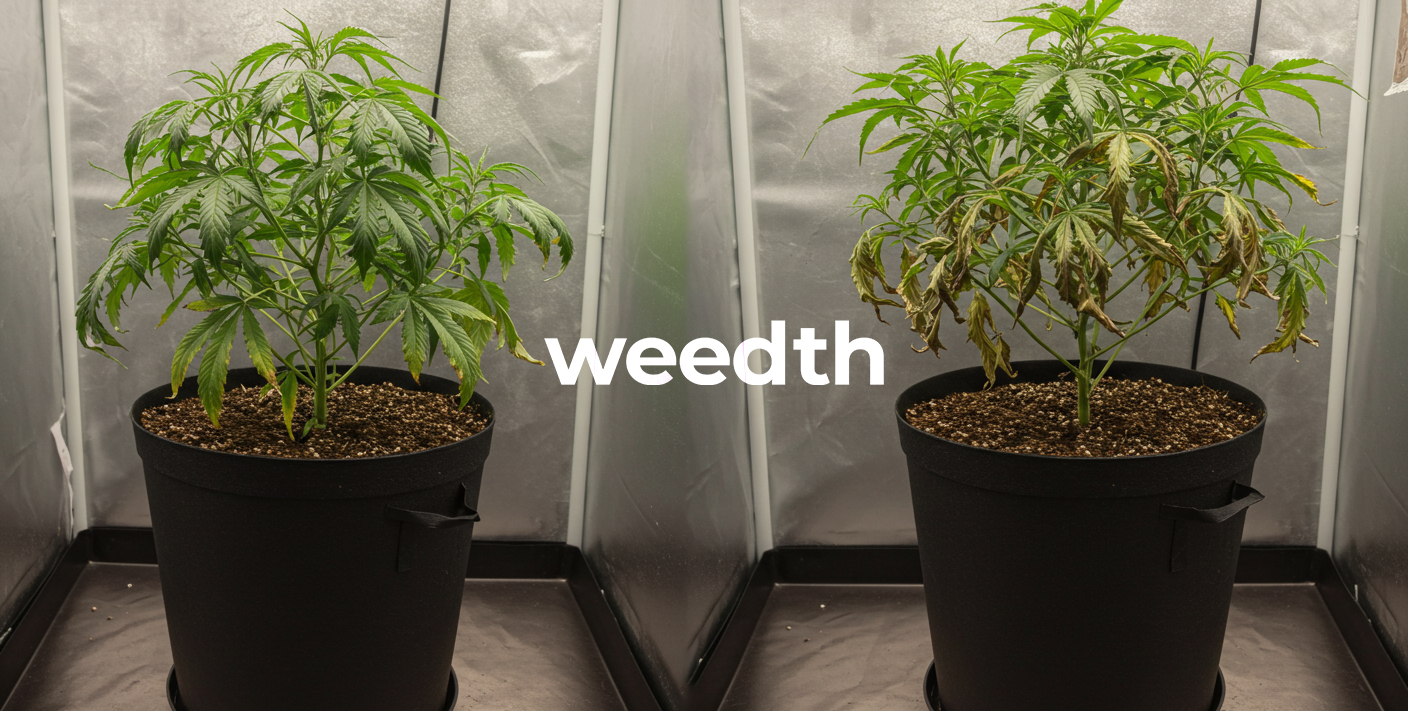
Overwatering, Underwatering, and Root-Zone Oxygen Stress in Cannabis
Overwatering and underwatering produce remarkably similar drooping postures above ground, yet pouring more water into an oxygen-starved root zone kills plants twice as fast as letting dry soil wilt slightly for half an afternoon. The biological driver behind ‘overwatering’ is rarely excessive volume in a single pour, it is waterlogging frequency that eliminates air-filled pore space around feeder roots. Cannabis roots consume atmospheric oxygen continuously for cellular respiration (generating ATP to power active nutrient uptake); once water fills every capillary pore longer than 24 to 48 hours without replenishment, dissolved oxygen crashes, stomata close to conserve turgor, and leaves curl downward stiff and swollen.
Conversely, true underwatering drops substrate matric water potential so sharply that roots cannot pull moisture inward, collapsing turgor throughout limp, paper-thin petioles while hydrophobic dry peat channels repel sudden fast drenching. This Watering Anchor guide unifies visual diagnosis (overwatered vs underwatered vs post-watering droop vs biological root rot), pot-weight measurement, safe rehydration of bone-dry blocks, overwatered oxygen rescue, and fungus gnat moisture cues into one complete system.
Air-Filled Porosity: Why Water and Oxygen Compete Inside Every Pot
Healthy soil and coco coir function like a breathable sponge holding both film water and open gas channels simultaneously.
Air-Filled Porosity (AFP) vs Container Capacity After Irrigation
Immediately after watering soil or coco thoroughly until 10 percent clear runoff drains away, gravity empties large macropores within 30 to 60 minutes, leaving an ideal active balance of 15 to 25 percent Air-Filled Porosity (AFP) beside water-coated micropores. Every successive irrigation before adequate dry-back displaces fresh oxygen drawn down into the pot during consumption, starving deep roots first.
Soil Temperature Effects on Dissolved Oxygen and Hypoxia Speed
Cool root zones (18 to 21 C) hold higher dissolved oxygen in water films and slow microbial oxygen consumption, buffering minor overwatering mistakes longer. By contrast, warm saturated media above 25 to 27 C slashes dissolved oxygen solubility while accelerating bacterial respiration and dormant Pythium motility, suffocating roots in half the time.
Root-Zone Hypoxia
Acute oxygen deprivation inside saturated substrate pores where oxygen diffusion drops below root respiratory demand (generally air porosity falling under 10 percent), halting ATP-driven ion transport and shutting foliar stomata despite abundant surrounding water.
Reading posture clues across leaf blades, petioles, and container weight separates overwatering from underwatering in 30 seconds.
Droopy leaves inside wet pots catch almost every beginner off guard because plants look thirsty right when their roots are actually suffocating.
“Why do my cannabis leaves droop noticeably an hour after I water them even though the pot feels light beforehand?”
Question sent by: Hudson Gillingham, via email.
Brief post-watering droop occurs when pouring a full drench temporarily pushes air out of root pores or shocks roots with overly cold tap water (below 14 C), or when dense un-aerated soil drains too sluggishly at the bottom of the pot. Water gently using room-temperature water (19 to 22 C), keep pots raised on open grid risers, and ensure medium includes 25 percent coarse aeration.
Evaluating plant response calmly after addressing the primary mechanism protects overwatering, underwatering, and root-zone oxygen stress in cannabis outcomes over the days ahead.
Overwatered vs Underwatered Cannabis: Visual Diagnosis and Droop Patterns
Never diagnose thirst from a glance at droopy foliage, touch leaf turgor, check petiole angle, and lift the pot weight.
Stiff Clawed Heavy Leaves (Overwatered) vs Paper-Limp Petioles (Underwatered)
An overwatered cannabis plant displays firm, swollen, turgid leaves that arch or ‘claw’ tightly downward along the blade and tip while main leaf stalks (petioles) often stay horizontal or bowed under tissue weight, feeling crisp if bent gently. An underwatered plant loses hydrostatic turgor simultaneously across both leaf blades and petioles: stalks droop limp and sad straight down beside stems like wet cloth, feeling thin and papery until moisture restores cell pressure.
Why Cannabis Droops Immediately After Normal Watering or While Soil Is Still Wet
Seeing plants droop 30 to 90 minutes right after a routine drench, even on well-timed schedules, often reflects brief hypoxia shock when cold tap water (<14 C) flushes out stale pot air, OR signals a perched water table trapped inside un-drained saucers or compressed bottom peat. Similarly, plants staying droopy days later while topsoil remains dark and clammy indicate a root ball too small for the oversize pot volume.
Abiotic Root-Zone Oxygen Stress vs Infectious Root Rot
Pure abiotic oxygen hypoxia slows top vigor cleanly with mild lower chlorosis and zero foul odor; once pots dry properly back to breathable air balance, new root tips emerge white within 72 hours. Biological root rot (Pythium, Fusarium) adds unmistakable root slime, sloughing brown cortex threads slipping off central vascular steles, and dank swamp odors requiring strict pathogen triage beyond dry-back alone.
| Diagnostic Clue | Overwatering / Hypoxia | True Underwatering | Infectious Root Rot |
|---|---|---|---|
| Leaf blade & petiole feel | Swollen, heavy, firm arched blades; clawed downward tips | Limp, papery thin leaves and drooping weak petioles | Flaccid wilt even inside warm moist pot; leaf edges crisp brown |
| Pot lift weight & top soil | Heavy like wet brick; cold soggy bottom; sluggish dry-back | Feather-light container; soil pulls shrunk away from pot wall | Pot stays weirdly heavy for days, water consumption stalls completely |
| Lower leaf & root look | Paling lower leaves or slow interveinal yellowing; intact tan-white roots | Crisp curling lower dry leaves; dry brittle fine root hairs | Dark brown mushy root cortex slides off inner core; sour bog odor |
| Fungus gnat presence | Adults flitting over persistently damp upper 5 cm organic mulch | Rare once upper horizon dries completely between pours | Frequent alongside decaying necrotic crown tissue |
| Immediate recovery speed | Lifts markedly within 18-36 hours once drainage & air return | Perks dramatically inside 45-120 minutes after proper slow rehydration | Fails to lift cleanly after watering or gentle dry-back; continues declining |
Testing exact pot moisture across depth removes every trace of guesswork before touching the watering can.
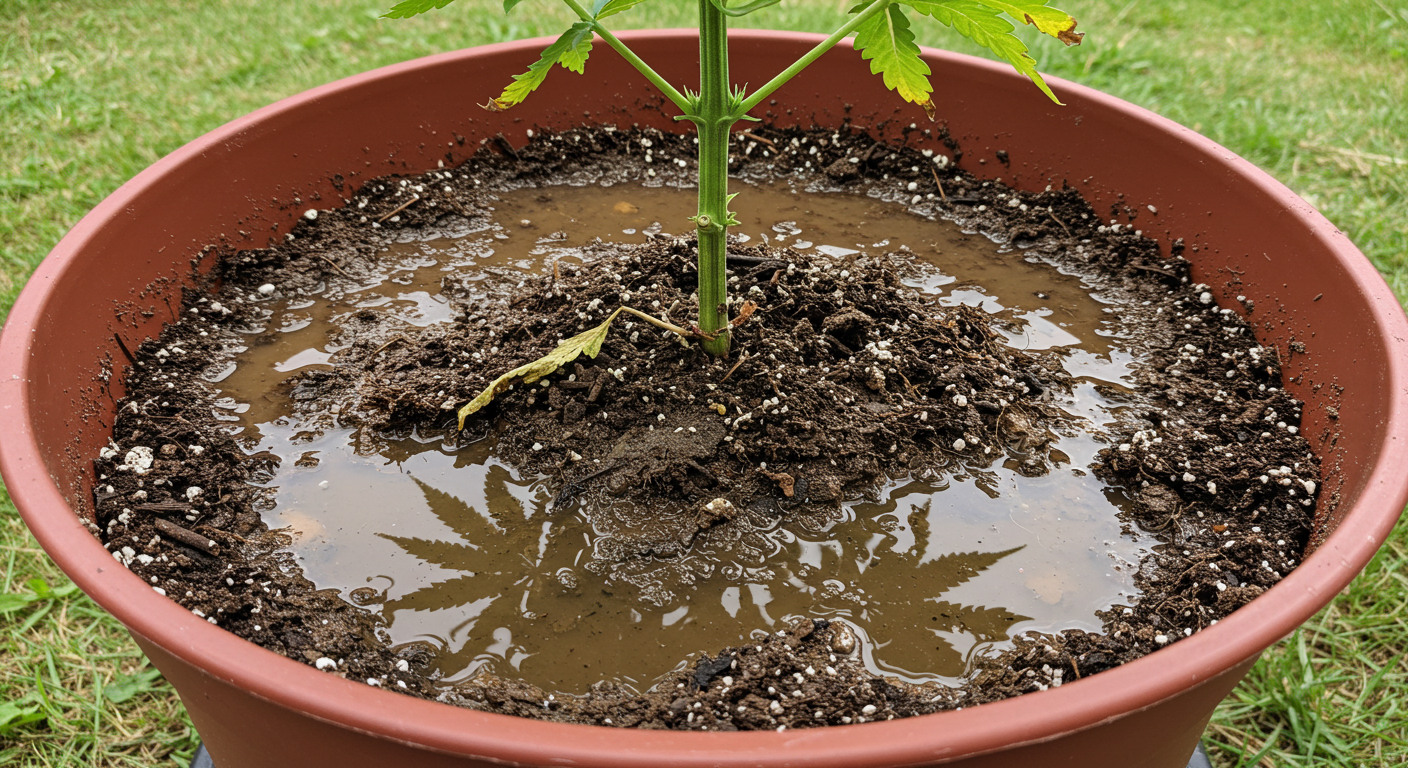
Combining structured field cues with clean environmental benchmarks separates primary triggers from harmless look-alikes.
How to Measure Root-Zone Moisture Accurately Across Pots and Beds
Touching only the top half-inch of sunny crust misleads almost every indoor grower because evaporation dries surface dust days before the lower root ball breathes.
The Two-Hand Container Lift Calibration Method
Calibrate muscle memory on day one by lifting an empty pot filled with dry-bagged medium, then lifting the same container right after saturated runoff stops dripping. Wait to water again until the container drops roughly 50 to 65 percent of its gained water weight (or feels noticeably light yet far short of feather-weight wilt). Never water by calendar days (‘every Monday and Thursday’); let plant demand set intervals.
Deep Probe Tensiometers, Wood Skewers, and Perched Drainage Checks
In large 15-to-50-gallon beds too heavy to lift, push a long clean wooden dowel or tensiometer probe cleanly 15 to 20 cm deep (keeping outdoor tensiometers cleanly near 10 to 25 kPa moisture tension for living soil). If water puddles cleanly into saucers under fabric pots and wicks back up for hours, elevate every pot onto plastic or metal grid risers immediately.
Field Advice: Never water on a fixed calendar schedule during shifting growth stages or temperature drops. Lift the pot with two hands, if the bottom third still feels dense and heavy, leave the watering can put away for another 24 to 48 hours.
Matching recovery steps strictly to whether roots are drowned or desiccated turns sick plants around without secondary salt shock.
Reviewing connected site and crop factors helps lock in consistent results across harvests.
Severely bone-dry peat pots pose the opposite trap when water races straight down shrunken pot edges and leaves the center root ball dust dry.
“My soil pot feels light and the edges pulled away from the plastic, yet water pours right out the bottom immediately. Is it full?”
Question sent by: NorCalRootOxygen, via Instagram.
No. Extremely dry peat-based soil shrinks and becomes hydrophobic, creating open cracks along pot walls where rapid pouring bypasses a bone-dry interior root ball entirely. Rehydrate using two or three slow spaced 10-minute pours or bottom-sit the pot briefly in 3 cm of water for 15 minutes so capillary action wets the core evenly.
Verifying environmental and physical checkpoints before layering a second intervention avoids compounding preventable crop stress.
Step-by-Step Recovery Protocols: Overwatered Rescue vs Severely Dry Rehydration
Rescue procedures are exact opposites: drowning roots need heat, airflow, and gentle dry-back, while hydrophobic shrunken peat needs patient surfactant-slow capillary wetting.
How to Help an Overwatered Cannabis Plant Recover
Stop watering immediately and vacuum or dump every drop of stagnant runoff sitting inside catch trays. Elevate the pot onto open grid risers (2 to 5 cm above floor slabs) and direct a gentle cross-canopy fan across the breathable pot walls (especially effective on fabric pots) while maintaining warm 24 to 26 C ambient day temperatures so evaporation and slow uptake clear excess water over 48 to 72 hours.
Dim overly intense overhead LEDs down 20 to 30 percent temporarily if severely hypoxic plants cannot match high photon demand with root-zone water supply, and avoid dumping extra liquid fertilizer or ‘root tonics’ onto soaking mud. Do NOT poke deep metal stakes blindly down into wet soil, stabbing thick center roots increases mechanical wounds open to fungal rot.
How to Rehydrate a Severely Underwatered, Hydrophobic Root Ball
When peat-heavy potting mix dries completely, natural organic waxes coat particles and turn hydrophobic, causing fast hose pours to race straight down shrunken gaps between pot sides and dry soil cores, draining out the bottom while leaving interior feeder roots dust dry.
Rehydrate gradually in three slow stages (10 percent gentle surface spray or light lukewarm wetting → wait 20 minutes for peat fibers to soften → second 20 percent slow pass → wait 15 minutes → final steady irrigation until slow saturation catches evenly), or bottom-soak plastic pots for 15 minutes in 3 cm of clean pH-balanced water until capillary action darkens the topsoil evenly, then drain completely onto grid risers.
| Recovery Scenario | First Immediate Step | Secondary Adjustment | Warning / What Not to Do |
|---|---|---|---|
| Overwatered heavy saturated soil pot | Empty saucers completely; lift pot onto elevated open mesh risers | Aim mild breeze across fabric pot sides; keep room temp 24-25 C | Do NOT pour extra ‘root booster’ liquids or poke sharp stakes through roots |
| Bone-dry shrunken peat / hydrophobic soil | Mist topsoil slowly (10% vol) + wait 20 min before main pour (or brief bottom-wick) | Add tiny dash horticultural yucca wetting agent cleanly if severe | Do NOT blast fast full gallons, water bypasses center down wall gaps |
| Severe coco coir dry-back salt spike | Slowly fertigate diluted low-EC balanced solution (50-70% strength) to 20% runoff | Verify runoff EC matches safe target range before restoring full feed | Do NOT flush stressed coco exclusively with raw unbuffered distilled water |
| Fungus gnat outbreak alongside wet topsoil | Let top 3-4 cm soil layer dry cleanly; place yellow sticky trap cards flat on rim | Apply Bti (Bacillus thuringiensis israelensis) only on next proper cycle | Do NOT soak damp soil further daily just to deliver extra gnat drenches |
Evaluating container volume, substrate porosity, and fungus gnat behavior keeps dry-back rhythms effortless all cycle.
Important: Firm, heavy, curled downward leaves inside a wet container signal root oxygen suffocation, not thirst. Waiting 48 hours on elevated risers rescues far more plants than panic-flushing wet pots.
Keeping clear operational boundaries prevents well-intentioned shortcuts from compounding small mistakes.
Recurring evening wilt right after watering often points to substrate structure or pot-drainage flaws rather than schedule timing.
“How can I tell for sure whether soggy soil droop is simple overwatering oxygen stress or fatal Pythium root rot?”
Question sent by: Asher Moretti, via contact form.
Abiotic overwatering clears cleanly within 48 to 72 hours once caught trays empty and breathable airflow restores oxygen, leaving firm pale-tan roots without foul smell. Infectious root rot causes stagnant water consumption for days, brown slimy root cortex sloughing right off inner white strands, and distinctive sour bog odor.
Keeping clear field measurements across consecutive checks ensures adjustments track the real root cause accurately.
Common Irrigation Traps That Keep Root Zones Hypoxic
Daily surface splashes, oversized pots for tiny seedlings, and flat saucers cause 80 percent of chronic indoor watering problems.
Daily ‘Little Sips’ Surface Splashing vs Deep Rhythmic Cycles
Pouring half a cup of water every single morning keeps the upper 5 centimeters permanently slimy (feeding fungus gnat larvae effortlessly) while deeper roots shrink in bone-dry bottom thirds or turn compacted without rhythmic oxygen replenishment. Water thoroughly until minor runoff exits, then allow clean air-pulling dry-back.
Transplanting Tiny Seedlings Straight Into Huge 7-to-15 Gallon Soil Volumes
Dropping a 3-inch seedling into 10 gallons of dense wet soil leaves 9.5 gallons uncolonized by drinking roots. Saturated outer soil sits wet and anaerobic for two full weeks per pour, step up cleanly from starter plugs (0.5L → 3-4L → 19L+ final pots) as white feeder roots reach container edges.
Fungus Gnats Confirming Chronic Upper-Soil Saturation
Adult fungus gnats (Bradysia spp.) lay eggs specifically into damp algae-covered soil crusts and feed microscopically on decaying root tips and fungi under chronic overwatering. Pairing yellow sticky monitoring cards with 3 to 4 cm topsoil dry-backs breaks larval survival naturally alongside targeted Bacillus thuringiensis israelensis (Bti) applications when needed.
Oxygen-Rich Root-Zone Habits
Set every container atop drained open mesh risers above catch trays; base irrigation on two-hand pot lift weight rather than fixed calendar days; blend 20 to 30 percent coarse perlite or pumice into dense bagged potting soils; rehydrate hydrophobic dry pots gradually in staged passes.
Chronic Saturation Mistakes
Avoid pouring tiny daily maintenance sips across damp surface crusts; avoid leaving pots sitting inside pools of runoff saucers; avoid watering cold 12 C winter tap water straight onto sensitive roots; avoid diagnosing firm downward leaf claws as thirst.
Tracking simple wet-to-dry interval lengths after every pour builds instinctive mastery over any growing medium.
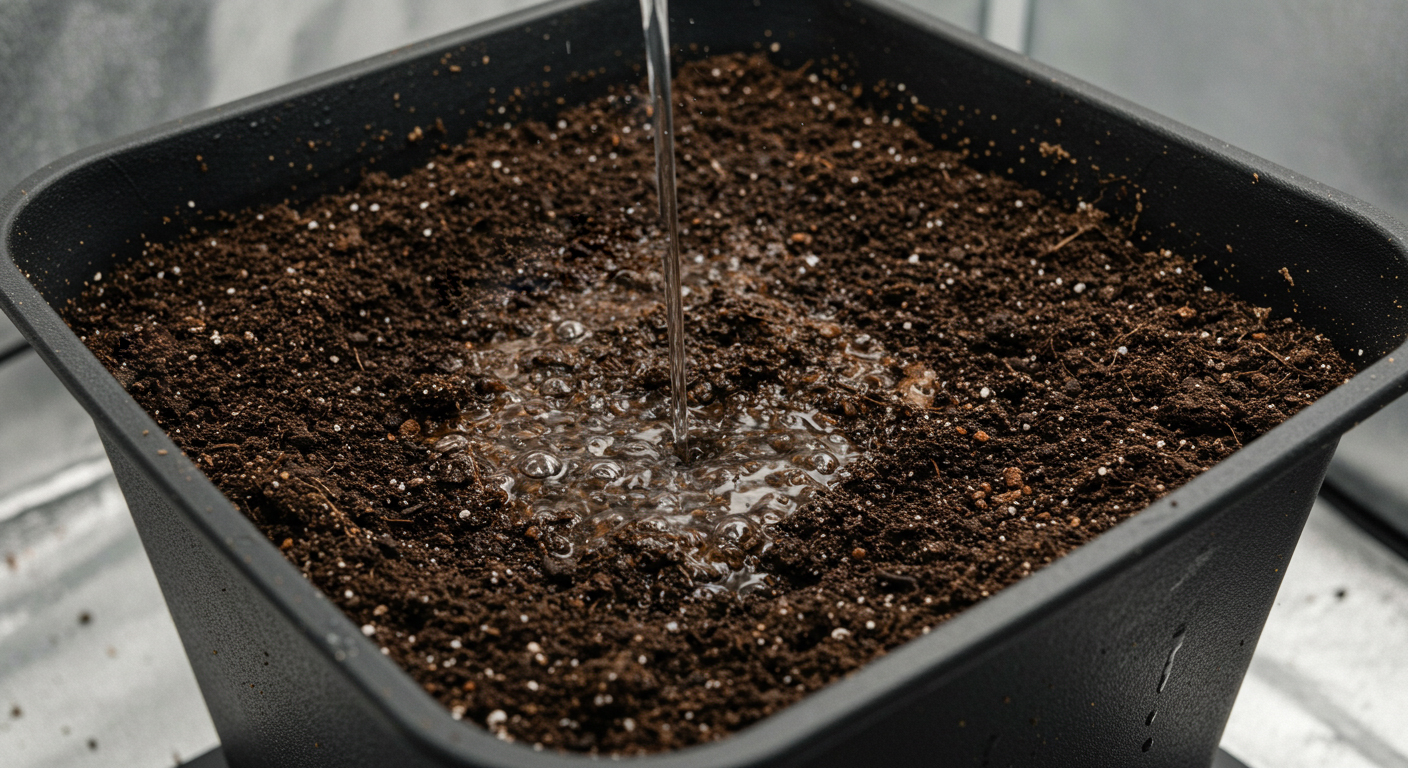
Documented canopy checkpoints and baseline equipment readings make follow-up evaluation fast and objective.
Daily Moisture Verification and Recovery Checklist
Verify container weight, catch-tray dryness, ambient pot-zone temperature, and foliar posture systematically on each morning walk.
Timing Recovery Checkpoints at 6, 24, and 72 Hours
Underhydrated plants typically regain full vertical leaf and petiole turgor within 1 to 3 hours of balanced staged rehydration. Overwatered pots improve much slower: expect stable holding by hour 24 and rising morning prayer posture between hours 48 and 72 as pore air refills.
Preventing Second-Wave Relapse After Recovery
Once recovered foliage stands proudly back at 45 degrees toward overhead photons, cut the next irrigation volume down slightly if dry-back took longer than 5 days, and check root drainage exit holes for tangled blocking mats before switching to bloom.
Root-Zone Moisture, Oxygen, and Recovery Checklist
- Verify container lift weight and probe top 4 cm depth before lifting a watering can, never water strictly by fixed calendar weekdays.
- Confirm every pot sits elevated on breathable grid risers so excess leachate never wicks back up from flat catch trays.
- Separate firm heavy downward leaf claws (overwatering hypoxia) from papery limp sagging petioles (true dehydration) before acting.
- Rehydrate shrunken hydrophobic soil gradually in 10-minute staged pours (or brief clean bottom-wicking) so moisture permeates the central root core.
- Empty trays, boost airflow around pot walls, and lower photon load slightly for 48 hours to rescue suffocating saturated containers.
- Control fungus gnats by letting upper soil horizons dry properly between cycles and timing Bti applications to legitimate watering intervals.
- Log wet-to-dry interval days alongside pot size and medium type; step up pot sizes incrementally rather than planting seedlings into giant soggy beds.
Balancing water volume with rhythmic root-zone oxygen exchange eliminates overwatering stress and keeps canopies vigorous from transplant to harvest.
Small fluttering fungus gnats hovering over wet mulch serve as a reliable early indicator that upper soil horizons stay saturated far too long.
“Why did fungus gnats suddenly swarm my tent right around the same week my lower leaves started drooping and yellowing?”
Question sent by: KelownaWetDryLog, via X.
Persistent damp upper potting crusts support algae and fungi that fungus gnat larvae graze alongside tender root hairs, making gnats an immediate biological symptom of overly frequent irrigation. Allow top 3 to 4 cm of soil to dry properly between deep cycles, mount yellow sticky traps near soil rims, and apply Bti on schedule.
Consistent routine tracking keeps long-term crop hygiene and quality repeatable from harvest to harvest.
Scientific References
- Raviv, M., Lieth, J. H., & Bar-Tal, A. (2019). Soilless Culture: Theory and Practice (2nd ed.), Air-filled porosity, matric tension, and container geometry.
- Zheng, Y., Wang, L., & Dixon, M. (2007). Dissolved oxygen concentration, root respiration, and root-zone hypoxia in container-grown horticultural crops. Scientia Horticulturae.
- Dekker, L. W., & Ritsema, C. J. (2000). Wetting patterns and moisture distribution in water-repellent peat and organic substrates. Hydrological Processes.
- Cloyd, R. A. (2015). Ecology and integrated management of fungus gnats (Bradysia spp.) and Bacillus thuringiensis israelensis in greenhouse production. Kansas State University Extension.
Share this article
A quick overview of the topics covered in this article.
Follow us
Latest articles
November 17, 2026
November 17, 2026
November 17, 2026
November 17, 2026
