
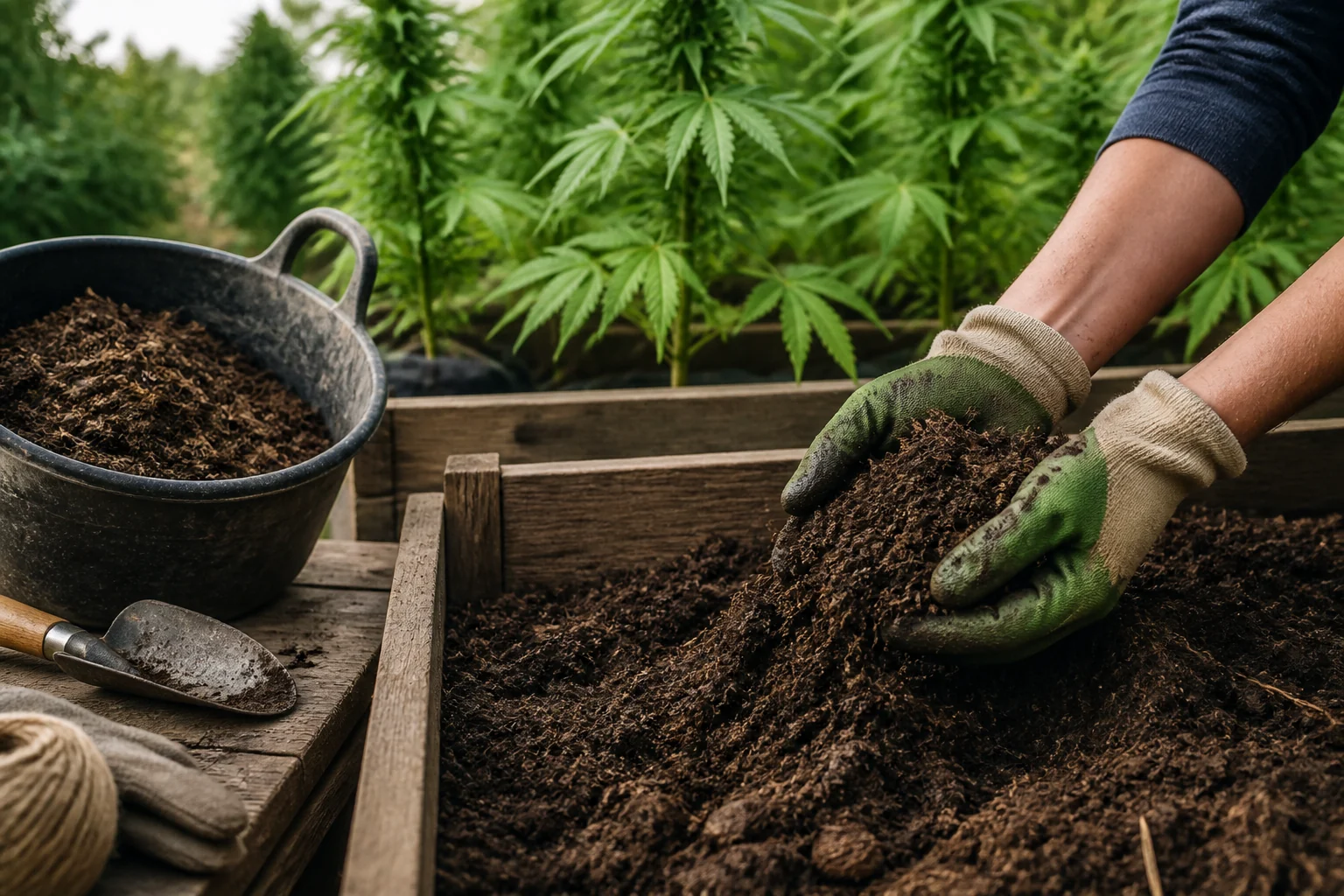
Raised Bed vs In-Ground Cannabis
Choosing between a raised bed and planting directly in-ground comes down to three measurable site properties: native soil drainage, spring root-zone temperature, and subsurface contamination risk. Raised beds outperform in-ground rows whenever native earth is heavy compacted clay, sits over a shallow seasonal water table, cools slowly in northern springs, or carries urban heavy-metal and herbicide history. Conversely, deep, well-drained agricultural loam in mild climates allows in-ground roots to tap virtually unlimited subsoil moisture and fungal networks at a fraction of the upfront lumber and fill-soil cost.
Many outdoor problems blamed on genetics or fertilizer actually stem from mismatched root architecture: putting a hungry full-season sativa in a shallow 8-inch raised frame over poor subsoil, or burying sensitive seedlings straight into cold, anaerobic clay holes that act like buried bathtubs. This guide breaks down the soil physics, water retention, thermal curves, and setup checklist to choose the right outdoor bed for your exact yard or field.
Direct Comparison: Drainage Physics, Soil Temperature, and Root Volume
Elevating a soil column even 35 to 45 centimeters above grade fundamentally alters hydraulic conductivity and early-season root growth.
Gravity Drainage and the Perched Water Table Advantage
When heavy spring or autumn rain saturates flat clay soil, downward percolation slows to millimeters per hour, drowning fine feeder hairs in stagnant hypoxic water. A properly constructed 12-to-18-inch (30 to 45 cm) raised bed uses gravity head pressure to pull excess saturation downward out of the active crown zone even while surrounding pathways turn muddy.
Avoiding a ‘perched water bathtub’ requires open bottom contact, never line the bottom of an outdoor soil bed over clay with solid plastic sheeting. Use permeable hardware cloth solely if gophers or burrowing voles are documented locally, and loosen the top 15 cm of native soil beneath the bed interface so capillary moisture and vertical taproots bridge smoothly rather than pooling at an abrupt texture boundary.
Spring Thermal Gain vs Peak August Edge Heating
In cool coastal or northern climates (above 42 degrees North latitude), unheated flat ground often stays below 13 C until late May, stalling seedling vigor and blocking phosphorus uptake. Exposed wooden, stone, or fabric raised bed walls catch lateral solar radiation and drain winter meltwater quickly, warming the root zone 3 to 6 C earlier for vigorous May transplanting.
The exact reverse occurs during 38 C August heatwaves in arid inland valleys: exposed dark fabric sides or thin metal edges heat up rapidly, cooking peripheral feeder roots and evaporating moisture out the sides unless shaded with straw mulch or wider bed geometry.
Hydraulic Texture Boundary
A sharp horizontal interface between two soils of starkly different particle sizes (such as coarse peat-pumice mix placed directly atop unfractured clay subsoil) that temporarily stalls downward drainage until the upper layer approaches near-saturation.
Evaluating these physical tradeoffs against your local rainfall and climate reveals clear structural winners.
Before hauling yards of lumber and bagged soil outdoors, growers routinely ask when native topsoil actually outperforms built frames.
“Should I put gravel or broken rocks at the bottom of my raised bed to help it drain faster?”
Question sent by: Bryce Lavoie, via contact form.
Adding a coarse gravel layer beneath finer garden soil actually slows drainage rather than helping it. Water resists crossing downward from fine soil pores into large gravel air gaps until the soil layer above becomes nearly saturated, creating an artificial perched water table closer to the roots. Place soil straight over loosened native subsoil instead.
Evaluating plant response calmly after addressing the primary mechanism protects raised bed vs in-ground cannabis outcomes over the days ahead.
Comparing Raised Beds, Mounded Rows, and Flat In-Ground Plots
Looking at construction cost, irrigation resilience, and root-volume flexibility highlights why hybrid mounded rows often bridge both worlds.
Open-Bottom Framed Raised Beds vs Broad Mounded Rows
Framed wooden or corrugated-metal beds (120 cm wide by 45 cm deep) give crisp spatial boundaries, ergonomic pruning height, and clean separation from invasive lawn grasses. Broad mounded hills or hilled rows shaped 25 to 35 cm high without lumber achieve nearly identical spring drainage and warming for multi-plant rural gardens at near-zero material cost.
When True Flat In-Ground Planting Wins Unquestionably
Where a site offers deep, friable sandy loam or silt loam tested clean for lead, arsenic, and residual herbicides, flat or lightly amended in-ground rows support massive late-summer canopies with half the irrigation frequency of containers. Subsoil moisture reserves below 60 cm buffer afternoon wilting during extreme heatwaves when small beds would dry crisp by 2:00 PM.
| Planting System | Drainage & Spring Warm-Up | Summer Water Stability | Cost & Build Effort | Best Site Fit |
|---|---|---|---|---|
| Framed Raised Bed (30-45 cm deep) | Rapid vertical drainage; warms 3 to 6 C faster in cool springs | Moderate; dries faster along perimeter edges in peak summer heat | High upfront lumber and cubic-yard soil blend cost | Clay yards, wet springs, urban legacy soil, limited mobility setups |
| Unframed Broad Mounded Bed (25-35 cm) | Strong crown runoff; avoids bathtub pooling on gentle slopes | High if anchored into clean loosened native subsoil below | Low cost; requires initial double-digging or broadfork loosening | Rural loamy-clay slopes, budget organic plots, large spacing |
| In-Ground Flat Amended Hole / Row | Slow if clay; excellent if deep sandy/silty loam | Highest drought buffer once taproots descend past 60 cm | Minimal cash cost; requires soil test and compaction checks | Tested clean agricultural loam, hot arid climates, long veg runs |
Before committing to either design, run two inexpensive pre-build site diagnostics to protect plant safety and drainage.
Combining structured field cues with clean environmental benchmarks separates primary triggers from harmless look-alikes.
Pre-Build Site Diagnostics: Drainage, Compaction, and Legacy Toxins
Two simple pre-season checks expose hidden site defects before a single seed enters the ground.
The 24-Hour Percolation Hole Test for Native Ground
Dig a straight-sided test hole 30 cm wide by 30 cm deep in the exact planting zone, fill it cleanly with water, let it soak overnight to pre-wet the surrounding matrix, then refill it to the top the next morning and time how quickly water drops. Healthy loamy cannabis soil drains at least 2.5 to 7.5 cm (1 to 3 inches) per hour; standing water after 6 hours proves poor subsoil permeability where flat in-ground holes will rot roots unless raised above grade.
Soil Laboratory Testing for Urban Yards and Former Orchard Land
Cannabis is an active bioaccumulator capable of drawing heavy metals, particularly lead, cadmium, and arsenic, from soil into plant tissue. Old residential lots near painted siding, pre-1970 roadways, former orchards treated with lead arsenate, or unknown industrial fill require a formal heavy-metal and pH/CEC soil test before planting directly in the earth.
When heavy-metal assays exceed agricultural thresholds, isolate the crop inside a deep raised bed (at least 45 to 60 cm of clean imported medium) lined at the bottom with permeable woven landscape geotextile to block roots from reaching contaminated subsoil while preserving drainage.
Hardpan Breakup and Transition Blending
Whether amending clean ground or setting an open-bottom raised bed, use a broadfork to crack deep compaction gently without inverting soil horizons, and blend 5 to 8 cm of your raised bed mix into the underlying native soil so roots and capillary water cross smoothly.
Important: Never dig a deep narrow hole in dense native clay and backfill it exclusively with light peat potting mix. During heavy rain, water rushes into the spongy hole faster than the surrounding clay walls can drain, turning the root ball into a drowned bathtub.
Selecting safe structural materials and clean fill mixes determines multi-year durability once construction begins.
Reviewing connected site and crop factors helps lock in consistent results across harvests.
Transitioning between cold spring nights and July dry heat exposes very different watering physics in raised frames versus native earth.
“How tall does a raised bed need to be if I am planting over solid concrete or contaminated urban soil?”
Question sent by: KootenayBedBuilder, via email.
Over concrete or heavy-metal-impacted soil separated with breathable geotextile fabric, aim for 45 to 60 centimeters (18 to 24 inches) of soil depth. That depth accommodates natural taproot anchoring, stores adequate multi-day moisture during July heatwaves, and keeps active feeder roots insulated above the bottom barrier.
Verifying environmental and physical checkpoints before layering a second intervention avoids compounding preventable crop stress.
Bed Geometry, Materials, and Long-Term Soil Management
Thoughtful lumber, aeration balance, and irrigation layout prevent edge collapse and uneven dry-back across the season.
Safe Framing Materials: Untreated Timber, Stone, and Fabric Beds
Choose naturally rot-resistant untreated cedar, redwood, white oak, corrugated galvanized steel (lined gently on interior edges if soil is strongly acidic below pH 6.0), or heavy-duty UV-stabilized woven geotextile fabric beds. Never build edible or botanical crop beds from creosote railroad ties, pentachlorophenol lumber, or unknown painted demolition scrap that leaches toxic preservatives into the root zone.
Minimum Volume and Dimension Guidelines Per Plant
Match container geometry to seasonal photoperiod timing. Autoflowers or late June clones perform well in 30 cm of bed depth (~30-50 gallons per plant footprint), whereas May-planted full-term photoperiod trees need at least 45 cm (18 inches) of structured soil depth and 120 x 120 cm horizontal spacing per plant, or unrestricted downward contact into loosened clean native subsoil.
No-Till Mulch Layers, Cover Crops, and Drip Rings
Because raised beds expose upper horizons to brisk afternoon winds, cap every square centimeter with 5 to 8 cm of clean straw, shredded leaves, or living white clover mulch and run twin-line pressure-compensating drip tubing or buried porous soaker rings rather than blasting soil crusts with a harsh hose.
| Site Condition Observed | Diagnostic Signal | Recommended Fix | Outcome to Verify |
|---|---|---|---|
| Standing water >4 hours in 30 cm test hole | Clay hardpan or shallow seasonal water table | Build 35-45 cm open-bottom raised bed or broad mounded berm | Soil moisture tension settles evenly within 12-24 hours post-rain |
| Urban yard with unknown soil fill or elevated lead | Lab test shows heavy metals near or above safe limits | Build 50-60 cm deep bed separated from ground by breathable geotextile barrier | 100% imported tested compost-loam blend stays isolated from native ground |
| Bed corners stay bone dry while center drips | Wicking/evaporation through porous wood or fabric edges | Add 7 cm surface straw mulch and extend drip emitters out to bed perimeter | Tensiometer or core checks show uniform moisture from edge to center |
| Roots hit solid flat bottom and swirl sideways | Untilled compacted interface beneath shallow bed | Fracture native interface with broadfork before filling next cycle | Uniform downward penetration without circling crowns |
Avoiding classic soil-blending shortcuts protects both water retention and root oxygen year after year.
Remember: If native ground drains poorly, building upward by 35 cm beats digging downward into clay every single time.
Keeping clear operational boundaries prevents well-intentioned shortcuts from compounding small mistakes.
Site history and drainage testing quickly settle debates over urban yard planting versus deep tilled rows.
“Can I fill a tall raised bed half full of logs and branches first to save money on soil?”
Question sent by: Landon Paquette, via Facebook page.
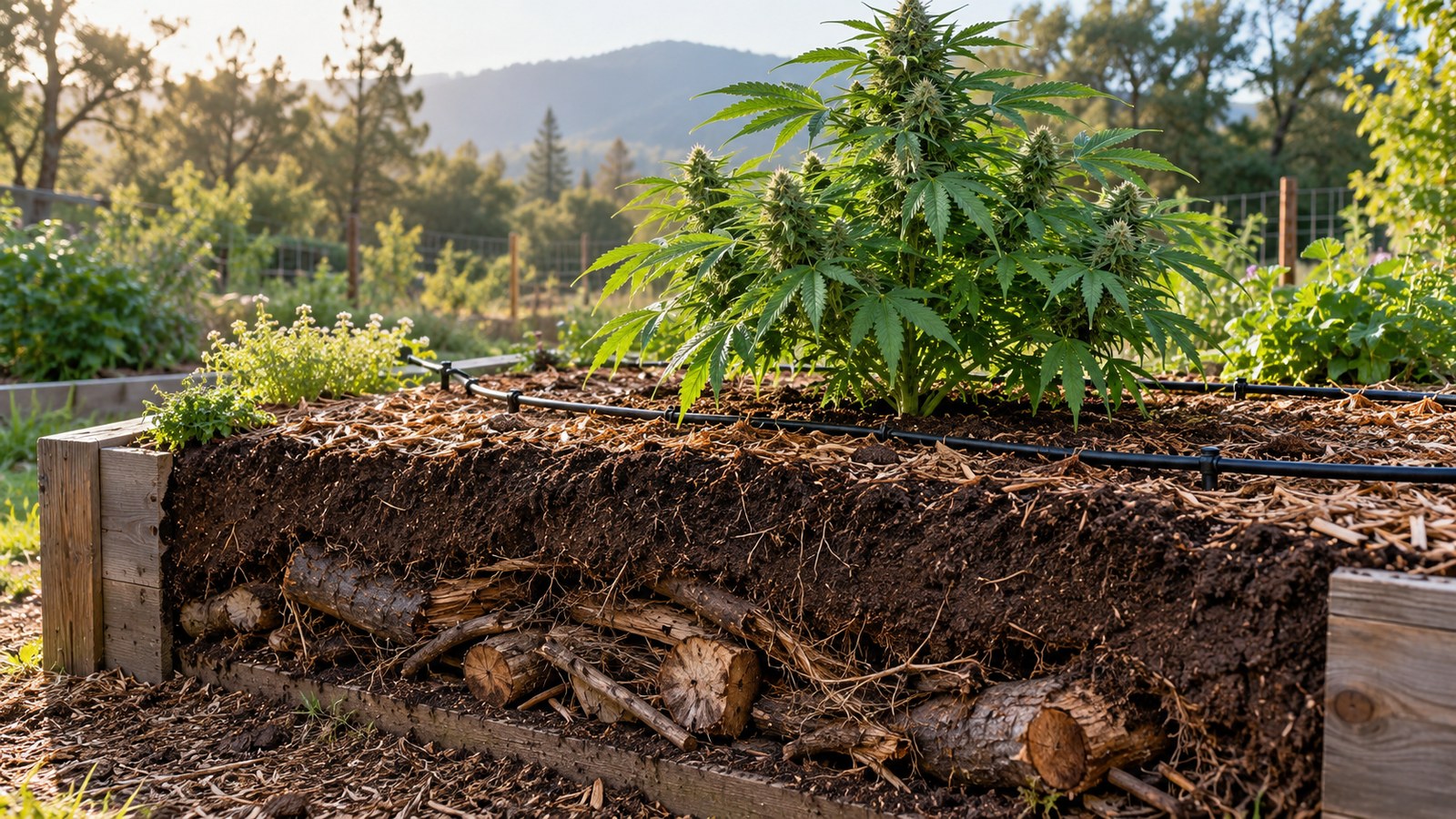
Burying dead wood and branches in the base layer (hugelkultur) works in moist climates over multi-year cycles, provided the wood is pre-wetted, non-allelopathic hardwood well buried beneath at least 35 cm of balanced loam. Fresh softwood chips mixed high up into the root zone tie up nitrogen during active decomposition and create uneven settling.
Keeping clear field measurements across consecutive checks ensures adjustments track the real root cause accurately.
Common Raised Bed and In-Ground Pitfalls to Avoid
Using pure bagging compost or skipping salt checks creates chronic nutrient antagonism inside expensive beds.
Filling Whole Raised Beds With 100% Pure Compost or Manure
Pure compost or bagged steer manure shrinks rapidly as carbon oxidizes, slumps into anoxic pudding when soaked, and frequently carries electrical conductivity above 4.0 to 6.0 mS/cm alongside excess sodium and potassium. Always cap compost/castings at 20 to 30 percent of total bed volume, anchoring the rest with 35 to 45 percent native clean topsoil or coco/peat bulk and 25 to 35 percent permanent mineral aeration (pumice, scoria, coarse horticultural sand, or rice hulls).
Overlooking Gopher and Vole Tunneling Pathways
Raised beds filled with warm loose soil act as irresistible winter and summer burrows for pocket gophers. Stapling sturdy 1/2-inch galvanized welded hardware cloth flush across the bottom of framed beds before adding soil blocks burrowing rodents cleanly while allowing taproots and worms to pass unrestricted.
Ignoring Perennial Root Competition Around Tree Drip Lines
Sinking an open-bottom raised bed within five meters of mature maples, willows, walnuts, or eucalyptus invites aggressive tree feeder roots to invade upward into your fertile amended bed by July, outcompeting your cannabis for water and nutrients, and black walnut trees release allelopathic juglone directly into neighboring soil.
Smart Outdoor Bed Construction
Run a 24-hour percolation test and check soil history before planting; blend 25-35 percent permanent mineral aeration like pumice or scoria into raised bed soil; line the base with galvanized hardware cloth against gophers where needed; mulch heavily with clean straw to shield top feeder roots.
Costly Soil and Structural Traps
Avoid filling raised beds with 100 percent pure compost or fresh hot manure; avoid sealing raised bed bottoms over clay with solid plastic sheets; avoid digging steep clay bathtub holes; avoid building beds under mature maple or black walnut tree drip lines.
Evaluating site tests before building keeps outdoor labor focused on productive, stress-free harvests.
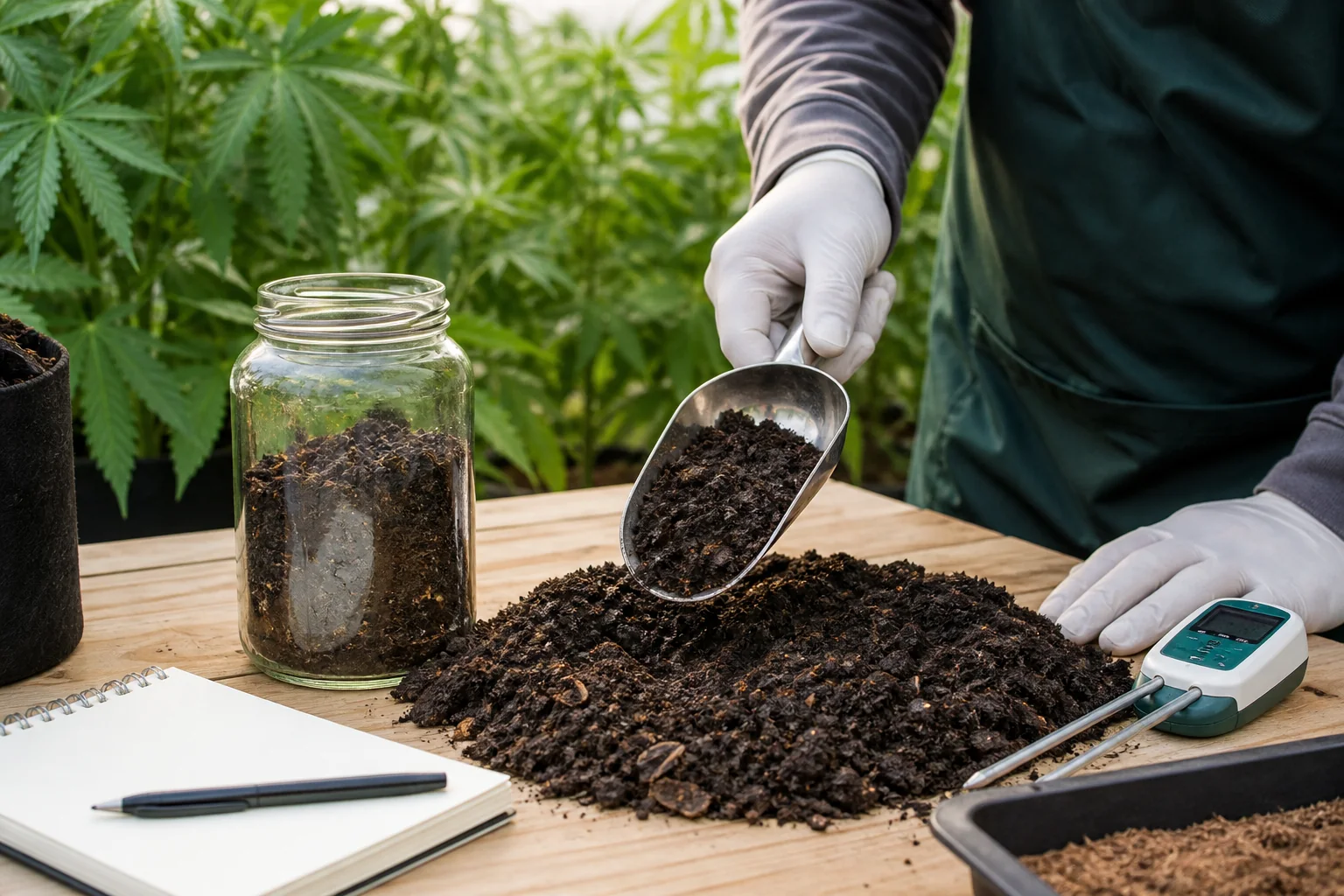
Documented canopy checkpoints and baseline equipment readings make follow-up evaluation fast and objective.
Pre-Build Site Checklist and Multi-Season Maintenance
Walking through six verification checkpoints before buying soil saves thousands of dollars and weeks of mid-summer rescue work.
Autumn Top-Dressing and Biological Winter Rest
Unlike single-season potting bags dumped each fall, open-bottom raised beds and clean in-ground rows improve every year when stems are cut flush at soil level (preserving old decaying root channels), top-dressed with 3 cm of finished worm castings and mineral dust in October, and covered with winter rye or crimson clover mulch.
Spring Pre-Plant Verification Checks
Two weeks before May transplanting, probe soil temperature at 15 cm depth (aiming for at least 15 C), verify cover crops are terminated cleanly into surface mulch, and flush drip manifolds to confirm uniform flow across perimeter edges.
Raised Bed vs In-Ground Pre-Build Decision Checklist
- Complete a 24-hour 30 cm percolation hole test across the exact planting zone to measure native drainage.
- Obtain a soil chemistry and heavy-metal laboratory screen if planting on urban fill, older lots, or orchard ground.
- Verify full-day sun path and distance away from competitive shade tree roots and allelopathic black walnuts.
- Select raised beds (35-45 cm deep) over in-ground holes whenever native drainage stalls or spring temps lag below 14 C.
- Formulate bulk fill with balanced topsoil/peat, max 25-30% compost, and 25-35% durable mineral aeration like pumice.
- Install bottom 1/2-inch galvanized hardware cloth in gopher areas and permeable landscape fabric only over contaminated subsoil.
- Mulch the surface to 6 cm depth and position drip lines evenly out toward bed corners before transplanting.
With site hydrology and root volume solved cleanly up front, seasonal outdoor water and nutrient management stay effortless.
Matching container depth to mature taproot and lateral feeder geometry eliminates late-summer tipping and salt stratification.
“Why do plants on the outside corner of my raised bed always wilt faster than plants in the center?”
Question sent by: SonomaLoamCraft, via Instagram.
Sidewalls of wooden or fabric beds lose moisture through both lateral evaporation and solar wall heating, drying outer soil faster than shaded interior soil. Adding perimeter straw mulch and looping an extra drip emitter circle along the inner wall equalizes root-zone moisture across the whole bed.
Consistent routine tracking keeps long-term crop hygiene and quality repeatable from harvest to harvest.
Scientific References
- Brady, N. C., & Weil, R. R. (2016). The Nature and Properties of Soils (15th ed.), Soil water potential, texture boundaries, and perched water tables.
- Hanson, B. R., & Chalker-Scott, L. (2017). The myth of coarse gravel drainage layers in containers and raised beds. Washington State University Extension.
- Angelova, V., et al. (2004). Bioaccumulation and distribution of heavy metals in hemp (Cannabis sativa L.) grown on contaminated agricultural soils. Environmental Pollution.
- Cornell Cooperative Extension. Urban gardening soil testing, safe lumber guidelines, and raised bed construction over contaminated subsoil.
Share this article
A quick overview of the topics covered in this article.
Follow us
Latest articles
November 17, 2026
November 17, 2026
November 17, 2026
November 17, 2026
