
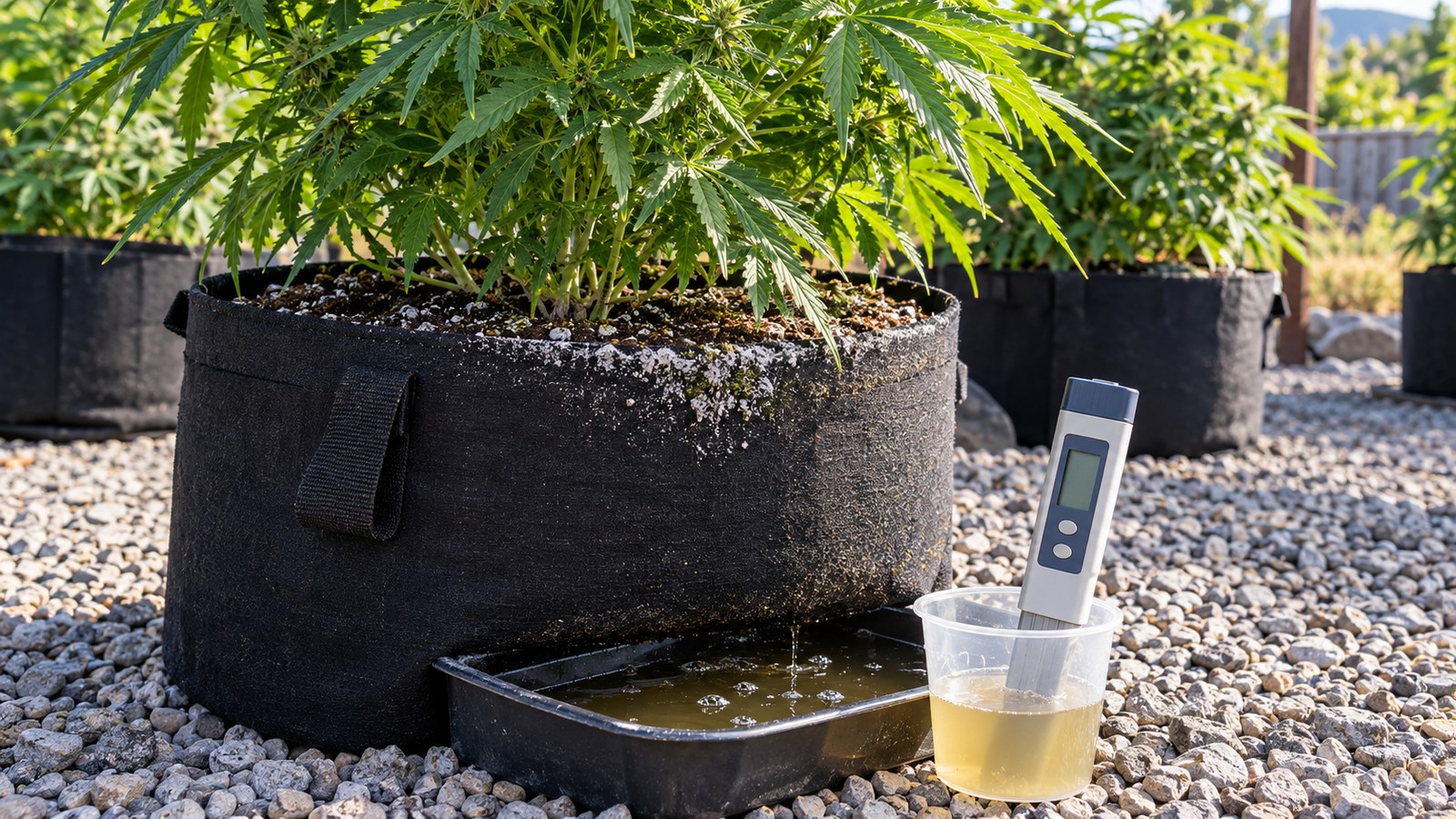
Salt Buildup and Leachate EC Outdoors
An outdoor container may look perfectly normal while salts accumulate in pockets of its root zone. Another pot can produce unusually concentrated drainage after a hot dry spell even though the previous fertilizer recipe has not changed. A third can show a low reading immediately after rain because fresh water diluted the collected sample. Those three observations can look like contradictory evidence until the irrigation history, sampling method and drainage route are considered together.
Direct answer: measure source water and the final irrigation solution, use one repeatable container leachate method, compare readings only under comparable conditions, and confirm an upward trend against plant condition and a suitable medium test before declaring excessive salts. Correct an input or irrigation mistake first. Consider managed leaching only if an excessive root-zone salt burden is supported, the pot can drain, suitable water is available and the effluent can be handled safely. An isolated runoff number is not a cannabis toxicity threshold.
This resource focuses on outdoor containers, especially peat-based mixes, coco blends and amended potting media. In-ground soil requires a different laboratory sampling framework, explained where it changes the decision. For complete outdoor site selection and seasonal production, use the Outdoor Grow Comprehensive Guide. For the overall fertilizer system, see Nutrients and Fertilizers; this article does not repeat either pillar.
What Leachate EC Can and Cannot Tell You Outdoors
A leachate EC measurement records the electrical conductivity of water that has passed through a container. It can provide a practical indication of the dissolved-ion concentration in that particular collected solution. Repeated under a defined procedure, it can reveal changes worth investigating. It does not identify which ions are present, prove that roots throughout the pot encounter the same concentration, or establish that the plant is damaged. The decision is whether there is a reproducible root-zone concern that warrants a change, not whether the meter displays a frightening number.
EC, salinity, leachate, and runoff mean different things
Electrical conductivity, or EC, rises as the total concentration and mobility of conducting dissolved ions increase. Fertilizer ions such as nitrate, potassium, calcium and sulfate contribute, as can sodium and chloride from source water. Conductivity is not a nitrate test, a sodium test, a nutrient balance test or a pesticide-contamination test. Two solutions may show similar EC but carry very different biological or environmental risks.
Leachate is the liquid that percolates through the growing medium and exits the drainage holes. Surface runoff may instead move across a pot rim, bench, pavement or ground without crossing the active root zone. A saucer containing yesterday’s water, evaporated residue and today’s rain is neither a fresh sample nor a controlled test. This distinction matters especially after storms and in uncovered outdoor gardens.
For ordinary aqueous measurements, 1 mS/cm equals 1 dS/m and 1,000 µS/cm. Record the meter unit and temperature-compensation setting. A TDS or ppm display estimates dissolved solids using an instrument-specific conversion and is not interchangeable with a laboratory ion analysis.
Choose a practical decision before collecting water
Ask which action the measurement could change. Are you checking whether a recent fertilizer mixing error persisted in the root zone? Has a normally vigorous container begun taking up less water after hot, dry weather? Did a well or stored-water source become saltier? Is one end of a drip-fed row receiving less water? The narrower the question, the easier it is to collect a representative sample and decide whether the answer supports action.
A sensible outcome may be to leave the program unchanged, repair uneven irrigation, reduce an unnecessarily strong input, request a medium or water laboratory analysis, or conduct a carefully monitored salt correction. The number alone cannot select among those options. If the plant has an urgent physical emergency, such as standing water or a dry and collapsed root ball, stabilize the immediate water problem without pretending that an EC reading has already explained it.
Remember: EC describes the solution placed against the probe. Diagnosis requires knowing where that solution came from, how it was collected, and what changed in the plant.
What this article does not cover
It does not prescribe a universal cannabis runoff target, a fixed input-to-runoff multiplier, a routine harvest flush or a container-volume rinse. It also does not replace crop-specific fertilization calculations, pathogen diagnosis, native-soil reclamation engineering, or legal water-discharge guidance. Those subjects require their own evidence. Here the goal is a reproducible outdoor monitoring and correction sequence.
Why Outdoor Containers Accumulate or Lose Soluble Salts
Outdoor salinity is a mass-balance problem. Salts enter in irrigation water, fertilizer, pre-amended media, compost or manure, and sometimes through contaminated floodwater or saline groundwater. Some nutrients are absorbed and stored in the plant. Others remain dissolved, exchange with the medium, precipitate or move out with drainage. Evaporation and transpiration remove water much faster than most dissolved salts, leaving the remaining solution more concentrated. Rain can redistribute salts or transport them downward if it infiltrates and the soil can drain.
Fertilizer is only one source of salt
A normal mineral feeding program contributes ions by design. Overconcentrated mixing and overlapping supplements can raise input EC, but the source water may already contain enough dissolved salts to affect the balance. Irrigating repeatedly with a saline well is not made sustainable by lowering fertilizer until the crop becomes underfed. Water testing for EC, sodium, chloride, alkalinity and relevant ions is valuable when a source changes or a persistent problem remains unexplained.
Organic amendments also contain soluble constituents. Fresh or excessive manure, some composts and concentrated organic extracts may release salts as decomposition and mineralization proceed. Slow release is not synonymous with zero salinity. Track everything applied and consider a medium analysis when the original nutrient charge is unknown. Salts deposited on the surface of an exposed pot can also come from fertilizer splash or mineral-rich irrigation, so visible white crust is a clue to investigate, not a unique diagnosis.
Dry-back, wetting fronts, and preferential flow
Hot sun, low humidity, wind and a large canopy can increase water loss. As the pot dries, solution remaining around roots becomes concentrated. A severely dried peat-based mix may also resist rewetting and allow water to run down cracks or along container walls. That early leachate can bypass much of the root-zone medium. A high or low first-drainage reading under such conditions may represent a narrow flow path rather than the pot as a whole.
Conversely, a dense mix or a container on a flat saucer may hold its lower layer saturated. It may produce drainage slowly while roots struggle for oxygen. In that case poor water use and injured roots can coexist with rising salts, making a simple cause-and-effect story impossible. Check drainage holes, container position, moisture at depth and water use before testing. Adding a decorative stone layer at the bottom is not a validated fix for the underlying physical structure.
Rain changes both the root zone and the sample
Light showers can wet foliage without bringing enough water into the full root zone to transport dissolved salts. A long rain may dilute pore water, cause substantial leaching, produce surface overflow, or leave a poorly drained container waterlogged. Which outcome occurs depends on rainfall amount and intensity, antecedent moisture, medium structure, pot size, canopy interception and drainage. A downpour followed by a low runoff EC does not prove the earlier problem is permanently corrected.
Treat the first clear post-rain reading as an event record. Log the date, estimated rain from a nearby gauge, whether the container stood in accumulated water, the previous fertilizer event and how much normal dry-back occurred before retesting. Never compare rain-filled saucer water with a sample collected after a regular measured irrigation and call the difference a nutrient-response trend.
Water carrying dissolved nutrients does not destroy them when it leaves the pot. Never channel concentrated leachate into a storm drain, watercourse, wetland or adjacent property. Check the lawful collection and disposal options available at the site before planning deliberate leaching.
Why some ions cause different damage at the same EC
A fertilizer-rich solution can impose osmotic stress when excessive, but sodium and chloride may add specific ion injury as well as osmotic pressure. In a peer-reviewed fiber-hemp salinity experiment, sufficiently high sodium-chloride irrigation treatments reduced biomass; the finding does not establish an outdoor cannabis container threshold. Another medical-cannabis experiment found that raising nutrient concentration caused root-zone accumulation without improving measured yield and cannabinoid endpoints. These studies help explain the risk, but their exact concentrations, cultivars and systems cannot be used as universal field targets.
If sodium or chloride is suspected from a coastal site, saltwater exposure, road-salt runoff, groundwater intrusion or a changing well, order the relevant ion tests. EC alone cannot distinguish those constituents from plant nutrients. Saline and sodic soils are different diagnoses: excess exchangeable sodium can damage soil structure and infiltration even when an EC reading alone looks manageable.
Establish a Site, Water, and Plant Baseline
Start with a small field inventory before moving the meter. A valid baseline records the inputs, the condition of the growing medium, the plant response and the route taken by water that leaves the container. Without those four pieces, a precise EC reading can create a false sense of certainty.
Map the outdoor environment and drainage pathway
Note whether containers are fully exposed to rainfall, protected beneath an overhang, shaded during part of the day or placed on heat-absorbing pavement. Record sun and wind exposure, estimated recent rain, recent heat or drought, irrigation coverage, source-water availability and where leachate flows. A pot at the end of a drip line, directly under a roof drip or beside a sprinkler jet may not receive the same water as its neighbor. Keep containers lifted above standing drainage where appropriate so old effluent cannot wick back through holes.
For lawful outdoor gardens, site access and water discharge are separate permissions. Cultivation permission does not automatically authorize groundwater extraction, stream withdrawal, storm-drain discharge or chemical disposal. Keep containers, testing materials and captured leachate secured from children, animals and unintended public access; use local requirements rather than guessing that one jurisdiction’s irrigation practice applies everywhere.
Measure both the raw source and the finished feed
Measure source-water EC first. For a fertilizer event, follow the verified mixing instructions and measure final solution EC after mixing; retain both readings. Record fertilizer formulation, any supplements, dose, irrigation pH, relevant water analysis and whether the source changed. For organic or pre-amended programs, list incorporated materials and application dates because ions may continue to release after liquid fertilizer stops. An EC change may have begun upstream of the container.
When water quality is unusual, request a laboratory panel rather than relying on a meter alone. Electrical conductivity indicates overall dissolved-ion strength, whereas alkalinity predicts the water’s capacity to shift pH over time. Sodium and chloride can reveal salinity not explained by fertilizer. If a contamination event is suspected, request contaminant-specific tests; a normal EC does not clear potentially unsafe water.
Establish healthy comparators and plant observations
Select representative containers with similar cultivar, stage, medium, irrigation delivery and exposure. Include a vigorous comparator when possible, along with the most affected container, rather than sampling only the worst-looking plant. Photograph the same canopy positions, mark new symptoms and note changes in daily water use. Look for abnormal tip necrosis, marginal injury, progressive lower-leaf loss, unexpected wilt and growth slowdown, but do not assign any of these symptoms uniquely to salt excess.
Test the meter against its standard before measuring. Verify that its range covers the sample, rinse the sensor with clean water between samples, and allow its reading to stabilize. Use consistent units and temperature compensation according to the instrument instructions. A meter that displays a value is not necessarily calibrated. Label clean collection containers and keep rain, fertilizer concentrate, dirty tools and ground splash out of them.
Pro Tip: A field record is more powerful than an isolated screenshot: pair each EC value with source water, feed, weather, sampling method, container ID and plant response.
Choose the analytical method before chasing a number
For a recurring outdoor container program, a properly standardized pour-through procedure or an explicitly defined drainage-monitoring procedure can track change. For occasional questions, a laboratory saturated media extract or a recognized, consistently prepared dilution extraction may be more defensible. Native ground should be assessed with an appropriate soil laboratory method, often a saturated-paste extract for salinity, supplemented by soil chemistry and site inspection. These methods create different concentrations by design. Do not combine their values in one graph or use the same numerical interpretation table.
A Repeatable Leachate EC Measurement Procedure
The most useful test is the one you can repeat without changing its chemistry every time. A standardized PourThru method, as described by horticultural extension services, uses a defined initial moisture state, a specified addition of clean water and collected leachate. A normal-irrigation drainage sample is a different practical monitoring method. Choose one, name it accurately and use its own interpretation. The steps below describe a consistent outdoor container drainage trend, not a substitute for the established laboratory or extension PourThru procedure.
Step 1: define the comparison group and a sampling window
Choose named plants and write down pot volume, medium and irrigation method. Select a repeatable event such as the next routine measured irrigation, rather than a random pot immediately after an unknown rain. Ensure the medium is in its normal pre-irrigation moisture condition and that the event is necessary for crop water demand. If conditions differ dramatically, mark the sample as an exception and do not force it into the ordinary trend.
Step 2: prepare clean instruments and capture without contamination
Use a calibrated EC meter, clean labeled containers, a graduated vessel for applied water and a separate collection vessel for each plant. Remove residual standing water from saucers before the event. Capture liquid directly from the pot drainage stream or a clean isolated collector; never sample from pavement or a shared puddle. If the pot is too heavy or unstable to lift safely, arrange an appropriate collector without tipping the plant or damaging roots. Keep the collector below the pot, not in contact with the drainage holes.
Step 3: record the input and irrigation event
Measure raw water and finished feed EC using the same calibrated meter. Record the applied water volume and the start/end of the event. For drip irrigation, confirm actual emitter delivery to the tested pot; an empty measuring vessel elsewhere in the system may not represent the dose at a clogged or leaking emitter. Avoid deliberately flooding a waterlogged pot to obtain a sample. If no drainage occurs under the usual event, record “no sample”; do not add an arbitrary flood simply to produce a number.
Step 4: collect a defined drainage fraction
Predefine the collection method and use it again: for example, a clean composite of drainage from the whole normal irrigation event, after draining to the same stopping condition. Do not alternate between the very first drops and a late fraction while comparing their readings as though identical. When fraction differences are themselves the research question, collect first, middle and late fractions separately, clearly label each and compare equivalent fractions on later events. Keep samples shaded, covered and test promptly so outdoor evaporation does not concentrate a small cup of leachate.
Measure collected drainage volume and EC, and pH if it serves a defined diagnostic purpose. Record water temperature or temperature-compensation status, the irrigation event, collection interval and whether rain entered the system. The measurement describes that fraction of effluent under those conditions; it does not replace a properly standardized medium extraction. Discard samples that have been diluted by rain or contaminated by debris and report that the sample was invalid rather than supplying a guessed correction factor.
Step 5: calculate leaching fraction for water accounting
Leaching fraction = measured drainage volume ÷ measured irrigation volume entering the pot. As a worked arithmetic example only, if 1.5 liters of measured irrigation enter a container and 0.3 liter is collected as drainage, the calculated fraction is 0.20, or 20 percent. This is an illustration of the calculation, not a target for cannabis. Under overhead watering, a canopy can redirect rain or irrigation into or away from the pot; the water entering the actual pot may differ from that captured by a nearby open container. Do not compute a meaningful fraction when input volume is unknown.
Leaching fraction answers how much applied water left as drainage, not how much of a given element was removed. A large drainage volume can export valuable nitrate or phosphorus and waste water. A very small one can leave salts accumulating if the input contains salts and the growing medium dries repeatedly. A responsible target must fit the irrigation system, water quality, crop response and disposal capacity, not an unqualified percentage copied from ornamental-nursery trials.
| Record for each event | Minimum useful entry | Why it matters | Stop or exclude if |
|---|---|---|---|
| Container and context | Plant ID; cultivar/stage; medium; pot size; sun and wind; last rain | Makes like-for-like comparisons possible | Plant or medium changed without annotation |
| Input | Source EC; final feed EC; pH when relevant; applied volume; recipe | Separates source or mixing changes from root-zone effects | Feed or delivered amount unknown |
| Leachate | Collection method/fraction; EC; drainage volume; temperature setting | Shows a reproducible output trend | Shared saucer, evaporation, soil splash or rain dilution |
| Response | Water use; moisture at depth; new damage; growth; drainage behavior | Connects chemistry with plant function | One isolated leaf or unknown irrigation history |
Step 6: graph the trend rather than importing an EC threshold
Plot comparable samples by container and event. Read the source and final input traces alongside the leachate trace and plant observations. Investigate a sustained upward pattern, a sudden shift after a new input, or one pot diverging from its matched group. Use the range for the actual laboratory or PourThru method only when it is validated for that method and relevant to the crop or system. No universal “runoff EC must equal input EC” or “twice the input means flush” rule follows from these measurements.
“My drainage reads higher than the feed after a hot week. Should I rinse now?”
Question sent by: Marcus Hill, via email.
Repeat the same sampling procedure after an appropriate normal irrigation, check source and final feed EC, document dry-back and compare a healthy pot. If the upward trend persists with compatible root-zone evidence, investigate further. One hot-week sample is not a universal trigger for aggressive leaching.
Separate Real Salt Problems From Misleading Readings
Interpretation begins by asking whether the observation could have been produced by the sampling method, the physical root zone or a different stress. Many symptoms that growers call “nutrient burn” or “lockout” occur when roots are oxygen-limited, excessively dry, cold, mechanically damaged or affected by pathogens. Start with the simplest independently testable distinctions.
High leachate EC with stable plants
Check whether the sample followed extreme dry-back, whether the first fraction was collected instead of the ordinary composite, or whether the input changed. Some cultivars and systems tolerate concentration better than others, and a single high sample does not prove injury. Nevertheless, stable appearance does not guarantee that excessive salts are harmless or will remain stable after further dry weather. Verify method and trend; consider a medium laboratory analysis if the pattern persists or the program lacks baseline data.
High EC with slow growth, tip damage, or reduced water use
The evidence for problematic root-zone conditions is stronger when a reproducible EC increase accompanies new injury and a relevant feeding or irrigation history. Still inspect moisture at depth, drainage, emitter operation, root condition and heat exposure. A plant using less water because roots are failing can concentrate the remaining solution, meaning high EC can be both consequence and contributor. A one-time dilution without correcting root oxygen or the input will not resolve that feedback loop.
Low EC with declining plant health
Low EC does not imply that roots have enough nutrients or that their oxygen supply is healthy. Rain can dilute the sample while the medium remains unevenly wet; a nutrient-deficient plant may genuinely lack supply; a dry bypass channel may yield surprisingly dilute drainage even while interior pockets remain concentrated. Check recent rainfall, root-zone moisture and nutrient analysis before adding high-strength fertilizer or performing a leach.
Salt crust, upward leaf curl, and yellow leaves
Visible crust may be deposited fertilizer, calcium carbonate or other surface minerals. Marginal damage and curled leaves also occur with heat, drought, pests, spray injury, deficient nutrients and multiple salt types. Leaf symptoms help establish urgency and progression, not the chemical identity of the problem. Compare the location of new injury with root-zone tests and recent events; request tissue or targeted water analysis when it would change the diagnosis.
| Observation | Competing explanation | Verification | Decision |
|---|---|---|---|
| One unusually high first-drainage sample | Dry-back or preferential flow; old residue in collector | Repeat an equivalent clean sampling event; inspect wetting pattern | Do not initiate a flood from the single value |
| High EC and pot stays wet | Salt concentration may coexist with root hypoxia | Moisture at depth; drainage; root condition; repeated test | Fix oxygen and drainage before considering leaching |
| Low EC after storm, plant still declines | Rain dilution; saturation; heterogeneous salts | Mark storm sample separately; retest when normal event resumes | Do not label low EC as a recovery verdict |
| Repeat high EC and new necrosis | True excessive salts, unbalanced ions or another root problem | Input history; method-specific medium test; targeted ion panel | Correct confirmed cause and define stop condition |
| Field soil surface runoff has high EC | Surface crust or dissolved material, not representative root solution | Depth-specific soil test and water analysis | Do not apply container EC targets to the field |
Native-ground soil is not a giant container
In outdoor native soil, a puddle or surface runoff sample does not establish average salt concentration around roots. Water may move laterally, evaporate at the surface, or infiltrate through preferred pathways. Salinity can differ between soil horizons, wet and dry landscape positions and patches affected by irrigation. Sample the relevant rooting depths with a soil laboratory’s instructions and request the appropriate salinity extraction, often saturated-paste ECe, along with relevant sodium and other chemistry when indicated.
Do not apply potting-mix PourThru tables to field soil or compare its runoff number directly with saturated-paste ECe. High sodium may cause poor infiltration and dispersion; simply applying more water without solving drainage can spread the problem. If a field shows saline patches, poor infiltration, a shallow water table, coastal flooding or unknown industrial contamination, consult qualified local soil and water specialists before reclamation. Site-scale drainage design belongs outside a home-container rinse protocol.
The same medium can return different EC readings using a saturated media extract, a 1:2 extract, a controlled PourThru or a random runoff sample. Field-soil ECe is another measurement. Preserve the procedure and use its matching reference data; numerical equality across methods is not evidence that the root zones are equal.
“The first runoff after rain was almost clear, but the oldest leaves worsened. Did the rain remove all the salts?”
Question sent by: Olivia Bennett, via contact form.
Not necessarily. The sample may have been diluted or bypassed concentrated zones, and old necrotic tissue cannot reverse. Record storm conditions, check oxygen and root function, and compare the next valid standardized medium result with new growth rather than judging the storm cup alone.
Correct the Source Without Flooding Roots or Polluting Runoff
A correction succeeds only when it removes the cause without creating a larger physical, nutritional or environmental problem. Begin by deciding whether the crop needs a chemistry change, an irrigation repair, improved water quality, better drainage, a laboratory investigation or no intervention. Do not stack several adjustments and then claim the one that looks most familiar worked.
First remove preventable incoming salts
Recheck mixing math, fertilizer and amendment inventory, raw-source quality, storage conditions and actual emitter delivery. Reduce an unnecessarily concentrated input to a defensible, balanced program when that is the documented cause. If the well or stored water is saline, test its specific ions and evaluate lawful alternative supply, treatment or blending options. Repeatedly leaching with the same high-salt water can replace one problem with another. If inadequate irrigation distribution creates dry saline zones, repair delivery before changing the recipe again.
High input EC may be correct for a specific validated system while another formulation with the same EC contains an unsuitable ion balance. No one EC value identifies an element. A 2025 controlled hydroponic cannabis study found greater root-zone nutrient accumulation at higher solution EC without measured yield or cannabinoid improvement in that experiment; it does not establish a universal feed number for outdoor soil or coco. It supports checking unnecessary concentration and mass balance instead of assuming that stronger is better.
Do not flood a saturated or non-draining root zone
If the pot stays heavy, drains slowly, smells abnormal or shows persistent wilt with wet lower media, adding more water can worsen oxygen limitation and disease risk. Correct obvious blockage, standing water or placement problems within safe site limits and let the medium return to an appropriate aerated state. If structural compaction or a perched saturated zone is the real problem, an EC correction cannot redesign the medium during the current crop. For background on the physical system, use the Cannabis Soil and Growing Media Guide.
Do not use large-volume rinses where water pools, flows onto public or neighboring land, reaches a storm drain, or could contaminate a well or surface water. Do not perform a chemical correction that requires disposal you cannot lawfully and safely manage. Escalate to local water or environmental guidance instead.
When corrective leaching is genuinely supported
A controlled leach is a possible response when a compatible medium test confirms problematic soluble salts, the input source can be corrected, the plant is not already oxygen-limited and the container drains into a manageable collection system. Define the target using a suitable laboratory interpretation or professional system-specific protocol before starting. Apply suitable water through the medium in a measured manner, collect effluent and monitor root-zone condition. Avoid fixed multiples of pot volume, universal rinse times and the demand that leachate match pure water.
Cease the intervention when its defined, method-specific endpoint is reached or when root-zone aeration, runoff containment, water quality or plant condition becomes unsafe. Afterward, resume a crop-appropriate and chemically balanced nutrient supply if required rather than leaving a recovering plant indefinitely deprived. Recheck with the same root-zone method once a comparable moisture state returns. The full distinction between corrective leaching and routine preharvest fertilizer withdrawal belongs to the existing flushing resource, which should be updated to remove unsupported fixed-volume claims before prominent cross-linking.
Protect soil, water, people, and neighbors
Collect leachate where feasible and follow local rules for its handling. Nutrient-bearing runoff can move nitrogen and phosphorus to streams and groundwater, while saline return water can burden the next receiving soil. Drainage capture and water reuse require design, quality control and sanitation; a shared bucket of unidentified leachate is not automatically safe irrigation water. Do not send it downhill to another growing area or assume that rain makes disposal acceptable. Protect wells, drains, ponds and public access points.
Check the legal status of cultivation, water extraction and wastewater disposal independently. A legal outdoor plant does not authorize an unapproved chemical discharge. Follow fertilizer-label handling requirements and local water guidance. Never recommend diversion toward neighbors, concealed discharge, improvised underground injection, or contaminated effluent reuse as a shortcut.
Do: correct source water or feed concentration, verify media and root conditions, set a method-specific endpoint and contain drainage. Avoid: repeated blind flushing, competing supplements, routine saturation and transferring collected salts into stormwater or another root zone.
When laboratory analysis is the better next action
Order a relevant water-ion panel when sodium, chloride, alkalinity or unusual source chemistry is suspected. Request medium salinity testing when spot measurements conflict, native soil is involved or a serious correction requires quantitative confirmation. Tissue testing may help determine whether the plant actually acquired enough or too much of a nutrient, but it cannot replace water and medium measurements. A lab report must be interpreted using its own extraction method and sample context.
Verify the Correction and Use a Seasonal Checklist
A successful result is more than a low drainage number on the afternoon of treatment. Look for a stable method-specific EC trend under comparable weather and irrigation conditions, improved delivery and drainage, adequate water use, and an absence of new injury. Old burned margins and necrotic leaves do not become green. Recovery must be evaluated on new tissues and root-zone function, not on the appearance of tissue that was already lost.
Recheck after a comparable event and preserve the record
After an input adjustment, document the next appropriate ordinary irrigation with the same sample fraction, instrument, units, collection geometry and container IDs. Compare it with pre-correction records rather than a storm-diluted sample. Note any change in water use and drainage behavior. If EC rebounds immediately, review the source water, fertilization, dry-back, amended mix, uneven wetting and whether the previous sample truly represented the root zone. Repeat once more before inventing a new intervention unless the plant is in immediate danger.
What counts as actual improvement
Evidence improves when three lines agree: valid chemistry shows a favorable and stable shift; the physical root zone drains and re-aerates without becoming chronically dry or wet; and new plant growth stops displaying progressive damage. Not every leaf responds on the same schedule and no universal recovery-day count applies. If conductivity falls but the plant deteriorates, inspect root health, other nutrient imbalances, pests, heat and contaminants. A lowered EC reading is one outcome, not the entire diagnosis.
Adapt the monitoring window to season and weather
During prolonged dry heat, monitor changing source quality, irrigation delivery and concentration trends more closely because evapotranspiration and inconsistent wetting can rapidly alter conditions. After intense rain, flag contaminated or diluted samples and wait for a normal, necessary irrigation or use an appropriate laboratory extraction. In cooler, wetter periods, watch for slow drainage and root oxygen stress rather than escalating irrigation to satisfy a sampling calendar. A mature large container, young transplant and root-restricted small pot may need different monitoring frequency; use risk and rate of change, not a mandatory weekly rinse.
Field Advice: Trend, moisture, symptoms and water destination should tell the same story before a salt diagnosis becomes a leaching order. When they disagree, improve the test rather than increasing the water.
Weekly field procedure for a legal outdoor garden
Use the checklist as a weekly review and repeat measurements only when the crop needs irrigation. A calendar entry is a reminder to inspect, not an instruction to soak. Update the site record after a storm, heat wave, fertilizer change, new water source, new container or a change in runoff routing. For the watering mechanism itself, see Deep Watering vs Daily Surface Splashes.
- Confirm lawful site access, safe water source and an appropriate effluent route.
- Record weather, rain, sun, wind and any source-water change since the last review.
- Inspect moisture at depth, actual drainage, emitter delivery and signs of standing water.
- Measure calibrated source-water EC and final feed EC when an irrigation event is due.
- Choose the same container IDs and the same defined sample method; reject rain-contaminated cups.
- Log units, input volume, drainage volume, fraction sampled, EC and plant response.
- Compare matched trends without importing targets from another extraction method.
- If results conflict, request appropriate medium, source-water or tissue testing.
- Correct only a confirmed cause, keep leachate out of waterways and define a stop condition.
- Recheck chemistry and healthy new growth; document a stable outcome before closing the case.
Keep one decision in view: does the available evidence justify changing the source, irrigation or root-zone chemistry? The best monitoring program can conclude that no leaching is required. When a correction is necessary, it is successful only if the measured root-zone condition stabilizes, the plant continues functioning and the exported salts do not become someone else’s environmental problem.
Educational content. Always follow applicable cultivation laws and safety requirements.
Share this article
A quick overview of the topics covered in this article.
Follow us
Latest articles
October 11, 2026
October 11, 2026
October 11, 2026
October 11, 2026